TUMORS OF SALIVARY
GLANDS
INTRODUCTION
• The majority of these neoplasms are benign 80%
and only20% are malignant.
• These best distinguished by their histologic
patterns.
EPIDEMIOLOGY
• Uncommon neoplasms
• Up to 6.5% of all head and neck neoplasms.
• Most salivary gland tumors originate in the parotid glands
(64%-80%), malignancy (15%- 32%).
• 7-11% occur in the submandibular glands, malignancy (37%- 45%).
• less than 1% in the sublingual glands, malignancy (70% - 90%)
RULE OF 80
80% of parotid tumors are benign.
80% of parotid tumors are Pleomorphic adenomas
80% of salivary gland Pleomorphic adenomas occur in
the parotid
80% of parotid Pleomorphic adenomas occur in the
superficial lobe
80% of untreated Pleomorphic adenomas remain benign
ETIOLOGY
• viruses- EBV, CMV, Polyoma virus,
• Ionizing radiation.
• occupational risks- asbestos, nickel
compounds or silica dust.
• Employment . woodworking, rubber industries
beauty saloons.
• Lifestyle- Warthin’s tumors - cigarette
smoking.
BENIGN EPITHELIAL TUMORS
• Pleomorphic adenoma
• Myoepithelioma
• Basal cell adenoma
• Warthin tumour
• Oncocytoma
• Canalicular adenoma
• Sebaceous adenoma
• Lymphadenoma
• Sebaceous
• Nonsebaceous
PLEOMORPHIC ADENOMA
• Most common neoplasm of salivary gland tumor.
• Its cells differentiate to epithelial (ductal and
nonductal) cells and mesenchymal (chondroid,
myxoid, osseous) cells.
• origin: epithelial
CLINICAL FEATURES
• Most common tumor.
• Rate of occurrence
– 60-70%- parotid glands
– 40-60%- submandibular glands
– 40-70%- minor salivary glands
– seldomly- sublingual glands
• Age: 30-50 years
• Sex: female> male – 3:1 – 4:1
• In parotid- presents in the lower lobe of the superior
lobe
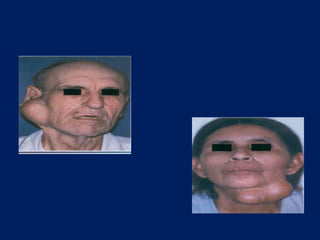
CLINICAL PRESENTATION
• painless, slow growing, firm mass, initially small in
size and begins to increase in size.
• Initially movable but with continued growth become
more nodular and less movable.
• Recurrent tumor- multinodular, fixed on palpation.
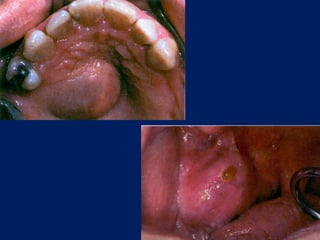
• Palate – intraorally common site.
• Seldom ulcerated- unless secondarily traumatized.
INVESTIGATION
• MRI
• CT SCAN
• FNAC showing well encapsulated mass tan coloured and
glossy in appearance
• DIFFERENTIAL DIAGNOSIS
• Polymorphous low grade adenocarcinoma.
• Adenoid cystic carcinoma.
• Epithelial myoepithelial carcinoma.
• Squamous cell carcinoma.
• Mucoepidermoid carcinoma.
• TREATMENT AND PROGNOSIS
• Superficial parotidectomy with preservation of the
facial nerve
• total parotidectomy for deep lobe with preservation
of the facial nerve.
• Local enucleation should be avoided .
MALIGNANT
TUMORS
• Mucoepidermoid carcinoma
• Adenoid cystic carcinoma
• Polymorphous low grade adenocarcinoma
MUCOEPIDERMOID CARCINOMA
• 5% of all salivary gland tumors
• Commonest malignant tumor in adult and childhood.
• 1st to 9th decade peaking in 4-5th decade
• Females
• Parotid gland (45%)And palate (21%)
• Malignant glandular epithelial neoplasm characterized by
mucous cells, intermediate cells, and epidermoid cells.
Etiology
Therapeutic Radiation
Lipoidal installation
Presence of other foreign material
Origin: Cells of the salivary gland excretory and
intercalated duct
CLINICAL FEATURES:
Age: 3rd – 5th decade
Sex: females> male
Site: parotid is most commonly affected.
Intraorally: palate
Most common salivary gland neoplasm in
children
CLINICAL FEATURES
• Low grade: slowly enlarging, painless mass, seldom
exceeds 5cm in diameter in low grade.
• may be mistaken as mucocele.
• High grade: grows rapidly, facial nerve paralysis
• ulceration, trismus, draining from the ear, dysphagia.
• metastasis to regional lymph node, lung, bone, brain,
suncutaneous tissue.
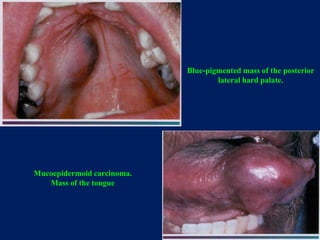
Blue-pigmented mass of the posterior
lateral hard palate.
Mucoepidermoid carcinoma.
Mass of the tongue
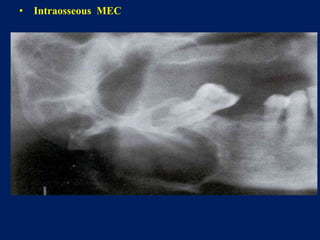
• Intraosseous MEC
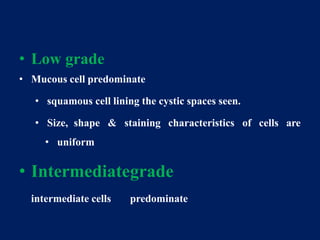
• Low grade
• Mucous cell predominate
• squamous cell lining the cystic spaces seen.
• Size, shape & staining characteristics of cells are
• uniform
• Intermediategrade
intermediate cells predominate
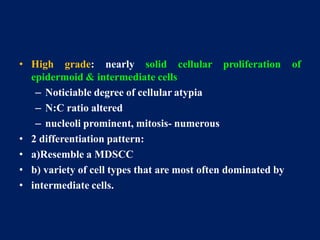
• High grade: nearly solid cellular proliferation of
epidermoid & intermediate cells
– Noticiable degree of cellular atypia
– N:C ratio altered
– nucleoli prominent, mitosis- numerous
• 2 differentiation pattern:
• a)Resemble a MDSCC
• b) variety of cell types that are most often dominated by
• intermediate cells.
• DIFFERENTIAL DIAGNOSIS:
• Necrotizing sialomataplasia
• Pleomorphic adenoma
• Inverted ductal papilloma
• Cystadenoma
• Matastatic SCC
• Sebaceous carcinoma
• Clear cell tumors
• Adenosquamous carcinoma
• TREATMENT AND PROGNOSIS
• Conservative excision with preservation of facial nerve
• Submandibular gland- removal of the gland
• Minor salivary gland- surgical
• Matastatis- 12% of cases
• Prognosis- fairly good.
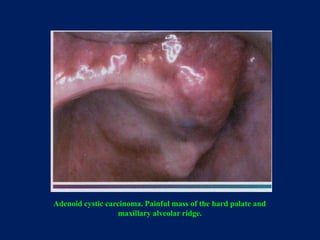
Adenoid cystic carcinoma. Painful mass of the hard palate and
maxillary alveolar ridge.
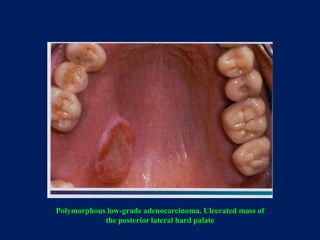
Polymorphous low-grade adenocarcinoma. Ulcerated mass of
the posterior lateral hard palate

SALIVORY GLAND FINAL YR.pptx

  • 1.
  • 2.
    INTRODUCTION • The majorityof these neoplasms are benign 80% and only20% are malignant. • These best distinguished by their histologic patterns.
  • 3.
    EPIDEMIOLOGY • Uncommon neoplasms •Up to 6.5% of all head and neck neoplasms. • Most salivary gland tumors originate in the parotid glands (64%-80%), malignancy (15%- 32%). • 7-11% occur in the submandibular glands, malignancy (37%- 45%). • less than 1% in the sublingual glands, malignancy (70% - 90%)
  • 4.
    RULE OF 80 80%of parotid tumors are benign. 80% of parotid tumors are Pleomorphic adenomas 80% of salivary gland Pleomorphic adenomas occur in the parotid 80% of parotid Pleomorphic adenomas occur in the superficial lobe 80% of untreated Pleomorphic adenomas remain benign
  • 5.
    ETIOLOGY • viruses- EBV,CMV, Polyoma virus, • Ionizing radiation. • occupational risks- asbestos, nickel compounds or silica dust. • Employment . woodworking, rubber industries beauty saloons. • Lifestyle- Warthin’s tumors - cigarette smoking.
  • 6.
    BENIGN EPITHELIAL TUMORS •Pleomorphic adenoma • Myoepithelioma • Basal cell adenoma • Warthin tumour • Oncocytoma • Canalicular adenoma • Sebaceous adenoma • Lymphadenoma • Sebaceous • Nonsebaceous
  • 7.
    PLEOMORPHIC ADENOMA • Mostcommon neoplasm of salivary gland tumor. • Its cells differentiate to epithelial (ductal and nonductal) cells and mesenchymal (chondroid, myxoid, osseous) cells. • origin: epithelial
  • 8.
    CLINICAL FEATURES • Mostcommon tumor. • Rate of occurrence – 60-70%- parotid glands – 40-60%- submandibular glands – 40-70%- minor salivary glands – seldomly- sublingual glands • Age: 30-50 years • Sex: female> male – 3:1 – 4:1 • In parotid- presents in the lower lobe of the superior lobe
  • 9.
    CLINICAL PRESENTATION • painless,slow growing, firm mass, initially small in size and begins to increase in size. • Initially movable but with continued growth become more nodular and less movable. • Recurrent tumor- multinodular, fixed on palpation. • Palate – intraorally common site. • Seldom ulcerated- unless secondarily traumatized.
  • 12.
    INVESTIGATION • MRI • CTSCAN • FNAC showing well encapsulated mass tan coloured and glossy in appearance
  • 13.
    • DIFFERENTIAL DIAGNOSIS •Polymorphous low grade adenocarcinoma. • Adenoid cystic carcinoma. • Epithelial myoepithelial carcinoma. • Squamous cell carcinoma. • Mucoepidermoid carcinoma.
  • 14.
    • TREATMENT ANDPROGNOSIS • Superficial parotidectomy with preservation of the facial nerve • total parotidectomy for deep lobe with preservation of the facial nerve. • Local enucleation should be avoided .
  • 15.
    MALIGNANT TUMORS • Mucoepidermoid carcinoma •Adenoid cystic carcinoma • Polymorphous low grade adenocarcinoma
  • 16.
    MUCOEPIDERMOID CARCINOMA • 5%of all salivary gland tumors • Commonest malignant tumor in adult and childhood. • 1st to 9th decade peaking in 4-5th decade • Females • Parotid gland (45%)And palate (21%) • Malignant glandular epithelial neoplasm characterized by mucous cells, intermediate cells, and epidermoid cells.
  • 17.
    Etiology Therapeutic Radiation Lipoidal installation Presenceof other foreign material Origin: Cells of the salivary gland excretory and intercalated duct
  • 18.
    CLINICAL FEATURES: Age: 3rd– 5th decade Sex: females> male Site: parotid is most commonly affected. Intraorally: palate Most common salivary gland neoplasm in children
  • 19.
    CLINICAL FEATURES • Lowgrade: slowly enlarging, painless mass, seldom exceeds 5cm in diameter in low grade. • may be mistaken as mucocele. • High grade: grows rapidly, facial nerve paralysis • ulceration, trismus, draining from the ear, dysphagia. • metastasis to regional lymph node, lung, bone, brain, suncutaneous tissue.
  • 20.
    Blue-pigmented mass ofthe posterior lateral hard palate. Mucoepidermoid carcinoma. Mass of the tongue
  • 21.
  • 22.
    • Low grade •Mucous cell predominate • squamous cell lining the cystic spaces seen. • Size, shape & staining characteristics of cells are • uniform • Intermediategrade intermediate cells predominate
  • 23.
    • High grade:nearly solid cellular proliferation of epidermoid & intermediate cells – Noticiable degree of cellular atypia – N:C ratio altered – nucleoli prominent, mitosis- numerous • 2 differentiation pattern: • a)Resemble a MDSCC • b) variety of cell types that are most often dominated by • intermediate cells.
  • 24.
    • DIFFERENTIAL DIAGNOSIS: •Necrotizing sialomataplasia • Pleomorphic adenoma • Inverted ductal papilloma • Cystadenoma • Matastatic SCC • Sebaceous carcinoma • Clear cell tumors • Adenosquamous carcinoma
  • 25.
    • TREATMENT ANDPROGNOSIS • Conservative excision with preservation of facial nerve • Submandibular gland- removal of the gland • Minor salivary gland- surgical • Matastatis- 12% of cases • Prognosis- fairly good.
  • 26.
    Adenoid cystic carcinoma.Painful mass of the hard palate and maxillary alveolar ridge.
  • 27.
    Polymorphous low-grade adenocarcinoma.Ulcerated mass of the posterior lateral hard palate