Lecture by
MA J ® DR. MUHAMMAD AFZAL CHAUDHARY
MBBS (Dow). FCPS (Gen Surgery)
Consultant Gen & Laparoscopic Surgeon
DEFINITION
are surgically created openings of small
or large intestines onto the anterior
abdominal wall.
PRINCIPLES OF STOMA FORMATION
_
• Mark the best site for a stoma.
• Area should be easy to see and
access.
• Avoid bony prominences
1- ILEOSTOMY
• opening 2 fingertips in anterior
abdominal wall.
• Deliver l through the rectus
abdominis.
• secure to skin
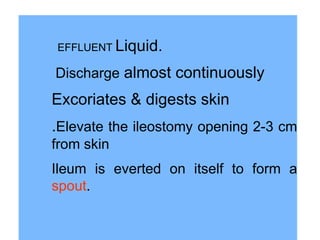
EFFLUENT Liquid.
Discharge almost continuously
Excoriates & digests skin
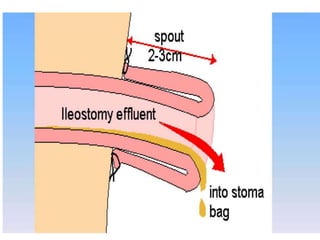
.Elevate the ileostomy opening 2-3 cm
from skin
Ileum is everted on itself to form a
spout.
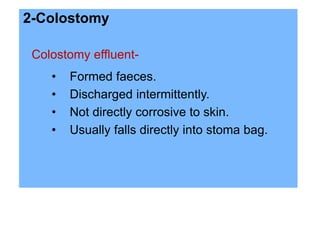
2-Colostomy
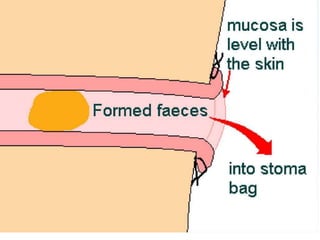
Colostomy effluent-
• Formed faeces.
• Discharged intermittently.
• Not directly corrosive to skin.
• Usually falls directly into stoma bag.
Colostomies are sutured flush with skin.
• Allowed to pout slightly to prevent retraction
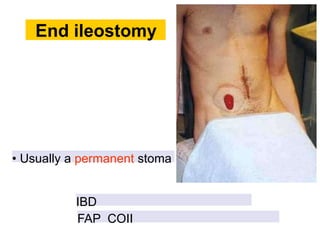
End ileostomy
• Usually a permanent stoma
IBD
FAP COII
End ileostomy
DONE IN emergency setting
Subtotal colectomy with end ileostomy-
• in fulminant or perforated UC
• distal LBO
• segmental resection WITH primary anastomosis
unsafe. e.g.CD
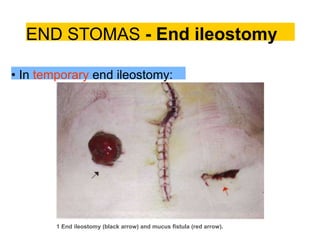
END STOMAS - End ileostomy
• In temporary end ileostomy:
1 End ileostomy (black arrow) and mucus fistula (red arrow).
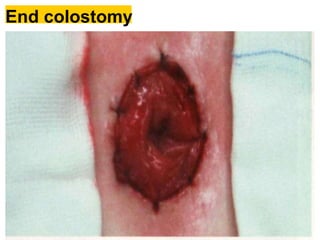
End colostomy
End colostomy
APR for CRC
• a permanent end colostomy
• an elective surgery
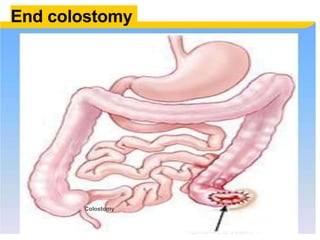
End colostomy
Colostomy
End colostomy
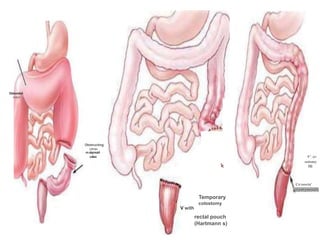
Hartmann’s procedure
• In emergency setting.
• For ischaemia, perforation or obstruction of
distal colon or rectum.
• Potentially reversible 3-4 months later.
• Patients are often elderly & frail.
40% never undergo reversal.
Distended
coton
Obstructing
Ulmer
msigmoid
colon
<
Temporary
colostomy
V with
rectal pouch
(Hartmann s)
F'.or
ostomy
Hi
Co'orecta’
aoastamosis
LOOP STOMAS
•
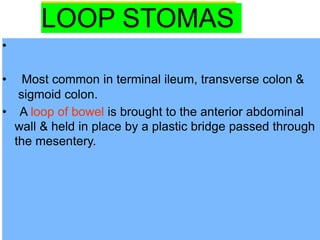
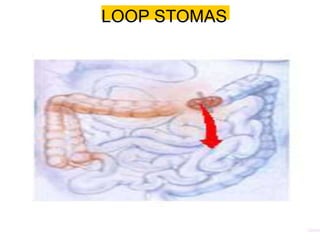
• Most common in terminal ileum, transverse colon &
sigmoid colon.
• A loop of bowel is brought to the anterior abdominal
wall & held in place by a plastic bridge passed through
the mesentery.
LOOP STOMAS
• In general, temporary stomas.

• Can be reversed via the stoma site 2-3
months after formation.
• Used to divert faecal stream to protect -
► a distal anastomosis after low anterior
resection.
► Difficult anal sphincter repairs.
► Complex perianal fistula procedures.
LOOP STOMAS
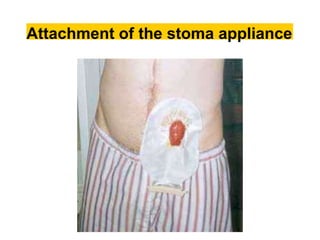
Attachment of the stoma appliance
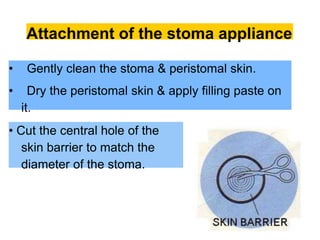
• Gently clean the stoma & peristomal skin.
• Dry the peristomal skin & apply filling paste on
it.
• Cut the central hole of the
skin barrier to match the
diameter of the stoma.
Attachment of the stoma appliance
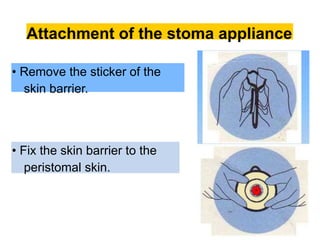
• Remove the sticker of the
skin barrier.
• Fix the skin barrier to the
peristomal skin.
Attachment of the stoma appliance
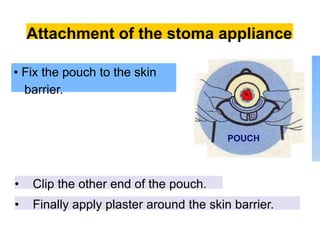
• Fix the pouch to the skin
barrier.
• Clip the other end of the pouch.
• Finally apply plaster around the skin barrier.
POUCH
Attachment of the stoma appliance
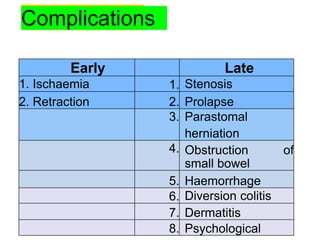
Complications
Early Late
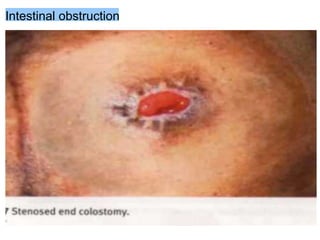
1. Ischaemia 1. Stenosis
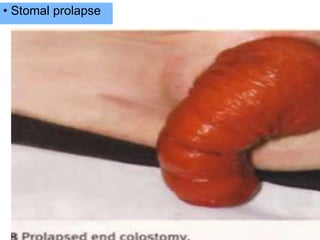
2. Retraction 2. Prolapse
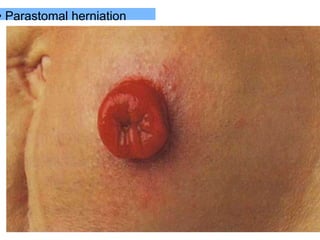
3. Parastomal
herniation
4. Obstruction of
small bowel
5. Haemorrhage
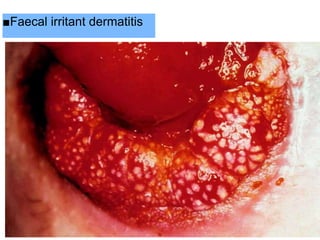
6. Diversion colitis
7. Dermatitis
8. Psychological
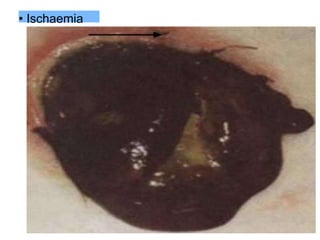
• Ischaemia
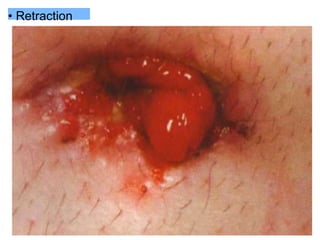
• Retraction
Intestinal obstruction
• Stomal prolapse
• Parastomal herniation
■Faecal irritant dermatitis
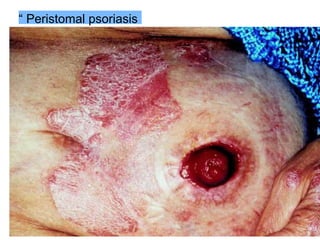
“ Peristomal psoriasis
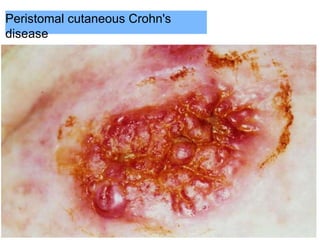
Peristomal cutaneous Crohn's
disease
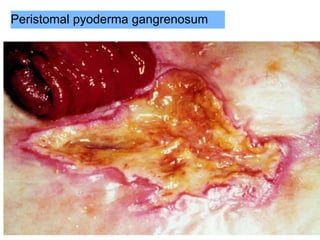
Peristomal pyoderma gangrenosum
Dietary advice
• Take low fibre food to reduce bulk in stool &
help prevent intestinal obstruction.
• • Avoid vegetables known to result in
offensive odour
• .
• xRaddish xCabbage
• xGarlic xCucumber
Dietary advice
To reduce flatus, avoid:
• carbonated beverages
• chewing gum x smoking
• Chew food well.
• Drink adequate amounts of water.
THANK U

intestinal stomas 07OCT22.pptx