ISM for D&T: Research Methods 2
           Interviews

     Alison Hardy & Sarah Davies

       Monday 28th January 2013
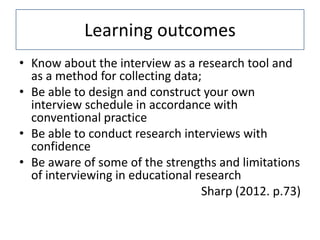
Learning outcomes
• Know about the interview as a research tool and
  as a method for collecting data;
• Be able to design and construct your own
  interview schedule in accordance with
  conventional practice
• Be able to conduct research interviews with
  confidence
• Be aware of some of the strengths and limitations
  of interviewing in educational research
                                  Sharp (2012. p.73)
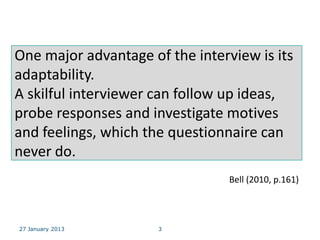
One major advantage of the interview is its
adaptability.
A skilful interviewer can follow up ideas,
probe responses and investigate motives
and feelings, which the questionnaire can
never do.
                                 Bell (2010, p.161)


27 January 2013       3
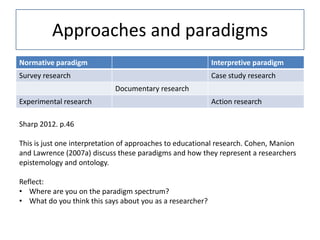
Approaches and paradigms
Normative paradigm                                         Interpretive paradigm
Survey research                                            Case study research
                             Documentary research
Experimental research                                      Action research

Sharp 2012. p.46

This is just one interpretation of approaches to educational research. Cohen, Manion
and Lawrence (2007a) discuss these paradigms and how they represent a researchers
epistemology and ontology.

Reflect:
• Where are you on the paradigm spectrum?
• What do you think this says about you as a researcher?
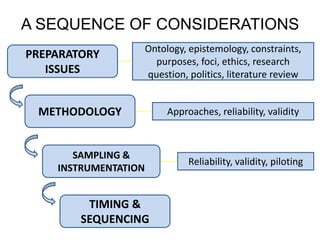
A SEQUENCE OF CONSIDERATIONS
                      Ontology, epistemology, constraints,
PREPARATORY
                        purposes, foci, ethics, research
   ISSUES             question, politics, literature review


 METHODOLOGY               Approaches, reliability, validity


       SAMPLING &
                                Reliability, validity, piloting
    INSTRUMENTATION


         TIMING &
        SEQUENCING
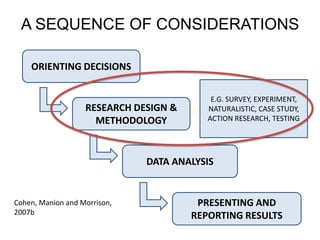
A SEQUENCE OF CONSIDERATIONS

    ORIENTING DECISIONS

                                           E.G. SURVEY, EXPERIMENT,
                   RESEARCH DESIGN &      NATURALISTIC, CASE STUDY,
                     METHODOLOGY          ACTION RESEARCH, TESTING


                              DATA ANALYSIS


Cohen, Manion and Morrison,             PRESENTING AND
2007b                                  REPORTING RESULTS
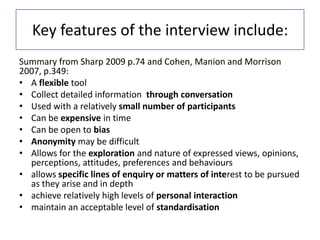
Key features of the interview include:
Summary from Sharp 2009 p.74 and Cohen, Manion and Morrison
2007, p.349:
• A flexible tool
• Collect detailed information through conversation
• Used with a relatively small number of participants
• Can be expensive in time
• Can be open to bias
• Anonymity may be difficult
• Allows for the exploration and nature of expressed views, opinions,
  perceptions, attitudes, preferences and behaviours
• allows specific lines of enquiry or matters of interest to be pursued
  as they arise and in depth
• achieve relatively high levels of personal interaction
• maintain an acceptable level of standardisation
Planning an interview Schedule
• Be clear about the data that you wish to
  collect in relation to your questions
• Consider how many questions to ask and plan
  a logical order
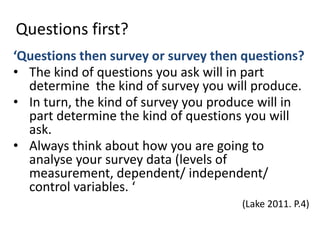
Questions first?
‘Questions then survey or survey then questions?
• The kind of questions you ask will in part
  determine the kind of survey you will produce.
• In turn, the kind of survey you produce will in
  part determine the kind of questions you will
  ask.
• Always think about how you are going to
  analyse your survey data (levels of
  measurement, dependent/ independent/
  control variables. ‘
                                      (Lake 2011. P.4)
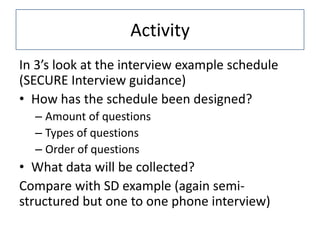
Activity
In 3’s look at the interview example schedule
(SECURE Interview guidance)
• How has the schedule been designed?
  – Amount of questions
  – Types of questions
  – Order of questions
• What data will be collected?
Compare with SD example (again semi-
structured but one to one phone interview)
considerations
• Pilot and review of schedule
• Interview protocol
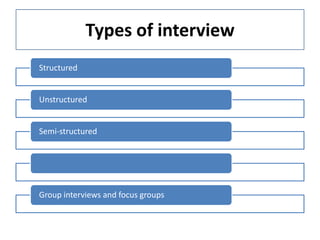
Types of interview
Structured


Unstructured


Semi-structured


Group interviews and focus groups
Interviewing Skills
•   Quality and nature of questions
•   Listening skills
•   Body language
•   Setting and atmosphere
•   Overall conduct of the interview
                   (Burton and Bartlett 2005, p.111)
References
• BELL, J., 2010. Doing your Research Project: a
  Guide for First-Time Researchers in Education,
  Health and Social Science. 5th ed. Maidenhead:
  McGraw-Hill Open University Press.
• BURTON, D., and BARTLETT, S., 2005. Practitioner
  Research for Teachers. London: Paul Chapman.
• COHEN, L., MANION, L. and MORRISON, K., 2007.
  Research Methods in Education. 6th ed. Oxon:
  Routledge.
• SHARP, J., 2009. Success with your education
  research project. GB: Learning Matters Ltd.
This work is licensed under the Creative
Commons Attribution – NonCommercial -
ShareAlike 2.0 UK: England & Wales License.

To view a copy of this license, visit
http://creativecommons.org/licenses/by-nc-
sa/2.0/uk/.

Interviews

  • 1.
    ISM for D&T:Research Methods 2 Interviews Alison Hardy & Sarah Davies Monday 28th January 2013
  • 2.
    Learning outcomes • Knowabout the interview as a research tool and as a method for collecting data; • Be able to design and construct your own interview schedule in accordance with conventional practice • Be able to conduct research interviews with confidence • Be aware of some of the strengths and limitations of interviewing in educational research Sharp (2012. p.73)
  • 3.
    One major advantageof the interview is its adaptability. A skilful interviewer can follow up ideas, probe responses and investigate motives and feelings, which the questionnaire can never do. Bell (2010, p.161) 27 January 2013 3
  • 4.
    Approaches and paradigms Normativeparadigm Interpretive paradigm Survey research Case study research Documentary research Experimental research Action research Sharp 2012. p.46 This is just one interpretation of approaches to educational research. Cohen, Manion and Lawrence (2007a) discuss these paradigms and how they represent a researchers epistemology and ontology. Reflect: • Where are you on the paradigm spectrum? • What do you think this says about you as a researcher?
  • 5.
    A SEQUENCE OFCONSIDERATIONS Ontology, epistemology, constraints, PREPARATORY purposes, foci, ethics, research ISSUES question, politics, literature review METHODOLOGY Approaches, reliability, validity SAMPLING & Reliability, validity, piloting INSTRUMENTATION TIMING & SEQUENCING
  • 6.
    A SEQUENCE OFCONSIDERATIONS ORIENTING DECISIONS E.G. SURVEY, EXPERIMENT, RESEARCH DESIGN & NATURALISTIC, CASE STUDY, METHODOLOGY ACTION RESEARCH, TESTING DATA ANALYSIS Cohen, Manion and Morrison, PRESENTING AND 2007b REPORTING RESULTS
  • 7.
    Key features ofthe interview include: Summary from Sharp 2009 p.74 and Cohen, Manion and Morrison 2007, p.349: • A flexible tool • Collect detailed information through conversation • Used with a relatively small number of participants • Can be expensive in time • Can be open to bias • Anonymity may be difficult • Allows for the exploration and nature of expressed views, opinions, perceptions, attitudes, preferences and behaviours • allows specific lines of enquiry or matters of interest to be pursued as they arise and in depth • achieve relatively high levels of personal interaction • maintain an acceptable level of standardisation
  • 8.
    Planning an interviewSchedule • Be clear about the data that you wish to collect in relation to your questions • Consider how many questions to ask and plan a logical order
  • 9.
    Questions first? ‘Questions thensurvey or survey then questions? • The kind of questions you ask will in part determine the kind of survey you will produce. • In turn, the kind of survey you produce will in part determine the kind of questions you will ask. • Always think about how you are going to analyse your survey data (levels of measurement, dependent/ independent/ control variables. ‘ (Lake 2011. P.4)
  • 10.
    Activity In 3’s lookat the interview example schedule (SECURE Interview guidance) • How has the schedule been designed? – Amount of questions – Types of questions – Order of questions • What data will be collected? Compare with SD example (again semi- structured but one to one phone interview)
  • 11.
    considerations • Pilot andreview of schedule • Interview protocol
  • 12.
  • 13.
    Interviewing Skills • Quality and nature of questions • Listening skills • Body language • Setting and atmosphere • Overall conduct of the interview (Burton and Bartlett 2005, p.111)
  • 14.
    References • BELL, J.,2010. Doing your Research Project: a Guide for First-Time Researchers in Education, Health and Social Science. 5th ed. Maidenhead: McGraw-Hill Open University Press. • BURTON, D., and BARTLETT, S., 2005. Practitioner Research for Teachers. London: Paul Chapman. • COHEN, L., MANION, L. and MORRISON, K., 2007. Research Methods in Education. 6th ed. Oxon: Routledge. • SHARP, J., 2009. Success with your education research project. GB: Learning Matters Ltd.
  • 15.
    This work islicensed under the Creative Commons Attribution – NonCommercial - ShareAlike 2.0 UK: England & Wales License. To view a copy of this license, visit http://creativecommons.org/licenses/by-nc- sa/2.0/uk/.

Editor's Notes

  • #4 Sensory evidence?Testimonial evidence?Strong intuition?Something else?
  • #6 These 2 slides are taken from the Cohen et alppts from the accompanying website. It just summarises the stages of a project and tries to give an overview of where they are – you might want to skip this apge and move ont the next quickly!
  • #7 I’ve highlighted where we are at them moment