

Group 1

Iffat qamar        21
Nighat aslam       44
Asma inayat        73

    2 march 2012
   Qualitative research

   Depth interviews and its types

   Advantages and disadvantages

   Mini groups
In Qualitative Research generally
Depth Interviews and Projective
Techniques are used by marketing
researchers when direct questioning
is impractical, more costly or less
accurate.
Depth interviews may be broadly classified
into Individual Depth Interviews and Focus
Group Interviews.


  Individual Depth Interview

  Focus groups
   Individual Depth Interviews involve one
    respondent and one interviewer. The
    interviewer is not bound by pre-
    specified questions.

    Instead, there is freedom to
    create questions, to probe those
    responses that appear relevant,
    and generally try to develop the
    best set of data in any way
    practical.
Three techniques are recommended for Individual Depth Interviews

   Laddering
          it involves having respondents identify attributes that
distinguish brands by asking questions such as “in what way is
Pepsi different from Classic Coke and Dr. Pepper?” Each
distinguishing attribute and its reason for distinction are then
probed. The purpose is to uncover the “network of meanings
“associated with the product, brand or concept.

 Hidden issue questioning
         focuses on individual respondents feelings about sensitive
issues such as wanting to have an affair or having a desire for
power.

 Symbolic analysis
        it requires respondents to describe the opposite of the
product/activity of interest or a specifiable attribute of the
product/activity.
 more detail, point out preferences and
 idiosyncrasies, and describe subtleties,
 nuances and shades of differences that are
 masked in a group setting.


 cost
     and time requirement greater than
 group interviews.
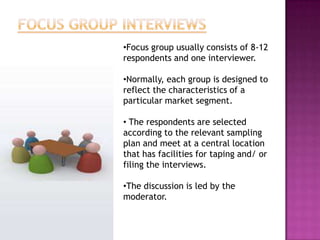
•Focus group usually consists of 8-12
respondents and one interviewer.

•Normally, each group is designed to
reflect the characteristics of a
particular market segment.

• The respondents are selected
according to the relevant sampling
plan and meet at a central location
that has facilities for taping and/ or
filing the interviews.

•The discussion is led by the
moderator.
 Basic need studies for product idea creation,
 New product idea or concept exploration,
 Product positioning studies,
 Advertising and communication research,
 Background studies on consumers frames of
  reference,
 Establishment of consumer vocabulary as a
  preliminary step in questionnaire
  development, and
 Determination of attributes and behavior.
 More   detailed and accurate information

 More   stimulus

 Security


 Degree   of spontaneity
   Misuse – Some people consider the results as
    conclusive when it should be just exploratory.

   Misjudge – client and researcher bias.

   Difficult to moderate

   Difficult to code, analyze and interpret.

   Not representative of the general population and
    not projectable.
 Insight   not Rules

 Social   not Individual

 Homogenous     not Diverse

 Flexible   not standardized
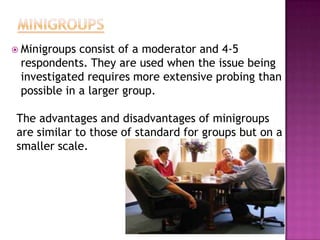
 Minigroups consist of a moderator and 4-5
 respondents. They are used when the issue being
 investigated requires more extensive probing than
 possible in a larger group.

The advantages and disadvantages of minigroups
are similar to those of standard for groups but on a
smaller scale.
 The
    need to converse with groups that are
 more difficult to reach

 Thetopics or subject matter require more
 explanation

 Experimental design requires the need to
 vary stimuli across multiple groups or
 individuals
Qualitative research

Qualitative research

  • 1.
    Group 1 Iffat qamar 21 Nighat aslam 44 Asma inayat 73 2 march 2012
  • 2.
    Qualitative research  Depth interviews and its types  Advantages and disadvantages  Mini groups
  • 3.
    In Qualitative Researchgenerally Depth Interviews and Projective Techniques are used by marketing researchers when direct questioning is impractical, more costly or less accurate.
  • 4.
    Depth interviews maybe broadly classified into Individual Depth Interviews and Focus Group Interviews.  Individual Depth Interview  Focus groups
  • 5.
    Individual Depth Interviews involve one respondent and one interviewer. The interviewer is not bound by pre- specified questions. Instead, there is freedom to create questions, to probe those responses that appear relevant, and generally try to develop the best set of data in any way practical.
  • 6.
    Three techniques arerecommended for Individual Depth Interviews  Laddering it involves having respondents identify attributes that distinguish brands by asking questions such as “in what way is Pepsi different from Classic Coke and Dr. Pepper?” Each distinguishing attribute and its reason for distinction are then probed. The purpose is to uncover the “network of meanings “associated with the product, brand or concept.  Hidden issue questioning focuses on individual respondents feelings about sensitive issues such as wanting to have an affair or having a desire for power.  Symbolic analysis it requires respondents to describe the opposite of the product/activity of interest or a specifiable attribute of the product/activity.
  • 7.
     more detail,point out preferences and idiosyncrasies, and describe subtleties, nuances and shades of differences that are masked in a group setting.  cost and time requirement greater than group interviews.
  • 8.
    •Focus group usuallyconsists of 8-12 respondents and one interviewer. •Normally, each group is designed to reflect the characteristics of a particular market segment. • The respondents are selected according to the relevant sampling plan and meet at a central location that has facilities for taping and/ or filing the interviews. •The discussion is led by the moderator.
  • 9.
     Basic needstudies for product idea creation,  New product idea or concept exploration,  Product positioning studies,  Advertising and communication research,  Background studies on consumers frames of reference,  Establishment of consumer vocabulary as a preliminary step in questionnaire development, and  Determination of attributes and behavior.
  • 10.
     More detailed and accurate information  More stimulus  Security  Degree of spontaneity
  • 11.
    Misuse – Some people consider the results as conclusive when it should be just exploratory.  Misjudge – client and researcher bias.  Difficult to moderate  Difficult to code, analyze and interpret.  Not representative of the general population and not projectable.
  • 12.
     Insight not Rules  Social not Individual  Homogenous not Diverse  Flexible not standardized
  • 13.
     Minigroups consistof a moderator and 4-5 respondents. They are used when the issue being investigated requires more extensive probing than possible in a larger group. The advantages and disadvantages of minigroups are similar to those of standard for groups but on a smaller scale.
  • 14.
     The need to converse with groups that are more difficult to reach  Thetopics or subject matter require more explanation  Experimental design requires the need to vary stimuli across multiple groups or individuals