IN-DEPTH INTERVIEW
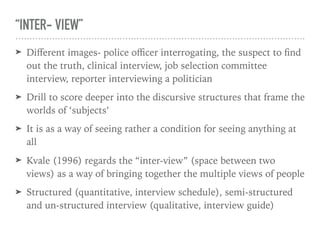
“INTER- VIEW”
➤ Different images- police officer interrogating, the suspect to find
out the truth, clinical interview, job selection committee
interview, reporter interviewing a politician
➤ Drill to score deeper into the discursive structures that frame the
worlds of ‘subjects’
➤ It is as a way of seeing rather a condition for seeing anything at
all
➤ Kvale (1996) regards the “inter-view” (space between two
views) as a way of bringing together the multiple views of people
➤ Structured (quantitative, interview schedule), semi-structured
and un-structured interview (qualitative, interview guide)
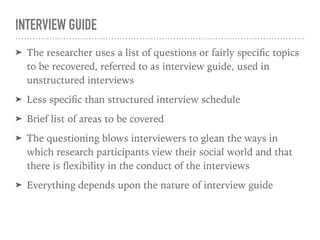
INTERVIEW GUIDE
➤ The researcher uses a list of questions or fairly specific topics
to be recovered, referred to as interview guide, used in
unstructured interviews
➤ Less specific than structured interview schedule
➤ Brief list of areas to be covered
➤ The questioning blows interviewers to glean the ways in
which research participants view their social world and that
there is flexibility in the conduct of the interviews
➤ Everything depends upon the nature of interview guide
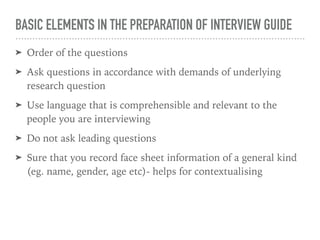
BASIC ELEMENTS IN THE PREPARATION OF INTERVIEW GUIDE
➤ Order of the questions
➤ Ask questions in accordance with demands of underlying
research question
➤ Use language that is comprehensible and relevant to the
people you are interviewing
➤ Do not ask leading questions
➤ Sure that you record face sheet information of a general kind
(eg. name, gender, age etc)- helps for contextualising
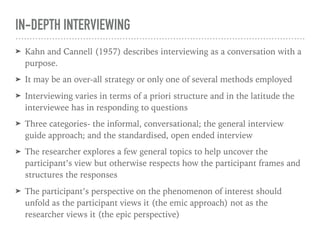
IN-DEPTH INTERVIEWING
➤ Kahn and Cannell (1957) describes interviewing as a conversation with a
purpose.
➤ It may be an over-all strategy or only one of several methods employed
➤ Interviewing varies in terms of a priori structure and in the latitude the
interviewee has in responding to questions
➤ Three categories- the informal, conversational; the general interview
guide approach; and the standardised, open ended interview
➤ The researcher explores a few general topics to help uncover the
participant’s view but otherwise respects how the participant frames and
structures the responses
➤ The participant’s perspective on the phenomenon of interest should
unfold as the participant views it (the emic approach) not as the
researcher views it (the epic perspective)
➤ Attitude towards the participant- participant’s views are valuable and useful
➤ Success of the researcher depends on how well he has anticipated and practiced
his role in ethical issues
➤ Strengths- yields data in quantity quickly, combined with observation
interviews allow the researcher to understand the meanings that everyday
activities hold for people
➤ Limitations- involve personal interaction, cooperation is essential ,interviewees
may be unwilling or uncomfortable sharing all that the interviewer hopes to
explore, volumes of data can be obtained through interviews, time consuming
to analyse, issue of quality of data to analyse
➤ Skills required- listening skills, skilful at personal interaction, question framing
and gentle probing for elaboration, to involver and describe the participant’s
perspective
➤ The subjective view is what matters

Interview guide, indepth interview

  • 1.
  • 2.
    “INTER- VIEW” ➤ Differentimages- police officer interrogating, the suspect to find out the truth, clinical interview, job selection committee interview, reporter interviewing a politician ➤ Drill to score deeper into the discursive structures that frame the worlds of ‘subjects’ ➤ It is as a way of seeing rather a condition for seeing anything at all ➤ Kvale (1996) regards the “inter-view” (space between two views) as a way of bringing together the multiple views of people ➤ Structured (quantitative, interview schedule), semi-structured and un-structured interview (qualitative, interview guide)
  • 3.
    INTERVIEW GUIDE ➤ Theresearcher uses a list of questions or fairly specific topics to be recovered, referred to as interview guide, used in unstructured interviews ➤ Less specific than structured interview schedule ➤ Brief list of areas to be covered ➤ The questioning blows interviewers to glean the ways in which research participants view their social world and that there is flexibility in the conduct of the interviews ➤ Everything depends upon the nature of interview guide
  • 4.
    BASIC ELEMENTS INTHE PREPARATION OF INTERVIEW GUIDE ➤ Order of the questions ➤ Ask questions in accordance with demands of underlying research question ➤ Use language that is comprehensible and relevant to the people you are interviewing ➤ Do not ask leading questions ➤ Sure that you record face sheet information of a general kind (eg. name, gender, age etc)- helps for contextualising
  • 5.
    IN-DEPTH INTERVIEWING ➤ Kahnand Cannell (1957) describes interviewing as a conversation with a purpose. ➤ It may be an over-all strategy or only one of several methods employed ➤ Interviewing varies in terms of a priori structure and in the latitude the interviewee has in responding to questions ➤ Three categories- the informal, conversational; the general interview guide approach; and the standardised, open ended interview ➤ The researcher explores a few general topics to help uncover the participant’s view but otherwise respects how the participant frames and structures the responses ➤ The participant’s perspective on the phenomenon of interest should unfold as the participant views it (the emic approach) not as the researcher views it (the epic perspective)
  • 6.
    ➤ Attitude towardsthe participant- participant’s views are valuable and useful ➤ Success of the researcher depends on how well he has anticipated and practiced his role in ethical issues ➤ Strengths- yields data in quantity quickly, combined with observation interviews allow the researcher to understand the meanings that everyday activities hold for people ➤ Limitations- involve personal interaction, cooperation is essential ,interviewees may be unwilling or uncomfortable sharing all that the interviewer hopes to explore, volumes of data can be obtained through interviews, time consuming to analyse, issue of quality of data to analyse ➤ Skills required- listening skills, skilful at personal interaction, question framing and gentle probing for elaboration, to involver and describe the participant’s perspective ➤ The subjective view is what matters