On-Campus Interviewing (OCI)
Orientation
Congratulations on your upcoming interview!
Agenda
5 Modules of Preparation for Interview Success
OCI Policy
Pre Interview Preparation
Interview Preparation
Accepting Job Offers
Resources for Practice
Orientation Quiz
Module 1 OCI Policy
General Information
Interview suites at DPC, Suite 9600
Always check in at 9700 first before your interview
OCI takes place during Fall, Winter, and Spring
Quarters
Click on View, Header and Footerto change text header.
Eligibility Requirements
Current DePaul student in good standing at either the
undergraduate or graduate level
Alumnus who meets employment qualifications
Complete the OCI Online Orientation session and pass
the quiz
Application Guidelines
Apply to jobs you qualify for, are interested in
Receiving a while waiting to interview
Contact DePaul’s Employer Relations team at 312-362-5201 or
interview@depaul.edu
Misrepresentation
Ethical behavior is required throughout the job search
process.
All data in DePaul.Experience must be true and accurate:
GPA, major or minor, activities or honors/awards, student
status, etc.
Misrepresentation cont.
Do not allow anyone else to use your DePaul.Experience
account
For more information on the Code of Student Responsibility
http://www.depaul.edu/university-catalog/academic-handbooks/code-of-student-responsibility/general-information/Pages/
Cancellation Policy
Withdraw your application and decline the invitation to
interview no later than 8:00 a.m., 2 business days prior to
the OCI date
If you must cancel due to an emergency less than 48 hours before the
interview date, notify the Employer Relations Office immediately at
312.362.5201 or email interview@depaul.edu
Cancellation Policy cont.
Last Minute Cancellations & Missed Interviews
Both count as “no shows” and are an equally
serious problem
No Show Policy
DePaul.Experience account immediately de-
activated
Apology letter addressed to the employer
‘Missed Interview Form’ (MIF)
http://www.careercenter.depaul.edu/general/forms/missed_interview.aspx
Click on View, Header and Footer to change text header.
MIF and letter of apology required within 3 business
days
Three offenses in one academic year will result in
DePaul.Experience account and OCI privileges
revoked for remainder of year
No Show Policy cont.
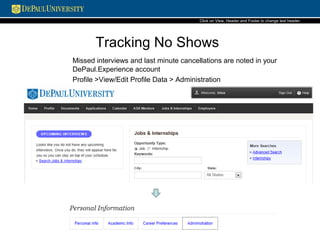
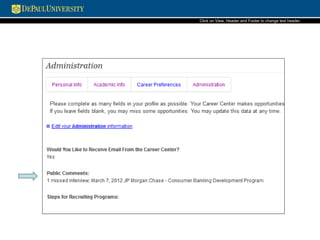
Tracking No Shows
Missed interviews and last minute cancellations are noted in your
DePaul.Experience account
Profile >View/Edit Profile Data > Administration
Click on View, Header and Footerto change text header.
Module 2
Pre-Interview Preparation
The interview process begins before the
interview date.
Know your value
Plan, prepare and practice!
Click on View, Header and Footerto change text header.
Attend Recruiting Events
Attend information sessions, pre night receptions, office
hours, career fairs or other on campus recruiting events
If you pre-register in depaul.experience, make sure you attend
If you receive an invitation directly from
a recruiter, RSVP or decline in a
timely manner
Why Attend?
Golden opportunity to build your
Be a step above
(Insider tip) Employers want you to do well in your interview
Walk into the interview with more knowledge. Knowledge is
power
Click on View, Header and Footerto change text header.
Company Research
&
Questions for the interviewer
Clickon View, Header andFooter tochange textheader.
Click on View, Header and Footerto change text header.
Click on View, Header and Footer to change text header.
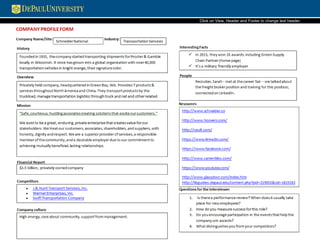
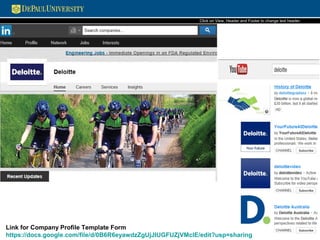
Link for Company Profile Template Form goo.gl/pPtFZ4
Questions
DO
Create genuine questions
Ask questions during the
interviewing
DON’T
Not have any questions
Use canned question
Click on View, Header and Footerto change text header.
Module 3
Interview Preparation
Interview Basics
Candidate serves as expert
Interviewer wants to know…….
work habits
energy level
problem solving approach
leadership and teamwork experience
Preparation can determine outcome
Click on View, Header and Footerto change text header.
Interview Questions
Most common interview questions are behavioral
Past behavior is indicative of future performance
Be strategic when choosing projects and accomplishments
to highlight
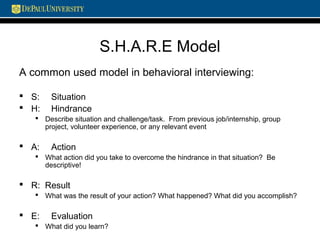
S.H.A.R.E Model
A commonly used model in behavioral interviewing:
 S: Situation
 H: Hindrance
 Describe situation and challenge/task. From previous job/internship, group
project, volunteer experience, or any relevant event
 A: Action
 What action did you take to overcome the hindrance in that situation? Be
descriptive!
 R: Result
 What was the result of your action? What happened? What did you accomplish?
 E: Evaluation
 What did you learn?
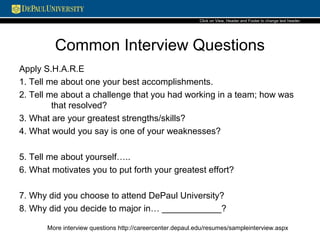
Common Interview Questions
Apply S.H.A.R.E
1. Tell me about one your best accomplishments.
2. Tell me about a challenge that you had working in a team; how was
that resolved?
3. What are your greatest strengths/skills?
4. What would you say is one of your weaknesses?
5. Tell me about yourself…..
6. What motivates you to put forth your greatest effort?
7. Why did you choose to attend DePaul University?
8. Why did you decide to major in… ____________?
More interview questions http://careercenter.depaul.edu/resumes/sampleinterview.aspx
Click on View, Header and Footerto change text header.
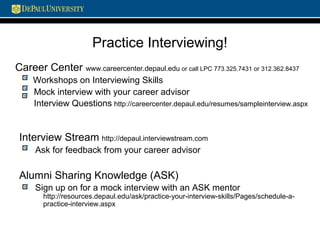
Practice Interviewing!
Career Center www.careercenter.depaul.edu or call LPC 773.325.7431 or 312.362.8437
Workshops on Interviewing Skills
Mock interview with your career advisor
Interview Questions http://careercenter.depaul.edu/resumes/sampleinterview.aspx
Interview Stream http://depaul.interviewstream.com
Ask for feedback from your career advisor
Alumni Sharing Knowledge (ASK)
Sign up on for a mock interview with an ASK mentor
http://resources.depaul.edu/ask/practice-your-interview-skills/Pages/schedule-a-
practice-interview.aspx
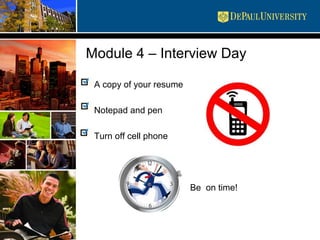
Module 4 – Interview Day
A copy of your resume
Notepad and pen
Turn off cell phone
Be on time!
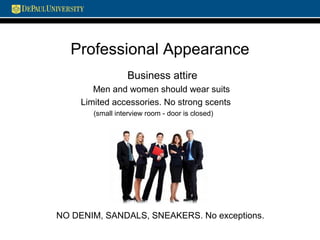
Professional Appearance
Business attire
Men and women should wear suits
Limited accessories. No strong scents
(small interview room - door is closed)
NO DENIM, SANDALS, SNEAKERS. No exceptions.
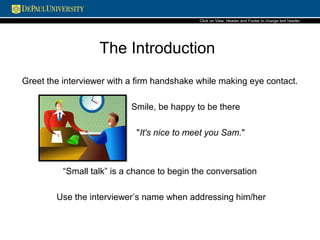
The Introduction
Greet the interviewer with a firm handshake while making eye contact.
Smile, be happy to be there
"It's nice to meet you Sam."
“Small talk” is a chance to begin the conversation
Use the interviewer’s name when addressing him/her
Click on View, Header and Footerto change text header.
Follow-up After Interview
Ask
about next steps/hiring timeline
business card or contact information after interview
send thank you email within 24 hours – last chance to
make a good impression
If you interview with more than 1 person, email separate
thank you notes
Module 5 – Job Offer
I aced the interview and received an
offer….
Now what?
Accepting
Consider what will be expected of you on the job, clarify the terms of
employment
Discuss questions/doubts with the Career Center or Employer Relations
office, BEFORE you accept or decline an offer
Only accept ONE offer
When you accept an offer, cancel all other interviews and inform other
potential employers that they should remove you from their list of applicants
More on
Can be verbal, followed by a written offer for the position
You can expect to have a reasonable amount of time to make a
decision, and most employers are willing to extend that time if you ask
for it.
Be specific about the extra time you need, and don't fail to meet the
new deadline.
Reneging on Job Offers
Be aware that the single most serious ethical breach in
your job search is reneging on a job acceptance.
Defined:
• Accepting a job offer and later turning down the
opportunity OR accepting multiple offers that will
prevent you from honoring your commitment to all parties
involved.
Reneging on Job Offers
When you accept an offer, you should have every intention of
honoring that commitment. Accepting an offer only as a
precautionary measure is misleading to the employer and may
restrict opportunities for others who are genuinely interested in the
employer.
Narrated by Mike Deedigan,VP Talent Development & HR
http://www.cdmmedia.com/
Click on View, Header and Footer to change text header.
Ayres, J., Keereetaweep, T., Chen, P., & Edwards, P. (2009). Communication
apprehension and employment interviews. Communication Education, 47(1), 1-17.
Barrick, M., Shaffer, J., & DeGrassi, S. (2009). What you see may not be what you get: relationships among self-presentation tactics and ratings of interview
and job performance. Journal of Applied Psychology, 94(6), 1294-1411.
Barrick, M., & Swider, B. (2010). Initial evaluations in the interview: relationships with subsequent interviewer evaluations and employment offers. Journal of
Applied Psychology, 95(6), 1163-1172.
Bellock, S. (2010). Choke: what the secrets of the brain reveal about getting it right when you have to. New York, NY: Free Press.
Lammers, J., Dubois, D., Rucker, D., & Galinsky, A. (2013). Power gets the job: priming power improves interview outcomes. Journal of Experimental Social
Psychology, 49, 776-779.
Macan, T. (2009). The employment interview: a review of current studies and directions for future research. Human Resource Management Review, 19, 203-
218.
Shants, A., & Latham, G. (2012). Transfer of training: written self-guidance to increase self-efficacy and interviewing performance of job seekers. Wiley
Periodicals, 51(5), 733-746.
Solamon, J. (2006). The science and practice of a structured employment interview coaching program. Personnel Psychology, 59, 433-456.
Young, M., Behnke, R., & Mann, Y. (2004). Anxiety patterns in employment interviews. Communication Reports, 17(1), 49-54.
Bibliography
Contact Information
Kate Dalin, Assistant Director, Employer Relations
312.362.5789 kdalin@depaul.edu
• Career Center/Employer Relations 312.362.5201
• Career Center http://careercenter.depaul.edu/
773.325.7431 LPC
312.362.8437 Loop
• General OCI questions interview@depaul.edu
To take the quiz go to this link http://goo.gl/iOcpqw

Oci Orientation 2013

  • 1.
  • 2.
    Agenda 5 Modules ofPreparation for Interview Success OCI Policy Pre Interview Preparation Interview Preparation Accepting Job Offers Resources for Practice Orientation Quiz
  • 3.
  • 4.
    General Information Interview suitesat DPC, Suite 9600 Always check in at 9700 first before your interview OCI takes place during Fall, Winter, and Spring Quarters Click on View, Header and Footerto change text header.
  • 5.
    Eligibility Requirements Current DePaulstudent in good standing at either the undergraduate or graduate level Alumnus who meets employment qualifications Complete the OCI Online Orientation session and pass the quiz
  • 6.
    Application Guidelines Apply tojobs you qualify for, are interested in Receiving a while waiting to interview Contact DePaul’s Employer Relations team at 312-362-5201 or interview@depaul.edu
  • 7.
    Misrepresentation Ethical behavior isrequired throughout the job search process. All data in DePaul.Experience must be true and accurate: GPA, major or minor, activities or honors/awards, student status, etc.
  • 8.
    Misrepresentation cont. Do notallow anyone else to use your DePaul.Experience account For more information on the Code of Student Responsibility http://www.depaul.edu/university-catalog/academic-handbooks/code-of-student-responsibility/general-information/Pages/
  • 9.
    Cancellation Policy Withdraw yourapplication and decline the invitation to interview no later than 8:00 a.m., 2 business days prior to the OCI date If you must cancel due to an emergency less than 48 hours before the interview date, notify the Employer Relations Office immediately at 312.362.5201 or email interview@depaul.edu
  • 10.
    Cancellation Policy cont. LastMinute Cancellations & Missed Interviews Both count as “no shows” and are an equally serious problem
  • 11.
    No Show Policy DePaul.Experienceaccount immediately de- activated Apology letter addressed to the employer ‘Missed Interview Form’ (MIF) http://www.careercenter.depaul.edu/general/forms/missed_interview.aspx
  • 12.
    Click on View,Header and Footer to change text header. MIF and letter of apology required within 3 business days Three offenses in one academic year will result in DePaul.Experience account and OCI privileges revoked for remainder of year No Show Policy cont.
  • 13.
    Tracking No Shows Missedinterviews and last minute cancellations are noted in your DePaul.Experience account Profile >View/Edit Profile Data > Administration Click on View, Header and Footerto change text header.
  • 14.
    Click on View,Header and Footerto change text header.
  • 15.
  • 16.
    Pre-Interview Preparation The interviewprocess begins before the interview date. Know your value Plan, prepare and practice! Click on View, Header and Footerto change text header.
  • 17.
    Attend Recruiting Events Attendinformation sessions, pre night receptions, office hours, career fairs or other on campus recruiting events If you pre-register in depaul.experience, make sure you attend If you receive an invitation directly from a recruiter, RSVP or decline in a timely manner
  • 18.
    Why Attend? Golden opportunityto build your Be a step above (Insider tip) Employers want you to do well in your interview Walk into the interview with more knowledge. Knowledge is power Click on View, Header and Footerto change text header.
  • 19.
    Company Research & Questions forthe interviewer Clickon View, Header andFooter tochange textheader.
  • 20.
    Click on View,Header and Footerto change text header.
  • 21.
    Click on View,Header and Footer to change text header. Link for Company Profile Template Form goo.gl/pPtFZ4
  • 22.
    Questions DO Create genuine questions Askquestions during the interviewing DON’T Not have any questions Use canned question Click on View, Header and Footerto change text header.
  • 23.
  • 24.
    Interview Basics Candidate servesas expert Interviewer wants to know……. work habits energy level problem solving approach leadership and teamwork experience Preparation can determine outcome Click on View, Header and Footerto change text header.
  • 25.
    Interview Questions Most commoninterview questions are behavioral Past behavior is indicative of future performance Be strategic when choosing projects and accomplishments to highlight
  • 26.
    S.H.A.R.E Model A commonlyused model in behavioral interviewing:  S: Situation  H: Hindrance  Describe situation and challenge/task. From previous job/internship, group project, volunteer experience, or any relevant event  A: Action  What action did you take to overcome the hindrance in that situation? Be descriptive!  R: Result  What was the result of your action? What happened? What did you accomplish?  E: Evaluation  What did you learn?
  • 27.
    Common Interview Questions ApplyS.H.A.R.E 1. Tell me about one your best accomplishments. 2. Tell me about a challenge that you had working in a team; how was that resolved? 3. What are your greatest strengths/skills? 4. What would you say is one of your weaknesses? 5. Tell me about yourself….. 6. What motivates you to put forth your greatest effort? 7. Why did you choose to attend DePaul University? 8. Why did you decide to major in… ____________? More interview questions http://careercenter.depaul.edu/resumes/sampleinterview.aspx Click on View, Header and Footerto change text header.
  • 28.
    Practice Interviewing! Career Centerwww.careercenter.depaul.edu or call LPC 773.325.7431 or 312.362.8437 Workshops on Interviewing Skills Mock interview with your career advisor Interview Questions http://careercenter.depaul.edu/resumes/sampleinterview.aspx Interview Stream http://depaul.interviewstream.com Ask for feedback from your career advisor Alumni Sharing Knowledge (ASK) Sign up on for a mock interview with an ASK mentor http://resources.depaul.edu/ask/practice-your-interview-skills/Pages/schedule-a- practice-interview.aspx
  • 29.
    Module 4 –Interview Day A copy of your resume Notepad and pen Turn off cell phone Be on time!
  • 30.
    Professional Appearance Business attire Menand women should wear suits Limited accessories. No strong scents (small interview room - door is closed) NO DENIM, SANDALS, SNEAKERS. No exceptions.
  • 31.
    The Introduction Greet theinterviewer with a firm handshake while making eye contact. Smile, be happy to be there "It's nice to meet you Sam." “Small talk” is a chance to begin the conversation Use the interviewer’s name when addressing him/her Click on View, Header and Footerto change text header.
  • 32.
    Follow-up After Interview Ask aboutnext steps/hiring timeline business card or contact information after interview send thank you email within 24 hours – last chance to make a good impression If you interview with more than 1 person, email separate thank you notes
  • 33.
    Module 5 –Job Offer I aced the interview and received an offer…. Now what?
  • 34.
    Accepting Consider what willbe expected of you on the job, clarify the terms of employment Discuss questions/doubts with the Career Center or Employer Relations office, BEFORE you accept or decline an offer Only accept ONE offer When you accept an offer, cancel all other interviews and inform other potential employers that they should remove you from their list of applicants
  • 35.
    More on Can beverbal, followed by a written offer for the position You can expect to have a reasonable amount of time to make a decision, and most employers are willing to extend that time if you ask for it. Be specific about the extra time you need, and don't fail to meet the new deadline.
  • 36.
    Reneging on JobOffers Be aware that the single most serious ethical breach in your job search is reneging on a job acceptance. Defined: • Accepting a job offer and later turning down the opportunity OR accepting multiple offers that will prevent you from honoring your commitment to all parties involved.
  • 37.
    Reneging on JobOffers When you accept an offer, you should have every intention of honoring that commitment. Accepting an offer only as a precautionary measure is misleading to the employer and may restrict opportunities for others who are genuinely interested in the employer.
  • 38.
    Narrated by MikeDeedigan,VP Talent Development & HR http://www.cdmmedia.com/ Click on View, Header and Footer to change text header. Ayres, J., Keereetaweep, T., Chen, P., & Edwards, P. (2009). Communication apprehension and employment interviews. Communication Education, 47(1), 1-17. Barrick, M., Shaffer, J., & DeGrassi, S. (2009). What you see may not be what you get: relationships among self-presentation tactics and ratings of interview and job performance. Journal of Applied Psychology, 94(6), 1294-1411. Barrick, M., & Swider, B. (2010). Initial evaluations in the interview: relationships with subsequent interviewer evaluations and employment offers. Journal of Applied Psychology, 95(6), 1163-1172. Bellock, S. (2010). Choke: what the secrets of the brain reveal about getting it right when you have to. New York, NY: Free Press. Lammers, J., Dubois, D., Rucker, D., & Galinsky, A. (2013). Power gets the job: priming power improves interview outcomes. Journal of Experimental Social Psychology, 49, 776-779. Macan, T. (2009). The employment interview: a review of current studies and directions for future research. Human Resource Management Review, 19, 203- 218. Shants, A., & Latham, G. (2012). Transfer of training: written self-guidance to increase self-efficacy and interviewing performance of job seekers. Wiley Periodicals, 51(5), 733-746. Solamon, J. (2006). The science and practice of a structured employment interview coaching program. Personnel Psychology, 59, 433-456. Young, M., Behnke, R., & Mann, Y. (2004). Anxiety patterns in employment interviews. Communication Reports, 17(1), 49-54. Bibliography
  • 39.
    Contact Information Kate Dalin,Assistant Director, Employer Relations 312.362.5789 kdalin@depaul.edu • Career Center/Employer Relations 312.362.5201 • Career Center http://careercenter.depaul.edu/ 773.325.7431 LPC 312.362.8437 Loop • General OCI questions interview@depaul.edu To take the quiz go to this link http://goo.gl/iOcpqw

Editor's Notes

  • #3 The orientation is required for all students who wish to participate in the on campus interview program. The training provides you with an overview of OCI policy, including interview preparation and several resources to practice your interview skills. At the end of the orientation you’ll take a quiz.
  • #4 1. OCI is a program that helps students bridge the transition from school to work. 2. Every year, the On Campus Interview program brings hundreds of Chicago’s top employers who are interested in interviewing DePaul students for job and internship opportunities. 3. Our mission is twofold: we strive to provide strategic and targeted opportunities to connect employers with DePaul talent 4. And 5. to prepare students for their upcoming interviews.
  • #5 1. The Interview suites are located in the DePaul Center, on the 9th floor, in suite 9600. 2. On the day of the interview, plan to arrive a few minutes early to check in at 9700. 3. Remember to always take your personal belongings with you into the interview room. 4. OCI takes place during the fall, winter and spring quarters of each academic year
  • #6 1.To participate in the OCI program, candidates must meet the following criteria: 2. You must be a current DePaul undergraduate or graduate student in good standing. 3. Or, an Alumnus who meets employment qualifications 4. You must Complete the OCI Online Orientation and pass the quiz before your scheduled interview date
  • #7 In addition, we expect that all candidates will follow these application guidelines Apply for and agree to interview only for the positions that you are interested in, qualified for, and wish to pursue If you receive and accept a job offer, you must immediately withdraw any applications in DePaul.Experience before the application deadline and cancel all pending interviews immediately. You may easily withdraw from a job or cancel a pending interview through your depaul.experience account. If you have any questions or difficulties contact the Employer Relations team for help.
  • #8 Misrepresentation is a very serious matter, as all candidates are expected to behave ethically throughout the job search. Ensure that all data in DePaul.Experience is true and accurate as Employers will verify details on your resume.
  • #9 Do not allow anyone else to use your depaul.experience account to apply for a job or internship or sign up for any DePaul on campus recruiting events, such as career fairs Any misuse of your depaul.experience account or misrepresentation is subject to be reported to the University Administration to investigate any possible violations of the Code of Student Responsibility.
  • #10 If you must decline a previously scheduled on campus interview, withdraw your application, remove your name from the interview schedule, no later than 8:00 a.m., 2 business days prior to your scheduled interview date. If you must cancel, due to an emergency, less than 48 hours before the interview date, notify the Employer Relations Office immediately.
  • #11 Both Last Minute Cancellations & Missed Interviews count as “no shows”. Internally, a "no show" is unfair to other students who could have used that opportunity to interview with the employer. Externally, "no shows" reflect poorly on the quality and professionalism of our students and waste the time and resources of employers.
  • #12 Ideally the number of no shows should be at zero. If you cancel the same day or simply don’t show up for an interview, your depaul.experience account will be immediately deactivated. You will receive an email with a request to complete a Missed Interview Form and write a letter of apology to the interviewer.
  • #13 Both the Missed Interview form and the apology letter must be submitted within 3 business days of the missed interview date. Your depaul.experience account will be reactivated once the Missed Interview Form and the apology letter are submitted. Three no shows, in one academic year will result in your DePaul.Experience account and OCI privileges being revoked for remainder of the academic year.
  • #14 1. The number of no shows are tracked internally in your DePaul.Experience account. 2. On your Home page, hover over the profile tab, click on View/Edit Profile Data. 4. This will bring you to the Personal Information Page. 5. Click on the Administration box.
  • #15 1. The number of no shows, date, company and position will be noted in the “Public Comments” section. 2. Although, it is recorded in the “public comments” section, it is only viewed by you and career center administrators. 3. This information is not shared with employers at any time.
  • #16 Module 2 Pre-interview Preparation
  • #17 The interview process began when you agreed to interview for the position that you applied for. Your accountability to the interviewer and to yourself to be prepared is something to take seriously. Know your value. The solid credentials on your resume secured the interview, so you are already off to a good start. Continue the momentum by preparing and practicing for your upcoming interview in a strategic way.
  • #18 Many times the companies that hold on campus interviews also host on campus recruiting events before their OCI dates. Search in the DePaul.experience calendar for various on campus recruiting events. If you pre-register in Experience to attend an event, make sure that you show up. It’s never too early to start making a good impression. If you receive an invitation directly from a recruiter, RSVP or decline in a timely manner. A quick response will brand you as someone who is responsible and mindful of other people’s time.
  • #19 Recruiting events are commonly used by employers to connect with students on campus. 2.This is a golden opportunity to brand yourself as a committed candidate who is showing an active interest in the company. 3. Be a step above and make the effort to engage with employers who genuinely want to learn more about you. 5. Here’s an Insider Tip: Employers want you to do well in your interview. 6. Not only are recruiting events, like a pre night receptions, used for employers to connect with students, they are also utilized to help students decrease interview anxiety. 7. By meeting recruiters ahead of time, you gain a better understanding of the position while learning more about the company. 8. This is a great opportunity to spend time with the person who may potentially be interviewing you in the near future.
  • #20 Researching the company is a very important piece of interview preparation. This is a concrete way to highlight your analytical skills and enthusiasm for the position. Once you’ve had the chance to learn more about the company, you will have better insight when writing questions for the interviewer. Some employers research you as well, so take the time to update your LinkedIn profile. Now let’s put your research and analytical skills to good use!
  • #21 The Company Profile Form helps you filter company research into key categories. This display allows you to easily access information for later use. The Resources box lists recommended sites, but feel free to add some of your own. As you go through the different sites, you’ll get a feel for the kind of information you can extract from each.
  • #22 Some questions to keep in mind during your search are, what are employees saying about their work experience at this company? And, what are clients saying about the company’s services or products? You can also follow the company on LinkedIn to receive current updates. Youtube has a range of videos that can provide insights into what it’s like to work at a certain company. Don’t forget to tap into Depaul library’s “Companies & Industries Research Guide “. Once you’ve completed the Company Profile Form, you can use the information to craft specific questions for the interviewer.
  • #23 When writing questions for the interviewer do, ask questions based on company research or from conversations you’ve had with recruiters at on campus recruiting events. Questions are part of any normal conversation and this is also true for the interview. If the conversation allows, ask questions during the interview. Asking canned questions implies a lack of interest and preparation. Do candidates really know everything about the company from this relatively short interview? Of course, not! Always come prepared with 2-3 questions for the interviewer. Here’s another Insider tip, sometimes interviewers leave room at the end of the interview to answer your questions, so be prepared.
  • #24 Interviewing is, the formal exchange of information between two people.
  • #25 The general perception is that the power lies solely with the interviewer. This is a misconception. The role of a candidate can be very powerful. The candidate serves as an expert on the information that the interviewer is trying to learn more about. The candidate’s task in the interview is to communicate a clear picture of their positive personality traits, skills and solid work habits. Your level of interview preparation can determine the outcome of the interview.
  • #26 The most common type of interview questions used in On Campus Interviewing are behavioral. Employers believe that past behavior is indicative of future performance. The interviewer bears the burden of making sure that the candidate is the right fit to perform the job and to fit in with the team. The process in determining a good fit, is, through your answers to the interview questions and your overall behavior during the interview. Evidence of your past performance is necessary, so choose your interview answers strategically.
  • #27 A common model to answer behavioral questions is the SHARE model. This model will be helpful in answering questions that require you to “walk’ the interviewer through an experience to illustrate behavior and your thought process in a given situation. Reference both the job description and the company profile form to help align your answers with the company’s needs and values. Choose projects and accomplishments, that gave you positive results and that you enjoyed working on.
  • #28 You can easily apply the SHARE model to questions 1-4 and other similar interview questions. Create answers and practice telling them like stories. Questions like numbers 5 & 6 ask about your level of self knowledge and introspection. Questions like 7 & 8 are used to understand your thought process in decision making. Find more interview questions on DePaul’s career center site. Know yourself well and prepare enough interview stories that showcase the behaviors that employers want to learn more about.
  • #29 Now it’s time to compile questions and answers. The key in an interview that flows like a conversation, is to be able to tell a story for each question, as opposed to just answering questions. Practice your interviewing skills with your career advisor, use interview stream and ask for feedback, sign up for an ASK mock interview. Make sure to take part in Mock interview events. Take advantage of all the resources at your disposal.
  • #30 We provide employers with resumes for On Campus Interviews, so you’ll need to bring 1 copy of your resume to reference during the interview. It’s encouraged to take notes during the interview, so bring a notepad and a pen. Take notes that you can reference when writing the thank you note later that day. Turn off your cell phone and put it away. Your personal items should not be left unattended in the interview suite, so plan to them bring into the interview room with you. Arriving 10 minutes early is plenty of time to check in at 9700 and wait a few minutes before your interview begins.
  • #31 Stand out for all the right reasons! Wear business casual or business professional attire. Men and women should wear a suit in a neutral color. Make sure your clothing is pressed and your shoes are polished. Accessories should be limited. Avoid wearing strong perfume or cologne. The interview rooms are not big and the door will most likely be closed. You don’t want to be remembered for the wrong reasons.
  • #32 The introduction is your first chance to make a great first impression. Greet the interviewer with a firm handshake while making eye contact. Smile and be genuinely happy to be there. Say the interviewer's name when you meet them. "It's nice to meet you Sam.“ This is an opportunity to establish rapport with the interviewer. Small talk is not small at all. It’s a good chance to begin the interview conversation. Use the interviewer’s name during the interview. Using their name helps establish camaraderie. It will also help you remember the name of the person to whom you will be writing a thank you note later that day. Be friendly, yet keep it professional. No matter how comfortable you become, keep in mind that this a professional setting. Avoid slang language at all times. Sit up straight, maintain eye contact and let your professional self shine through.
  • #33 Properly closing the interview and creating a lasting impression is just as important as setting the first impression. The following 3 steps are essential to properly closing an interview: At the end of the interview, politely ask about next steps/hiring timeline. Ask for a business card or contact information. Send thank you notes via email within 24 hours of the interview, preferably that same day. Thank you notes should be written in a formal tone. Refer to your notes to mention something specific about your meeting. Remember that the interviewer talked with several candidates and this is yet another opportunity for you to set yourself apart. Check grammar and spelling before hitting the send button. Should I send a hand written thank you note instead of an email to help distinguish me from other candidates? You may, but keep in mind that, as more companies are going green, an email thank you note is appropriate to reduce paper usage AND If the employer is making a decision soon, you don’t want to wait too long in sending the thank you note by carrier. If you interview with more than 1 person, email separate thank you notes.
  • #34 The job offer is most likely the most exciting part of your search!
  • #35 Accepting the job offer can bring much excitement and also anxiety regarding how to handle the actual job offer process, and the making the right decision for yourself. By following these guidelines and thinking through your offer BEFORE making a decision, the process will be much easier for you. Only accept ONE offer for the position that you truly wish to pursue. Refer to OCI Policy, make sure to withdraw any pending applications or interviews.
  • #36 The job offer can be verbal or written. You may receive the job offer verbally, followed by a formal written offer. Politely ask the employer if they are willing to extend the time for you to make a decision. Most employers are willing to accommodate you with extra time. Be specific about the extra time that you’ll need and be on time in submitting your answer to the employer. If you have any questions on how to handle job offers contact your career advisor or the Employer Relations office immediately.
  • #37 The single most serious ethical breach in your job search is reneging on a job acceptance. Reneging on a job offer is the act of accepting a job offer and later turning down the opportunity OR accepting multiple offers that will prevent you from honoring your commitment to all parties involved. This is a serious matter that will damage your professional image and will result in punitive measures that will be determined on a case by case basis by the Career Center staff.
  • #38 If you accept an offer or decide on graduate or professional studies instead of employment, you should notify The Employer Relations Office and withdraw from the recruiting process. You should also let employers who are actively considering you for a position know of your decision.
  • #40 1. If you have questions, kindly contact Alma Ceballos who manages the On Campus Interview Program or any of the resources listed. 2. Thank you for your time. 3. Best of luck to you!