Recruitment Overview
Management Boot Camp
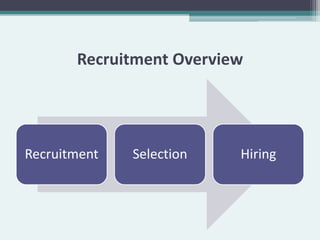
Recruitment Overview


Recruitment   Selection   Hiring
Crucial Components
• Recruitment
  ▫ Importance of the Job Description
  ▫ Development of Requirements
  ▫ Posting/Advertising
• Selection
  ▫ Screening Process
  ▫ Matching Qualifications & Competencies
  ▫ Interviewing
• Hiring
  ▫ Electronic Workflow
  ▫ Role of Human Resources
Recruitment
          The Importance of the Job Description

• Drives the content for posting
  ▫ Allows the manager to articulate the requirements
  ▫ Allows the candidates to preview the job
  ▫ Sets foundation for matching people to jobs
• Bona-Fide Occupational Requirements (BFOQs)
  ▫   Legal Protections – EEO, ADA
  ▫   Government Contract Requirements
  ▫   Policy Compliance
  ▫   Best Practice –recruit the most qualified candidates
Recruitment
          Development of Requirements (KSAs)
• Essential Job Functions
  ▫ Determine experience necessary to perform basic job requirements
  ▫ Consider both breadth and depth
• Education & Skills
  ▫   Education level to be competent in position
  ▫   Certifications, Body of Knowledge
  ▫   Mastery level of Competencies
  ▫   Other training and internships
• Rank Importance of KSAs
  ▫ Helps to determine priorities for best fit
  ▫ Distinguish between requirements and preferences
Recruitment
                    Posting/Advertising Options

• Internal Posting
  ▫ Intranet, internal job boards
  ▫ Distribution lists, Alert feature for subscribers
• External Posting
  ▫   Public Website – all postings reference this site
  ▫   Craigslist – most cost effective
  ▫   Print packaged with online – usually most expensive
  ▫   CareerBuilder/Monster – use with automated screening
  ▫   Community Newspapers – very local or specialized target
  ▫   LinkedIn – best for professional positions
Recruitment
                          How to Get it Posted

• Self Service Approach
  ▫   Intranet Resources
  ▫   Library of Job Posting Templates
  ▫   Utilize a template and customize it to fit your position
  ▫   Create draft
  ▫   Email to HR with instructions
• Full Service Approach
  ▫   Call HR for consultation
  ▫   We can send you a draft to review/customize
  ▫   We will make recommendations based on your goals
  ▫   We can provide you quotes for external sites
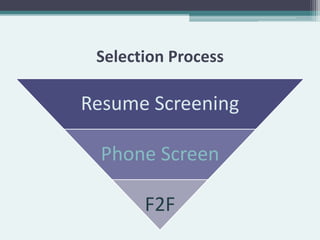
Selection Process

Resume Screening

  Phone Screen

       F2F
Selection
                        Screening Process
• Screen out those not qualified
  ▫   Licensure/Designation requirements not met
  ▫   Resume – Does not meet minimum KSAs
  ▫   Salary Requirements – Outside of Range
  ▫   Outside of commuting distance (generally more than 50 miles)
• Do not pursue unqualified candidates
• Best not to make notes on the resume itself
  ▫ Use highlighter to highlight strong points
  ▫ Use pencil to underline areas in question
Selection
       Matching Qualifications & Competencies

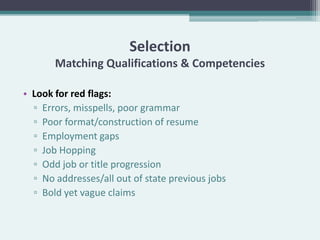
• Look for red flags:
  ▫ Errors, misspells, poor grammar
  ▫ Poor format/construction of resume
  ▫ Employment gaps
  ▫ Job Hopping
  ▫ Odd job or title progression
  ▫ No addresses/all out of state previous jobs
  ▫ Bold yet vague claims
Selection
       Matching Qualifications & Competencies
              (Three Bears Approach)
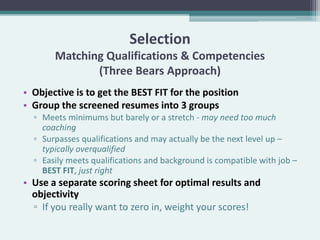
• Objective is to get the BEST FIT for the position
• Group the screened resumes into 3 groups
  ▫ Meets minimums but barely or a stretch - may need too much
    coaching
  ▫ Surpasses qualifications and may actually be the next level up –
    typically overqualified
  ▫ Easily meets qualifications and background is compatible with job –
    BEST FIT, just right
• Use a separate scoring sheet for optimal results and
  objectivity
  ▫ If you really want to zero in, weight your scores!
Recruitment
             Preliminary Phone Interviewing

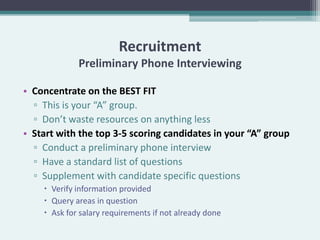
• Concentrate on the BEST FIT
  ▫ This is your “A” group.
  ▫ Don’t waste resources on anything less
• Start with the top 3-5 scoring candidates in your “A” group
  ▫ Conduct a preliminary phone interview
  ▫ Have a standard list of questions
  ▫ Supplement with candidate specific questions
     Verify information provided
     Query areas in question
     Ask for salary requirements if not already done
Interviewing
                    Keep your Questions Clean

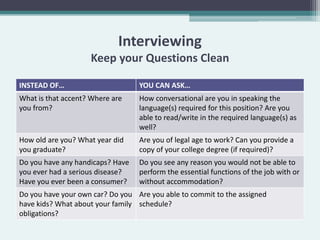
INSTEAD OF…                       YOU CAN ASK…
What is that accent? Where are    How conversational are you in speaking the
you from?                         language(s) required for this position? Are you
                                  able to read/write in the required language(s) as
                                  well?
How old are you? What year did    Are you of legal age to work? Can you provide a
you graduate?                     copy of your college degree (if required)?
Do you have any handicaps? Have   Do you see any reason you would not be able to
you ever had a serious disease?   perform the essential functions of the job with or
Have you ever been a consumer?    without accommodation?
Do you have your own car? Do you Are you able to commit to the assigned
have kids? What about your family schedule?
obligations?
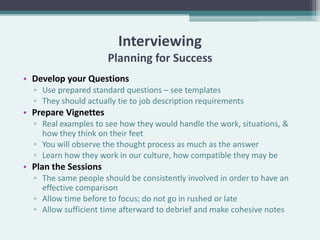
Interviewing
                      Planning for Success
• Develop your Questions
  ▫ Use prepared standard questions – see templates
  ▫ They should actually tie to job description requirements
• Prepare Vignettes
  ▫ Real examples to see how they would handle the work, situations, &
    how they think on their feet
  ▫ You will observe the thought process as much as the answer
  ▫ Learn how they work in our culture, how compatible they may be
• Plan the Sessions
  ▫ The same people should be consistently involved in order to have an
    effective comparison
  ▫ Allow time before to focus; do not go in rushed or late
  ▫ Allow sufficient time afterward to debrief and make cohesive notes
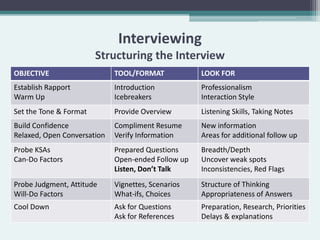
Interviewing
                        Structuring the Interview
OBJECTIVE                    TOOL/FORMAT            LOOK FOR
Establish Rapport            Introduction           Professionalism
Warm Up                      Icebreakers            Interaction Style
Set the Tone & Format        Provide Overview       Listening Skills, Taking Notes
Build Confidence             Compliment Resume      New information
Relaxed, Open Conversation   Verify Information     Areas for additional follow up
Probe KSAs                   Prepared Questions     Breadth/Depth
Can-Do Factors               Open-ended Follow up   Uncover weak spots
                             Listen, Don’t Talk     Inconsistencies, Red Flags
Probe Judgment, Attitude     Vignettes, Scenarios   Structure of Thinking
Will-Do Factors              What-ifs, Choices      Appropriateness of Answers
Cool Down                    Ask for Questions      Preparation, Research, Priorities
                             Ask for References     Delays & explanations
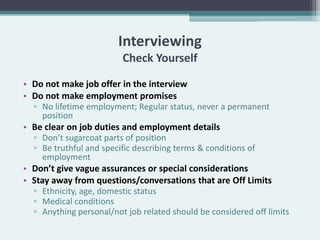
Interviewing
                         Check Yourself

• Do not make job offer in the interview
• Do not make employment promises
  ▫ No lifetime employment; Regular status, never a permanent
     position
• Be clear on job duties and employment details
  ▫ Don’t sugarcoat parts of position
  ▫ Be truthful and specific describing terms & conditions of
     employment
• Don’t give vague assurances or special considerations
• Stay away from questions/conversations that are Off Limits
  ▫ Ethnicity, age, domestic status
  ▫ Medical conditions
  ▫ Anything personal/not job related should be considered off limits
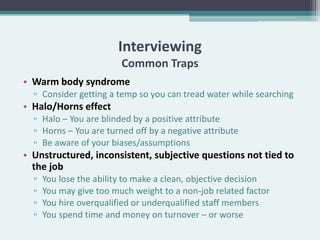
Interviewing
                         Common Traps
• Warm body syndrome
  ▫ Consider getting a temp so you can tread water while searching
• Halo/Horns effect
  ▫ Halo – You are blinded by a positive attribute
  ▫ Horns – You are turned off by a negative attribute
  ▫ Be aware of your biases/assumptions
• Unstructured, inconsistent, subjective questions not tied to
  the job
  ▫   You lose the ability to make a clean, objective decision
  ▫   You may give too much weight to a non-job related factor
  ▫   You hire overqualified or underqualified staff members
  ▫   You spend time and money on turnover – or worse
Interviewing
                           Check Them
• Inconsistencies
  ▫ Follow up on inconsistencies between resume and answers
  ▫ Pursue evasion relentlessly from different angles
  ▫ Conflicting body language—eye contact, looks away on certain
    topics or questions
  ▫ Implausible history, stories don’t stack up well
  ▫ Attribution – Reasons for leaving – Negative explanations
• Following Direction
  ▫   Answers the wrong question; Rephrase to see if they self-correct
  ▫   Unable to track on topic; Bring them back to earth
  ▫   Consider their thinking process – do philosophies align?
  ▫   Changes answers to please you – disingenuous answers
Interviewing
              Getting to the Hiring Decision
• Debrief with other Interviewers
  ▫ Confirm or discuss reactions, assessment of competencies
  ▫ Discuss concerns that may be dealbreakers
• Update score sheets with new information
  ▫ Calculate scores & rank candidates
  ▫ Can be done alone or as part of the interview group
• Check References
  ▫ Get their direct manager when possible
  ▫ They may need to provide a release to their former employer
  ▫ No personal references
• Summarize/Document reasons for choice
  ▫ Should not conflict with KSAs, scoring, interviews
  ▫ Do not use non-job related criteria in the hiring decision
The New Hire Process
                       Making the Offer

•   Call with specific terms of offer
•   Okay to initiate with verbal acceptance.
•   Some candidates will want to consider offer
•   Set time to advise you by before offer expires
The New Hire Process
           Coordinating with Human Resources
• Complete Electronic Notification
  ▫ Employees (New, rehires)
  ▫ Interns
  ▫ Intern-to-Employee Hires
• Attach resume, interview notes
• Human Resources will take it from there
  ▫   Application, Offer Letter
  ▫   Background Check
  ▫   New Hire Documentation
  ▫   You will be notified when Clearance is Complete
The New Hire Process
                 Wrapping up Loose Ends

• After desired candidate accepts, notify others that they
  were not selected
  ▫ Form letter to most applicants
  ▫ Phone call to anyone who was contacted
• Be general, but concrete on reason why candidate not
  selected
  ▫ We selected a candidate who was the best fit for the position
  ▫ We selected the candidate who was the closest match for the
    position
• Thank them for their time and wish them good luck in their
  search
Putting it All Together
• Questions at this Point?
• Practice/Role Play
  ▫   Getting specifics/facts from bold claims and generalizations
  ▫   Pursuing Evasive answers
  ▫   Handling distracters and keeping focus
  ▫   Getting around personal information offered
• What other tools might be helpful?
Recruitment Overview

  • 1.
  • 2.
  • 3.
    Crucial Components • Recruitment ▫ Importance of the Job Description ▫ Development of Requirements ▫ Posting/Advertising • Selection ▫ Screening Process ▫ Matching Qualifications & Competencies ▫ Interviewing • Hiring ▫ Electronic Workflow ▫ Role of Human Resources
  • 4.
    Recruitment The Importance of the Job Description • Drives the content for posting ▫ Allows the manager to articulate the requirements ▫ Allows the candidates to preview the job ▫ Sets foundation for matching people to jobs • Bona-Fide Occupational Requirements (BFOQs) ▫ Legal Protections – EEO, ADA ▫ Government Contract Requirements ▫ Policy Compliance ▫ Best Practice –recruit the most qualified candidates
  • 5.
    Recruitment Development of Requirements (KSAs) • Essential Job Functions ▫ Determine experience necessary to perform basic job requirements ▫ Consider both breadth and depth • Education & Skills ▫ Education level to be competent in position ▫ Certifications, Body of Knowledge ▫ Mastery level of Competencies ▫ Other training and internships • Rank Importance of KSAs ▫ Helps to determine priorities for best fit ▫ Distinguish between requirements and preferences
  • 6.
    Recruitment Posting/Advertising Options • Internal Posting ▫ Intranet, internal job boards ▫ Distribution lists, Alert feature for subscribers • External Posting ▫ Public Website – all postings reference this site ▫ Craigslist – most cost effective ▫ Print packaged with online – usually most expensive ▫ CareerBuilder/Monster – use with automated screening ▫ Community Newspapers – very local or specialized target ▫ LinkedIn – best for professional positions
  • 7.
    Recruitment How to Get it Posted • Self Service Approach ▫ Intranet Resources ▫ Library of Job Posting Templates ▫ Utilize a template and customize it to fit your position ▫ Create draft ▫ Email to HR with instructions • Full Service Approach ▫ Call HR for consultation ▫ We can send you a draft to review/customize ▫ We will make recommendations based on your goals ▫ We can provide you quotes for external sites
  • 8.
  • 9.
    Selection Screening Process • Screen out those not qualified ▫ Licensure/Designation requirements not met ▫ Resume – Does not meet minimum KSAs ▫ Salary Requirements – Outside of Range ▫ Outside of commuting distance (generally more than 50 miles) • Do not pursue unqualified candidates • Best not to make notes on the resume itself ▫ Use highlighter to highlight strong points ▫ Use pencil to underline areas in question
  • 10.
    Selection Matching Qualifications & Competencies • Look for red flags: ▫ Errors, misspells, poor grammar ▫ Poor format/construction of resume ▫ Employment gaps ▫ Job Hopping ▫ Odd job or title progression ▫ No addresses/all out of state previous jobs ▫ Bold yet vague claims
  • 11.
    Selection Matching Qualifications & Competencies (Three Bears Approach) • Objective is to get the BEST FIT for the position • Group the screened resumes into 3 groups ▫ Meets minimums but barely or a stretch - may need too much coaching ▫ Surpasses qualifications and may actually be the next level up – typically overqualified ▫ Easily meets qualifications and background is compatible with job – BEST FIT, just right • Use a separate scoring sheet for optimal results and objectivity ▫ If you really want to zero in, weight your scores!
  • 12.
    Recruitment Preliminary Phone Interviewing • Concentrate on the BEST FIT ▫ This is your “A” group. ▫ Don’t waste resources on anything less • Start with the top 3-5 scoring candidates in your “A” group ▫ Conduct a preliminary phone interview ▫ Have a standard list of questions ▫ Supplement with candidate specific questions  Verify information provided  Query areas in question  Ask for salary requirements if not already done
  • 13.
    Interviewing Keep your Questions Clean INSTEAD OF… YOU CAN ASK… What is that accent? Where are How conversational are you in speaking the you from? language(s) required for this position? Are you able to read/write in the required language(s) as well? How old are you? What year did Are you of legal age to work? Can you provide a you graduate? copy of your college degree (if required)? Do you have any handicaps? Have Do you see any reason you would not be able to you ever had a serious disease? perform the essential functions of the job with or Have you ever been a consumer? without accommodation? Do you have your own car? Do you Are you able to commit to the assigned have kids? What about your family schedule? obligations?
  • 14.
    Interviewing Planning for Success • Develop your Questions ▫ Use prepared standard questions – see templates ▫ They should actually tie to job description requirements • Prepare Vignettes ▫ Real examples to see how they would handle the work, situations, & how they think on their feet ▫ You will observe the thought process as much as the answer ▫ Learn how they work in our culture, how compatible they may be • Plan the Sessions ▫ The same people should be consistently involved in order to have an effective comparison ▫ Allow time before to focus; do not go in rushed or late ▫ Allow sufficient time afterward to debrief and make cohesive notes
  • 15.
    Interviewing Structuring the Interview OBJECTIVE TOOL/FORMAT LOOK FOR Establish Rapport Introduction Professionalism Warm Up Icebreakers Interaction Style Set the Tone & Format Provide Overview Listening Skills, Taking Notes Build Confidence Compliment Resume New information Relaxed, Open Conversation Verify Information Areas for additional follow up Probe KSAs Prepared Questions Breadth/Depth Can-Do Factors Open-ended Follow up Uncover weak spots Listen, Don’t Talk Inconsistencies, Red Flags Probe Judgment, Attitude Vignettes, Scenarios Structure of Thinking Will-Do Factors What-ifs, Choices Appropriateness of Answers Cool Down Ask for Questions Preparation, Research, Priorities Ask for References Delays & explanations
  • 16.
    Interviewing Check Yourself • Do not make job offer in the interview • Do not make employment promises ▫ No lifetime employment; Regular status, never a permanent position • Be clear on job duties and employment details ▫ Don’t sugarcoat parts of position ▫ Be truthful and specific describing terms & conditions of employment • Don’t give vague assurances or special considerations • Stay away from questions/conversations that are Off Limits ▫ Ethnicity, age, domestic status ▫ Medical conditions ▫ Anything personal/not job related should be considered off limits
  • 17.
    Interviewing Common Traps • Warm body syndrome ▫ Consider getting a temp so you can tread water while searching • Halo/Horns effect ▫ Halo – You are blinded by a positive attribute ▫ Horns – You are turned off by a negative attribute ▫ Be aware of your biases/assumptions • Unstructured, inconsistent, subjective questions not tied to the job ▫ You lose the ability to make a clean, objective decision ▫ You may give too much weight to a non-job related factor ▫ You hire overqualified or underqualified staff members ▫ You spend time and money on turnover – or worse
  • 18.
    Interviewing Check Them • Inconsistencies ▫ Follow up on inconsistencies between resume and answers ▫ Pursue evasion relentlessly from different angles ▫ Conflicting body language—eye contact, looks away on certain topics or questions ▫ Implausible history, stories don’t stack up well ▫ Attribution – Reasons for leaving – Negative explanations • Following Direction ▫ Answers the wrong question; Rephrase to see if they self-correct ▫ Unable to track on topic; Bring them back to earth ▫ Consider their thinking process – do philosophies align? ▫ Changes answers to please you – disingenuous answers
  • 19.
    Interviewing Getting to the Hiring Decision • Debrief with other Interviewers ▫ Confirm or discuss reactions, assessment of competencies ▫ Discuss concerns that may be dealbreakers • Update score sheets with new information ▫ Calculate scores & rank candidates ▫ Can be done alone or as part of the interview group • Check References ▫ Get their direct manager when possible ▫ They may need to provide a release to their former employer ▫ No personal references • Summarize/Document reasons for choice ▫ Should not conflict with KSAs, scoring, interviews ▫ Do not use non-job related criteria in the hiring decision
  • 20.
    The New HireProcess Making the Offer • Call with specific terms of offer • Okay to initiate with verbal acceptance. • Some candidates will want to consider offer • Set time to advise you by before offer expires
  • 21.
    The New HireProcess Coordinating with Human Resources • Complete Electronic Notification ▫ Employees (New, rehires) ▫ Interns ▫ Intern-to-Employee Hires • Attach resume, interview notes • Human Resources will take it from there ▫ Application, Offer Letter ▫ Background Check ▫ New Hire Documentation ▫ You will be notified when Clearance is Complete
  • 22.
    The New HireProcess Wrapping up Loose Ends • After desired candidate accepts, notify others that they were not selected ▫ Form letter to most applicants ▫ Phone call to anyone who was contacted • Be general, but concrete on reason why candidate not selected ▫ We selected a candidate who was the best fit for the position ▫ We selected the candidate who was the closest match for the position • Thank them for their time and wish them good luck in their search
  • 23.
    Putting it AllTogether • Questions at this Point? • Practice/Role Play ▫ Getting specifics/facts from bold claims and generalizations ▫ Pursuing Evasive answers ▫ Handling distracters and keeping focus ▫ Getting around personal information offered • What other tools might be helpful?