seeitssam@gmail.com
The Presentation of Self in
Everyday Life
ERVING GOFFMAN
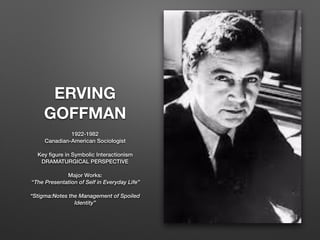
ERVING
GOFFMAN
1922-1982
Canadian-American Sociologist
Key figure in Symbolic Interactionism
DRAMATURGICAL PERSPECTIVE
Major Works:
“The Presentation of Self in Everyday Life”
“Stigma:Notes the Management of Spoiled
Identity”
s
e
e
i
t
s
s
a
m
@
g
m
a
i
l
.
c
o
m
DRAMATURGY-Everyday behaviour
as a theatrical performance!
• 1959-Erving Goffman introduced the idea of
dramaturgical analysis in his book “The Presentation
of Self in Everyday Life”
• This symbolic interactionist theory makes the analogy
of life as a theatrical performance and states that how
we present ourselves in everyday life is similar to a
stage performance
s
e
e
i
t
s
s
a
m
@
g
m
a
i
l
.
c
o
m
Tenets
• All actions are social in nature
• All social actions are performances
• All performances are managed
s
e
e
i
t
s
s
a
m
@
g
m
a
i
l
.
c
o
m
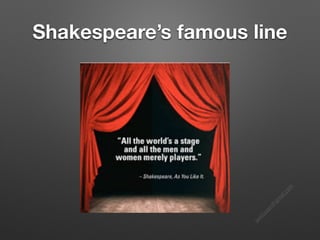
Shakespeare’s famous line
s
e
e
i
t
s
s
a
m
@
g
m
a
i
l
.
c
o
m
• “all the world’s a stage.. and all the men and women
are merely players..they have their own exits and their
entrance.. and one man in his time plays many parts…”
• Goffman took these lines seriously in his dramaturgical
account of human interaction and he argued that we
display a series of masks to other enacting roles,
controlling in staging how we appear
• When we interact with individuals we are actors in a
performance
s
e
e
i
t
s
s
a
m
@
g
m
a
i
l
.
c
o
m
• That performances are largely based on values, beliefs
and habits that we learn from social institutions and our
interaction with others
• In situations, where we don’t know the others in the
scene on an un-familiar interaction, we present our
FRONT STAGE SELF (F.S.S)
• This FSS is the version of us that we believe would be
favourable to others; when we engage with FSS, we
also engage in IMPRESSION MANAGEMENT
TECHNIQUES (IMT)
s
e
e
i
t
s
s
a
m
@
g
m
a
i
l
.
c
o
m
• In IMT, we engage in behaviour what we want the
world to see about us; which is often favourable (I am
a good person, I want to show people that I am a good
person; I am going to do this so they like me etc)
• BACK STAGE SELF: The version of self, that we often
present to those we are familiar with (“we accept you
group’)
• MYSTIFICATION: the social distance that should be
kept between the actor and the audience
s
e
e
i
t
s
s
a
m
@
g
m
a
i
l
.
c
o
m
• The actor should conceal the past life which incompatible with the
current performance
• The errors that have been made in the preparations of the
performance should be concealed
• The process of producing something is concealed and on the end
product is shown
• The unfair practices in making the end product is concealed
• The actors have to compromise with standards
ALL THESE ARE CRUCIAL FOR SUCCESSFUL ROLE PERFORMANCE
s
e
e
i
t
s
s
a
m
@
g
m
a
i
l
.
c
o
m
• We do this everyday (the front stage self, back stage
self, Impression management techniques)
• The more socially connected we are the more we tent
to management that type of a self we want to brought
to see favourably
• We do this a lot in social media when we do status
updates in FB and WhatsApp. (eg. I volunteered
today)
s
e
e
i
t
s
s
a
m
@
g
m
a
i
l
.
c
o
m
“Reciprocal influence of individuals upon another’s
actions when in one another’s immediate physical
presence”
Goffman (1959)
s
e
e
i
t
s
s
a
m
@
g
m
a
i
l
.
c
o
m
• According to Goffman, we juggle masks as per the
different social groups we are interacting with
• In his view, there NO TRUE SELF
• That is, no identifiable performer behind the roles
• The roles are just performances
• He also challenged the idea that each of us have more
or less a fixed character or psychological identity
s
e
e
i
t
s
s
a
m
@
g
m
a
i
l
.
c
o
m
Performance Teams
• A performance team refers to “any set of individuals who
cooperate in staging a single routine” (Goffman, 1959)
• The routine staged is the activity associated with the social
establishment
• To perform successfully, a team must proceed through
different processes
• First they must establish PARTY LINE, maintain loyalty to the
teams performance, and sustain that “line” effectively during
the show; to carry out those tasks, participants must trust
partners
s
e
e
i
t
s
s
a
m
@
g
m
a
i
l
.
c
o
m
• People cannot switch teams mid-performance (i.e., that
they betray one team to die with another during the show)
• To organise performances, teams try to control as much
of the performance setting as possible, with a person
serving as a “director” and some division of performative
labour allocated among different members during shows
• Directors and team members will assign “parts” and work
together to bring wayward performers back into line,
avoid disruptions and repair them as much as possible
s
e
e
i
t
s
s
a
m
@
g
m
a
i
l
.
c
o
m
Criticism
• Gouldner: too much micro
• Psathas & Schegloff: too unsystematic; concepts are
assembled in a disorganised way
• Much later in his career, Goffman returned to the
questions of the lists of the dramaturgical metaphor; in
the preface to Frame Analysis (1974) he wrote- “all the
world is not a stage:we need real parking lots,
cloakrooms, insurance, and so on.
s
e
e
i
t
s
s
a
m
@
g
m
a
i
l
.
c
o
m
Writing Activity
• Explain the approach that tried to understand the
social reality using theatrical analogy
• Explain the concept of “team” in dramaturgy
• Discuss the theory of dramaturgy.
s
e
e
i
t
s
s
a
m
@
g
m
a
i
l
.
c
o
m
Reading Activity
• Read the book chapter “Workplaces as
Stages” (Check the link of reading activity in the LMS
portal)
s
e
e
i
t
s
s
a
m
@
g
m
a
i
l
.
c
o
m
References
• (Key Sociologists) Greg Smith - Erving Goffman-
Routledge (2006)
• Wallace, Ruth A (1995) Contemporary Sociological
Theory: Continuing the Classical Tradition
• George Ritzer - Encyclopedia of social theory. Vol 1-
Sage Publications (2005).page 212-13
• Goffman, The Presentation of Self in Everyday Life
(1959)

GOFFMAN-Dramaturgy.pdf

  • 1.
    seeitssam@gmail.com The Presentation ofSelf in Everyday Life ERVING GOFFMAN
  • 2.
    ERVING GOFFMAN 1922-1982 Canadian-American Sociologist Key figurein Symbolic Interactionism DRAMATURGICAL PERSPECTIVE Major Works: “The Presentation of Self in Everyday Life” “Stigma:Notes the Management of Spoiled Identity”
  • 3.
    s e e i t s s a m @ g m a i l . c o m DRAMATURGY-Everyday behaviour as atheatrical performance! • 1959-Erving Goffman introduced the idea of dramaturgical analysis in his book “The Presentation of Self in Everyday Life” • This symbolic interactionist theory makes the analogy of life as a theatrical performance and states that how we present ourselves in everyday life is similar to a stage performance
  • 4.
    s e e i t s s a m @ g m a i l . c o m Tenets • All actionsare social in nature • All social actions are performances • All performances are managed
  • 5.
  • 6.
    s e e i t s s a m @ g m a i l . c o m • “all theworld’s a stage.. and all the men and women are merely players..they have their own exits and their entrance.. and one man in his time plays many parts…” • Goffman took these lines seriously in his dramaturgical account of human interaction and he argued that we display a series of masks to other enacting roles, controlling in staging how we appear • When we interact with individuals we are actors in a performance
  • 7.
    s e e i t s s a m @ g m a i l . c o m • That performancesare largely based on values, beliefs and habits that we learn from social institutions and our interaction with others • In situations, where we don’t know the others in the scene on an un-familiar interaction, we present our FRONT STAGE SELF (F.S.S) • This FSS is the version of us that we believe would be favourable to others; when we engage with FSS, we also engage in IMPRESSION MANAGEMENT TECHNIQUES (IMT)
  • 8.
    s e e i t s s a m @ g m a i l . c o m • In IMT,we engage in behaviour what we want the world to see about us; which is often favourable (I am a good person, I want to show people that I am a good person; I am going to do this so they like me etc) • BACK STAGE SELF: The version of self, that we often present to those we are familiar with (“we accept you group’) • MYSTIFICATION: the social distance that should be kept between the actor and the audience
  • 9.
    s e e i t s s a m @ g m a i l . c o m • The actorshould conceal the past life which incompatible with the current performance • The errors that have been made in the preparations of the performance should be concealed • The process of producing something is concealed and on the end product is shown • The unfair practices in making the end product is concealed • The actors have to compromise with standards ALL THESE ARE CRUCIAL FOR SUCCESSFUL ROLE PERFORMANCE
  • 10.
    s e e i t s s a m @ g m a i l . c o m • We dothis everyday (the front stage self, back stage self, Impression management techniques) • The more socially connected we are the more we tent to management that type of a self we want to brought to see favourably • We do this a lot in social media when we do status updates in FB and WhatsApp. (eg. I volunteered today)
  • 11.
    s e e i t s s a m @ g m a i l . c o m “Reciprocal influence ofindividuals upon another’s actions when in one another’s immediate physical presence” Goffman (1959)
  • 12.
    s e e i t s s a m @ g m a i l . c o m • According toGoffman, we juggle masks as per the different social groups we are interacting with • In his view, there NO TRUE SELF • That is, no identifiable performer behind the roles • The roles are just performances • He also challenged the idea that each of us have more or less a fixed character or psychological identity
  • 13.
    s e e i t s s a m @ g m a i l . c o m Performance Teams • Aperformance team refers to “any set of individuals who cooperate in staging a single routine” (Goffman, 1959) • The routine staged is the activity associated with the social establishment • To perform successfully, a team must proceed through different processes • First they must establish PARTY LINE, maintain loyalty to the teams performance, and sustain that “line” effectively during the show; to carry out those tasks, participants must trust partners
  • 14.
    s e e i t s s a m @ g m a i l . c o m • People cannotswitch teams mid-performance (i.e., that they betray one team to die with another during the show) • To organise performances, teams try to control as much of the performance setting as possible, with a person serving as a “director” and some division of performative labour allocated among different members during shows • Directors and team members will assign “parts” and work together to bring wayward performers back into line, avoid disruptions and repair them as much as possible
  • 15.
    s e e i t s s a m @ g m a i l . c o m Criticism • Gouldner: toomuch micro • Psathas & Schegloff: too unsystematic; concepts are assembled in a disorganised way • Much later in his career, Goffman returned to the questions of the lists of the dramaturgical metaphor; in the preface to Frame Analysis (1974) he wrote- “all the world is not a stage:we need real parking lots, cloakrooms, insurance, and so on.
  • 16.
    s e e i t s s a m @ g m a i l . c o m Writing Activity • Explainthe approach that tried to understand the social reality using theatrical analogy • Explain the concept of “team” in dramaturgy • Discuss the theory of dramaturgy.
  • 17.
    s e e i t s s a m @ g m a i l . c o m Reading Activity • Readthe book chapter “Workplaces as Stages” (Check the link of reading activity in the LMS portal)
  • 18.
    s e e i t s s a m @ g m a i l . c o m References • (Key Sociologists)Greg Smith - Erving Goffman- Routledge (2006) • Wallace, Ruth A (1995) Contemporary Sociological Theory: Continuing the Classical Tradition • George Ritzer - Encyclopedia of social theory. Vol 1- Sage Publications (2005).page 212-13 • Goffman, The Presentation of Self in Everyday Life (1959)