How to conduct in-depth interview(IDI)
Experience from Field
Kumar Gaurav
MLE Manager- MNCH
What is In-depth
Interview???
It is a qualitative research technique that
allows person to person discussion.
It can lead to increased insight into people's
thoughts, feelings, and behavior on
important issues.
This type of interview is often unstructured
and therefore permits the interviewer to
encourage an informant (respondent) to
talk at length about the topic of interest
Cont…
Its offer the opportunity to capture rich,
descriptive data about people‟s behaviors,
attitudes and perceptions, and unfolding
complex processes.
In-depth interview uses a flexible interview
approach.
 It aims to ask questions to explain the
reasons underlying a problem or practice in
a target group
How to Be an Effective
Interviewer???
• Be familiar with research documents
• Practice interviewing (zero round or
mock sessions)
• Practice using the equipment
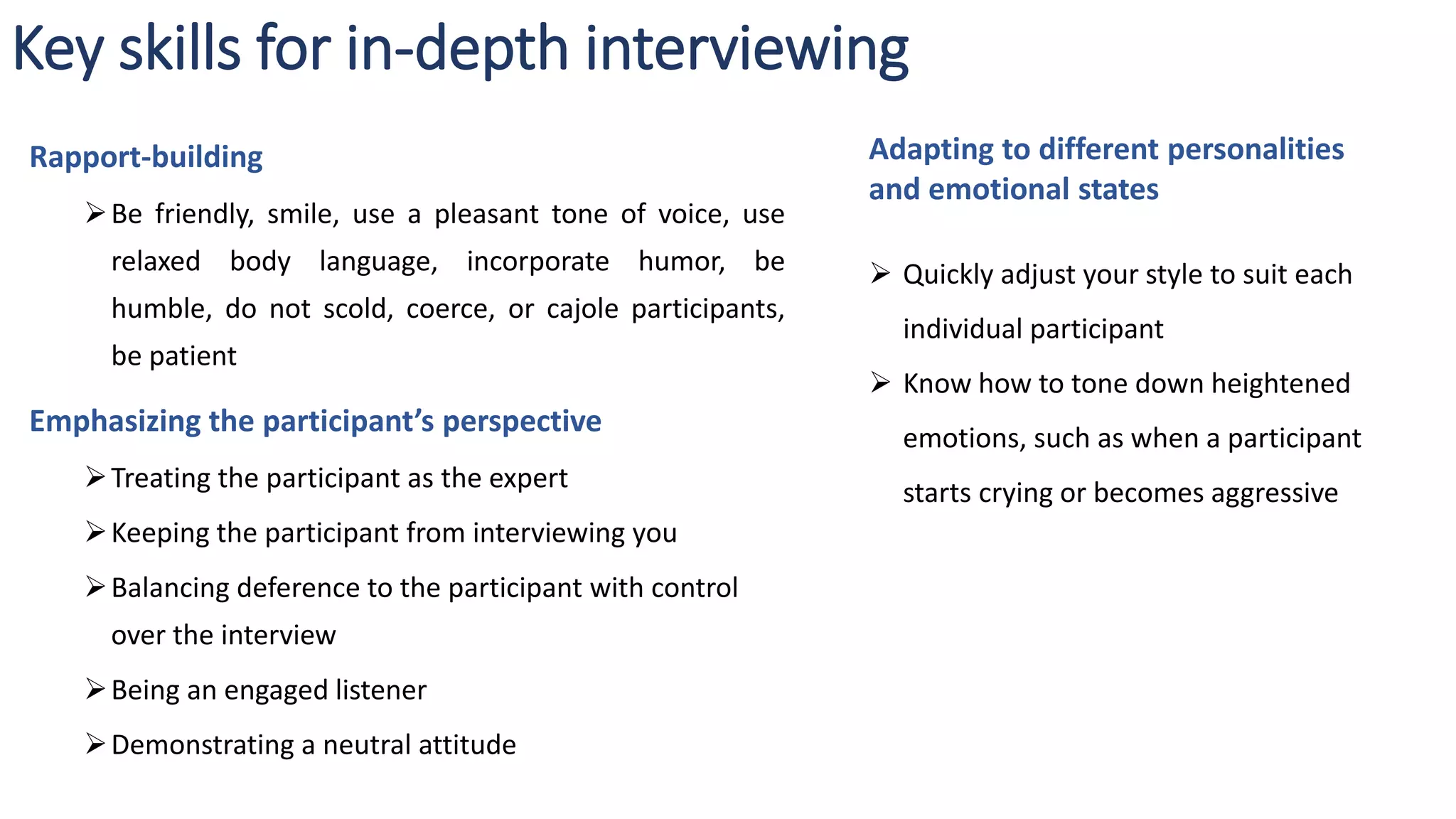
Key skills for in-depth interviewing
Rapport-building
Be friendly, smile, use a pleasant tone of voice, use
relaxed body language, incorporate humor, be
humble, do not scold, coerce, or cajole participants,
be patient
Emphasizing the participant’s perspective
Treating the participant as the expert
Keeping the participant from interviewing you
Balancing deference to the participant with control
over the interview
Being an engaged listener
Demonstrating a neutral attitude
Adapting to different personalities
and emotional states
 Quickly adjust your style to suit each
individual participant
 Know how to tone down heightened
emotions, such as when a participant
starts crying or becomes aggressive
Question Order
Small Chat/Ice- breaker
Bridging Question
More Serious Question
Sensitive Question
Question types
1. Main questions
2. Prompt+Probes
 Extensions of main question
 Aimed to encourage respondents to
share more information and touch on
areas they did not initially address
 May reflect statements or use vocabulary
of respondent
• Open ended,
• Neutral,
• Sensitive,
• Clear to respondent
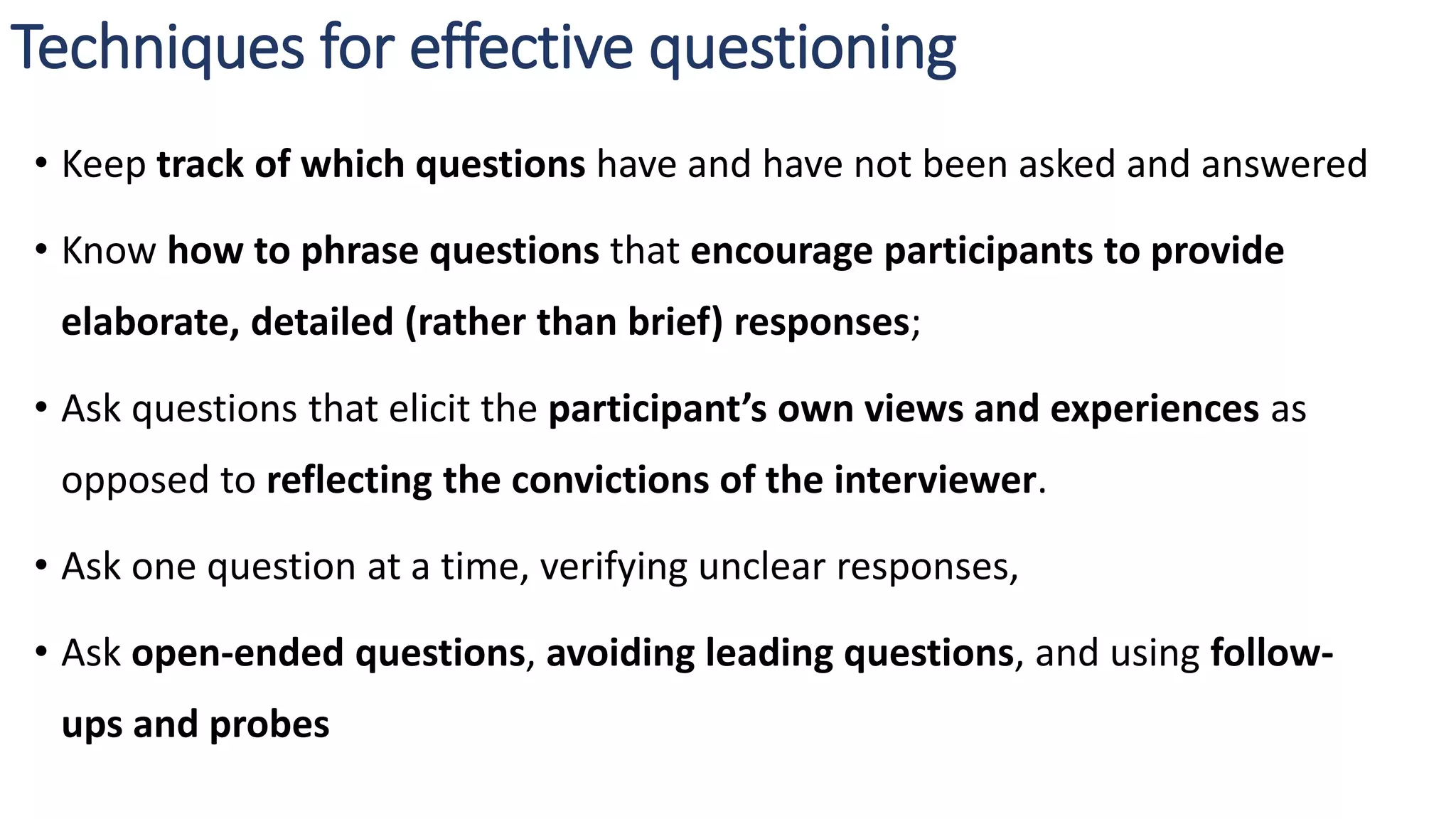
Techniques for effective questioning
• Keep track of which questions have and have not been asked and answered
• Know how to phrase questions that encourage participants to provide
elaborate, detailed (rather than brief) responses;
• Ask questions that elicit the participant’s own views and experiences as
opposed to reflecting the convictions of the interviewer.
• Ask one question at a time, verifying unclear responses,
• Ask open-ended questions, avoiding leading questions, and using follow-
ups and probes
The "Do’s"
• Begin interview with a friendly and familiar greeting.
• Listen with attention to capture every piece of information from
respondents.
• Explore key words, phrases, terms as they occur in the discussion.
• Listen to impressions, topics avoided by informant, deliberate
distortions and misconceptions or misunderstandings.
• Take prompt action to explore each of these.
• Where appropriate, use "probes
• Ensure a natural flow of discussion by guiding informant from one
topic to the next.
• "Play dumb"(be silent) to give the respondent plenty of room to
talk.
• Be open to unexpected information
The “Don'ts
• Influence or bias responses by introducing one's
own perceptions or asking leading questions
which encourage a particular response.
• Move too quickly from one topic to the next
Interrupt the informant.
• Do not mislead about the subject matter in
order to obtain information
Note taking to report writing………….
• Try to take short notes
• Write down all important phrases/words/local words
• Note down all expression/emotion of respondents
• Observe the body language
• Expansion of short notes with 24 hours of completion of interview
• Transcribed the audio (if recorded) and complete coding preferably withing 24 hours.
• Analysis and Report writing
Please Ask your Question/s???
Thank You

How to conduct in depth interview

  • 1.
    How to conductin-depth interview(IDI) Experience from Field Kumar Gaurav MLE Manager- MNCH
  • 2.
    What is In-depth Interview??? Itis a qualitative research technique that allows person to person discussion. It can lead to increased insight into people's thoughts, feelings, and behavior on important issues. This type of interview is often unstructured and therefore permits the interviewer to encourage an informant (respondent) to talk at length about the topic of interest
  • 3.
    Cont… Its offer theopportunity to capture rich, descriptive data about people‟s behaviors, attitudes and perceptions, and unfolding complex processes. In-depth interview uses a flexible interview approach.  It aims to ask questions to explain the reasons underlying a problem or practice in a target group
  • 4.
    How to Bean Effective Interviewer??? • Be familiar with research documents • Practice interviewing (zero round or mock sessions) • Practice using the equipment
  • 5.
    Key skills forin-depth interviewing Rapport-building Be friendly, smile, use a pleasant tone of voice, use relaxed body language, incorporate humor, be humble, do not scold, coerce, or cajole participants, be patient Emphasizing the participant’s perspective Treating the participant as the expert Keeping the participant from interviewing you Balancing deference to the participant with control over the interview Being an engaged listener Demonstrating a neutral attitude Adapting to different personalities and emotional states  Quickly adjust your style to suit each individual participant  Know how to tone down heightened emotions, such as when a participant starts crying or becomes aggressive
  • 6.
    Question Order Small Chat/Ice-breaker Bridging Question More Serious Question Sensitive Question
  • 7.
    Question types 1. Mainquestions 2. Prompt+Probes  Extensions of main question  Aimed to encourage respondents to share more information and touch on areas they did not initially address  May reflect statements or use vocabulary of respondent • Open ended, • Neutral, • Sensitive, • Clear to respondent
  • 8.
    Techniques for effectivequestioning • Keep track of which questions have and have not been asked and answered • Know how to phrase questions that encourage participants to provide elaborate, detailed (rather than brief) responses; • Ask questions that elicit the participant’s own views and experiences as opposed to reflecting the convictions of the interviewer. • Ask one question at a time, verifying unclear responses, • Ask open-ended questions, avoiding leading questions, and using follow- ups and probes
  • 9.
    The "Do’s" • Begininterview with a friendly and familiar greeting. • Listen with attention to capture every piece of information from respondents. • Explore key words, phrases, terms as they occur in the discussion. • Listen to impressions, topics avoided by informant, deliberate distortions and misconceptions or misunderstandings. • Take prompt action to explore each of these. • Where appropriate, use "probes • Ensure a natural flow of discussion by guiding informant from one topic to the next. • "Play dumb"(be silent) to give the respondent plenty of room to talk. • Be open to unexpected information The “Don'ts • Influence or bias responses by introducing one's own perceptions or asking leading questions which encourage a particular response. • Move too quickly from one topic to the next Interrupt the informant. • Do not mislead about the subject matter in order to obtain information
  • 10.
    Note taking toreport writing…………. • Try to take short notes • Write down all important phrases/words/local words • Note down all expression/emotion of respondents • Observe the body language • Expansion of short notes with 24 hours of completion of interview • Transcribed the audio (if recorded) and complete coding preferably withing 24 hours. • Analysis and Report writing
  • 11.
    Please Ask yourQuestion/s??? Thank You