NEO-FUNCTIONALISM
JEFFREY C ALEXANDER AND PAUL COLOMY
Neo-functionalism-
Emergence
A revival of interest in Parson’s work, first in Germany and then, the
United States; led to the emergence of neo-functionalism in the mid
1980s.

To merge certain aspects of functionalism, those which have withstood
the test of time with other paradigms that have developed better critical
perspective

In 1984, American Sociological Association devoted two sessions to a
conference on neo-functionalism at its annual meeting

Reconsideration of Parsonian theory

All these papers later edited by Jeffrey C Alexander, The leading
proponent of neo-functionalism in United States
Four volume work, Theoretical Logic in Sociology
Introduction to Neo-functionalism, 3 similarities
between Neo-functionalism and Neo-marxism

Both include critique of some of the basic tenets
of the original theory

Main spokespersons of neo-functionalism in
America are Jeffrey Alexander and Paul Colomy
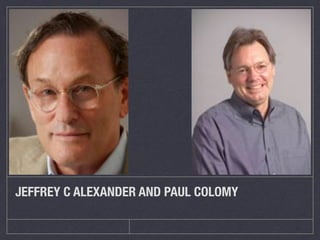
JEFFREY C ALEXANDER AND PAUL COLOMY
In one of their joint publications of 1985, they define neo-functionalism as a
‘self-critical strand of functional theory that seeks to broaden functionalism’s
intellectual scope while retaining its theoretical core’

Under the rubric of neo-functionalism, they have made an effort to extend
structural functionalism by overcoming its difficulties.

Alexander and Colomy think that the deficiencies of structural functionalism are
not irreversible

Its synthetic orientation can be recaptured

The concepts of conflict and subjective meaning can be introduced

One can regard the integration of the system and the interpenetration of its
various subsystems as a ‘tendency’, to be investigated rather than as a ‘given’
or ‘assumed’ fact.
Neo-functionalism as a tendency
rather than a developed theory
(1985)
1.To create a form of functionalism that is multi-dimensional and
includes micro as well as macro levels of analysis

2.To push functionalism to the left and reject Parson’s optimism
about modernity

3.To argue for an implicit democratic thrust in functional analysis

4.To incorporate a conflict orientation and 

5.To emphasise contingency (uncertainty) and interactional
creativity
Neo-Functionalism:Problems
that Need to be Surmounted
1.Anti-Individualism- the individual in structural functionalism is passive and
lacks creativity, and is simply a product of the social forces, which he neither
checks nor controls

2.Antagonism to change- Structural functionalism is a theory of social order
rather than of change

3.Conservatism- Structural functionalism has worked toward offering a
justification of the system and its practices, often justifying inequality,
exploitation and oppression

4.Idealism- Structural functionalism speaks in terms of an ideal society, where
everything is in order and stability

5.Anti-empiricist bias— structural functionalism is more concerned with
abstract social systems instead of real societies.
Merits and Demerits of
Neo-functionalism
A restricted use of the term ‘neo-functionalism’ is
also found in ecological studies where it basically
means assigning primary importance to techno-
environmental forces in an analysis of the
processes of cultural adaptation

Neo-functionalism worked on the aspects that
were not considered by the followers of the
functional approach
REFERENCES
Jeffrey C. Alexander and Paul Colomy, Towards Neo-
Functionalism, Sociological Theory, Vol.3, No.2 (Autumn,
1985), pp. 11-23, American Sociological Association

Ronald R Matson (2005) The spirit of sociology : a
reader, Boston: Pearson/Allyn & Bacon

Abrahamson, Mark (2001) Functional, conflict and
Nonfunctional Theories. In George Ritzer and Barry
Smart (eds) Handbook of Social Theory. Sage
Publications (pp. 141-51)

Neo-functionalism.pdf

  • 1.
  • 2.
    Neo-functionalism- Emergence A revival ofinterest in Parson’s work, first in Germany and then, the United States; led to the emergence of neo-functionalism in the mid 1980s. To merge certain aspects of functionalism, those which have withstood the test of time with other paradigms that have developed better critical perspective In 1984, American Sociological Association devoted two sessions to a conference on neo-functionalism at its annual meeting Reconsideration of Parsonian theory All these papers later edited by Jeffrey C Alexander, The leading proponent of neo-functionalism in United States
  • 3.
    Four volume work,Theoretical Logic in Sociology Introduction to Neo-functionalism, 3 similarities between Neo-functionalism and Neo-marxism Both include critique of some of the basic tenets of the original theory Main spokespersons of neo-functionalism in America are Jeffrey Alexander and Paul Colomy
  • 4.
    JEFFREY C ALEXANDERAND PAUL COLOMY
  • 5.
    In one oftheir joint publications of 1985, they define neo-functionalism as a ‘self-critical strand of functional theory that seeks to broaden functionalism’s intellectual scope while retaining its theoretical core’ Under the rubric of neo-functionalism, they have made an effort to extend structural functionalism by overcoming its difficulties. Alexander and Colomy think that the deficiencies of structural functionalism are not irreversible Its synthetic orientation can be recaptured The concepts of conflict and subjective meaning can be introduced One can regard the integration of the system and the interpenetration of its various subsystems as a ‘tendency’, to be investigated rather than as a ‘given’ or ‘assumed’ fact.
  • 6.
    Neo-functionalism as atendency rather than a developed theory (1985) 1.To create a form of functionalism that is multi-dimensional and includes micro as well as macro levels of analysis 2.To push functionalism to the left and reject Parson’s optimism about modernity 3.To argue for an implicit democratic thrust in functional analysis 4.To incorporate a conflict orientation and 5.To emphasise contingency (uncertainty) and interactional creativity
  • 7.
    Neo-Functionalism:Problems that Need tobe Surmounted 1.Anti-Individualism- the individual in structural functionalism is passive and lacks creativity, and is simply a product of the social forces, which he neither checks nor controls 2.Antagonism to change- Structural functionalism is a theory of social order rather than of change 3.Conservatism- Structural functionalism has worked toward offering a justification of the system and its practices, often justifying inequality, exploitation and oppression 4.Idealism- Structural functionalism speaks in terms of an ideal society, where everything is in order and stability 5.Anti-empiricist bias— structural functionalism is more concerned with abstract social systems instead of real societies.
  • 8.
    Merits and Demeritsof Neo-functionalism A restricted use of the term ‘neo-functionalism’ is also found in ecological studies where it basically means assigning primary importance to techno- environmental forces in an analysis of the processes of cultural adaptation Neo-functionalism worked on the aspects that were not considered by the followers of the functional approach
  • 9.
    REFERENCES Jeffrey C. Alexanderand Paul Colomy, Towards Neo- Functionalism, Sociological Theory, Vol.3, No.2 (Autumn, 1985), pp. 11-23, American Sociological Association Ronald R Matson (2005) The spirit of sociology : a reader, Boston: Pearson/Allyn & Bacon Abrahamson, Mark (2001) Functional, conflict and Nonfunctional Theories. In George Ritzer and Barry Smart (eds) Handbook of Social Theory. Sage Publications (pp. 141-51)