COLLECTION OF
QUANTITATIVE DATA
Quantitative Data
 These are data which are measurable, numerical,
and related to a metrical system.
Descriptive qualities: age, shape, speed, amount,
height, weight, number, positions are measurable.
Techniques in Collecting Quantitative
Data
1. OBSERVATION
 Sense organs is used to gather information about
people, things, places, events and so on.
Watching and listening to them then record them with
the use of numbers.
Example: Watching patients lining up at a medical
clinic.
2 kinds of Observation
1. Direct observation- seeing, touching, and hearing the
sources of data personally
2. Indirect observation- if you see and hear your subjects by
means of technological and electronic gadgets
Techniques in Collecting Quantitative
Data
2. SURVEY
 data-gathering technique that makes you obtain facts or
information about the subject or object of your research
through data-gathering instruments of interview and
questionnaire.
Survey is done through?
1. Questionnaire
 is a paper containing series of questions formulated for an individual
and will be independently answered by respondents.
 a good instrument for collecting data from a big number of respondents
situated in different places.
 responses yielded by this instrument are given their numerical
forms(numbers, fractions, percentages) and categories and are subjected
to statistical analysis.
susceptible to waste of money, time, and effort
Survey is done through?
2. Interview
 makes you ask a set of questions orally.
Order of Interview Questions
First set of questions-opening questions
Second set of questions- generative questions
Third set of questions- directive questions
Fourth set of questions- ending questions
Guidelines in Formulating Interview
Questions
1. Use clear and simple language.
2. Avoid using acronyms, abbreviations, jargons, and highfalutin
terms.
3. let one question elicit only one answer.
4. Express your point in exact, specific, bias-free, and gender-free
language.
5. Establish continuity or free-flow of ideas/ thoughts of the
respondents by using appropriate follow-up questions.
6. Ask questions in a sequential manner.
Techniques in Collecting Quantitative
Data
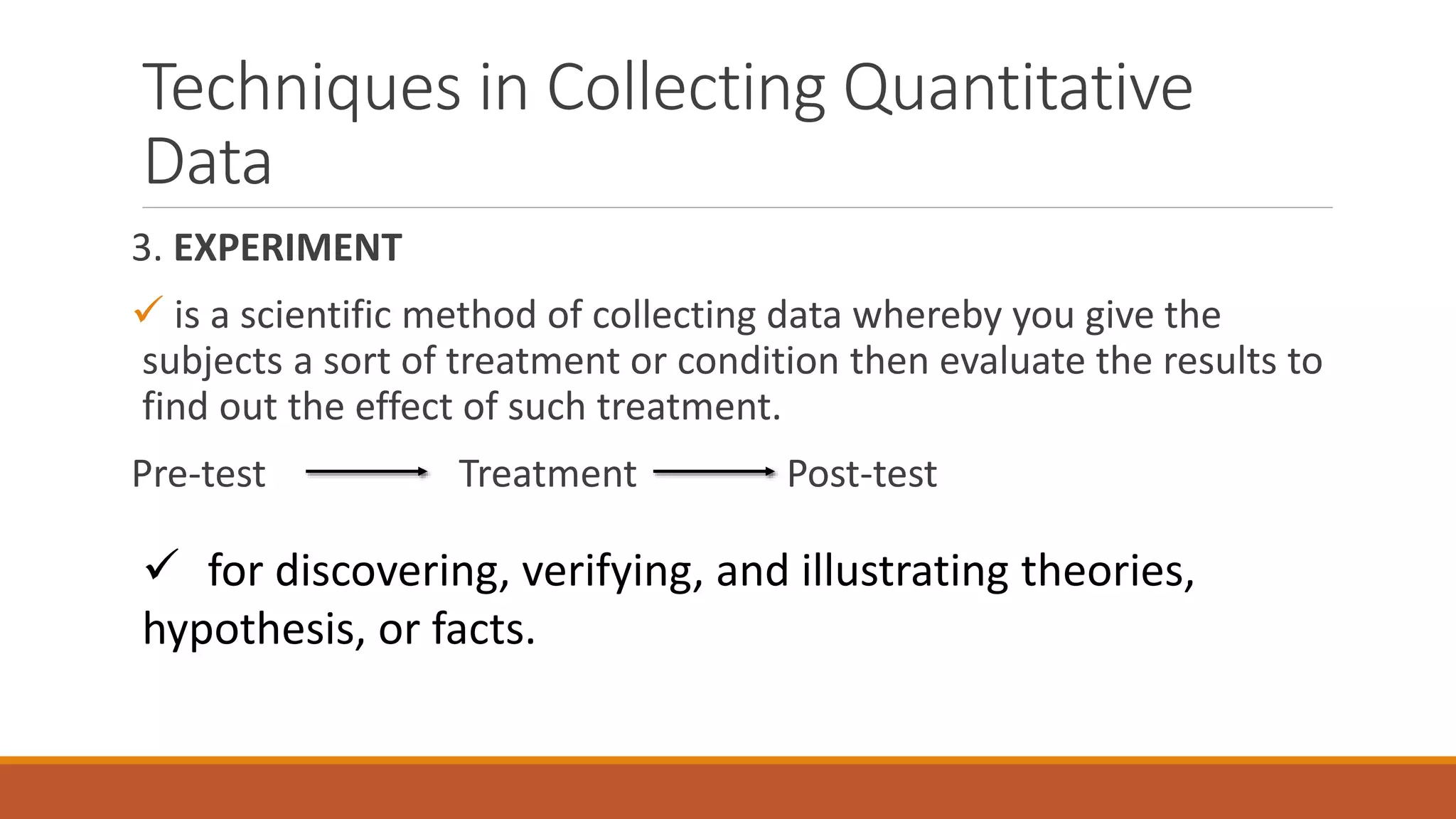
3. EXPERIMENT
 is a scientific method of collecting data whereby you give the
subjects a sort of treatment or condition then evaluate the results to
find out the effect of such treatment.
Pre-test Treatment Post-test
 for discovering, verifying, and illustrating theories,
hypothesis, or facts.
Techniques in Collecting Quantitative
Data
4. CONTENT ANALYSIS
 searching through several oral or written forms of
communication to find answers to your research questions.
examining printed materials
 the focus of the study is on a single subject or on two
entities to determine their comparative features.
MEASUREMENT SCALES
FOR QUANTITATIVE
DATA
NOMINAL SCALE
 categorizing or classifying things based on a
certain criterion like gender, religion, position,
origin, brand, etc.
ORDINAL SCALE
 used to indicate the rank or hierarchical
order of things.
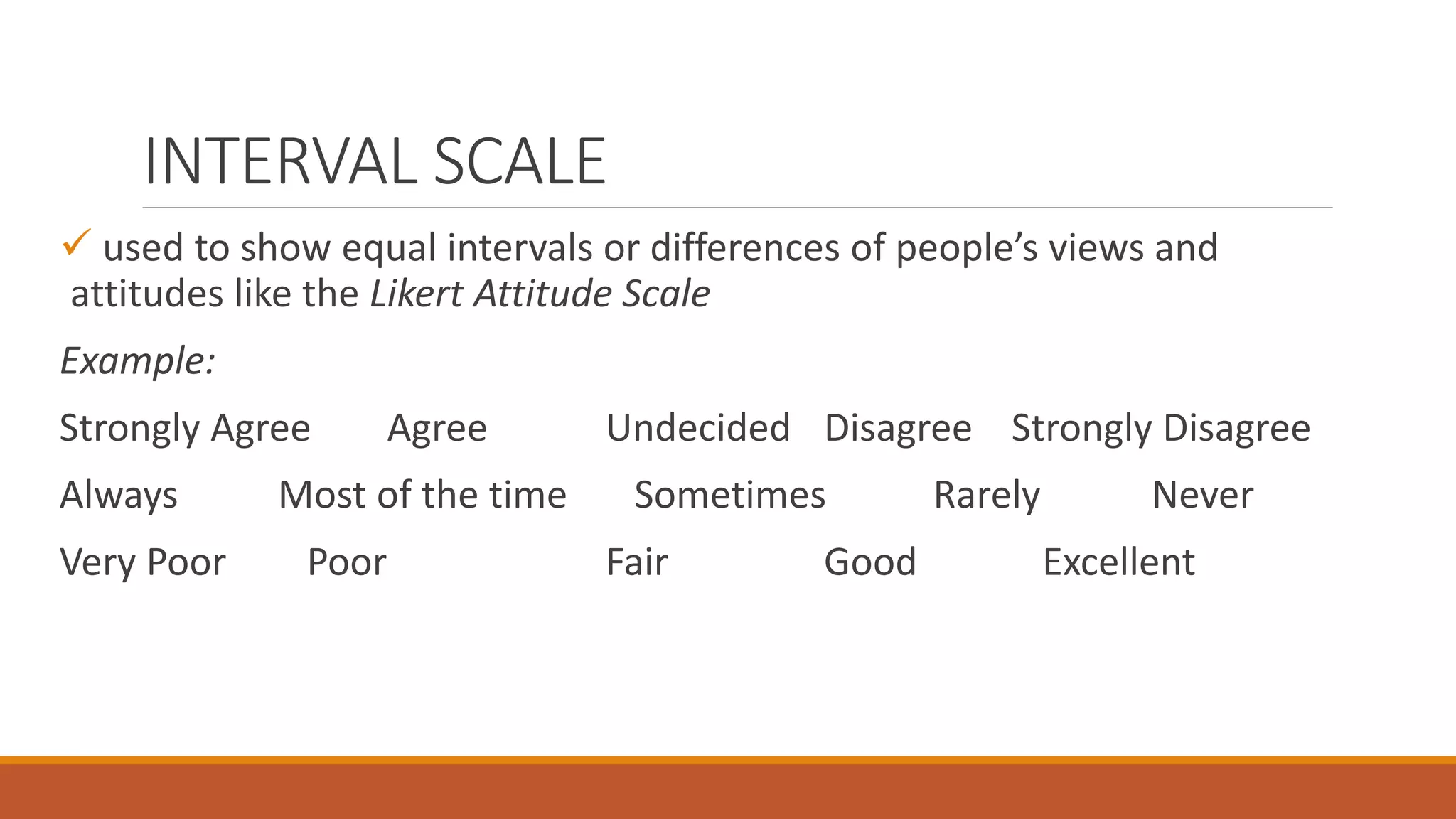
INTERVAL SCALE
 used to show equal intervals or differences of people’s views and
attitudes like the Likert Attitude Scale
Example:
Strongly Agree Agree Undecided Disagree Strongly Disagree
Always Most of the time Sometimes Rarely Never
Very Poor Poor Fair Good Excellent
RATIO SCALE
 rating something from zero to a certain point
 Example: Performance in Math Subject- a grade of
89% (from 0 to 100%)
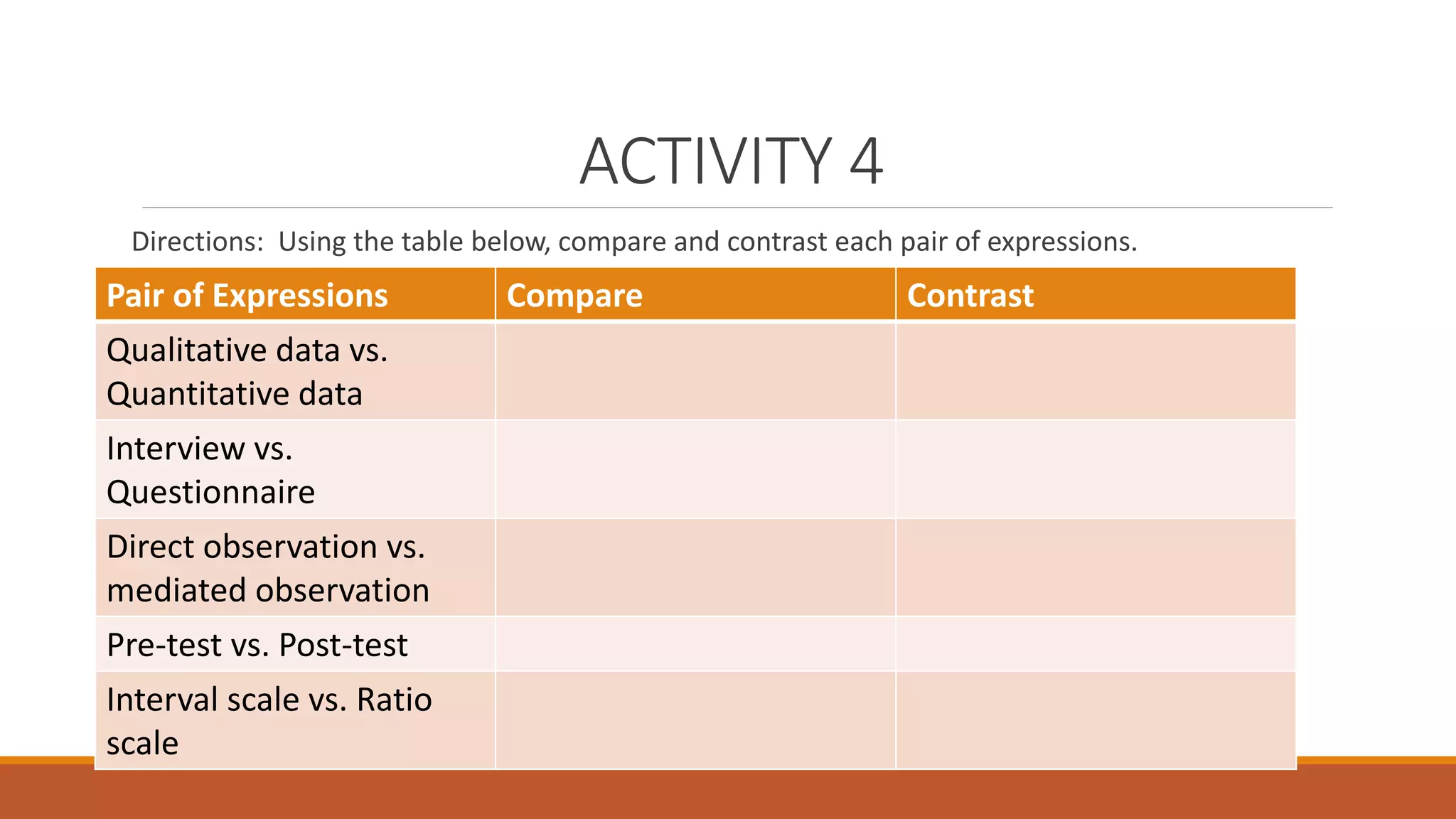
ACTIVITY 4
Directions: Using the table below, compare and contrast each pair of expressions.
Pair of Expressions Compare Contrast
Qualitative data vs.
Quantitative data
Interview vs.
Questionnaire
Direct observation vs.
mediated observation
Pre-test vs. Post-test
Interval scale vs. Ratio
scale

Collection of Quantitative Data

  • 1.
  • 2.
    Quantitative Data  Theseare data which are measurable, numerical, and related to a metrical system. Descriptive qualities: age, shape, speed, amount, height, weight, number, positions are measurable.
  • 3.
    Techniques in CollectingQuantitative Data 1. OBSERVATION  Sense organs is used to gather information about people, things, places, events and so on. Watching and listening to them then record them with the use of numbers. Example: Watching patients lining up at a medical clinic.
  • 4.
    2 kinds ofObservation 1. Direct observation- seeing, touching, and hearing the sources of data personally 2. Indirect observation- if you see and hear your subjects by means of technological and electronic gadgets
  • 5.
    Techniques in CollectingQuantitative Data 2. SURVEY  data-gathering technique that makes you obtain facts or information about the subject or object of your research through data-gathering instruments of interview and questionnaire.
  • 6.
    Survey is donethrough? 1. Questionnaire  is a paper containing series of questions formulated for an individual and will be independently answered by respondents.  a good instrument for collecting data from a big number of respondents situated in different places.  responses yielded by this instrument are given their numerical forms(numbers, fractions, percentages) and categories and are subjected to statistical analysis. susceptible to waste of money, time, and effort
  • 7.
    Survey is donethrough? 2. Interview  makes you ask a set of questions orally. Order of Interview Questions First set of questions-opening questions Second set of questions- generative questions Third set of questions- directive questions Fourth set of questions- ending questions
  • 8.
    Guidelines in FormulatingInterview Questions 1. Use clear and simple language. 2. Avoid using acronyms, abbreviations, jargons, and highfalutin terms. 3. let one question elicit only one answer. 4. Express your point in exact, specific, bias-free, and gender-free language. 5. Establish continuity or free-flow of ideas/ thoughts of the respondents by using appropriate follow-up questions. 6. Ask questions in a sequential manner.
  • 9.
    Techniques in CollectingQuantitative Data 3. EXPERIMENT  is a scientific method of collecting data whereby you give the subjects a sort of treatment or condition then evaluate the results to find out the effect of such treatment. Pre-test Treatment Post-test  for discovering, verifying, and illustrating theories, hypothesis, or facts.
  • 10.
    Techniques in CollectingQuantitative Data 4. CONTENT ANALYSIS  searching through several oral or written forms of communication to find answers to your research questions. examining printed materials  the focus of the study is on a single subject or on two entities to determine their comparative features.
  • 11.
  • 12.
    NOMINAL SCALE  categorizingor classifying things based on a certain criterion like gender, religion, position, origin, brand, etc.
  • 13.
    ORDINAL SCALE  usedto indicate the rank or hierarchical order of things.
  • 14.
    INTERVAL SCALE  usedto show equal intervals or differences of people’s views and attitudes like the Likert Attitude Scale Example: Strongly Agree Agree Undecided Disagree Strongly Disagree Always Most of the time Sometimes Rarely Never Very Poor Poor Fair Good Excellent
  • 15.
    RATIO SCALE  ratingsomething from zero to a certain point  Example: Performance in Math Subject- a grade of 89% (from 0 to 100%)
  • 16.
    ACTIVITY 4 Directions: Usingthe table below, compare and contrast each pair of expressions. Pair of Expressions Compare Contrast Qualitative data vs. Quantitative data Interview vs. Questionnaire Direct observation vs. mediated observation Pre-test vs. Post-test Interval scale vs. Ratio scale