
INTERPERSONAL SKILLS
• Interpersonal skills are of utmost importance
  when dealing at work place or outside.
• Companies today stress highly on
  interpersonal skills and positive personalities
  traits the existence of which ensures a
  groomed person.
• Ways to Improve Your Interpersonal Skills
• Call out greetings- In a corporate
  organization, it almost becomes mandatory by
  everyone’s behavior.
• You will be looked up on as attentive and
  cheerful.
• It shows how you respect and care about the
  people working around you.
• 2. Smile often- Smiling makes people think
  about you as approachable and hence you will
  be interacting more in your work place.
• A sullen face or an indifferent one will only
  make you look severe in your work
  environment.
• 3. Listen- When someone speaks to you –
  LISTEN.
• Listening to someone assures that you are
  attentive and have a great emotional quotient
  when comes to dealing with people.
• 4. Humor- Humor is a remedy to lighten
  things and makes getting along easier.
• Inject smart humor in your work and
  otherwise in your dealings with people around
  you at your work place or when at a social
  setting.
• It is also a way of attracting people.
• 5. Communicate- Communication is the
  soul of human relationships.
• Communicating in the right way will help you
  build a professional as well as personal
  network.
• Appreciate someone when they are looking
  nice, give your opinion when asked; oppose
  something which does not feel right.
• 6. Do not involve yourself in disputes- We
  suggest you watch from the side lines.
• It’s not always considered smart to interfere
  in someone’s conflict.
• Another important point on the list of
  interpersonal skills is to try and be assertive,
  diplomatic before you give rise to a dispute
  yourself.
• 7. Network- Network to the best of your
  ability with the people you come across.
• The reason why interpersonal skills are
  stressed on is to help a person build a network
  be it personal, professional or for some other
  purpose.
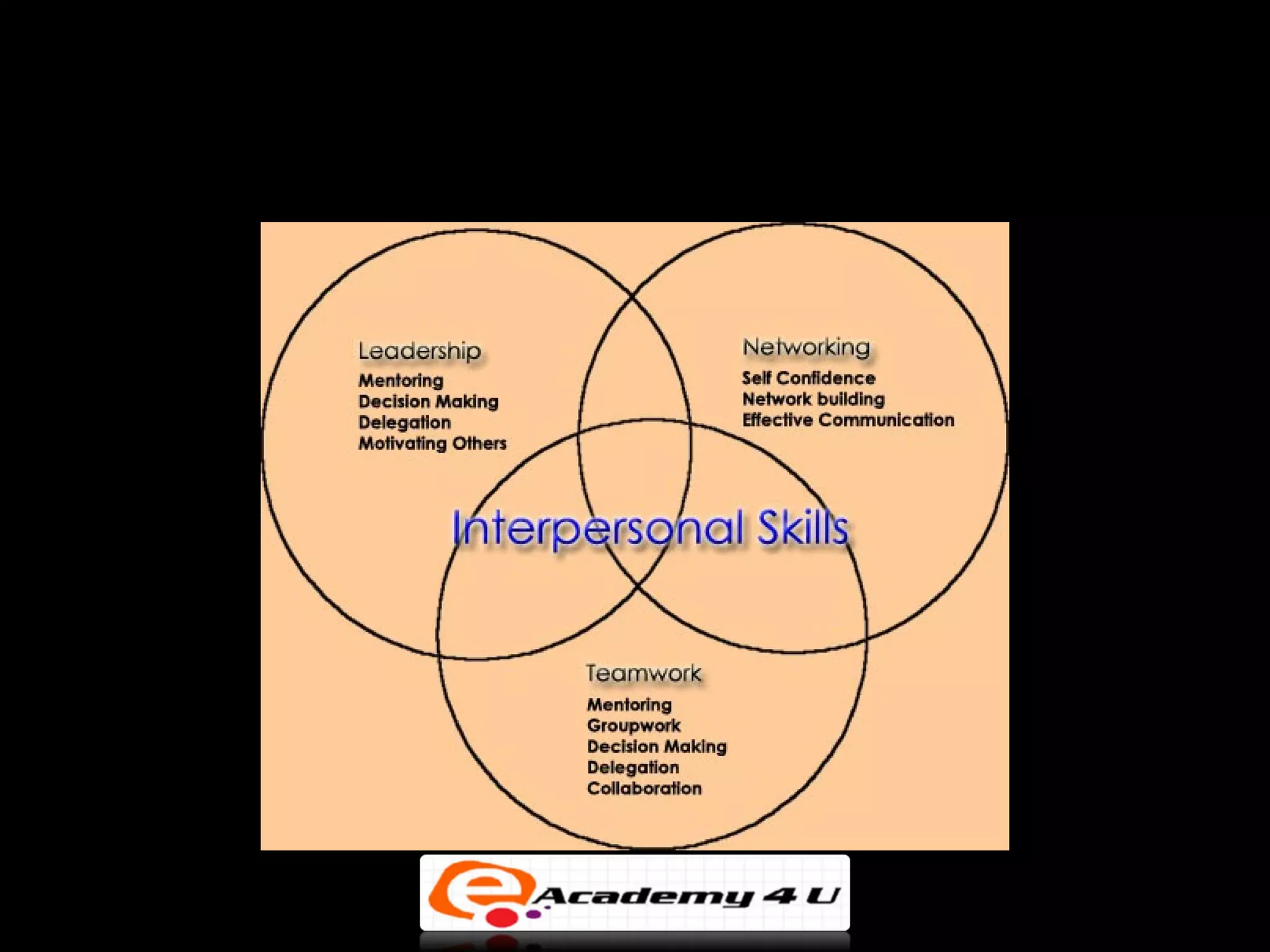
• 8. Leadership

 A leader has the ability to influence others
 through qualities such as personal charisma,
 expertise, command of language, and the
 creation of mutual respect.
• Teamwork

  Involves working with others in a group
  towards a common goal.
• This requires cooperating with others, being
  responsive to others' ideas, taking a
  collaborative approach to learning, and taking
  a responsibility for developing and achieving
  group goals.
• Mentoring is:
• A mentoring relationship may be formal or
  informal, but must involve trust, mutual
  respect, and commitment as both parties
  work together to achieve a goal.
• Group work is:
• any activity which has been specifically
  designed so that students work in pairs or
  groups, and may be assessed as a group
  (referred to as formal group work); or
• Motivating others is:
• Generating enthusiasm and energy by being
  positive, focusing on finding solutions and
  maintaining a positive attitude even when
  things are not going well (for example, when
  something goes wrong, asking "What can we
  try now?" instead of saying, "That should have
  worked better.").
THANK YOU

Interpersonal skills

  • 1.
  • 2.
    INTERPERSONAL SKILLS • Interpersonalskills are of utmost importance when dealing at work place or outside. • Companies today stress highly on interpersonal skills and positive personalities traits the existence of which ensures a groomed person.
  • 3.
    • Ways toImprove Your Interpersonal Skills
  • 5.
    • Call outgreetings- In a corporate organization, it almost becomes mandatory by everyone’s behavior. • You will be looked up on as attentive and cheerful. • It shows how you respect and care about the people working around you.
  • 6.
    • 2. Smileoften- Smiling makes people think about you as approachable and hence you will be interacting more in your work place. • A sullen face or an indifferent one will only make you look severe in your work environment.
  • 7.
    • 3. Listen-When someone speaks to you – LISTEN. • Listening to someone assures that you are attentive and have a great emotional quotient when comes to dealing with people.
  • 8.
    • 4. Humor-Humor is a remedy to lighten things and makes getting along easier. • Inject smart humor in your work and otherwise in your dealings with people around you at your work place or when at a social setting. • It is also a way of attracting people.
  • 9.
    • 5. Communicate-Communication is the soul of human relationships. • Communicating in the right way will help you build a professional as well as personal network. • Appreciate someone when they are looking nice, give your opinion when asked; oppose something which does not feel right.
  • 10.
    • 6. Donot involve yourself in disputes- We suggest you watch from the side lines. • It’s not always considered smart to interfere in someone’s conflict. • Another important point on the list of interpersonal skills is to try and be assertive, diplomatic before you give rise to a dispute yourself.
  • 11.
    • 7. Network-Network to the best of your ability with the people you come across. • The reason why interpersonal skills are stressed on is to help a person build a network be it personal, professional or for some other purpose.
  • 12.
    • 8. Leadership A leader has the ability to influence others through qualities such as personal charisma, expertise, command of language, and the creation of mutual respect.
  • 13.
    • Teamwork Involves working with others in a group towards a common goal. • This requires cooperating with others, being responsive to others' ideas, taking a collaborative approach to learning, and taking a responsibility for developing and achieving group goals.
  • 14.
    • Mentoring is: •A mentoring relationship may be formal or informal, but must involve trust, mutual respect, and commitment as both parties work together to achieve a goal.
  • 15.
    • Group workis: • any activity which has been specifically designed so that students work in pairs or groups, and may be assessed as a group (referred to as formal group work); or
  • 16.
    • Motivating othersis: • Generating enthusiasm and energy by being positive, focusing on finding solutions and maintaining a positive attitude even when things are not going well (for example, when something goes wrong, asking "What can we try now?" instead of saying, "That should have worked better.").
  • 17.