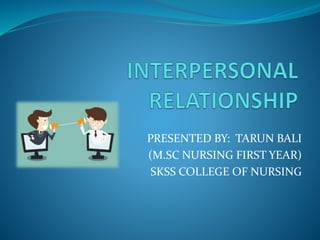
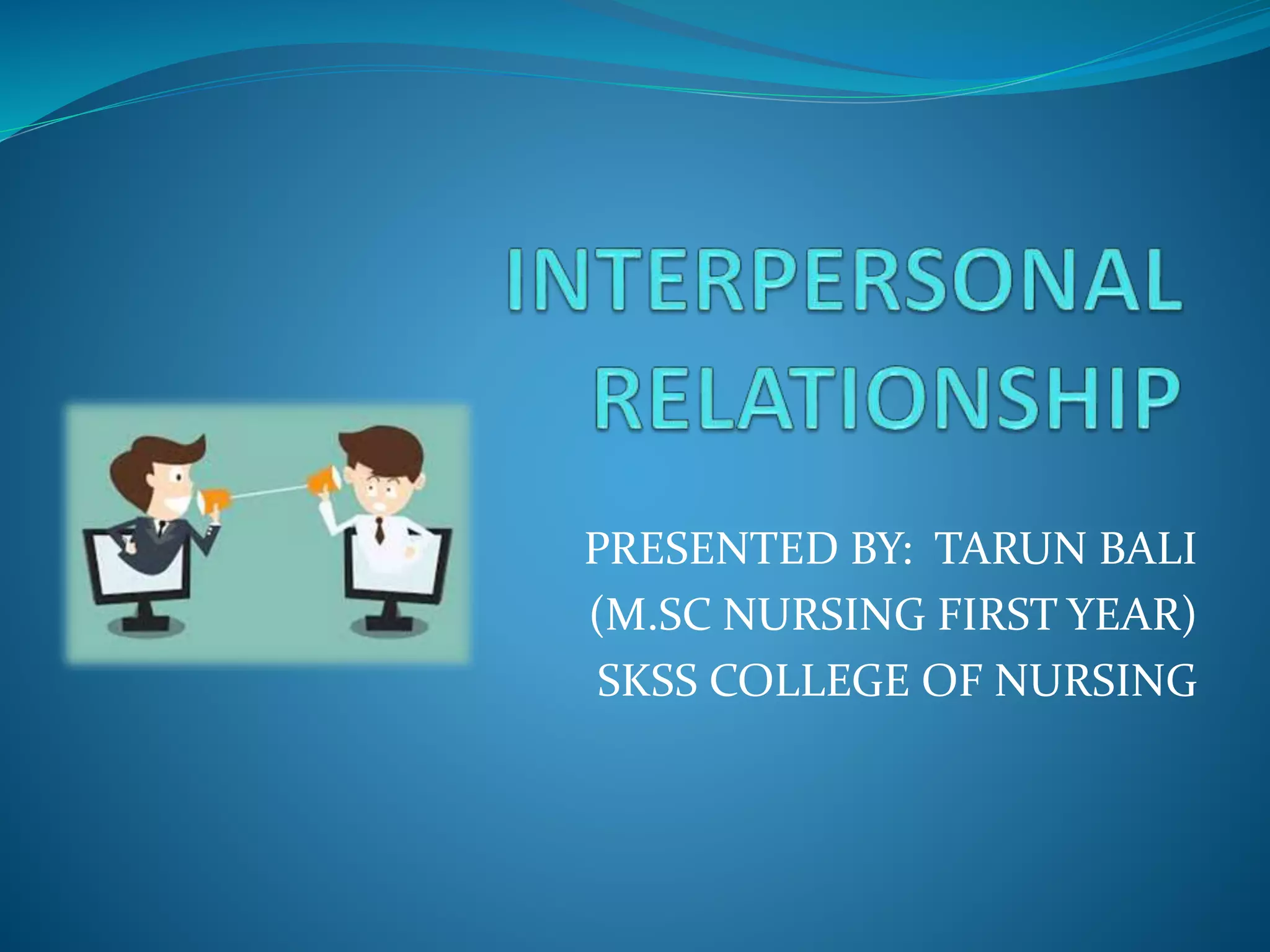
PRESENTED BY: TARUN BALI
(M.SC NURSING FIRST YEAR)
SKSS COLLEGE OF NURSING
DEFINITION
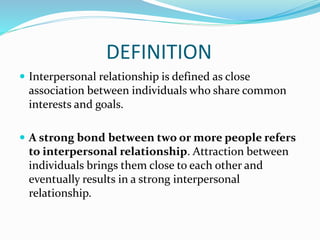
 Interpersonal relationship is defined as close
association between individuals who share common
interests and goals.
 A strong bond between two or more people refers
to interpersonal relationship. Attraction between
individuals brings them close to each other and
eventually results in a strong interpersonal
relationship.
STAGES IN IPR
 A sense of trust, loyalty and commitment is essential
in a relationship. Individuals need to trust and respect
their partners to avoid misunderstandings and
conflicts in relationship.
 It takes time for a relationship to grow and pass the
test of time.
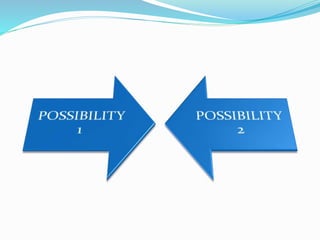
 There are two possibilities in a relationship:
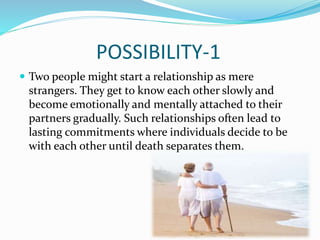
POSSIBILITY-1
 Two people might start a relationship as mere
strangers. They get to know each other slowly and
become emotionally and mentally attached to their
partners gradually. Such relationships often lead to
lasting commitments where individuals decide to be
with each other until death separates them.
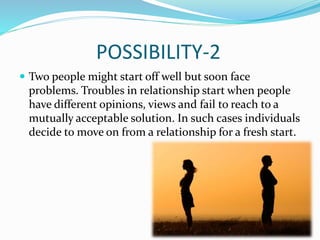
POSSIBILITY-2
 Two people might start off well but soon face
problems. Troubles in relationship start when people
have different opinions, views and fail to reach to a
mutually acceptable solution. In such cases individuals
decide to move on from a relationship for a fresh start.
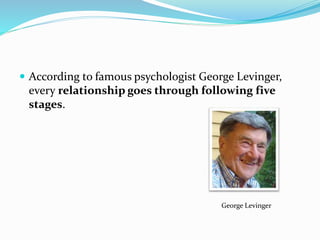
 According to famous psychologist George Levinger,
every relationship goes through following five
stages.
George Levinger
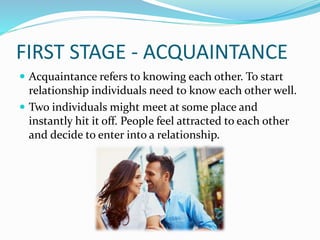
FIRST STAGE - ACQUAINTANCE
 Acquaintance refers to knowing each other. To start
relationship individuals need to know each other well.
 Two individuals might meet at some place and
instantly hit it off. People feel attracted to each other
and decide to enter into a relationship.
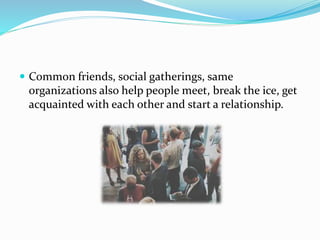
 Common friends, social gatherings, same
organizations also help people meet, break the ice, get
acquainted with each other and start a relationship.
SECOND STAGE
THE BUILD UP STAGE
 This is the stage when the relationship actually grows.
Individuals are no longer strangers and start trusting
each other.
 Individuals must be compatible with each other for the
relationship to continue for a longer period of time.
Individuals with similar interests and backgrounds
tend to gel with each other more as compared to
individuals from diverse backgrounds and different
objectives.
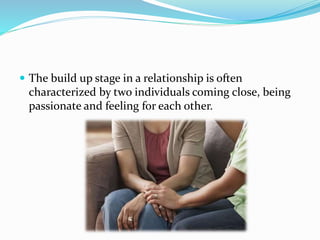
 The build up stage in a relationship is often
characterized by two individuals coming close, being
passionate and feeling for each other.
THIRD STAGE
CONTINUATION STAGE
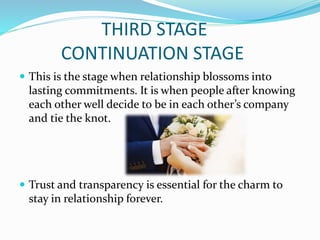
 This is the stage when relationship blossoms into
lasting commitments. It is when people after knowing
each other well decide to be in each other’s company
and tie the knot.
 Trust and transparency is essential for the charm to
stay in relationship forever.
FOURTH STAGE
DETERIORATION
 Not all relationships pass through this stage. Lack of
compatibility, trust, love and care often lead to
misunderstandings and serious troubles in
relationship.
 Individuals sometimes find it extremely difficult to
adjust with each other and eventually decide to bring
their relationship to an end.
 Compromise is an integral part of every relationship.
Individuals failing to compromise with each other find
it difficult to take the relationship to the next level.
FIFTH STAGE
TERMINATION
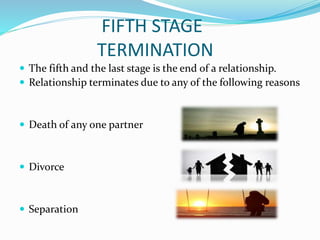
 The fifth and the last stage is the end of a relationship.
 Relationship terminates due to any of the following reasons
 Death of any one partner
 Divorce
 Separation
PURPOSE OF INTERPERSONAL
RELATIONSHIP
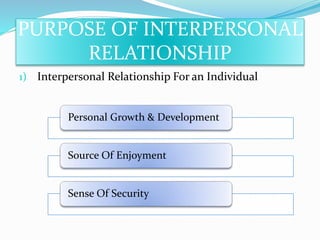
1) Interpersonal Relationship For an Individual
Personal Growth & Development
Source Of Enjoyment
Sense Of Security
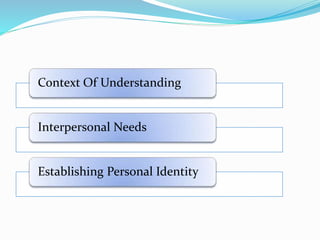
Context Of Understanding
Interpersonal Needs
Establishing Personal Identity
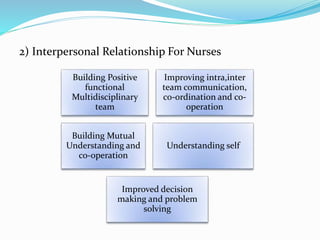
2) Interpersonal Relationship For Nurses
Building Positive
functional
Multidisciplinary
team
Improving intra,inter
team communication,
co-ordination and co-
operation
Building Mutual
Understanding and
co-operation
Understanding self
Improved decision
making and problem
solving
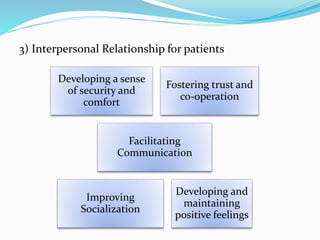
3) Interpersonal Relationship for patients
Developing a sense
of security and
comfort
Fostering trust and
co-operation
Facilitating
Communication
Improving
Socialization
Developing and
maintaining
positive feelings
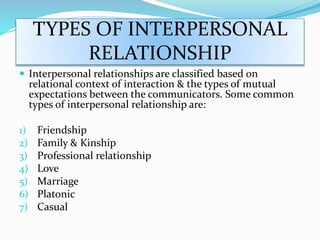
TYPES OF INTERPERSONAL
RELATIONSHIP
 Interpersonal relationships are classified based on
relational context of interaction & the types of mutual
expectations between the communicators. Some common
types of interpersonal relationship are:
1) Friendship
2) Family & Kinship
3) Professional relationship
4) Love
5) Marriage
6) Platonic
7) Casual
1) FRIENDSHIP
 Friendship is an unconditional interpersonal
relationship where individuals enter into by their own
sweet will and choice.
 Friendship is a relationship where there are no
formalities and individuals enjoy each other’s
presence.
2) FAMILY & KINSHIP
 Family communication pattern establish roles &
identify & enable & social growth of individuals.
 Family relationship get distorted if there is any
unresolved conflict between members.
 Most of the time, a significant family member senses
other family members have significant emotional
difficulties but fails to bring them out unless the
physician or nurse enquires.
3) PROFESSIONAL RELATIONSHIP
 Individuals working together for the same
organization are said to share a professional
relationship.
 Individuals sharing a professional relationship are
called colleagues. Colleagues may or may not like each
other.
4) LOVE
 An interpersonal relationship characterized by
passion, intimacy, trust and respect is called love.
 Individuals in a romantic relationship are deeply
attached to each other and share a special bond.
5) MARRIAGE
 Marriage is a formalize intimate relationship or a long
term relationship where two individuals decide to
enter into wed lock and stay together life-long after
knowing each other well.
6) PLATONIC RELATIONSHIP
 A relationship between two individuals without any
feelings or sexual desire for each other is called a
platonic relationship.
 In such a relationship, a man and a woman are just
friends and do not mix love with friendship.
 Platonic relationships might end in romantic
relationship with both the partners developing mutual
love and falling for each other.
7) CASUAL RELATIONSHIP
 In this type of relationship individual usually develops
a relationship that excessively lacks mutual love and
consist of sexual behavior only that does not extend
beyond one night.
 These individuals maybe known as sexual partners
who only consider sexual intercourse in their
relationship.
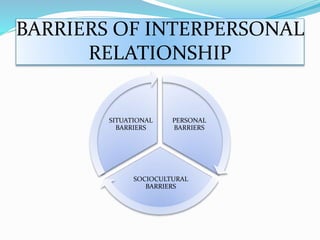
BARRIERS OF INTERPERSONAL
RELATIONSHIP
PERSONAL
BARRIERS
SOCIOCULTURAL
BARRIERS
SITUATIONAL
BARRIERS
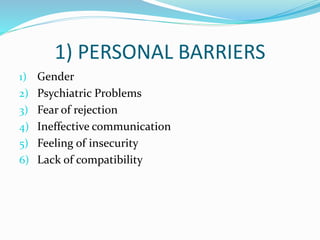
1) PERSONAL BARRIERS
1) Gender
2) Psychiatric Problems
3) Fear of rejection
4) Ineffective communication
5) Feeling of insecurity
6) Lack of compatibility
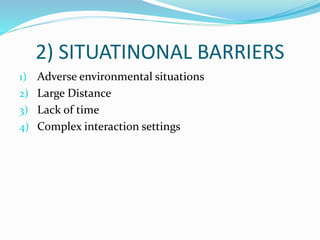
2) SITUATINONAL BARRIERS
1) Adverse environmental situations
2) Large Distance
3) Lack of time
4) Complex interaction settings
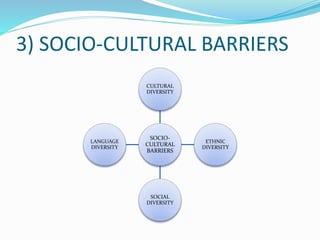
3) SOCIO-CULTURAL BARRIERS
SOCIO-
CULTURAL
BARRIERS
CULTURAL
DIVERSITY
ETHNIC
DIVERSITY
SOCIAL
DIVERSITY
LANGUAGE
DIVERSITY
TECHNIQUES TO IMPROVE
INTERPERSONAL RELATIONSHIP
1) Appreciate People.
2) Don’t criticize, condemn or complain about people.
3) Give smile as it makes other feel warm from inside.
4) Be genuinely interested in others.
5) Avoid Arguing.
6) Be a good listener.
7) Try to understand others view as you are not always
right.
8) Approach the person calmly.
9) Admit the mistake if committed.
RECAPTUALIZATION
 DEFINITION OF IPR
 STAGES OF IPR
 PURPOSE OF IPR
 TYPES OF IPR
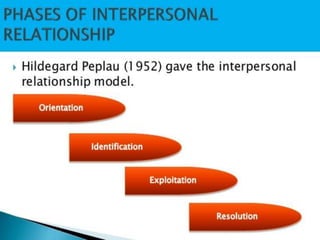
 PHASES OF IPR
 BARRIERS OF IPR
 TECHNIQUES TO IMPROVE IPR
Interpersonal relationship For B.sc & M.sc Students

Interpersonal relationship For B.sc & M.sc Students

  • 1.
    PRESENTED BY: TARUNBALI (M.SC NURSING FIRST YEAR) SKSS COLLEGE OF NURSING
  • 2.
    DEFINITION  Interpersonal relationshipis defined as close association between individuals who share common interests and goals.  A strong bond between two or more people refers to interpersonal relationship. Attraction between individuals brings them close to each other and eventually results in a strong interpersonal relationship.
  • 3.
    STAGES IN IPR A sense of trust, loyalty and commitment is essential in a relationship. Individuals need to trust and respect their partners to avoid misunderstandings and conflicts in relationship.  It takes time for a relationship to grow and pass the test of time.  There are two possibilities in a relationship:
  • 5.
    POSSIBILITY-1  Two peoplemight start a relationship as mere strangers. They get to know each other slowly and become emotionally and mentally attached to their partners gradually. Such relationships often lead to lasting commitments where individuals decide to be with each other until death separates them.
  • 6.
    POSSIBILITY-2  Two peoplemight start off well but soon face problems. Troubles in relationship start when people have different opinions, views and fail to reach to a mutually acceptable solution. In such cases individuals decide to move on from a relationship for a fresh start.
  • 7.
     According tofamous psychologist George Levinger, every relationship goes through following five stages. George Levinger
  • 8.
    FIRST STAGE -ACQUAINTANCE  Acquaintance refers to knowing each other. To start relationship individuals need to know each other well.  Two individuals might meet at some place and instantly hit it off. People feel attracted to each other and decide to enter into a relationship.
  • 9.
     Common friends,social gatherings, same organizations also help people meet, break the ice, get acquainted with each other and start a relationship.
  • 10.
    SECOND STAGE THE BUILDUP STAGE  This is the stage when the relationship actually grows. Individuals are no longer strangers and start trusting each other.  Individuals must be compatible with each other for the relationship to continue for a longer period of time. Individuals with similar interests and backgrounds tend to gel with each other more as compared to individuals from diverse backgrounds and different objectives.
  • 11.
     The buildup stage in a relationship is often characterized by two individuals coming close, being passionate and feeling for each other.
  • 12.
    THIRD STAGE CONTINUATION STAGE This is the stage when relationship blossoms into lasting commitments. It is when people after knowing each other well decide to be in each other’s company and tie the knot.  Trust and transparency is essential for the charm to stay in relationship forever.
  • 13.
    FOURTH STAGE DETERIORATION  Notall relationships pass through this stage. Lack of compatibility, trust, love and care often lead to misunderstandings and serious troubles in relationship.  Individuals sometimes find it extremely difficult to adjust with each other and eventually decide to bring their relationship to an end.  Compromise is an integral part of every relationship. Individuals failing to compromise with each other find it difficult to take the relationship to the next level.
  • 14.
    FIFTH STAGE TERMINATION  Thefifth and the last stage is the end of a relationship.  Relationship terminates due to any of the following reasons  Death of any one partner  Divorce  Separation
  • 15.
    PURPOSE OF INTERPERSONAL RELATIONSHIP 1)Interpersonal Relationship For an Individual Personal Growth & Development Source Of Enjoyment Sense Of Security
  • 16.
    Context Of Understanding InterpersonalNeeds Establishing Personal Identity
  • 17.
    2) Interpersonal RelationshipFor Nurses Building Positive functional Multidisciplinary team Improving intra,inter team communication, co-ordination and co- operation Building Mutual Understanding and co-operation Understanding self Improved decision making and problem solving
  • 18.
    3) Interpersonal Relationshipfor patients Developing a sense of security and comfort Fostering trust and co-operation Facilitating Communication Improving Socialization Developing and maintaining positive feelings
  • 19.
    TYPES OF INTERPERSONAL RELATIONSHIP Interpersonal relationships are classified based on relational context of interaction & the types of mutual expectations between the communicators. Some common types of interpersonal relationship are: 1) Friendship 2) Family & Kinship 3) Professional relationship 4) Love 5) Marriage 6) Platonic 7) Casual
  • 20.
    1) FRIENDSHIP  Friendshipis an unconditional interpersonal relationship where individuals enter into by their own sweet will and choice.  Friendship is a relationship where there are no formalities and individuals enjoy each other’s presence.
  • 21.
    2) FAMILY &KINSHIP  Family communication pattern establish roles & identify & enable & social growth of individuals.  Family relationship get distorted if there is any unresolved conflict between members.  Most of the time, a significant family member senses other family members have significant emotional difficulties but fails to bring them out unless the physician or nurse enquires.
  • 22.
    3) PROFESSIONAL RELATIONSHIP Individuals working together for the same organization are said to share a professional relationship.  Individuals sharing a professional relationship are called colleagues. Colleagues may or may not like each other.
  • 23.
    4) LOVE  Aninterpersonal relationship characterized by passion, intimacy, trust and respect is called love.  Individuals in a romantic relationship are deeply attached to each other and share a special bond.
  • 24.
    5) MARRIAGE  Marriageis a formalize intimate relationship or a long term relationship where two individuals decide to enter into wed lock and stay together life-long after knowing each other well.
  • 25.
    6) PLATONIC RELATIONSHIP A relationship between two individuals without any feelings or sexual desire for each other is called a platonic relationship.  In such a relationship, a man and a woman are just friends and do not mix love with friendship.  Platonic relationships might end in romantic relationship with both the partners developing mutual love and falling for each other.
  • 26.
    7) CASUAL RELATIONSHIP In this type of relationship individual usually develops a relationship that excessively lacks mutual love and consist of sexual behavior only that does not extend beyond one night.  These individuals maybe known as sexual partners who only consider sexual intercourse in their relationship.
  • 33.
  • 34.
    1) PERSONAL BARRIERS 1)Gender 2) Psychiatric Problems 3) Fear of rejection 4) Ineffective communication 5) Feeling of insecurity 6) Lack of compatibility
  • 35.
    2) SITUATINONAL BARRIERS 1)Adverse environmental situations 2) Large Distance 3) Lack of time 4) Complex interaction settings
  • 36.
  • 37.
    TECHNIQUES TO IMPROVE INTERPERSONALRELATIONSHIP 1) Appreciate People. 2) Don’t criticize, condemn or complain about people. 3) Give smile as it makes other feel warm from inside. 4) Be genuinely interested in others. 5) Avoid Arguing. 6) Be a good listener. 7) Try to understand others view as you are not always right. 8) Approach the person calmly. 9) Admit the mistake if committed.
  • 38.
    RECAPTUALIZATION  DEFINITION OFIPR  STAGES OF IPR  PURPOSE OF IPR  TYPES OF IPR  PHASES OF IPR  BARRIERS OF IPR  TECHNIQUES TO IMPROVE IPR