INTERPERSONAL RELATIONSHIPS
BY
ULFAT AMIN
MSC PEADIATRIC NURSING
INTRODUCTION
• One of the most distinctive aspects of human beings is that we are social
beings.
• Interpersonal relationships are & have been the core of our social system since
the dawn of civilization.
• Nursing is a therapeutic process & demands an association between the nurse
& the patient.
• The nurse is an important member of the health care team that must work in
cooperation and harmony for the care of the patient.
• This harmony depends upon the interpersonal relationship that is maintained
among the members of the health care team and between the nurse and the
patient.
DEFINITIONS
• Interpersonal relationships refer to reciprocal
social & emotional interactions between two or
more individuals in an environment.
• It is a close association between individuals who
share common interests & goals.
• It is the learning experience whereby two people
interact to face an immediate health problem, to
share, if possible, in resolving it and to discover
ways to adapt to the situation.
PRINCIPLES OF IPR
•Learn everyone’s name and address them properly.
•Respect everyone’s individuality.
•Do not impose anything on anyone.
•Keep emotions under control.
•Develop habits of listening and focus attention on the
problem.
•Do not do or say anything that disturbs other’s faith.
•There should be mutual understanding between the
members.
•Establish a good rapport among the members in order to
achieve the aim.
•Be up to the date with the information that is going
around.
•Talk in terms of other’s interest.
•Praise the slightest improvement made by others. Use
words of encouragement.
•Prepare yourself mentally to accept the worst if
necessary.
•Have a smiling face always.
•Avoid arguments in the group.
•Teach the new comer about the job.
PHASES OF IPR
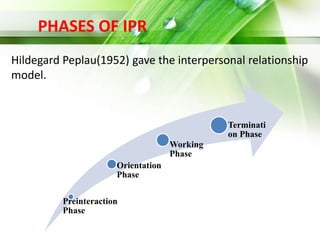
Hildegard Peplau(1952) gave the interpersonal relationship
model.
Preinteraction
Phase
Orientation
Phase
Working
Phase
Terminati
on Phase
PEPLAU(1952) GAVE THE IPR MODEL.
PREINTERACTION/PREORIENTATION PHASE
In this phase the nurse;
 Gathers information about the client , his
condition and situation. Data is gathered from
medical records and other caregivers before
meeting the patient.
 Chooses the location and setting for the first
meeting.
INTRODUCTORY/ORIENTATION PHASE:
• The phase begins when the nurse and the
patient first meet.
• The purpose of this phase is to become
acquainted with the client, gain rapport,
demonstrate understanding and establish trust.
• This phase usually lasts 2 to 10 sessions.
• The nurse clarifies his or her roles &
responsibilities within the therapeutic boundary
to the patient.
• The Nurse identifies the patient’s problem &
settles on the type of nursing services needed.
CONTINUE…
• After developing a trustworthy relationship, the
patients start clarifying doubts, share perceptions
& convey their needs & expectation to the nurse.
• There are several factors that may affect this
phase in a nurse-patient relationship.
WORKING PHASE
• This phase begins when the client assumes
responsibility to uphold the limits of the relationship.
• Adjustments may have to be made, depending on the
client’s length of stay.
• The purpose of this phase is to bring about positive
changes in the client’s behavior.
• The nurse also takes actions to meet goals set with the
client.
TERMINATION PHASE
• Ideally, this phase begins during the orientation
phase.
• The purpose of this phase is to dissolve the
relationship and assure that the client can be
independent in some or all of his/her functioning.
• Termination normally occurs when the client has
improved sufficiently for the relationship to end,
but it may also occur if a client is transferred or a
nurse leaves the facility.
CHARACTERISTICS OF IPR
• Ideally, this phase begins during the orientation
phase.
• The purpose of this phase is to dissolve the
relationship and assure that the client can be
independent in some or all of his/her functioning.
• Termination normally occurs when the client has
improved sufficiently for the relationship to end,
but it may also occur if a client is transferred or a
nurse leaves the facility.
FACILITATIVE CHARACTERISTICS
They are the essentials message for the nurse to
establish positive and supportive relationship with
the client.
Trust
Empathy
Autonomy and mutuality
Non possessive warmth
ACTION ORIENTATION
These are conditions that assist a person to move
towards his goals. Action oriented characteristic
are used on the nurse patient relationship to
progress beyond the initiation
 Concreteness in communication
 In immediacy
 Sensitive confrontation
 Are mainly involved in this characteristic
BARRIERS TO IPR
PERSONAL BARRIERS
SITUATIONAL BARRIERS
• Complex interaction setting
• Adverse environmental situations
• Lack of territoriality
• High density of individual
• Large distance
• Lack of tome
SOCIO CULTURAL BARRIERS
• Cultural diversity
• Ethnic diversity
• Language diversity
• Social diversity
THANK YOU

Intarpersonal relationship

  • 1.
  • 2.
    INTRODUCTION • One ofthe most distinctive aspects of human beings is that we are social beings. • Interpersonal relationships are & have been the core of our social system since the dawn of civilization. • Nursing is a therapeutic process & demands an association between the nurse & the patient. • The nurse is an important member of the health care team that must work in cooperation and harmony for the care of the patient. • This harmony depends upon the interpersonal relationship that is maintained among the members of the health care team and between the nurse and the patient.
  • 3.
    DEFINITIONS • Interpersonal relationshipsrefer to reciprocal social & emotional interactions between two or more individuals in an environment. • It is a close association between individuals who share common interests & goals. • It is the learning experience whereby two people interact to face an immediate health problem, to share, if possible, in resolving it and to discover ways to adapt to the situation.
  • 4.
    PRINCIPLES OF IPR •Learneveryone’s name and address them properly. •Respect everyone’s individuality. •Do not impose anything on anyone. •Keep emotions under control. •Develop habits of listening and focus attention on the problem. •Do not do or say anything that disturbs other’s faith. •There should be mutual understanding between the members.
  • 5.
    •Establish a goodrapport among the members in order to achieve the aim. •Be up to the date with the information that is going around. •Talk in terms of other’s interest. •Praise the slightest improvement made by others. Use words of encouragement. •Prepare yourself mentally to accept the worst if necessary. •Have a smiling face always. •Avoid arguments in the group. •Teach the new comer about the job.
  • 6.
    PHASES OF IPR HildegardPeplau(1952) gave the interpersonal relationship model. Preinteraction Phase Orientation Phase Working Phase Terminati on Phase
  • 7.
  • 8.
    PREINTERACTION/PREORIENTATION PHASE In thisphase the nurse;  Gathers information about the client , his condition and situation. Data is gathered from medical records and other caregivers before meeting the patient.  Chooses the location and setting for the first meeting.
  • 9.
    INTRODUCTORY/ORIENTATION PHASE: • Thephase begins when the nurse and the patient first meet. • The purpose of this phase is to become acquainted with the client, gain rapport, demonstrate understanding and establish trust. • This phase usually lasts 2 to 10 sessions. • The nurse clarifies his or her roles & responsibilities within the therapeutic boundary to the patient. • The Nurse identifies the patient’s problem & settles on the type of nursing services needed.
  • 10.
    CONTINUE… • After developinga trustworthy relationship, the patients start clarifying doubts, share perceptions & convey their needs & expectation to the nurse. • There are several factors that may affect this phase in a nurse-patient relationship.
  • 11.
    WORKING PHASE • Thisphase begins when the client assumes responsibility to uphold the limits of the relationship. • Adjustments may have to be made, depending on the client’s length of stay. • The purpose of this phase is to bring about positive changes in the client’s behavior. • The nurse also takes actions to meet goals set with the client.
  • 12.
    TERMINATION PHASE • Ideally,this phase begins during the orientation phase. • The purpose of this phase is to dissolve the relationship and assure that the client can be independent in some or all of his/her functioning. • Termination normally occurs when the client has improved sufficiently for the relationship to end, but it may also occur if a client is transferred or a nurse leaves the facility.
  • 13.
    CHARACTERISTICS OF IPR •Ideally, this phase begins during the orientation phase. • The purpose of this phase is to dissolve the relationship and assure that the client can be independent in some or all of his/her functioning. • Termination normally occurs when the client has improved sufficiently for the relationship to end, but it may also occur if a client is transferred or a nurse leaves the facility.
  • 14.
    FACILITATIVE CHARACTERISTICS They arethe essentials message for the nurse to establish positive and supportive relationship with the client. Trust Empathy Autonomy and mutuality Non possessive warmth
  • 15.
    ACTION ORIENTATION These areconditions that assist a person to move towards his goals. Action oriented characteristic are used on the nurse patient relationship to progress beyond the initiation  Concreteness in communication  In immediacy  Sensitive confrontation  Are mainly involved in this characteristic
  • 16.
  • 17.
  • 18.
    SITUATIONAL BARRIERS • Complexinteraction setting • Adverse environmental situations • Lack of territoriality • High density of individual • Large distance • Lack of tome
  • 19.
    SOCIO CULTURAL BARRIERS •Cultural diversity • Ethnic diversity • Language diversity • Social diversity
  • 20.