









THERAPEUTIC COMMUNICATION AND
INTERPERSONAL RELATIONSHIP
PRESENTED BY:-
NEHA SHARMA
COMMUNICATION
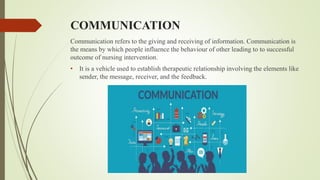
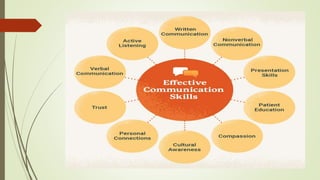
Communication refers to the giving and receiving of information. Communication is
the means by which people influence the behaviour of other leading to to successful
outcome of nursing intervention.
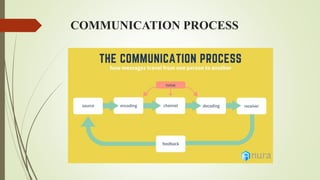
• It is a vehicle used to establish therapeutic relationship involving the elements like
sender, the message, receiver, and the feedback.
COMMUNICATION PROCESS
TYPES OF
COMMUNICATION
FACTORS AFFECTING COMMUNICATION
• Status/Role
• Cultural Differences
• Use Of Language
• Atmosphere/Noise
• Clarity of Message
• Length of Communication
• Individual Perceptions
• Disabilities
• Lack of Feedback
THERAPEUTIC COMMUNICATION
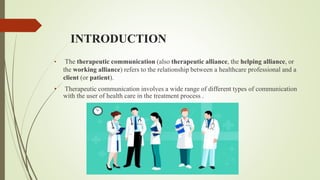
INTRODUCTION
• The therapeutic communication (also therapeutic alliance, the helping alliance, or
the working alliance) refers to the relationship between a healthcare professional and a
client (or patient).
• Therapeutic communication involves a wide range of different types of communication
with the user of health care in the treatment process .
DEFINITION
 “Promotes mutual understanding, establishes a constructive relationship between
the nurse and the client”.
(Kozier, 2004)
 “It is the process, in which the nurse utilizes a planned approach to learn about the
client”.
(Potter A, 1997)
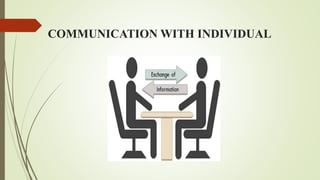
COMMUNICATION WITH INDIVIDUAL
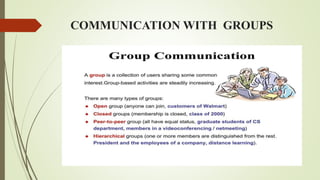
COMMUNICATION WITH GROUPS
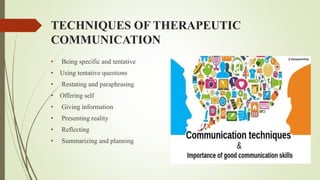
TECHNIQUES OF THERAPEUTIC
COMMUNICATION
• Being specific and tentative
• Using tentative questions
• Restating and paraphrasing
• Offering self
• Giving information
• Presenting reality
• Reflecting
• Summarizing and planning
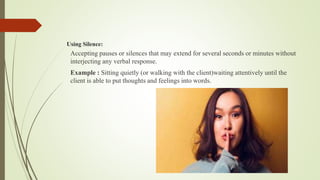
Using Silence:
Accepting pauses or silences that may extend for several seconds or minutes without
interjecting any verbal response.
Example : Sitting quietly (or walking with the client)waiting attentively until the
client is able to put thoughts and feelings into words.
Cont….
 Providing general leads: Using statements or questions that –
(a) Encourage the client to verbalize
(b) Choose a topic of conversation
(c) Facilitate continued verbalization
Example:
• “Can you tell me how it is for you?”
• “Perhaps you would like to talk about. . . .”
• “Would it help to discuss your feelings?”
• “Where would you like to begin?”
• “And then what?”
Cont….
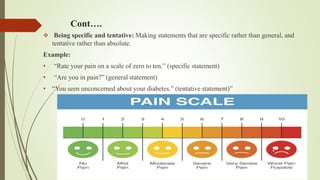
 Being specific and tentative: Making statements that are specific rather than general, and
tentative rather than absolute.
Example:
• “Rate your pain on a scale of zero to ten.” (specific statement)
• “Are you in pain?” (general statement)
• “You seen unconcerned about your diabetes.” (tentative statement)”
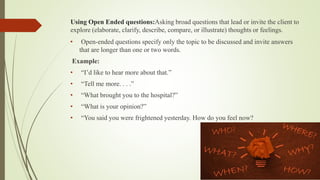
Using Open Ended questions:Asking broad questions that lead or invite the client to
explore (elaborate, clarify, describe, compare, or illustrate) thoughts or feelings.
• Open-ended questions specify only the topic to be discussed and invite answers
that are longer than one or two words.
Example:
• “I’d like to hear more about that.”
• “Tell me more. . . .”
• “What brought you to the hospital?”
• “What is your opinion?”
• “You said you were frightened yesterday. How do you feel now?
Cont…
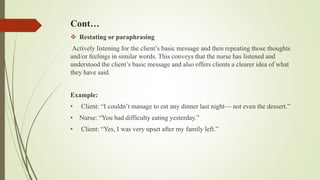
 Restating or paraphrasing
Actively listening for the client’s basic message and then repeating those thoughts
and/or feelings in similar words. This conveys that the nurse has listened and
understood the client’s basic message and also offers clients a clearer idea of what
they have said.
Example:
• Client: “I couldn’t manage to eat any dinner last night— not even the dessert.”
• Nurse: “You had difficulty eating yesterday.”
• Client: “Yes, I was very upset after my family left.”
Cont….
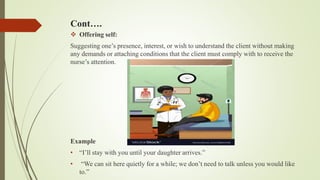
 Offering self:
Suggesting one’s presence, interest, or wish to understand the client without making
any demands or attaching conditions that the client must comply with to receive the
nurse’s attention.
Example
• “I’ll stay with you until your daughter arrives.”
• “We can sit here quietly for a while; we don’t need to talk unless you would like
to.”
Cont….
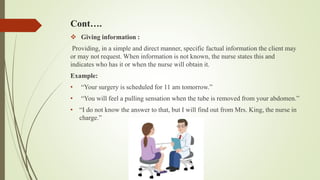
 Giving information :
Providing, in a simple and direct manner, specific factual information the client may
or may not request. When information is not known, the nurse states this and
indicates who has it or when the nurse will obtain it.
Example:
• “Your surgery is scheduled for 11 am tomorrow.”
• “You will feel a pulling sensation when the tube is removed from your abdomen.”
• “I do not know the answer to that, but I will find out from Mrs. King, the nurse in
charge.”
Cont….
 Presenting reality :
Helping the client to differentiate the real from the unreal.
Example:
• “That telephone ring came from the program on television.”
• “Your magazine is here in the drawer. It has not been stolen.”
Cont….
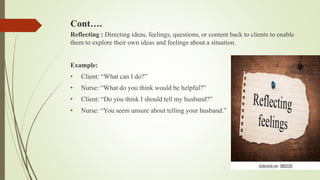
Reflecting : Directing ideas, feelings, questions, or content back to clients to enable
them to explore their own ideas and feelings about a situation.
Example:
• Client: “What can I do?”
• Nurse: “What do you think would be helpful?”
• Client: “Do you think I should tell my husband?”
• Nurse: “You seem unsure about telling your husband.”
Cont….
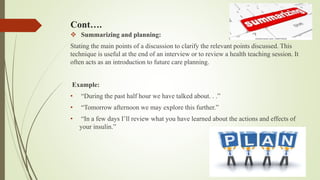
 Summarizing and planning:
Stating the main points of a discussion to clarify the relevant points discussed. This
technique is useful at the end of an interview or to review a health teaching session. It
often acts as an introduction to future care planning.
Example:
• “During the past half hour we have talked about. . .”
• “Tomorrow afternoon we may explore this further.”
• “In a few days I’ll review what you have learned about the actions and effects of
your insulin.”
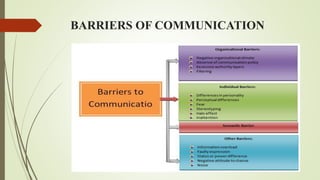
BARRIERS OF COMMUNICATION
THERAPEUTIC ATTITUDE
• It is a frame of reference around which an individual organize knowledge about his/her
world. An attitude also has an emotional component, it can be prejudgement or selective
or biased. It help to find the meaning in life and to provide clarity and consistency to
individual.
• The prevailing stigma attached to mental illness is an example of negative attitude.
INTERPERSONAL/THERAPEUTIC
RELATIONSHIP
INTRODUCTION
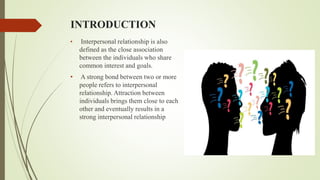
• Interpersonal relationship is also
defined as the close association
between the individuals who share
common interest and goals.
• A strong bond between two or more
people refers to interpersonal
relationship. Attraction between
individuals brings them close to each
other and eventually results in a
strong interpersonal relationship
DEFINITION
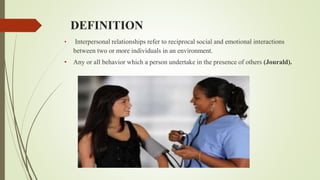
• Interpersonal relationships refer to reciprocal social and emotional interactions
between two or more individuals in an environment.
• Any or all behavior which a person undertake in the presence of others (Jourald).
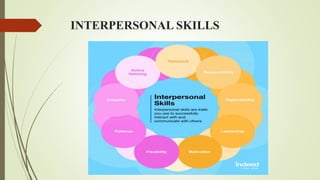
INTERPERSONAL SKILLS
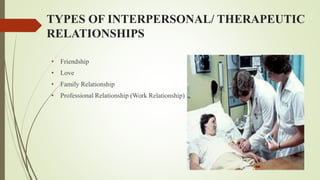
TYPES OF INTERPERSONAL/ THERAPEUTIC
RELATIONSHIPS
• Friendship
• Love
• Family Relationship
• Professional Relationship (Work Relationship)
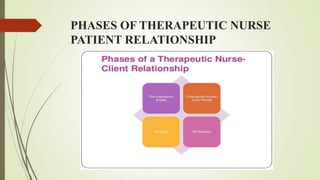
PHASES OF THERAPEUTIC NURSE
PATIENT RELATIONSHIP
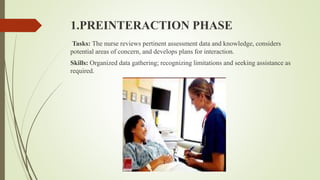
1.PREINTERACTION PHASE
Tasks: The nurse reviews pertinent assessment data and knowledge, considers
potential areas of concern, and develops plans for interaction.
Skills: Organized data gathering; recognizing limitations and seeking assistance as
required.
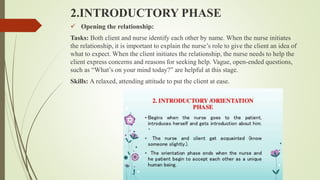
2.INTRODUCTORY PHASE
 Opening the relationship:
Tasks: Both client and nurse identify each other by name. When the nurse initiates
the relationship, it is important to explain the nurse’s role to give the client an idea of
what to expect. When the client initiates the relationship, the nurse needs to help the
client express concerns and reasons for seeking help. Vague, open-ended questions,
such as “What’s on your mind today?” are helpful at this stage.
Skills: A relaxed, attending attitude to put the client at ease.
 Clarifying the problem:
Tasks: Because the client initially may not see the problem clearly, the nurse’s major
task is to help clarify the problem.
Skills: Attentive listening, paraphrasing, clarifying, and other effective
communication techniques as discussed before . A common error at this stage is to
ask too many questions of the client. Instead focus on priorities.
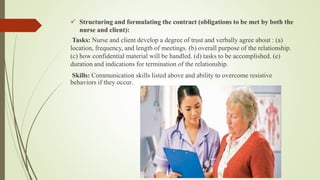
 Structuring and formulating the contract (obligations to be met by both the
nurse and client):
Tasks: Nurse and client develop a degree of trust and verbally agree about : (a)
location, frequency, and length of meetings. (b) overall purpose of the relationship.
(c) how confidential material will be handled. (d) tasks to be accomplished. (e)
duration and indications for termination of the relationship.
Skills: Communication skills listed above and ability to overcome resistive
behaviors if they occur.
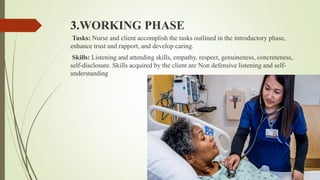
3.WORKING PHASE
Tasks: Nurse and client accomplish the tasks outlined in the introductory phase,
enhance trust and rapport, and develop caring.
Skills: Listening and attending skills, empathy, respect, genuineness, concreteness,
self-disclosure. Skills acquired by the client are Non defensive listening and self-
understanding
Cont….
1. Exploring and understanding thoughts and feelings:
The nurse assists the client to explore thoughts and feelings and acquires an
understanding of the client. The client explores thoughts and feelings associated with
problems, develops the skill of listening, and gains insight into personal behavior.
Cont….
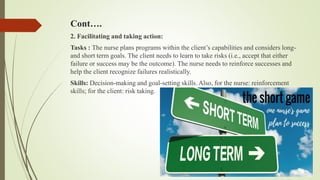
2. Facilitating and taking action:
Tasks : The nurse plans programs within the client’s capabilities and considers long-
and short term goals. The client needs to learn to take risks (i.e., accept that either
failure or success may be the outcome). The nurse needs to reinforce successes and
help the client recognize failures realistically.
Skills: Decision-making and goal-setting skills. Also, for the nurse: reinforcement
skills; for the client: risk taking.
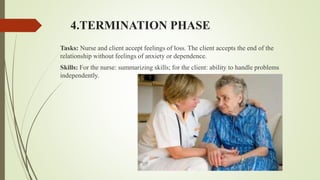
4.TERMINATION PHASE
Tasks: Nurse and client accept feelings of loss. The client accepts the end of the
relationship without feelings of anxiety or dependence.
Skills: For the nurse: summarizing skills; for the client: ability to handle problems
independently.
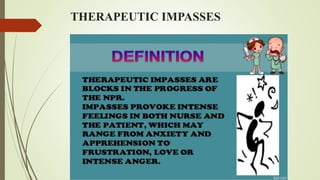
THERAPEUTIC IMPASSES
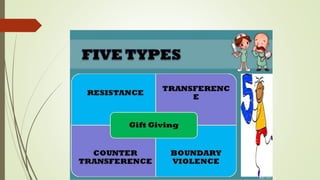
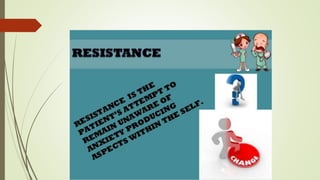
TYPES OF THERAPEUTIC IMPASSES
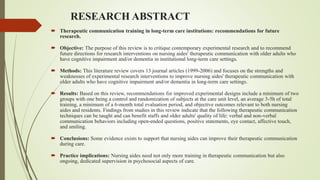
RESEARCH ABSTRACT
 Therapeutic communication training in long-term care institutions: recommendations for future
research.
 Objective: The purpose of this review is to critique contemporary experimental research and to recommend
future directions for research interventions on nursing aides' therapeutic communication with older adults who
have cognitive impairment and/or dementia in institutional long-term care settings.
 Methods: This literature review covers 13 journal articles (1999-2006) and focuses on the strengths and
weaknesses of experimental research interventions to improve nursing aides' therapeutic communication with
older adults who have cognitive impairment and/or dementia in long-term care settings.
 Results: Based on this review, recommendations for improved experimental designs include a minimum of two
groups with one being a control and randomization of subjects at the care unit level, an average 3-5h of total
training, a minimum of a 6-month total evaluation period, and objective outcomes relevant to both nursing
aides and residents. Findings from studies in this review indicate that the following therapeutic communication
techniques can be taught and can benefit staffs and older adults' quality of life: verbal and non-verbal
communication behaviors including open-ended questions, positive statements, eye contact, affective touch,
and smiling.
 Conclusions: Some evidence exists to support that nursing aides can improve their therapeutic communication
during care.
 Practice implications: Nursing aides need not only more training in therapeutic communication but also
ongoing, dedicated supervision in psychosocial aspects of care.
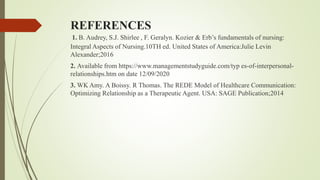
REFERENCES
1. B. Audrey, S.J. Shirlee , F. Geralyn. Kozier & Erb’s fundamentals of nursing:
Integral Aspects of Nursing.10TH ed. United States of America:Julie Levin
Alexander;2016
2. Available from https://www.managementstudyguide.com/typ es-of-interpersonal-
relationships.htm on date 12/09/2020
3. WK Amy. A Boissy. R Thomas. The REDE Model of Healthcare Communication:
Optimizing Relationship as a Therapeutic Agent. USA: SAGE Publication;2014
Therapeutic communication and interpersonal relationship

Therapeutic communication and interpersonal relationship

  • 1.
    THERAPEUTIC COMMUNICATION AND INTERPERSONALRELATIONSHIP PRESENTED BY:- NEHA SHARMA
  • 2.
    COMMUNICATION Communication refers tothe giving and receiving of information. Communication is the means by which people influence the behaviour of other leading to to successful outcome of nursing intervention. • It is a vehicle used to establish therapeutic relationship involving the elements like sender, the message, receiver, and the feedback.
  • 3.
  • 4.
  • 5.
    FACTORS AFFECTING COMMUNICATION •Status/Role • Cultural Differences • Use Of Language • Atmosphere/Noise • Clarity of Message • Length of Communication • Individual Perceptions • Disabilities • Lack of Feedback
  • 6.
  • 7.
    INTRODUCTION • The therapeuticcommunication (also therapeutic alliance, the helping alliance, or the working alliance) refers to the relationship between a healthcare professional and a client (or patient). • Therapeutic communication involves a wide range of different types of communication with the user of health care in the treatment process .
  • 8.
    DEFINITION  “Promotes mutualunderstanding, establishes a constructive relationship between the nurse and the client”. (Kozier, 2004)  “It is the process, in which the nurse utilizes a planned approach to learn about the client”. (Potter A, 1997)
  • 9.
  • 10.
  • 11.
    TECHNIQUES OF THERAPEUTIC COMMUNICATION •Being specific and tentative • Using tentative questions • Restating and paraphrasing • Offering self • Giving information • Presenting reality • Reflecting • Summarizing and planning
  • 12.
    Using Silence: Accepting pausesor silences that may extend for several seconds or minutes without interjecting any verbal response. Example : Sitting quietly (or walking with the client)waiting attentively until the client is able to put thoughts and feelings into words.
  • 13.
    Cont….  Providing generalleads: Using statements or questions that – (a) Encourage the client to verbalize (b) Choose a topic of conversation (c) Facilitate continued verbalization Example: • “Can you tell me how it is for you?” • “Perhaps you would like to talk about. . . .” • “Would it help to discuss your feelings?” • “Where would you like to begin?” • “And then what?”
  • 14.
    Cont….  Being specificand tentative: Making statements that are specific rather than general, and tentative rather than absolute. Example: • “Rate your pain on a scale of zero to ten.” (specific statement) • “Are you in pain?” (general statement) • “You seen unconcerned about your diabetes.” (tentative statement)”
  • 15.
    Using Open Endedquestions:Asking broad questions that lead or invite the client to explore (elaborate, clarify, describe, compare, or illustrate) thoughts or feelings. • Open-ended questions specify only the topic to be discussed and invite answers that are longer than one or two words. Example: • “I’d like to hear more about that.” • “Tell me more. . . .” • “What brought you to the hospital?” • “What is your opinion?” • “You said you were frightened yesterday. How do you feel now?
  • 16.
    Cont…  Restating orparaphrasing Actively listening for the client’s basic message and then repeating those thoughts and/or feelings in similar words. This conveys that the nurse has listened and understood the client’s basic message and also offers clients a clearer idea of what they have said. Example: • Client: “I couldn’t manage to eat any dinner last night— not even the dessert.” • Nurse: “You had difficulty eating yesterday.” • Client: “Yes, I was very upset after my family left.”
  • 17.
    Cont….  Offering self: Suggestingone’s presence, interest, or wish to understand the client without making any demands or attaching conditions that the client must comply with to receive the nurse’s attention. Example • “I’ll stay with you until your daughter arrives.” • “We can sit here quietly for a while; we don’t need to talk unless you would like to.”
  • 18.
    Cont….  Giving information: Providing, in a simple and direct manner, specific factual information the client may or may not request. When information is not known, the nurse states this and indicates who has it or when the nurse will obtain it. Example: • “Your surgery is scheduled for 11 am tomorrow.” • “You will feel a pulling sensation when the tube is removed from your abdomen.” • “I do not know the answer to that, but I will find out from Mrs. King, the nurse in charge.”
  • 19.
    Cont….  Presenting reality: Helping the client to differentiate the real from the unreal. Example: • “That telephone ring came from the program on television.” • “Your magazine is here in the drawer. It has not been stolen.”
  • 20.
    Cont…. Reflecting : Directingideas, feelings, questions, or content back to clients to enable them to explore their own ideas and feelings about a situation. Example: • Client: “What can I do?” • Nurse: “What do you think would be helpful?” • Client: “Do you think I should tell my husband?” • Nurse: “You seem unsure about telling your husband.”
  • 21.
    Cont….  Summarizing andplanning: Stating the main points of a discussion to clarify the relevant points discussed. This technique is useful at the end of an interview or to review a health teaching session. It often acts as an introduction to future care planning. Example: • “During the past half hour we have talked about. . .” • “Tomorrow afternoon we may explore this further.” • “In a few days I’ll review what you have learned about the actions and effects of your insulin.”
  • 23.
  • 24.
    THERAPEUTIC ATTITUDE • Itis a frame of reference around which an individual organize knowledge about his/her world. An attitude also has an emotional component, it can be prejudgement or selective or biased. It help to find the meaning in life and to provide clarity and consistency to individual. • The prevailing stigma attached to mental illness is an example of negative attitude.
  • 25.
  • 26.
    INTRODUCTION • Interpersonal relationshipis also defined as the close association between the individuals who share common interest and goals. • A strong bond between two or more people refers to interpersonal relationship. Attraction between individuals brings them close to each other and eventually results in a strong interpersonal relationship
  • 27.
    DEFINITION • Interpersonal relationshipsrefer to reciprocal social and emotional interactions between two or more individuals in an environment. • Any or all behavior which a person undertake in the presence of others (Jourald).
  • 28.
  • 29.
    TYPES OF INTERPERSONAL/THERAPEUTIC RELATIONSHIPS • Friendship • Love • Family Relationship • Professional Relationship (Work Relationship)
  • 30.
    PHASES OF THERAPEUTICNURSE PATIENT RELATIONSHIP
  • 31.
    1.PREINTERACTION PHASE Tasks: Thenurse reviews pertinent assessment data and knowledge, considers potential areas of concern, and develops plans for interaction. Skills: Organized data gathering; recognizing limitations and seeking assistance as required.
  • 32.
    2.INTRODUCTORY PHASE  Openingthe relationship: Tasks: Both client and nurse identify each other by name. When the nurse initiates the relationship, it is important to explain the nurse’s role to give the client an idea of what to expect. When the client initiates the relationship, the nurse needs to help the client express concerns and reasons for seeking help. Vague, open-ended questions, such as “What’s on your mind today?” are helpful at this stage. Skills: A relaxed, attending attitude to put the client at ease.
  • 33.
     Clarifying theproblem: Tasks: Because the client initially may not see the problem clearly, the nurse’s major task is to help clarify the problem. Skills: Attentive listening, paraphrasing, clarifying, and other effective communication techniques as discussed before . A common error at this stage is to ask too many questions of the client. Instead focus on priorities.
  • 34.
     Structuring andformulating the contract (obligations to be met by both the nurse and client): Tasks: Nurse and client develop a degree of trust and verbally agree about : (a) location, frequency, and length of meetings. (b) overall purpose of the relationship. (c) how confidential material will be handled. (d) tasks to be accomplished. (e) duration and indications for termination of the relationship. Skills: Communication skills listed above and ability to overcome resistive behaviors if they occur.
  • 35.
    3.WORKING PHASE Tasks: Nurseand client accomplish the tasks outlined in the introductory phase, enhance trust and rapport, and develop caring. Skills: Listening and attending skills, empathy, respect, genuineness, concreteness, self-disclosure. Skills acquired by the client are Non defensive listening and self- understanding
  • 36.
    Cont…. 1. Exploring andunderstanding thoughts and feelings: The nurse assists the client to explore thoughts and feelings and acquires an understanding of the client. The client explores thoughts and feelings associated with problems, develops the skill of listening, and gains insight into personal behavior.
  • 37.
    Cont…. 2. Facilitating andtaking action: Tasks : The nurse plans programs within the client’s capabilities and considers long- and short term goals. The client needs to learn to take risks (i.e., accept that either failure or success may be the outcome). The nurse needs to reinforce successes and help the client recognize failures realistically. Skills: Decision-making and goal-setting skills. Also, for the nurse: reinforcement skills; for the client: risk taking.
  • 38.
    4.TERMINATION PHASE Tasks: Nurseand client accept feelings of loss. The client accepts the end of the relationship without feelings of anxiety or dependence. Skills: For the nurse: summarizing skills; for the client: ability to handle problems independently.
  • 39.
  • 40.
  • 60.
    RESEARCH ABSTRACT  Therapeuticcommunication training in long-term care institutions: recommendations for future research.  Objective: The purpose of this review is to critique contemporary experimental research and to recommend future directions for research interventions on nursing aides' therapeutic communication with older adults who have cognitive impairment and/or dementia in institutional long-term care settings.  Methods: This literature review covers 13 journal articles (1999-2006) and focuses on the strengths and weaknesses of experimental research interventions to improve nursing aides' therapeutic communication with older adults who have cognitive impairment and/or dementia in long-term care settings.  Results: Based on this review, recommendations for improved experimental designs include a minimum of two groups with one being a control and randomization of subjects at the care unit level, an average 3-5h of total training, a minimum of a 6-month total evaluation period, and objective outcomes relevant to both nursing aides and residents. Findings from studies in this review indicate that the following therapeutic communication techniques can be taught and can benefit staffs and older adults' quality of life: verbal and non-verbal communication behaviors including open-ended questions, positive statements, eye contact, affective touch, and smiling.  Conclusions: Some evidence exists to support that nursing aides can improve their therapeutic communication during care.  Practice implications: Nursing aides need not only more training in therapeutic communication but also ongoing, dedicated supervision in psychosocial aspects of care.
  • 61.
    REFERENCES 1. B. Audrey,S.J. Shirlee , F. Geralyn. Kozier & Erb’s fundamentals of nursing: Integral Aspects of Nursing.10TH ed. United States of America:Julie Levin Alexander;2016 2. Available from https://www.managementstudyguide.com/typ es-of-interpersonal- relationships.htm on date 12/09/2020 3. WK Amy. A Boissy. R Thomas. The REDE Model of Healthcare Communication: Optimizing Relationship as a Therapeutic Agent. USA: SAGE Publication;2014