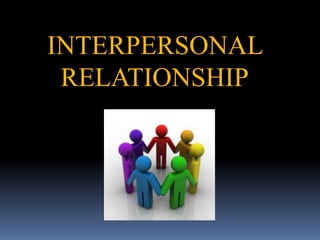


INTERPERSONAL
RELATIONSHIP
The concept of interpersonal relationship
involves social associations. Connections,
or affiliations between two or more
people. Such persons may interact overtly,
covertly, face-to-face or may remain
effectively unknown to each other ( as in a
virtual community whose member
maintain anonymity and do not socialize
outside of a chat-room).
ANALYZING INTERPERSONAL
RELATIONSHIP
•Explicit Interaction- That define an interpersonal
relationship- such as Body Language and Dialogue.
•Implicit Interaction- Include standing in a Shopping line
or in an Emergency lane.
•Focused- ( Such as the Sales-oriented relationship
between a sales assistant and a customer).
•Unfocused- ( as between passengers on a bus).
CHARACTERSTICS
•Interpersonal relationship vary in their degree of
Self-Disclosure, Feedback, Power, and Respect.
•Degree of changeability itself can demonstrate
power differentials in a variety of interpersonal
relationship and settings.
•Relationships vary in the degree to which both
intimacy and sharing occur.
POSSIBLE STAGES IN THE COURSE
OF INTERPERSONAL RELATIONSHIPS
1. CONTACT:
• PERCEPTUAL- Notices how parties look at each other and
their body-language.
• INTERACTIONAL CUES- Nodding, maintaining eye-
contact etc.
• INVITATIONAL- Encouraging the potential relationship,
requesting for something, like tea, coffee.
• AVOIDANCE STRATEGIES- If one person discloses and
the other does not: minimal response, lack of eye-contact, etc.
2. INVOLVEMENT
FEELERS- Hints or questions ( for example: asking about
family).
INTENSIFYING STRATEGIES- Furthering the relationship
(for example meeting an old friend, bringing the other to meet
family, becoming more affectionate, etc.
PUBLIC- Parties seen in public together often (if in a romantic
relationship, may involve holding hands).
3. INTIMACY: Parties very close; may have exchanged
some sort of personal belonging or something that represents
further commitment.
4. DETERIORATION: Things start to fall apart. In a
romantic relationship, typically after approximately six months
people move out of the so-called “Honeymoon stage”, and start
to notice flaws. The way they address this determines the fate
of the relationship.
TYPES OF INTERPERSONAL
RELATIONSHIPS
Kinship relationships (including family relationships) involved
relating to someone else:
• Genetically (consanguinity, as for example in fatherhood,
motherhood).
• Through marriage (affinity as for example as a father-in-law,
mother-in-law, uncle-by-marriage, aunty-by-marriage).
Formalized intimate relationships or long term relationships
recognized by law and formalized through public ceremony ( for
example the relationship of marriage and of civil-union).
Non-Formalized intimate relationships or long
term relationships such as loving relationships or
romantic relationships with or without living
together.
Soul mates, individuals intimately drawn to
one another through a favorable “Meeting Of
Minds” and who find mutual acceptance and/or
understanding with one another. Soul mates may
feel themselves bonded together for a lifetime
Friendship , which consist of mutual love, trust, respect
and (often unconditional) acceptance and usually implies
the discovery of establishment of common ground
between the individuals involved; brotherhood and
sisterhood.
Partners or co-workers in a profession, business or a
common workplace, compare team.
Participation in a community, for example, a
community of interest or practice.
Association, simply knowing someone by introduction
or knowing someone by interaction.
FACTORS IN ESTABLISHING AND
MAINTAINING RELATIONSHIPS
Compassion
Intelligence
An ability and willingness to communicate.
Self awareness
Expertise in each relationship- type (in this hierarchy)
requires the skills of all previous relationship- types (for
example partnership requires friendship and teamwork
skills).
HIERARCHY OF FORMS OF ACTIVITY
AND INTERPERSONAL RELATIONSHIP
1. BEHAVIOR
2. ACTION
3. SOCIAL BEHAVIOR
4. SOCIAL ACTION
5. SOCIAL CONTACT
6. SOCIAL INTERACTION
7. SOCIAL RELATION
THEORIES CONCERNING
INTERPERSONAL RELATIONSHIPS
1. Closure
2. Trust, as trust between parties can become mutual.
This way lead to enduring relationship.
3. Social Exchange Theory, which interprets relationship
in terms of exchange benefits. People will regard
relationship in the light of the rewards of the
relationship, as well as reward they may potentially
received in alternate relationship.
4. Systemic Coaching, which analyzes relationship as
a expression of a perceived human need to give and
receive love.
5. Transferences, entanglements, and substitution can
complicate relationships. Systemic coaching claims to
offer solutions for many difficulties in relationships.
6. Equity Theory, which stems for a criticism of social
exchange theory. Proponents argue that people care
about more than just maximizing reward: they also
allegedly want fairness and equity in their
relationships.
7. Relational Dialectics, which regards relationships not
as static entities, but as continuing processes, forever
changing. This approach sees constant tension in the
negotiation.
8. Attachment styles, which analyze relationship in yet
another way. Proponents of attachment style argue that
style developed in childhood continue influential
throughout adulthood, influencing the roles people
adopt in relationships.
9. Socionics and some other theories of psychological
compatibility consider interpersonal relationships as at
least partly dependent on the psychological types of
partners.
INTERPERSONAL
COMMUNICATION THEORIES
1.SOCIAL PENETRATION THEORY (SPT)
SPT is a theory about the development of “relational
closeness”.
Relational closeness can progress from superficial to
intimate.
Closeness develops through self-disclosure.
2. SELF-DISCLOSURE
Self-disclosure is sharing with someone information which helps him or her
understand you. Self-disclosure is most revealing when the sharing is in the
present and least revealing when the sharing is about the past. -- D. Johnson,
Self-Disclosure Characteristics
The story always represents the storyteller (the person disclosing).
SD stimulates feedback. The quality of the feedback is related to the amount
and relevance of self-disclosure we receive and share with others.
Self-disclosure can be most revealing or least revealing.
3. UNCERTAINTY REDUCTION THEORY (URT)
Presumes that “the beginning of personal relationships are fraught with uncertainties” (C. Berger).
Presumes that people want to reduce uncertainty in relationships through knowledge and
understanding.
Three ways we learn about others:
Passive strategies -- we observe the person, either in situations where the other person is likely to
be self-monitoring (a reactivity search) as in a classroom, or where the other person is likely to act
more naturally (a disinhibition search) as in the stands at a football game.
Active strategies -- we ask others about the person we're interested in or try to set up a situation
where we can observe that person (e.g., taking the same class, sitting a table away at dinner).
Once the situation is set up we sometime observe (a passive strategy) or talk with the person (an
interactive strategy).
Interactive strategies -- we communicate directly with the person.
4. RELATIONAL DIALECTICS THEORY
(RDT)
Relationships reflect tensions (conflicts, contradictions)
that are played out in communication interaction
(dialectical tensions).
Relationships are “organized around the dynamic
interplay of opposing tendencies” (L. Baxter & B.
Montgomery)
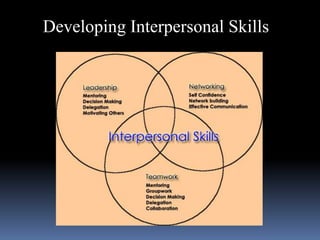
Developing Interpersonal Skills
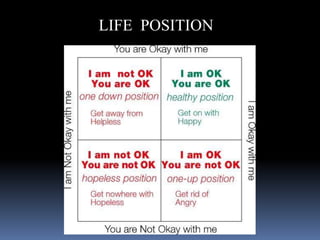
LIFE POSITION
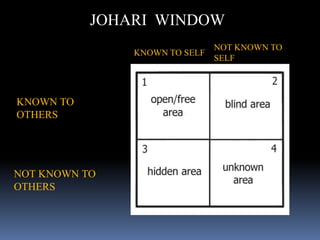
JOHARI WINDOW
KNOWN TO
OTHERS
NOT KNOWN TO
OTHERS
KNOWN TO SELF
NOT KNOWN TO
SELF
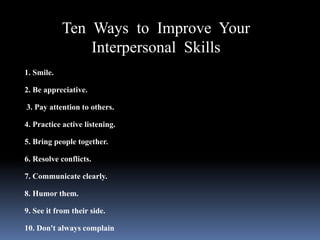
Ten Ways to Improve Your
Interpersonal Skills
1. Smile.
2. Be appreciative.
3. Pay attention to others.
4. Practice active listening.
5. Bring people together.
6. Resolve conflicts.
7. Communicate clearly.
8. Humor them.
9. See it from their side.
10. Don't always complain
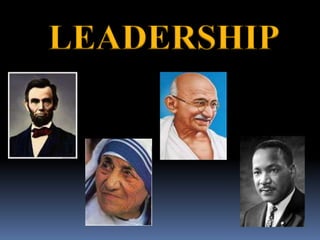
LEADERSHIP
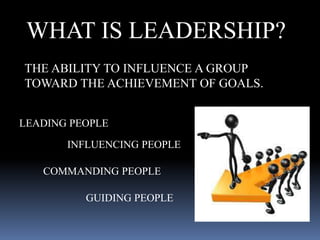
WHAT IS LEADERSHIP?
THE ABILITY TO INFLUENCE A GROUP
TOWARD THE ACHIEVEMENT OF GOALS.
INFLUENCING PEOPLE
COMMANDING PEOPLE
GUIDING PEOPLE
LEADING PEOPLE
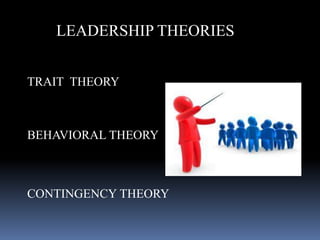
LEADERSHIP THEORIES
TRAIT THEORY
BEHAVIORAL THEORY
CONTINGENCY THEORY
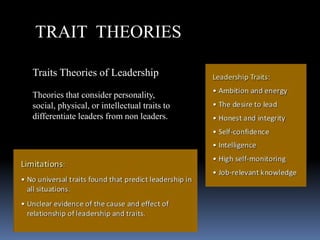
TRAIT THEORIES
Traits Theories of Leadership
Theories that consider personality,
social, physical, or intellectual traits to
differentiate leaders from non leaders.
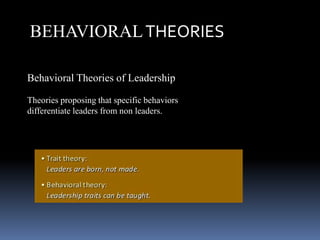
BEHAVIORALTHEORIES
Behavioral Theories of Leadership
Theories proposing that specific behaviors
differentiate leaders from non leaders.
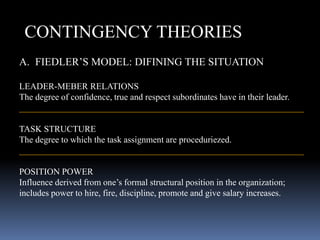
CONTINGENCY THEORIES
A. FIEDLER’S MODEL: DIFINING THE SITUATION
LEADER-MEBER RELATIONS
The degree of confidence, true and respect subordinates have in their leader.
________________________________________________________________
TASK STRUCTURE
The degree to which the task assignment are proceduriezed.
________________________________________________________________
POSITION POWER
Influence derived from one’s formal structural position in the organization;
includes power to hire, fire, discipline, promote and give salary increases.
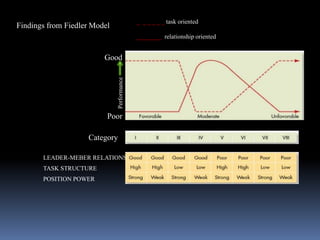
Findings from Fiedler Model
Good
PoorPerformance
Category
LEADER-MEBER RELATIONS
TASK STRUCTURE
POSITION POWER
_ _ _ _ _ _ task oriented
________ relationship oriented
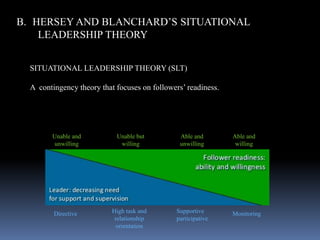
B. HERSEY AND BLANCHARD’S SITUATIONAL
LEADERSHIP THEORY
SITUATIONAL LEADERSHIP THEORY (SLT)
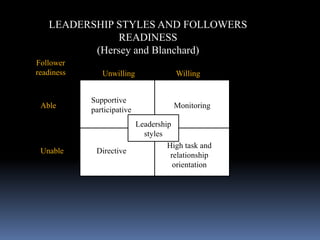
A contingency theory that focuses on followers’ readiness.
Unable and
unwilling
Unable but
willing
Able and
unwilling
Able and
willing
Directive High task and
relationship
orientation
Supportive
participative
Monitoring
LEADERSHIP STYLES AND FOLLOWERS
READINESS
(Hersey and Blanchard)
Supportive
participative
Monitoring
Directive
High task and
relationship
orientation
Leadership
styles
Able
Unable
Unwilling Willing
Follower
readiness
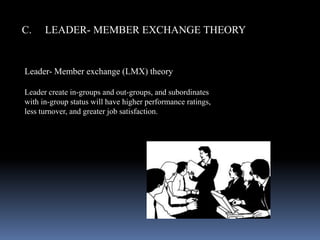
C. LEADER- MEMBER EXCHANGE THEORY
Leader- Member exchange (LMX) theory
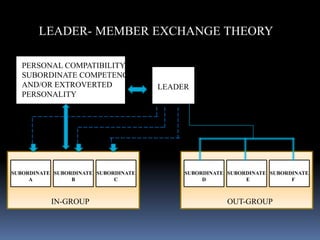
Leader create in-groups and out-groups, and subordinates
with in-group status will have higher performance ratings,
less turnover, and greater job satisfaction.
LEADER- MEMBER EXCHANGE THEORY
PERSONAL COMPATIBILITY,
SUBORDINATE COMPETENCE,
AND/OR EXTROVERTED
PERSONALITY
LEADER
SUBORDINATE
A
SUBORDINATE
B
SUBORDINATE
C
SUBORDINATE
D
SUBORDINATE
E
SUBORDINATE
F
_ _ _ _ _ _ _ _ _ _ _ _ _ _ _ _ _ _ _ _ _ _ _
_____
_ _ _ _ _ _ _ _ _ _ _ _ _ _ _ _
___
____
__
______
_ _ _ _ _ _ _ _ _ _ _ _ _
__
IN-GROUP OUT-GROUP
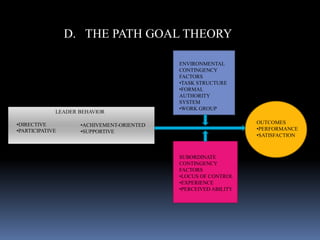
D. THE PATH GOAL THEORY
ENVIRONMENTAL
CONTINGENCY
FACTORS
•TASK STRUCTURE
•FORMAL
AUTHORITY
SYSTEM
•WORK GROUP
SUBORDINATE
CONTINGENCY
FACTORS
•LOCUS OF CONTROL
•EXPERIENCE
•PERCEIVED ABILITY
OUTCOMES
•PERFORMANCE
•SATISFACTION
LEADER BEHAVIOR
•DIRECTIVE
•PARTICIPATIVE
•ACHIVEMENT-ORIENTED
•SUPPORTIVE
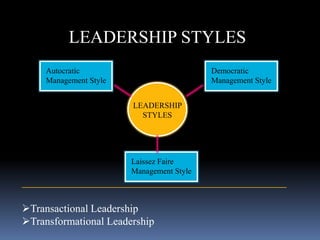
LEADERSHIP STYLES
____________________________________________________________________
Transactional Leadership
Transformational Leadership
LEADERSHIP
STYLES
Autocratic
Management Style
Democratic
Management Style
Laissez Faire
Management Style
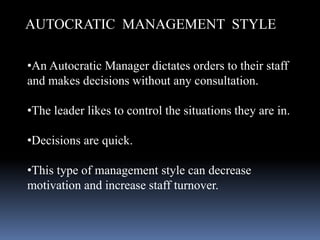
AUTOCRATIC MANAGEMENT STYLE
•An Autocratic Manager dictates orders to their staff
and makes decisions without any consultation.
•The leader likes to control the situations they are in.
•Decisions are quick.
•This type of management style can decrease
motivation and increase staff turnover.
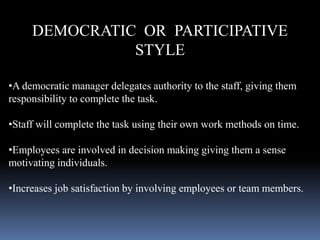
DEMOCRATIC OR PARTICIPATIVE
STYLE
•A democratic manager delegates authority to the staff, giving them
responsibility to complete the task.
•Staff will complete the task using their own work methods on time.
•Employees are involved in decision making giving them a sense
motivating individuals.
•Increases job satisfaction by involving employees or team members.
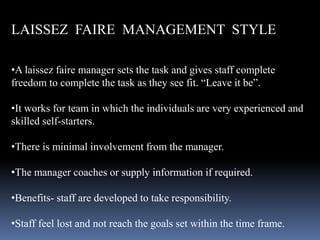
LAISSEZ FAIRE MANAGEMENT STYLE
•A laissez faire manager sets the task and gives staff complete
freedom to complete the task as they see fit. “Leave it be”.
•It works for team in which the individuals are very experienced and
skilled self-starters.
•There is minimal involvement from the manager.
•The manager coaches or supply information if required.
•Benefits- staff are developed to take responsibility.
•Staff feel lost and not reach the goals set within the time frame.
TRANSACTIONAL AND TRANSFORMATIONAL
LEADERSHIP
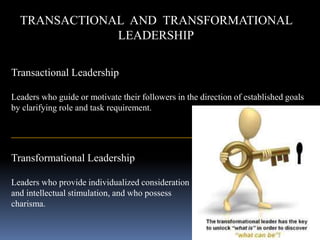
Transactional Leadership
Leaders who guide or motivate their followers in the direction of established goals
by clarifying role and task requirement.
_______________________________________________________
Transformational Leadership
Leaders who provide individualized consideration
and intellectual stimulation, and who possess
charisma.
Characteristics of transactional leaders
Contingent Reward: Contracts exchange of rewards
for efforts, promises rewards for good performance,
recognizes accomplishment.
Management By exception: Watches and searches
for deviations from rules and standards, takes
corrective action.
Characteristics for transformational leaders
Idealized Influence: Provides vision and sense of mission,
instills pride, gains respect and trust.
Inspiration: Communicates high expectations, uses
symbols to focus efforts, expresses important purposes in
simple ways.
Intellectual Stimulation: Promotes intelligence, rationality,
and careful problem solving.
Individualized consideration: Gives personal attention,
treats each employee individually, coaches, advises.
INTERPERSONAL  RELATIONSHIP  AND  LEADERSHIP

INTERPERSONAL RELATIONSHIP AND LEADERSHIP

  • 2.
  • 3.
    The concept ofinterpersonal relationship involves social associations. Connections, or affiliations between two or more people. Such persons may interact overtly, covertly, face-to-face or may remain effectively unknown to each other ( as in a virtual community whose member maintain anonymity and do not socialize outside of a chat-room).
  • 4.
    ANALYZING INTERPERSONAL RELATIONSHIP •Explicit Interaction-That define an interpersonal relationship- such as Body Language and Dialogue. •Implicit Interaction- Include standing in a Shopping line or in an Emergency lane. •Focused- ( Such as the Sales-oriented relationship between a sales assistant and a customer). •Unfocused- ( as between passengers on a bus).
  • 5.
    CHARACTERSTICS •Interpersonal relationship varyin their degree of Self-Disclosure, Feedback, Power, and Respect. •Degree of changeability itself can demonstrate power differentials in a variety of interpersonal relationship and settings. •Relationships vary in the degree to which both intimacy and sharing occur.
  • 6.
    POSSIBLE STAGES INTHE COURSE OF INTERPERSONAL RELATIONSHIPS 1. CONTACT: • PERCEPTUAL- Notices how parties look at each other and their body-language. • INTERACTIONAL CUES- Nodding, maintaining eye- contact etc. • INVITATIONAL- Encouraging the potential relationship, requesting for something, like tea, coffee. • AVOIDANCE STRATEGIES- If one person discloses and the other does not: minimal response, lack of eye-contact, etc.
  • 7.
    2. INVOLVEMENT FEELERS- Hintsor questions ( for example: asking about family). INTENSIFYING STRATEGIES- Furthering the relationship (for example meeting an old friend, bringing the other to meet family, becoming more affectionate, etc. PUBLIC- Parties seen in public together often (if in a romantic relationship, may involve holding hands).
  • 8.
    3. INTIMACY: Partiesvery close; may have exchanged some sort of personal belonging or something that represents further commitment. 4. DETERIORATION: Things start to fall apart. In a romantic relationship, typically after approximately six months people move out of the so-called “Honeymoon stage”, and start to notice flaws. The way they address this determines the fate of the relationship.
  • 9.
    TYPES OF INTERPERSONAL RELATIONSHIPS Kinshiprelationships (including family relationships) involved relating to someone else: • Genetically (consanguinity, as for example in fatherhood, motherhood). • Through marriage (affinity as for example as a father-in-law, mother-in-law, uncle-by-marriage, aunty-by-marriage). Formalized intimate relationships or long term relationships recognized by law and formalized through public ceremony ( for example the relationship of marriage and of civil-union).
  • 10.
    Non-Formalized intimate relationshipsor long term relationships such as loving relationships or romantic relationships with or without living together. Soul mates, individuals intimately drawn to one another through a favorable “Meeting Of Minds” and who find mutual acceptance and/or understanding with one another. Soul mates may feel themselves bonded together for a lifetime
  • 11.
    Friendship , whichconsist of mutual love, trust, respect and (often unconditional) acceptance and usually implies the discovery of establishment of common ground between the individuals involved; brotherhood and sisterhood. Partners or co-workers in a profession, business or a common workplace, compare team. Participation in a community, for example, a community of interest or practice. Association, simply knowing someone by introduction or knowing someone by interaction.
  • 12.
    FACTORS IN ESTABLISHINGAND MAINTAINING RELATIONSHIPS Compassion Intelligence An ability and willingness to communicate. Self awareness Expertise in each relationship- type (in this hierarchy) requires the skills of all previous relationship- types (for example partnership requires friendship and teamwork skills).
  • 13.
    HIERARCHY OF FORMSOF ACTIVITY AND INTERPERSONAL RELATIONSHIP 1. BEHAVIOR 2. ACTION 3. SOCIAL BEHAVIOR 4. SOCIAL ACTION 5. SOCIAL CONTACT 6. SOCIAL INTERACTION 7. SOCIAL RELATION
  • 14.
    THEORIES CONCERNING INTERPERSONAL RELATIONSHIPS 1.Closure 2. Trust, as trust between parties can become mutual. This way lead to enduring relationship. 3. Social Exchange Theory, which interprets relationship in terms of exchange benefits. People will regard relationship in the light of the rewards of the relationship, as well as reward they may potentially received in alternate relationship.
  • 15.
    4. Systemic Coaching,which analyzes relationship as a expression of a perceived human need to give and receive love. 5. Transferences, entanglements, and substitution can complicate relationships. Systemic coaching claims to offer solutions for many difficulties in relationships. 6. Equity Theory, which stems for a criticism of social exchange theory. Proponents argue that people care about more than just maximizing reward: they also allegedly want fairness and equity in their relationships.
  • 16.
    7. Relational Dialectics,which regards relationships not as static entities, but as continuing processes, forever changing. This approach sees constant tension in the negotiation. 8. Attachment styles, which analyze relationship in yet another way. Proponents of attachment style argue that style developed in childhood continue influential throughout adulthood, influencing the roles people adopt in relationships. 9. Socionics and some other theories of psychological compatibility consider interpersonal relationships as at least partly dependent on the psychological types of partners.
  • 17.
    INTERPERSONAL COMMUNICATION THEORIES 1.SOCIAL PENETRATIONTHEORY (SPT) SPT is a theory about the development of “relational closeness”. Relational closeness can progress from superficial to intimate. Closeness develops through self-disclosure.
  • 18.
    2. SELF-DISCLOSURE Self-disclosure issharing with someone information which helps him or her understand you. Self-disclosure is most revealing when the sharing is in the present and least revealing when the sharing is about the past. -- D. Johnson, Self-Disclosure Characteristics The story always represents the storyteller (the person disclosing). SD stimulates feedback. The quality of the feedback is related to the amount and relevance of self-disclosure we receive and share with others. Self-disclosure can be most revealing or least revealing.
  • 19.
    3. UNCERTAINTY REDUCTIONTHEORY (URT) Presumes that “the beginning of personal relationships are fraught with uncertainties” (C. Berger). Presumes that people want to reduce uncertainty in relationships through knowledge and understanding. Three ways we learn about others: Passive strategies -- we observe the person, either in situations where the other person is likely to be self-monitoring (a reactivity search) as in a classroom, or where the other person is likely to act more naturally (a disinhibition search) as in the stands at a football game. Active strategies -- we ask others about the person we're interested in or try to set up a situation where we can observe that person (e.g., taking the same class, sitting a table away at dinner). Once the situation is set up we sometime observe (a passive strategy) or talk with the person (an interactive strategy). Interactive strategies -- we communicate directly with the person.
  • 20.
    4. RELATIONAL DIALECTICSTHEORY (RDT) Relationships reflect tensions (conflicts, contradictions) that are played out in communication interaction (dialectical tensions). Relationships are “organized around the dynamic interplay of opposing tendencies” (L. Baxter & B. Montgomery)
  • 21.
  • 22.
  • 23.
    JOHARI WINDOW KNOWN TO OTHERS NOTKNOWN TO OTHERS KNOWN TO SELF NOT KNOWN TO SELF
  • 24.
    Ten Ways toImprove Your Interpersonal Skills 1. Smile. 2. Be appreciative. 3. Pay attention to others. 4. Practice active listening. 5. Bring people together. 6. Resolve conflicts. 7. Communicate clearly. 8. Humor them. 9. See it from their side. 10. Don't always complain
  • 26.
  • 27.
    WHAT IS LEADERSHIP? THEABILITY TO INFLUENCE A GROUP TOWARD THE ACHIEVEMENT OF GOALS. INFLUENCING PEOPLE COMMANDING PEOPLE GUIDING PEOPLE LEADING PEOPLE
  • 28.
  • 29.
    TRAIT THEORIES Traits Theoriesof Leadership Theories that consider personality, social, physical, or intellectual traits to differentiate leaders from non leaders.
  • 30.
    BEHAVIORALTHEORIES Behavioral Theories ofLeadership Theories proposing that specific behaviors differentiate leaders from non leaders.
  • 31.
    CONTINGENCY THEORIES A. FIEDLER’SMODEL: DIFINING THE SITUATION LEADER-MEBER RELATIONS The degree of confidence, true and respect subordinates have in their leader. ________________________________________________________________ TASK STRUCTURE The degree to which the task assignment are proceduriezed. ________________________________________________________________ POSITION POWER Influence derived from one’s formal structural position in the organization; includes power to hire, fire, discipline, promote and give salary increases.
  • 32.
    Findings from FiedlerModel Good PoorPerformance Category LEADER-MEBER RELATIONS TASK STRUCTURE POSITION POWER _ _ _ _ _ _ task oriented ________ relationship oriented
  • 33.
    B. HERSEY ANDBLANCHARD’S SITUATIONAL LEADERSHIP THEORY SITUATIONAL LEADERSHIP THEORY (SLT) A contingency theory that focuses on followers’ readiness. Unable and unwilling Unable but willing Able and unwilling Able and willing Directive High task and relationship orientation Supportive participative Monitoring
  • 34.
    LEADERSHIP STYLES ANDFOLLOWERS READINESS (Hersey and Blanchard) Supportive participative Monitoring Directive High task and relationship orientation Leadership styles Able Unable Unwilling Willing Follower readiness
  • 35.
    C. LEADER- MEMBEREXCHANGE THEORY Leader- Member exchange (LMX) theory Leader create in-groups and out-groups, and subordinates with in-group status will have higher performance ratings, less turnover, and greater job satisfaction.
  • 36.
    LEADER- MEMBER EXCHANGETHEORY PERSONAL COMPATIBILITY, SUBORDINATE COMPETENCE, AND/OR EXTROVERTED PERSONALITY LEADER SUBORDINATE A SUBORDINATE B SUBORDINATE C SUBORDINATE D SUBORDINATE E SUBORDINATE F _ _ _ _ _ _ _ _ _ _ _ _ _ _ _ _ _ _ _ _ _ _ _ _____ _ _ _ _ _ _ _ _ _ _ _ _ _ _ _ _ ___ ____ __ ______ _ _ _ _ _ _ _ _ _ _ _ _ _ __ IN-GROUP OUT-GROUP
  • 37.
    D. THE PATHGOAL THEORY ENVIRONMENTAL CONTINGENCY FACTORS •TASK STRUCTURE •FORMAL AUTHORITY SYSTEM •WORK GROUP SUBORDINATE CONTINGENCY FACTORS •LOCUS OF CONTROL •EXPERIENCE •PERCEIVED ABILITY OUTCOMES •PERFORMANCE •SATISFACTION LEADER BEHAVIOR •DIRECTIVE •PARTICIPATIVE •ACHIVEMENT-ORIENTED •SUPPORTIVE
  • 38.
    LEADERSHIP STYLES ____________________________________________________________________ Transactional Leadership TransformationalLeadership LEADERSHIP STYLES Autocratic Management Style Democratic Management Style Laissez Faire Management Style
  • 39.
    AUTOCRATIC MANAGEMENT STYLE •AnAutocratic Manager dictates orders to their staff and makes decisions without any consultation. •The leader likes to control the situations they are in. •Decisions are quick. •This type of management style can decrease motivation and increase staff turnover.
  • 40.
    DEMOCRATIC OR PARTICIPATIVE STYLE •Ademocratic manager delegates authority to the staff, giving them responsibility to complete the task. •Staff will complete the task using their own work methods on time. •Employees are involved in decision making giving them a sense motivating individuals. •Increases job satisfaction by involving employees or team members.
  • 41.
    LAISSEZ FAIRE MANAGEMENTSTYLE •A laissez faire manager sets the task and gives staff complete freedom to complete the task as they see fit. “Leave it be”. •It works for team in which the individuals are very experienced and skilled self-starters. •There is minimal involvement from the manager. •The manager coaches or supply information if required. •Benefits- staff are developed to take responsibility. •Staff feel lost and not reach the goals set within the time frame.
  • 42.
    TRANSACTIONAL AND TRANSFORMATIONAL LEADERSHIP TransactionalLeadership Leaders who guide or motivate their followers in the direction of established goals by clarifying role and task requirement. _______________________________________________________ Transformational Leadership Leaders who provide individualized consideration and intellectual stimulation, and who possess charisma.
  • 43.
    Characteristics of transactionalleaders Contingent Reward: Contracts exchange of rewards for efforts, promises rewards for good performance, recognizes accomplishment. Management By exception: Watches and searches for deviations from rules and standards, takes corrective action.
  • 44.
    Characteristics for transformationalleaders Idealized Influence: Provides vision and sense of mission, instills pride, gains respect and trust. Inspiration: Communicates high expectations, uses symbols to focus efforts, expresses important purposes in simple ways. Intellectual Stimulation: Promotes intelligence, rationality, and careful problem solving. Individualized consideration: Gives personal attention, treats each employee individually, coaches, advises.