Chapter One
Introducing
Interpersonal
Communication
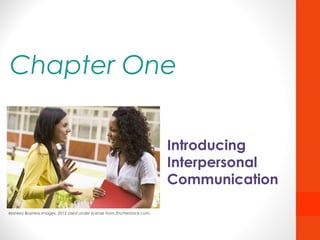
Monkey Business Images, 2012 Used under license from Shutterstock.com.
What Is
Communication?
Communication is the process through which
people use messages to generate meanings
within and across contexts, cultures, channels,
and media.
Defining Communication
Communication…
1. Is a process.
2. Uses messages.
3. Occurs in contexts.
4. Happens via channels.
5. Requires media.
Five Most Common Forms of
Communication Media Used
by College Students
Figure 1.1
Understanding
Communication Models
Three models of the communication process:
1. Linear
2. Interactive
3. Transactional
Linear Communication Model
Figure 1.2
Interactive Communication
Model
Figure 1.3
Transactional Communication
Model
Figure 1.4
What Is Interpersonal
Communication?
Interpersonal communication is a dynamic form
of communication between two (or more)
people in which the messages exchanged
significantly influence their thoughts, emotions,
behaviors, and relationships.
Defining Interpersonal
Communication
Interpersonal communication is:
• Dynamic
• Typically transactional
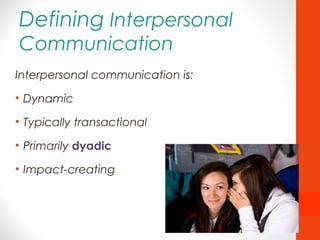
• Primarily dyadic
• Impact-creating
Defining Interpersonal
Communication (cont.)
Buber names two ways of relating to others:
1. I-Thou: deepens bonds and affirms individual
uniqueness
2. I-It: leads to impersonal communication and
even disrespectful communication
Principles of Interpersonal
Communication
Principles of Interpersonal Communication:
1. Conveys content and relationship
information
• Meta-communication is communication
about communication.
2. Can be intentional or unintentional
Principles of Interpersonal
Communication (cont.)
Principles of Interpersonal Communication:
3. Is irreversible
4. Is dynamic
5. Is intertwined with ethics and moral principles
Motives for Interpersonal
Communication
Maslow’s hierarchy of needs:
1. Physical
2. Safety
3. Social
4. Self-esteem
5. Self-actualization
Motives for Interpersonal
Communication (cont.)
Interpersonal communication fulfills three
types of goals:
1. Self-presentation goals
2. Instrumental goals
3. Relationship goals
Research in Interpersonal
Communication
• Research
• Theory
• Qualitative approaches
• Hypotheses
• Quantitative approaches
What Is Interpersonal
Communication
Competence?
Interpersonal communication competence
means consistently communicating in ways
that are appropriate, effective, and ethical.
Understanding Competence
Communication skills are repeatable goal-
directed behaviors and behavioral patterns
that you routinely practice in your interpersonal
encounters and relationships.
Understanding
Competence
(cont.)
Appropriateness is the degree to which your
communication matches situational, relational,
and cultural expectations.
•We judge how appropriate our
communication is through self-monitoring.
•High self-monitors follow expectations while
low self-monitors “act like themselves.”
Self-Quiz:
Test Your Self-Disclosure
Effectiveness is the ability to use communication
to accomplish self-presentational, instrumental,
and relational goals.
Understanding
Competence
(cont.)
Ethics is the set of moral principles that guide
our behavior toward others.
Understanding
Competence
(cont.)
Improving Your
Competence Online
Online Communication refers to any
interaction by means of social networking
sites (such as Facebook), e-mail, text- or
instant-messaging, Skype, chatrooms, and
even massive multiplayer video games.
Improving Your
Competence Online
(cont.)
1. Choose the appropriate medium.
2. Don’t assume online communication is
more efficient.
3. Presume posts are public.
4. Remember posts are permanent.
5. Practice creating drafts.
Issues in Interpersonal
Communication
1. Culture
2. Gender and sexual orientation
3. Online communication
4. The dark side of
interpersonal relationships
Self-Quiz:
The Dark Side of Interpersonal
Relationships

Presentation for McCornack Chapter 1