Introduction to Management 11e
John Schermerhorn
Chapter 5:Chapter 5:
International ManagementInternational Management
Planning Ahead — Chapter 5 study questions
1. What are the management challenges of
globalization?
2. What are global businesses and what do they
do?
3. What is culture and how does it impact global
management?
4. How can we benefit from global management
learning?
Study Question 1: What are the management challenges of
globalization?
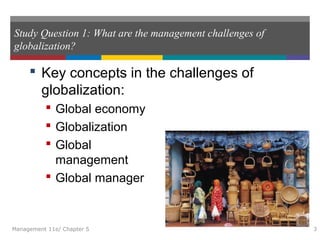
 Key concepts in the challenges of
globalization:
 Global economy
 Globalization
 Global
management
 Global manager
Management 11e/ Chapter 5 3
Study Question 1: What are the management challenges of
globalization?
 Global economy
 Resource supplies, product markets, and
business competition are worldwide, rather
than local
 Globalization
 The process of growing interdependence of
these components in the global economy
Management 11e/ Chapter 5 4
Study Question 1: What are the management challenges of
globalization?
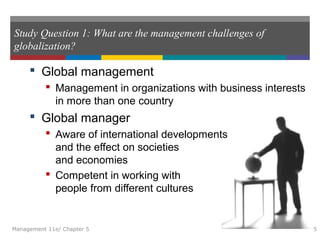
 Global management
 Management in organizations with business interests
in more than one country
 Global manager
 Aware of international developments
and the effect on societies
and economies
 Competent in working with
people from different cultures
Management 11e/ Chapter 5 5
Study Question 1: What are the management challenges of
globalization?
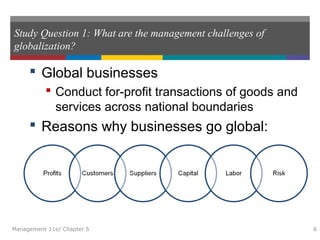
 Global businesses
 Conduct for-profit transactions of goods and
services across national boundaries
 Reasons why businesses go global:
Management 11e/ Chapter 5 6
Study Question 1: What are the management challenges of
globalization?
 Market entry strategies
 involve the sale of goods or services to
foreign markets but do not require expensive
investments
Management 11e/ Chapter 5 7
Study Question 1: What are the management challenges of
globalization?
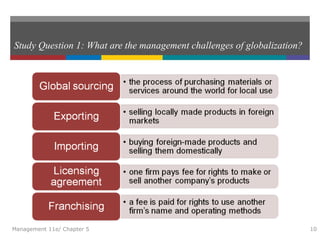
 Types of market entry strategies:
 Global sourcing
 Exporting
 Importing
 Licensing agreement
 Franchising
Management 11e/ Chapter 5 8
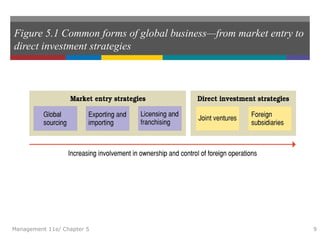
Figure 5.1 Common forms of global business—from market entry to
direct investment strategies
Management 11e/ Chapter 5 9
Study Question 1: What are the management challenges of globalization?
Management 11e/ Chapter 5 10
Study Question 1: What are the international business challenges of
globalization?
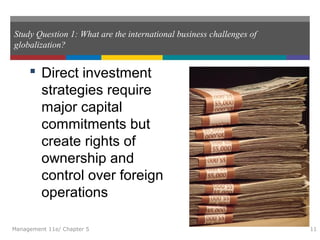
 Direct investment
strategies require
major capital
commitments but
create rights of
ownership and
control over foreign
operations
Management 11e/ Chapter 5 11
Study Question 1: What are the international business challenges of
globalization?
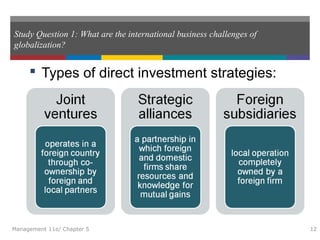
 Types of direct investment strategies:
Management 11e/ Chapter 5 12
Study Question 1: What are the international business challenges of
globalization?
Management 11e/ Chapter 5 13
Study Question 1: What are the international business challenges of
globalization?
Management 11e/ Chapter 5 14
Study Question 1: What are the international business challenges of
globalization?
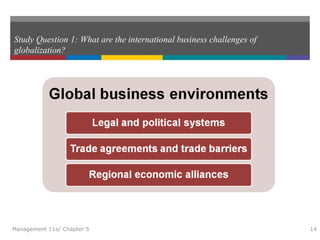
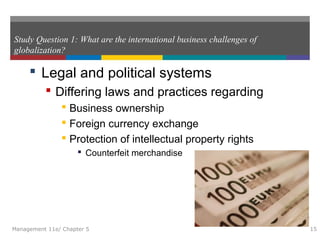
 Legal and political systems
 Differing laws and practices regarding
 Business ownership
 Foreign currency exchange
 Protection of intellectual property rights
 Counterfeit merchandise
Management 11e/ Chapter 5 15
Study Question 1: What are the international business challenges of
globalization?
 Legal and political systems
 Political risk
 Potential loss in value of a foreign investment due
to instability and political changes in the host
country
 Political risk analysis
 Forecast political disruptions that threaten the
value of a foreign investment
Management 11e/ Chapter 5 16
Study Question 1: What are the international business challenges of
globalization?
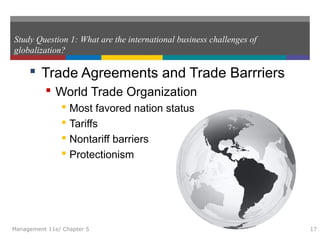
 Trade Agreements and Trade Barrriers
 World Trade Organization
 Most favored nation status
 Tariffs
 Nontariff barriers
 Protectionism
Management 11e/ Chapter 5 17
Study Question 1: What are the international business challenges of
globalization?
 Regional Economic Alliances
 NAFTA – North American Free Trade
Agreement
 EU – European Union
 APEC – Asia Pacific Economic Cooperation
 ASEAN – Association of Southeast Asian
Nations
 SADC – Southern Africa Development
Community
Management 11e/ Chapter 5 18
Study Question 2: What are global businesses and what do they do?
 Types of global businesses:
 Global corporation
 MNC (multinational corporation) with extensive
business operations in more than one foreign
country
 Transnational corporation
 MNC (multinational corporation) operates
worldwide on a borderless basis
Management 11e/ Chapter 5 19
Study Question 2: What are global businesses and what do they do?
 Mutual benefits for host country and
global corporation or MNC:
 Shared growth opportunities
 Shared income opportunities
 Shared learning opportunities
 Shared development opportunities
Management 11e/ Chapter 5 20
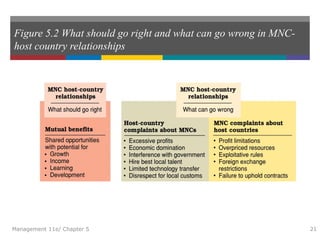
Figure 5.2 What should go right and what can go wrong in MNC-
host country relationships
Management 11e/ Chapter 5 21
Study Question 2: What are global businesses and what do they do?
 Host country complaints about MNCs:
 Excessive profits
 Domination of local economy
 Interference with local government
 Hiring the best local talent
 Limited technology transfer
 Disrespect for local customs
Management 11e/ Chapter 5 22
Study Question 2: What are global businesses and what do they do?
 MNC complaints about host countries:
 Profit limitations
 Overpriced resources
 Exploitative rules
 Foreign exchange restrictions
 Failure to uphold contracts
Management 11e/ Chapter 5 23
Study Question 2: What are global businesses and what do they do?
Management 11e/ Chapter 5 24
Study Question 2: What are global businesses and what do they do?
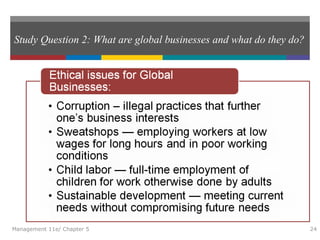
 Ethical issues for Global Businesses:
 Corruption – illegal practices that further
one’s business interests
 Foreign Corrupt Practices Act – makes it
illegal for U.S. firms and their representatives
to engage in corrupt practices overseas
 Bribes to foreign officials
 Excessive commissions
 Non monetary gifts
Management 11e/ Chapter 5 25
Study Question 2: What are global businesses and what do they do?
 Child labor and Sweatshops:
 Child labor – full time employment of children
for work otherwise done by adults
 Sweatshops – employ workers at very low
wages for long hours in poor working
conditions
Management 11e/ Chapter 5 26
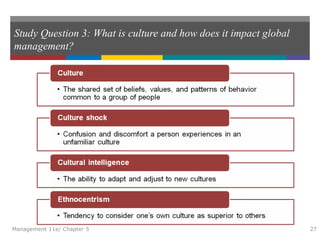
Study Question 3: What is culture and how does it impact global
management?
Management 11e/ Chapter 5 27
Study Question 3: What is culture and how does it impact global
management?
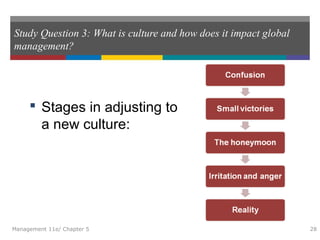
 Stages in adjusting to
a new culture:
Management 11e/ Chapter 5 28
Study Question 3: What is culture and how does it impact global
management?
Management 11e/ Chapter 5 29
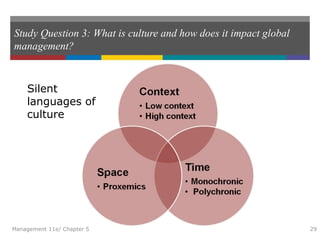
Silent
languages of
culture
Study Question 3: What is culture and how does it impact global
management?
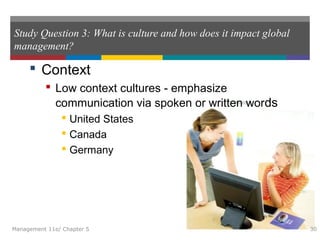
 Context
 Low context cultures - emphasize
communication via spoken or written words
 United States
 Canada
 Germany
Management 11e/ Chapter 5 30
Study Question 3: What is culture and how does it impact global
management?
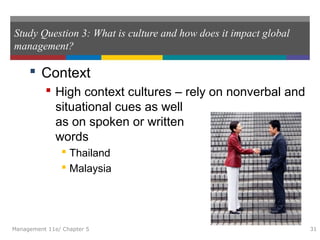
 Context
 High context cultures – rely on nonverbal and
situational cues as well
as on spoken or written
words
 Thailand
 Malaysia
Management 11e/ Chapter 5 31
Study Question 3: What is culture and how does it impact global
management?
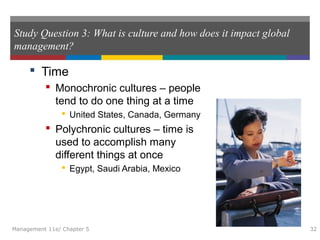
 Time
 Monochronic cultures – people
tend to do one thing at a time
 United States, Canada, Germany
 Polychronic cultures – time is
used to accomplish many
different things at once
 Egypt, Saudi Arabia, Mexico
Management 11e/ Chapter 5 32
Study Question 3: What is culture and how does it impact global
management?
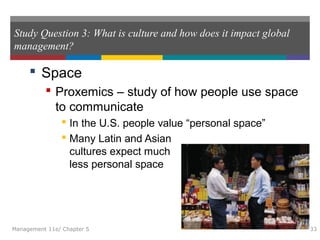
 Space
 Proxemics – study of how people use space
to communicate
 In the U.S. people value “personal space”
 Many Latin and Asian
cultures expect much
less personal space
Management 11e/ Chapter 5 33
Study Question 3: What is culture and how does it impact global
management?
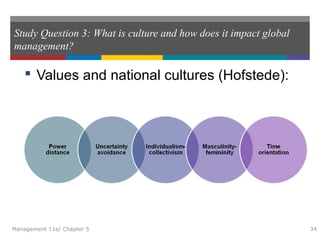
 Values and national cultures (Hofstede):
Management 11e/ Chapter 5 34
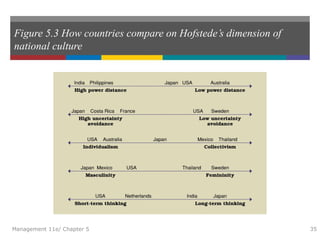
Figure 5.3 How countries compare on Hofstede’s dimension of
national culture
Management 11e/ Chapter 5 35
Study Question 4: How can we benefit from global management
learning?
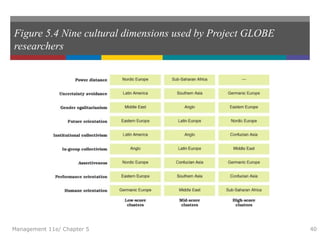
 Project GLOBE (Global Leadership and
Organizational Behavior Effectiveness)
 Researches the leadership, organizational
practices, and diversity among world cultures
 Power distance
 Uncertainty avoidance
 Gender egalitarianism
 Future orientation
Management 11e/ Chapter 5 36
Study Question 4: How can we benefit from global management
learning?
 Project GLOBE’s nine dimensions continued
 Institutional collectivism
 In-group collectivism
 Assertiveness
 Performance orientation
 Humane orientation
Management 11e/ Chapter 5 37
Study Question 4: How can we benefit from global management
learning?
 Project GLOBE’s research on leadership
practices across cultures
 Facilitators of leadership success
 Acting trustworthy, just, honest
 Showing foresight, planning
 Being positive, dynamic, motivating
 Inspiring confidence
 Being informed and communicative
 Being a coordinator and team builder
Management 11e/ Chapter 5 38
Study Question 4: How can we benefit from global management
learning?
 Project GLOBE’s research on leadership
practices across cultures
 Inhibitors of leadership success
 Being a loner
 Acting uncooperative
 Being irritable
 Acting autocratic
Management 11e/ Chapter 5 39
Figure 5.4 Nine cultural dimensions used by Project GLOBE
researchers
Management 11e/ Chapter 5 40
Study Question 4: How can we benefit from global management learning?
 Comparative management
 How management systematically differs
among countries and/or cultures
 Global managers
 Need to successfully apply management
functions across international boundaries
Management 11e/ Chapter 5 41
Study Question 4: How can we benefit from global management learning?
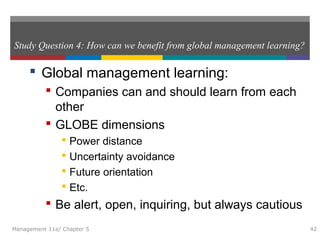
 Global management learning:
 Companies can and should learn from each
other
 GLOBE dimensions
 Power distance
 Uncertainty avoidance
 Future orientation
 Etc.
 Be alert, open, inquiring, but always cautious
Management 11e/ Chapter 5 42
Chapter 5 Case
 Harley-Davidson: Style and Strategy have
Global Reach

International Management

  • 1.
    Introduction to Management11e John Schermerhorn Chapter 5:Chapter 5: International ManagementInternational Management
  • 2.
    Planning Ahead —Chapter 5 study questions 1. What are the management challenges of globalization? 2. What are global businesses and what do they do? 3. What is culture and how does it impact global management? 4. How can we benefit from global management learning?
  • 3.
    Study Question 1:What are the management challenges of globalization?  Key concepts in the challenges of globalization:  Global economy  Globalization  Global management  Global manager Management 11e/ Chapter 5 3
  • 4.
    Study Question 1:What are the management challenges of globalization?  Global economy  Resource supplies, product markets, and business competition are worldwide, rather than local  Globalization  The process of growing interdependence of these components in the global economy Management 11e/ Chapter 5 4
  • 5.
    Study Question 1:What are the management challenges of globalization?  Global management  Management in organizations with business interests in more than one country  Global manager  Aware of international developments and the effect on societies and economies  Competent in working with people from different cultures Management 11e/ Chapter 5 5
  • 6.
    Study Question 1:What are the management challenges of globalization?  Global businesses  Conduct for-profit transactions of goods and services across national boundaries  Reasons why businesses go global: Management 11e/ Chapter 5 6
  • 7.
    Study Question 1:What are the management challenges of globalization?  Market entry strategies  involve the sale of goods or services to foreign markets but do not require expensive investments Management 11e/ Chapter 5 7
  • 8.
    Study Question 1:What are the management challenges of globalization?  Types of market entry strategies:  Global sourcing  Exporting  Importing  Licensing agreement  Franchising Management 11e/ Chapter 5 8
  • 9.
    Figure 5.1 Commonforms of global business—from market entry to direct investment strategies Management 11e/ Chapter 5 9
  • 10.
    Study Question 1:What are the management challenges of globalization? Management 11e/ Chapter 5 10
  • 11.
    Study Question 1:What are the international business challenges of globalization?  Direct investment strategies require major capital commitments but create rights of ownership and control over foreign operations Management 11e/ Chapter 5 11
  • 12.
    Study Question 1:What are the international business challenges of globalization?  Types of direct investment strategies: Management 11e/ Chapter 5 12
  • 13.
    Study Question 1:What are the international business challenges of globalization? Management 11e/ Chapter 5 13
  • 14.
    Study Question 1:What are the international business challenges of globalization? Management 11e/ Chapter 5 14
  • 15.
    Study Question 1:What are the international business challenges of globalization?  Legal and political systems  Differing laws and practices regarding  Business ownership  Foreign currency exchange  Protection of intellectual property rights  Counterfeit merchandise Management 11e/ Chapter 5 15
  • 16.
    Study Question 1:What are the international business challenges of globalization?  Legal and political systems  Political risk  Potential loss in value of a foreign investment due to instability and political changes in the host country  Political risk analysis  Forecast political disruptions that threaten the value of a foreign investment Management 11e/ Chapter 5 16
  • 17.
    Study Question 1:What are the international business challenges of globalization?  Trade Agreements and Trade Barrriers  World Trade Organization  Most favored nation status  Tariffs  Nontariff barriers  Protectionism Management 11e/ Chapter 5 17
  • 18.
    Study Question 1:What are the international business challenges of globalization?  Regional Economic Alliances  NAFTA – North American Free Trade Agreement  EU – European Union  APEC – Asia Pacific Economic Cooperation  ASEAN – Association of Southeast Asian Nations  SADC – Southern Africa Development Community Management 11e/ Chapter 5 18
  • 19.
    Study Question 2:What are global businesses and what do they do?  Types of global businesses:  Global corporation  MNC (multinational corporation) with extensive business operations in more than one foreign country  Transnational corporation  MNC (multinational corporation) operates worldwide on a borderless basis Management 11e/ Chapter 5 19
  • 20.
    Study Question 2:What are global businesses and what do they do?  Mutual benefits for host country and global corporation or MNC:  Shared growth opportunities  Shared income opportunities  Shared learning opportunities  Shared development opportunities Management 11e/ Chapter 5 20
  • 21.
    Figure 5.2 Whatshould go right and what can go wrong in MNC- host country relationships Management 11e/ Chapter 5 21
  • 22.
    Study Question 2:What are global businesses and what do they do?  Host country complaints about MNCs:  Excessive profits  Domination of local economy  Interference with local government  Hiring the best local talent  Limited technology transfer  Disrespect for local customs Management 11e/ Chapter 5 22
  • 23.
    Study Question 2:What are global businesses and what do they do?  MNC complaints about host countries:  Profit limitations  Overpriced resources  Exploitative rules  Foreign exchange restrictions  Failure to uphold contracts Management 11e/ Chapter 5 23
  • 24.
    Study Question 2:What are global businesses and what do they do? Management 11e/ Chapter 5 24
  • 25.
    Study Question 2:What are global businesses and what do they do?  Ethical issues for Global Businesses:  Corruption – illegal practices that further one’s business interests  Foreign Corrupt Practices Act – makes it illegal for U.S. firms and their representatives to engage in corrupt practices overseas  Bribes to foreign officials  Excessive commissions  Non monetary gifts Management 11e/ Chapter 5 25
  • 26.
    Study Question 2:What are global businesses and what do they do?  Child labor and Sweatshops:  Child labor – full time employment of children for work otherwise done by adults  Sweatshops – employ workers at very low wages for long hours in poor working conditions Management 11e/ Chapter 5 26
  • 27.
    Study Question 3:What is culture and how does it impact global management? Management 11e/ Chapter 5 27
  • 28.
    Study Question 3:What is culture and how does it impact global management?  Stages in adjusting to a new culture: Management 11e/ Chapter 5 28
  • 29.
    Study Question 3:What is culture and how does it impact global management? Management 11e/ Chapter 5 29 Silent languages of culture
  • 30.
    Study Question 3:What is culture and how does it impact global management?  Context  Low context cultures - emphasize communication via spoken or written words  United States  Canada  Germany Management 11e/ Chapter 5 30
  • 31.
    Study Question 3:What is culture and how does it impact global management?  Context  High context cultures – rely on nonverbal and situational cues as well as on spoken or written words  Thailand  Malaysia Management 11e/ Chapter 5 31
  • 32.
    Study Question 3:What is culture and how does it impact global management?  Time  Monochronic cultures – people tend to do one thing at a time  United States, Canada, Germany  Polychronic cultures – time is used to accomplish many different things at once  Egypt, Saudi Arabia, Mexico Management 11e/ Chapter 5 32
  • 33.
    Study Question 3:What is culture and how does it impact global management?  Space  Proxemics – study of how people use space to communicate  In the U.S. people value “personal space”  Many Latin and Asian cultures expect much less personal space Management 11e/ Chapter 5 33
  • 34.
    Study Question 3:What is culture and how does it impact global management?  Values and national cultures (Hofstede): Management 11e/ Chapter 5 34
  • 35.
    Figure 5.3 Howcountries compare on Hofstede’s dimension of national culture Management 11e/ Chapter 5 35
  • 36.
    Study Question 4:How can we benefit from global management learning?  Project GLOBE (Global Leadership and Organizational Behavior Effectiveness)  Researches the leadership, organizational practices, and diversity among world cultures  Power distance  Uncertainty avoidance  Gender egalitarianism  Future orientation Management 11e/ Chapter 5 36
  • 37.
    Study Question 4:How can we benefit from global management learning?  Project GLOBE’s nine dimensions continued  Institutional collectivism  In-group collectivism  Assertiveness  Performance orientation  Humane orientation Management 11e/ Chapter 5 37
  • 38.
    Study Question 4:How can we benefit from global management learning?  Project GLOBE’s research on leadership practices across cultures  Facilitators of leadership success  Acting trustworthy, just, honest  Showing foresight, planning  Being positive, dynamic, motivating  Inspiring confidence  Being informed and communicative  Being a coordinator and team builder Management 11e/ Chapter 5 38
  • 39.
    Study Question 4:How can we benefit from global management learning?  Project GLOBE’s research on leadership practices across cultures  Inhibitors of leadership success  Being a loner  Acting uncooperative  Being irritable  Acting autocratic Management 11e/ Chapter 5 39
  • 40.
    Figure 5.4 Ninecultural dimensions used by Project GLOBE researchers Management 11e/ Chapter 5 40
  • 41.
    Study Question 4:How can we benefit from global management learning?  Comparative management  How management systematically differs among countries and/or cultures  Global managers  Need to successfully apply management functions across international boundaries Management 11e/ Chapter 5 41
  • 42.
    Study Question 4:How can we benefit from global management learning?  Global management learning:  Companies can and should learn from each other  GLOBE dimensions  Power distance  Uncertainty avoidance  Future orientation  Etc.  Be alert, open, inquiring, but always cautious Management 11e/ Chapter 5 42
  • 43.
    Chapter 5 Case Harley-Davidson: Style and Strategy have Global Reach