
FOREIGN POLICY
CHINA FOREIGN
POLICY TOWARDS
JAPAN
INTRODUCTION
• China is the largest country in this region and also
the largest population with 1.3 billion citizens
where Beijing as the capital city.
• China were practiced various foreign policy since
her ruled by Communist party.
• China before 1989 are not practiced open-door
policy like other country especially Japan.
• This both of countries make a friendship on 1972
after long time have each other.
The Factors..
1. China’s spectacular economic growth.
• Chinese exports to Japan grew 14.9%
annually on average from 1990 to 2007 and
jumped to $127.7 billion.
• create a huge market to each other for earn
more money.
2. Trade liberalization within the two countries
and China’s accession to the World Trade
Organization (WTO):
• While China exported labor and resource
intensive products to Japan, Japan mainly
exported capital goods to China.
• Japanese direct investment in China have
been driving the rapid growth in intra-
industry trade from year 1980 until now.
3. The massive Japanese direct investment
integrating the Chinese industries.
• Chinese firms can use the global marketing
networks to selling out their products
affected by the Japanese multinational
enterprises.
• China can get more investment, new
information technology and others from
Japan.
4. The complementarity nature of the two
economies:
• it wants to increase their market to create
more goods and advantage to each other.
• Both of the countries will have more bilateral
trade and technology transfer to increase
good relationship.
• Japan also gets more profits in their products
because China has a huge market.
5. The geographic proximity between the two
countries:
• China and Japan are closely because it just has
small distance only.
• Japan can get many of resources and labor in
more cheap wages easily compare to other
countries.
• China also can get more capital of goods and
this country become wealthier.
China foreign policy toward Japan in sosial
issues:
• Trainings for and exchanges between young
and middle-aged officials and personnel in the
fields were conducted.
• Japan and China signed the Japan-China
Cultural Exchange Agreement in 1979
• China have been visited Japan for diplomatic
since 1994 based of info from Ministry of
Foreign Affairs of Japan.
China foreign policy toward Japan in politics:
• The visit of Hu Jintao to Japan on 6-10 May
2008 was notable for the evident mutual
desire to avoid controversy over the existing
or potential areas of tension between China
and Japan.
• Chinese and Japanese politicians had a perfect
opportunity to symbolic a new era of
friendship.
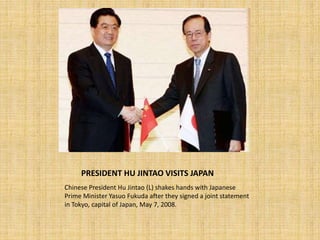
PRESIDENT HU JINTAO VISITS JAPAN
Chinese President Hu Jintao (L) shakes hands with Japanese
Prime Minister Yasuo Fukuda after they signed a joint statement
in Tokyo, capital of Japan, May 7, 2008.
China and Japan’s simmering rivalry:
• China and Japan, the giants of Asia, account
for nearly three-quarters of the region's
economic activity and more than half of the
region's military spending.
• Before the nineteenth century, China was
usually dominant; since the Meiji Restoration,
in 1868, Japan has generally been preeminent.
Continue..
• China has nuclear weapons and
intercontinental ballistic missiles, and its
military budget has grown by double-digit
rates for 17 consecutive years.
• Both states are adopting confrontational
stances, partly because of rising popular
involvement in politics and resurgent
nationalism exacerbated by revived memories
of World War II.
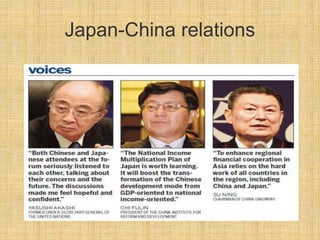
Japan-China relations
THANK YOU

CHINA FOREIGN POLICY TOWARDS JAPAN

  • 1.
  • 2.
    INTRODUCTION • China isthe largest country in this region and also the largest population with 1.3 billion citizens where Beijing as the capital city. • China were practiced various foreign policy since her ruled by Communist party. • China before 1989 are not practiced open-door policy like other country especially Japan. • This both of countries make a friendship on 1972 after long time have each other.
  • 3.
    The Factors.. 1. China’sspectacular economic growth. • Chinese exports to Japan grew 14.9% annually on average from 1990 to 2007 and jumped to $127.7 billion. • create a huge market to each other for earn more money.
  • 4.
    2. Trade liberalizationwithin the two countries and China’s accession to the World Trade Organization (WTO): • While China exported labor and resource intensive products to Japan, Japan mainly exported capital goods to China. • Japanese direct investment in China have been driving the rapid growth in intra- industry trade from year 1980 until now.
  • 5.
    3. The massiveJapanese direct investment integrating the Chinese industries. • Chinese firms can use the global marketing networks to selling out their products affected by the Japanese multinational enterprises. • China can get more investment, new information technology and others from Japan.
  • 6.
    4. The complementaritynature of the two economies: • it wants to increase their market to create more goods and advantage to each other. • Both of the countries will have more bilateral trade and technology transfer to increase good relationship. • Japan also gets more profits in their products because China has a huge market.
  • 7.
    5. The geographicproximity between the two countries: • China and Japan are closely because it just has small distance only. • Japan can get many of resources and labor in more cheap wages easily compare to other countries. • China also can get more capital of goods and this country become wealthier.
  • 8.
    China foreign policytoward Japan in sosial issues: • Trainings for and exchanges between young and middle-aged officials and personnel in the fields were conducted. • Japan and China signed the Japan-China Cultural Exchange Agreement in 1979 • China have been visited Japan for diplomatic since 1994 based of info from Ministry of Foreign Affairs of Japan.
  • 9.
    China foreign policytoward Japan in politics: • The visit of Hu Jintao to Japan on 6-10 May 2008 was notable for the evident mutual desire to avoid controversy over the existing or potential areas of tension between China and Japan. • Chinese and Japanese politicians had a perfect opportunity to symbolic a new era of friendship.
  • 10.
    PRESIDENT HU JINTAOVISITS JAPAN Chinese President Hu Jintao (L) shakes hands with Japanese Prime Minister Yasuo Fukuda after they signed a joint statement in Tokyo, capital of Japan, May 7, 2008.
  • 11.
    China and Japan’ssimmering rivalry: • China and Japan, the giants of Asia, account for nearly three-quarters of the region's economic activity and more than half of the region's military spending. • Before the nineteenth century, China was usually dominant; since the Meiji Restoration, in 1868, Japan has generally been preeminent.
  • 12.
    Continue.. • China hasnuclear weapons and intercontinental ballistic missiles, and its military budget has grown by double-digit rates for 17 consecutive years. • Both states are adopting confrontational stances, partly because of rising popular involvement in politics and resurgent nationalism exacerbated by revived memories of World War II.
  • 13.
  • 14.