Introduction to Management 11e
John Schermerhorn
Chapter 3Chapter 3
Ethical Behavior andEthical Behavior and
Social ResponsibilitySocial Responsibility
Planning Ahead — Chapter 3 Study Questions
1. What is ethical behavior?
2. How do ethical dilemmas complicate the
workplace?
3. How can high ethical standards be
maintained?
4. What is social responsibility and governance?
Study Question 1: What is ethical behavior?
 Ethics
 Code of moral principles.
 Set standards of “good” or “bad” or “right” or
“wrong” in one’s conduct.
 Ethical behavior
 What is accepted as good and right in the
context of the governing moral code.
Study Question 1: What is ethical behavior?Study Question 1: What is ethical behavior?
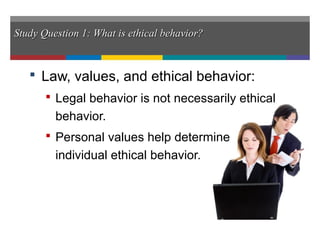
 Law, values, and ethical behavior:
 Legal behavior is not necessarily ethical
behavior.
 Personal values help determine
individual ethical behavior.
Study Question 1: What is ethical behavior?Study Question 1: What is ethical behavior?
 Law, values, and ethical behavior:
 Values - underlying beliefs and attitudes that
help determine individual behavior
 Terminal values - preferences about desired ends
 Instrumental values – preferences regarding the
means to desired ends
Study Question 1: What is ethical behavior?
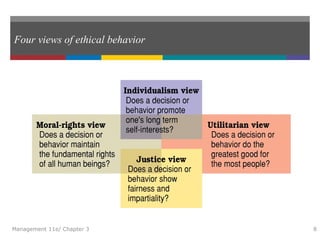
 Alternative ethical views
 Utilitarian
 Delivers the greatest good to the most people
 Individualism
 Advances long-term self-interests
 Moral rights
 Maintains fundamental rights of all human beings
Study Question 1: What is ethical behavior?
 Justice view of ethics
 fair and impartial treatment of people according to
legal rules and standards
 Procedural justice – policies and rules fairly applied
 Distributive justice – equal treatment for all people
 Interactional justice – people treated with dignity and
respect
 Commutative justice – fairness to all involved
Four views of ethical behavior
Management 11e/ Chapter 3 8
Study Question 1: What is ethical behavior?
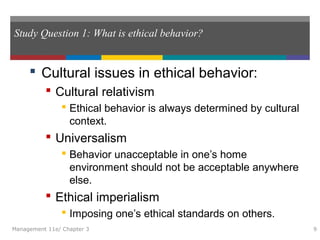
 Cultural issues in ethical behavior:
 Cultural relativism
 Ethical behavior is always determined by cultural
context.
 Universalism
 Behavior unacceptable in one’s home
environment should not be acceptable anywhere
else.
 Ethical imperialism
 Imposing one’s ethical standards on others.
Management 11e/ Chapter 3 9
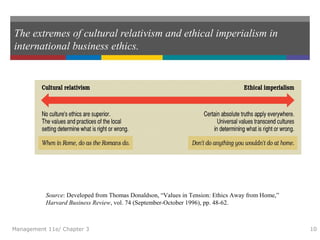
The extremes of cultural relativism and ethical imperialism in
international business ethics.
Management 11e/ Chapter 3 10
Source: Developed from Thomas Donaldson, “Values in Tension: Ethics Away from Home,”
Harvard Business Review, vol. 74 (September-October 1996), pp. 48-62.
Study Question 1: What is ethical behavior?
 Sources of information on ethical behavior:
 Institute for Global Ethics at www.globalethics.org
and on Facebook at
http://www.facebook.com/pages/Rockland-ME/Institute-fo
 Ethics Resource Center at www.ethics.org
Management 11e/ Chapter 3 11
Study Question 2: How do ethical dilemmas complicate the workplace?
 An ethical dilemma
 occurs when choices, although having
potential for personal and/or organizational
benefit, may be considered unethical.
Management 11e/ Chapter 3 12
Study Question 2: How do ethical dilemmas complicate the workplace?
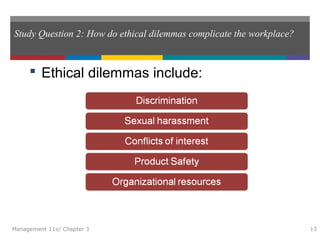
 Ethical dilemmas include:
Management 11e/ Chapter 3 13
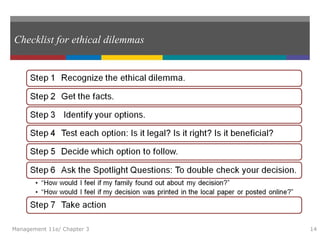
Checklist for ethical dilemmas
Management 11e/ Chapter 3 14
Study Question 2: How do ethical dilemmas complicate the workplace?
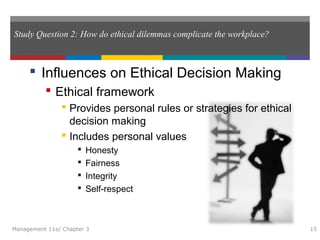
 Influences on Ethical Decision Making
 Ethical framework
 Provides personal rules or strategies for ethical
decision making
 Includes personal values
 Honesty
 Fairness
 Integrity
 Self-respect
Management 11e/ Chapter 3 15
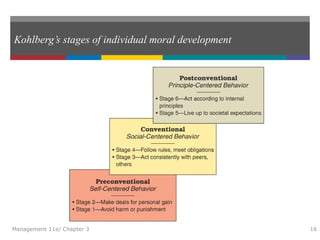
Kohlberg’s stages of individual moral development
Management 11e/ Chapter 3 16
Study Question 2: How do ethical dilemmas complicate the workplace?
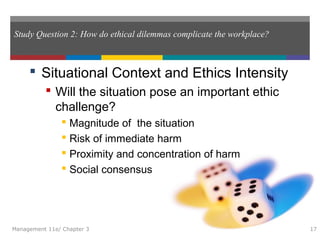
 Situational Context and Ethics Intensity
 Will the situation pose an important ethic
challenge?
 Magnitude of the situation
 Risk of immediate harm
 Proximity and concentration of harm
 Social consensus
Management 11e/ Chapter 3 17
Study Question 2: How do ethical dilemmas complicate the workplace?
 Organizational Culture Influence
 What is considered ethical behavior within
the organizational context?
 What are the expectations of management?
 What are the expectations of co-workers?
 Is there a code of ethics?
Management 11e/ Chapter 3 18
Study Question 2: How do ethical dilemmas complicate the workplace?Study Question 2: How do ethical dilemmas complicate the workplace?
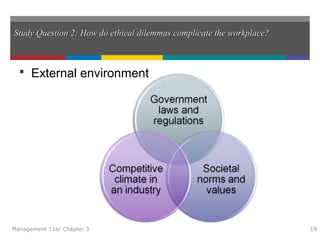
 External environment
Management 11e/ Chapter 3 19
Study Question 2: How do ethical dilemmas complicate the workplace?
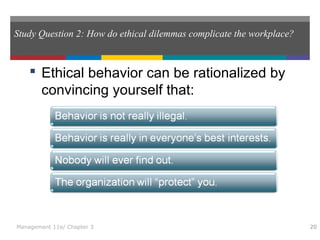
 Ethical behavior can be rationalized by
convincing yourself that:
20Management 11e/ Chapter 3
Study Question 3: How can high ethical standards be maintained?
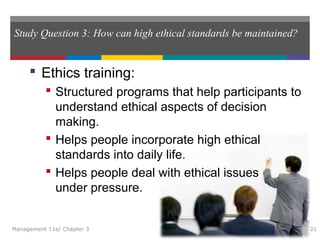
 Ethics training:
 Structured programs that help participants to
understand ethical aspects of decision
making.
 Helps people incorporate high ethical
standards into daily life.
 Helps people deal with ethical issues
under pressure.
Management 11e/ Chapter 3 21
Study Question 3: How can high ethical standards be maintained?
 Codes of Ethical Conduct
 Formal statement of an organization’s values
and ethical principles regarding how to
behave in situations susceptible to the
creation of ethical dilemmas
Management 11e/ Chapter 3 22
Study Question 3: How can high ethical standards be maintained?
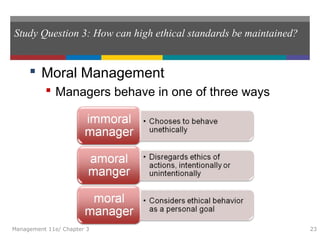
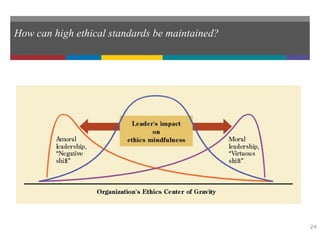
 Moral Management
 Managers behave in one of three ways
Management 11e/ Chapter 3 23
How can high ethical standards be maintained?
24
Study Question 3: How can high ethical standards be maintained?
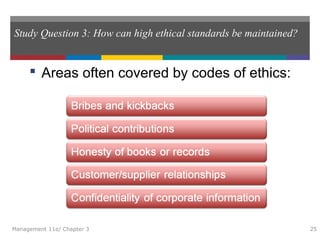
 Areas often covered by codes of ethics:
Management 11e/ Chapter 3 25
Study Question 3: How can high ethical standards be maintained?
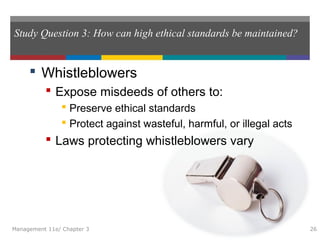
 Whistleblowers
 Expose misdeeds of others to:
 Preserve ethical standards
 Protect against wasteful, harmful, or illegal acts
 Laws protecting whistleblowers vary
Management 11e/ Chapter 3 26
Study Question 3: How can high ethical standards be maintained?
 Barriers to whistleblowing include:
 Strict chain of command
 Strong work group identities
 Ambiguous priorities
Management 11e/ Chapter 3 27
Study Question 3: How can high ethical standards be maintained?
 Organizational methods for overcoming
whistleblowing barriers:
 Ethics staff units who serve as ethics
advocates
 Moral quality circles
Management 11e/ Chapter 3 28
Study Question 3: How can high ethical standards be maintained?
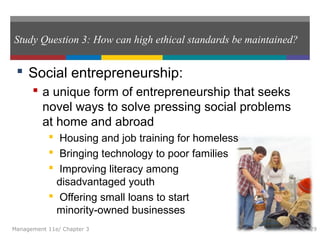
 Social entrepreneurship:
 a unique form of entrepreneurship that seeks
novel ways to solve pressing social problems
at home and abroad
 Housing and job training for homeless
 Bringing technology to poor families
 Improving literacy among
disadvantaged youth
 Offering small loans to start
minority-owned businesses
Management 11e/ Chapter 3 29
Study Question 4: What is social responsibility and corporate governance?
 Corporate social responsibility and
governance:
 Looks at ethical issues on the
organization level.
 Obligates organizations to
act in ways that serve both
its own interests and the
interests of society at large.
Management 11e/ Chapter 3 30
Study Question 4: What is social responsibility and corporate governance?
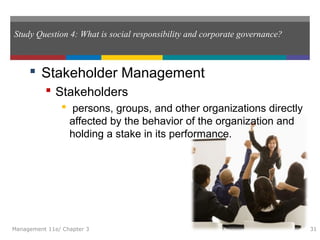
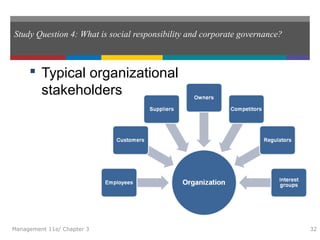
 Stakeholder Management
 Stakeholders
 persons, groups, and other organizations directly
affected by the behavior of the organization and
holding a stake in its performance.
Management 11e/ Chapter 3 31
Study Question 4: What is social responsibility and corporate governance?
 Typical organizational
stakeholders
Management 11e/ Chapter 3 32
Study Question 4: What is social responsibility and corporate
governance?
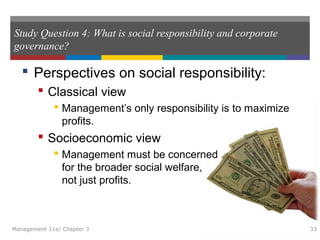
 Perspectives on social responsibility:
 Classical view
 Management’s only responsibility is to maximize
profits.
 Socioeconomic view
 Management must be concerned
for the broader social welfare,
not just profits.
Management 11e/ Chapter 3 33
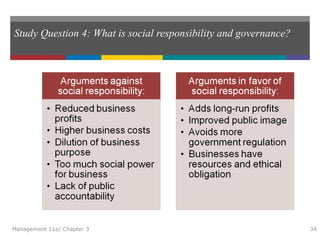
Study Question 4: What is social responsibility and governance?
Management 11e/ Chapter 3 34
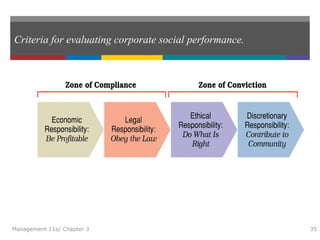
Criteria for evaluating corporate social performance.
Management 11e/ Chapter 3 35
Study Question 4: What is social responsibility and corporate
governance?
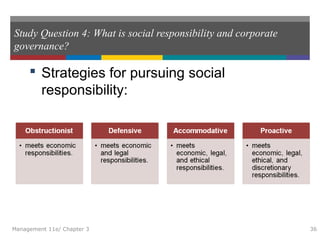
 Strategies for pursuing social
responsibility:
Management 11e/ Chapter 3 36
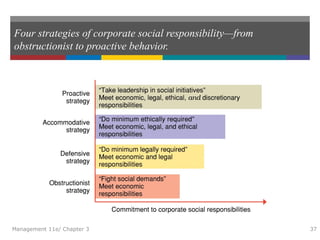
Four strategies of corporate social responsibility—from
obstructionist to proactive behavior.
Management 11e/ Chapter 3 37
Study Question 4: What is social responsibility and governance?
 Corporate governance:
 The oversight of the top management of an
organization by a board of directors.
 Corporate governance involves:
 Hiring, firing, and compensating the CEO.
 Assessing strategy.
 Verifying financial records.
Management 11e/ Chapter 3 38
Study Question 4: What is social responsibility and governance?
 How government influences
organizations:
 Common areas of government regulation of
business affairs:
 Occupational safety and health
 Fair labor practices
 Consumer protection
 Environmental protection
Management 11e/ Chapter 3 39
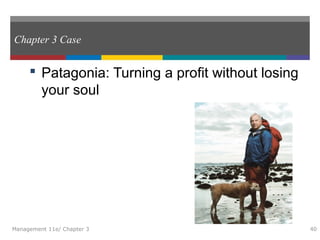
Chapter 3 Case
 Patagonia: Turning a profit without losing
your soul
Management 11e/ Chapter 3 40

Ethical Behavior and Social Responsibility

  • 1.
    Introduction to Management11e John Schermerhorn Chapter 3Chapter 3 Ethical Behavior andEthical Behavior and Social ResponsibilitySocial Responsibility
  • 2.
    Planning Ahead —Chapter 3 Study Questions 1. What is ethical behavior? 2. How do ethical dilemmas complicate the workplace? 3. How can high ethical standards be maintained? 4. What is social responsibility and governance?
  • 3.
    Study Question 1:What is ethical behavior?  Ethics  Code of moral principles.  Set standards of “good” or “bad” or “right” or “wrong” in one’s conduct.  Ethical behavior  What is accepted as good and right in the context of the governing moral code.
  • 4.
    Study Question 1:What is ethical behavior?Study Question 1: What is ethical behavior?  Law, values, and ethical behavior:  Legal behavior is not necessarily ethical behavior.  Personal values help determine individual ethical behavior.
  • 5.
    Study Question 1:What is ethical behavior?Study Question 1: What is ethical behavior?  Law, values, and ethical behavior:  Values - underlying beliefs and attitudes that help determine individual behavior  Terminal values - preferences about desired ends  Instrumental values – preferences regarding the means to desired ends
  • 6.
    Study Question 1:What is ethical behavior?  Alternative ethical views  Utilitarian  Delivers the greatest good to the most people  Individualism  Advances long-term self-interests  Moral rights  Maintains fundamental rights of all human beings
  • 7.
    Study Question 1:What is ethical behavior?  Justice view of ethics  fair and impartial treatment of people according to legal rules and standards  Procedural justice – policies and rules fairly applied  Distributive justice – equal treatment for all people  Interactional justice – people treated with dignity and respect  Commutative justice – fairness to all involved
  • 8.
    Four views ofethical behavior Management 11e/ Chapter 3 8
  • 9.
    Study Question 1:What is ethical behavior?  Cultural issues in ethical behavior:  Cultural relativism  Ethical behavior is always determined by cultural context.  Universalism  Behavior unacceptable in one’s home environment should not be acceptable anywhere else.  Ethical imperialism  Imposing one’s ethical standards on others. Management 11e/ Chapter 3 9
  • 10.
    The extremes ofcultural relativism and ethical imperialism in international business ethics. Management 11e/ Chapter 3 10 Source: Developed from Thomas Donaldson, “Values in Tension: Ethics Away from Home,” Harvard Business Review, vol. 74 (September-October 1996), pp. 48-62.
  • 11.
    Study Question 1:What is ethical behavior?  Sources of information on ethical behavior:  Institute for Global Ethics at www.globalethics.org and on Facebook at http://www.facebook.com/pages/Rockland-ME/Institute-fo  Ethics Resource Center at www.ethics.org Management 11e/ Chapter 3 11
  • 12.
    Study Question 2:How do ethical dilemmas complicate the workplace?  An ethical dilemma  occurs when choices, although having potential for personal and/or organizational benefit, may be considered unethical. Management 11e/ Chapter 3 12
  • 13.
    Study Question 2:How do ethical dilemmas complicate the workplace?  Ethical dilemmas include: Management 11e/ Chapter 3 13
  • 14.
    Checklist for ethicaldilemmas Management 11e/ Chapter 3 14
  • 15.
    Study Question 2:How do ethical dilemmas complicate the workplace?  Influences on Ethical Decision Making  Ethical framework  Provides personal rules or strategies for ethical decision making  Includes personal values  Honesty  Fairness  Integrity  Self-respect Management 11e/ Chapter 3 15
  • 16.
    Kohlberg’s stages ofindividual moral development Management 11e/ Chapter 3 16
  • 17.
    Study Question 2:How do ethical dilemmas complicate the workplace?  Situational Context and Ethics Intensity  Will the situation pose an important ethic challenge?  Magnitude of the situation  Risk of immediate harm  Proximity and concentration of harm  Social consensus Management 11e/ Chapter 3 17
  • 18.
    Study Question 2:How do ethical dilemmas complicate the workplace?  Organizational Culture Influence  What is considered ethical behavior within the organizational context?  What are the expectations of management?  What are the expectations of co-workers?  Is there a code of ethics? Management 11e/ Chapter 3 18
  • 19.
    Study Question 2:How do ethical dilemmas complicate the workplace?Study Question 2: How do ethical dilemmas complicate the workplace?  External environment Management 11e/ Chapter 3 19
  • 20.
    Study Question 2:How do ethical dilemmas complicate the workplace?  Ethical behavior can be rationalized by convincing yourself that: 20Management 11e/ Chapter 3
  • 21.
    Study Question 3:How can high ethical standards be maintained?  Ethics training:  Structured programs that help participants to understand ethical aspects of decision making.  Helps people incorporate high ethical standards into daily life.  Helps people deal with ethical issues under pressure. Management 11e/ Chapter 3 21
  • 22.
    Study Question 3:How can high ethical standards be maintained?  Codes of Ethical Conduct  Formal statement of an organization’s values and ethical principles regarding how to behave in situations susceptible to the creation of ethical dilemmas Management 11e/ Chapter 3 22
  • 23.
    Study Question 3:How can high ethical standards be maintained?  Moral Management  Managers behave in one of three ways Management 11e/ Chapter 3 23
  • 24.
    How can highethical standards be maintained? 24
  • 25.
    Study Question 3:How can high ethical standards be maintained?  Areas often covered by codes of ethics: Management 11e/ Chapter 3 25
  • 26.
    Study Question 3:How can high ethical standards be maintained?  Whistleblowers  Expose misdeeds of others to:  Preserve ethical standards  Protect against wasteful, harmful, or illegal acts  Laws protecting whistleblowers vary Management 11e/ Chapter 3 26
  • 27.
    Study Question 3:How can high ethical standards be maintained?  Barriers to whistleblowing include:  Strict chain of command  Strong work group identities  Ambiguous priorities Management 11e/ Chapter 3 27
  • 28.
    Study Question 3:How can high ethical standards be maintained?  Organizational methods for overcoming whistleblowing barriers:  Ethics staff units who serve as ethics advocates  Moral quality circles Management 11e/ Chapter 3 28
  • 29.
    Study Question 3:How can high ethical standards be maintained?  Social entrepreneurship:  a unique form of entrepreneurship that seeks novel ways to solve pressing social problems at home and abroad  Housing and job training for homeless  Bringing technology to poor families  Improving literacy among disadvantaged youth  Offering small loans to start minority-owned businesses Management 11e/ Chapter 3 29
  • 30.
    Study Question 4:What is social responsibility and corporate governance?  Corporate social responsibility and governance:  Looks at ethical issues on the organization level.  Obligates organizations to act in ways that serve both its own interests and the interests of society at large. Management 11e/ Chapter 3 30
  • 31.
    Study Question 4:What is social responsibility and corporate governance?  Stakeholder Management  Stakeholders  persons, groups, and other organizations directly affected by the behavior of the organization and holding a stake in its performance. Management 11e/ Chapter 3 31
  • 32.
    Study Question 4:What is social responsibility and corporate governance?  Typical organizational stakeholders Management 11e/ Chapter 3 32
  • 33.
    Study Question 4:What is social responsibility and corporate governance?  Perspectives on social responsibility:  Classical view  Management’s only responsibility is to maximize profits.  Socioeconomic view  Management must be concerned for the broader social welfare, not just profits. Management 11e/ Chapter 3 33
  • 34.
    Study Question 4:What is social responsibility and governance? Management 11e/ Chapter 3 34
  • 35.
    Criteria for evaluatingcorporate social performance. Management 11e/ Chapter 3 35
  • 36.
    Study Question 4:What is social responsibility and corporate governance?  Strategies for pursuing social responsibility: Management 11e/ Chapter 3 36
  • 37.
    Four strategies ofcorporate social responsibility—from obstructionist to proactive behavior. Management 11e/ Chapter 3 37
  • 38.
    Study Question 4:What is social responsibility and governance?  Corporate governance:  The oversight of the top management of an organization by a board of directors.  Corporate governance involves:  Hiring, firing, and compensating the CEO.  Assessing strategy.  Verifying financial records. Management 11e/ Chapter 3 38
  • 39.
    Study Question 4:What is social responsibility and governance?  How government influences organizations:  Common areas of government regulation of business affairs:  Occupational safety and health  Fair labor practices  Consumer protection  Environmental protection Management 11e/ Chapter 3 39
  • 40.
    Chapter 3 Case Patagonia: Turning a profit without losing your soul Management 11e/ Chapter 3 40