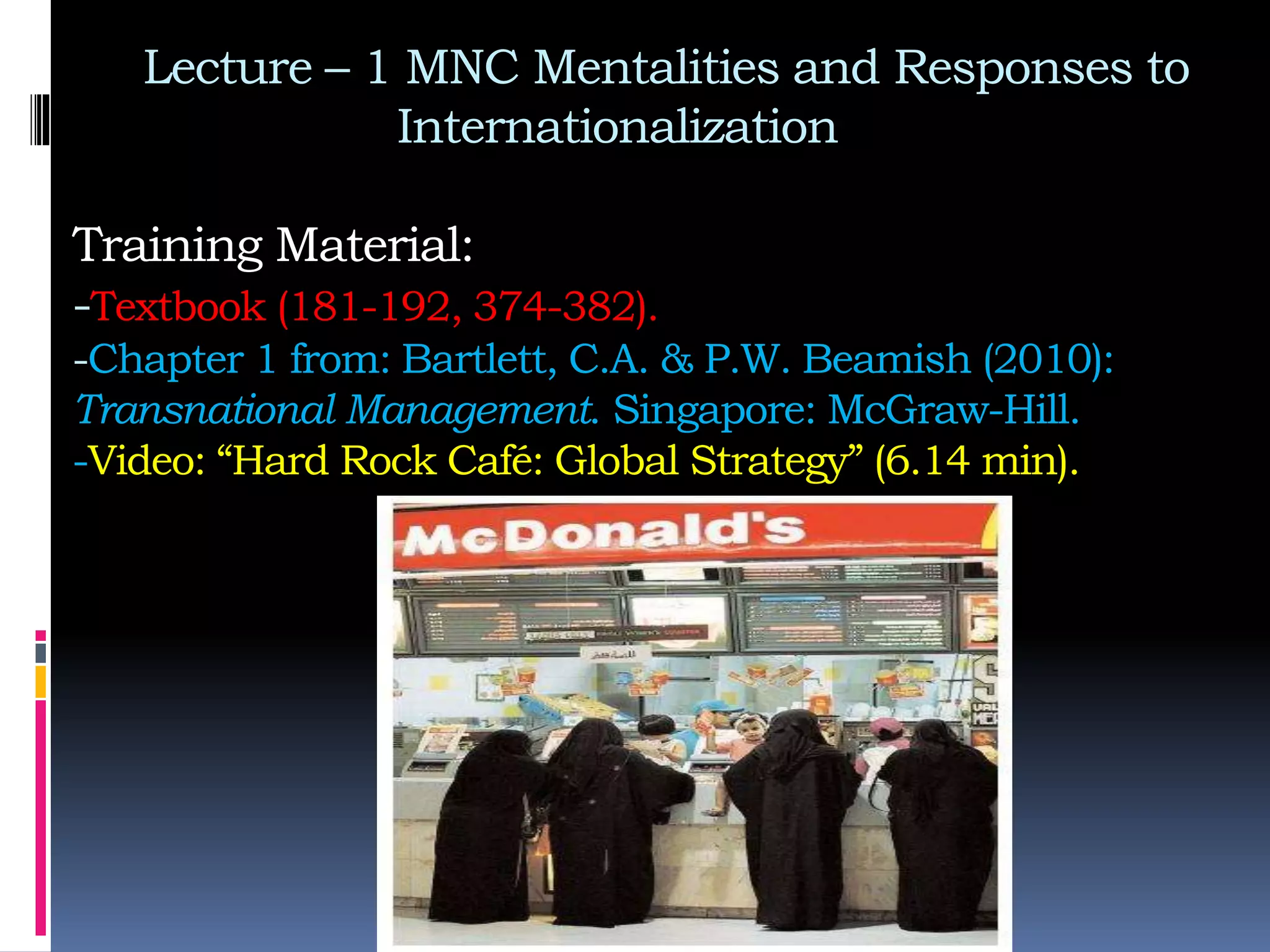
Lecture – 1 MNC Mentalities and Responses to
Internationalization
Training Material:
-Textbook (181-192, 374-382).
-Chapter 1 from: Bartlett, C.A. & P.W. Beamish (2010):
Transnational Management. Singapore: McGraw-Hill.
-Video: “Hard Rock Café: Global Strategy” (6.14 min).
Think global, act local
 The original phrase "Think Global, Act Local" first appeared
in the book "The Evolution of Cities" (1905) by Scots
Planner and was later applied by the social activist Patrick
Geddes.
 Strategic moves are integrated and coordinated worldwide,
aiming at building a global brand name.
 Global thinking and local response utilizes a common
strategic approach (low-cost, differentiation, focus), but
allows country-to-country customization to fit local market
conditions.
 Marketing and distribution are adapted to fit local customs
and cultures
Glocalization: Think global, act local
 « The term Glocal and the process of Glocalization are formed by
telescoping global and local to make a blend». The Oxford
Dictionary of New Words, 1991
 Glocalization : The interpenetration of global and local, resulting
in unique outcomes in different geographic areas. George Ritzer
 Refers to the development and selling of products or services
intended for the global market, but adapted to suit local culture
and behavior.
 «Only truly global companies can achieve ‘global localisation’
that is, be as much of an insider as a local company but still
accomplish the benefits of world- scale operations». Kenichi
Ohmae
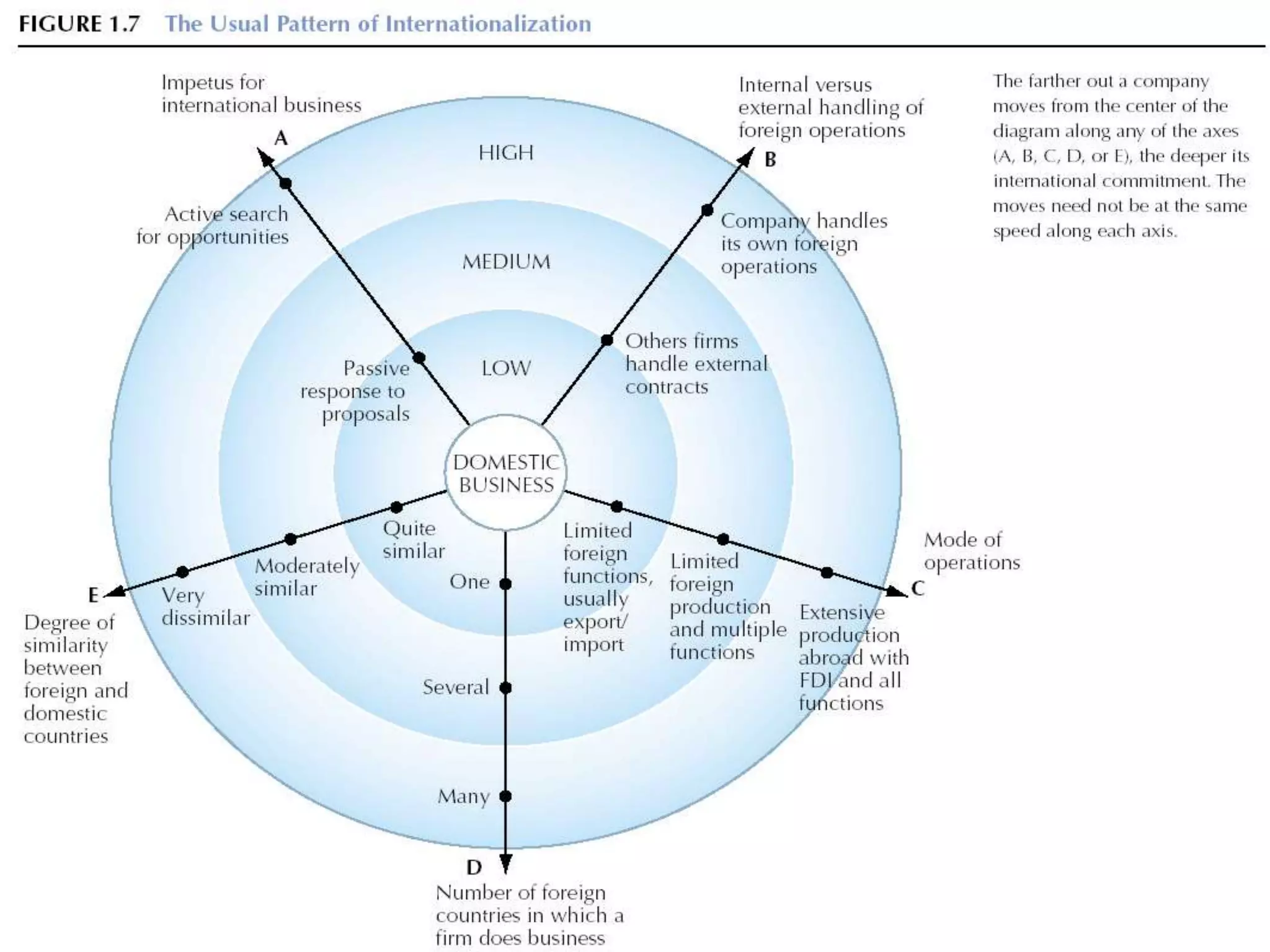
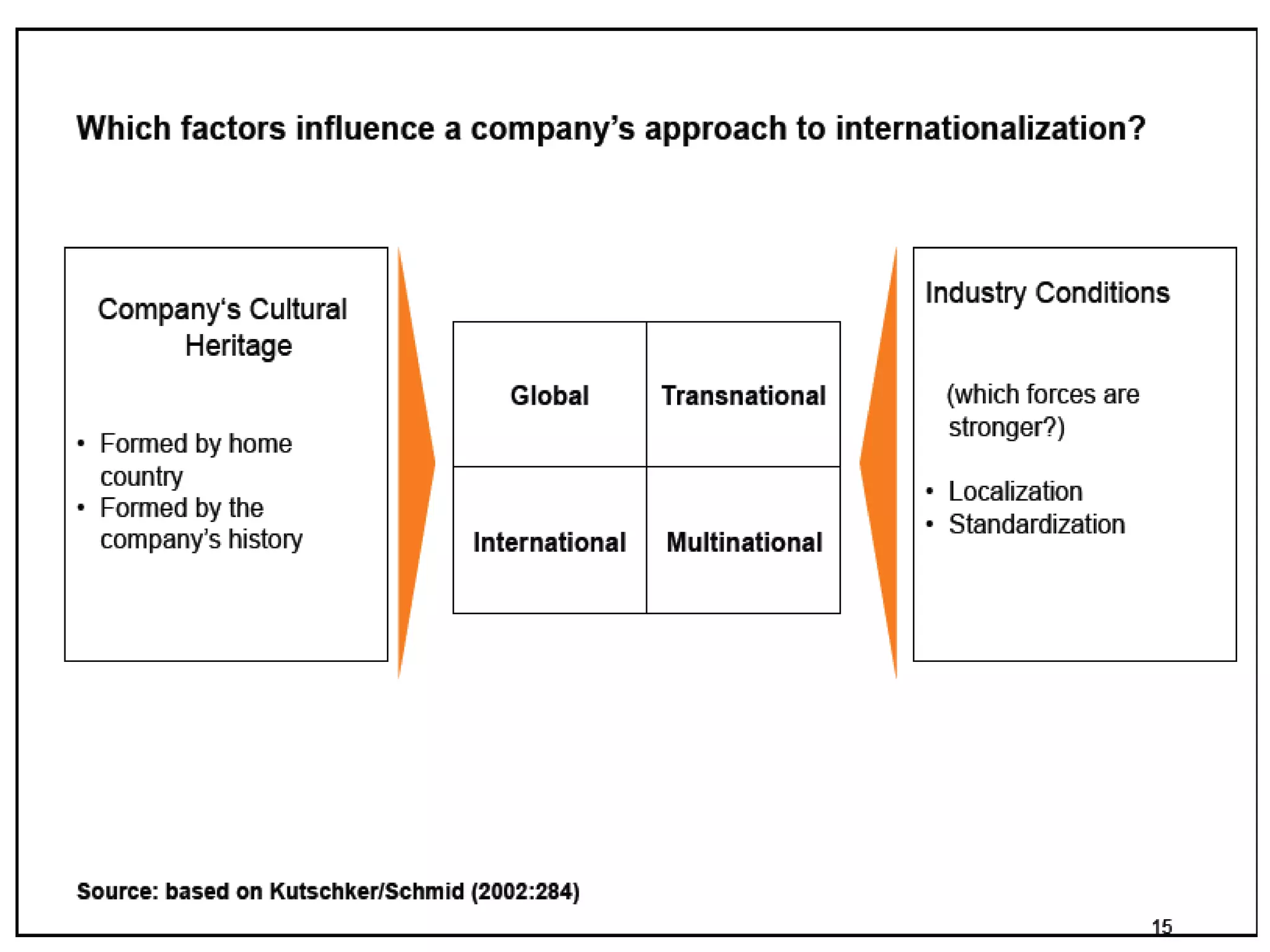
Patterns of
Internationalization
Figure 1.7
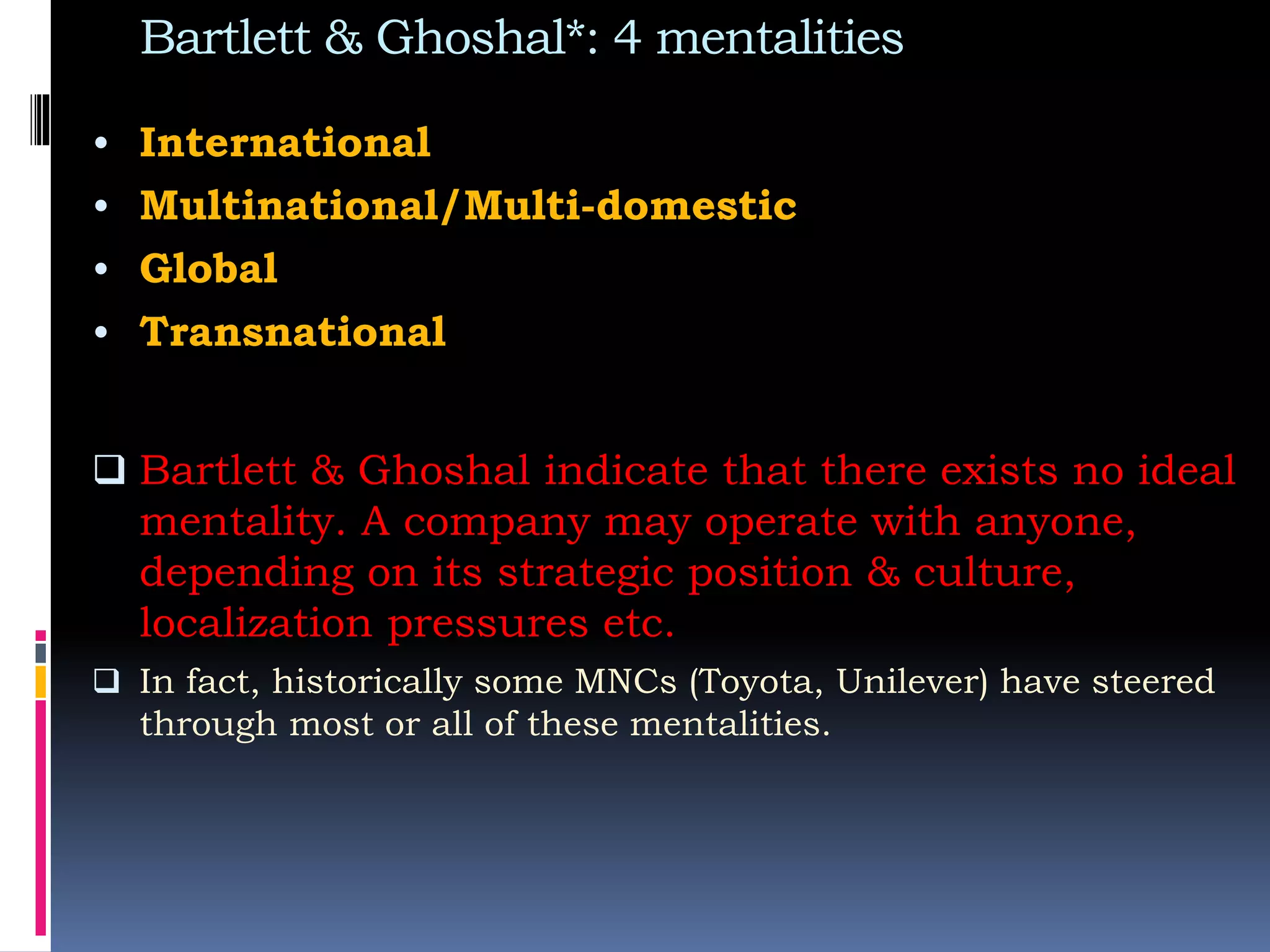
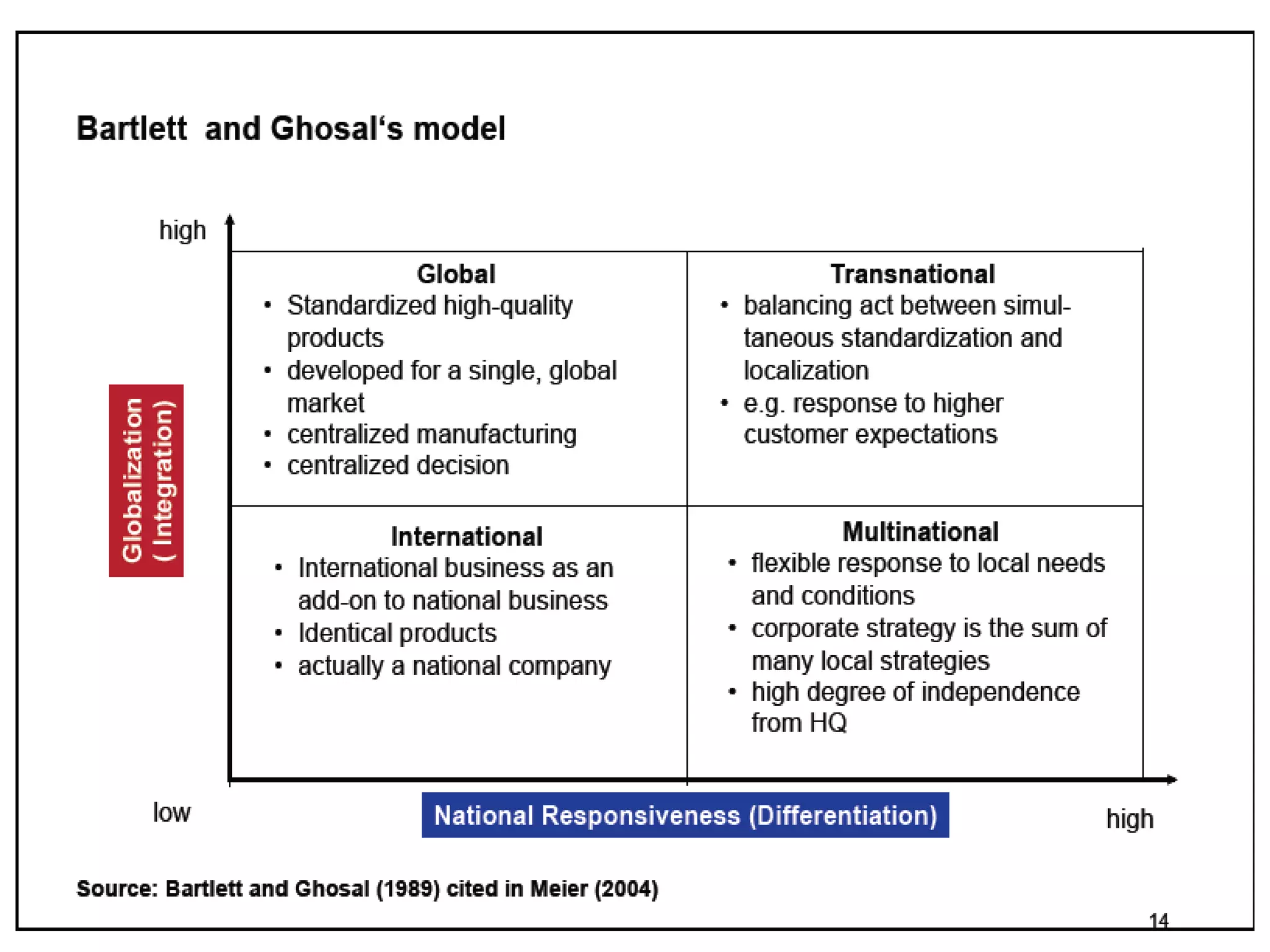
Bartlett & Ghoshal*: 4 mentalities
• International
• Multinational/Multi-domestic
• Global
• Transnational
 Bartlett & Ghoshal indicate that there exists no ideal
mentality. A company may operate with anyone,
depending on its strategic position & culture,
localization pressures etc.
 In fact, historically some MNCs (Toyota, Unilever) have steered
through most or all of these mentalities.
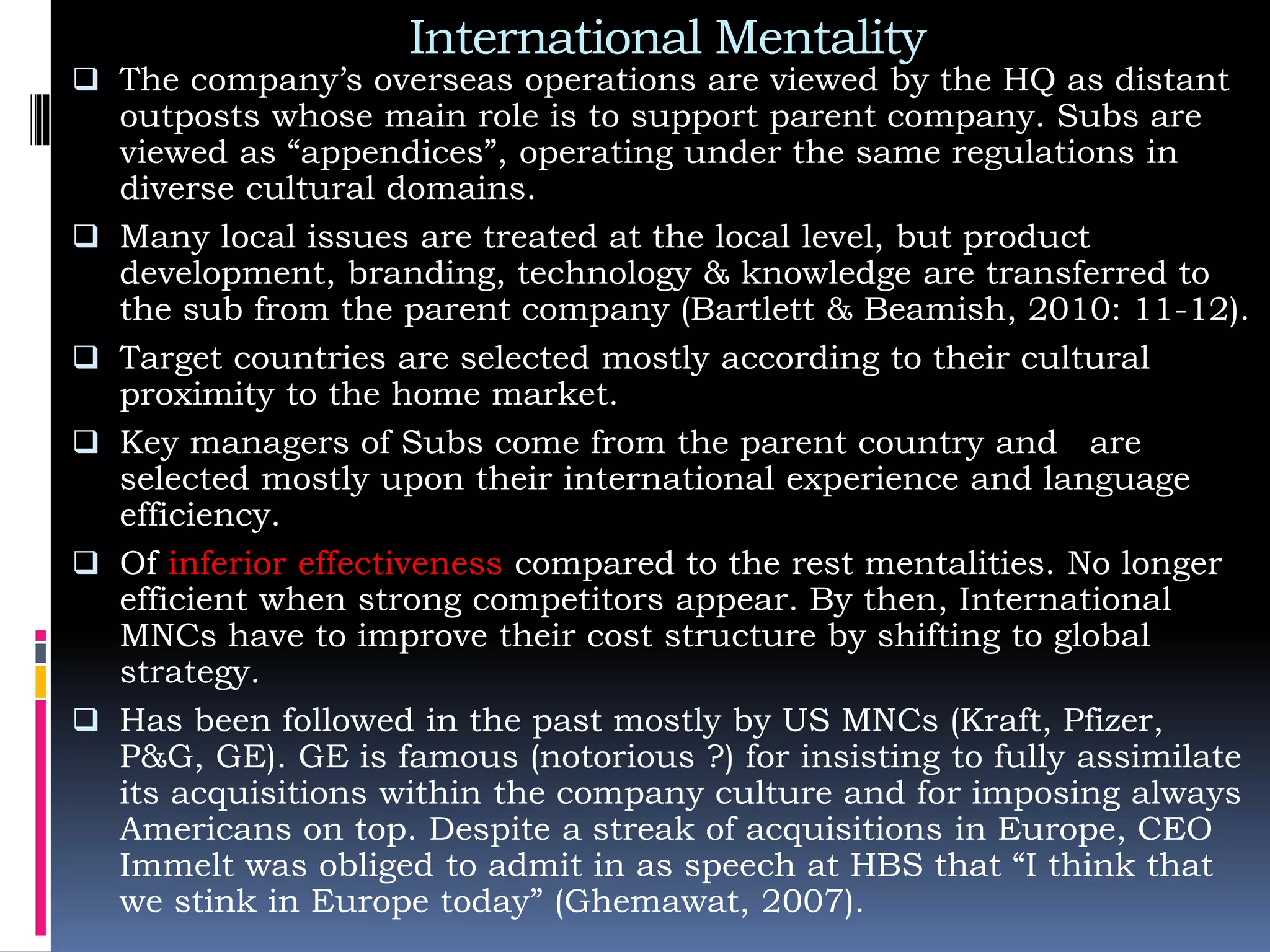
International Mentality
 The company’s overseas operations are viewed by the HQ as distant
outposts whose main role is to support parent company. Subs are
viewed as “appendices”, operating under the same regulations in
diverse cultural domains.
 Many local issues are treated at the local level, but product
development, branding, technology & knowledge are transferred to
the sub from the parent company (Bartlett & Beamish, 2010: 11-12).
 Target countries are selected mostly according to their cultural
proximity to the home market.
 Key managers of Subs come from the parent country and are
selected mostly upon their international experience and language
efficiency.
 Of inferior effectiveness compared to the rest mentalities. No longer
efficient when strong competitors appear. By then, International
MNCs have to improve their cost structure by shifting to global
strategy.
 Has been followed in the past mostly by US MNCs (Kraft, Pfizer,
P&G, GE). GE is famous (notorious ?) for insisting to fully assimilate
its acquisitions within the company culture and for imposing always
Americans on top. Despite a streak of acquisitions in Europe, CEO
Immelt was obliged to admit in as speech at HBS that “I think that
we stink in Europe today” (Ghemawat, 2007).
8
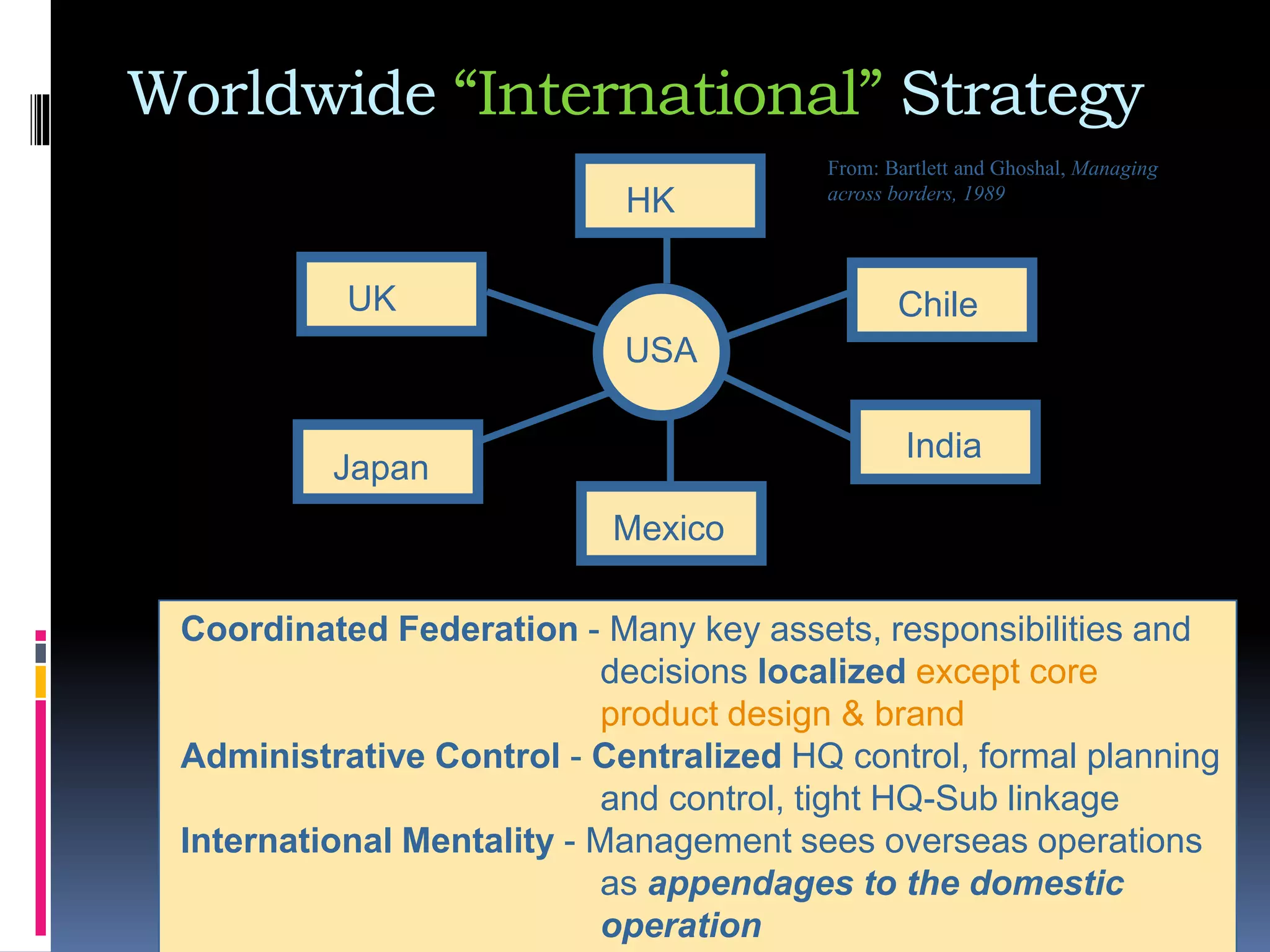
Worldwide “International” Strategy
Coordinated Federation - Many key assets, responsibilities and
decisions localized except core
product design & brand
Administrative Control - Centralized HQ control, formal planning
and control, tight HQ-Sub linkage
International Mentality - Management sees overseas operations
as appendages to the domestic
operation
UK Chile
India
Japan
USA
HK
Mexico
From: Bartlett and Ghoshal, Managing
across borders, 1989
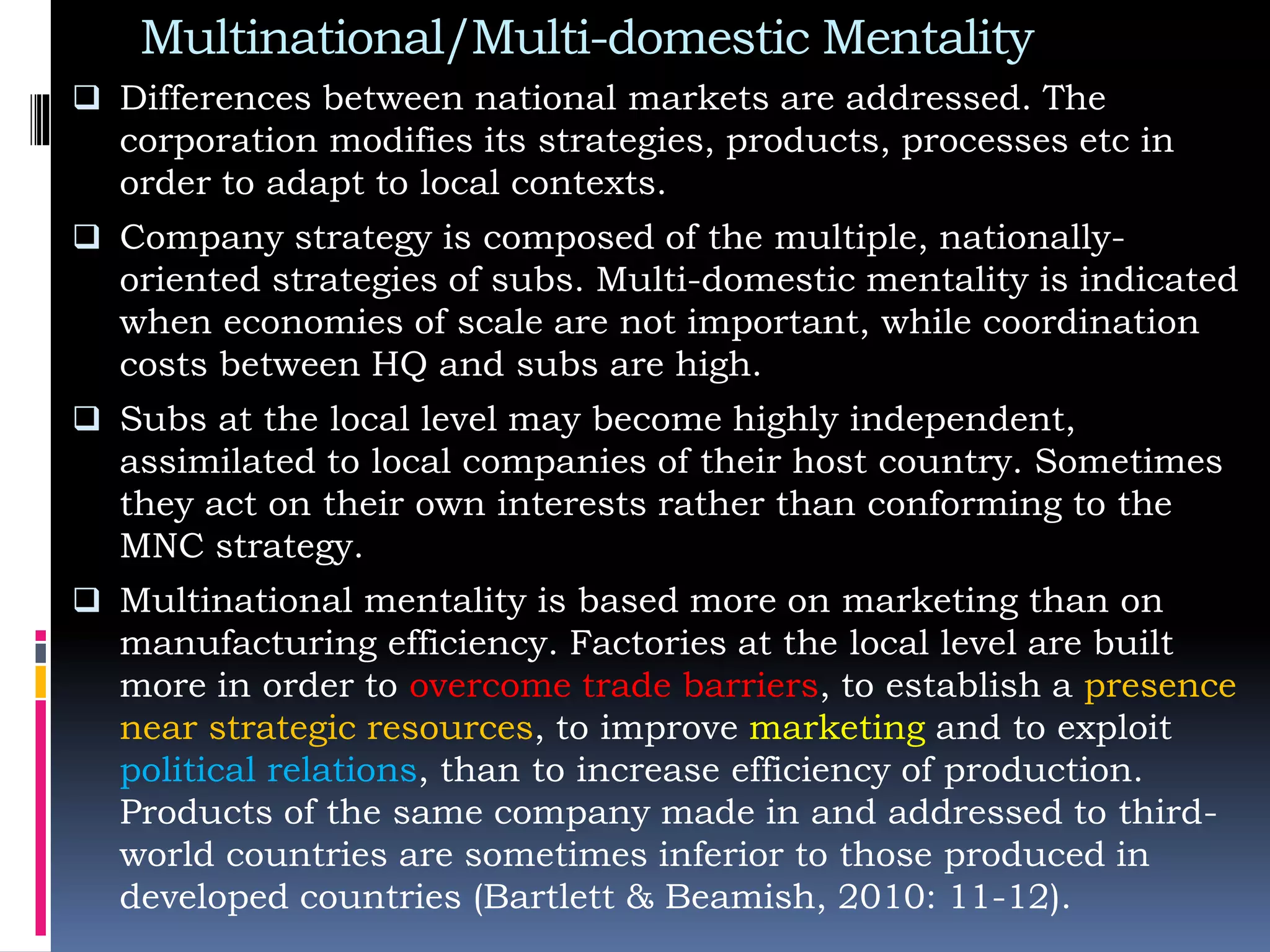
Multinational/Multi-domestic Mentality
 Differences between national markets are addressed. The
corporation modifies its strategies, products, processes etc in
order to adapt to local contexts.
 Company strategy is composed of the multiple, nationally-
oriented strategies of subs. Multi-domestic mentality is indicated
when economies of scale are not important, while coordination
costs between HQ and subs are high.
 Subs at the local level may become highly independent,
assimilated to local companies of their host country. Sometimes
they act on their own interests rather than conforming to the
MNC strategy.
 Multinational mentality is based more on marketing than on
manufacturing efficiency. Factories at the local level are built
more in order to overcome trade barriers, to establish a presence
near strategic resources, to improve marketing and to exploit
political relations, than to increase efficiency of production.
Products of the same company made in and addressed to third-
world countries are sometimes inferior to those produced in
developed countries (Bartlett & Beamish, 2010: 11-12).
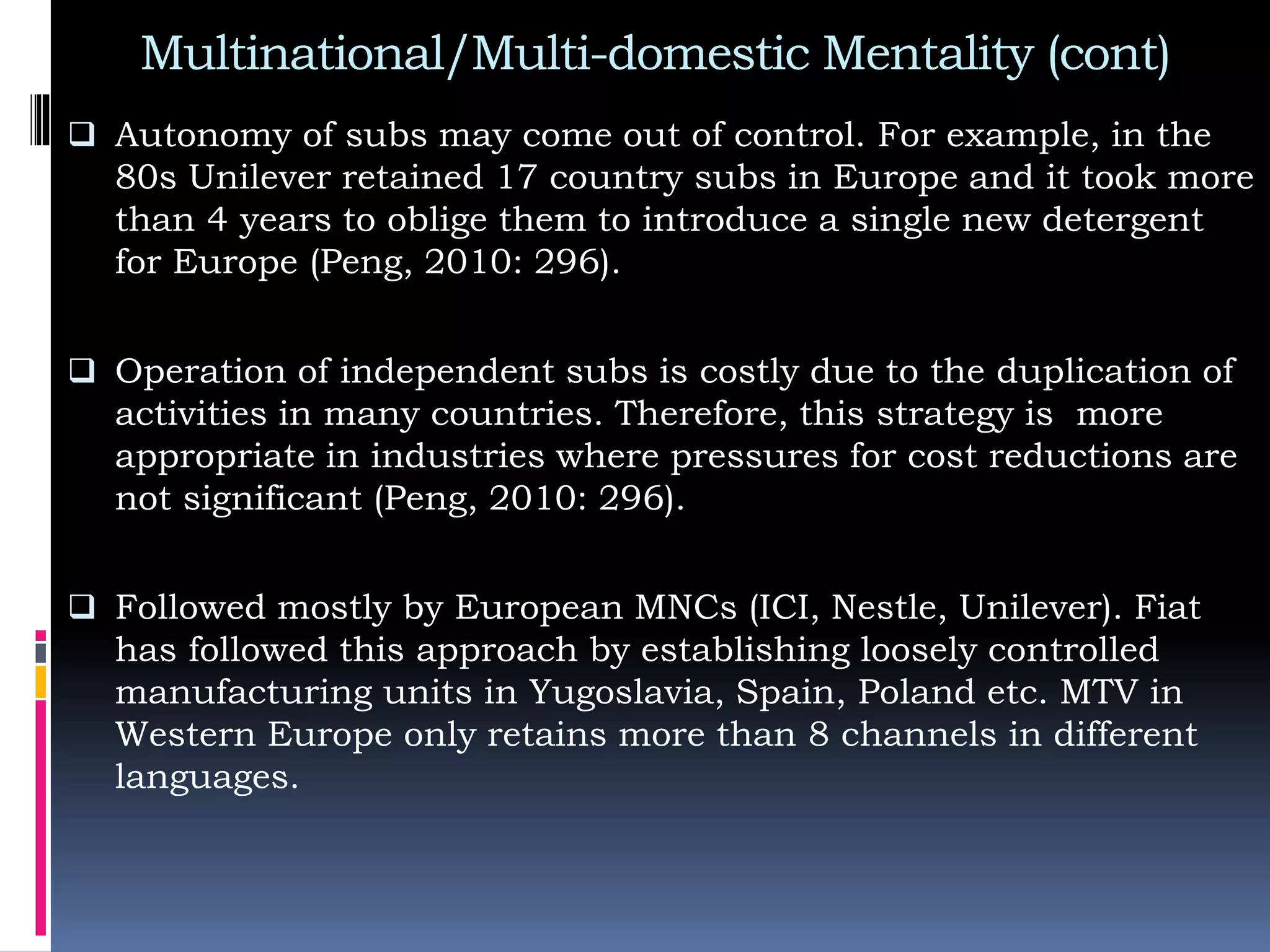
Multinational/Multi-domestic Mentality (cont)
 Autonomy of subs may come out of control. For example, in the
80s Unilever retained 17 country subs in Europe and it took more
than 4 years to oblige them to introduce a single new detergent
for Europe (Peng, 2010: 296).
 Operation of independent subs is costly due to the duplication of
activities in many countries. Therefore, this strategy is more
appropriate in industries where pressures for cost reductions are
not significant (Peng, 2010: 296).
 Followed mostly by European MNCs (ICI, Nestle, Unilever). Fiat
has followed this approach by establishing loosely controlled
manufacturing units in Yugoslavia, Spain, Poland etc. MTV in
Western Europe only retains more than 8 channels in different
languages.
11
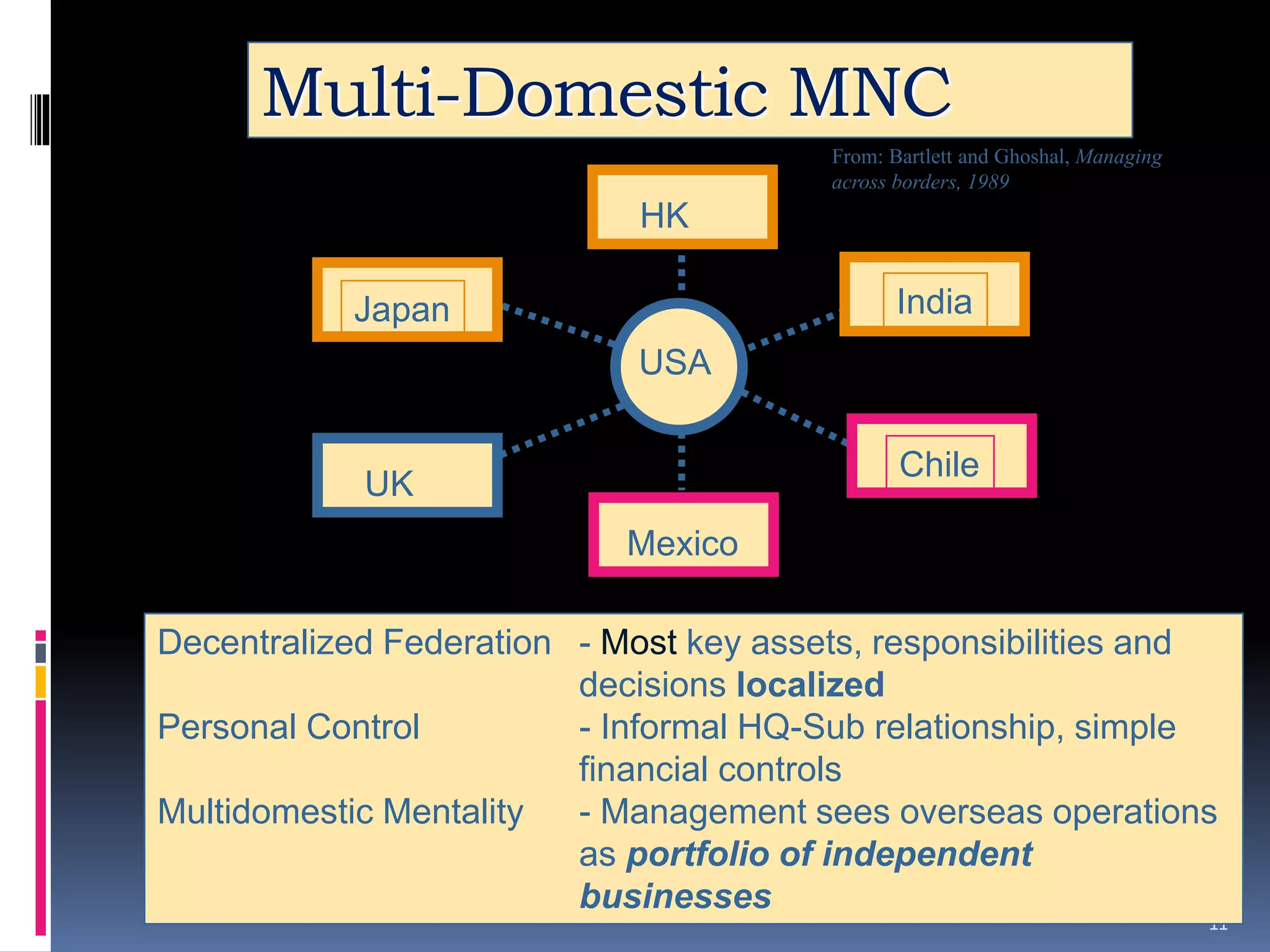
Multi-Domestic MNC
Decentralized Federation - Most key assets, responsibilities and
decisions localized
Personal Control - Informal HQ-Sub relationship, simple
financial controls
Multidomestic Mentality - Management sees overseas operations
as portfolio of independent
businesses
UK
Chile
India
Japan
USA
HK
Mexico
From: Bartlett and Ghoshal, Managing
across borders, 1989
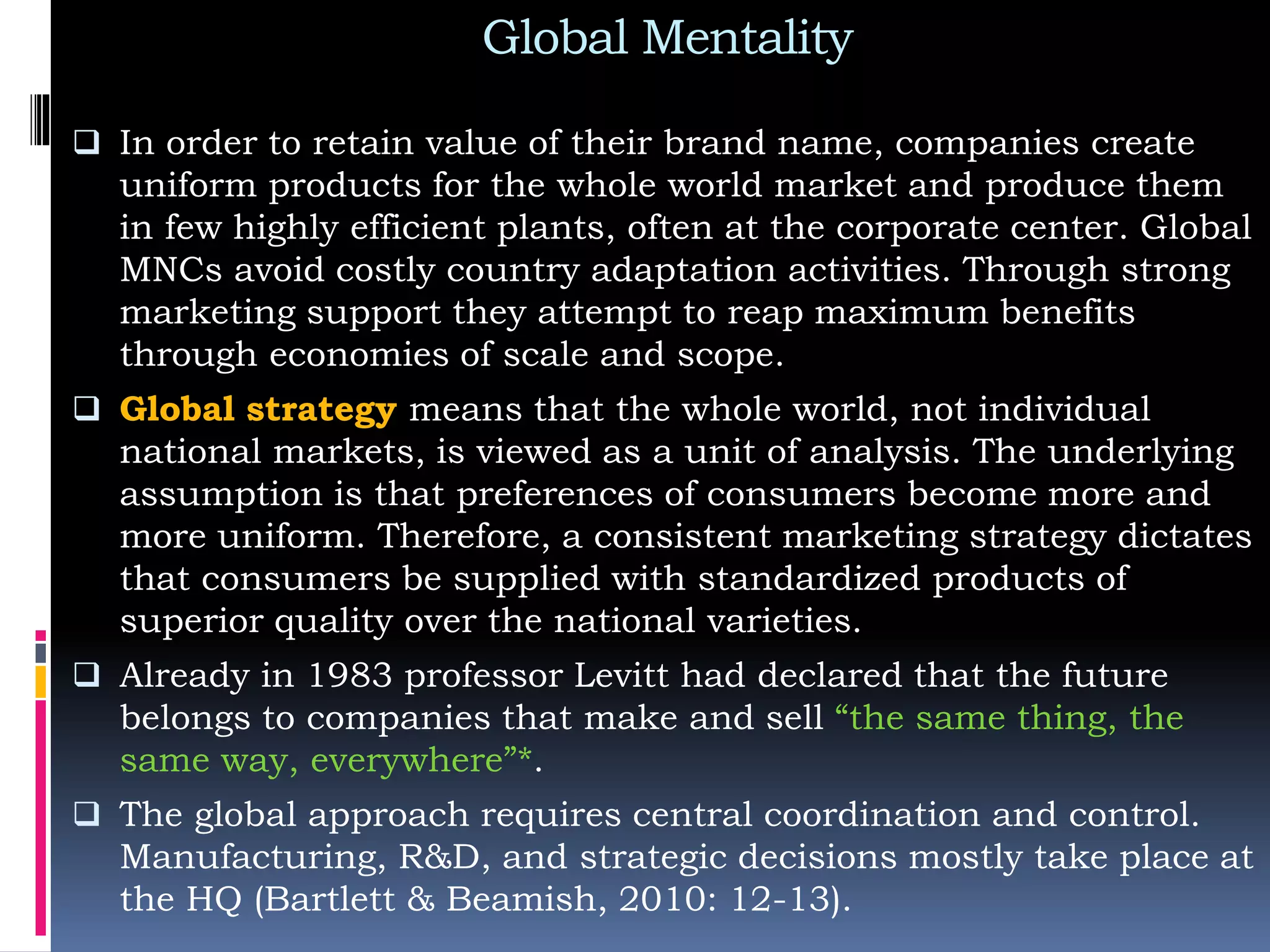
Global Mentality
 In order to retain value of their brand name, companies create
uniform products for the whole world market and produce them
in few highly efficient plants, often at the corporate center. Global
MNCs avoid costly country adaptation activities. Through strong
marketing support they attempt to reap maximum benefits
through economies of scale and scope.
 Global strategy means that the whole world, not individual
national markets, is viewed as a unit of analysis. The underlying
assumption is that preferences of consumers become more and
more uniform. Therefore, a consistent marketing strategy dictates
that consumers be supplied with standardized products of
superior quality over the national varieties.
 Already in 1983 professor Levitt had declared that the future
belongs to companies that make and sell “the same thing, the
same way, everywhere”*.
 The global approach requires central coordination and control.
Manufacturing, R&D, and strategic decisions mostly take place at
the HQ (Bartlett & Beamish, 2010: 12-13).
Global Mentality (cont)
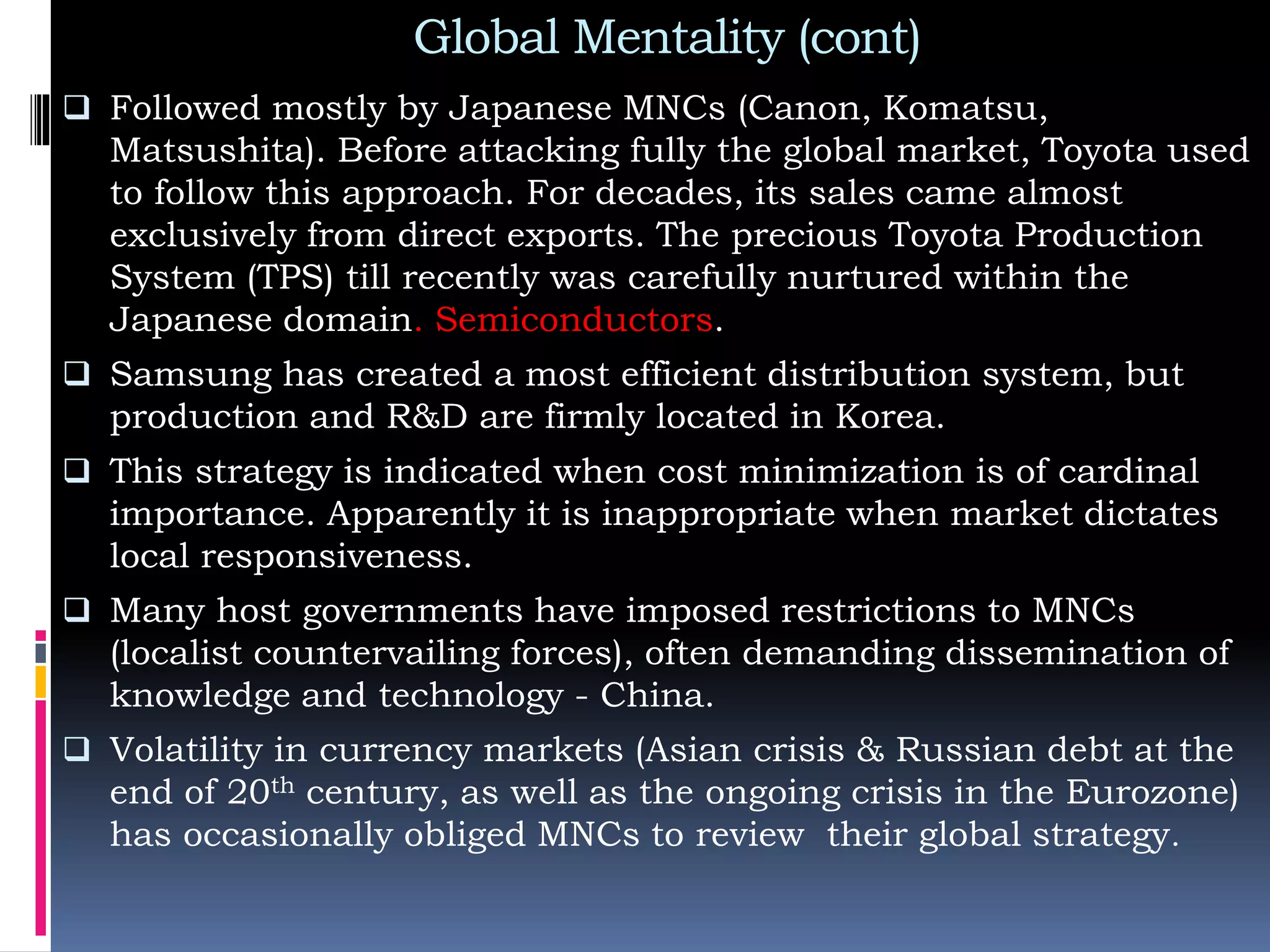
 Followed mostly by Japanese MNCs (Canon, Komatsu,
Matsushita). Before attacking fully the global market, Toyota used
to follow this approach. For decades, its sales came almost
exclusively from direct exports. The precious Toyota Production
System (TPS) till recently was carefully nurtured within the
Japanese domain. Semiconductors.
 Samsung has created a most efficient distribution system, but
production and R&D are firmly located in Korea.
 This strategy is indicated when cost minimization is of cardinal
importance. Apparently it is inappropriate when market dictates
local responsiveness.
 Many host governments have imposed restrictions to MNCs
(localist countervailing forces), often demanding dissemination of
knowledge and technology - China.
 Volatility in currency markets (Asian crisis & Russian debt at the
end of 20th century, as well as the ongoing crisis in the Eurozone)
has occasionally obliged MNCs to review their global strategy.
14
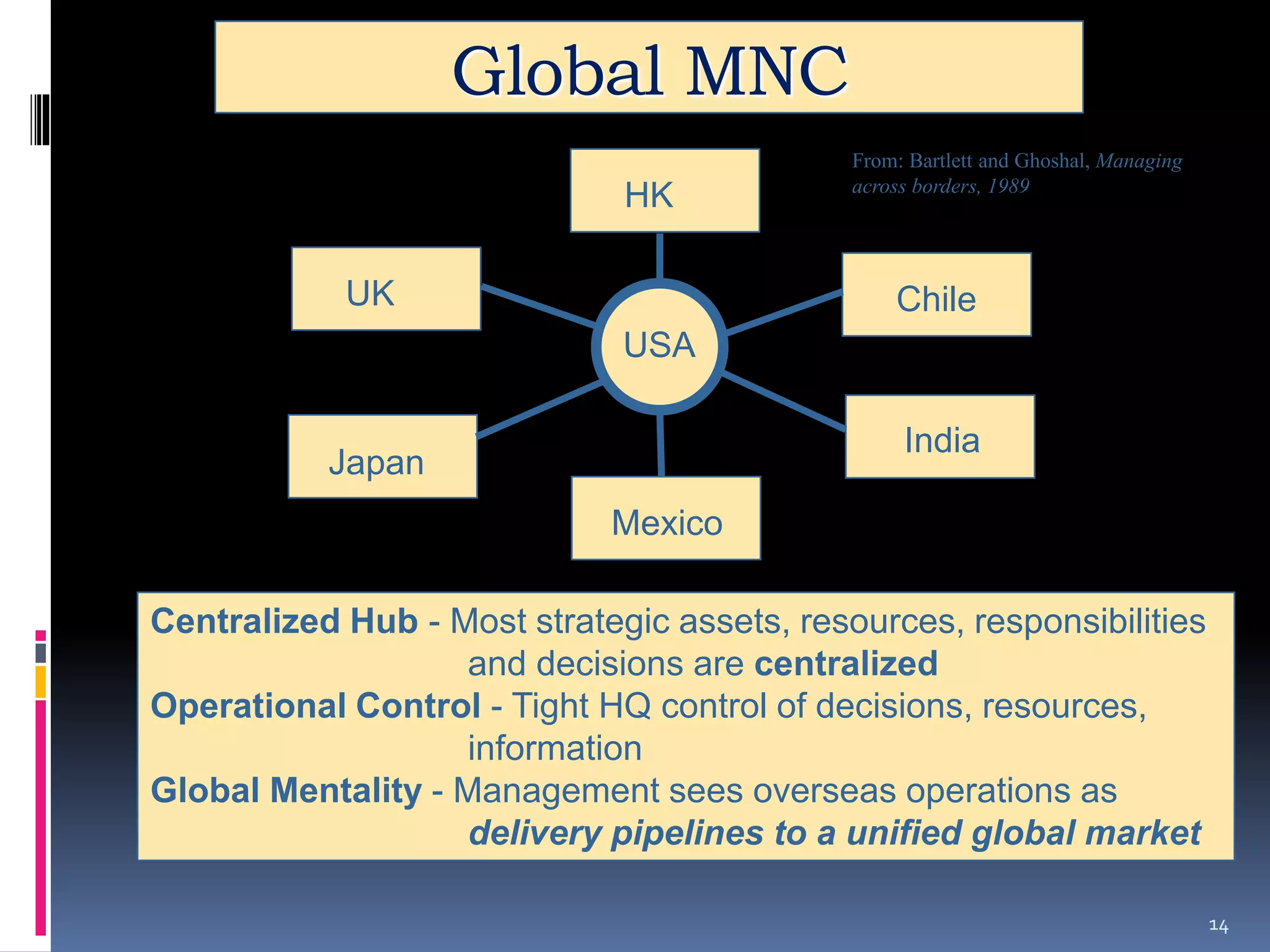
Global MNC
UK Chile
India
Japan
USA
Centralized Hub - Most strategic assets, resources, responsibilities
and decisions are centralized
Operational Control - Tight HQ control of decisions, resources,
information
Global Mentality - Management sees overseas operations as
delivery pipelines to a unified global market
HK
Mexico
From: Bartlett and Ghoshal, Managing
across borders, 1989
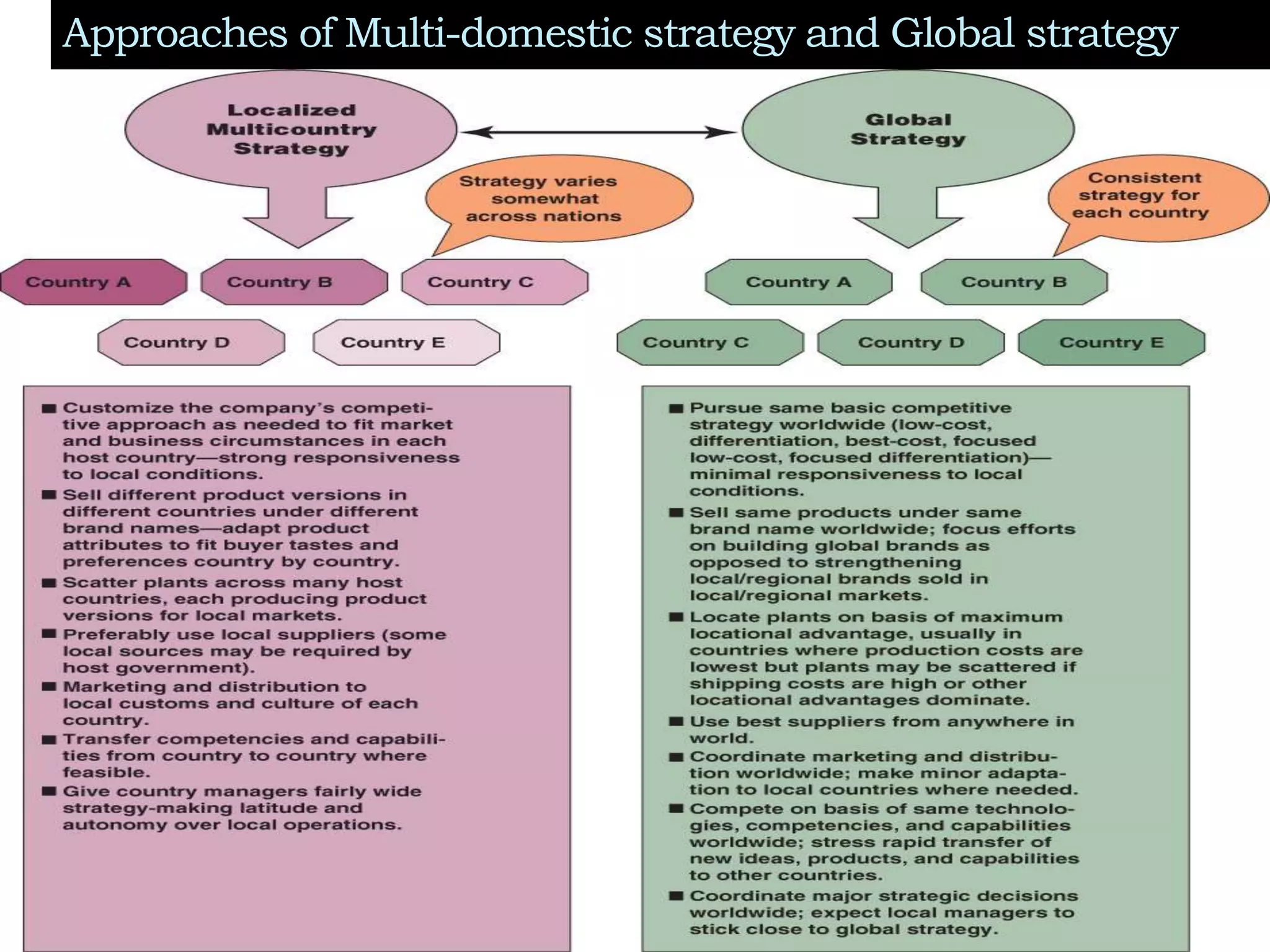
Approaches of Multi-domestic strategy and Global strategy
Effective Global Strategy
Transnational Mentality
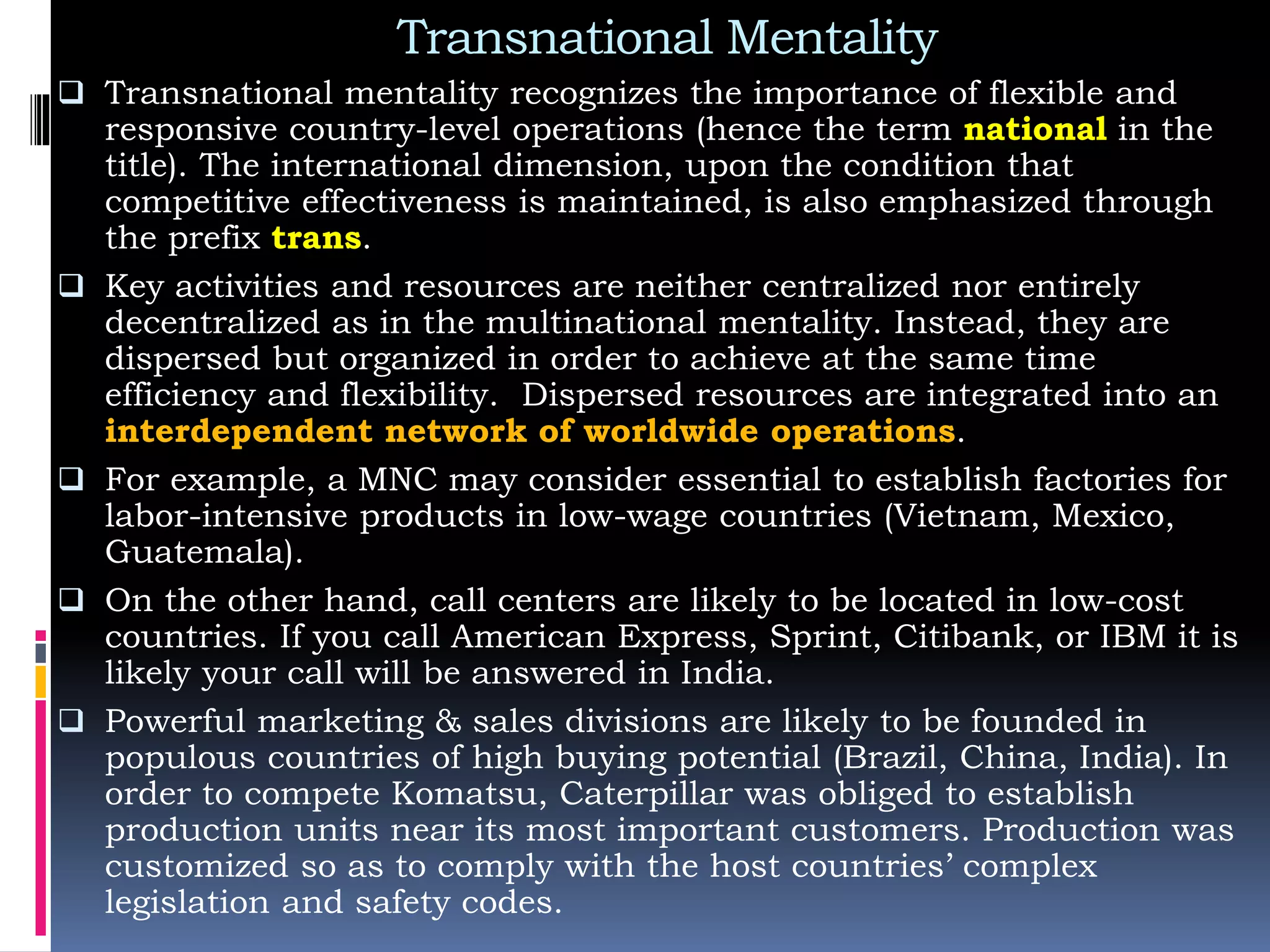
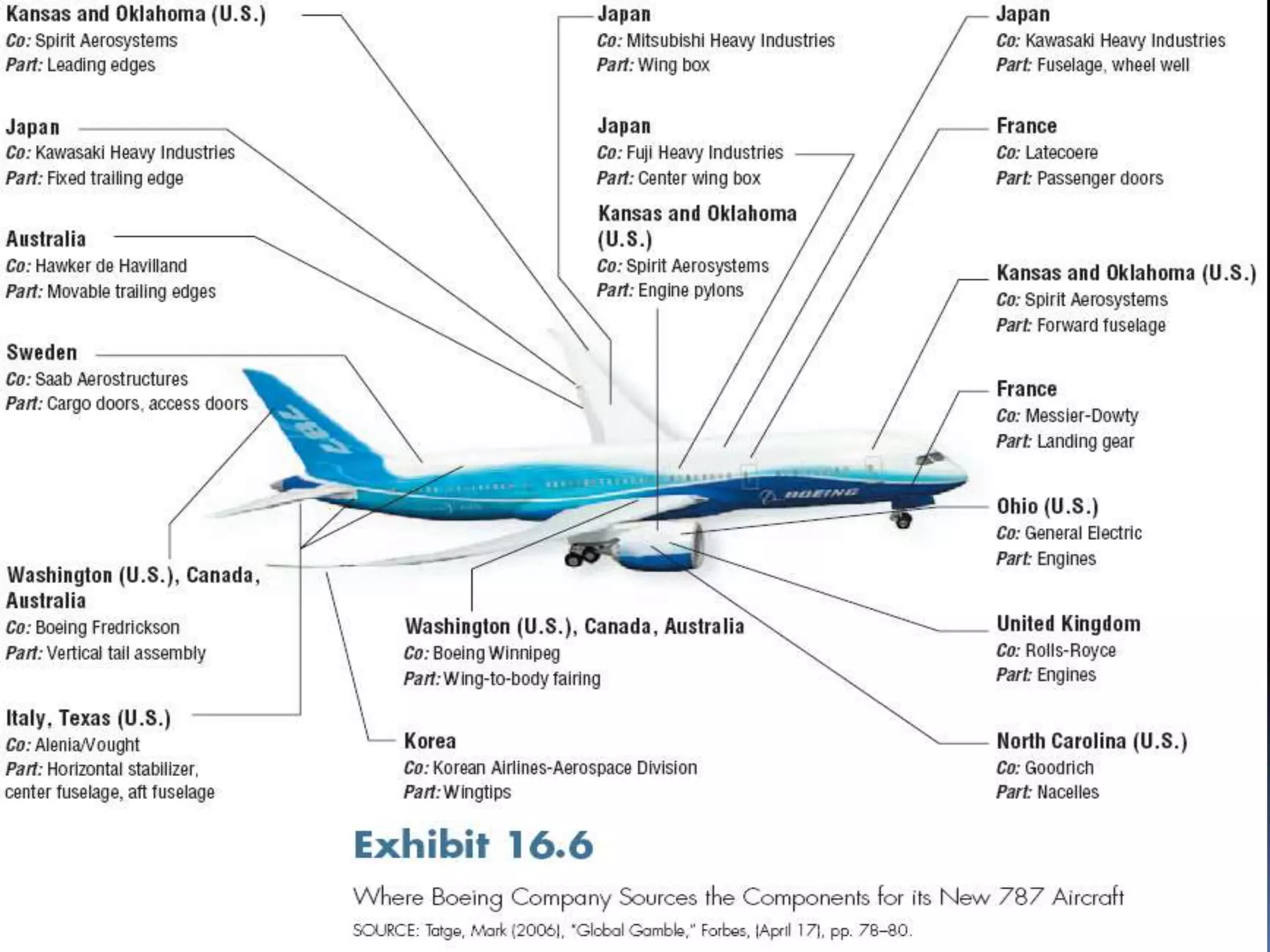
 Transnational mentality recognizes the importance of flexible and
responsive country-level operations (hence the term national in the
title). The international dimension, upon the condition that
competitive effectiveness is maintained, is also emphasized through
the prefix trans.
 Key activities and resources are neither centralized nor entirely
decentralized as in the multinational mentality. Instead, they are
dispersed but organized in order to achieve at the same time
efficiency and flexibility. Dispersed resources are integrated into an
interdependent network of worldwide operations.
 For example, a MNC may consider essential to establish factories for
labor-intensive products in low-wage countries (Vietnam, Mexico,
Guatemala).
 On the other hand, call centers are likely to be located in low-cost
countries. If you call American Express, Sprint, Citibank, or IBM it is
likely your call will be answered in India.
 Powerful marketing & sales divisions are likely to be founded in
populous countries of high buying potential (Brazil, China, India). In
order to compete Komatsu, Caterpillar was obliged to establish
production units near its most important customers. Production was
customized so as to comply with the host countries’ complex
legislation and safety codes.
Transnational Mentality (cont)
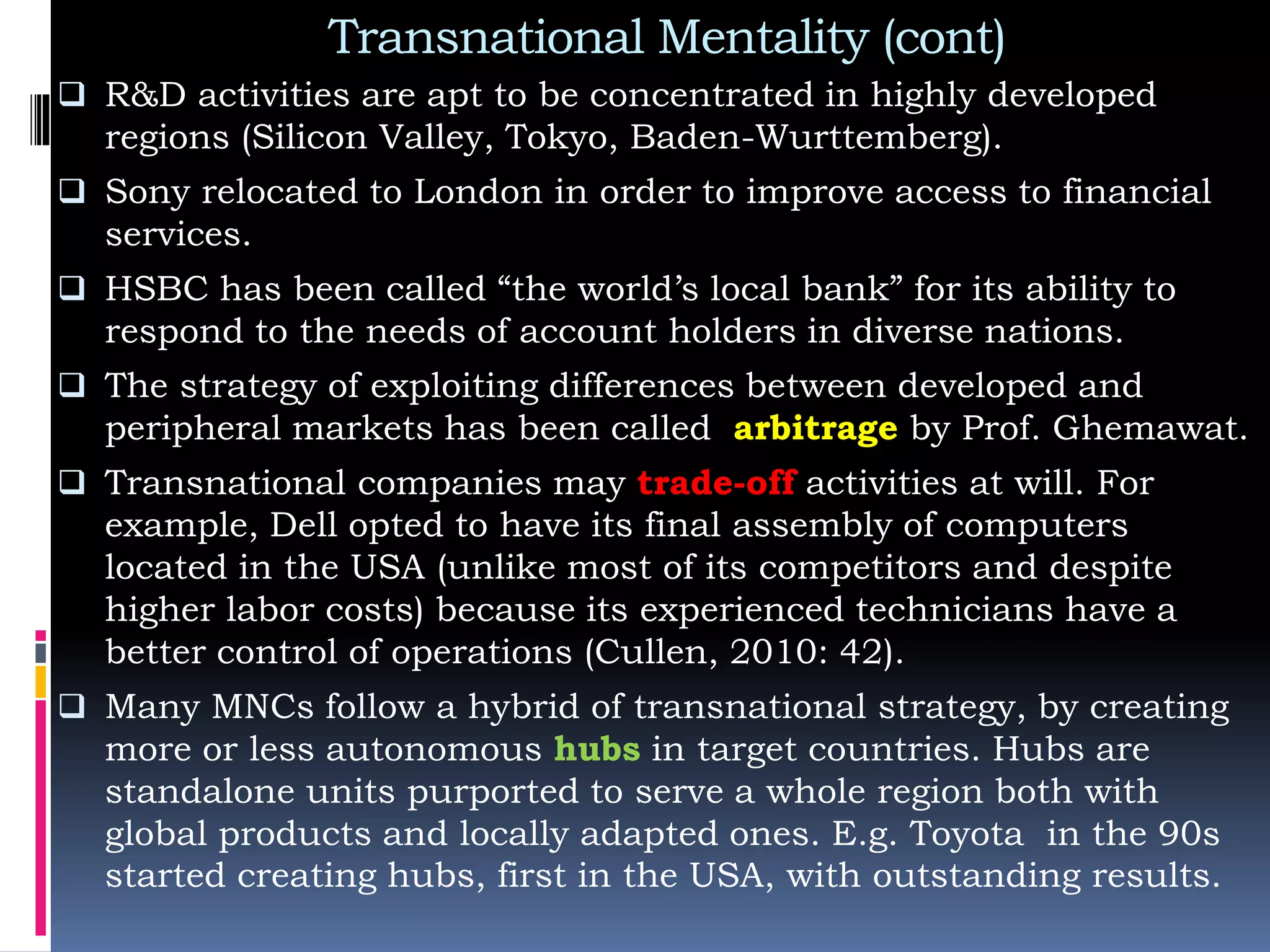
 R&D activities are apt to be concentrated in highly developed
regions (Silicon Valley, Tokyo, Baden-Wurttemberg).
 Sony relocated to London in order to improve access to financial
services.
 HSBC has been called “the world’s local bank” for its ability to
respond to the needs of account holders in diverse nations.
 The strategy of exploiting differences between developed and
peripheral markets has been called arbitrage by Prof. Ghemawat.
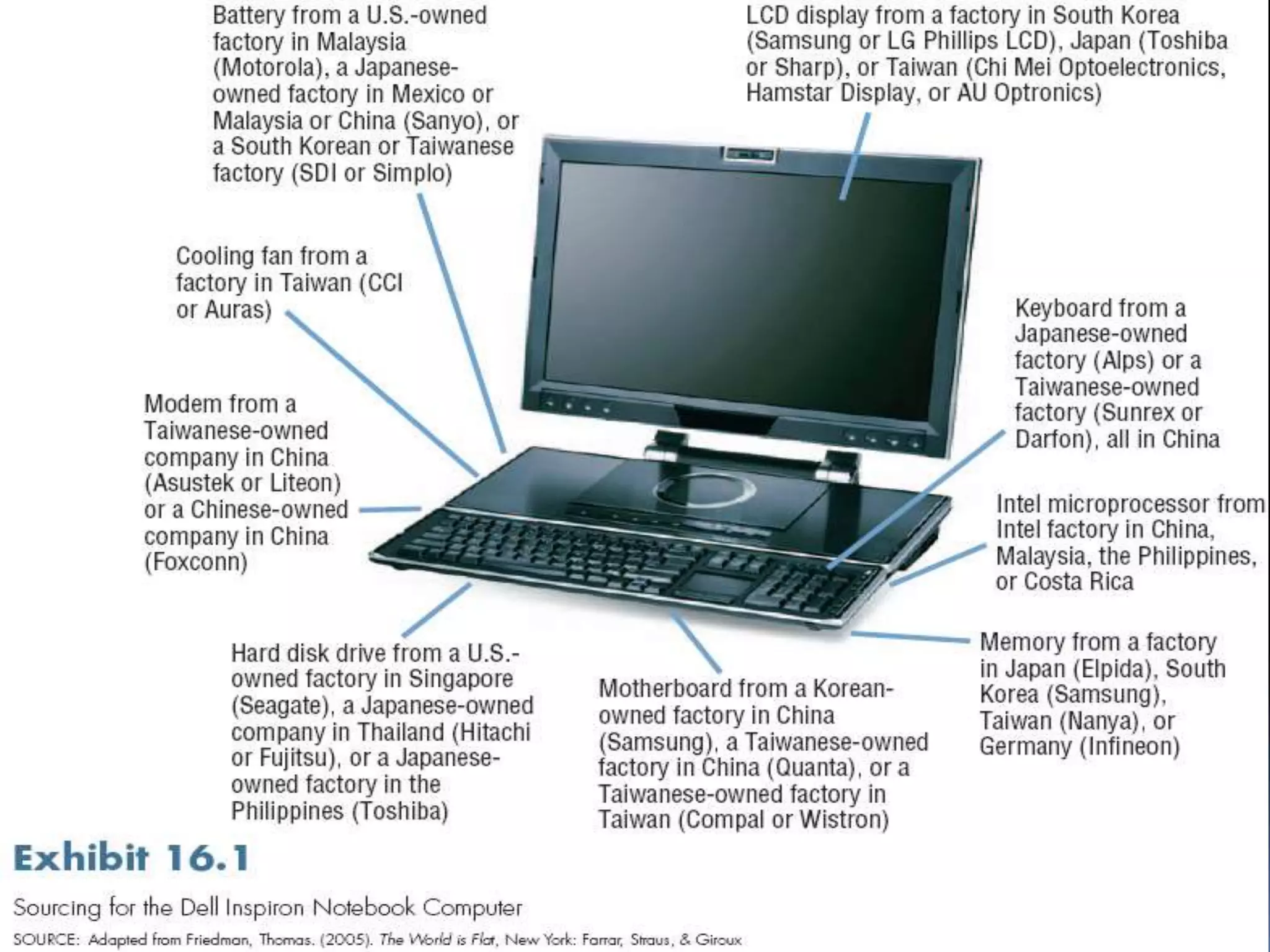
 Transnational companies may trade-off activities at will. For
example, Dell opted to have its final assembly of computers
located in the USA (unlike most of its competitors and despite
higher labor costs) because its experienced technicians have a
better control of operations (Cullen, 2010: 42).
 Many MNCs follow a hybrid of transnational strategy, by creating
more or less autonomous hubs in target countries. Hubs are
standalone units purported to serve a whole region both with
global products and locally adapted ones. E.g. Toyota in the 90s
started creating hubs, first in the USA, with outstanding results.
19
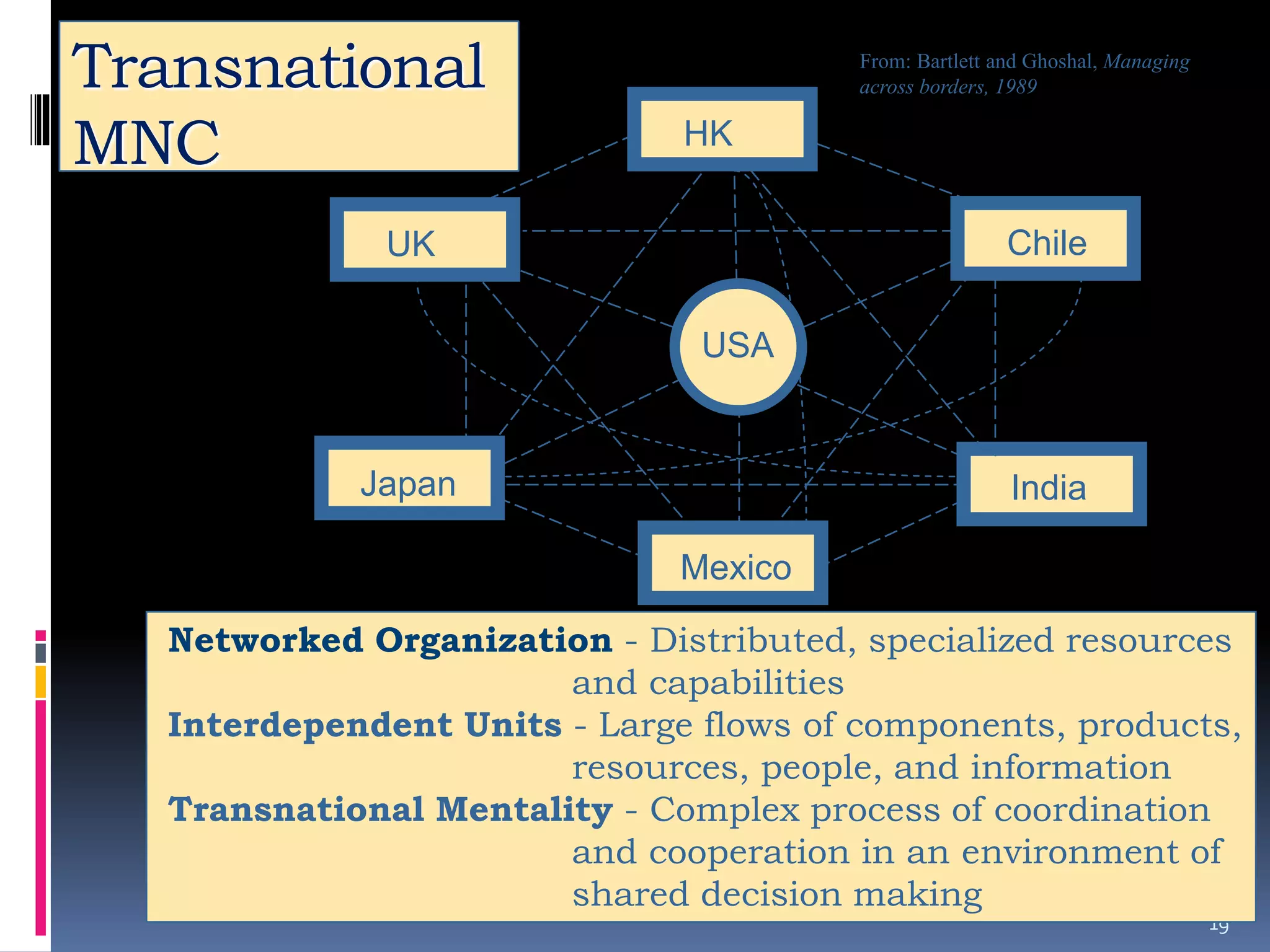
Transnational
MNC
UK Chile
India
Japan
USA
Networked Organization - Distributed, specialized resources
and capabilities
Interdependent Units - Large flows of components, products,
resources, people, and information
Transnational Mentality - Complex process of coordination
and cooperation in an environment of
shared decision making
HK
Mexico
From: Bartlett and Ghoshal, Managing
across borders, 1989
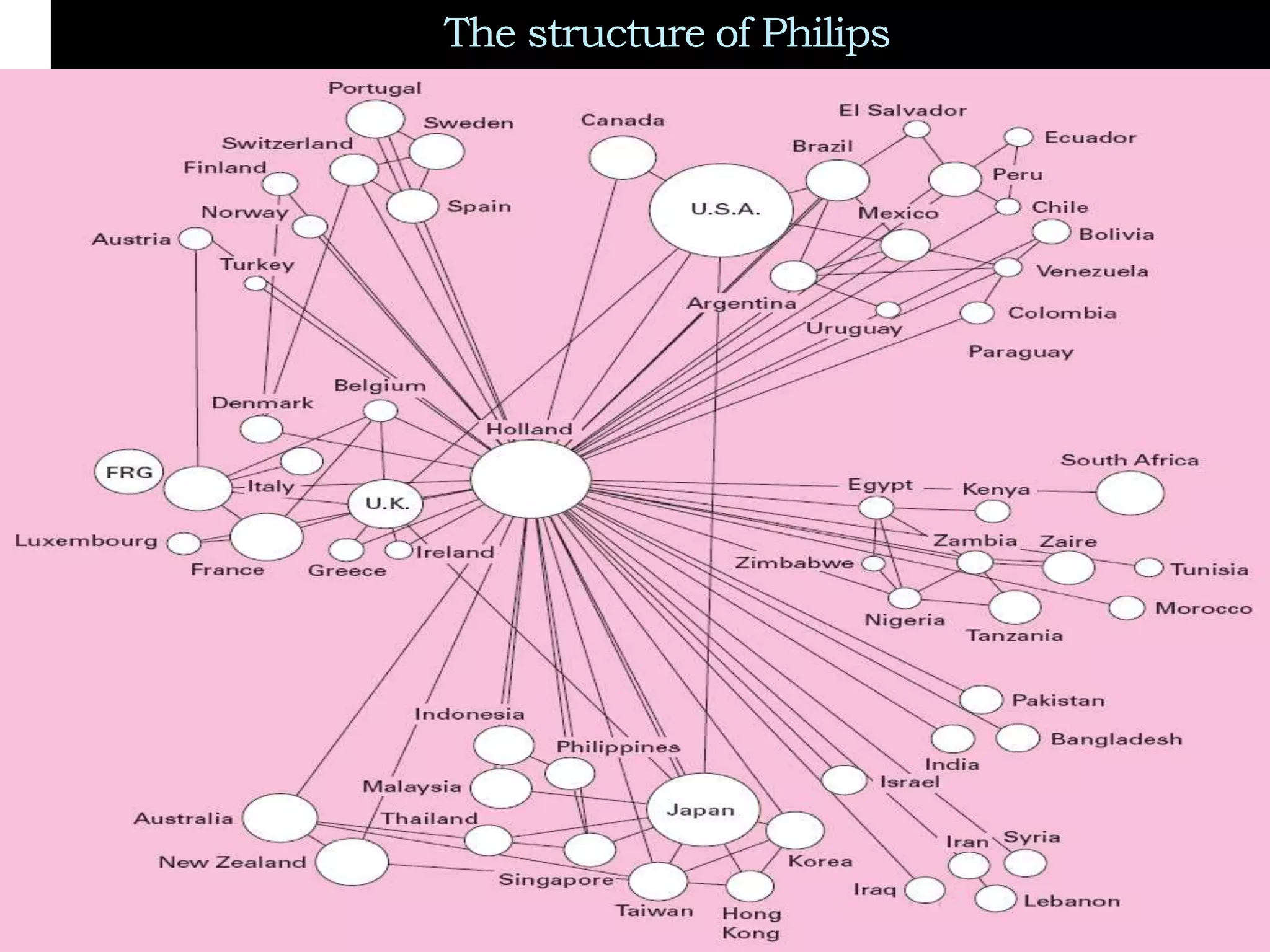
The structure of Philips
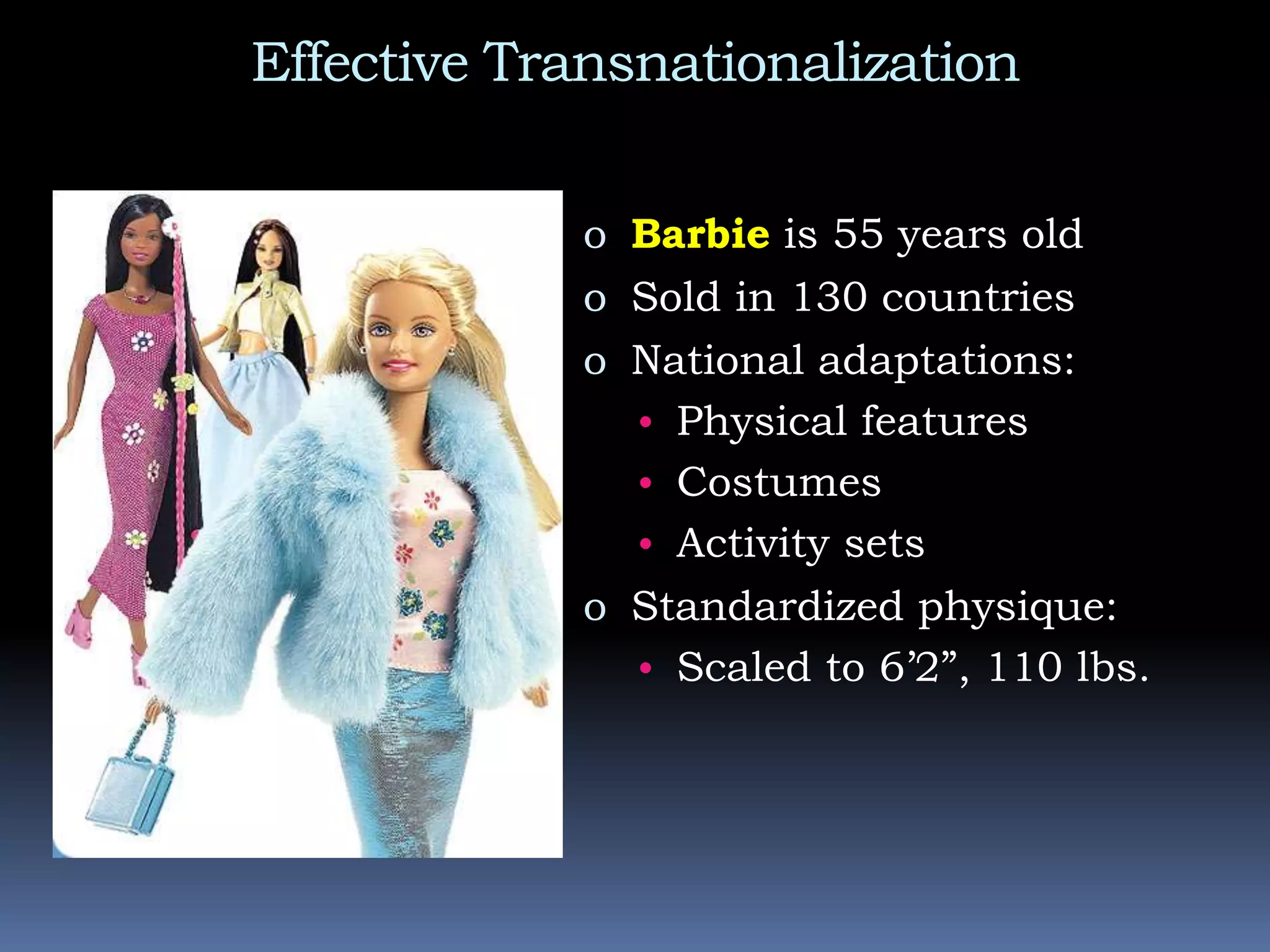
Effective Transnationalization
o Barbie is 55 years old
o Sold in 130 countries
o National adaptations:
• Physical features
• Costumes
• Activity sets
o Standardized physique:
• Scaled to 6’2”, 110 lbs.
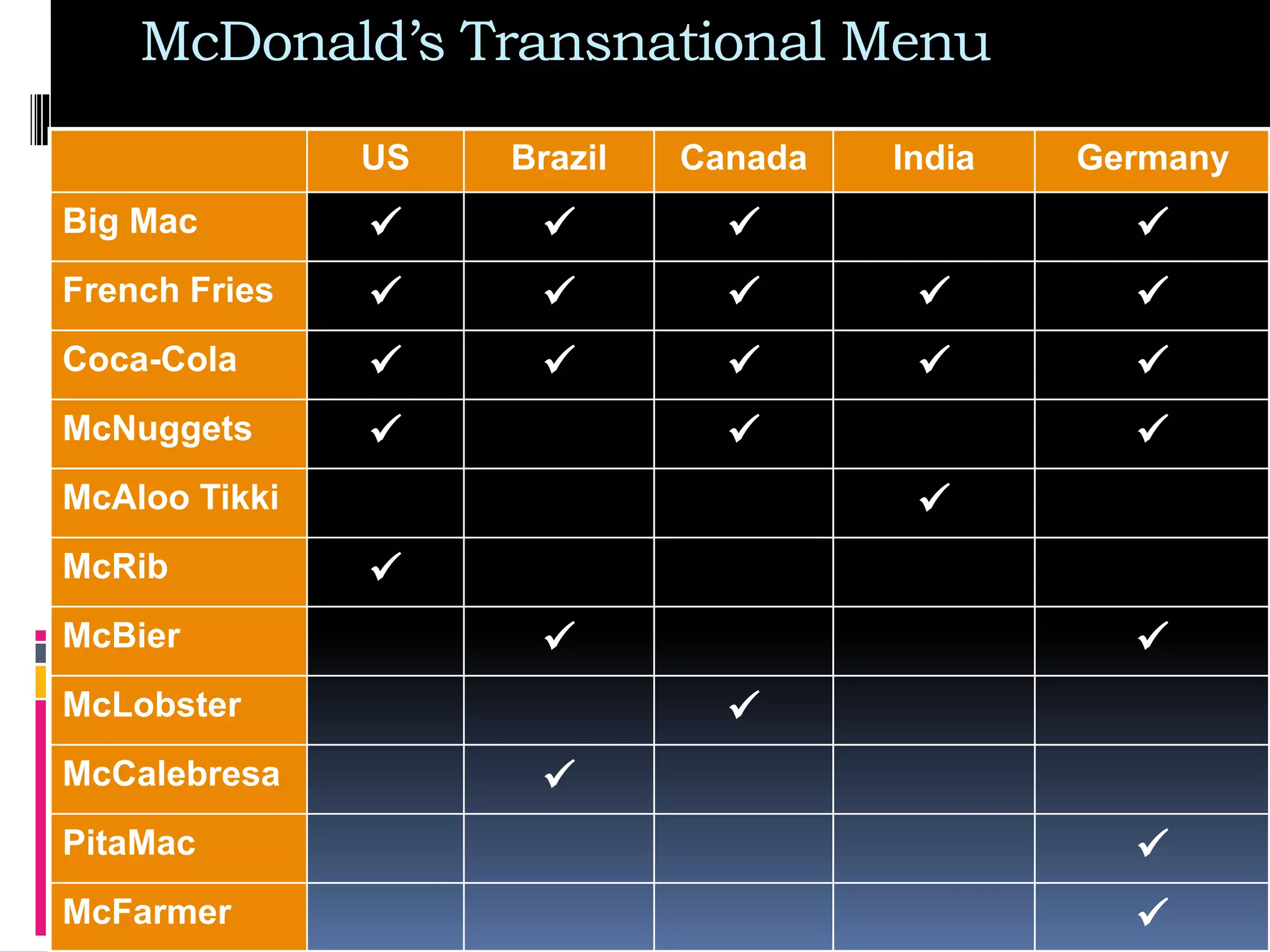
McDonald’s Transnational Menu
US Brazil Canada India Germany
Big Mac    
French Fries     
Coca-Cola     
McNuggets   
McAloo Tikki 
McRib 
McBier  
McLobster 
McCalebresa 
PitaMac 
McFarmer 
.
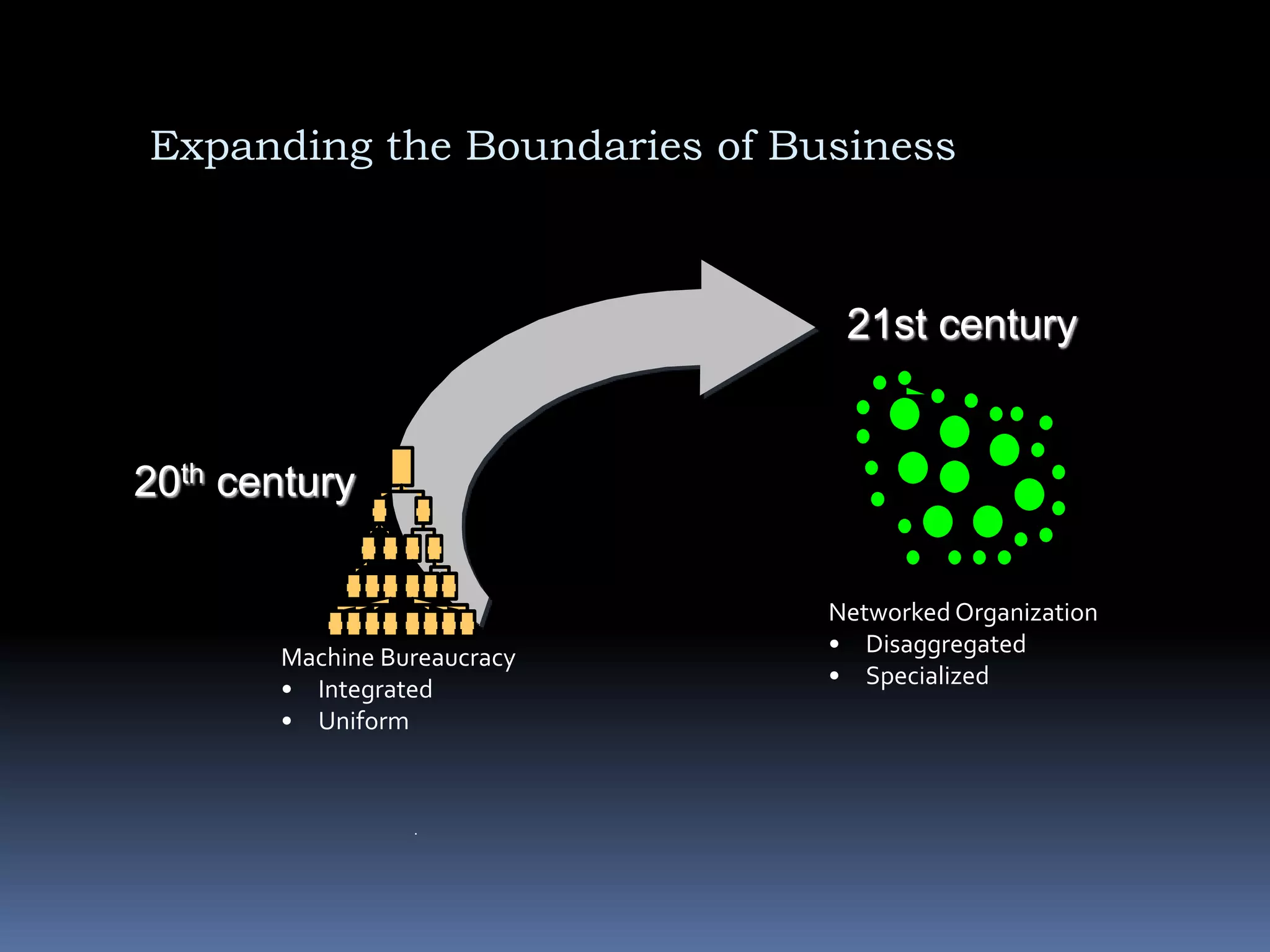
20th century
Machine Bureaucracy
• Integrated
• Uniform
21st century
Networked Organization
• Disaggregated
• Specialized
Expanding the Boundaries of Business
26
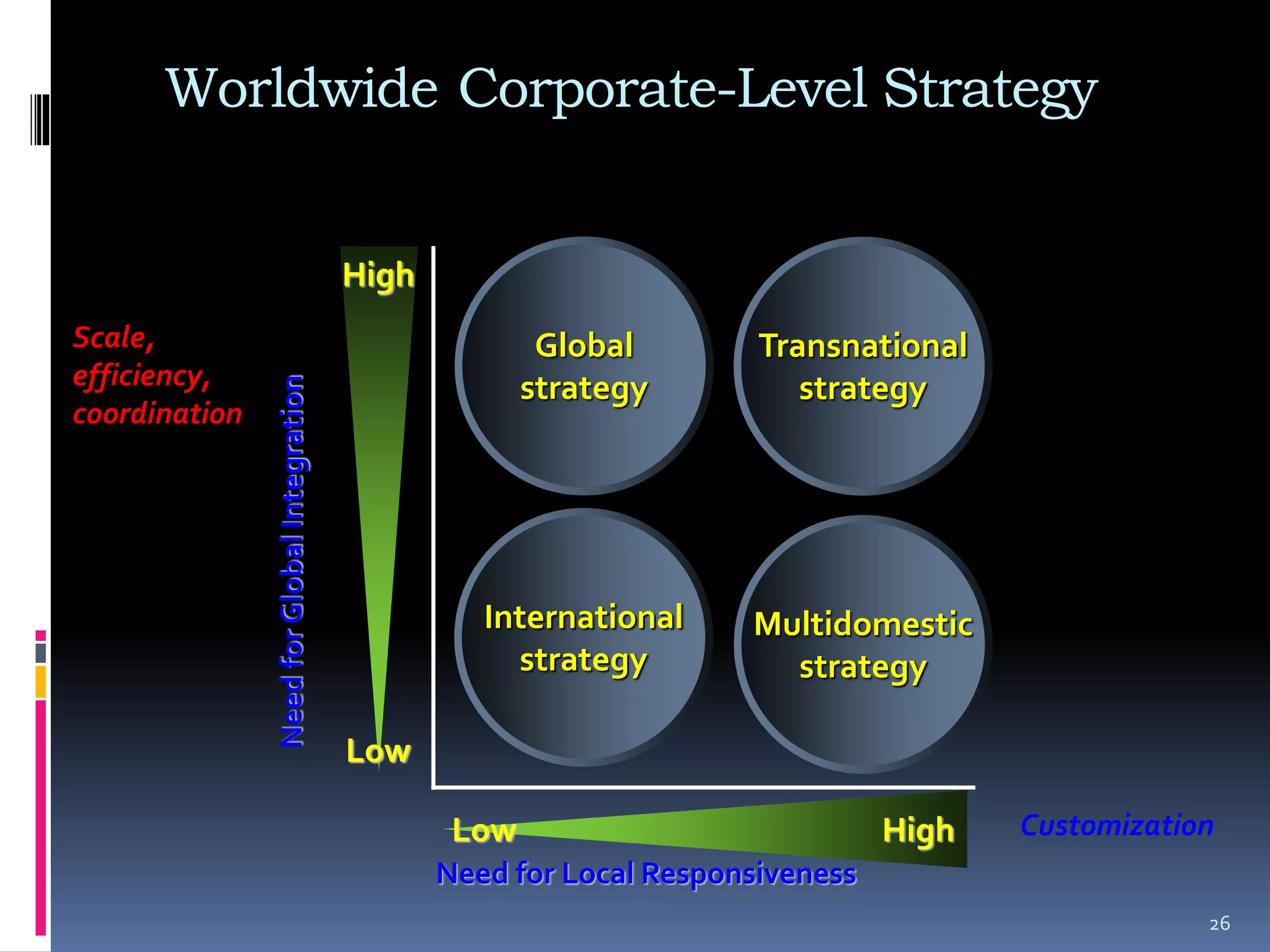
Worldwide Corporate-Level Strategy
Need for Local Responsiveness
Need
for
Global
Integration
Low
High
Low High
Global
strategy
Transnational
strategy
Multidomestic
strategy
Scale,
efficiency,
coordination
Customization
International
strategy
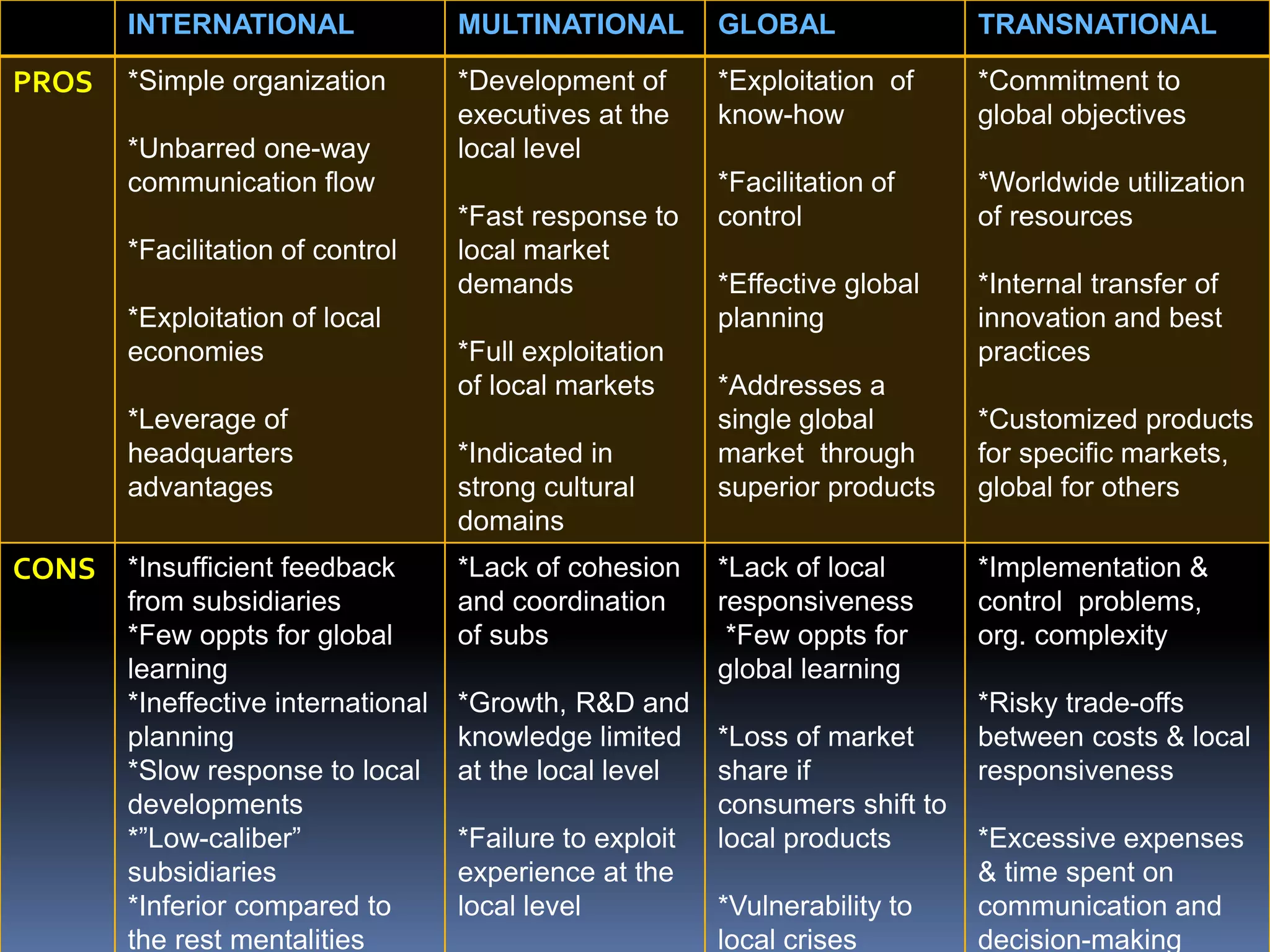
INTERNATIONAL MULTINATIONAL GLOBAL TRANSNATIONAL
PROS *Simple organization
*Unbarred one-way
communication flow
*Facilitation of control
*Exploitation of local
economies
*Leverage of
headquarters
advantages
*Development of
executives at the
local level
*Fast response to
local market
demands
*Full exploitation
of local markets
*Indicated in
strong cultural
domains
*Exploitation of
know-how
*Facilitation of
control
*Effective global
planning
*Addresses a
single global
market through
superior products
*Commitment to
global objectives
*Worldwide utilization
of resources
*Internal transfer of
innovation and best
practices
*Customized products
for specific markets,
global for others
CONS *Insufficient feedback
from subsidiaries
*Few oppts for global
learning
*Ineffective international
planning
*Slow response to local
developments
*”Low-caliber”
subsidiaries
*Inferior compared to
the rest mentalities
*Lack of cohesion
and coordination
of subs
*Growth, R&D and
knowledge limited
at the local level
*Failure to exploit
experience at the
local level
*Lack of local
responsiveness
*Few oppts for
global learning
*Loss of market
share if
consumers shift to
local products
*Vulnerability to
local crises
*Implementation &
control problems,
org. complexity
*Risky trade-offs
between costs & local
responsiveness
*Excessive expenses
& time spent on
communication and
decision-making
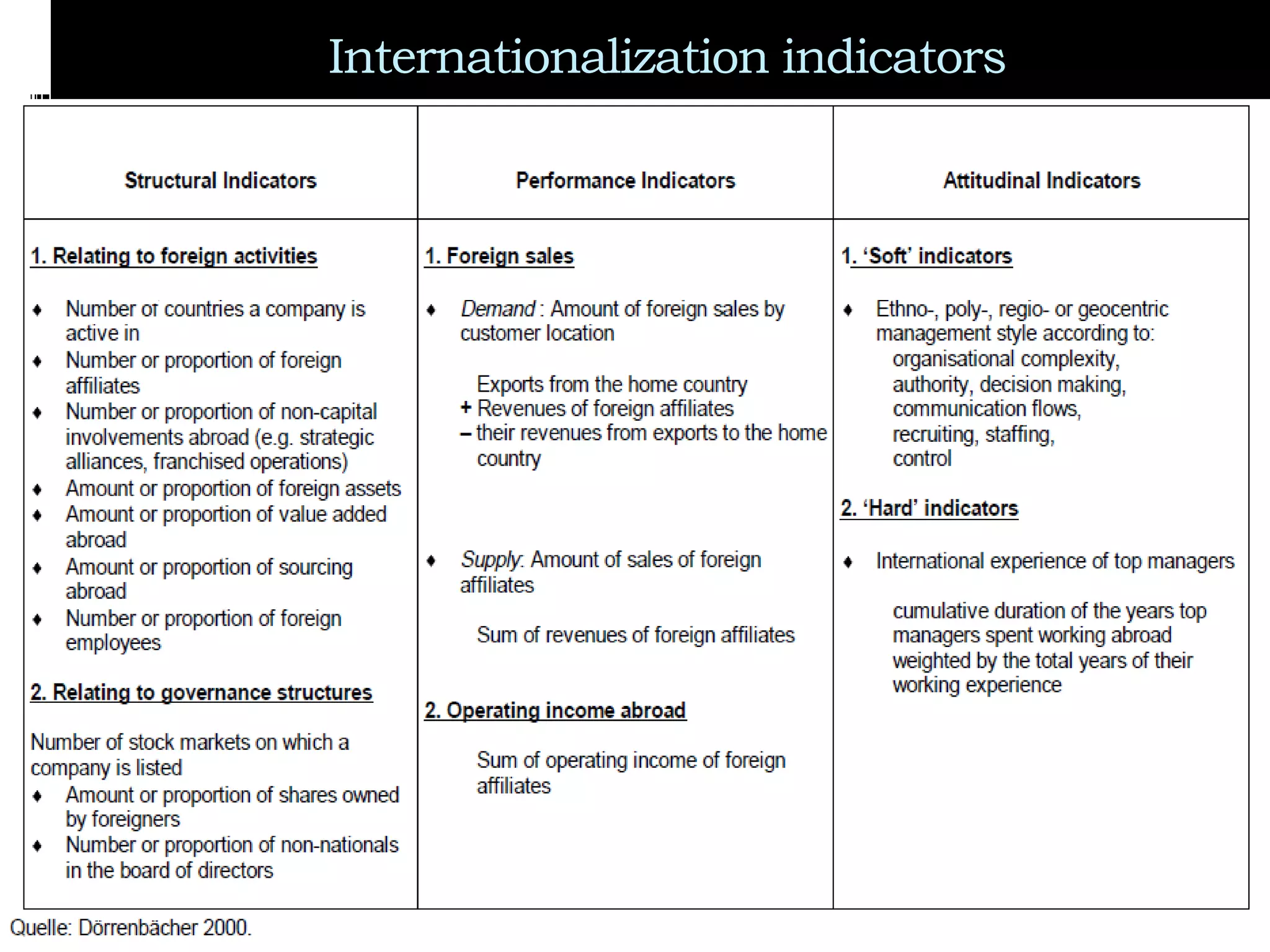
Internationalization indicators
.
31
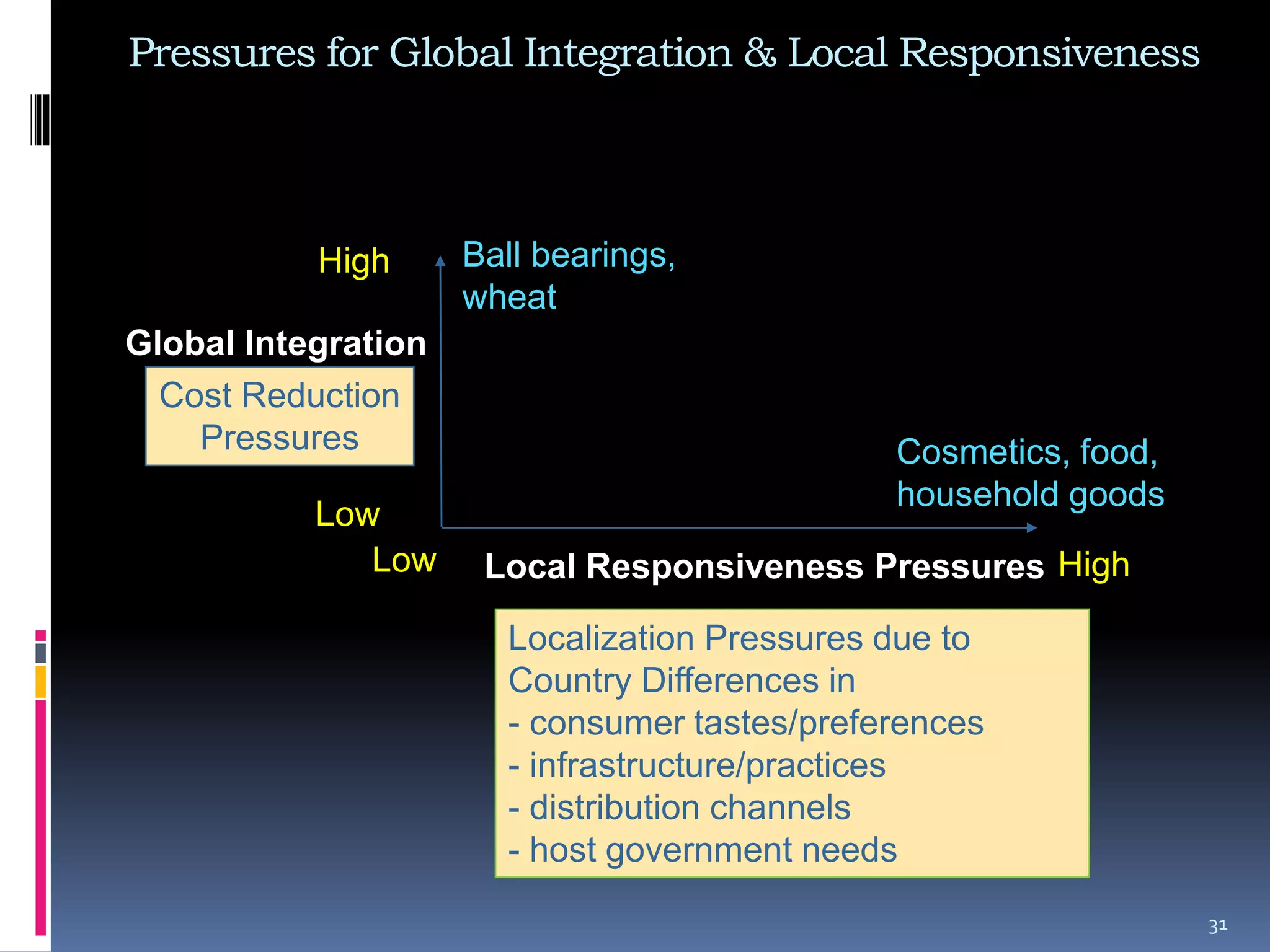
Pressures for Global Integration & Local Responsiveness
High
High
Low
Low
Global Integration
Local Responsiveness Pressures
Localization Pressures due to
Country Differences in
- consumer tastes/preferences
- infrastructure/practices
- distribution channels
- host government needs
Ball bearings,
wheat
Cosmetics, food,
household goods
Cost Reduction
Pressures
33
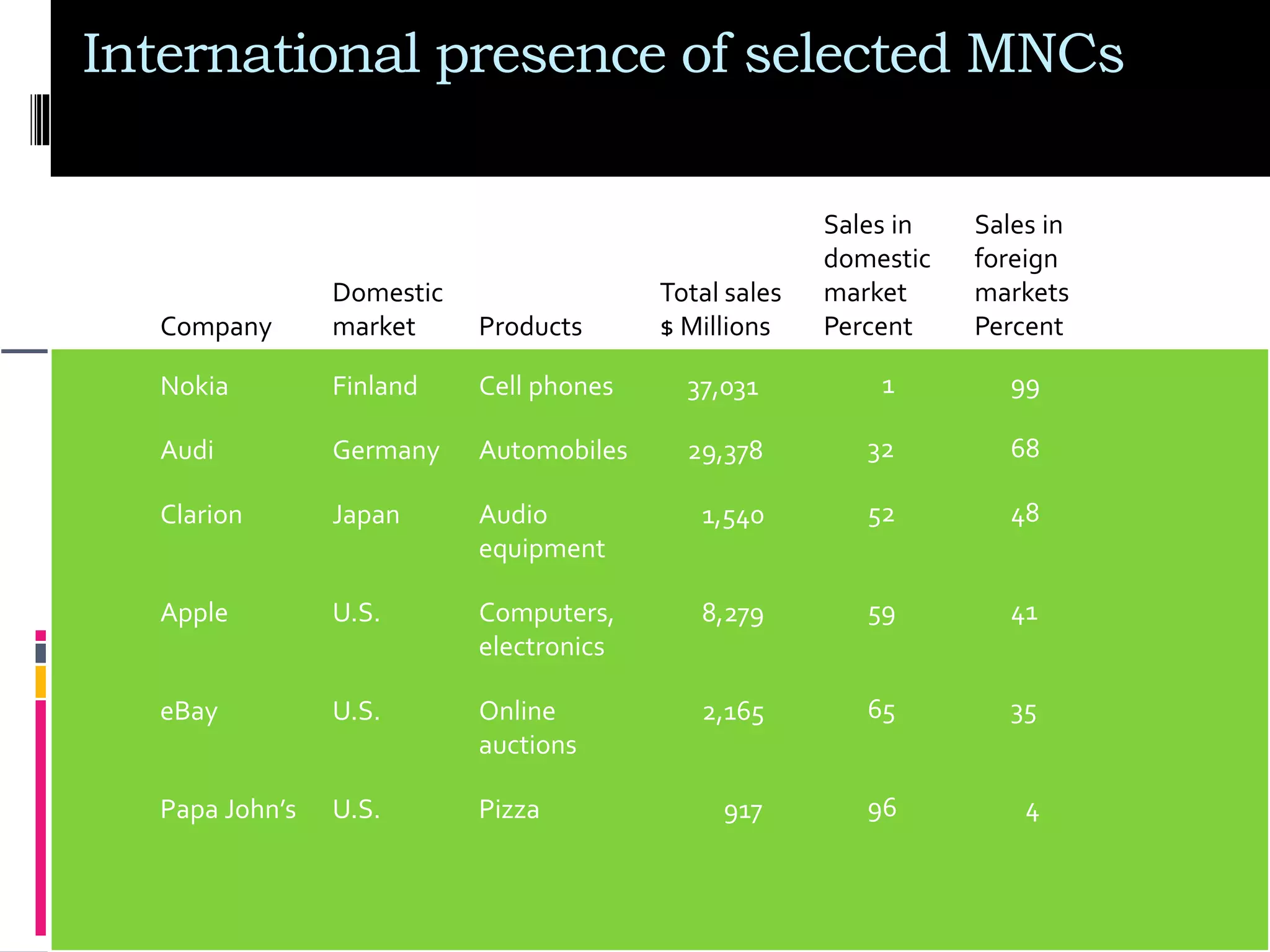
International presence of selected MNCs
1
32
52
59
65
96
37,031
29,378
1,540
8,279
2,165
917
Cell phones
Automobiles
Audio
equipment
Computers,
electronics
Online
auctions
Pizza
Finland
Germany
Japan
U.S.
U.S.
U.S.
Nokia
Audi
Clarion
Apple
eBay
Papa John’s
Sales in
domestic
market
Percent
Total sales
$ Millions
Products
Domestic
market
Company
Sales in
foreign
markets
Percent
99
68
48
41
35
4
34
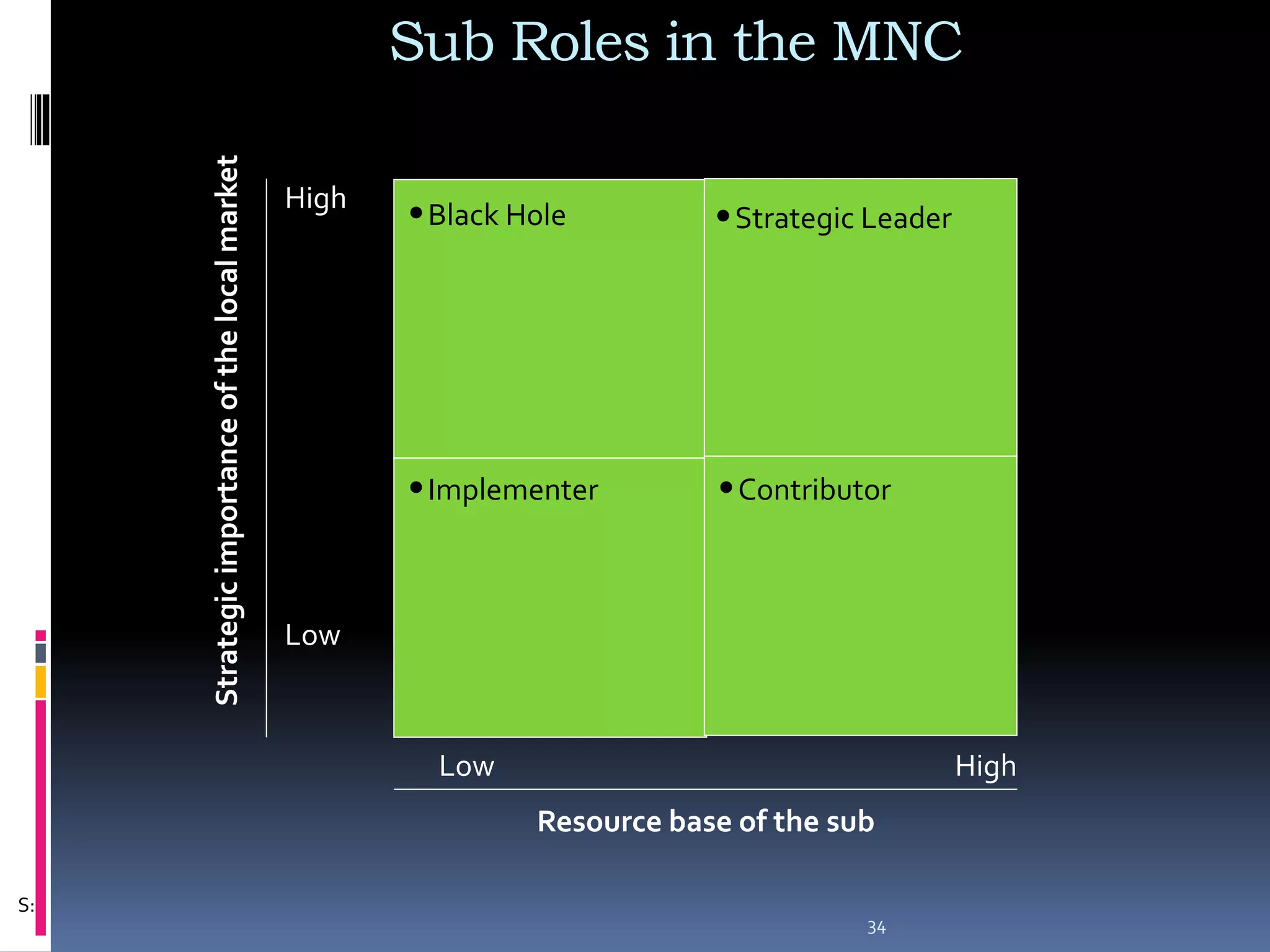
Sub Roles in the MNC
.
S:
High
Low
Low High
Strategic
importance
of
the
local
market
Resource base of the sub
•Black Hole •Strategic Leader
•Implementer •Contributor
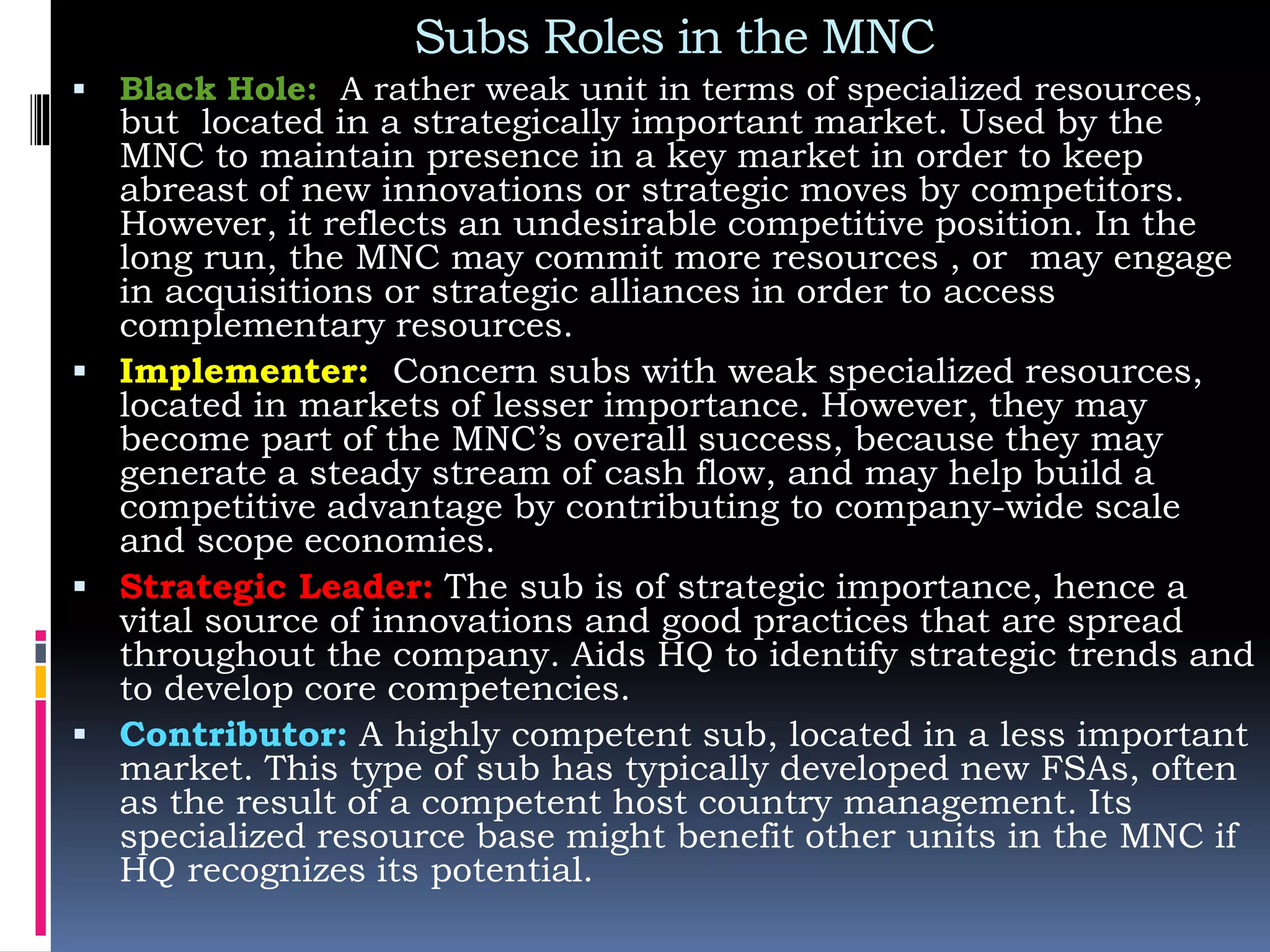
Subs Roles in the MNC
 Black Hole: A rather weak unit in terms of specialized resources,
but located in a strategically important market. Used by the
MNC to maintain presence in a key market in order to keep
abreast of new innovations or strategic moves by competitors.
However, it reflects an undesirable competitive position. In the
long run, the MNC may commit more resources , or may engage
in acquisitions or strategic alliances in order to access
complementary resources.
 Implementer: Concern subs with weak specialized resources,
located in markets of lesser importance. However, they may
become part of the MNC’s overall success, because they may
generate a steady stream of cash flow, and may help build a
competitive advantage by contributing to company-wide scale
and scope economies.
 Strategic Leader: The sub is of strategic importance, hence a
vital source of innovations and good practices that are spread
throughout the company. Aids HQ to identify strategic trends and
to develop core competencies.
 Contributor: A highly competent sub, located in a less important
market. This type of sub has typically developed new FSAs, often
as the result of a competent host country management. Its
specialized resource base might benefit other units in the MNC if
HQ recognizes its potential.

International business lecture 1 - ppt notes

  • 1.
    Lecture – 1MNC Mentalities and Responses to Internationalization Training Material: -Textbook (181-192, 374-382). -Chapter 1 from: Bartlett, C.A. & P.W. Beamish (2010): Transnational Management. Singapore: McGraw-Hill. -Video: “Hard Rock Café: Global Strategy” (6.14 min).
  • 2.
    Think global, actlocal  The original phrase "Think Global, Act Local" first appeared in the book "The Evolution of Cities" (1905) by Scots Planner and was later applied by the social activist Patrick Geddes.  Strategic moves are integrated and coordinated worldwide, aiming at building a global brand name.  Global thinking and local response utilizes a common strategic approach (low-cost, differentiation, focus), but allows country-to-country customization to fit local market conditions.  Marketing and distribution are adapted to fit local customs and cultures
  • 3.
    Glocalization: Think global,act local  « The term Glocal and the process of Glocalization are formed by telescoping global and local to make a blend». The Oxford Dictionary of New Words, 1991  Glocalization : The interpenetration of global and local, resulting in unique outcomes in different geographic areas. George Ritzer  Refers to the development and selling of products or services intended for the global market, but adapted to suit local culture and behavior.  «Only truly global companies can achieve ‘global localisation’ that is, be as much of an insider as a local company but still accomplish the benefits of world- scale operations». Kenichi Ohmae
  • 5.
  • 6.
    Bartlett & Ghoshal*:4 mentalities • International • Multinational/Multi-domestic • Global • Transnational  Bartlett & Ghoshal indicate that there exists no ideal mentality. A company may operate with anyone, depending on its strategic position & culture, localization pressures etc.  In fact, historically some MNCs (Toyota, Unilever) have steered through most or all of these mentalities.
  • 7.
    International Mentality  Thecompany’s overseas operations are viewed by the HQ as distant outposts whose main role is to support parent company. Subs are viewed as “appendices”, operating under the same regulations in diverse cultural domains.  Many local issues are treated at the local level, but product development, branding, technology & knowledge are transferred to the sub from the parent company (Bartlett & Beamish, 2010: 11-12).  Target countries are selected mostly according to their cultural proximity to the home market.  Key managers of Subs come from the parent country and are selected mostly upon their international experience and language efficiency.  Of inferior effectiveness compared to the rest mentalities. No longer efficient when strong competitors appear. By then, International MNCs have to improve their cost structure by shifting to global strategy.  Has been followed in the past mostly by US MNCs (Kraft, Pfizer, P&G, GE). GE is famous (notorious ?) for insisting to fully assimilate its acquisitions within the company culture and for imposing always Americans on top. Despite a streak of acquisitions in Europe, CEO Immelt was obliged to admit in as speech at HBS that “I think that we stink in Europe today” (Ghemawat, 2007).
  • 8.
    8 Worldwide “International” Strategy CoordinatedFederation - Many key assets, responsibilities and decisions localized except core product design & brand Administrative Control - Centralized HQ control, formal planning and control, tight HQ-Sub linkage International Mentality - Management sees overseas operations as appendages to the domestic operation UK Chile India Japan USA HK Mexico From: Bartlett and Ghoshal, Managing across borders, 1989
  • 9.
    Multinational/Multi-domestic Mentality  Differencesbetween national markets are addressed. The corporation modifies its strategies, products, processes etc in order to adapt to local contexts.  Company strategy is composed of the multiple, nationally- oriented strategies of subs. Multi-domestic mentality is indicated when economies of scale are not important, while coordination costs between HQ and subs are high.  Subs at the local level may become highly independent, assimilated to local companies of their host country. Sometimes they act on their own interests rather than conforming to the MNC strategy.  Multinational mentality is based more on marketing than on manufacturing efficiency. Factories at the local level are built more in order to overcome trade barriers, to establish a presence near strategic resources, to improve marketing and to exploit political relations, than to increase efficiency of production. Products of the same company made in and addressed to third- world countries are sometimes inferior to those produced in developed countries (Bartlett & Beamish, 2010: 11-12).
  • 10.
    Multinational/Multi-domestic Mentality (cont) Autonomy of subs may come out of control. For example, in the 80s Unilever retained 17 country subs in Europe and it took more than 4 years to oblige them to introduce a single new detergent for Europe (Peng, 2010: 296).  Operation of independent subs is costly due to the duplication of activities in many countries. Therefore, this strategy is more appropriate in industries where pressures for cost reductions are not significant (Peng, 2010: 296).  Followed mostly by European MNCs (ICI, Nestle, Unilever). Fiat has followed this approach by establishing loosely controlled manufacturing units in Yugoslavia, Spain, Poland etc. MTV in Western Europe only retains more than 8 channels in different languages.
  • 11.
    11 Multi-Domestic MNC Decentralized Federation- Most key assets, responsibilities and decisions localized Personal Control - Informal HQ-Sub relationship, simple financial controls Multidomestic Mentality - Management sees overseas operations as portfolio of independent businesses UK Chile India Japan USA HK Mexico From: Bartlett and Ghoshal, Managing across borders, 1989
  • 12.
    Global Mentality  Inorder to retain value of their brand name, companies create uniform products for the whole world market and produce them in few highly efficient plants, often at the corporate center. Global MNCs avoid costly country adaptation activities. Through strong marketing support they attempt to reap maximum benefits through economies of scale and scope.  Global strategy means that the whole world, not individual national markets, is viewed as a unit of analysis. The underlying assumption is that preferences of consumers become more and more uniform. Therefore, a consistent marketing strategy dictates that consumers be supplied with standardized products of superior quality over the national varieties.  Already in 1983 professor Levitt had declared that the future belongs to companies that make and sell “the same thing, the same way, everywhere”*.  The global approach requires central coordination and control. Manufacturing, R&D, and strategic decisions mostly take place at the HQ (Bartlett & Beamish, 2010: 12-13).
  • 13.
    Global Mentality (cont) Followed mostly by Japanese MNCs (Canon, Komatsu, Matsushita). Before attacking fully the global market, Toyota used to follow this approach. For decades, its sales came almost exclusively from direct exports. The precious Toyota Production System (TPS) till recently was carefully nurtured within the Japanese domain. Semiconductors.  Samsung has created a most efficient distribution system, but production and R&D are firmly located in Korea.  This strategy is indicated when cost minimization is of cardinal importance. Apparently it is inappropriate when market dictates local responsiveness.  Many host governments have imposed restrictions to MNCs (localist countervailing forces), often demanding dissemination of knowledge and technology - China.  Volatility in currency markets (Asian crisis & Russian debt at the end of 20th century, as well as the ongoing crisis in the Eurozone) has occasionally obliged MNCs to review their global strategy.
  • 14.
    14 Global MNC UK Chile India Japan USA CentralizedHub - Most strategic assets, resources, responsibilities and decisions are centralized Operational Control - Tight HQ control of decisions, resources, information Global Mentality - Management sees overseas operations as delivery pipelines to a unified global market HK Mexico From: Bartlett and Ghoshal, Managing across borders, 1989
  • 15.
    Approaches of Multi-domesticstrategy and Global strategy
  • 16.
  • 17.
    Transnational Mentality  Transnationalmentality recognizes the importance of flexible and responsive country-level operations (hence the term national in the title). The international dimension, upon the condition that competitive effectiveness is maintained, is also emphasized through the prefix trans.  Key activities and resources are neither centralized nor entirely decentralized as in the multinational mentality. Instead, they are dispersed but organized in order to achieve at the same time efficiency and flexibility. Dispersed resources are integrated into an interdependent network of worldwide operations.  For example, a MNC may consider essential to establish factories for labor-intensive products in low-wage countries (Vietnam, Mexico, Guatemala).  On the other hand, call centers are likely to be located in low-cost countries. If you call American Express, Sprint, Citibank, or IBM it is likely your call will be answered in India.  Powerful marketing & sales divisions are likely to be founded in populous countries of high buying potential (Brazil, China, India). In order to compete Komatsu, Caterpillar was obliged to establish production units near its most important customers. Production was customized so as to comply with the host countries’ complex legislation and safety codes.
  • 18.
    Transnational Mentality (cont) R&D activities are apt to be concentrated in highly developed regions (Silicon Valley, Tokyo, Baden-Wurttemberg).  Sony relocated to London in order to improve access to financial services.  HSBC has been called “the world’s local bank” for its ability to respond to the needs of account holders in diverse nations.  The strategy of exploiting differences between developed and peripheral markets has been called arbitrage by Prof. Ghemawat.  Transnational companies may trade-off activities at will. For example, Dell opted to have its final assembly of computers located in the USA (unlike most of its competitors and despite higher labor costs) because its experienced technicians have a better control of operations (Cullen, 2010: 42).  Many MNCs follow a hybrid of transnational strategy, by creating more or less autonomous hubs in target countries. Hubs are standalone units purported to serve a whole region both with global products and locally adapted ones. E.g. Toyota in the 90s started creating hubs, first in the USA, with outstanding results.
  • 19.
    19 Transnational MNC UK Chile India Japan USA Networked Organization- Distributed, specialized resources and capabilities Interdependent Units - Large flows of components, products, resources, people, and information Transnational Mentality - Complex process of coordination and cooperation in an environment of shared decision making HK Mexico From: Bartlett and Ghoshal, Managing across borders, 1989
  • 20.
  • 21.
    Effective Transnationalization o Barbieis 55 years old o Sold in 130 countries o National adaptations: • Physical features • Costumes • Activity sets o Standardized physique: • Scaled to 6’2”, 110 lbs.
  • 22.
    McDonald’s Transnational Menu USBrazil Canada India Germany Big Mac     French Fries      Coca-Cola      McNuggets    McAloo Tikki  McRib  McBier   McLobster  McCalebresa  PitaMac  McFarmer 
  • 25.
    . 20th century Machine Bureaucracy •Integrated • Uniform 21st century Networked Organization • Disaggregated • Specialized Expanding the Boundaries of Business
  • 26.
    26 Worldwide Corporate-Level Strategy Needfor Local Responsiveness Need for Global Integration Low High Low High Global strategy Transnational strategy Multidomestic strategy Scale, efficiency, coordination Customization International strategy
  • 28.
    INTERNATIONAL MULTINATIONAL GLOBALTRANSNATIONAL PROS *Simple organization *Unbarred one-way communication flow *Facilitation of control *Exploitation of local economies *Leverage of headquarters advantages *Development of executives at the local level *Fast response to local market demands *Full exploitation of local markets *Indicated in strong cultural domains *Exploitation of know-how *Facilitation of control *Effective global planning *Addresses a single global market through superior products *Commitment to global objectives *Worldwide utilization of resources *Internal transfer of innovation and best practices *Customized products for specific markets, global for others CONS *Insufficient feedback from subsidiaries *Few oppts for global learning *Ineffective international planning *Slow response to local developments *”Low-caliber” subsidiaries *Inferior compared to the rest mentalities *Lack of cohesion and coordination of subs *Growth, R&D and knowledge limited at the local level *Failure to exploit experience at the local level *Lack of local responsiveness *Few oppts for global learning *Loss of market share if consumers shift to local products *Vulnerability to local crises *Implementation & control problems, org. complexity *Risky trade-offs between costs & local responsiveness *Excessive expenses & time spent on communication and decision-making
  • 29.
  • 31.
    31 Pressures for GlobalIntegration & Local Responsiveness High High Low Low Global Integration Local Responsiveness Pressures Localization Pressures due to Country Differences in - consumer tastes/preferences - infrastructure/practices - distribution channels - host government needs Ball bearings, wheat Cosmetics, food, household goods Cost Reduction Pressures
  • 33.
    33 International presence ofselected MNCs 1 32 52 59 65 96 37,031 29,378 1,540 8,279 2,165 917 Cell phones Automobiles Audio equipment Computers, electronics Online auctions Pizza Finland Germany Japan U.S. U.S. U.S. Nokia Audi Clarion Apple eBay Papa John’s Sales in domestic market Percent Total sales $ Millions Products Domestic market Company Sales in foreign markets Percent 99 68 48 41 35 4
  • 34.
    34 Sub Roles inthe MNC . S: High Low Low High Strategic importance of the local market Resource base of the sub •Black Hole •Strategic Leader •Implementer •Contributor
  • 35.
    Subs Roles inthe MNC  Black Hole: A rather weak unit in terms of specialized resources, but located in a strategically important market. Used by the MNC to maintain presence in a key market in order to keep abreast of new innovations or strategic moves by competitors. However, it reflects an undesirable competitive position. In the long run, the MNC may commit more resources , or may engage in acquisitions or strategic alliances in order to access complementary resources.  Implementer: Concern subs with weak specialized resources, located in markets of lesser importance. However, they may become part of the MNC’s overall success, because they may generate a steady stream of cash flow, and may help build a competitive advantage by contributing to company-wide scale and scope economies.  Strategic Leader: The sub is of strategic importance, hence a vital source of innovations and good practices that are spread throughout the company. Aids HQ to identify strategic trends and to develop core competencies.  Contributor: A highly competent sub, located in a less important market. This type of sub has typically developed new FSAs, often as the result of a competent host country management. Its specialized resource base might benefit other units in the MNC if HQ recognizes its potential.