
With the advent of globalization, 
organizations - big or small have ceased to 
be local, they have become global! This has 
increased the workforce diversity and 
cultural sensitivities have emerged like never 
before. All this led to the development of 
Global Human Resource Management.
 Globalization, the process of integrating a 
business's operations and strategies across a 
wide array of cultures, products and ideas, is 
having an impact on the role of human resource 
managers. Once concerned with the impact of 
local issues on employees, human resources must 
now consider the effects of workforce diversity, 
legal restrictions and the interdependence 
between training and professional development 
on the organization. As such, the five main 
functions of global human resource management 
are vital concepts to the strategic operation of a 
business.
 The preliminary function of global Human 
Resource Management is that the 
organization carries a local appeal in the 
host country despite maintaining an 
international feel.
 Create a local appeal without compromising 
upon the global identity. 
 Generating awareness of cross cultural 
sensitivities among managers globally and 
hiring of staff across geographic boundaries. 
 Training upon cultures and sensitivities of the 
host country.
 Decision Making: There is a certain degree 
of centralization of operating decision 
making. Compare this to the International 
strategy, the core competencies are 
centralized and the rest are decentralized. 
 Co-ordination: A high degree of coordination 
is required in wake of the cross cultural 
sensitivities. There is in addition also a high 
need for cultural control. 
 Integrating Mechanisms: Many integrating 
mechanisms operate simultaneously
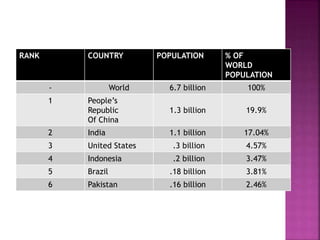
RANK COUNTRY POPULATION % OF 
WORLD 
POPULATION 
- World 6.7 billion 100% 
1 People’s 
Republic 
Of China 
1.3 billion 19.9% 
2 India 1.1 billion 17.04% 
3 United States .3 billion 4.57% 
4 Indonesia .2 billion 3.47% 
5 Brazil .18 billion 3.81% 
6 Pakistan .16 billion 2.46%
 Some of the largest international firms are 
owned by families, especially in China, 
Taiwan, Thailand, Hong Kong, Indonesia, 
Malaysia and Singapore 
 Growing numbers of Small Multinationals 
(SME’s) 
 In Germany there are 350 SME’s that dominate 
their market niche
 Increased travel 
 Rapid and extensive global communications 
 Rapid transfer of new technology 
 Growing trade, foreign competition 
 Improving education 
 Emigration of large numbers of people
 Operation of parent-country firms 
 Operation of foreign firms in the home 
country 
 Operation of Third party nationals 
 Employment of foreign citizens (or recent 
immigrants and/or their families
TRAINING AND MANAGEMENT DEVELOPMENT 
 Training begins where selection ends and it focuses 
upon preparing the manager for a specific job 
 Management development is concerned with developing 
the skills of the manager over his or her career with the 
firm
A key issue in international labor relations is 
the degree to which organized labor is able to 
limit the choices available to an international 
business 
 A firm's ability to pursue a transnational or 
global strategy can be significantly constrained 
by the actions of labor unions
 Helping organisational employees recognize that 
they work in a multi-cultural environment or a 
global environment so that they can undersatnd the 
expectations of Different Cultures.
 The meaning of job titles and job responsibilities 
vary across cultures.HR Dept. helps the employees 
in adapting local practices which makes them 
appropriate for various geographies in which they 
work.
The global leadership competencies required for 
success include: 
i. The flexibility to work and manage across cultures 
ii. The ability to be the voice of the local culture to 
home office while being the voice of home office to 
the local employees 
iii. Understanding of and ability to adapt to cultural 
differences as they impact business practices
Global human resource_management

Global human resource_management

  • 2.
    With the adventof globalization, organizations - big or small have ceased to be local, they have become global! This has increased the workforce diversity and cultural sensitivities have emerged like never before. All this led to the development of Global Human Resource Management.
  • 3.
     Globalization, theprocess of integrating a business's operations and strategies across a wide array of cultures, products and ideas, is having an impact on the role of human resource managers. Once concerned with the impact of local issues on employees, human resources must now consider the effects of workforce diversity, legal restrictions and the interdependence between training and professional development on the organization. As such, the five main functions of global human resource management are vital concepts to the strategic operation of a business.
  • 4.
     The preliminaryfunction of global Human Resource Management is that the organization carries a local appeal in the host country despite maintaining an international feel.
  • 5.
     Create alocal appeal without compromising upon the global identity.  Generating awareness of cross cultural sensitivities among managers globally and hiring of staff across geographic boundaries.  Training upon cultures and sensitivities of the host country.
  • 6.
     Decision Making:There is a certain degree of centralization of operating decision making. Compare this to the International strategy, the core competencies are centralized and the rest are decentralized.  Co-ordination: A high degree of coordination is required in wake of the cross cultural sensitivities. There is in addition also a high need for cultural control.  Integrating Mechanisms: Many integrating mechanisms operate simultaneously
  • 7.
    RANK COUNTRY POPULATION% OF WORLD POPULATION - World 6.7 billion 100% 1 People’s Republic Of China 1.3 billion 19.9% 2 India 1.1 billion 17.04% 3 United States .3 billion 4.57% 4 Indonesia .2 billion 3.47% 5 Brazil .18 billion 3.81% 6 Pakistan .16 billion 2.46%
  • 8.
     Some ofthe largest international firms are owned by families, especially in China, Taiwan, Thailand, Hong Kong, Indonesia, Malaysia and Singapore  Growing numbers of Small Multinationals (SME’s)  In Germany there are 350 SME’s that dominate their market niche
  • 9.
     Increased travel  Rapid and extensive global communications  Rapid transfer of new technology  Growing trade, foreign competition  Improving education  Emigration of large numbers of people
  • 10.
     Operation ofparent-country firms  Operation of foreign firms in the home country  Operation of Third party nationals  Employment of foreign citizens (or recent immigrants and/or their families
  • 11.
    TRAINING AND MANAGEMENTDEVELOPMENT  Training begins where selection ends and it focuses upon preparing the manager for a specific job  Management development is concerned with developing the skills of the manager over his or her career with the firm
  • 12.
    A key issuein international labor relations is the degree to which organized labor is able to limit the choices available to an international business  A firm's ability to pursue a transnational or global strategy can be significantly constrained by the actions of labor unions
  • 13.
     Helping organisationalemployees recognize that they work in a multi-cultural environment or a global environment so that they can undersatnd the expectations of Different Cultures.
  • 14.
     The meaningof job titles and job responsibilities vary across cultures.HR Dept. helps the employees in adapting local practices which makes them appropriate for various geographies in which they work.
  • 15.
    The global leadershipcompetencies required for success include: i. The flexibility to work and manage across cultures ii. The ability to be the voice of the local culture to home office while being the voice of home office to the local employees iii. Understanding of and ability to adapt to cultural differences as they impact business practices