Hofstede’s Cultural Dimensions
1. Power distance
2. Uncertainty avoidance
3. Individualism/collectivism
4. Masculinity/femininity
5. Long term / Short term
Hofstede’s Cultural Dimensions
Power distance is ‘the extent to which
the less powerful members of the
organizations and institutions accept
and expect that power is distributed
unequally’.
Power distance is the degree of
inequality among people that a culture
considers normal.
• Flatter, decentralized structures, smaller ratio
of supervisor to employee.
• People expect and accept power relations that
are more consultative or democratic.
• The hierarchies are flat with a decentralized
organization and a small number of
supervisors who are expected to be accessible
for their subordinates.
• The degree for unequal treatment is reduced
to a low level.
• There is a interdependence between employer
and employee
• Example: Australia, Austria, Finland &
Low Power Distance
Superior treat subordinate with respect
Blame are shared by everybody
Manager socialized with subordinates
Societies are more toward egalitarianism (equal to all)
High Power Distance
Societies with high power distance are more
comfortable with taller, centralized organization
structures with a large proportion of supervisory &
employees blindly obey superiors.
The relation between boss and subordinate is strictly
ruled and dependent on the decisions of the boss.
Centralized organization - subordinates expect to be
told what to do from their superiors because they
consider each other as unequal.
Inequalities are normally expected and privileges are
seen as desirable by superiors.
Example: Malaysia, Guatemala, Panama, Philippines,
Mexico, Venezuela, Arab countries, Equador,
Indonesia, India, China, West Africa.
High Power Distance
Employee fear to express disagreement to their boss
Boss more on autocratic decision making style
Inequalities are expected and desired – class divisions are accepted
Subordinate very dependence on leader/supervisor – expected to be
directed
Relationship between boss and subordinate is rarely close or personal
Subordinate are expected to take the blame
for things that go wrong/failure
privileges and status symbols are
expected and popular
Hofstede’s Cultural
Dimensions
Uncertainty avoidance:
-To what extent people feel threatened by
ambiguous situations ; create
beliefs/institutions to avoid such situations.
- It also reflects the level of tolerance for
uncertainty and ambiguity within the society
and the extent to which people avoid
uncertainty by creating laws, rules, regulations
and controls in order to reduce the amount of
uncertainty.
High uncertainty avoidance
countries:
High need for security, strong belief in
experts and their knowledge; structure
organizational activities, more written
rules, less managerial risk taking.
Employees tend to remain longer with
their present employer.
Example: Germany, Japan, Spain, Mexico,
France, Argentina
High uncertainty avoidance
Prefer formal rules – try to minimize uncertainty through strict law
and regulations
Have more written rules
Motivation for work comes from security
More emotional
Typically manager take less risk
Low turnover
Low uncertainty avoidance
countries:
• People more willing to accept risks of the
unknown, less structured organizational
activities, fewer written rules, more
managerial risk taking, higher employee
turnover, more ambitious employees .
• Example: Denmark, Great Britain, China,
India, Singapore, Hong Kong, Philippines,
USA.
Low uncertainty avoidance
More tolerant of different opinion
Try to minimize rules as possible
Low UAI people don’t easily express their emotion
Risk taker and may choose strategy that offer high reward
Comfort with ambiguity and curious about differences
Work hard only when necessary, tolerate, innovation and motivate by
achievement, esteem and belongliness
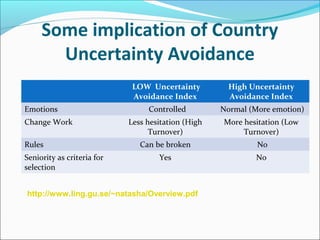
Some implication of Country
Uncertainty Avoidance
LOW Uncertainty
Avoidance Index
High Uncertainty
Avoidance Index
Emotions Controlled Normal (More emotion)
Change Work Less hesitation (High
Turnover)
More hesitation (Low
Turnover)
Rules Can be broken No
Seniority as criteria for
selection
Yes No
http://www.ling.gu.se/~natasha/Overview.pdf
Hofstede’s Cultural
Dimensions
Individualism VS Collectivism:
-The extent to which people feel they are
supposed to look after themselves,
immediate family or organizations they
belong to.
- Focuses on the degree the society
reinforces individual or collective in
term of achievement or interpersonal
relationship
Hofstede’s Cultural Dimensions
High individualism countries:
Wealthier, greater individual initiative,
promotions based on market value (e.g.,
U.S, Canada, Sweden)
A high IDV score indicates a loose
connection with people.
In countries with a high IDV score there
is a lack of interpersonal connection and
little sharing of responsibility, beyond
family and perhaps a few close friends.
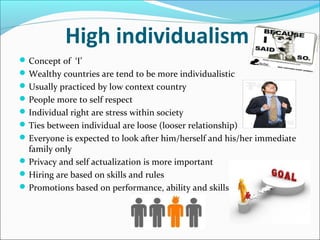
High individualism
Concept of ‘I’
Wealthy countries are tend to be more individualistic
Usually practiced by low context country
People more to self respect
Individual right are stress within society
Ties between individual are loose (looser relationship)
Everyone is expected to look after him/herself and his/her immediate
family only
Privacy and self actualization is more important
Hiring are based on skills and rules
Promotions based on performance, ability and skills.
Hofstede’s Cultural Dimensions
High collectivism countries: Poorer,
less individual initiative, promotions
based on seniority (e.g., Indonesia,
Pakistan).
Have strong group cohesion, and there
would be a large amount of loyalty and
respect for members of the group. The
group itself is also larger and people take
more responsibility for each other's well
being.
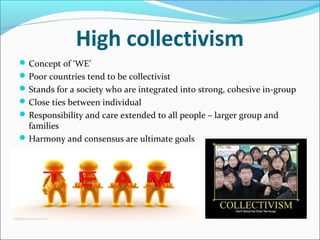
High collectivism
Concept of ‘WE’
Poor countries tend to be collectivist
Stands for a society who are integrated into strong, cohesive in-group
Close ties between individual
Responsibility and care extended to all people – larger group and
families
Harmony and consensus are ultimate goals
Hofstede’s Cultural Dimensions
High IDV Low IDV
Individual is most important unit Collectivist cultures believe group
is most important unit
People taking care of themselves They encourage: Primary loyalty to
group (nuclear family, extended
family, caste, organization)
Making decision based on
individual needs
Decision-making based on what is
best for the group
People speak out, question,
confrontational & direct
People blend in, avoidance conflict,
use intermediaries
Hofstede’s Cultural Dimensions
Masculinity-Femininity: Indicates the
degree to which a culture values such
behavior as assertiveness, achievement,
acquisition of wealth or caring for others,
social supports & the quality of life.
Masculinity: Dominant social values are
success, money, and things.
Hofstede’s Cultural
Dimensions
High masculine countries: Stress earnings,
recognition, advancement, challenge, wealth; high job
stress (e.g. Germanic countries).
Value competitiveness, assertiveness, ambition &
accumulation of wealth/material possession.
Have very distinct expectation of male & female roles in
society.
Japan is highly, whereas Sweden has the lowest
measured value. According to Hofstede's analysis, if you
were to open an office in Japan, you might have greater
success if you appointed a male employee to lead the
team and had a strong male contingent on the team.
High masculinity
Priorities are achievement, wealth and expansion
Acceptable to settle conflict through aggressive means
Women and men have different role in society (gender role clearly
distinct)
Women are subordinated to male leadership
Failing is disaster
Value high earning, recognition for a good job, advancement and
challenge to have personal accomplishment
Hofstede’s Cultural
Dimensions
 High feminine countries: Emphasize caring for others
and quality of life; cooperation, friendly atmosphere,
employment security, group decision making; low job
stress (e.g. Norway).
 Prefer equality between male and female & less
perspective role behaviors associated with genders.
* Masculine cultures believe that man should be assertive,
tough & focus on material success; women should be
more modest, tender and concerned with quality of life.
Low Masculinity (Feminine)
Value relationship and quality of life
Value interdependence, empathy and emotional openness
Prefer equality between male and female
Men and women can be gentle, both can express weakness and
fighting are minimized
Sympathy for weaknesses
 consider failing as accident
 resolve conflict by compromise and negotiation
Work to live
Manager use intuition
Strive for consensus
Hofstede’s Cultural Dimensions
Long term vs short term
-This refers to how much society values
long-standing - as opposed to short term
- traditions and values.
-This is the fifth dimension that Hofstede
added in the 1990s after finding that
Asian countries with a strong link to
Confucian philosophy acted differently
from western cultures.
Hofstede’s Cultural Dimensions
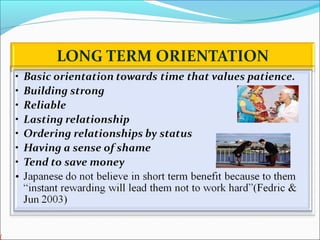
Long Term Orientation
- People value actions and attitudes that affect the
future: persistence/perseverance, thrift and
shame.
- Have strong work ethic and respect for a
hierarchy of the status. (e.g China, Japan, India)
Short Term Orientation
- People value actions and attitudes that are
affected by the past or the present: normative
statements, immediate stability, protecting one’s
own face, respect for tradition and reciprocation
of greetings favors and gifts.(UK,US, Germany)
/
Short Term Orientation
Value action and attitude
Affected by the past
Respect the tradition
Normative statement
Immediate stability
Protecting one’s own face
Hofstede’s Cultural Dimensions
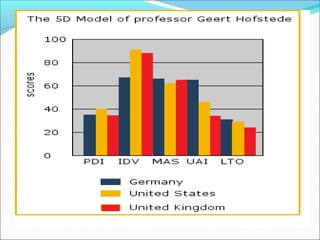
According to Hofstede's analysis, people in the
United States and United Kingdom have low LTO
scores. This suggests that you can pretty much
expect anything in this culture in terms of creative
expression and novel ideas. The model implies
that people in the US and UK don't value tradition
as much as many others, and are therefore likely
to be willing to help you execute the most
innovative plans as long as they get to participate
fully.
Below are the scores of the 20 countries samples for the LONG-
TERM orientation:
 China - 118
 Hong Kong - 96
 Taiwan - 87
 Japan - 80
 South Korea - 75
 India - 61
 Thailand - 56
 Singapore - 48
 Bangladesh - 40
 Sweden - 33
 Poland - 32
 Germany FR - 31
 Australia 31
 New Zealand - 30
 USA - 29
 Great Britain - 25
 Zimbabwe – 25
 Philippines - 19
 Nigeria - 16
 Pakistan - 00
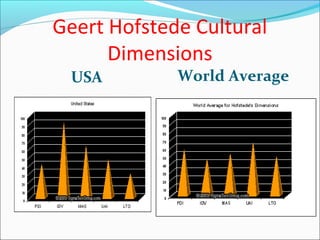
Geert Hofstede Cultural
Dimensions
USA World Average
HOFSTEDE THEORYHOFSTEDE THEORY
Dimensions:
PDI = Power distance
IDV = Individualism
versus
collectivism
MAS = Masculinity
versus femininity
UAI = Uncertainty
avoidance
LTO = Long term
versus short
term orientation
Sources from:
http://moodle.metropolia.fi/file.php/221/Materia
ls_on_crosscultural_communication/Cultural_
dimensions_by_Geert_Hofstede.pdf
Hofstede’s Cultural
Dimensions
Country Power
Distance
Uncertainty
Avoidance
Individualism Masculinity
Arab 80 68 38 52
France 68 86 71 43
India 77 40 48 56
Indonesia 78 48 14 46
Japan 54 92 46 95
Malaysia 104 36 26 50
South Africa 49 49 65 63
Thailand 64 64 20 34
USA 40 46 91 62
http://www.docstoc.com/docs/3542579/hofstedes-theory
16-36
McGraw-Hill/Irwin ©2006 The McGraw-Hill Companies, Inc., All Rights Reserved
Hofstede’s Cultures Ranking in the Top 10
CLASS EXERCISE
Write a one page proposal on how to improve
relationship between Malaysian students and
students from other cultures in UUM.

HOFSTEDE DIMENSION

  • 2.
    Hofstede’s Cultural Dimensions 1.Power distance 2. Uncertainty avoidance 3. Individualism/collectivism 4. Masculinity/femininity 5. Long term / Short term
  • 4.
    Hofstede’s Cultural Dimensions Powerdistance is ‘the extent to which the less powerful members of the organizations and institutions accept and expect that power is distributed unequally’. Power distance is the degree of inequality among people that a culture considers normal.
  • 5.
    • Flatter, decentralizedstructures, smaller ratio of supervisor to employee. • People expect and accept power relations that are more consultative or democratic. • The hierarchies are flat with a decentralized organization and a small number of supervisors who are expected to be accessible for their subordinates. • The degree for unequal treatment is reduced to a low level. • There is a interdependence between employer and employee • Example: Australia, Austria, Finland &
  • 6.
    Low Power Distance Superiortreat subordinate with respect Blame are shared by everybody Manager socialized with subordinates Societies are more toward egalitarianism (equal to all)
  • 7.
    High Power Distance Societieswith high power distance are more comfortable with taller, centralized organization structures with a large proportion of supervisory & employees blindly obey superiors. The relation between boss and subordinate is strictly ruled and dependent on the decisions of the boss. Centralized organization - subordinates expect to be told what to do from their superiors because they consider each other as unequal. Inequalities are normally expected and privileges are seen as desirable by superiors. Example: Malaysia, Guatemala, Panama, Philippines, Mexico, Venezuela, Arab countries, Equador, Indonesia, India, China, West Africa.
  • 8.
    High Power Distance Employeefear to express disagreement to their boss Boss more on autocratic decision making style Inequalities are expected and desired – class divisions are accepted Subordinate very dependence on leader/supervisor – expected to be directed Relationship between boss and subordinate is rarely close or personal Subordinate are expected to take the blame for things that go wrong/failure privileges and status symbols are expected and popular
  • 9.
    Hofstede’s Cultural Dimensions Uncertainty avoidance: -Towhat extent people feel threatened by ambiguous situations ; create beliefs/institutions to avoid such situations. - It also reflects the level of tolerance for uncertainty and ambiguity within the society and the extent to which people avoid uncertainty by creating laws, rules, regulations and controls in order to reduce the amount of uncertainty.
  • 10.
    High uncertainty avoidance countries: Highneed for security, strong belief in experts and their knowledge; structure organizational activities, more written rules, less managerial risk taking. Employees tend to remain longer with their present employer. Example: Germany, Japan, Spain, Mexico, France, Argentina
  • 11.
    High uncertainty avoidance Preferformal rules – try to minimize uncertainty through strict law and regulations Have more written rules Motivation for work comes from security More emotional Typically manager take less risk Low turnover
  • 12.
    Low uncertainty avoidance countries: •People more willing to accept risks of the unknown, less structured organizational activities, fewer written rules, more managerial risk taking, higher employee turnover, more ambitious employees . • Example: Denmark, Great Britain, China, India, Singapore, Hong Kong, Philippines, USA.
  • 13.
    Low uncertainty avoidance Moretolerant of different opinion Try to minimize rules as possible Low UAI people don’t easily express their emotion Risk taker and may choose strategy that offer high reward Comfort with ambiguity and curious about differences Work hard only when necessary, tolerate, innovation and motivate by achievement, esteem and belongliness
  • 14.
    Some implication ofCountry Uncertainty Avoidance LOW Uncertainty Avoidance Index High Uncertainty Avoidance Index Emotions Controlled Normal (More emotion) Change Work Less hesitation (High Turnover) More hesitation (Low Turnover) Rules Can be broken No Seniority as criteria for selection Yes No http://www.ling.gu.se/~natasha/Overview.pdf
  • 15.
    Hofstede’s Cultural Dimensions Individualism VSCollectivism: -The extent to which people feel they are supposed to look after themselves, immediate family or organizations they belong to. - Focuses on the degree the society reinforces individual or collective in term of achievement or interpersonal relationship
  • 16.
    Hofstede’s Cultural Dimensions Highindividualism countries: Wealthier, greater individual initiative, promotions based on market value (e.g., U.S, Canada, Sweden) A high IDV score indicates a loose connection with people. In countries with a high IDV score there is a lack of interpersonal connection and little sharing of responsibility, beyond family and perhaps a few close friends.
  • 17.
    High individualism Concept of‘I’ Wealthy countries are tend to be more individualistic Usually practiced by low context country People more to self respect Individual right are stress within society Ties between individual are loose (looser relationship) Everyone is expected to look after him/herself and his/her immediate family only Privacy and self actualization is more important Hiring are based on skills and rules Promotions based on performance, ability and skills.
  • 18.
    Hofstede’s Cultural Dimensions Highcollectivism countries: Poorer, less individual initiative, promotions based on seniority (e.g., Indonesia, Pakistan). Have strong group cohesion, and there would be a large amount of loyalty and respect for members of the group. The group itself is also larger and people take more responsibility for each other's well being.
  • 19.
    High collectivism Concept of‘WE’ Poor countries tend to be collectivist Stands for a society who are integrated into strong, cohesive in-group Close ties between individual Responsibility and care extended to all people – larger group and families Harmony and consensus are ultimate goals
  • 20.
    Hofstede’s Cultural Dimensions HighIDV Low IDV Individual is most important unit Collectivist cultures believe group is most important unit People taking care of themselves They encourage: Primary loyalty to group (nuclear family, extended family, caste, organization) Making decision based on individual needs Decision-making based on what is best for the group People speak out, question, confrontational & direct People blend in, avoidance conflict, use intermediaries
  • 21.
    Hofstede’s Cultural Dimensions Masculinity-Femininity:Indicates the degree to which a culture values such behavior as assertiveness, achievement, acquisition of wealth or caring for others, social supports & the quality of life. Masculinity: Dominant social values are success, money, and things.
  • 22.
    Hofstede’s Cultural Dimensions High masculinecountries: Stress earnings, recognition, advancement, challenge, wealth; high job stress (e.g. Germanic countries). Value competitiveness, assertiveness, ambition & accumulation of wealth/material possession. Have very distinct expectation of male & female roles in society. Japan is highly, whereas Sweden has the lowest measured value. According to Hofstede's analysis, if you were to open an office in Japan, you might have greater success if you appointed a male employee to lead the team and had a strong male contingent on the team.
  • 23.
    High masculinity Priorities areachievement, wealth and expansion Acceptable to settle conflict through aggressive means Women and men have different role in society (gender role clearly distinct) Women are subordinated to male leadership Failing is disaster Value high earning, recognition for a good job, advancement and challenge to have personal accomplishment
  • 24.
    Hofstede’s Cultural Dimensions  Highfeminine countries: Emphasize caring for others and quality of life; cooperation, friendly atmosphere, employment security, group decision making; low job stress (e.g. Norway).  Prefer equality between male and female & less perspective role behaviors associated with genders. * Masculine cultures believe that man should be assertive, tough & focus on material success; women should be more modest, tender and concerned with quality of life.
  • 25.
    Low Masculinity (Feminine) Valuerelationship and quality of life Value interdependence, empathy and emotional openness Prefer equality between male and female Men and women can be gentle, both can express weakness and fighting are minimized Sympathy for weaknesses  consider failing as accident  resolve conflict by compromise and negotiation Work to live Manager use intuition Strive for consensus
  • 26.
    Hofstede’s Cultural Dimensions Longterm vs short term -This refers to how much society values long-standing - as opposed to short term - traditions and values. -This is the fifth dimension that Hofstede added in the 1990s after finding that Asian countries with a strong link to Confucian philosophy acted differently from western cultures.
  • 27.
    Hofstede’s Cultural Dimensions LongTerm Orientation - People value actions and attitudes that affect the future: persistence/perseverance, thrift and shame. - Have strong work ethic and respect for a hierarchy of the status. (e.g China, Japan, India) Short Term Orientation - People value actions and attitudes that are affected by the past or the present: normative statements, immediate stability, protecting one’s own face, respect for tradition and reciprocation of greetings favors and gifts.(UK,US, Germany)
  • 28.
  • 29.
    Short Term Orientation Valueaction and attitude Affected by the past Respect the tradition Normative statement Immediate stability Protecting one’s own face
  • 30.
    Hofstede’s Cultural Dimensions Accordingto Hofstede's analysis, people in the United States and United Kingdom have low LTO scores. This suggests that you can pretty much expect anything in this culture in terms of creative expression and novel ideas. The model implies that people in the US and UK don't value tradition as much as many others, and are therefore likely to be willing to help you execute the most innovative plans as long as they get to participate fully.
  • 31.
    Below are thescores of the 20 countries samples for the LONG- TERM orientation:  China - 118  Hong Kong - 96  Taiwan - 87  Japan - 80  South Korea - 75  India - 61  Thailand - 56  Singapore - 48  Bangladesh - 40  Sweden - 33  Poland - 32  Germany FR - 31  Australia 31  New Zealand - 30  USA - 29  Great Britain - 25  Zimbabwe – 25  Philippines - 19  Nigeria - 16  Pakistan - 00
  • 32.
  • 33.
  • 34.
    Dimensions: PDI = Powerdistance IDV = Individualism versus collectivism MAS = Masculinity versus femininity UAI = Uncertainty avoidance LTO = Long term versus short term orientation Sources from: http://moodle.metropolia.fi/file.php/221/Materia ls_on_crosscultural_communication/Cultural_ dimensions_by_Geert_Hofstede.pdf
  • 35.
    Hofstede’s Cultural Dimensions Country Power Distance Uncertainty Avoidance IndividualismMasculinity Arab 80 68 38 52 France 68 86 71 43 India 77 40 48 56 Indonesia 78 48 14 46 Japan 54 92 46 95 Malaysia 104 36 26 50 South Africa 49 49 65 63 Thailand 64 64 20 34 USA 40 46 91 62 http://www.docstoc.com/docs/3542579/hofstedes-theory
  • 36.
    16-36 McGraw-Hill/Irwin ©2006 TheMcGraw-Hill Companies, Inc., All Rights Reserved Hofstede’s Cultures Ranking in the Top 10
  • 37.
    CLASS EXERCISE Write aone page proposal on how to improve relationship between Malaysian students and students from other cultures in UUM.

Editor's Notes

  • #34 http://www.geert-hofstede.com/hofstede_united_states.shtml