Walta Nemariam, Emily Roberson, Katie Quill,
                     and Madison Cawthon
   Culture is how people behave and react as a
    result of what they see and experience

   This knowledge forms values, creates
    attitudes, and influences behavior
   Learned -acquired by learning or experience

   Shared - not specific to single individuals

   Trans-generational - cumulative, passed
    down from one generation to the next
   Symbolic - culture is based on the human
    capacity to symbolize or use one thing to
    represent another
   Patterned - has structure and is integrated; a
    change in one part will bring changes in
    another
   Adaptive - based on human capacity to
    change or adapt
   -centralized vs. decentralized decision
    making

   -safety vs. risk

   -individual vs. group rewards

   -informal vs. formal procedures
   -high vs. low organizational loyalty

   -cooperation vs. competition

   -short term vs. long term horizons

   -stability vs. innovation
   Values are the basic convictions people have
    concerning right and wrong, good and bad,
    important and unimportant
    ◦ learned from the culture in which the individual is
      raised
    ◦ help direct the person’s behavior
• 5 dimensions that help explain how and why
people from different cultures behave the way
they do
1. Power distance- the extent to which less
powerful members of institutions and
organizations accept that power is distributed
unequally

2. uncertainty avoidance- extent to which
people feel threatened by ambiguous situations
and have created beliefs and institutions that
try to avoid these
3. Individualism/Collectivism
individualism- the tendency of people to look
after themselves and their immediate family
only
collectivism- tendency of people to belong to
groups or collectives and to look after each
other in exchange for loyalty
4. masculinity- a cultural characteristic
in which the dominant values in society
are success, money, and materialistic
things
femininity- a cultural characteristic in
which the dominant values are caring
for others and the quality of life
5. Time orientation is the fifth and newer
dimension, but not as well known


   Integrating the dimensions of culture into
    pairings or clusters helps depict what
    countries are similar in values
   Dimensions:
    1.   Universalism vs. Particularism
    2.   Individualism vs. Communitarianism
    3.   Neutral culture vs. Emotional culture
    4.   Specific vs. Diffuse culture
    5.   Achievement vs. Ascription culture

   Widely accepted study of international
    management
   Conducted over 10-year period, 28 countries
   These dimensions address the way people deal
    with one another
   Universalism
    ◦ the belief that ideas and practices can be applied
      everywhere without modification
    ◦ Focus is on rules over relationships
    ◦ United States, Germany, Sweden, Australia
   Particularism
    ◦ The belief that circumstances dictate how ideas and
      practices should be applied
    ◦ Legal contracts are modified
    ◦ Venezuela, Indonesia, China
    ◦ Be prepared for small talk and meandering
a.   My friend has a definite right as a friend to
     expect me to testify to the lower figure.
b.   He has some right as a friend to expect me
     to testify to the lower figure
c.   He has no right as friend to expect me to
     testify to the lower figure.
   Individualism
    ◦ People regard themselves as individuals.
    ◦ Negotiation takes the form of a representative

   Communitarianism
    ◦ People regard themselves as being part of a whole
    ◦ Decisions are usually referred to committees

    How should people from these different cultures deal
     with one another in business settings?
   Neutral culture
    ◦ One in which emotions are held in check
    ◦ Japan, UK
    ◦ Lack of emotion does not mean disinterest or
      boredom
   Emotional culture
    ◦ One in which emotions are expressed openly and
      naturally
    ◦ Mexico, the Netherlands, Switzerland
    ◦ Those in an emotional culture should respond
      warmly in a business setting
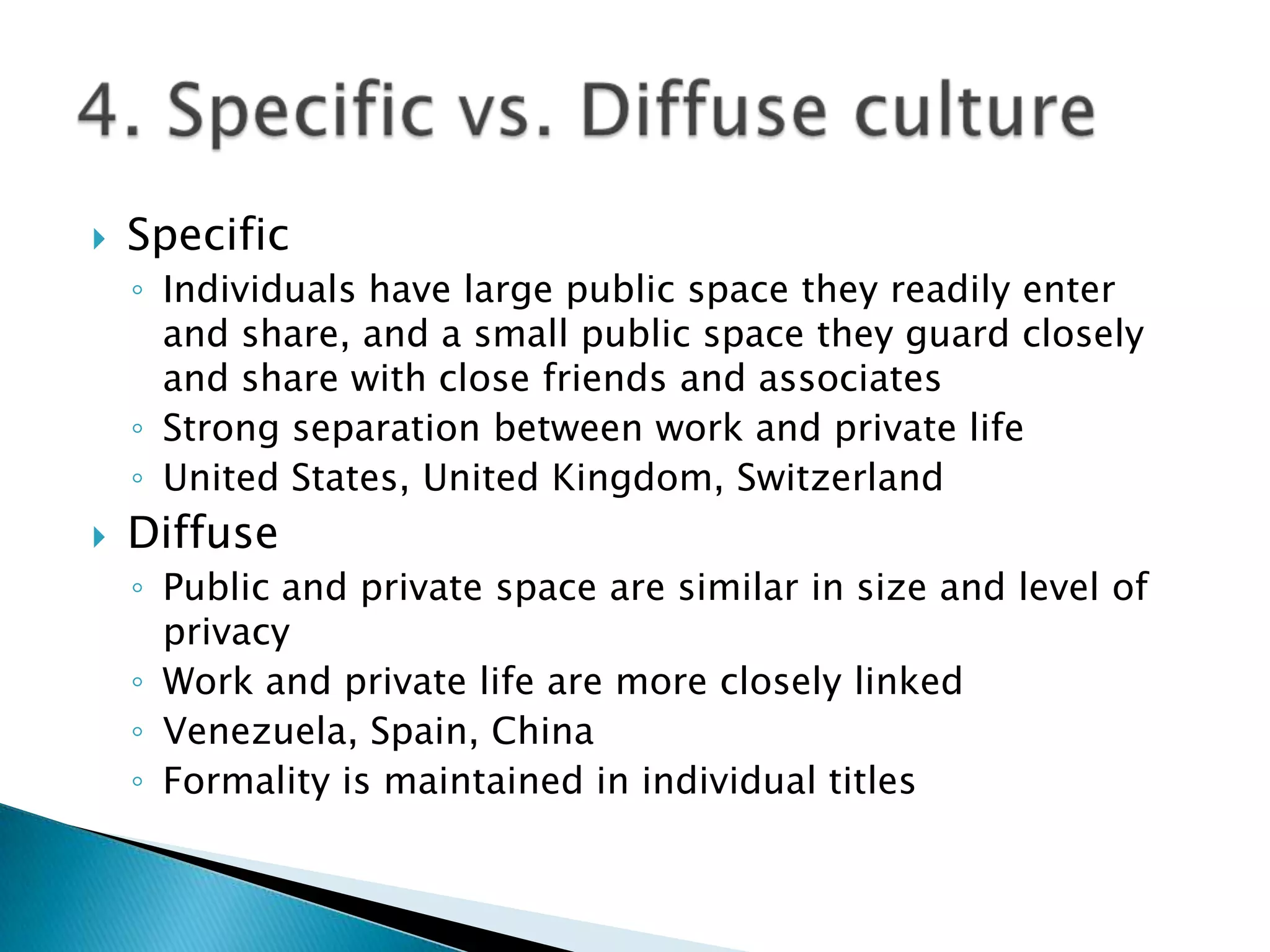
   Specific
    ◦ Individuals have large public space they readily enter
      and share, and a small public space they guard closely
      and share with close friends and associates
    ◦ Strong separation between work and private life
    ◦ United States, United Kingdom, Switzerland
   Diffuse
    ◦ Public and private space are similar in size and level of
      privacy
    ◦ Work and private life are more closely linked
    ◦ Venezuela, Spain, China
    ◦ Formality is maintained in individual titles
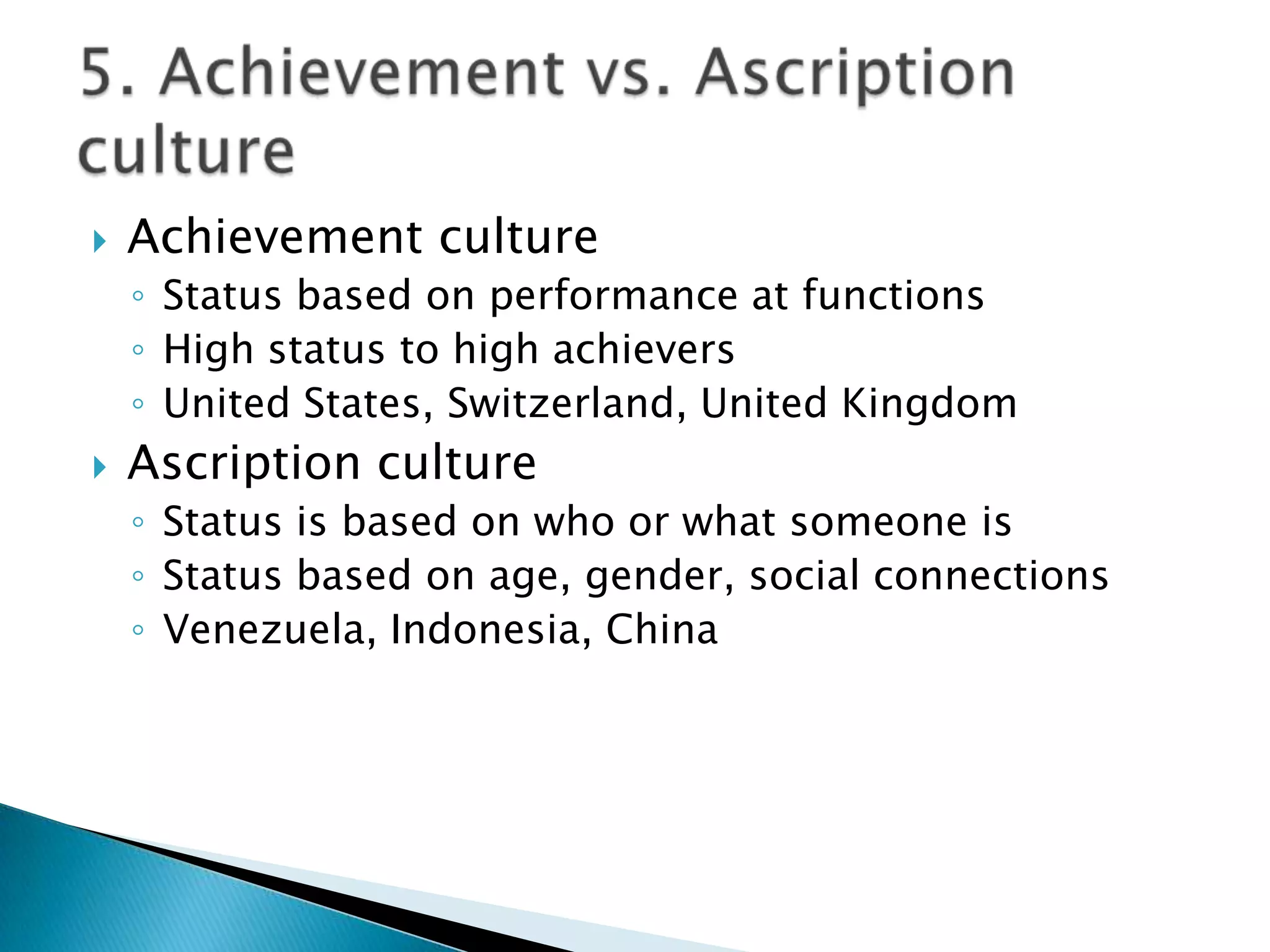
   Achievement culture
    ◦ Status based on performance at functions
    ◦ High status to high achievers
    ◦ United States, Switzerland, United Kingdom
   Ascription culture
    ◦ Status is based on who or what someone is
    ◦ Status based on age, gender, social connections
    ◦ Venezuela, Indonesia, China
   Sequential
    ◦   One activity at a time
    ◦   Keep appointments strictly
    ◦   Show strong preference for following plans
    ◦   United States
   Synchronous
    ◦ Multitasking
    ◦ Appointments are approximate
    ◦ Mexico
    ◦ “For French and Mexicans, what was important was that
      they get to the end, not the particular path or sequence
      by which that end was reached.”
    ◦ Past, present, future orientation
   One thing he did was asked managers to
    choose one of the following statements.
    1. What happens to me is my own doing.
    2. Sometimes I feel that I do not have enough
       control over the directions my life is taking.

    ◦ When dealing with those from cultures who believe
      in dominating the environment, it is important to
      play hardball.
    ◦ When dealing with cultures that believe in letting
      things run their course, it is important to be polite
      and to maintain relationships.
   Trompenaar’s research lends itself to cultural
    patterns.

    ◦ Anglo cluster: United States, United Kingdom
    ◦ Asian cluster: Japan, China, Indonesia, Hong Kong,
      Singapore
    ◦ Latin American cluster: Argentina, Mexico,
      Venezuela, Brazil
    ◦ Latin European cluster: France, Belgium, Spain, Italy
    ◦ Germanic cluster: Austria, Germany, Switzerland,
      Czechoslovakia
   Similar to Trompenaars and Hofsted with
    greater emphasis on managerial styles
   A different approach to measuring cultural
    differences
   Conducted by a team of multicultural
    researchers
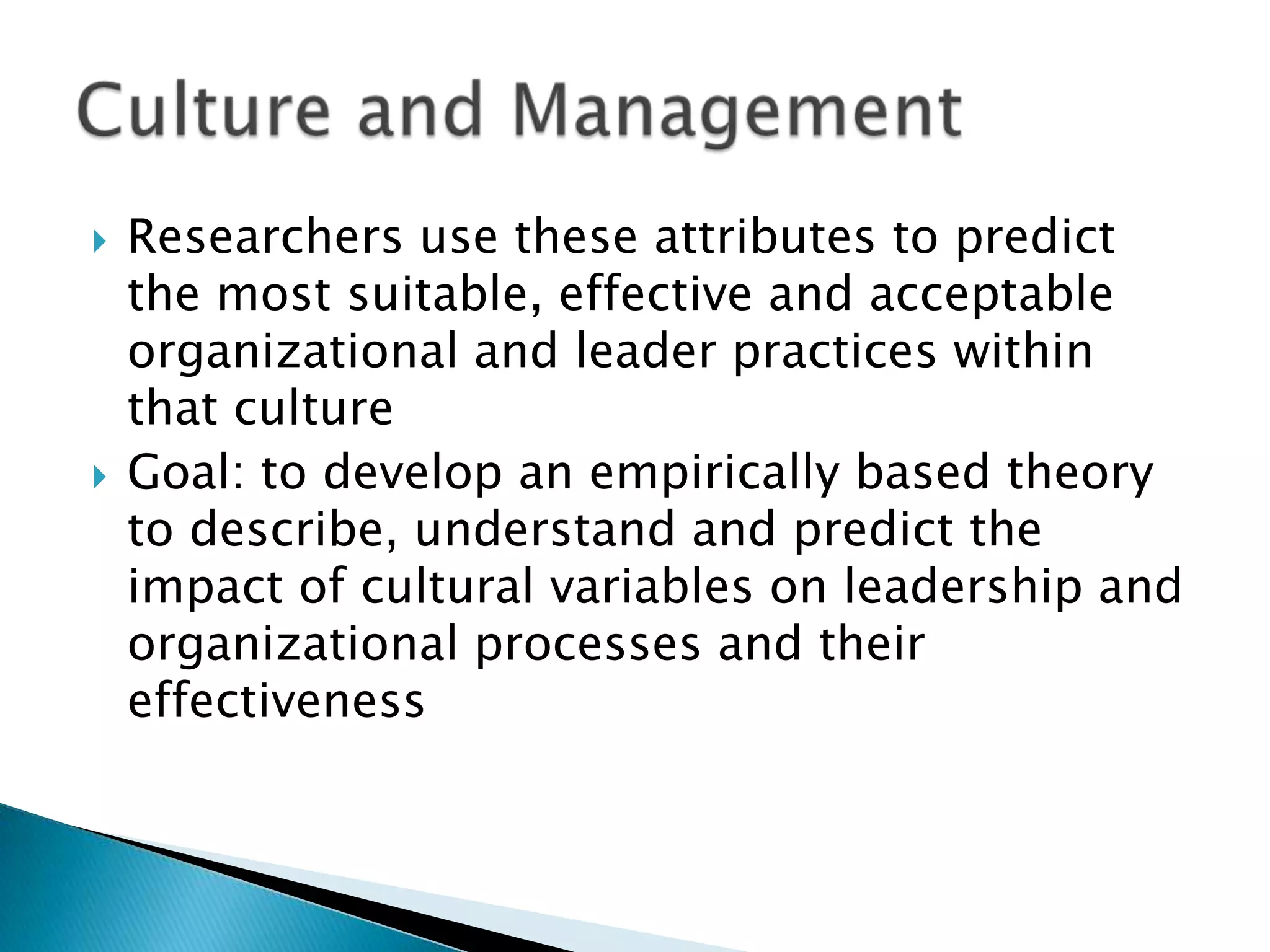
   Researchers use these attributes to predict
    the most suitable, effective and acceptable
    organizational and leader practices within
    that culture
   Goal: to develop an empirically based theory
    to describe, understand and predict the
    impact of cultural variables on leadership and
    organizational processes and their
    effectiveness
   For MNCs to be successful companies must
    carefully address the cultural similarities and
    differences in their varied markets.
    ◦ Renault
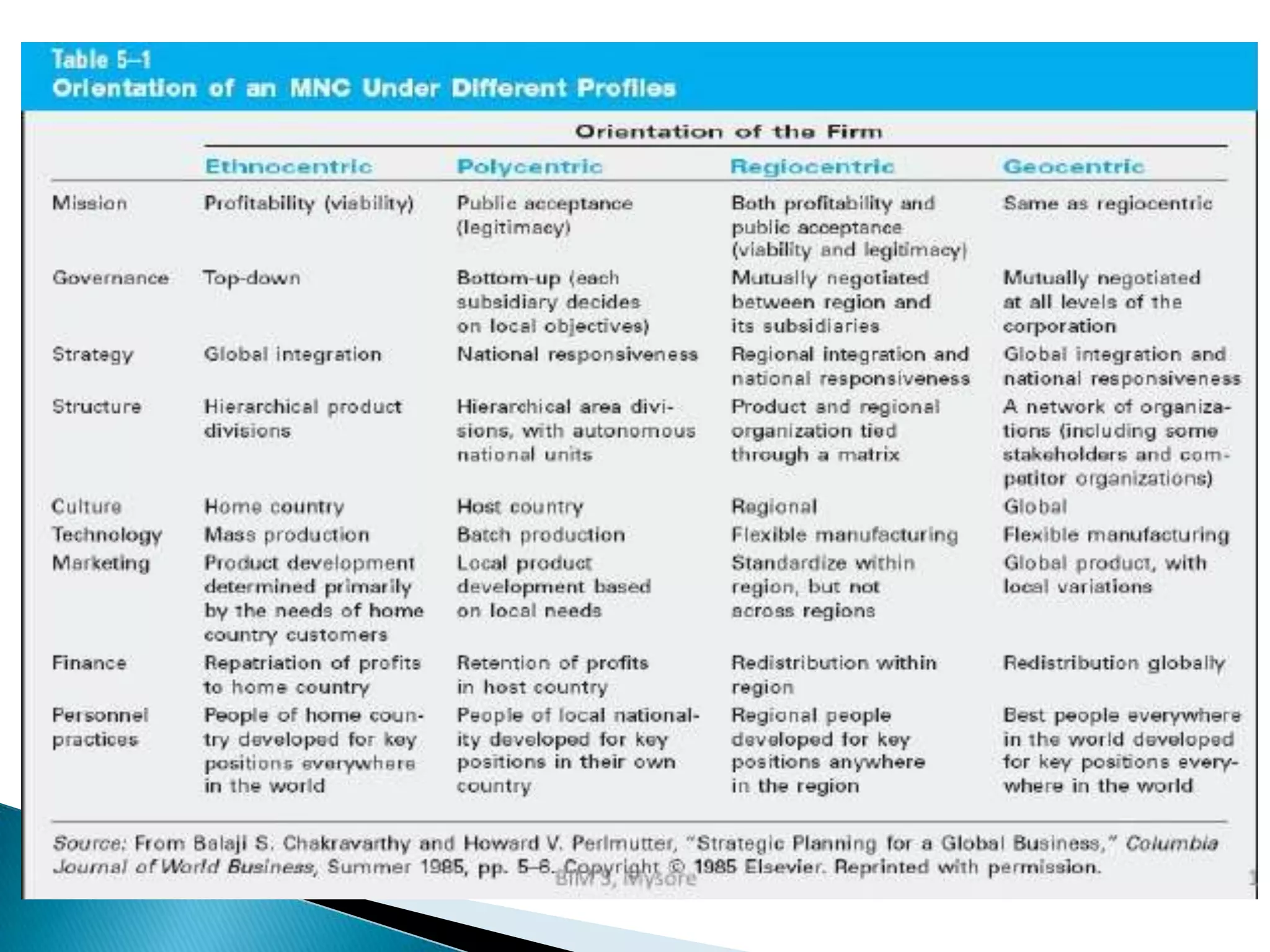
   Ethnocentric Predisposition
    ◦ allows the values of the parent company to guide
      strategic decisions.
   Polycentric Predisposition
    ◦ firms make strategic decisions tailored to suit the
      cultures of the countries where the MNC operates. EX-
      Disney
   Regiocentric Predisposition
    ◦ firm tries to blend its own interests with those of its
      subsidiaries on a regional basis.
   Geocentric Predisposition
    ◦ tries to integrate a global systems approach to decision
      making
   Some companies are committed to a
    globalization imperative or one worldwide
    approach to doing business.
    ◦ A study showed that 103 medium and large MNCs
      out of 115 use the same strategies at home as they
      do abroad.
    ◦ http://www.youtube.com/watch?v=m0rKn7X7UWk
    ◦ http://www.youtube.com/watch?v=rB85iQ0Y_bw
   The most effective MNCs are constantly trying
    to address local needs.
    ◦ Warner-Lambert
      They have manufacturing facilities in Belgium, France,
       Germany, Italy, Ireland, Spain, and the United
       Kingdom. Each plant is specializes and produces a
       small number of products for the entire European
       market. This allows each one to focus on the unique
       demands for the various markets.
   There are several reasons for differentiating
    strategies to meet the needs of different
    cultures.
    ◦   1. Industry standards are different for each country.
    ◦   2. Customers want differentiated products
    ◦   3. Customers prefer to buy local
    ◦   4. The difficulty of managing global organizations
    ◦   5. Letting subsidiaries customize their products for
        their market
   Marketing becomes especially different when
    dealing cultures.
    ◦ Cosmetic products
      In Spain and Greece tooth paste is marketed as a
       cosmetic product but is marketed as a cavity-fighter in
       the Netherlands and the US. Soap is also considered a
       cosmetic product in Spain.

      http://www.youtube.com/watch?v=mCSxbIvpE4Q
      http://www.youtube.com/watch?v=nT1uvi7qjrs
   How the marketing message is delivered is
    essential.
    ◦ German advertising is factual and rational. They
      fear being manipulated.
    ◦ French avoid reasoning and logic. Their advertising
      is emotional and dramatic. Commercials are viewed
      as short films.
    ◦ British value laughter above all else. They like to
      mock the advertiser and consumer.
      However, with a high end or low end products
       marketing messages are similar world wide. Ex. Coca-
       Cola, Porsche
   The need to adjust global strategies for
    regional markets presents three major
    challenges:
    ◦ 1. The MNC must stay up to date about local
      markets and be careful not to assume that all
      markets are basically the same.
    ◦ 2.The MNC must know the needs of the subsidiaries
      so that it can provide best for these units when it
      comes to addressing local demands
    ◦ 3. The company must give the subsidiary more
      autonomy so that it can respond to changes in local
      demands.
   Cross-Cultural Differences and Similarities-
    The way MNCs manage their home
    businesses often should be different from the
    way they manage their overseas operations.
   Parochialism- the tendency to view the world
    through one’s own eyes and perspectives.
    ◦ Soviet Companies
   Simplification- exhibiting the same
    orientation toward different cultural groups.
   There was a lot of hope that businesses
    would be able to keep their practices the
    same when internationalization started in the
    1970s which proved to be false. However,
    there are similarities.
   Studies show that the US has several
    similarities with Russia.
    ◦ Managerial Activities- Networking
    ◦ Organizational Behavioral Modification- providing
      corrective feedback proved to have positive results
      in Russia after adopting the US practice.
   From a Human Resource Standpoint
    ◦ Management has to be careful when letting each
      national operating company oversee evaluations.
   Each evaluation will vary greatly from country
    to country.
    ◦ Shell Oil had the head office established criteria to
      evaluate the personal and had the national
      operating company do the evaluating. Each
      company had completely different results.
   Other Human Resource Management differences:
    wages, compensation, pay equity, and maternity
    leave.
    ◦ Hourly wage plays a minor role in Mexico. Labor law
      requires that employees receive full pay 365 days a year.
    ◦ Austrian and Brazilian employees with one year of
      service are automatically given 30 days of paid vacation.
    ◦ Japan: compensation levels are determined by age,
      length of service, and educational background rather
      than skill, ability, and performance…that comes into
      play at age 45
    ◦ United Kingdom: Employees are given 40 weeks for
      maternity leave including 18 weeks of government
      mandated pay.
   Incentive Plans are also different for
    different cultures
    ◦ Pacific Rim: Japan, Hong Kong, Malaysia, the Philippines,
      Singapore. High salaries should be paid to senior-level managers.
    ◦ For Belgium and Italy- significantly higher salaries should be paid
      to local senior-level managers because of the high masculinity
      index.
    ◦ Portugal and Greece- both of which have a low individualism
      index, profit sharing plans would be more effective than individual
      incentive plan.
    ◦ Personal Incentive plans would be highly useful for Denmark,
      Netherlands, Germany because of the high individualism in these
      cultures.
    ◦ Great Britain and Ireland and the US managers value their
      individualism and are motivated by the opportunity for earnings,
      recognition, advancement, and challenge.
   Hiring also varies from country to country.
    ◦ In the Untied States people are hired based on what
      they can do for the firm in the short run. Americans
      also prefer specialized training.
    ◦ In Japan, they hire based on who will help the firm
      in the long run, and prefer cross training.
    ◦ Americans prefer to reward people as individuals
      while in Japan they prefer to reward people as a
      group.
   1979-Deng Xiaoping opened the country
    to the world
   US and Europeans find doing business
    with China a long and grueling process
    ◦ Technical Competence
    ◦ Time/Patience
   Guanxi: means good connection in
    Chinese
   Collective society: pride themselves on
    being members of a group
• Build personal relationships with
  partners
• Use local consultants
• Consider business ethics
• Stress exclusivity
• Keep financial information personal
• Research the company
• Stress mutual gain
• Written contracts are not as binding
   Unsaturated consumer markets, cheap labor
    and production location
   Be on time
   Personal questions should not be asked
   Titles are important
   PDA is inappropriate (backslaps)
   Namaste gesture
   Many Indians understand that Westerners
    may not be familiar with their culture and
    that’s ok
   Social class is very important
   Friendly, humorous and sarcastic
   Accustomed to conflict
   Trustworthiness
   View on Work ethic
   Highly centralized and have rigid
    structures
   Management differences
   French business tips
   Portuguese influence
   Relaxed work ethic
   Good natured and avoid confrontation
   Working with Brazil:
       Personal space
       Face-to-Face interaction
       Trust
       Patience
       Appearance
       Loyal and Committed
       Consistency
   Allah controls time
   Status is determined by family position and
    connections
   Emotions over logic
   Working with Arabs:
        Never display feelings of superiority
        Never take credit for joint efforts
        Administrative channels
        Connections are important
        Patience
International Management Presentation

International Management Presentation

  • 1.
    Walta Nemariam, EmilyRoberson, Katie Quill, and Madison Cawthon
  • 2.
    Culture is how people behave and react as a result of what they see and experience  This knowledge forms values, creates attitudes, and influences behavior
  • 3.
    Learned -acquired by learning or experience  Shared - not specific to single individuals  Trans-generational - cumulative, passed down from one generation to the next
  • 4.
    Symbolic - culture is based on the human capacity to symbolize or use one thing to represent another  Patterned - has structure and is integrated; a change in one part will bring changes in another  Adaptive - based on human capacity to change or adapt
  • 5.
    -centralized vs. decentralized decision making  -safety vs. risk  -individual vs. group rewards  -informal vs. formal procedures
  • 6.
    -high vs. low organizational loyalty  -cooperation vs. competition  -short term vs. long term horizons  -stability vs. innovation
  • 8.
    Values are the basic convictions people have concerning right and wrong, good and bad, important and unimportant ◦ learned from the culture in which the individual is raised ◦ help direct the person’s behavior
  • 9.
    • 5 dimensionsthat help explain how and why people from different cultures behave the way they do
  • 10.
    1. Power distance-the extent to which less powerful members of institutions and organizations accept that power is distributed unequally 2. uncertainty avoidance- extent to which people feel threatened by ambiguous situations and have created beliefs and institutions that try to avoid these
  • 11.
    3. Individualism/Collectivism individualism- thetendency of people to look after themselves and their immediate family only collectivism- tendency of people to belong to groups or collectives and to look after each other in exchange for loyalty
  • 12.
    4. masculinity- acultural characteristic in which the dominant values in society are success, money, and materialistic things femininity- a cultural characteristic in which the dominant values are caring for others and the quality of life
  • 13.
    5. Time orientationis the fifth and newer dimension, but not as well known  Integrating the dimensions of culture into pairings or clusters helps depict what countries are similar in values
  • 14.
    Dimensions: 1. Universalism vs. Particularism 2. Individualism vs. Communitarianism 3. Neutral culture vs. Emotional culture 4. Specific vs. Diffuse culture 5. Achievement vs. Ascription culture  Widely accepted study of international management  Conducted over 10-year period, 28 countries  These dimensions address the way people deal with one another
  • 15.
    Universalism ◦ the belief that ideas and practices can be applied everywhere without modification ◦ Focus is on rules over relationships ◦ United States, Germany, Sweden, Australia  Particularism ◦ The belief that circumstances dictate how ideas and practices should be applied ◦ Legal contracts are modified ◦ Venezuela, Indonesia, China ◦ Be prepared for small talk and meandering
  • 16.
    a. My friend has a definite right as a friend to expect me to testify to the lower figure. b. He has some right as a friend to expect me to testify to the lower figure c. He has no right as friend to expect me to testify to the lower figure.
  • 17.
    Individualism ◦ People regard themselves as individuals. ◦ Negotiation takes the form of a representative  Communitarianism ◦ People regard themselves as being part of a whole ◦ Decisions are usually referred to committees How should people from these different cultures deal with one another in business settings?
  • 18.
    Neutral culture ◦ One in which emotions are held in check ◦ Japan, UK ◦ Lack of emotion does not mean disinterest or boredom  Emotional culture ◦ One in which emotions are expressed openly and naturally ◦ Mexico, the Netherlands, Switzerland ◦ Those in an emotional culture should respond warmly in a business setting
  • 19.
    Specific ◦ Individuals have large public space they readily enter and share, and a small public space they guard closely and share with close friends and associates ◦ Strong separation between work and private life ◦ United States, United Kingdom, Switzerland  Diffuse ◦ Public and private space are similar in size and level of privacy ◦ Work and private life are more closely linked ◦ Venezuela, Spain, China ◦ Formality is maintained in individual titles
  • 20.
    Achievement culture ◦ Status based on performance at functions ◦ High status to high achievers ◦ United States, Switzerland, United Kingdom  Ascription culture ◦ Status is based on who or what someone is ◦ Status based on age, gender, social connections ◦ Venezuela, Indonesia, China
  • 21.
    Sequential ◦ One activity at a time ◦ Keep appointments strictly ◦ Show strong preference for following plans ◦ United States  Synchronous ◦ Multitasking ◦ Appointments are approximate ◦ Mexico ◦ “For French and Mexicans, what was important was that they get to the end, not the particular path or sequence by which that end was reached.” ◦ Past, present, future orientation
  • 22.
    One thing he did was asked managers to choose one of the following statements. 1. What happens to me is my own doing. 2. Sometimes I feel that I do not have enough control over the directions my life is taking. ◦ When dealing with those from cultures who believe in dominating the environment, it is important to play hardball. ◦ When dealing with cultures that believe in letting things run their course, it is important to be polite and to maintain relationships.
  • 23.
    Trompenaar’s research lends itself to cultural patterns. ◦ Anglo cluster: United States, United Kingdom ◦ Asian cluster: Japan, China, Indonesia, Hong Kong, Singapore ◦ Latin American cluster: Argentina, Mexico, Venezuela, Brazil ◦ Latin European cluster: France, Belgium, Spain, Italy ◦ Germanic cluster: Austria, Germany, Switzerland, Czechoslovakia
  • 24.
    Similar to Trompenaars and Hofsted with greater emphasis on managerial styles  A different approach to measuring cultural differences  Conducted by a team of multicultural researchers
  • 26.
    Researchers use these attributes to predict the most suitable, effective and acceptable organizational and leader practices within that culture  Goal: to develop an empirically based theory to describe, understand and predict the impact of cultural variables on leadership and organizational processes and their effectiveness
  • 28.
    For MNCs to be successful companies must carefully address the cultural similarities and differences in their varied markets. ◦ Renault
  • 29.
    Ethnocentric Predisposition ◦ allows the values of the parent company to guide strategic decisions.  Polycentric Predisposition ◦ firms make strategic decisions tailored to suit the cultures of the countries where the MNC operates. EX- Disney  Regiocentric Predisposition ◦ firm tries to blend its own interests with those of its subsidiaries on a regional basis.  Geocentric Predisposition ◦ tries to integrate a global systems approach to decision making
  • 31.
    Some companies are committed to a globalization imperative or one worldwide approach to doing business. ◦ A study showed that 103 medium and large MNCs out of 115 use the same strategies at home as they do abroad. ◦ http://www.youtube.com/watch?v=m0rKn7X7UWk ◦ http://www.youtube.com/watch?v=rB85iQ0Y_bw
  • 32.
    The most effective MNCs are constantly trying to address local needs. ◦ Warner-Lambert  They have manufacturing facilities in Belgium, France, Germany, Italy, Ireland, Spain, and the United Kingdom. Each plant is specializes and produces a small number of products for the entire European market. This allows each one to focus on the unique demands for the various markets.
  • 33.
    There are several reasons for differentiating strategies to meet the needs of different cultures. ◦ 1. Industry standards are different for each country. ◦ 2. Customers want differentiated products ◦ 3. Customers prefer to buy local ◦ 4. The difficulty of managing global organizations ◦ 5. Letting subsidiaries customize their products for their market
  • 34.
    Marketing becomes especially different when dealing cultures. ◦ Cosmetic products  In Spain and Greece tooth paste is marketed as a cosmetic product but is marketed as a cavity-fighter in the Netherlands and the US. Soap is also considered a cosmetic product in Spain.  http://www.youtube.com/watch?v=mCSxbIvpE4Q  http://www.youtube.com/watch?v=nT1uvi7qjrs
  • 35.
    How the marketing message is delivered is essential. ◦ German advertising is factual and rational. They fear being manipulated. ◦ French avoid reasoning and logic. Their advertising is emotional and dramatic. Commercials are viewed as short films. ◦ British value laughter above all else. They like to mock the advertiser and consumer.  However, with a high end or low end products marketing messages are similar world wide. Ex. Coca- Cola, Porsche
  • 36.
    The need to adjust global strategies for regional markets presents three major challenges: ◦ 1. The MNC must stay up to date about local markets and be careful not to assume that all markets are basically the same. ◦ 2.The MNC must know the needs of the subsidiaries so that it can provide best for these units when it comes to addressing local demands ◦ 3. The company must give the subsidiary more autonomy so that it can respond to changes in local demands.
  • 37.
    Cross-Cultural Differences and Similarities- The way MNCs manage their home businesses often should be different from the way they manage their overseas operations.  Parochialism- the tendency to view the world through one’s own eyes and perspectives. ◦ Soviet Companies  Simplification- exhibiting the same orientation toward different cultural groups.
  • 38.
    There was a lot of hope that businesses would be able to keep their practices the same when internationalization started in the 1970s which proved to be false. However, there are similarities.  Studies show that the US has several similarities with Russia. ◦ Managerial Activities- Networking ◦ Organizational Behavioral Modification- providing corrective feedback proved to have positive results in Russia after adopting the US practice.
  • 39.
    From a Human Resource Standpoint ◦ Management has to be careful when letting each national operating company oversee evaluations.  Each evaluation will vary greatly from country to country. ◦ Shell Oil had the head office established criteria to evaluate the personal and had the national operating company do the evaluating. Each company had completely different results.
  • 40.
    Other Human Resource Management differences: wages, compensation, pay equity, and maternity leave. ◦ Hourly wage plays a minor role in Mexico. Labor law requires that employees receive full pay 365 days a year. ◦ Austrian and Brazilian employees with one year of service are automatically given 30 days of paid vacation. ◦ Japan: compensation levels are determined by age, length of service, and educational background rather than skill, ability, and performance…that comes into play at age 45 ◦ United Kingdom: Employees are given 40 weeks for maternity leave including 18 weeks of government mandated pay.
  • 41.
    Incentive Plans are also different for different cultures ◦ Pacific Rim: Japan, Hong Kong, Malaysia, the Philippines, Singapore. High salaries should be paid to senior-level managers. ◦ For Belgium and Italy- significantly higher salaries should be paid to local senior-level managers because of the high masculinity index. ◦ Portugal and Greece- both of which have a low individualism index, profit sharing plans would be more effective than individual incentive plan. ◦ Personal Incentive plans would be highly useful for Denmark, Netherlands, Germany because of the high individualism in these cultures. ◦ Great Britain and Ireland and the US managers value their individualism and are motivated by the opportunity for earnings, recognition, advancement, and challenge.
  • 42.
    Hiring also varies from country to country. ◦ In the Untied States people are hired based on what they can do for the firm in the short run. Americans also prefer specialized training. ◦ In Japan, they hire based on who will help the firm in the long run, and prefer cross training. ◦ Americans prefer to reward people as individuals while in Japan they prefer to reward people as a group.
  • 43.
    1979-Deng Xiaoping opened the country to the world  US and Europeans find doing business with China a long and grueling process ◦ Technical Competence ◦ Time/Patience  Guanxi: means good connection in Chinese  Collective society: pride themselves on being members of a group
  • 44.
    • Build personalrelationships with partners • Use local consultants • Consider business ethics • Stress exclusivity • Keep financial information personal • Research the company • Stress mutual gain • Written contracts are not as binding
  • 45.
    Unsaturated consumer markets, cheap labor and production location  Be on time  Personal questions should not be asked  Titles are important  PDA is inappropriate (backslaps)  Namaste gesture  Many Indians understand that Westerners may not be familiar with their culture and that’s ok
  • 46.
    Social class is very important  Friendly, humorous and sarcastic  Accustomed to conflict  Trustworthiness  View on Work ethic  Highly centralized and have rigid structures  Management differences  French business tips
  • 47.
    Portuguese influence  Relaxed work ethic  Good natured and avoid confrontation  Working with Brazil: Personal space Face-to-Face interaction Trust Patience Appearance Loyal and Committed Consistency
  • 48.
    Allah controls time  Status is determined by family position and connections  Emotions over logic  Working with Arabs: Never display feelings of superiority Never take credit for joint efforts Administrative channels Connections are important Patience