CHAPTER 3:
MANAGING IN A GLOBAL DIVERSE
ENVIRONMENT
CH 3
© 2015 SAGE Publications
Global Business in the Global Village
• Global business: buying and selling of goods amongst different
countries
• Global village: companies conducting business worldwide
without boundaries
Different Types of Global Business
• Domestic Business: Conducts business in only one country
• International Business: Based primarily in one country but
transacts business in other countries
• Multinational Corporations (MNC): Has ownership of operations
in two or more countries
Foreign and Transnational Companies
• Foreign subsidiaries or affiliates: company owned and controlled
by another company making up a combined company called the
holding or parent company
• Transnational Company type: eliminates artificial geographical
barriers and does not have a single national headquarter
Foreign Trade
• Foreign Trade is conducting business with other countries
• Foreign trade generally, but not always, benefits a company
• Dumping is when a company sells a product in another country at a loss
with the intention of driving out the competition
Trade Barriers
• Embargo: Total ban on the importing of a product from one or
more countries
• Quotas: Sets a limit on the number or volume of a product that
can be imported or exported during a set period of time
• Subsidies: Include government grants, loans and a tax breaks
given to domestic companies
• Tariff (Tax Method): Direct tax on imports to make foreign
products more expensive
World Trade Organization (WTO)
• Allows organizations and governments to work together to
develop free trade among countries
Trade Agreements
• There are six major trade agreements around the globe:
• North American Free Trade Agreement (NAFTA)
• Dominican Republic-Central American Free Trade Agreement (CAFTA-
DR)
• Union of South American Nations (UNASUR)
• European Union (EU)
• Association of Southeast Asian Nations (ASEAN)
• Asia-Pacific Economic Cooperation (APEC)
Exchange Rates
• Exchange Rates: the value of one country’s currency when
accepted by/convereted to another country
• Balance of Trade: The difference between the value of the
products and services a country exports and imports.
The Balance of Trade
• Trade deficit: a country importing more than it exports
• Trade surplus: a country exporting more than it imports
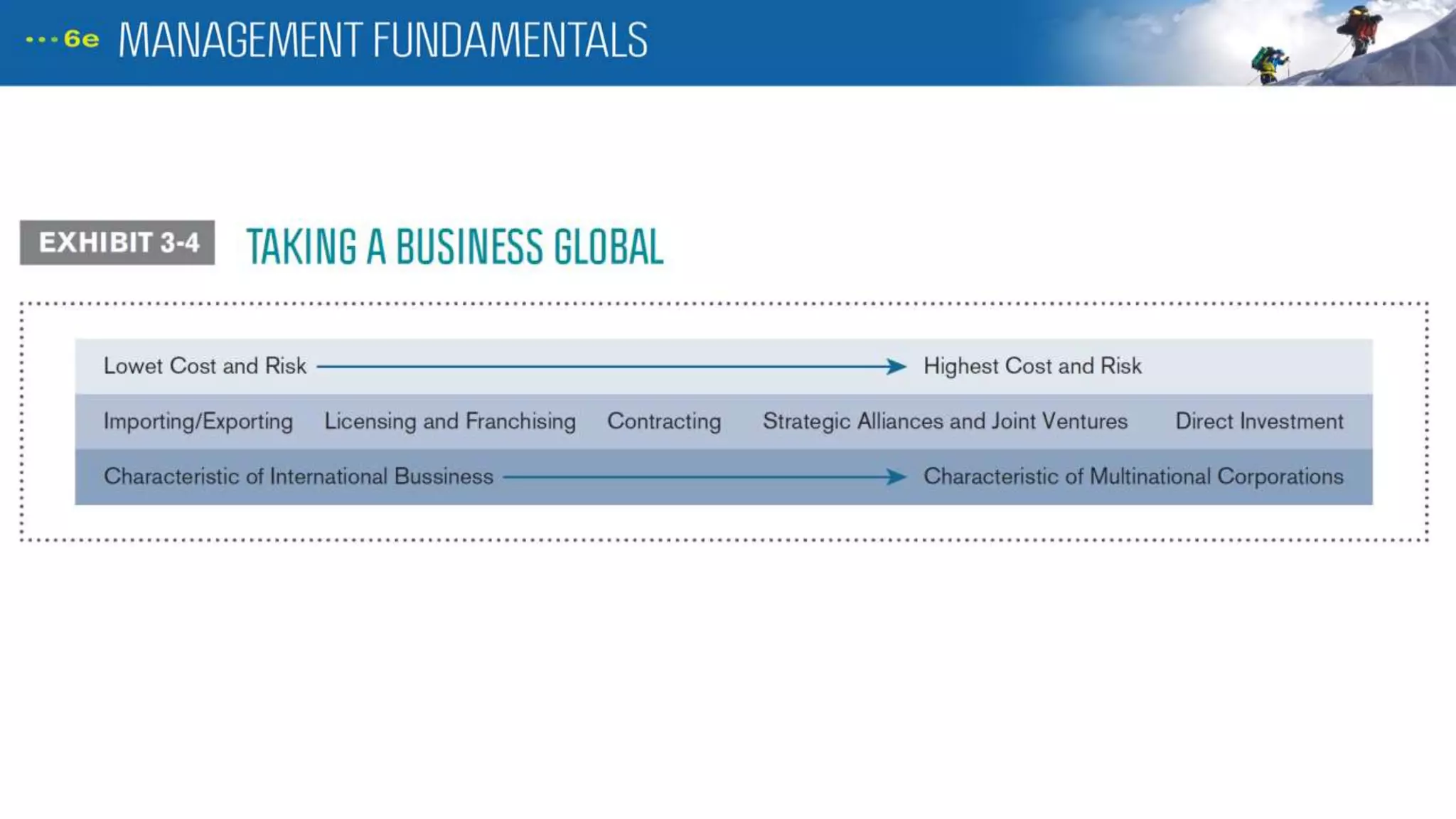
Becoming a Business Global
• Global Sourcing: Hiring others outside the firm to perform work
worldwide
• Importing and Exporting: Commerce that moves goods or
services into or out of a country
• Licensing and Franchising: Licensor allows the licensee to
make its products, serves or intellectual property for a fee
Becoming a Business Global
• Contracting: A foreign company making a product or providing
a service for domestic one
• Contract manufacturing vs. Management Contracting
• Strategic Alliances and Joint Ventures Strategic
• Alliance is an agreement to share resources that does not necessarily
involve creating a new company.
• Joint venture is created when two or more firms share ownership of a
new company
• Direct Investment: The building or buying operating facilities in
a foreign country
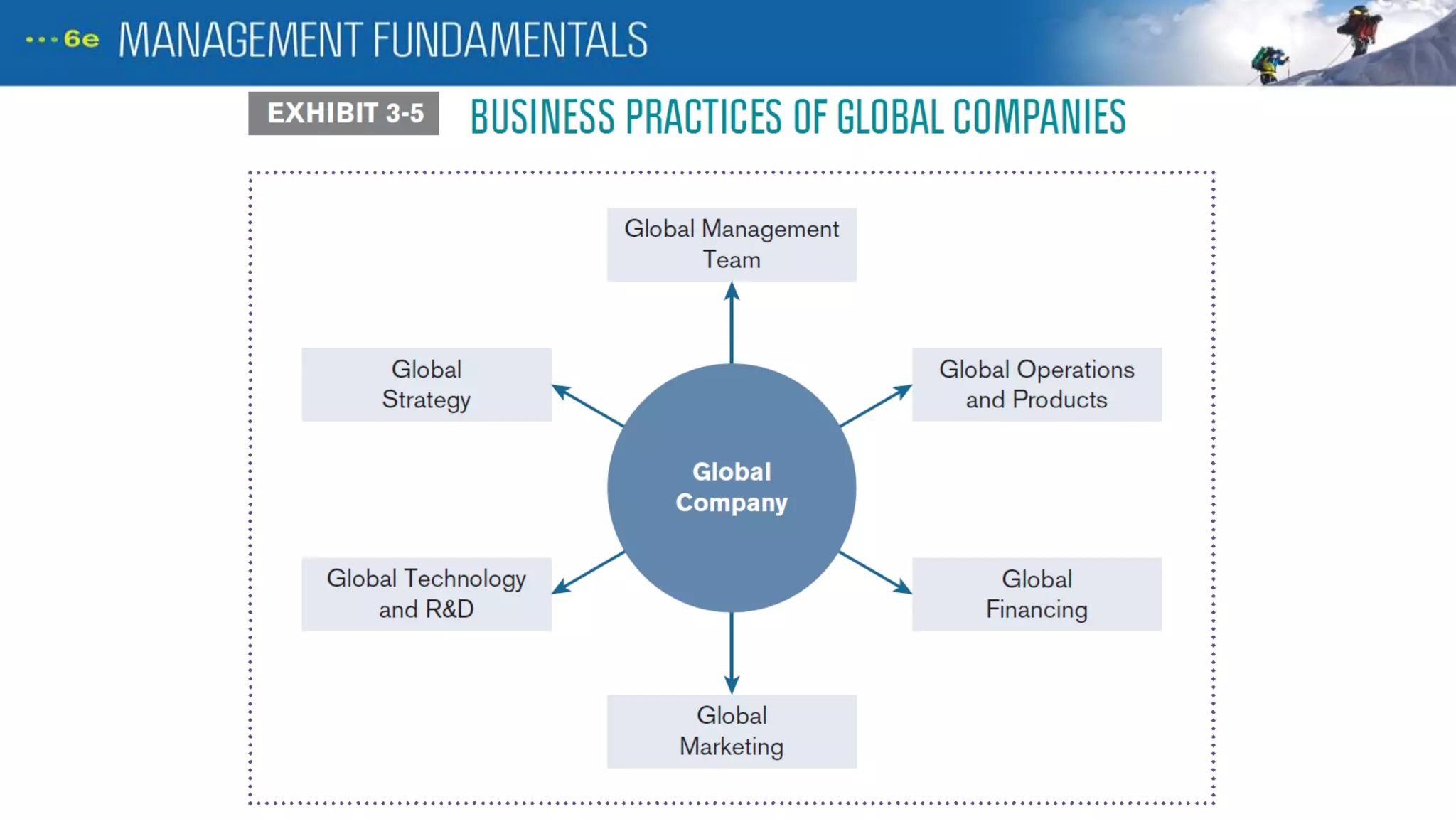
Business Practices of Global Companies
• Global Management Team- Top level managers who are foreign
nationals
• Global Strategy- One strategy for the entire company not one
per subsidiary
Business Practices of Global Companies
• Global Operations and Products- Standardized operations and
products worldwide to attain economies of scale
• Global Technology and R&D- Technology research and
development centralized in one country, rather than duplicated at
each subsidiary
Business Practices of Global Companies
• Global Financing- Search world markets to get the best rates
and terms when borrowing money for the long term; short term
financing is largely arranged in individual countries using local
financial institutions
• Global Marketing- Global products and marketing are adapted
for local markets and are often developed by local agencies
Workplace Diversity
• Diversity: the variety of people with different group identities
within the same workplace
• Diversity has a major impact on employees’ work related values
and attitudes and can affect the way an organization is
managed
Workplace Diversity
• Age
• Gender
• Race and Ethnicity
• Disability
• Other
Hofstede National Culture Diversity
• Power Distance
• Individualism vs. Collectivism
• Assertiveness vs. Nurturing
• Uncertainty Avoidance vs. Acceptance
• Long term vs. Short term Orientation
Power Distance
• High Power Distance Cultures
• Employees expect and accept that management will make all decisions
with little input from them
• China, Philippines, & most Arab countries
• Low Power Distance Cultures
• Employees expect to be consulted on decisions of management and want
to participate
• Israel, United States, & most European countries
Individualism vs. Collectivism
• Individualism
• Individualist cultures believe the individual should be self-sufficient with
loyalty to themselves first and the group and company second
• United States & Netherlands
• Collectivism
• Places society, the group & the company first
• Indonesia & China
Assertiveness vs. Nurturing
• Assertiveness
• Assertive cultures are more aggressive and competitive with focus on
achievement and material possessions
• Indonesia & China
• Nurturing
• Nurturing cultures emphasize the importance of relationships, modesty,
caring and quality of life
• Netherlands & France
Uncertainty Avoidance vs. Acceptance
• Uncertainty Avoidance
• Uncertainty avoidance cultures like structure, security, and are less likely
to take risk
• Japan & Germany
• Uncertainty Acceptance
• Uncertainty acceptance cultures are more comfortable dealing with the
unknown, changes and take more risk
• Hong Kong
Long Term vs. Short Term Orientation
• Long Term Orientation
• Long term cultures look to the future and value thrift
• China & Hong Kong
• Short Term Orientation
• Short term cultures focus on the past and present, and value immediate
gratification
• United States & Germany
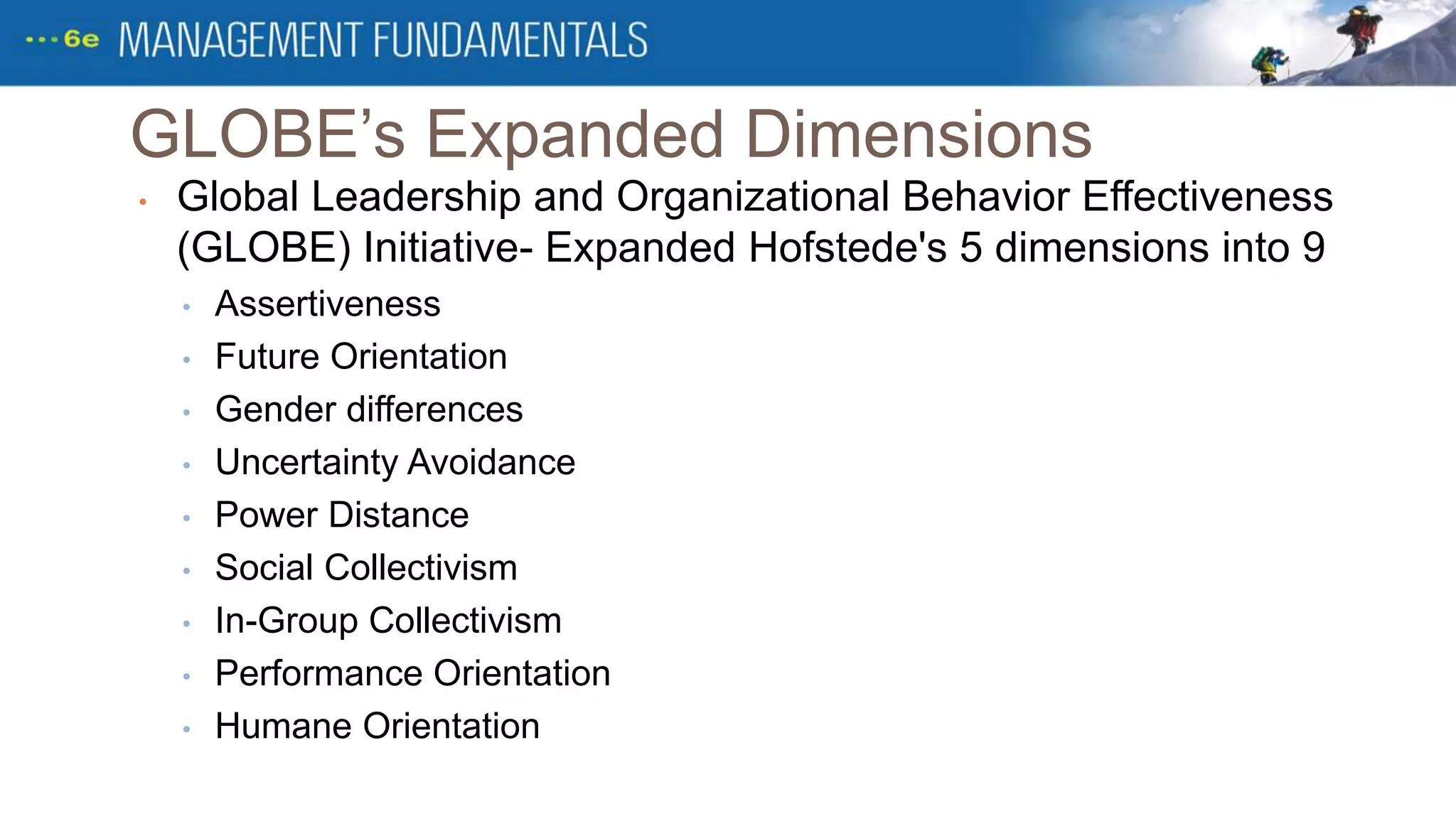
GLOBE’s Expanded Dimensions
• Global Leadership and Organizational Behavior Effectiveness
(GLOBE) Initiative- Expanded Hofstede's 5 dimensions into 9
• Assertiveness
• Future Orientation
• Gender differences
• Uncertainty Avoidance
• Power Distance
• Social Collectivism
• In-Group Collectivism
• Performance Orientation
• Humane Orientation
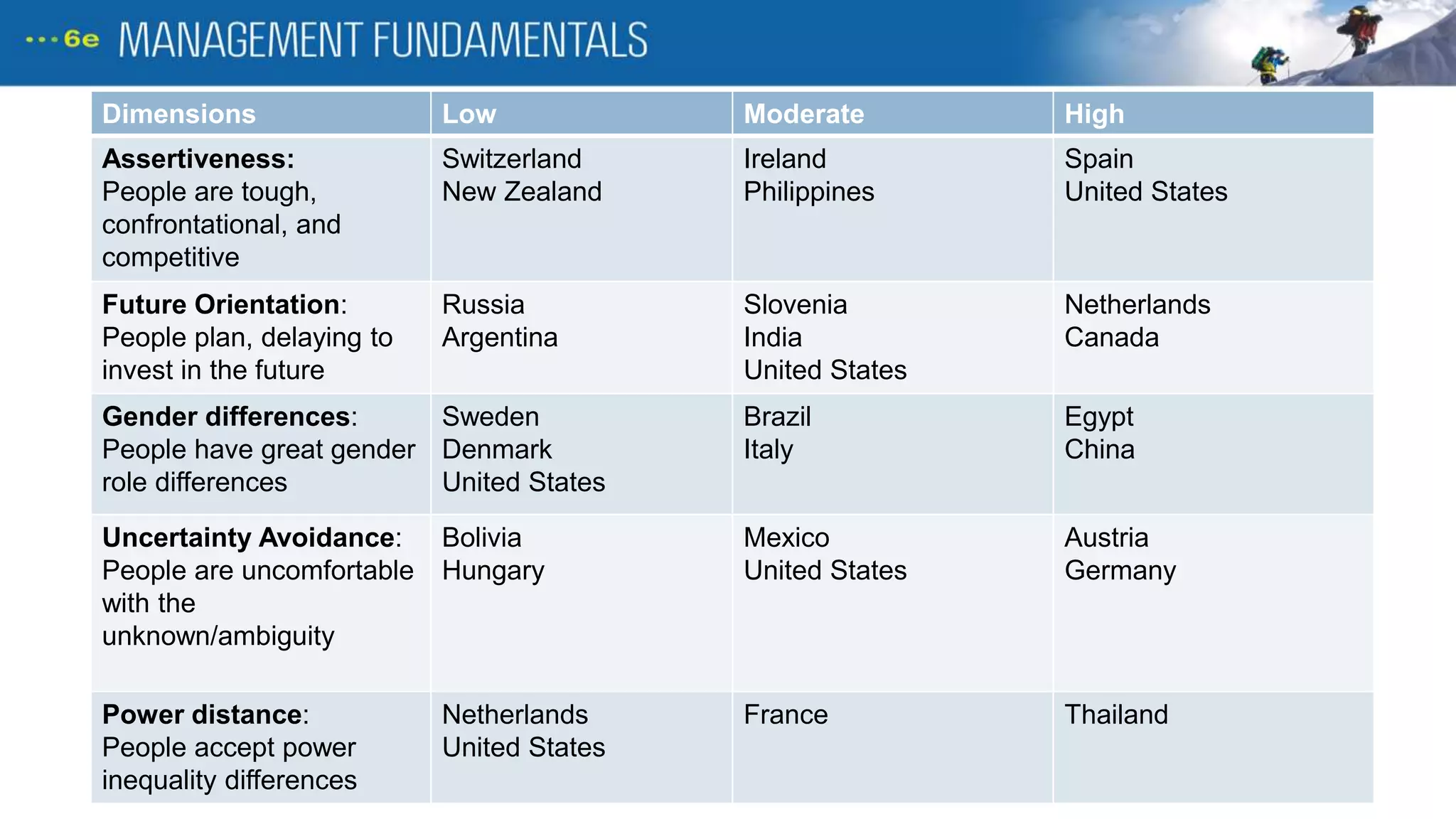
Dimensions Low Moderate High
Assertiveness:
People are tough,
confrontational, and
competitive
Switzerland
New Zealand
Ireland
Philippines
Spain
United States
Future Orientation:
People plan, delaying to
invest in the future
Russia
Argentina
Slovenia
India
United States
Netherlands
Canada
Gender differences:
People have great gender
role differences
Sweden
Denmark
United States
Brazil
Italy
Egypt
China
Uncertainty Avoidance:
People are uncomfortable
with the
unknown/ambiguity
Bolivia
Hungary
Mexico
United States
Austria
Germany
Power distance:
People accept power
inequality differences
Netherlands
United States
France Thailand
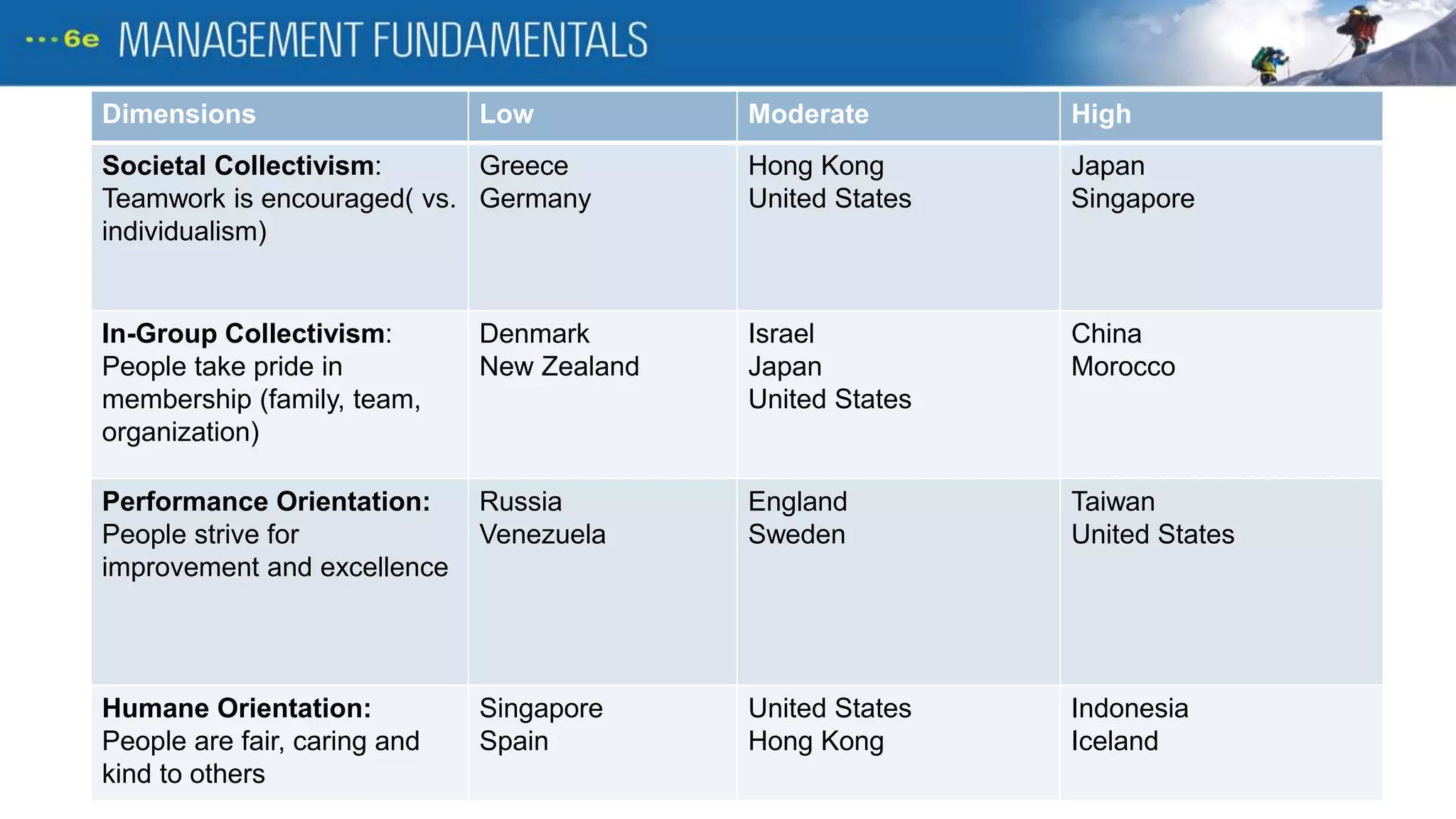
Dimensions Low Moderate High
Societal Collectivism:
Teamwork is encouraged( vs.
individualism)
Greece
Germany
Hong Kong
United States
Japan
Singapore
In-Group Collectivism:
People take pride in
membership (family, team,
organization)
Denmark
New Zealand
Israel
Japan
United States
China
Morocco
Performance Orientation:
People strive for
improvement and excellence
Russia
Venezuela
England
Sweden
Taiwan
United States
Humane Orientation:
People are fair, caring and
kind to others
Singapore
Spain
United States
Hong Kong
Indonesia
Iceland

3 managing in a global diverse environment

  • 1.
    CHAPTER 3: MANAGING INA GLOBAL DIVERSE ENVIRONMENT CH 3 © 2015 SAGE Publications
  • 2.
    Global Business inthe Global Village • Global business: buying and selling of goods amongst different countries • Global village: companies conducting business worldwide without boundaries
  • 3.
    Different Types ofGlobal Business • Domestic Business: Conducts business in only one country • International Business: Based primarily in one country but transacts business in other countries • Multinational Corporations (MNC): Has ownership of operations in two or more countries
  • 4.
    Foreign and TransnationalCompanies • Foreign subsidiaries or affiliates: company owned and controlled by another company making up a combined company called the holding or parent company • Transnational Company type: eliminates artificial geographical barriers and does not have a single national headquarter
  • 5.
    Foreign Trade • ForeignTrade is conducting business with other countries • Foreign trade generally, but not always, benefits a company • Dumping is when a company sells a product in another country at a loss with the intention of driving out the competition
  • 6.
    Trade Barriers • Embargo:Total ban on the importing of a product from one or more countries • Quotas: Sets a limit on the number or volume of a product that can be imported or exported during a set period of time • Subsidies: Include government grants, loans and a tax breaks given to domestic companies • Tariff (Tax Method): Direct tax on imports to make foreign products more expensive
  • 7.
    World Trade Organization(WTO) • Allows organizations and governments to work together to develop free trade among countries
  • 8.
    Trade Agreements • Thereare six major trade agreements around the globe: • North American Free Trade Agreement (NAFTA) • Dominican Republic-Central American Free Trade Agreement (CAFTA- DR) • Union of South American Nations (UNASUR) • European Union (EU) • Association of Southeast Asian Nations (ASEAN) • Asia-Pacific Economic Cooperation (APEC)
  • 9.
    Exchange Rates • ExchangeRates: the value of one country’s currency when accepted by/convereted to another country • Balance of Trade: The difference between the value of the products and services a country exports and imports.
  • 10.
    The Balance ofTrade • Trade deficit: a country importing more than it exports • Trade surplus: a country exporting more than it imports
  • 12.
    Becoming a BusinessGlobal • Global Sourcing: Hiring others outside the firm to perform work worldwide • Importing and Exporting: Commerce that moves goods or services into or out of a country • Licensing and Franchising: Licensor allows the licensee to make its products, serves or intellectual property for a fee
  • 13.
    Becoming a BusinessGlobal • Contracting: A foreign company making a product or providing a service for domestic one • Contract manufacturing vs. Management Contracting • Strategic Alliances and Joint Ventures Strategic • Alliance is an agreement to share resources that does not necessarily involve creating a new company. • Joint venture is created when two or more firms share ownership of a new company • Direct Investment: The building or buying operating facilities in a foreign country
  • 15.
    Business Practices ofGlobal Companies • Global Management Team- Top level managers who are foreign nationals • Global Strategy- One strategy for the entire company not one per subsidiary
  • 16.
    Business Practices ofGlobal Companies • Global Operations and Products- Standardized operations and products worldwide to attain economies of scale • Global Technology and R&D- Technology research and development centralized in one country, rather than duplicated at each subsidiary
  • 17.
    Business Practices ofGlobal Companies • Global Financing- Search world markets to get the best rates and terms when borrowing money for the long term; short term financing is largely arranged in individual countries using local financial institutions • Global Marketing- Global products and marketing are adapted for local markets and are often developed by local agencies
  • 18.
    Workplace Diversity • Diversity:the variety of people with different group identities within the same workplace • Diversity has a major impact on employees’ work related values and attitudes and can affect the way an organization is managed
  • 19.
    Workplace Diversity • Age •Gender • Race and Ethnicity • Disability • Other
  • 20.
    Hofstede National CultureDiversity • Power Distance • Individualism vs. Collectivism • Assertiveness vs. Nurturing • Uncertainty Avoidance vs. Acceptance • Long term vs. Short term Orientation
  • 21.
    Power Distance • HighPower Distance Cultures • Employees expect and accept that management will make all decisions with little input from them • China, Philippines, & most Arab countries • Low Power Distance Cultures • Employees expect to be consulted on decisions of management and want to participate • Israel, United States, & most European countries
  • 22.
    Individualism vs. Collectivism •Individualism • Individualist cultures believe the individual should be self-sufficient with loyalty to themselves first and the group and company second • United States & Netherlands • Collectivism • Places society, the group & the company first • Indonesia & China
  • 23.
    Assertiveness vs. Nurturing •Assertiveness • Assertive cultures are more aggressive and competitive with focus on achievement and material possessions • Indonesia & China • Nurturing • Nurturing cultures emphasize the importance of relationships, modesty, caring and quality of life • Netherlands & France
  • 24.
    Uncertainty Avoidance vs.Acceptance • Uncertainty Avoidance • Uncertainty avoidance cultures like structure, security, and are less likely to take risk • Japan & Germany • Uncertainty Acceptance • Uncertainty acceptance cultures are more comfortable dealing with the unknown, changes and take more risk • Hong Kong
  • 25.
    Long Term vs.Short Term Orientation • Long Term Orientation • Long term cultures look to the future and value thrift • China & Hong Kong • Short Term Orientation • Short term cultures focus on the past and present, and value immediate gratification • United States & Germany
  • 26.
    GLOBE’s Expanded Dimensions •Global Leadership and Organizational Behavior Effectiveness (GLOBE) Initiative- Expanded Hofstede's 5 dimensions into 9 • Assertiveness • Future Orientation • Gender differences • Uncertainty Avoidance • Power Distance • Social Collectivism • In-Group Collectivism • Performance Orientation • Humane Orientation
  • 27.
    Dimensions Low ModerateHigh Assertiveness: People are tough, confrontational, and competitive Switzerland New Zealand Ireland Philippines Spain United States Future Orientation: People plan, delaying to invest in the future Russia Argentina Slovenia India United States Netherlands Canada Gender differences: People have great gender role differences Sweden Denmark United States Brazil Italy Egypt China Uncertainty Avoidance: People are uncomfortable with the unknown/ambiguity Bolivia Hungary Mexico United States Austria Germany Power distance: People accept power inequality differences Netherlands United States France Thailand
  • 28.
    Dimensions Low ModerateHigh Societal Collectivism: Teamwork is encouraged( vs. individualism) Greece Germany Hong Kong United States Japan Singapore In-Group Collectivism: People take pride in membership (family, team, organization) Denmark New Zealand Israel Japan United States China Morocco Performance Orientation: People strive for improvement and excellence Russia Venezuela England Sweden Taiwan United States Humane Orientation: People are fair, caring and kind to others Singapore Spain United States Hong Kong Indonesia Iceland