Strategic Management Concepts: A
Competitive Advantage Approach,
Concepts and Cases
Seventeenth Edition, Global Edition
Chapter 11
Global and International Issues
Copyright © 2023 Pearson Education, Ltd. All Rights Reserved
Learning Objectives (1 of 2)
11.1 Discuss the nature of doing business globally,
including labor union issues and tax rates.
11.2 Explain the advantages and disadvantages of doing
business globally.
11.3 Discuss the global challenge facing firms, including
outsourcing and reshoring.
Copyright © 2023 Pearson Education, Ltd. All Rights Reserved
Learning Objectives (2 of 2)
11.4 Compare and contrast American business culture
versus foreign business cultures; explain why this is a
strategic issue.
11.5 Discuss business culture, with emphasis on Mexico,
Japan, China, and India.
11.6 Discuss business climate, with emphasis on Africa,
China, Indonesia, India, and Mexico.
Copyright © 2023 Pearson Education, Ltd. All Rights Reserved
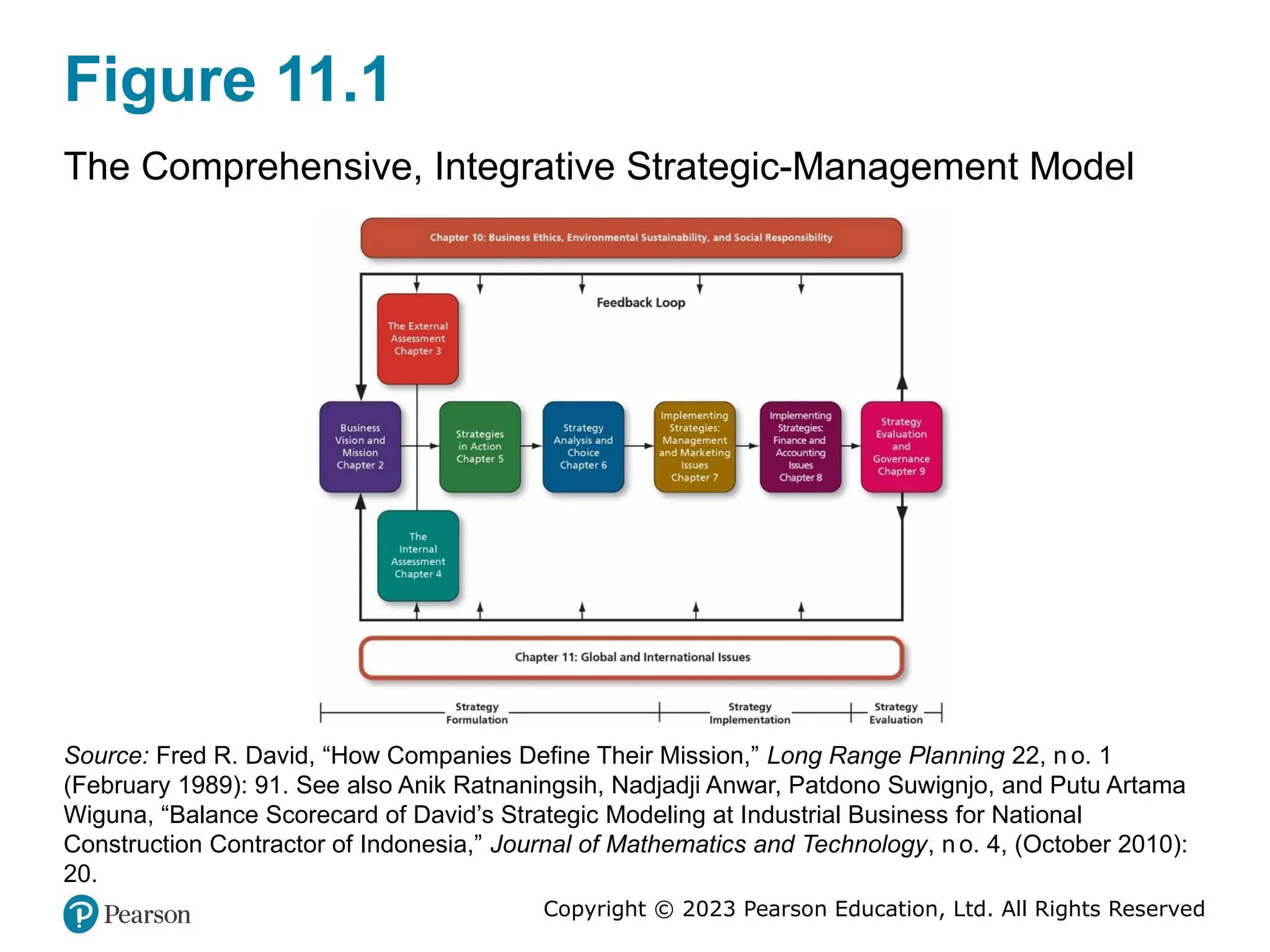
Figure 11.1
The Comprehensive, Integrative Strategic-Management Model
Source: Fred R. David, “How Companies Define Their Mission,” Long Range Planning 22, n o. 1
(February 1989): 91. See also Anik Ratnaningsih, Nadjadji Anwar, Patdono Suwignjo, and Putu Artama
Wiguna, “Balance Scorecard of David’s Strategic Modeling at Industrial Business for National
Construction Contractor of Indonesia,” Journal of Mathematics and Technology, n o. 4, (October 2010):
20.
Copyright © 2023 Pearson Education, Ltd. All Rights Reserved
Global/International Issues
• The underpinnings of strategic management hinge on
managers gaining an understanding of competitors,
markets, prices, suppliers, distributors, governments,
creditors, shareholders, and customers worldwide.
• The price and quality of a firm’s products and services
must be competitive on a worldwide basis, not just on a
local basis.
Copyright © 2023 Pearson Education, Ltd. All Rights Reserved
The Nature of Doing Business
Globally
• Exports of goods and services from the United States
account for only 13 percent of U.S. gross domestic
product.
Copyright © 2023 Pearson Education, Ltd. All Rights Reserved
Globalization
• Globalization
– process of doing business worldwide, so strategic
decisions are made based on global profitability of the
firm rather than just domestic considerations
• Global Strategy
– includes designing, producing, and marketing products
with global needs in mind, instead of considering
individual countries alone
Copyright © 2023 Pearson Education, Ltd. All Rights Reserved
Multinational Firms
• Multinational Firms
– Organizations that conduct business operations across
national borders
Copyright © 2023 Pearson Education, Ltd. All Rights Reserved
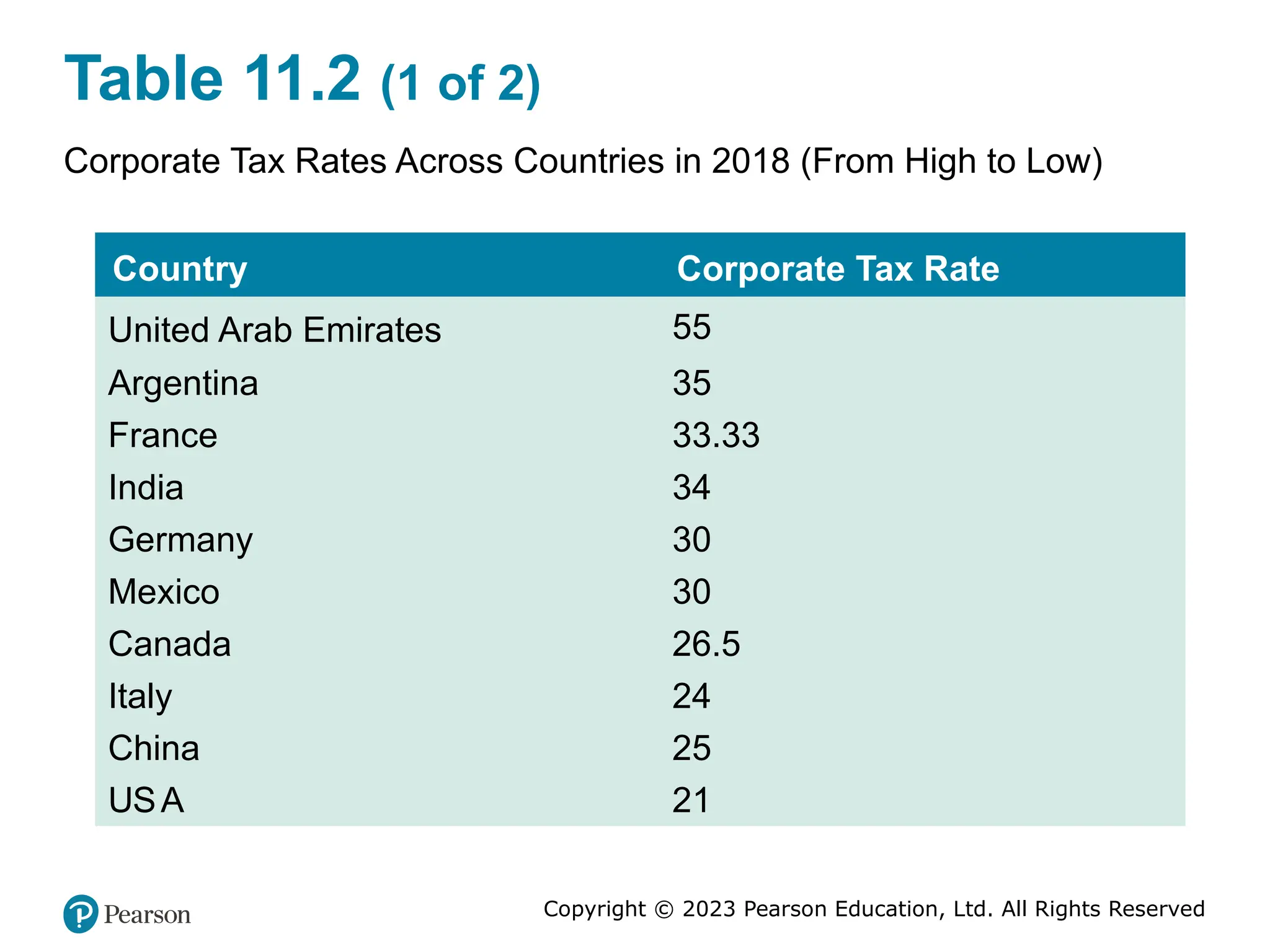
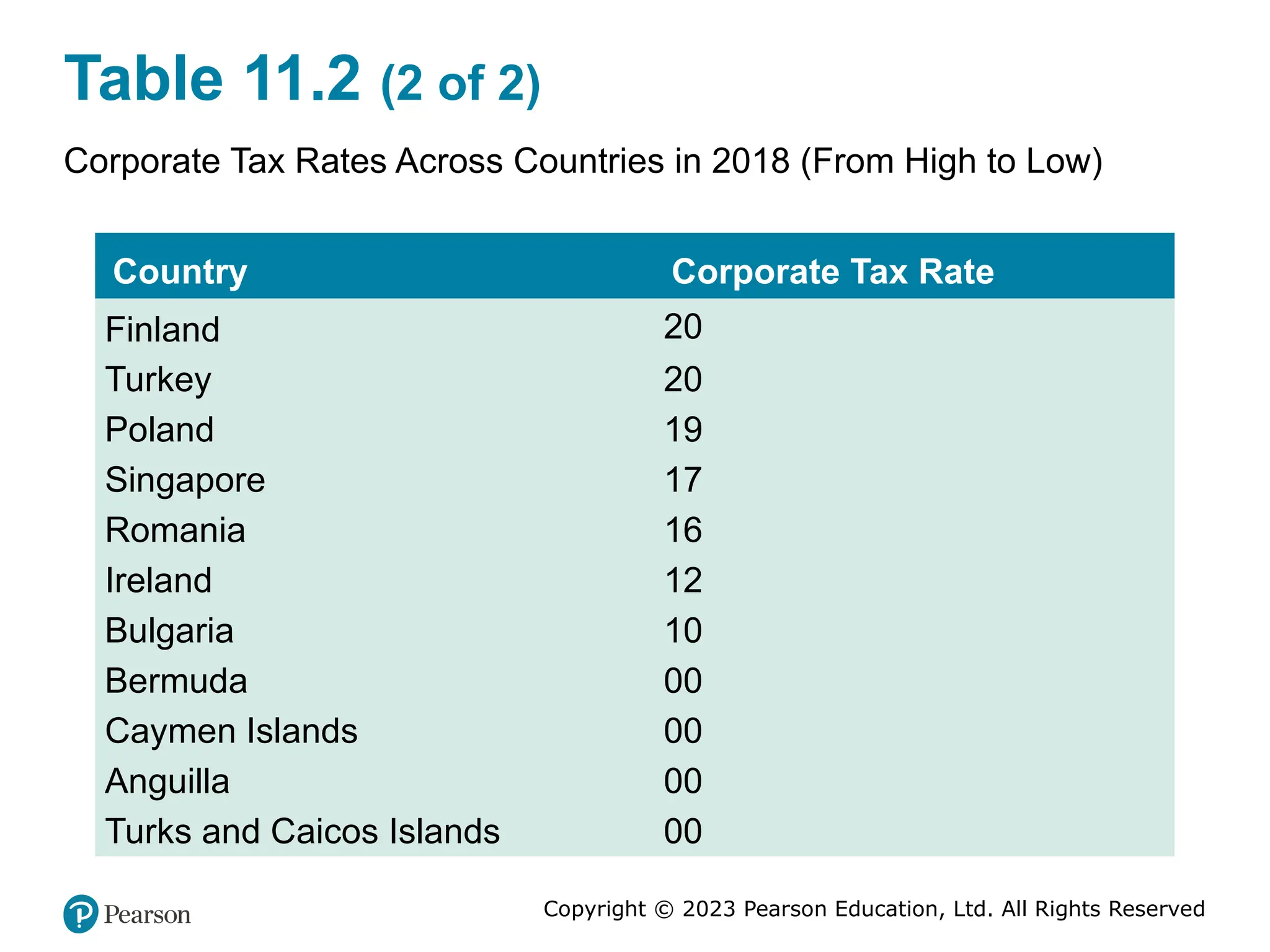
Table 11.2 (1 of 2)
Corporate Tax Rates Across Countries in 2018 (From High to Low)
Country Corporate Tax Rate
United Arab Emirates 55
Argentina 35
France 33.33
India 34
Germany 30
Mexico 30
Canada 26.5
Italy 24
China 25
USA 21
Copyright © 2023 Pearson Education, Ltd. All Rights Reserved
Table 11.2 (2 of 2)
Corporate Tax Rates Across Countries in 2018 (From High to Low)
Country Corporate Tax Rate
Finland 20
Turkey 20
Poland 19
Singapore 17
Romania 16
Ireland 12
Bulgaria 10
Bermuda 00
Caymen Islands 00
Anguilla 00
Turks and Caicos Islands 00
Copyright © 2023 Pearson Education, Ltd. All Rights Reserved
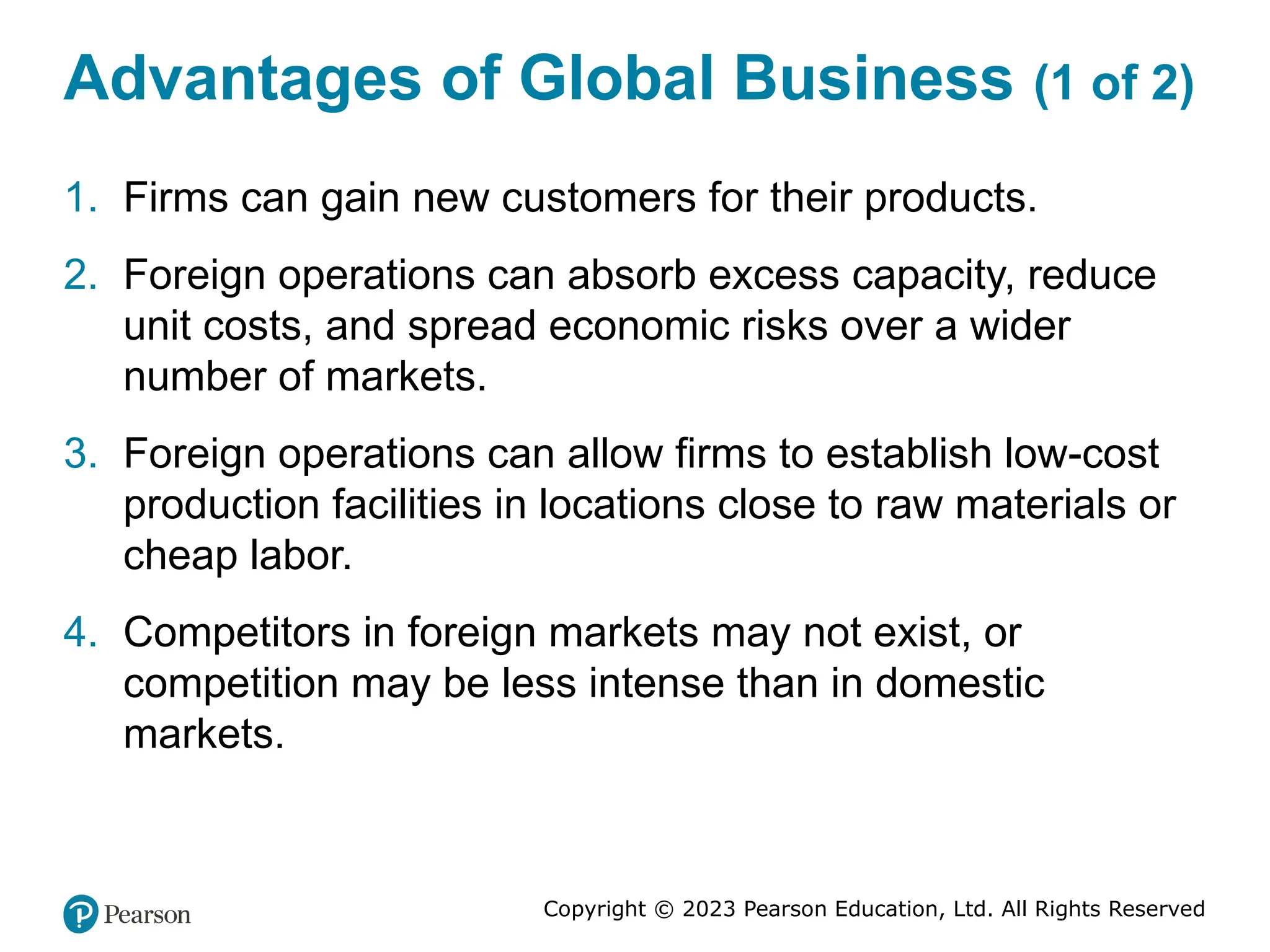
Advantages of Global Business (1 of 2)
1. Firms can gain new customers for their products.
2. Foreign operations can absorb excess capacity, reduce
unit costs, and spread economic risks over a wider
number of markets.
3. Foreign operations can allow firms to establish low-cost
production facilities in locations close to raw materials or
cheap labor.
4. Competitors in foreign markets may not exist, or
competition may be less intense than in domestic
markets.
Copyright © 2023 Pearson Education, Ltd. All Rights Reserved
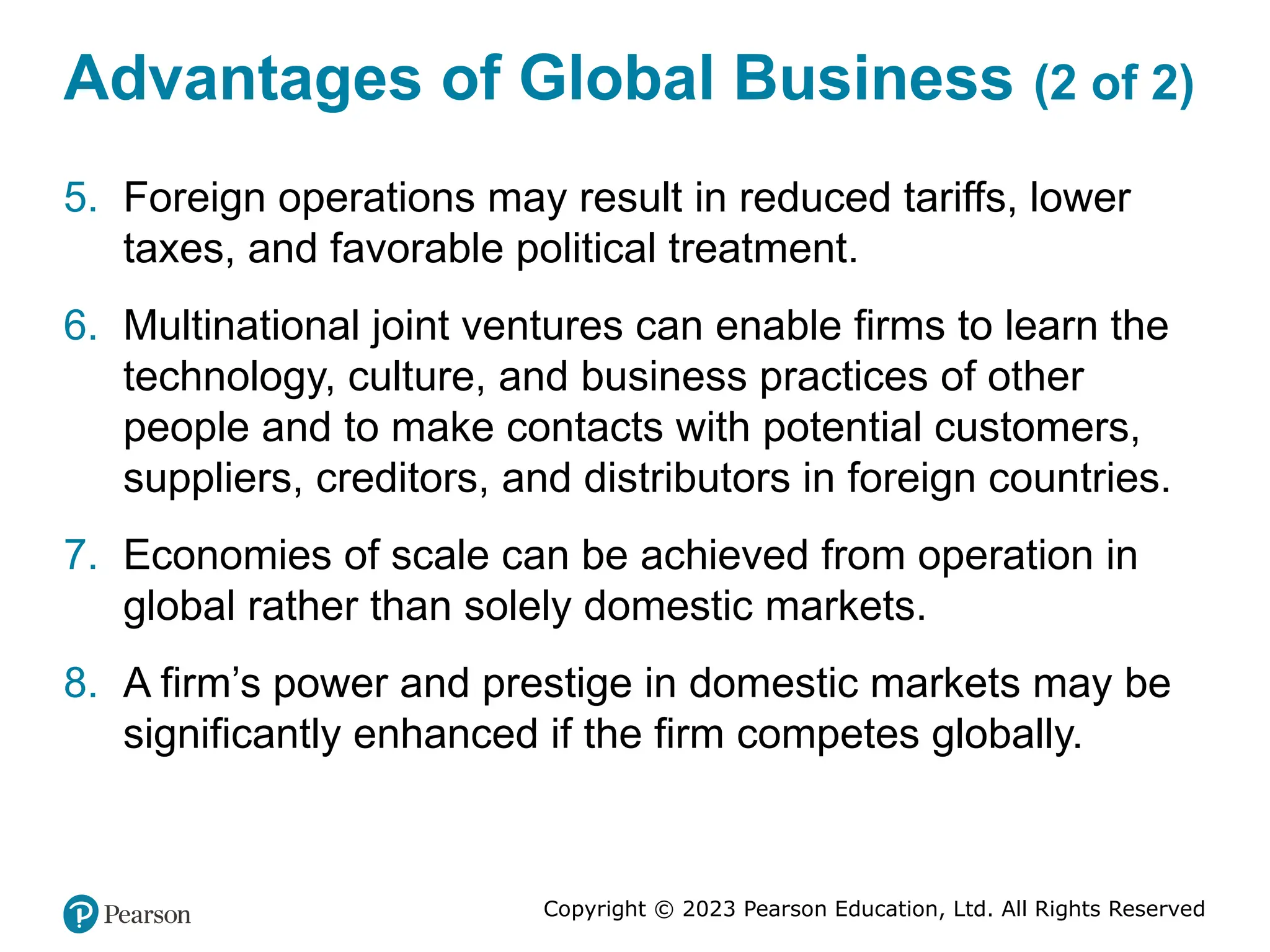
Advantages of Global Business (2 of 2)
5. Foreign operations may result in reduced tariffs, lower
taxes, and favorable political treatment.
6. Multinational joint ventures can enable firms to learn the
technology, culture, and business practices of other
people and to make contacts with potential customers,
suppliers, creditors, and distributors in foreign countries.
7. Economies of scale can be achieved from operation in
global rather than solely domestic markets.
8. A firm’s power and prestige in domestic markets may be
significantly enhanced if the firm competes globally.
Copyright © 2023 Pearson Education, Ltd. All Rights Reserved
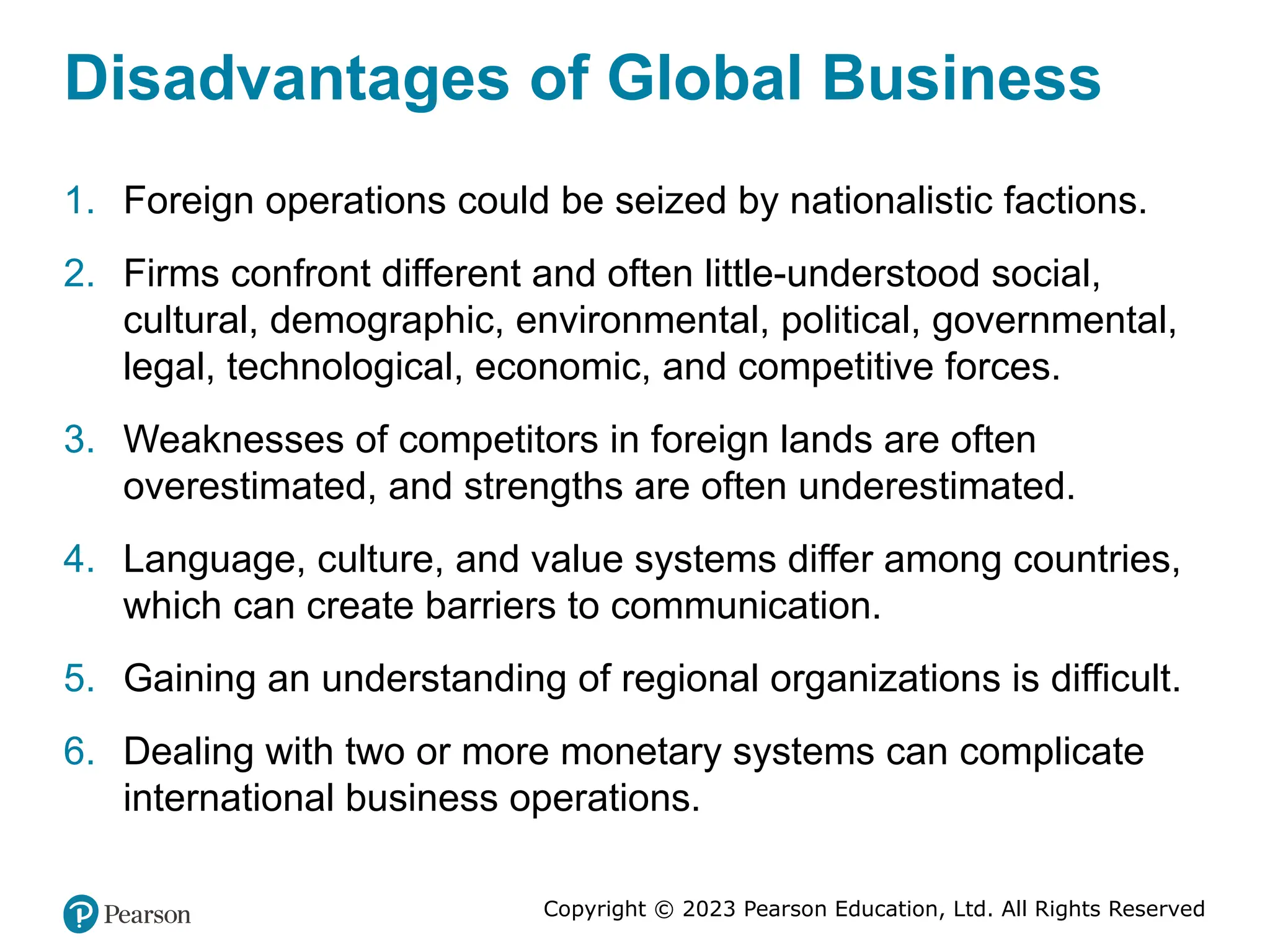
Disadvantages of Global Business
1. Foreign operations could be seized by nationalistic factions.
2. Firms confront different and often little-understood social,
cultural, demographic, environmental, political, governmental,
legal, technological, economic, and competitive forces.
3. Weaknesses of competitors in foreign lands are often
overestimated, and strengths are often underestimated.
4. Language, culture, and value systems differ among countries,
which can create barriers to communication.
5. Gaining an understanding of regional organizations is difficult.
6. Dealing with two or more monetary systems can complicate
international business operations.
Copyright © 2023 Pearson Education, Ltd. All Rights Reserved
The Global Challenge (1 of 3)
• America's economy is becoming much less American.
• A world economy and monetary system are emerging.
• Markets are shifting rapidly and in many cases converging
in tastes, trends, and prices.
Copyright © 2023 Pearson Education, Ltd. All Rights Reserved
The Global Challenge (2 of 3)
• Protectionism
– Refers to countries imposing tariffs, taxes, and
regulations on firms outside the country to favor their
own companies and people.
– The U.S. and China in early 2018 are imposing tariffs
on each other’s products imported.
Copyright © 2023 Pearson Education, Ltd. All Rights Reserved
The Global Challenge (3 of 3)
• Outsourcing
– Involves companies hiring other companies to take
over various parts of their functional operations, such
as human resources, information systems, payroll,
accounting, customer service, and even marketing.
• Reshoring
– Refers to U.S. companies moving a portion of their
manufacturing back to the United States.
Copyright © 2023 Pearson Education, Ltd. All Rights Reserved
American Versus Foreign Business
Culture
• To be successful in world markets, U.S. managers must
obtain a better knowledge of historical, cultural, and
religious forces that motivate and drive people in other
countries.
• For multinational firms, knowledge of business culture
variation across countries can be essential for gaining and
sustaining competitive advantage.
Copyright © 2023 Pearson Education, Ltd. All Rights Reserved
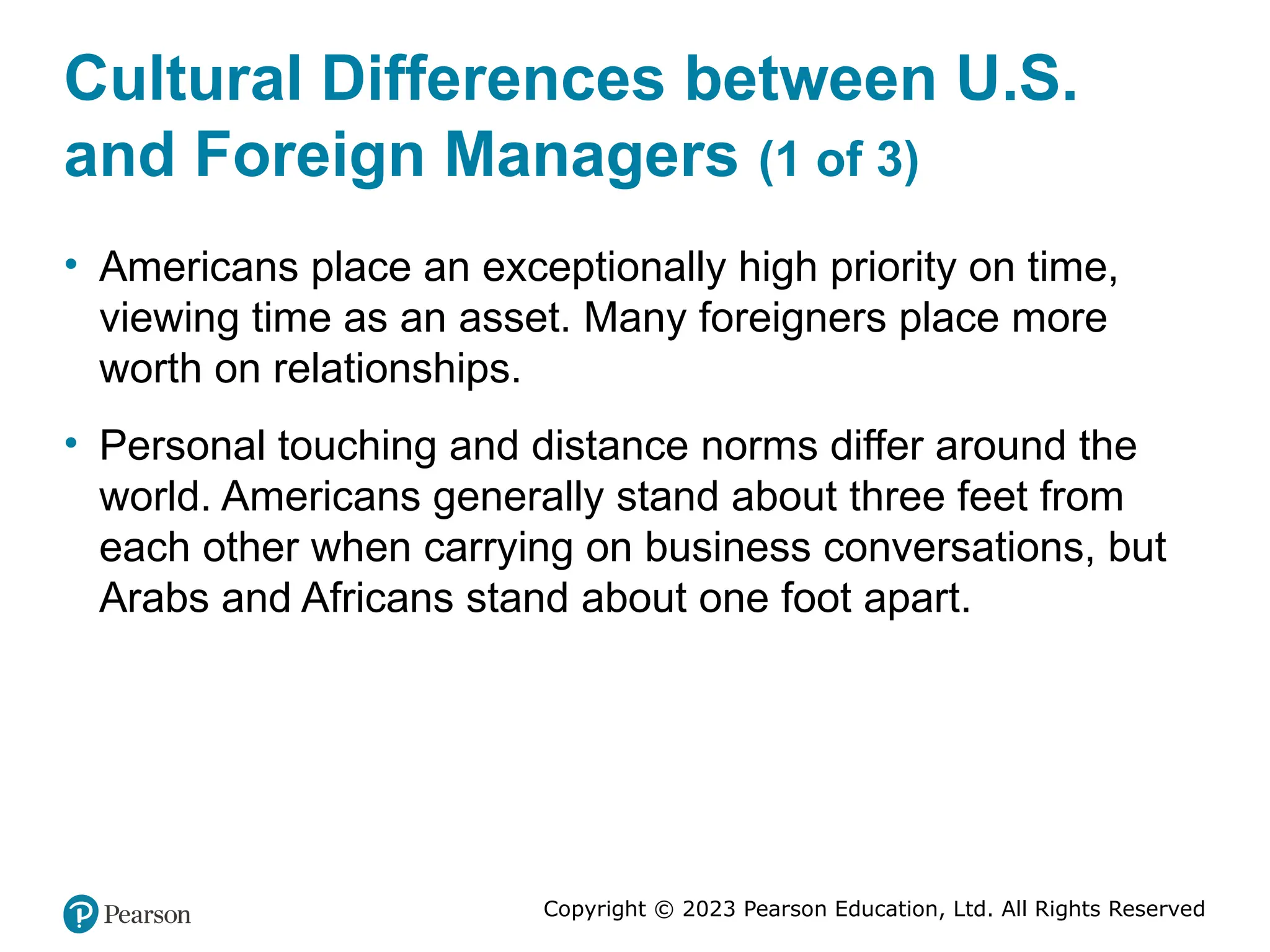
Table 11.4 (1 of 2)
Cultural Pitfalls to Avoid to be a Better Manager
• Waving is a serious insult in Greece and Nigeria, particularly if the
hand is near someone’s face.
• Making a “good-bye” wave in Europe can mean “No,” but it means
“Come here” in Peru.
• In China, last names are written first.
• A man named Carlos Lopez-Garcia should be addressed as Mr.
Lopez in Latin America but as Mr. Garcia in Brazil.
• Breakfast meetings are considered uncivilized in most foreign
countries.
• Latin Americans are, on average, 20 minutes late to business
appointments.
• Direct eye contact is impolite in Japan.
• Do not cross your legs in any Arab or many Asian countries because it
is rude to show the sole of your shoe.
• In Brazil, touching your thumb and first finger—an American “Okay”
sign—is the equivalent of raising your middle finger.
Copyright © 2023 Pearson Education, Ltd. All Rights Reserved
Table 11.4 (2 of 2)
• Nodding or tossing your head back in southern Italy, Malta, Greece,
and Tunisia means “No.” In India, this body motion means “Yes.”
• Snapping your fingers is vulgar in France and Belgium.
• Folding your arms across your chest is a sign of annoyance in
Finland.
• In China, leave some food on your plate to show that your host was so
generous that you could not finish.
• Do not eat with your left hand when dining with clients from Malaysia
or India.
• One form of communication works the same worldwide. It is the smile;
so take that along wherever you go..
Copyright © 2023 Pearson Education, Ltd. All Rights Reserved
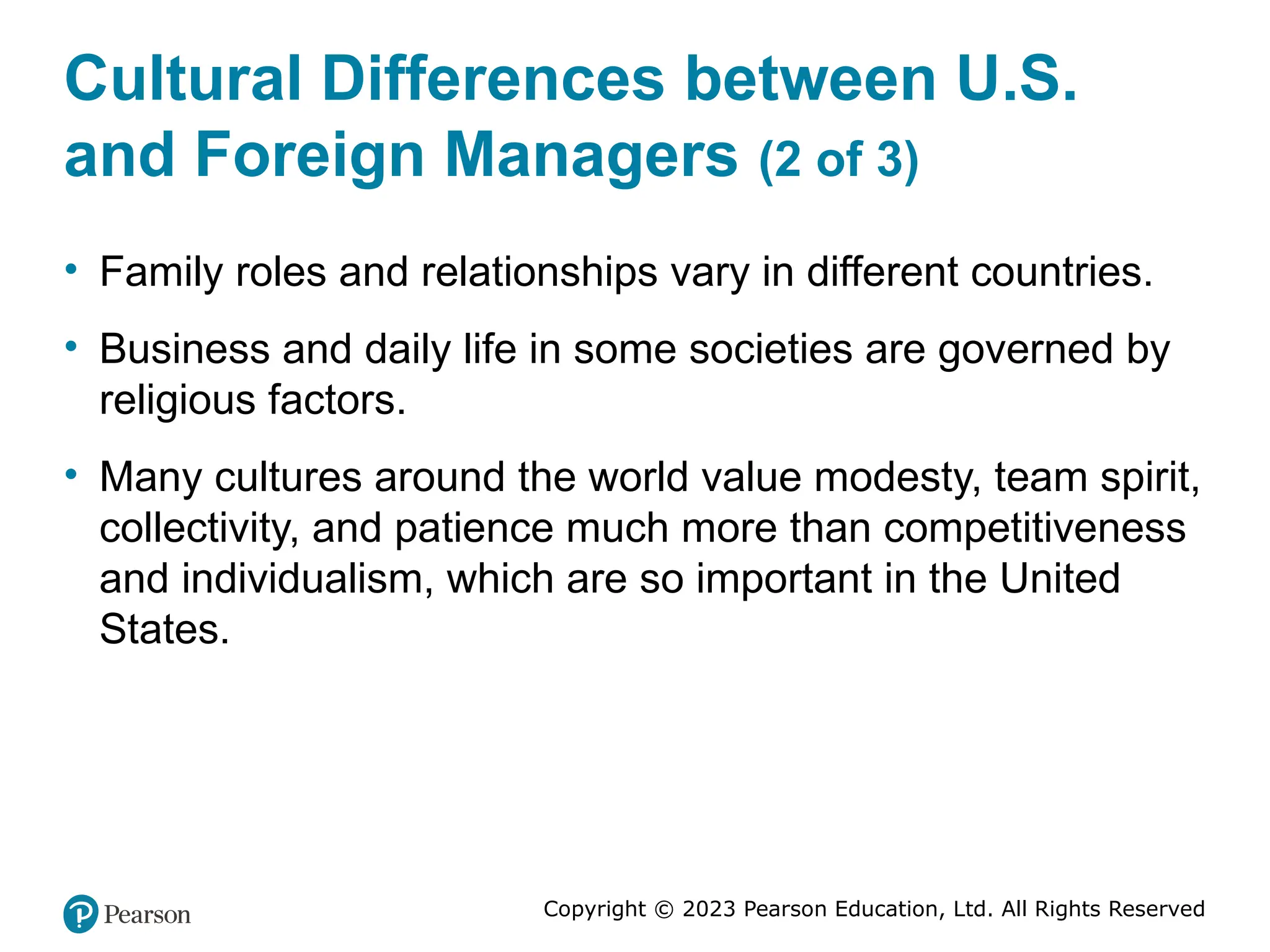
Cultural Differences between U.S.
and Foreign Managers (1 of 3)
• Americans place an exceptionally high priority on time,
viewing time as an asset. Many foreigners place more
worth on relationships.
• Personal touching and distance norms differ around the
world. Americans generally stand about three feet from
each other when carrying on business conversations, but
Arabs and Africans stand about one foot apart.
Copyright © 2023 Pearson Education, Ltd. All Rights Reserved
Cultural Differences between U.S.
and Foreign Managers (2 of 3)
• Family roles and relationships vary in different countries.
• Business and daily life in some societies are governed by
religious factors.
• Many cultures around the world value modesty, team spirit,
collectivity, and patience much more than competitiveness
and individualism, which are so important in the United
States.
Copyright © 2023 Pearson Education, Ltd. All Rights Reserved
Cultural Differences between U.S.
and Foreign Managers (3 of 3)
• Eating habits differ dramatically across cultures.
• Rules of etiquette vary and managers must learn the rules
of others.
• Americans often do business with individuals they do not
know, unlike businesspersons in many other cultures.
Copyright © 2023 Pearson Education, Ltd. All Rights Reserved
Communication Differences Across
Countries
• Americans sometimes come across as intrusive,
manipulative, and garrulous; this impression may reduce
their effectiveness in communication.
• Managers from the United States are much more action-
oriented than their counterparts around the world; they
rush to appointments, conferences, and meetings—and
then feel the day has been productive.
• U.S. managers often use blunt criticism, ask prying
questions, and make quick decisions.
Copyright © 2023 Pearson Education, Ltd. All Rights Reserved
Mexico’s Business Culture
• Employers seek workers who are agreeable, respectful,
and obedient, rather than innovative, creative, and
independent.
• Mexican employers are paternalistic, providing workers
with more than a paycheck, but in return they expect
allegiance.
Copyright © 2023 Pearson Education, Ltd. All Rights Reserved
Japan’s Business Culture
• The Japanese place great importance on group loyalty and
consensus, a concept called Wa.
• When confronted with disturbing questions or opinions,
Japanese managers tend to remain silent.
Copyright © 2023 Pearson Education, Ltd. All Rights Reserved
China’s Business Culture
• The Chinese rarely do business with companies or people
they do not know.
• Your position on an organizational chart is extremely
important in business relationships.
• Arriving late to a meeting is an insult and could negatively
affect your relationship.
• Meetings require patience because mobile phones ring
frequently and conversations tend to be boisterous.
Copyright © 2023 Pearson Education, Ltd. All Rights Reserved
India’s Business Culture (1 of 2)
• People in India do not like to say “no,” verbally or
nonverbally.
• Rather than disappoint you, they often will say something
is not available, or will offer you the response that they
think you want to hear, or will be vague with you.
Copyright © 2023 Pearson Education, Ltd. All Rights Reserved
India’s Business Culture (2 of 2)
• Indians prefer to do business with those whom they have
established a relationship built upon mutual trust and
respect.
• Punctuality is important.
• Indians generally do not trust the legal system and
someone’s word is often sufficient to reach an agreement.
Copyright © 2023 Pearson Education, Ltd. All Rights Reserved
Business Climate Across Countries
• Ease of doing business rankings based on how easy it is
to:
– start a business
– deal with construction permits
– register property
– get credit
– protect investors
– pay taxes
– trade across borders
– enforce contracts
– resolve insolvency
– get electricity
Copyright © 2023 Pearson Education, Ltd. All Rights Reserved
Africa’s Business Climate
• About 30 African countries are considered democracies.
• Currencies in Africa are stabilizing and many countries are
fund-raising to build modern highways, ports, and power
grids.
• Many African and non-African companies are launching
operations in Africa due to the rapidly growing middle class
and an average GD P growth of 5 percent for the continent
through 2020.
• McKinsey predicts that by 2025, 50 percent of Africa will
be online.
Copyright © 2023 Pearson Education, Ltd. All Rights Reserved
China’s Business Climate
• As the world’s most populous country, China’s economic
output annually exceeds the United States.
• China ranks about 90th
out of 190 countries in terms of
doing business.
• China accounts for nearly one-third of the global market for
cars.
• China has a relatively low ranking in ease of doing
business because of human rights issues and substantial
disregard for copyright, patent, and trademark rules of law.
Copyright © 2023 Pearson Education, Ltd. All Rights Reserved
Indonesia’s Business Climate
• Indonesia is a democratic Pacific archipelago comprised of
thousands of islands.
• Indonesia’s currency is the rupiah and its economy is one
of the fastest growing in Asia, behind China and the
Philippines.
• Indonesia’s GD P growth is 5 percent in 2017.
• The economic forecast for Indonesia is very bright.
Copyright © 2023 Pearson Education, Ltd. All Rights Reserved
India’s Business Climate
• India ranks 130 in terms of ease of doing business.
• While it ranks the lowest among BRIC S nations, India has
made substantial progress in some areas.
Copyright © 2023 Pearson Education, Ltd. All Rights Reserved
Mexico’s Business Climate
• The country of Mexico is now the fourth-largest auto
exporter in the world, behind Japan, Germany, and South
Korea.
• Mexico auto industry now employs one of every six
Mexican factory workers and comprises one third of all
exports from Mexico.
• Foreign direct investment (FD I) in Mexico has surged to
exceed $30 billion annually.
Copyright © 2023 Pearson Education, Ltd. All Rights Reserved
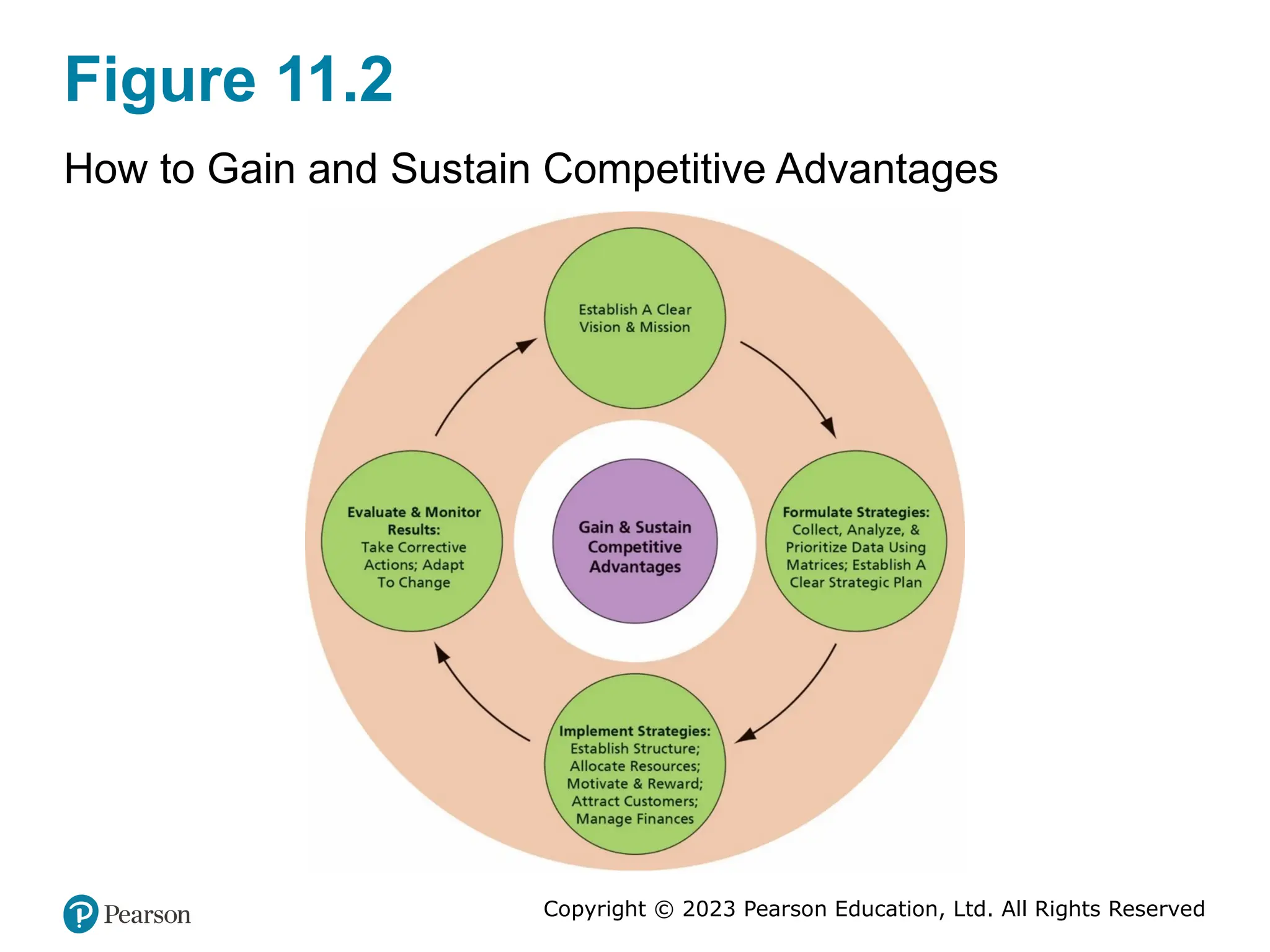
Figure 11.2
How to Gain and Sustain Competitive Advantages

Strategic Management by David - Chapter 11

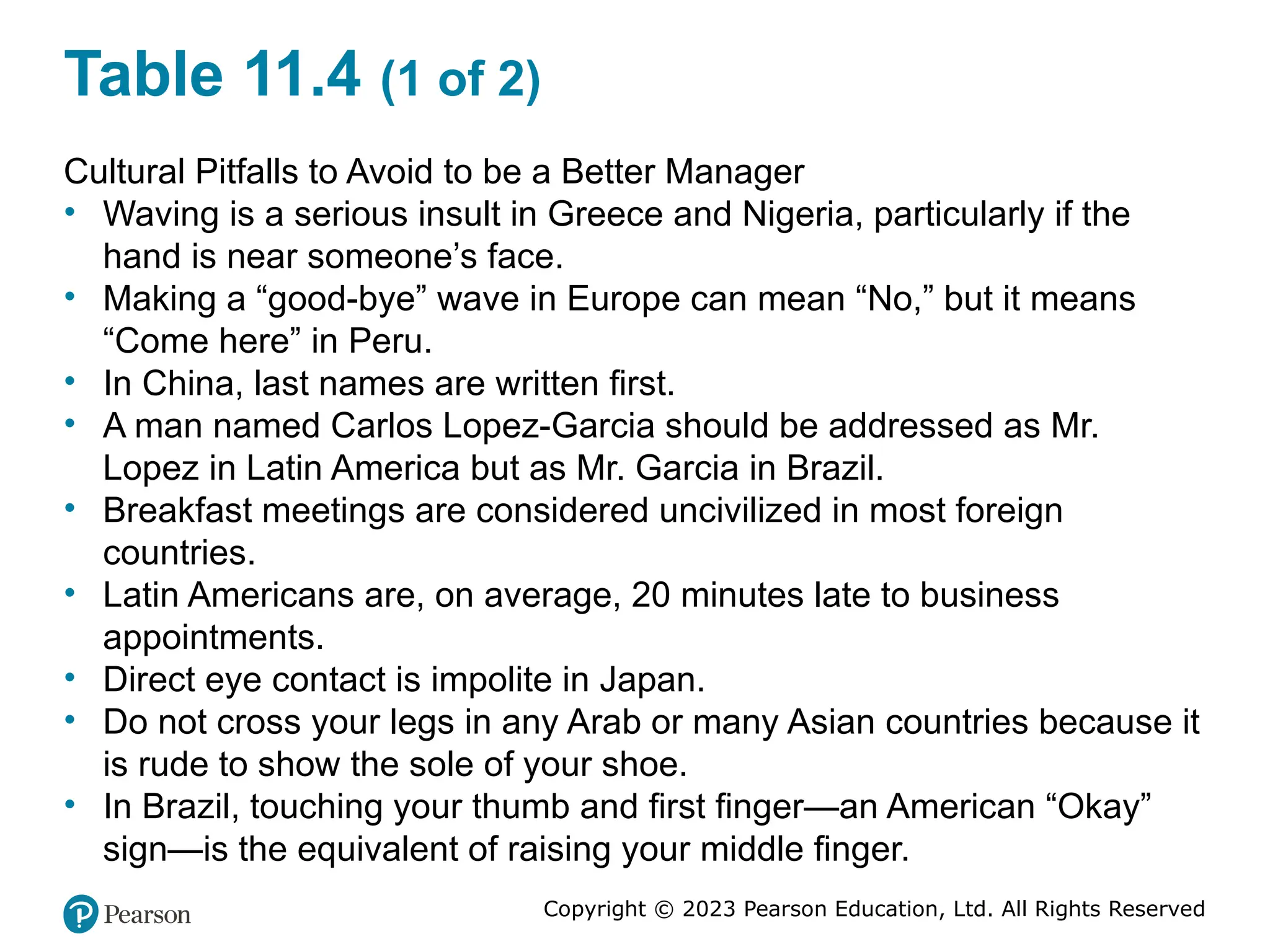
  • 1.
    Strategic Management Concepts:A Competitive Advantage Approach, Concepts and Cases Seventeenth Edition, Global Edition Chapter 11 Global and International Issues Copyright © 2023 Pearson Education, Ltd. All Rights Reserved
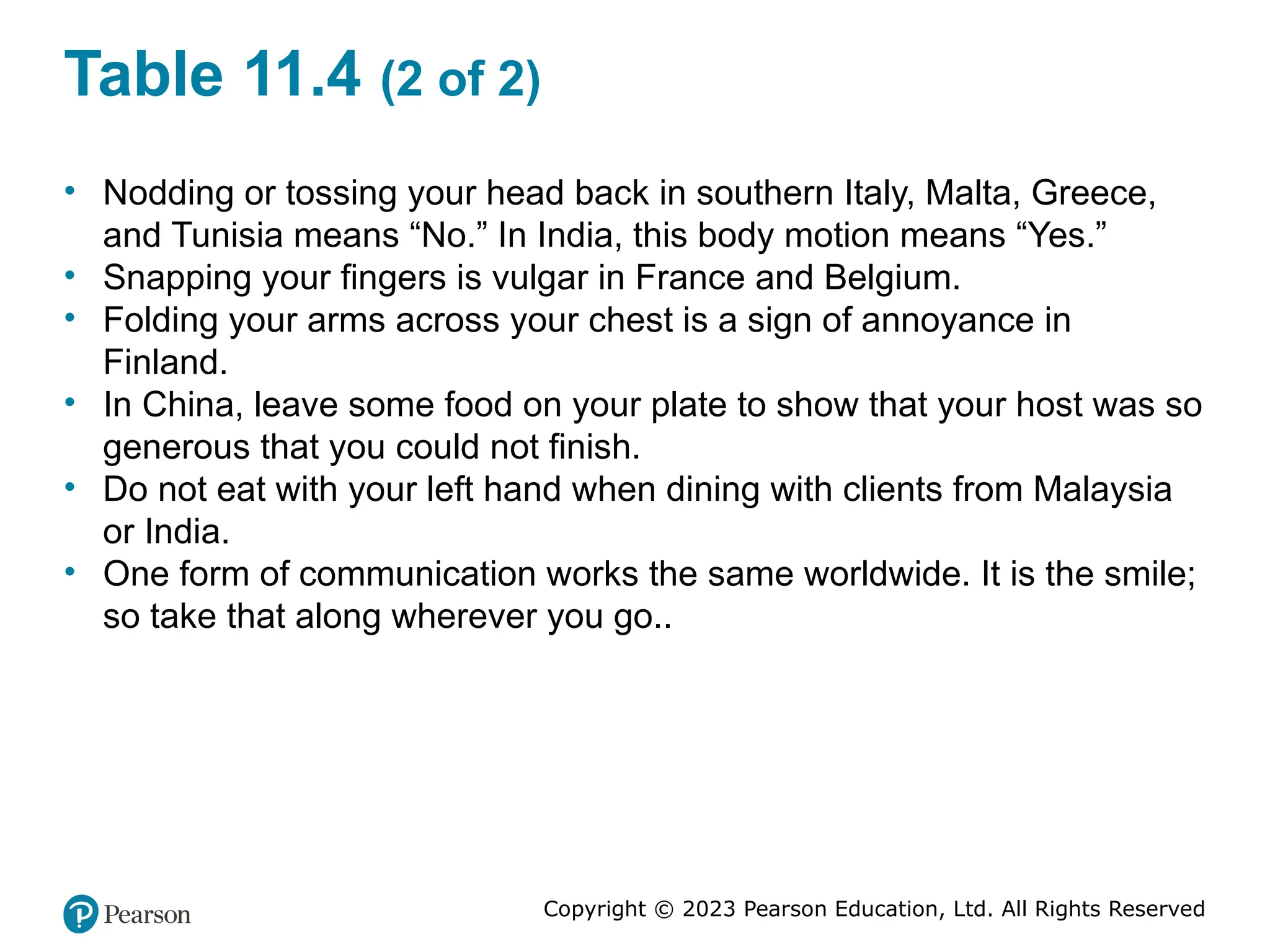
  • 2.
    Copyright © 2023Pearson Education, Ltd. All Rights Reserved Learning Objectives (1 of 2) 11.1 Discuss the nature of doing business globally, including labor union issues and tax rates. 11.2 Explain the advantages and disadvantages of doing business globally. 11.3 Discuss the global challenge facing firms, including outsourcing and reshoring.
  • 3.
    Copyright © 2023Pearson Education, Ltd. All Rights Reserved Learning Objectives (2 of 2) 11.4 Compare and contrast American business culture versus foreign business cultures; explain why this is a strategic issue. 11.5 Discuss business culture, with emphasis on Mexico, Japan, China, and India. 11.6 Discuss business climate, with emphasis on Africa, China, Indonesia, India, and Mexico.
  • 4.
    Copyright © 2023Pearson Education, Ltd. All Rights Reserved Figure 11.1 The Comprehensive, Integrative Strategic-Management Model Source: Fred R. David, “How Companies Define Their Mission,” Long Range Planning 22, n o. 1 (February 1989): 91. See also Anik Ratnaningsih, Nadjadji Anwar, Patdono Suwignjo, and Putu Artama Wiguna, “Balance Scorecard of David’s Strategic Modeling at Industrial Business for National Construction Contractor of Indonesia,” Journal of Mathematics and Technology, n o. 4, (October 2010): 20.
  • 5.
    Copyright © 2023Pearson Education, Ltd. All Rights Reserved Global/International Issues • The underpinnings of strategic management hinge on managers gaining an understanding of competitors, markets, prices, suppliers, distributors, governments, creditors, shareholders, and customers worldwide. • The price and quality of a firm’s products and services must be competitive on a worldwide basis, not just on a local basis.
  • 6.
    Copyright © 2023Pearson Education, Ltd. All Rights Reserved The Nature of Doing Business Globally • Exports of goods and services from the United States account for only 13 percent of U.S. gross domestic product.
  • 7.
    Copyright © 2023Pearson Education, Ltd. All Rights Reserved Globalization • Globalization – process of doing business worldwide, so strategic decisions are made based on global profitability of the firm rather than just domestic considerations • Global Strategy – includes designing, producing, and marketing products with global needs in mind, instead of considering individual countries alone
  • 8.
    Copyright © 2023Pearson Education, Ltd. All Rights Reserved Multinational Firms • Multinational Firms – Organizations that conduct business operations across national borders
  • 9.
    Copyright © 2023Pearson Education, Ltd. All Rights Reserved Table 11.2 (1 of 2) Corporate Tax Rates Across Countries in 2018 (From High to Low) Country Corporate Tax Rate United Arab Emirates 55 Argentina 35 France 33.33 India 34 Germany 30 Mexico 30 Canada 26.5 Italy 24 China 25 USA 21
  • 10.
    Copyright © 2023Pearson Education, Ltd. All Rights Reserved Table 11.2 (2 of 2) Corporate Tax Rates Across Countries in 2018 (From High to Low) Country Corporate Tax Rate Finland 20 Turkey 20 Poland 19 Singapore 17 Romania 16 Ireland 12 Bulgaria 10 Bermuda 00 Caymen Islands 00 Anguilla 00 Turks and Caicos Islands 00
  • 11.
    Copyright © 2023Pearson Education, Ltd. All Rights Reserved Advantages of Global Business (1 of 2) 1. Firms can gain new customers for their products. 2. Foreign operations can absorb excess capacity, reduce unit costs, and spread economic risks over a wider number of markets. 3. Foreign operations can allow firms to establish low-cost production facilities in locations close to raw materials or cheap labor. 4. Competitors in foreign markets may not exist, or competition may be less intense than in domestic markets.
  • 12.
    Copyright © 2023Pearson Education, Ltd. All Rights Reserved Advantages of Global Business (2 of 2) 5. Foreign operations may result in reduced tariffs, lower taxes, and favorable political treatment. 6. Multinational joint ventures can enable firms to learn the technology, culture, and business practices of other people and to make contacts with potential customers, suppliers, creditors, and distributors in foreign countries. 7. Economies of scale can be achieved from operation in global rather than solely domestic markets. 8. A firm’s power and prestige in domestic markets may be significantly enhanced if the firm competes globally.
  • 13.
    Copyright © 2023Pearson Education, Ltd. All Rights Reserved Disadvantages of Global Business 1. Foreign operations could be seized by nationalistic factions. 2. Firms confront different and often little-understood social, cultural, demographic, environmental, political, governmental, legal, technological, economic, and competitive forces. 3. Weaknesses of competitors in foreign lands are often overestimated, and strengths are often underestimated. 4. Language, culture, and value systems differ among countries, which can create barriers to communication. 5. Gaining an understanding of regional organizations is difficult. 6. Dealing with two or more monetary systems can complicate international business operations.
  • 14.
    Copyright © 2023Pearson Education, Ltd. All Rights Reserved The Global Challenge (1 of 3) • America's economy is becoming much less American. • A world economy and monetary system are emerging. • Markets are shifting rapidly and in many cases converging in tastes, trends, and prices.
  • 15.
    Copyright © 2023Pearson Education, Ltd. All Rights Reserved The Global Challenge (2 of 3) • Protectionism – Refers to countries imposing tariffs, taxes, and regulations on firms outside the country to favor their own companies and people. – The U.S. and China in early 2018 are imposing tariffs on each other’s products imported.
  • 16.
    Copyright © 2023Pearson Education, Ltd. All Rights Reserved The Global Challenge (3 of 3) • Outsourcing – Involves companies hiring other companies to take over various parts of their functional operations, such as human resources, information systems, payroll, accounting, customer service, and even marketing. • Reshoring – Refers to U.S. companies moving a portion of their manufacturing back to the United States.
  • 17.
    Copyright © 2023Pearson Education, Ltd. All Rights Reserved American Versus Foreign Business Culture • To be successful in world markets, U.S. managers must obtain a better knowledge of historical, cultural, and religious forces that motivate and drive people in other countries. • For multinational firms, knowledge of business culture variation across countries can be essential for gaining and sustaining competitive advantage.
  • 18.
    Copyright © 2023Pearson Education, Ltd. All Rights Reserved Table 11.4 (1 of 2) Cultural Pitfalls to Avoid to be a Better Manager • Waving is a serious insult in Greece and Nigeria, particularly if the hand is near someone’s face. • Making a “good-bye” wave in Europe can mean “No,” but it means “Come here” in Peru. • In China, last names are written first. • A man named Carlos Lopez-Garcia should be addressed as Mr. Lopez in Latin America but as Mr. Garcia in Brazil. • Breakfast meetings are considered uncivilized in most foreign countries. • Latin Americans are, on average, 20 minutes late to business appointments. • Direct eye contact is impolite in Japan. • Do not cross your legs in any Arab or many Asian countries because it is rude to show the sole of your shoe. • In Brazil, touching your thumb and first finger—an American “Okay” sign—is the equivalent of raising your middle finger.
  • 19.
    Copyright © 2023Pearson Education, Ltd. All Rights Reserved Table 11.4 (2 of 2) • Nodding or tossing your head back in southern Italy, Malta, Greece, and Tunisia means “No.” In India, this body motion means “Yes.” • Snapping your fingers is vulgar in France and Belgium. • Folding your arms across your chest is a sign of annoyance in Finland. • In China, leave some food on your plate to show that your host was so generous that you could not finish. • Do not eat with your left hand when dining with clients from Malaysia or India. • One form of communication works the same worldwide. It is the smile; so take that along wherever you go..
  • 20.
    Copyright © 2023Pearson Education, Ltd. All Rights Reserved Cultural Differences between U.S. and Foreign Managers (1 of 3) • Americans place an exceptionally high priority on time, viewing time as an asset. Many foreigners place more worth on relationships. • Personal touching and distance norms differ around the world. Americans generally stand about three feet from each other when carrying on business conversations, but Arabs and Africans stand about one foot apart.
  • 21.
    Copyright © 2023Pearson Education, Ltd. All Rights Reserved Cultural Differences between U.S. and Foreign Managers (2 of 3) • Family roles and relationships vary in different countries. • Business and daily life in some societies are governed by religious factors. • Many cultures around the world value modesty, team spirit, collectivity, and patience much more than competitiveness and individualism, which are so important in the United States.
  • 22.
    Copyright © 2023Pearson Education, Ltd. All Rights Reserved Cultural Differences between U.S. and Foreign Managers (3 of 3) • Eating habits differ dramatically across cultures. • Rules of etiquette vary and managers must learn the rules of others. • Americans often do business with individuals they do not know, unlike businesspersons in many other cultures.
  • 23.
    Copyright © 2023Pearson Education, Ltd. All Rights Reserved Communication Differences Across Countries • Americans sometimes come across as intrusive, manipulative, and garrulous; this impression may reduce their effectiveness in communication. • Managers from the United States are much more action- oriented than their counterparts around the world; they rush to appointments, conferences, and meetings—and then feel the day has been productive. • U.S. managers often use blunt criticism, ask prying questions, and make quick decisions.
  • 24.
    Copyright © 2023Pearson Education, Ltd. All Rights Reserved Mexico’s Business Culture • Employers seek workers who are agreeable, respectful, and obedient, rather than innovative, creative, and independent. • Mexican employers are paternalistic, providing workers with more than a paycheck, but in return they expect allegiance.
  • 25.
    Copyright © 2023Pearson Education, Ltd. All Rights Reserved Japan’s Business Culture • The Japanese place great importance on group loyalty and consensus, a concept called Wa. • When confronted with disturbing questions or opinions, Japanese managers tend to remain silent.
  • 26.
    Copyright © 2023Pearson Education, Ltd. All Rights Reserved China’s Business Culture • The Chinese rarely do business with companies or people they do not know. • Your position on an organizational chart is extremely important in business relationships. • Arriving late to a meeting is an insult and could negatively affect your relationship. • Meetings require patience because mobile phones ring frequently and conversations tend to be boisterous.
  • 27.
    Copyright © 2023Pearson Education, Ltd. All Rights Reserved India’s Business Culture (1 of 2) • People in India do not like to say “no,” verbally or nonverbally. • Rather than disappoint you, they often will say something is not available, or will offer you the response that they think you want to hear, or will be vague with you.
  • 28.
    Copyright © 2023Pearson Education, Ltd. All Rights Reserved India’s Business Culture (2 of 2) • Indians prefer to do business with those whom they have established a relationship built upon mutual trust and respect. • Punctuality is important. • Indians generally do not trust the legal system and someone’s word is often sufficient to reach an agreement.
  • 29.
    Copyright © 2023Pearson Education, Ltd. All Rights Reserved Business Climate Across Countries • Ease of doing business rankings based on how easy it is to: – start a business – deal with construction permits – register property – get credit – protect investors – pay taxes – trade across borders – enforce contracts – resolve insolvency – get electricity
  • 30.
    Copyright © 2023Pearson Education, Ltd. All Rights Reserved Africa’s Business Climate • About 30 African countries are considered democracies. • Currencies in Africa are stabilizing and many countries are fund-raising to build modern highways, ports, and power grids. • Many African and non-African companies are launching operations in Africa due to the rapidly growing middle class and an average GD P growth of 5 percent for the continent through 2020. • McKinsey predicts that by 2025, 50 percent of Africa will be online.
  • 31.
    Copyright © 2023Pearson Education, Ltd. All Rights Reserved China’s Business Climate • As the world’s most populous country, China’s economic output annually exceeds the United States. • China ranks about 90th out of 190 countries in terms of doing business. • China accounts for nearly one-third of the global market for cars. • China has a relatively low ranking in ease of doing business because of human rights issues and substantial disregard for copyright, patent, and trademark rules of law.
  • 32.
    Copyright © 2023Pearson Education, Ltd. All Rights Reserved Indonesia’s Business Climate • Indonesia is a democratic Pacific archipelago comprised of thousands of islands. • Indonesia’s currency is the rupiah and its economy is one of the fastest growing in Asia, behind China and the Philippines. • Indonesia’s GD P growth is 5 percent in 2017. • The economic forecast for Indonesia is very bright.
  • 33.
    Copyright © 2023Pearson Education, Ltd. All Rights Reserved India’s Business Climate • India ranks 130 in terms of ease of doing business. • While it ranks the lowest among BRIC S nations, India has made substantial progress in some areas.
  • 34.
    Copyright © 2023Pearson Education, Ltd. All Rights Reserved Mexico’s Business Climate • The country of Mexico is now the fourth-largest auto exporter in the world, behind Japan, Germany, and South Korea. • Mexico auto industry now employs one of every six Mexican factory workers and comprises one third of all exports from Mexico. • Foreign direct investment (FD I) in Mexico has surged to exceed $30 billion annually.
  • 35.
    Copyright © 2023Pearson Education, Ltd. All Rights Reserved Figure 11.2 How to Gain and Sustain Competitive Advantages

Editor's Notes

  • #1 If this PowerPoint presentation contains mathematical equations, you may need to check that your computer has the following installed: 1) MathType Plugin 2) Math Player (free versions available) 3) NVDA Reader (free versions available)
  • #2 After studying this chapter, you should be able to do the following: 11.1 Discuss the nature of doing business globally, including labor union issues and tax rates. 11.2 Explain the advantages and disadvantages of doing business globally. 11.3 Discuss the global challenge facing firms, including outsourcing and reshoring.
  • #3 After studying this chapter, you should be able to do the following: 11.4 Compare and contrast American business culture versus foreign business cultures; explain why this is a strategic issue. 11.5 Discuss business culture, with emphasis on Mexico, Japan, China, and India. 11.6 Discuss business climate, with emphasis on Africa, China, Indonesia, India, and Mexico.
  • #4 The strategic management model is included on this slide. This chapter informs all earlier steps in the model. Long Description: The top of the flowchart reads, “chapter 10: business ethics, environmental sustainability, and social responsibility.” The bottom of the flowchart reads, “chapter 11: global and international issues.” the details shown in the flowchart between chapters 10 and 11 are as follows: business vision and mission chapter 2 leads to strategies in action chapter 5, chapter 5 leads to strategy analysis and choice chapter 6, chapter 6 leads to implementing strategies: management and marketing issues chapter 7, chapter 7 leads to implementing strategies: finance and accounting issues chapter 8, chapter 8 leads to strategy evaluation and governance chapter 9, chapter 9 then leads back to business vision and mission chapter 2 in a feedback loop. The loop also results in the external assessment chapter 3 and the internal assessment chapter 4 connected to each other between chapters 2 and 5. The flowchart also shows various chapters categorized into different terms as follows: chapters 2, 3, 4, 5, and 6 are categorized as strategy formulation; chapters 7 and 8 are categorized as strategy implementation; chapter 9 is categorized as strategy evaluation. The chapter 11 is highlighted.
  • #5 The boundaries of countries no longer can define the limits of our imaginations. To see and appreciate the world from the perspective of others has become a matter of survival for businesses.
  • #6 In contrast, as a percent of gross domestic product (G D P), exports comprise 46 percent of the German economy, 20 percent of the Chinese economy, and 172 percent of the Singapore economy (http://data.worldbank.org/indicator/NE.EXP.GNFS.ZS).
  • #7 A world market has emerged from what previously was a multitude of distinct national markets, and the climate for international business today is more favorable than in years past.
  • #8 The strategic-management process is conceptually the same for multinational firms as for purely domestic firms; however, the process is more complex for international firms as a result of more variables and relationships.
  • #9 Tax rates in countries are important in strategic decisions regarding where to build manufacturing facilities or retail stores or even where to acquire other firms. High corporate tax rates deter investment in new factories and also provide strong incentives for corporations to avoid and evade taxes. Corporate tax rates vary considerably across countries and companies.
  • #10 Tax rates in countries are important in strategic decisions regarding where to build manufacturing facilities or retail stores or even where to acquire other firms. High corporate tax rates deter investment in new factories and also provide strong incentives for corporations to avoid and evade taxes. Corporate tax rates vary considerably across countries and companies.
  • #11 Firms have numerous reasons for formulating and implementing strategies that initiate, continue, or expand involvement in business operations across national borders.
  • #13 The availability, depth, and reliability of economic and marketing information in different countries vary extensively, as do industrial structures, business practices, and the number and nature of regional organizations.
  • #14 Few companies can afford to ignore the presence of international competition. Firms that seem insulated and comfortable today may be vulnerable tomorrow.
  • #15 Most economists argue that protectionism harms the world economy because it inhibits trade among countries and invites retaliation.
  • #16 The outsourcing business is booming. The current U.S. administration is spurring and rewarding reshoring.
  • #17 An excellent website to visit on this topic is www.worldbusinessculture.com, where you may select any country in the world and check out how business culture varies in that country versus other lands.
  • #20 Rose Knotts summarized some important cultural differences between U.S. and foreign managers. Awareness and consideration of these differences listed on the next four slides can enable a manager to be more effective, regardless of his or her own nationality.
  • #23 Communication may be the most important word in strategic management. Americans increasingly interact with managers in other countries, so it is important to understand communication differences across countries.
  • #24 Mexico is an authoritarian society in terms of schools, churches, businesses, and families.
  • #25 Nearly all corporate activities in Japan encourage Wa among managers and employees. Wa requires that all members of a group agree and cooperate; this results in constant discussion and compromise.
  • #26 In China, greetings are formal and the oldest person is always greeted first. Like in the United States, handshakes are the most common form of greeting.
  • #27 Do not disagree publicly with anyone in India. Titles such as professor, doctor, or engineer are important in India, as is a person’s age, university degree, caste, and profession.
  • #28 Use the right hand to give and receive business cards. Business cards need not be translated into Hindi but always present your business card so the recipient may read the card as it is handed to him or her. This is a nice, expected gesture in most countries around the world.
  • #29 The World Bank and the International Finance Corporation annually rank 189 countries in terms of their respective ease of doing business (http://www.doingbusiness.org/rankings). The index ranks nations from 1 (best) to 189 (worst).
  • #30 The general stereotype of Africa is rapidly changing from subsistence farmers avoiding lions, to millions of smartphone-carrying consumers in cities purchasing products.
  • #31 China has tremendous importance globally because of its economic might.
  • #32 Despite its large population and densely populated regions, Indonesia has the world’s second-highest level of biodiversity, with vast areas of wilderness and abundant natural resources.
  • #33 Online activity has accelerated in India – in 2017, India replaced the U.S. as the country that downloaded more apps from Google’s Play Store than any other on the planet.
  • #34 Mexico is especially attractive for manufacturing products that are bulky or costly to transport, such as automobiles.
  • #35 Long Description: The gain and sustain competitive advantages depicted in the loop are as follows: 1, establish a clear vision and mission; 2, formulate strategies, collect, analyze, and prioritize data using matrices; establish a clear strategic plan; 3, implement strategies, establish structure; allocate resources; motivate and reward; attract customers; manage finances; 4, evaluate and monitor results: take corrective actions; adapt to change.