Internal controls should be built “into,” not “onto” business processes
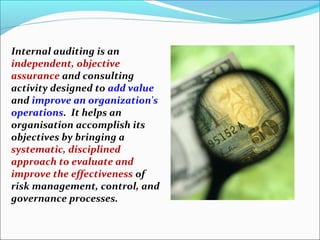
Internal auditing is an 
independent, objective 
assurance and consulting 
activity designed to add value 
and improve an organization's 
operations. It helps an 
organisation accomplish its 
objectives by bringing a 
systematic, disciplined 
approach to evaluate and 
improve the effectiveness of 
risk management, control, and 
governance processes.
WWWWhhhhaaaatttt iiiissss IIIInnnntttteeeerrrrnnnnaaaallll AAAAuuuuddddiiiitttt???? 
Internal Audit is a professional activity which helps organisations to achieve their 
stated objectives by: 
 Analyzing key processes, procedures & operations 
 Identifying key controls in each such operation, procedure & process 
 Evaluating the adequacy of these controls 
 Testing compliance of sample transactions against these controls 
 Reporting results of the evaluation of controls and compliance testing of 
transactions 
 Recommending stronger controls wherever necessary 
 Suggesting methods to improve compliance with key controls 
 Follow up of action taken on recommendations made in previous reports
WWhhyy IInntteerrnnaall AAuuddiitt?? 
Legal and Statutory Requirement 
As per Companies Act 1956 : 
Internal Audit system is compulsory if, 
a. Paid-up capital and reserves exceeding Rs. 50 lakhs 
as at the commencement of the FY. or 
b. Having an average annual turnover exceeding 
Rs.5.00 crores for a period of three consecutive FY’s 
immediately preceding the FY concerned,
WWWWhhhhyyyy IIIInnnntttteeeerrrrnnnnaaaallll AAAAuuuuddddiiiitttt???? CCCCoooonnnnttttiiiinnnnuuuueeeedddd………… 
Management Requirement 
To ensure error free accounting 
To support statutory audit 
To have proper control over business 
To control on the size of operations
IIAA –– CCooddee ooff EEtthhiiccss 
PPrriinncciipplleess 
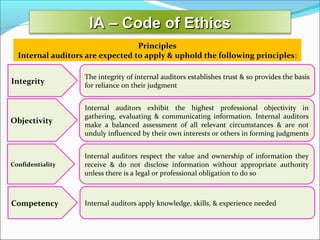
Internal auditors are expected to apply & uphold the following principles: 
Integrity The integrity of internal auditors establishes trust & so provides the basis 
for reliance on their judgment 
Objectivity 
Internal auditors exhibit the highest professional objectivity in 
gathering, evaluating & communicating information. Internal auditors 
make a balanced assessment of all relevant circumstances & are not 
unduly influenced by their own interests or others in forming judgments 
Confidentiality 
Internal auditors respect the value and ownership of information they 
receive & do not disclose information without appropriate authority 
unless there is a legal or professional obligation to do so 
Competency Internal auditors apply knowledge, skills, & experience needed
WWWWhhhhaaaatttt aaaarrrreeee IIIInnnntttteeeerrrrnnnnaaaallll CCCCoooonnnnttttrrrroooollllssss???? 
Internal Controls are important checks instituted by management to have 
reasonable assurance that: 
 Operations are carried out in an efficient & effective manner 
 Transactions are recorded accurately & completely 
 Assets are properly recorded & safeguarded 
 Laws are complied with 
 Reliable reports are generated
IIIInnnntttteeeerrrrnnnnaaaallll CCCCoooonnnnttttrrrroooollll MMMMyyyytttthhhhssss aaaannnndddd FFFFaaaaccccttttssss 
MYTHS: FACTS: 
Internal control starts with a strong set 
of policies and procedures 
Internal control starts with a strong set 
of policies and procedures 
Internal control: That’s why we have 
internal auditors! 
While internal auditors play a key role 
in the system of control, management 
has responsibility for internal control 
Internal control is a finance thing Internal control is integral to every 
aspect of business/operations 
Internal controls are essentially 
negative, like a list of “thou-shalt-nots” 
Internal control makes the right things 
happen the first time 
Internal controls take time away from 
our core activities of implementing 
development objectives 
Internal controls should be built 
“into,” not “onto” business processes
IIIInnnntttteeeerrrrnnnnaaaallll CCCCoooonnnnttttrrrroooollll PPPPrrrraaaaccccttttiiiicccceeeessss 
How? 
 Internal control is a process. It's a means to an end, not an end 
in itself 
 Internal control is effected by people as a team, not by 
internal auditor. It's not merely policy manuals & forms, but 
people at every level of an organization 
 Internal control can be expected to provide only reasonable 
assurance, not absolute assurance, to an entity's management 
and governing bodies/ committees 
 Uses systematic methodology for analysing business 
processes, procedures & activities 
 The cost of IA should not exceed expected benefits to be 
derived
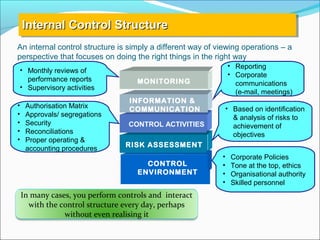
IIIInnnntttteeeerrrrnnnnaaaallll CCCCoooonnnnttttrrrroooollll SSSSttttrrrruuuuccccttttuuuurrrreeee 
An internal control structure is simply a different way of viewing operations – a 
perspective that focuses on doing the right things in the right way 
MONITORING 
INFORMATION INFORMATION AND 
& 
COMMUNICATION 
COMMUNICATION 
CONTROL CONTROL ACTIVITIES 
ACTIVITIES 
RISK ASSESSMENT 
CONTROL 
ENVIRONMENT 
• Monthly reviews of 
performance reports 
• Supervisory activities 
In many cases, you perform controls and interact 
with the control structure every day, perhaps 
without even realising it 
• Reporting 
• Corporate 
communications 
(e-mail, meetings) 
• Authorisation Matrix 
• Approvals/ segregations 
• Security 
• Reconciliations 
• Proper operating & 
accounting procedures 
• Based on identification 
& analysis of risks to 
achievement of 
objectives 
• Corporate Policies 
• Tone at the top, ethics 
• Organisational authority 
• Skilled personnel
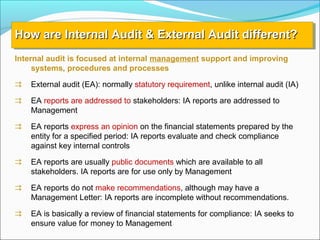
How are HHHooowww aaarrreee IIIInnnntttteeeerrrrnnnnaaaallll AAAAuuuuddddiiiitttt &&&& EEEExxxxtttteeeerrrrnnnnaaaallll AAAAuuuuddddiiiitttt ddddiiiiffffffffeeeerrrreeeennnntttt???? 
Internal audit is focused at internal management support and improving 
systems, procedures and processes 
⇉ External audit (EA): normally statutory requirement, unlike internal audit (IA) 
⇉ EA reports are addressed to stakeholders: IA reports are addressed to 
Management 
⇉ EA reports express an opinion on the financial statements prepared by the 
entity for a specified period: IA reports evaluate and check compliance 
against key internal controls 
⇉ EA reports are usually public documents which are available to all 
stakeholders. IA reports are for use only by Management 
⇉ EA reports do not make recommendations, although may have a 
Management Letter: IA reports are incomplete without recommendations. 
⇉ EA is basically a review of financial statements for compliance: IA seeks to 
ensure value for money to Management
BBBBeeeennnneeeeffffiiiittttssss ooooffff IIIInnnntttteeeerrrrnnnnaaaallll AAAAuuuuddddiiiitttt 
Correct financial figures 
No deviation in process 
Timely work completion 
Reduction in reconciliation 
Delegation of work 
Detection of errors and frauds 
Proper place of documents and records
Risks of not having Internal Audit 
Chances of conflict and delay in accounting 
Affects day to day activity by 
Increase in Reconciliation activity 
Documentation problem 
Delay in closing books of accounts 
Lack of track on business 
Non compliance of statutory regulation
NNNNaaaattttuuuurrrreeee ooooffff IIIInnnntttteeeerrrrnnnnaaaallll AAAAuuuuddddiiiitttt AAAAccccttttiiiivvvviiiittttyyyy 
 Establish scope & activities for audit to Management 
 Describe key risks facing the business activities within scope of audit 
 Identify control procedures used to ensure each key risk is properly 
controlled & monitored 
 Develop & execute risk based sampling & testing approach to determine 
whether most important controls are operating as intended (NB: input from 
Management required – e.g. 100% vouching of Credit notes to Trade partners ) 
 Report issues/make recommendations/negotiate action plans with 
Management to address issues 
 Follow up on reported findings periodically 
 ATR ( Action Taken Report ) Submission on or before time by Respective 
Department.
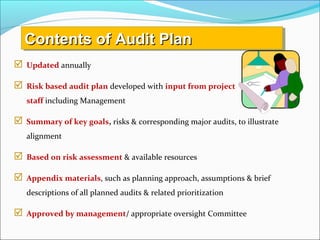
CCCCoooonnnntttteeeennnnttttssss ooooffff AAAAuuuuddddiiiitttt PPPPllllaaaannnn 
 Updated annually 
 Risk based audit plan developed with input from project 
staff including Management 
 Summary of key goals, risks & corresponding major audits, to illustrate 
alignment 
 Based on risk assessment & available resources 
 Appendix materials, such as planning approach, assumptions & brief 
descriptions of all planned audits & related prioritization 
 Approved by management/ appropriate oversight Committee
CCCCoooonnnntttteeeennnnttttssss ooooffff AAAAuuuuddddiiiitttt RRRReeeeppppoooorrrrtttt 
 Observations 
 Narration/ description 
 Remedial action 
 Consequences/ fall out 
 Recommendation for improvement (prioritized between 
“high” and “normal”) 
 Response (action plan) – who, when and how
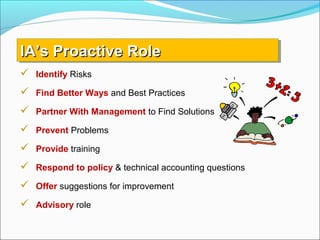
IIIIAAAA’’’’ssss PPPPrrrrooooaaaaccccttttiiiivvvveeee RRRRoooolllleeee 
 Identify Risks 
 Find Better Ways and Best Practices 
 Partner With Management to Find Solutions 
 Prevent Problems 
 Provide training 
 Respond to policy & technical accounting questions 
 Offer suggestions for improvement 
 Advisory role
IIddeeaall SSccooppee ooff IInntteerrnnaall AAuuddiitt 
Vouching 
Cash and Bank 
Income and Expenses 
Capital and Petty expenses 
Stocks & Inventory 
Verification 
Purchases and Sales Registers 
Debtors and Creditors 
Ledger & Trial Scrutiny 
Approval Matrix in routine operations
SSccooppee CCoonnttiinnuueedd…….... 
Statutory Compliances 
VAT & Service Tax 
ESI & PF 
TDS & TCS 
Excise and Customs 
Channel Management 
Performance of Channel Partners 
Report NPA Channel Partners to Management 
Revenue vs Cost Ratio of Channel Partners. 
Dispute and Grievances of Channel Partner, 
If any Long Pending Claims of Channel Partners 
Local Support to Channel Partners, if any up gradation require in 
Infrastructure then recommend to Management in Report
CCoonncclluuttiioonn 
Company can achieve its goals in a 
organised and systematic manner with 
help of Internal Audit 
More formal control structures reduce 
possibility that risks become real 
issues 
Identify areas of high risk & 
opportunities 
Validation of process documentation 
& controls 
Incorporate best Practices of Trade 
with in SOP and Review & update 
changes regularly in SOP and Credit 
Policy of Business to strengthen the 
support function to sales
Auditors believes in ………. 
“ Perception can not be reality every time” 
“ Tenure has nothing to do with Honesty “ 
“ Best has to be Acknowledged and Worst has to be reported “ 
“ Only Apple to Apple to Comparisons attitude, no Apple to Orange “ 
“Integrity and Ethics - Zero Tolerance behaviour ” 
Thank You………. 
A Honest Attempt to Describe the Core function of 
Enterprise

Internal_audit

  • 1.
    Internal controls shouldbe built “into,” not “onto” business processes
  • 2.
    Internal auditing isan independent, objective assurance and consulting activity designed to add value and improve an organization's operations. It helps an organisation accomplish its objectives by bringing a systematic, disciplined approach to evaluate and improve the effectiveness of risk management, control, and governance processes.
  • 3.
    WWWWhhhhaaaatttt iiiissss IIIInnnntttteeeerrrrnnnnaaaallllAAAAuuuuddddiiiitttt???? Internal Audit is a professional activity which helps organisations to achieve their stated objectives by:  Analyzing key processes, procedures & operations  Identifying key controls in each such operation, procedure & process  Evaluating the adequacy of these controls  Testing compliance of sample transactions against these controls  Reporting results of the evaluation of controls and compliance testing of transactions  Recommending stronger controls wherever necessary  Suggesting methods to improve compliance with key controls  Follow up of action taken on recommendations made in previous reports
  • 4.
    WWhhyy IInntteerrnnaall AAuuddiitt?? Legal and Statutory Requirement As per Companies Act 1956 : Internal Audit system is compulsory if, a. Paid-up capital and reserves exceeding Rs. 50 lakhs as at the commencement of the FY. or b. Having an average annual turnover exceeding Rs.5.00 crores for a period of three consecutive FY’s immediately preceding the FY concerned,
  • 5.
    WWWWhhhhyyyy IIIInnnntttteeeerrrrnnnnaaaallll AAAAuuuuddddiiiitttt????CCCCoooonnnnttttiiiinnnnuuuueeeedddd………… Management Requirement To ensure error free accounting To support statutory audit To have proper control over business To control on the size of operations
  • 6.
    IIAA –– CCooddeeooff EEtthhiiccss PPrriinncciipplleess Internal auditors are expected to apply & uphold the following principles: Integrity The integrity of internal auditors establishes trust & so provides the basis for reliance on their judgment Objectivity Internal auditors exhibit the highest professional objectivity in gathering, evaluating & communicating information. Internal auditors make a balanced assessment of all relevant circumstances & are not unduly influenced by their own interests or others in forming judgments Confidentiality Internal auditors respect the value and ownership of information they receive & do not disclose information without appropriate authority unless there is a legal or professional obligation to do so Competency Internal auditors apply knowledge, skills, & experience needed
  • 7.
    WWWWhhhhaaaatttt aaaarrrreeee IIIInnnntttteeeerrrrnnnnaaaallllCCCCoooonnnnttttrrrroooollllssss???? Internal Controls are important checks instituted by management to have reasonable assurance that:  Operations are carried out in an efficient & effective manner  Transactions are recorded accurately & completely  Assets are properly recorded & safeguarded  Laws are complied with  Reliable reports are generated
  • 8.
    IIIInnnntttteeeerrrrnnnnaaaallll CCCCoooonnnnttttrrrroooollll MMMMyyyytttthhhhssssaaaannnndddd FFFFaaaaccccttttssss MYTHS: FACTS: Internal control starts with a strong set of policies and procedures Internal control starts with a strong set of policies and procedures Internal control: That’s why we have internal auditors! While internal auditors play a key role in the system of control, management has responsibility for internal control Internal control is a finance thing Internal control is integral to every aspect of business/operations Internal controls are essentially negative, like a list of “thou-shalt-nots” Internal control makes the right things happen the first time Internal controls take time away from our core activities of implementing development objectives Internal controls should be built “into,” not “onto” business processes
  • 9.
    IIIInnnntttteeeerrrrnnnnaaaallll CCCCoooonnnnttttrrrroooollll PPPPrrrraaaaccccttttiiiicccceeeessss How?  Internal control is a process. It's a means to an end, not an end in itself  Internal control is effected by people as a team, not by internal auditor. It's not merely policy manuals & forms, but people at every level of an organization  Internal control can be expected to provide only reasonable assurance, not absolute assurance, to an entity's management and governing bodies/ committees  Uses systematic methodology for analysing business processes, procedures & activities  The cost of IA should not exceed expected benefits to be derived
  • 10.
    IIIInnnntttteeeerrrrnnnnaaaallll CCCCoooonnnnttttrrrroooollll SSSSttttrrrruuuuccccttttuuuurrrreeee An internal control structure is simply a different way of viewing operations – a perspective that focuses on doing the right things in the right way MONITORING INFORMATION INFORMATION AND & COMMUNICATION COMMUNICATION CONTROL CONTROL ACTIVITIES ACTIVITIES RISK ASSESSMENT CONTROL ENVIRONMENT • Monthly reviews of performance reports • Supervisory activities In many cases, you perform controls and interact with the control structure every day, perhaps without even realising it • Reporting • Corporate communications (e-mail, meetings) • Authorisation Matrix • Approvals/ segregations • Security • Reconciliations • Proper operating & accounting procedures • Based on identification & analysis of risks to achievement of objectives • Corporate Policies • Tone at the top, ethics • Organisational authority • Skilled personnel
  • 11.
    How are HHHooowwwaaarrreee IIIInnnntttteeeerrrrnnnnaaaallll AAAAuuuuddddiiiitttt &&&& EEEExxxxtttteeeerrrrnnnnaaaallll AAAAuuuuddddiiiitttt ddddiiiiffffffffeeeerrrreeeennnntttt???? Internal audit is focused at internal management support and improving systems, procedures and processes ⇉ External audit (EA): normally statutory requirement, unlike internal audit (IA) ⇉ EA reports are addressed to stakeholders: IA reports are addressed to Management ⇉ EA reports express an opinion on the financial statements prepared by the entity for a specified period: IA reports evaluate and check compliance against key internal controls ⇉ EA reports are usually public documents which are available to all stakeholders. IA reports are for use only by Management ⇉ EA reports do not make recommendations, although may have a Management Letter: IA reports are incomplete without recommendations. ⇉ EA is basically a review of financial statements for compliance: IA seeks to ensure value for money to Management
  • 12.
    BBBBeeeennnneeeeffffiiiittttssss ooooffff IIIInnnntttteeeerrrrnnnnaaaallllAAAAuuuuddddiiiitttt Correct financial figures No deviation in process Timely work completion Reduction in reconciliation Delegation of work Detection of errors and frauds Proper place of documents and records
  • 13.
    Risks of nothaving Internal Audit Chances of conflict and delay in accounting Affects day to day activity by Increase in Reconciliation activity Documentation problem Delay in closing books of accounts Lack of track on business Non compliance of statutory regulation
  • 14.
    NNNNaaaattttuuuurrrreeee ooooffff IIIInnnntttteeeerrrrnnnnaaaallllAAAAuuuuddddiiiitttt AAAAccccttttiiiivvvviiiittttyyyy  Establish scope & activities for audit to Management  Describe key risks facing the business activities within scope of audit  Identify control procedures used to ensure each key risk is properly controlled & monitored  Develop & execute risk based sampling & testing approach to determine whether most important controls are operating as intended (NB: input from Management required – e.g. 100% vouching of Credit notes to Trade partners )  Report issues/make recommendations/negotiate action plans with Management to address issues  Follow up on reported findings periodically  ATR ( Action Taken Report ) Submission on or before time by Respective Department.
  • 15.
    CCCCoooonnnntttteeeennnnttttssss ooooffff AAAAuuuuddddiiiittttPPPPllllaaaannnn  Updated annually  Risk based audit plan developed with input from project staff including Management  Summary of key goals, risks & corresponding major audits, to illustrate alignment  Based on risk assessment & available resources  Appendix materials, such as planning approach, assumptions & brief descriptions of all planned audits & related prioritization  Approved by management/ appropriate oversight Committee
  • 16.
    CCCCoooonnnntttteeeennnnttttssss ooooffff AAAAuuuuddddiiiittttRRRReeeeppppoooorrrrtttt  Observations  Narration/ description  Remedial action  Consequences/ fall out  Recommendation for improvement (prioritized between “high” and “normal”)  Response (action plan) – who, when and how
  • 17.
    IIIIAAAA’’’’ssss PPPPrrrrooooaaaaccccttttiiiivvvveeee RRRRoooolllleeee  Identify Risks  Find Better Ways and Best Practices  Partner With Management to Find Solutions  Prevent Problems  Provide training  Respond to policy & technical accounting questions  Offer suggestions for improvement  Advisory role
  • 18.
    IIddeeaall SSccooppee ooffIInntteerrnnaall AAuuddiitt Vouching Cash and Bank Income and Expenses Capital and Petty expenses Stocks & Inventory Verification Purchases and Sales Registers Debtors and Creditors Ledger & Trial Scrutiny Approval Matrix in routine operations
  • 19.
    SSccooppee CCoonnttiinnuueedd…….... StatutoryCompliances VAT & Service Tax ESI & PF TDS & TCS Excise and Customs Channel Management Performance of Channel Partners Report NPA Channel Partners to Management Revenue vs Cost Ratio of Channel Partners. Dispute and Grievances of Channel Partner, If any Long Pending Claims of Channel Partners Local Support to Channel Partners, if any up gradation require in Infrastructure then recommend to Management in Report
  • 20.
    CCoonncclluuttiioonn Company canachieve its goals in a organised and systematic manner with help of Internal Audit More formal control structures reduce possibility that risks become real issues Identify areas of high risk & opportunities Validation of process documentation & controls Incorporate best Practices of Trade with in SOP and Review & update changes regularly in SOP and Credit Policy of Business to strengthen the support function to sales
  • 21.
    Auditors believes in………. “ Perception can not be reality every time” “ Tenure has nothing to do with Honesty “ “ Best has to be Acknowledged and Worst has to be reported “ “ Only Apple to Apple to Comparisons attitude, no Apple to Orange “ “Integrity and Ethics - Zero Tolerance behaviour ” Thank You………. A Honest Attempt to Describe the Core function of Enterprise