New Materials
Presentedby:
Why choose a right material???
• Ecological balance
• Green building material
• Economical structures
• Faster construction
• Aesthetic advantages
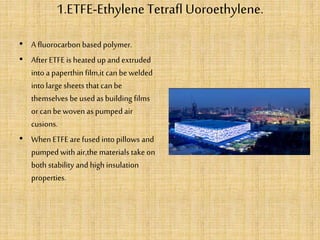
1.ETFE-Ethylene Tetrafl Uoroethylene.
• A fluorocarbon based polymer.
• After ETFE is heatedup and extruded
into a paperthin film,it can be welded
into largesheets that can be
themselves beused as building films
orcan be woven as pumped air
cusions.
• When ETFE arefused into pillows and
pumped with air,the materials take on
both stability and high insulation
properties.
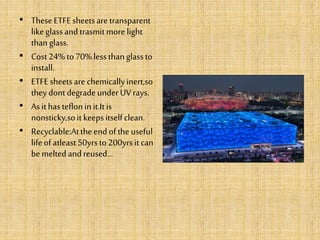
• TheseETFEsheetsare transparent
likeglassandtrasmitmore light
thanglass.
• Cost24%to70%lessthanglassto
install.
• ETFEsheetsare chemicallyinert,so
theydontdegradeunderUVrays.
• Asithastefloninit.Itis
nonsticky,soitkeepsitselfclean.
• Recyclable:Attheendoftheuseful
lifeofatleast50yrsto200yrsitcan
bemeltedandreused...
Asthetics:
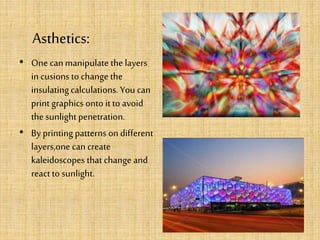
• One canmanipulate the layers
in cusions to change the
insulatingcalculations.You can
print graphics onto it to avoid
the sunlightpenetration.
• By printing patterns on different
layers,one can create
kaleidoscopes that change and
react to sunlight.
2.Lucem Translucent concrete: LED concrete
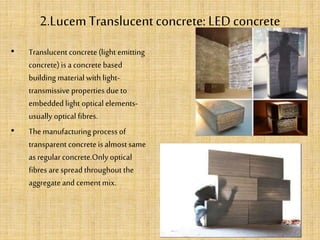
• Translucent concrete(light emitting
concrete) is a concrete based
building material with light-
transmissive properties due to
embedded light optical elements-
usually optical fibres.
• Themanufacturing process of
transparent concreteis almost same
as regular concrete.Only optical
fibres are spread throughout the
aggregateand cementmix.
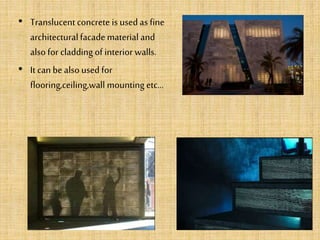
• Translucentconcrete is used as fine
architecturalfacade material and
also for cladding of interior walls.
• It can be also usedfor
flooring,ceiling,wall mounting etc...
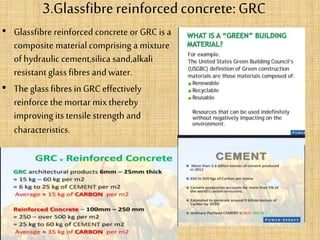
3.Glassfibrereinforcedconcrete:GRC
• Glassfibre reinforced concrete or GRC is a
composite material comprising a mixture
of hydraulic cement,silica sand,alkali
resistant glassfibres and water.
• The glass fibres in GRC effectively
reinforce the mortar mix thereby
improving its tensile strength and
characteristics.
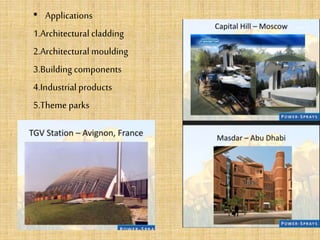
• Applications
1.Architectural cladding
2.Architectural moulding
3.Building components
4.Industrial products
5.Theme parks
Advantages
• GRC was developed as a corrosion free alternativeto traditional steel
reinforced concrete.
• GRC can be moulded intoany complex shape,profiles and
architectural components.
• Main advantage over precast concrete is one can have very light
structures resultingin savings in thecosts of transportation,handling
and erection of panels.
• Lightweightdesign(both low and highrise superstructures) helps
both in economicsavings and also effectthe sustainable
environment.
• GRC is durable,seismic capable,chemical resistant,non combustible
and good sound and heat insulator.
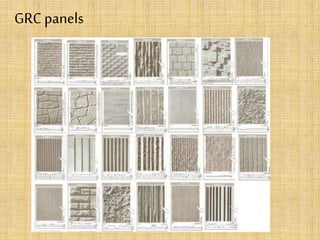
GRCpanels
4.Nanomaterials
• Nanotechnology:When combined with ultra-high-strength
concrete, nanomaterialssuch as Carbon Nanotubes(CNT’s)
create a materialso strong in both tensionand compression
thatsteelreber is no longer needed in construction.
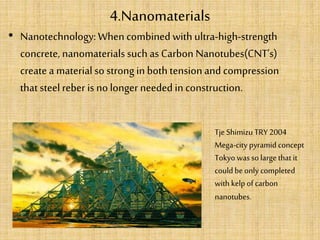
Tje Shimizu TRY 2004
Mega-city pyramid concept
Tokyo was so large that it
could be only completed
with kelp of carbon
nanotubes.
5.Self healing concrete
• Thegreat downfallofconcrete-the
worldsmostwidelyusedmaterial
is–unavoidablecracking,caused
bywater andchemicals.
• Buta selfhealingconcrete was
developedbyNetherland.Which
saysbyinfusingbacterialsporesin
concretehelpinpatchingup
crackswhenwater seepsthrough.
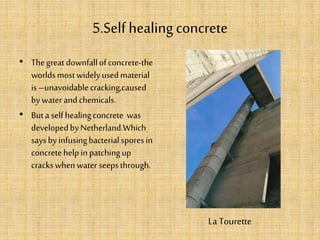
La Tourette
6.Germ repellent
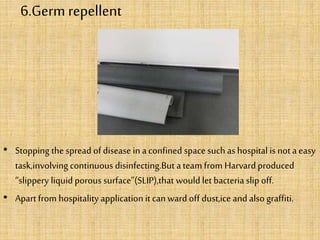
• Stopping the spread of disease in a confined space such as hospital is not a easy
task,involving continuous disinfecting.But a team from Harvard produced
“slippery liquidporous surface”(SLIP),that would let bacteria slip off.
• Apart from hospitality application it canward off dust,ice and also graffiti.
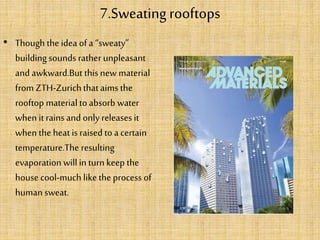
7.Sweating rooftops
• Though the idea of a “sweaty”
building sounds rather unpleasant
andawkward.But this new material
from ZTH-Zurichthat aims the
rooftop material toabsorb water
when it rainsand only releases it
when the heat is raised to a certain
temperature.The resulting
evaporation will in turn keep the
house cool-much like the process of
human sweat.
Thank you 

New materials used in building industry

  • 1.
  • 2.
    Why choose aright material??? • Ecological balance • Green building material • Economical structures • Faster construction • Aesthetic advantages
  • 3.
    1.ETFE-Ethylene Tetrafl Uoroethylene. •A fluorocarbon based polymer. • After ETFE is heatedup and extruded into a paperthin film,it can be welded into largesheets that can be themselves beused as building films orcan be woven as pumped air cusions. • When ETFE arefused into pillows and pumped with air,the materials take on both stability and high insulation properties.
  • 4.
    • TheseETFEsheetsare transparent likeglassandtrasmitmorelight thanglass. • Cost24%to70%lessthanglassto install. • ETFEsheetsare chemicallyinert,so theydontdegradeunderUVrays. • Asithastefloninit.Itis nonsticky,soitkeepsitselfclean. • Recyclable:Attheendoftheuseful lifeofatleast50yrsto200yrsitcan bemeltedandreused...
  • 5.
    Asthetics: • One canmanipulatethe layers in cusions to change the insulatingcalculations.You can print graphics onto it to avoid the sunlightpenetration. • By printing patterns on different layers,one can create kaleidoscopes that change and react to sunlight.
  • 6.
    2.Lucem Translucent concrete:LED concrete • Translucent concrete(light emitting concrete) is a concrete based building material with light- transmissive properties due to embedded light optical elements- usually optical fibres. • Themanufacturing process of transparent concreteis almost same as regular concrete.Only optical fibres are spread throughout the aggregateand cementmix.
  • 7.
    • Translucentconcrete isused as fine architecturalfacade material and also for cladding of interior walls. • It can be also usedfor flooring,ceiling,wall mounting etc...
  • 8.
    3.Glassfibrereinforcedconcrete:GRC • Glassfibre reinforcedconcrete or GRC is a composite material comprising a mixture of hydraulic cement,silica sand,alkali resistant glassfibres and water. • The glass fibres in GRC effectively reinforce the mortar mix thereby improving its tensile strength and characteristics.
  • 9.
    • Applications 1.Architectural cladding 2.Architecturalmoulding 3.Building components 4.Industrial products 5.Theme parks
  • 10.
    Advantages • GRC wasdeveloped as a corrosion free alternativeto traditional steel reinforced concrete. • GRC can be moulded intoany complex shape,profiles and architectural components. • Main advantage over precast concrete is one can have very light structures resultingin savings in thecosts of transportation,handling and erection of panels. • Lightweightdesign(both low and highrise superstructures) helps both in economicsavings and also effectthe sustainable environment. • GRC is durable,seismic capable,chemical resistant,non combustible and good sound and heat insulator.
  • 12.
  • 13.
    4.Nanomaterials • Nanotechnology:When combinedwith ultra-high-strength concrete, nanomaterialssuch as Carbon Nanotubes(CNT’s) create a materialso strong in both tensionand compression thatsteelreber is no longer needed in construction. Tje Shimizu TRY 2004 Mega-city pyramid concept Tokyo was so large that it could be only completed with kelp of carbon nanotubes.
  • 14.
    5.Self healing concrete •Thegreat downfallofconcrete-the worldsmostwidelyusedmaterial is–unavoidablecracking,caused bywater andchemicals. • Buta selfhealingconcrete was developedbyNetherland.Which saysbyinfusingbacterialsporesin concretehelpinpatchingup crackswhenwater seepsthrough. La Tourette
  • 15.
    6.Germ repellent • Stoppingthe spread of disease in a confined space such as hospital is not a easy task,involving continuous disinfecting.But a team from Harvard produced “slippery liquidporous surface”(SLIP),that would let bacteria slip off. • Apart from hospitality application it canward off dust,ice and also graffiti.
  • 16.
    7.Sweating rooftops • Thoughthe idea of a “sweaty” building sounds rather unpleasant andawkward.But this new material from ZTH-Zurichthat aims the rooftop material toabsorb water when it rainsand only releases it when the heat is raised to a certain temperature.The resulting evaporation will in turn keep the house cool-much like the process of human sweat.
  • 17.