OFFICE INTERIORS
REPORT By
ADUITI SHARMA
YAMINI PATIDAR
FLOORING
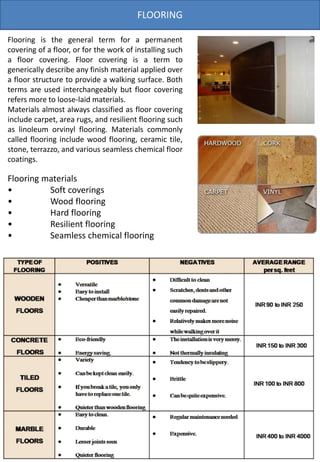
Flooring is the general term for a permanent
covering of a floor, or for the work of installing such
a floor covering. Floor covering is a term to
generically describe any finish material applied over
a floor structure to provide a walking surface. Both
terms are used interchangeably but floor covering
refers more to loose-laid materials.
Materials almost always classified as floor covering
include carpet, area rugs, and resilient flooring such
as linoleum orvinyl flooring. Materials commonly
called flooring include wood flooring, ceramic tile,
stone, terrazzo, and various seamless chemical floor
coatings.
Flooring materials
• Soft coverings
• Wood flooring
• Hard flooring
• Resilient flooring
• Seamless chemical flooring
FLOORING
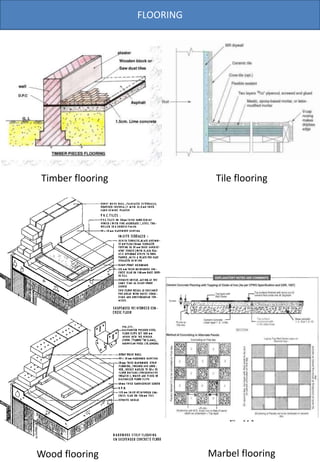
Wood flooring
Tile flooring
Marbel flooring
Timber flooring
CEILING
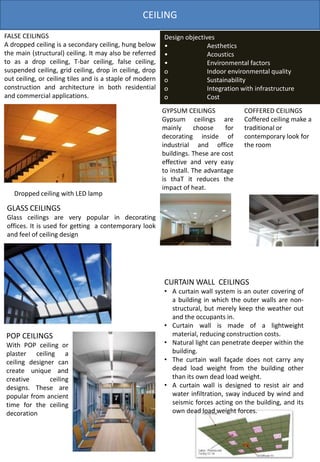
FALSE CEILINGS
A dropped ceiling is a secondary ceiling, hung below
the main (structural) ceiling. It may also be referred
to as a drop ceiling, T-bar ceiling, false ceiling,
suspended ceiling, grid ceiling, drop in ceiling, drop
out ceiling, or ceiling tiles and is a staple of modern
construction and architecture in both residential
and commercial applications.
Dropped ceiling with LED lamp
Design objectives
• Aesthetics
• Acoustics
• Environmental factors
o Indoor environmental quality
o Sustainability
o Integration with infrastructure
o Cost
GLASS CEILINGS
Glass ceilings are very popular in decorating
offices. It is used for getting a contemporary look
and feel of ceiling design
POP CEILINGS
With POP ceiling or
plaster ceiling a
ceiling designer can
create unique and
creative ceiling
designs. These are
popular from ancient
time for the ceiling
decoration
GYPSUM CEILINGS
Gypsum ceilings are
mainly choose for
decorating inside of
industrial and office
buildings. These are cost
effective and very easy
to install. The advantage
is thaT it reduces the
impact of heat.
COFFERED CEILINGS
Coffered ceiling make a
traditional or
contemporary look for
the room
CURTAIN WALL CEILINGS
• A curtain wall system is an outer covering of
a building in which the outer walls are non-
structural, but merely keep the weather out
and the occupants in.
• Curtain wall is made of a lightweight
material, reducing construction costs.
• Natural light can penetrate deeper within the
building.
• The curtain wall façade does not carry any
dead load weight from the building other
than its own dead load weight.
• A curtain wall is designed to resist air and
water infiltration, sway induced by wind and
seismic forces acting on the building, and its
own dead load weight forces.
CEILING
WALL FINISH
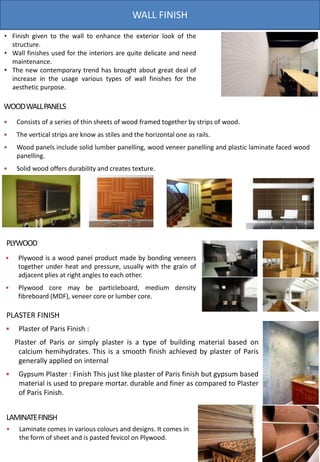
• Finish given to the wall to enhance the exterior look of the
structure.
• Wall finishes used for the interiors are quite delicate and need
maintenance.
• The new contemporary trend has brought about great deal of
increase in the usage various types of wall finishes for the
aesthetic purpose.
WOODWALLPANELS
 Consists of a series of thin sheets of wood framed together by strips of wood.
 The vertical strips are know as stiles and the horizontal one as rails.
 Wood panels include solid lumber panelling, wood veneer panelling and plastic laminate faced wood
panelling.
 Solid wood offers durability and creates texture.
PLYWOOD
 Plywood is a wood panel product made by bonding veneers
together under heat and pressure, usually with the grain of
adjacent plies at right angles to each other.
 Plywood core may be particleboard, medium density
fibreboard (MDF), veneer core or lumber core.
 Plaster of Paris Finish :
Plaster of Paris or simply plaster is a type of building material based on
calcium hemihydrates. This is a smooth finish achieved by plaster of Paris
generally applied on internal
 Gypsum Plaster : Finish This just like plaster of Paris finish but gypsum based
material is used to prepare mortar. durable and finer as compared to Plaster
of Paris Finish.
PLASTER FINISH
LAMINATEFINISH
 Laminate comes in various colours and designs. It comes in
the form of sheet and is pasted fevicol on Plywood.
LIGHTING
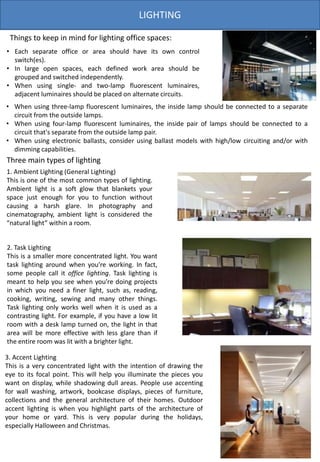
Three main types of lighting
1. Ambient Lighting (General Lighting)
This is one of the most common types of lighting.
Ambient light is a soft glow that blankets your
space just enough for you to function without
causing a harsh glare. In photography and
cinematography, ambient light is considered the
“natural light” within a room.
2. Task Lighting
This is a smaller more concentrated light. You want
task lighting around when you’re working. In fact,
some people call it office lighting. Task lighting is
meant to help you see when you’re doing projects
in which you need a finer light, such as, reading,
cooking, writing, sewing and many other things.
Task lighting only works well when it is used as a
contrasting light. For example, if you have a low lit
room with a desk lamp turned on, the light in that
area will be more effective with less glare than if
the entire room was lit with a brighter light.
3. Accent Lighting
This is a very concentrated light with the intention of drawing the
eye to its focal point. This will help you illuminate the pieces you
want on display, while shadowing dull areas. People use accenting
for wall washing, artwork, bookcase displays, pieces of furniture,
collections and the general architecture of their homes. Outdoor
accent lighting is when you highlight parts of the architecture of
your home or yard. This is very popular during the holidays,
especially Halloween and Christmas.
• Each separate office or area should have its own control
switch(es).
• In large open spaces, each defined work area should be
grouped and switched independently.
• When using single- and two-lamp fluorescent luminaires,
adjacent luminaires should be placed on alternate circuits.
Things to keep in mind for lighting office spaces:
• When using three-lamp fluorescent luminaires, the inside lamp should be connected to a separate
circuit from the outside lamps.
• When using four-lamp fluorescent luminaires, the inside pair of lamps should be connected to a
circuit that's separate from the outside lamp pair.
• When using electronic ballasts, consider using ballast models with high/low circuiting and/or with
dimming capabilities.
PARTITION
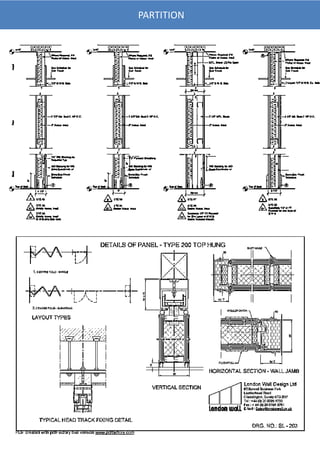
In the office world, in which the trend points towards open spaces, offices and
multipurpose rooms demarcated with different types of partition can still be seen.
The acoustic requirements of each of these areas is different and companies provide
solutions for each of such situation.
TYPES OF PARTITIONS
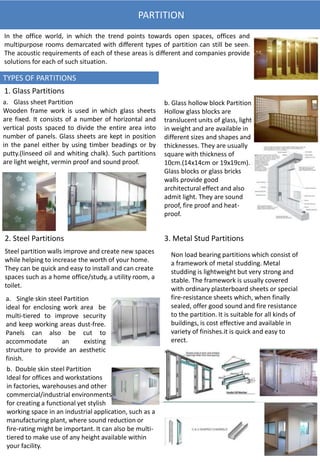
1. Glass Partitions
a. Glass sheet Partition
Wooden frame work is used in which glass sheets
are fixed. It consists of a number of horizontal and
vertical posts spaced to divide the entire area into
number of panels. Glass sheets are kept in position
in the panel either by using timber beadings or by
putty.(linseed oil and whiting chalk). Such partitions
are light weight, vermin proof and sound proof.
b. Glass hollow block Partition
Hollow glass blocks are
translucent units of glass, light
in weight and are available in
different sizes and shapes and
thicknesses. They are usually
square with thickness of
10cm.(14x14cm or 19x19cm).
Glass blocks or glass bricks
walls provide good
architectural effect and also
admit light. They are sound
proof, fire proof and heat-
proof.
2. Steel Partitions
Steel partition walls improve and create new spaces
while helping to increase the worth of your home.
They can be quick and easy to install and can create
spaces such as a home office/study, a utility room, a
toilet.
a. Single skin steel Partition
ideal for enclosing work area be
multi-tiered to improve security
and keep working areas dust-free.
Panels can also be cut to
accommodate an existing
structure to provide an aesthetic
finish.
b. Double skin steel Partition
Ideal for offices and workstations
in factories, warehouses and other
commercial/industrial environments. It is perfect
for creating a functional yet stylish
working space in an industrial application, such as a
manufacturing plant, where sound reduction or
fire-rating might be important. It can also be multi-
tiered to make use of any height available within
your facility.
3. Metal Stud Partitions
Non load bearing partitions which consist of
a framework of metal studding. Metal
studding is lightweight but very strong and
stable. The framework is usually covered
with ordinary plasterboard sheets or special
fire-resistance sheets which, when finally
sealed, offer good sound and fire resistance
to the partition. It is suitable for all kinds of
buildings, is cost effective and available in
variety of finishes.it is quick and easy to
erect.
PARTITION
SMOKE DETECTION
Heat detector have two main classifications of
operation,
• Rate-of-rise
• Fixed temperature
A heat detector is a fire alarm device designed to respond when the converted thermal energy of a fire
increases the temperature of a heat sensitive element. The thermal mass and conductivity of the element
regulate the rate flow of heat into the element. All heat detectors have this thermal lag.
HEAT DETECTOR
A smoke detector is a device that senses smoke, typically as an
indicator of fire. Commercial security devices issue a signal to
a fire alarm control panel as part of a fire alarm system, while
household detectors, known as smoke alarms, generally issue
a local audible or visual alarm from the detector itself.
 Heat detectors are best suited for: applications where detection speed is not a prime consideration
or where ambient conditions would not allow the use of a smoke detector fire detection in small,
confined spaces where rapidly burning, high heat fires are anticipated
 Heat detectors have a lower false alarm rate, but they are also slower than smoke detectors in
detecting fires. Studies have shown that heat detectors are not as effective as smoke detectors in
detecting fires in residential homes.
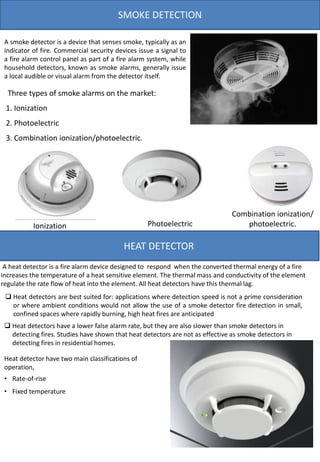
Three types of smoke alarms on the market:
1. Ionization
2. Photoelectric
3. Combination ionization/photoelectric.
Ionization Photoelectric
Combination ionization/
photoelectric.
SPRINKLERS
TYPES OF SPRINKLER SYSTEMS
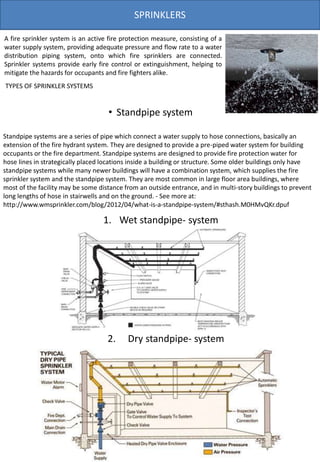
A fire sprinkler system is an active fire protection measure, consisting of a
water supply system, providing adequate pressure and flow rate to a water
distribution piping system, onto which fire sprinklers are connected.
Sprinkler systems provide early fire control or extinguishment, helping to
mitigate the hazards for occupants and fire fighters alike.
2. Dry standpipe- system
1. Wet standpipe- system
• Standpipe system
Standpipe systems are a series of pipe which connect a water supply to hose connections, basically an
extension of the fire hydrant system. They are designed to provide a pre-piped water system for building
occupants or the fire department. Standpipe systems are designed to provide fire protection water for
hose lines in strategically placed locations inside a building or structure. Some older buildings only have
standpipe systems while many newer buildings will have a combination system, which supplies the fire
sprinkler system and the standpipe system. They are most common in large floor area buildings, where
most of the facility may be some distance from an outside entrance, and in multi-story buildings to prevent
long lengths of hose in stairwells and on the ground. - See more at:
http://www.wmsprinkler.com/blog/2012/04/what-is-a-standpipe-system/#sthash.M0HMvQKr.dpuf
AIR CONDITIONERS
• An air conditioning system, or a standalone air conditioner, provides cooling and humidity control for
all or part of a building.
• Air conditioned buildings often have sealed windows, because open windows would work against the
system intended to maintain constant indoor air conditions.
• Outside, fresh air is generally drawn into the system by a vent into the indoor heat exchanger section,
creating positive air pressure.
• The percentage of return air made up of fresh air can usually be manipulated by adjusting the
opening of this vent. Typical fresh air intake is about 10%.
SPLIT SYSTEMS
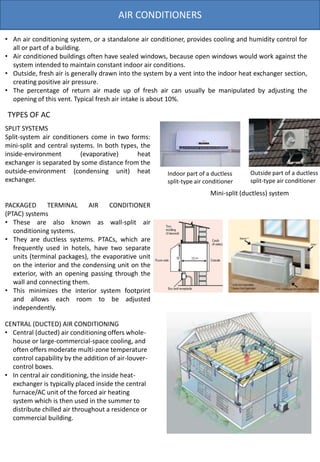
Split-system air conditioners come in two forms:
mini-split and central systems. In both types, the
inside-environment (evaporative) heat
exchanger is separated by some distance from the
outside-environment (condensing unit) heat
exchanger.
PACKAGED TERMINAL AIR CONDITIONER
(PTAC) systems
• These are also known as wall-split air
conditioning systems.
• They are ductless systems. PTACs, which are
frequently used in hotels, have two separate
units (terminal packages), the evaporative unit
on the interior and the condensing unit on the
exterior, with an opening passing through the
wall and connecting them.
• This minimizes the interior system footprint
and allows each room to be adjusted
independently.
TYPES OF AC
Mini-split (ductless) system
Outside part of a ductless
split-type air conditioner
Indoor part of a ductless
split-type air conditioner
CENTRAL (DUCTED) AIR CONDITIONING
• Central (ducted) air conditioning offers whole-
house or large-commercial-space cooling, and
often offers moderate multi-zone temperature
control capability by the addition of air-louver-
control boxes.
• In central air conditioning, the inside heat-
exchanger is typically placed inside the central
furnace/AC unit of the forced air heating
system which is then used in the summer to
distribute chilled air throughout a residence or
commercial building.

Office interiors

  • 1.
    OFFICE INTERIORS REPORT By ADUITISHARMA YAMINI PATIDAR
  • 2.
    FLOORING Flooring is thegeneral term for a permanent covering of a floor, or for the work of installing such a floor covering. Floor covering is a term to generically describe any finish material applied over a floor structure to provide a walking surface. Both terms are used interchangeably but floor covering refers more to loose-laid materials. Materials almost always classified as floor covering include carpet, area rugs, and resilient flooring such as linoleum orvinyl flooring. Materials commonly called flooring include wood flooring, ceramic tile, stone, terrazzo, and various seamless chemical floor coatings. Flooring materials • Soft coverings • Wood flooring • Hard flooring • Resilient flooring • Seamless chemical flooring
  • 3.
  • 4.
    CEILING FALSE CEILINGS A droppedceiling is a secondary ceiling, hung below the main (structural) ceiling. It may also be referred to as a drop ceiling, T-bar ceiling, false ceiling, suspended ceiling, grid ceiling, drop in ceiling, drop out ceiling, or ceiling tiles and is a staple of modern construction and architecture in both residential and commercial applications. Dropped ceiling with LED lamp Design objectives • Aesthetics • Acoustics • Environmental factors o Indoor environmental quality o Sustainability o Integration with infrastructure o Cost GLASS CEILINGS Glass ceilings are very popular in decorating offices. It is used for getting a contemporary look and feel of ceiling design POP CEILINGS With POP ceiling or plaster ceiling a ceiling designer can create unique and creative ceiling designs. These are popular from ancient time for the ceiling decoration GYPSUM CEILINGS Gypsum ceilings are mainly choose for decorating inside of industrial and office buildings. These are cost effective and very easy to install. The advantage is thaT it reduces the impact of heat. COFFERED CEILINGS Coffered ceiling make a traditional or contemporary look for the room CURTAIN WALL CEILINGS • A curtain wall system is an outer covering of a building in which the outer walls are non- structural, but merely keep the weather out and the occupants in. • Curtain wall is made of a lightweight material, reducing construction costs. • Natural light can penetrate deeper within the building. • The curtain wall façade does not carry any dead load weight from the building other than its own dead load weight. • A curtain wall is designed to resist air and water infiltration, sway induced by wind and seismic forces acting on the building, and its own dead load weight forces.
  • 5.
  • 6.
    WALL FINISH • Finishgiven to the wall to enhance the exterior look of the structure. • Wall finishes used for the interiors are quite delicate and need maintenance. • The new contemporary trend has brought about great deal of increase in the usage various types of wall finishes for the aesthetic purpose. WOODWALLPANELS  Consists of a series of thin sheets of wood framed together by strips of wood.  The vertical strips are know as stiles and the horizontal one as rails.  Wood panels include solid lumber panelling, wood veneer panelling and plastic laminate faced wood panelling.  Solid wood offers durability and creates texture. PLYWOOD  Plywood is a wood panel product made by bonding veneers together under heat and pressure, usually with the grain of adjacent plies at right angles to each other.  Plywood core may be particleboard, medium density fibreboard (MDF), veneer core or lumber core.  Plaster of Paris Finish : Plaster of Paris or simply plaster is a type of building material based on calcium hemihydrates. This is a smooth finish achieved by plaster of Paris generally applied on internal  Gypsum Plaster : Finish This just like plaster of Paris finish but gypsum based material is used to prepare mortar. durable and finer as compared to Plaster of Paris Finish. PLASTER FINISH LAMINATEFINISH  Laminate comes in various colours and designs. It comes in the form of sheet and is pasted fevicol on Plywood.
  • 7.
    LIGHTING Three main typesof lighting 1. Ambient Lighting (General Lighting) This is one of the most common types of lighting. Ambient light is a soft glow that blankets your space just enough for you to function without causing a harsh glare. In photography and cinematography, ambient light is considered the “natural light” within a room. 2. Task Lighting This is a smaller more concentrated light. You want task lighting around when you’re working. In fact, some people call it office lighting. Task lighting is meant to help you see when you’re doing projects in which you need a finer light, such as, reading, cooking, writing, sewing and many other things. Task lighting only works well when it is used as a contrasting light. For example, if you have a low lit room with a desk lamp turned on, the light in that area will be more effective with less glare than if the entire room was lit with a brighter light. 3. Accent Lighting This is a very concentrated light with the intention of drawing the eye to its focal point. This will help you illuminate the pieces you want on display, while shadowing dull areas. People use accenting for wall washing, artwork, bookcase displays, pieces of furniture, collections and the general architecture of their homes. Outdoor accent lighting is when you highlight parts of the architecture of your home or yard. This is very popular during the holidays, especially Halloween and Christmas. • Each separate office or area should have its own control switch(es). • In large open spaces, each defined work area should be grouped and switched independently. • When using single- and two-lamp fluorescent luminaires, adjacent luminaires should be placed on alternate circuits. Things to keep in mind for lighting office spaces: • When using three-lamp fluorescent luminaires, the inside lamp should be connected to a separate circuit from the outside lamps. • When using four-lamp fluorescent luminaires, the inside pair of lamps should be connected to a circuit that's separate from the outside lamp pair. • When using electronic ballasts, consider using ballast models with high/low circuiting and/or with dimming capabilities.
  • 8.
    PARTITION In the officeworld, in which the trend points towards open spaces, offices and multipurpose rooms demarcated with different types of partition can still be seen. The acoustic requirements of each of these areas is different and companies provide solutions for each of such situation. TYPES OF PARTITIONS 1. Glass Partitions a. Glass sheet Partition Wooden frame work is used in which glass sheets are fixed. It consists of a number of horizontal and vertical posts spaced to divide the entire area into number of panels. Glass sheets are kept in position in the panel either by using timber beadings or by putty.(linseed oil and whiting chalk). Such partitions are light weight, vermin proof and sound proof. b. Glass hollow block Partition Hollow glass blocks are translucent units of glass, light in weight and are available in different sizes and shapes and thicknesses. They are usually square with thickness of 10cm.(14x14cm or 19x19cm). Glass blocks or glass bricks walls provide good architectural effect and also admit light. They are sound proof, fire proof and heat- proof. 2. Steel Partitions Steel partition walls improve and create new spaces while helping to increase the worth of your home. They can be quick and easy to install and can create spaces such as a home office/study, a utility room, a toilet. a. Single skin steel Partition ideal for enclosing work area be multi-tiered to improve security and keep working areas dust-free. Panels can also be cut to accommodate an existing structure to provide an aesthetic finish. b. Double skin steel Partition Ideal for offices and workstations in factories, warehouses and other commercial/industrial environments. It is perfect for creating a functional yet stylish working space in an industrial application, such as a manufacturing plant, where sound reduction or fire-rating might be important. It can also be multi- tiered to make use of any height available within your facility. 3. Metal Stud Partitions Non load bearing partitions which consist of a framework of metal studding. Metal studding is lightweight but very strong and stable. The framework is usually covered with ordinary plasterboard sheets or special fire-resistance sheets which, when finally sealed, offer good sound and fire resistance to the partition. It is suitable for all kinds of buildings, is cost effective and available in variety of finishes.it is quick and easy to erect.
  • 9.
  • 10.
    SMOKE DETECTION Heat detectorhave two main classifications of operation, • Rate-of-rise • Fixed temperature A heat detector is a fire alarm device designed to respond when the converted thermal energy of a fire increases the temperature of a heat sensitive element. The thermal mass and conductivity of the element regulate the rate flow of heat into the element. All heat detectors have this thermal lag. HEAT DETECTOR A smoke detector is a device that senses smoke, typically as an indicator of fire. Commercial security devices issue a signal to a fire alarm control panel as part of a fire alarm system, while household detectors, known as smoke alarms, generally issue a local audible or visual alarm from the detector itself.  Heat detectors are best suited for: applications where detection speed is not a prime consideration or where ambient conditions would not allow the use of a smoke detector fire detection in small, confined spaces where rapidly burning, high heat fires are anticipated  Heat detectors have a lower false alarm rate, but they are also slower than smoke detectors in detecting fires. Studies have shown that heat detectors are not as effective as smoke detectors in detecting fires in residential homes. Three types of smoke alarms on the market: 1. Ionization 2. Photoelectric 3. Combination ionization/photoelectric. Ionization Photoelectric Combination ionization/ photoelectric.
  • 11.
    SPRINKLERS TYPES OF SPRINKLERSYSTEMS A fire sprinkler system is an active fire protection measure, consisting of a water supply system, providing adequate pressure and flow rate to a water distribution piping system, onto which fire sprinklers are connected. Sprinkler systems provide early fire control or extinguishment, helping to mitigate the hazards for occupants and fire fighters alike. 2. Dry standpipe- system 1. Wet standpipe- system • Standpipe system Standpipe systems are a series of pipe which connect a water supply to hose connections, basically an extension of the fire hydrant system. They are designed to provide a pre-piped water system for building occupants or the fire department. Standpipe systems are designed to provide fire protection water for hose lines in strategically placed locations inside a building or structure. Some older buildings only have standpipe systems while many newer buildings will have a combination system, which supplies the fire sprinkler system and the standpipe system. They are most common in large floor area buildings, where most of the facility may be some distance from an outside entrance, and in multi-story buildings to prevent long lengths of hose in stairwells and on the ground. - See more at: http://www.wmsprinkler.com/blog/2012/04/what-is-a-standpipe-system/#sthash.M0HMvQKr.dpuf
  • 12.
    AIR CONDITIONERS • Anair conditioning system, or a standalone air conditioner, provides cooling and humidity control for all or part of a building. • Air conditioned buildings often have sealed windows, because open windows would work against the system intended to maintain constant indoor air conditions. • Outside, fresh air is generally drawn into the system by a vent into the indoor heat exchanger section, creating positive air pressure. • The percentage of return air made up of fresh air can usually be manipulated by adjusting the opening of this vent. Typical fresh air intake is about 10%. SPLIT SYSTEMS Split-system air conditioners come in two forms: mini-split and central systems. In both types, the inside-environment (evaporative) heat exchanger is separated by some distance from the outside-environment (condensing unit) heat exchanger. PACKAGED TERMINAL AIR CONDITIONER (PTAC) systems • These are also known as wall-split air conditioning systems. • They are ductless systems. PTACs, which are frequently used in hotels, have two separate units (terminal packages), the evaporative unit on the interior and the condensing unit on the exterior, with an opening passing through the wall and connecting them. • This minimizes the interior system footprint and allows each room to be adjusted independently. TYPES OF AC Mini-split (ductless) system Outside part of a ductless split-type air conditioner Indoor part of a ductless split-type air conditioner CENTRAL (DUCTED) AIR CONDITIONING • Central (ducted) air conditioning offers whole- house or large-commercial-space cooling, and often offers moderate multi-zone temperature control capability by the addition of air-louver- control boxes. • In central air conditioning, the inside heat- exchanger is typically placed inside the central furnace/AC unit of the forced air heating system which is then used in the summer to distribute chilled air throughout a residence or commercial building.