LIGHT
Interior design
Prepared by-
Radhika saboo
Ridhima goyal
Shreya goyal
Simran walia
Vaishnavi jhala
INTRODUCTION
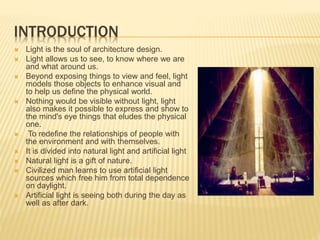
 Light is the soul of architecture design.
 Light allows us to see, to know where we are
and what around us.
 Beyond exposing things to view and feel, light
models those objects to enhance visual and
to help us define the physical world.
 Nothing would be visible without light, light
also makes it possible to express and show to
the mind's eye things that eludes the physical
one.
 To redefine the relationships of people with
the environment and with themselves.
 It is divided into natural light and artificial light
 Natural light is a gift of nature.
 Civilized man learns to use artificial light
sources which free him from total dependence
on daylight.
 Artificial light is seeing both during the day as
well as after dark.
RELATION BETWEEN LIGHT SPACE AND HUMAN
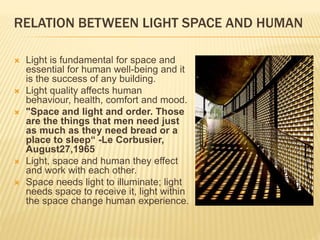
 Light is fundamental for space and
essential for human well-being and it
is the success of any building.
 Light quality affects human
behaviour, health, comfort and mood.
 "Space and light and order. Those
are the things that men need just
as much as they need bread or a
place to sleep“ -Le Corbusier,
August27,1965
 Light, space and human they effect
and work with each other.
 Space needs light to illuminate; light
needs space to receive it, light within
the space change human experience.
NATURAL LIGHT AND ARCHITECTURE
 Natural light keeps changing through
times.
 However, architects cannot control
natural light, which from morning to
night, day after day changes.
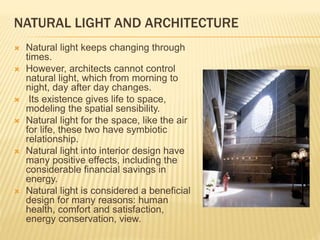
 Its existence gives life to space,
modeling the spatial sensibility.
 Natural light for the space, like the air
for life, these two have symbiotic
relationship.
 Natural light into interior design have
many positive effects, including the
considerable financial savings in
energy.
 Natural light is considered a beneficial
design for many reasons: human
health, comfort and satisfaction,
energy conservation, view.
LIGHTNING
 Lighting within the indoor
environment can be considered to
have three basic purposes:
 To enable the occupants to work
and move about in safety.
 To enable tasks to be performed.
 To make the interior look pleasant.
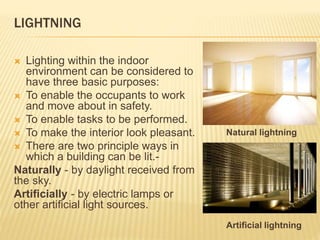
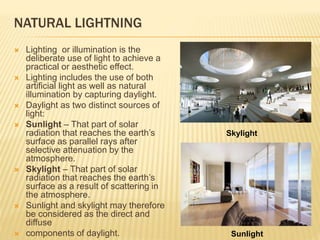
 There are two principle ways in
which a building can be lit.-
Naturally - by daylight received from
the sky.
Artificially - by electric lamps or
other artificial light sources.
Natural lightning
Artificial lightning
NATURAL LIGHTNING
 Lighting or illumination is the
deliberate use of light to achieve a
practical or aesthetic effect.
 Lighting includes the use of both
artificial light as well as natural
illumination by capturing daylight.
 Daylight as two distinct sources of
light:
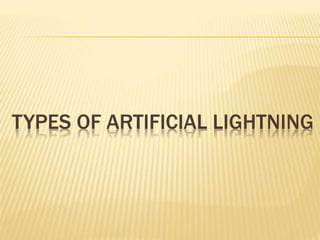
 Sunlight – That part of solar
radiation that reaches the earth’s
surface as parallel rays after
selective attenuation by the
atmosphere.
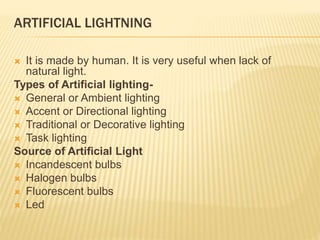
 Skylight – That part of solar
radiation that reaches the earth’s
surface as a result of scattering in
the atmosphere.
 Sunlight and skylight may therefore
be considered as the direct and
diffuse
 components of daylight.
Skylight
Sunlight
ARTIFICIAL LIGHTNING
 It is made by human. It is very useful when lack of
natural light.
Types of Artificial lighting-
 General or Ambient lighting
 Accent or Directional lighting
 Traditional or Decorative lighting
 Task lighting
Source of Artificial Light
 Incandescent bulbs
 Halogen bulbs
 Fluorescent bulbs
 Led
TYPES OF ARTIFICIAL LIGHTNING
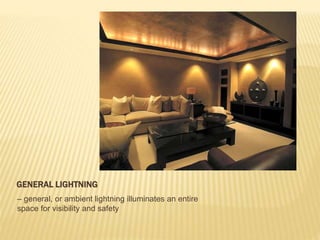
GENERAL LIGHTNING
– general, or ambient lightning illuminates an entire
space for visibility and safety
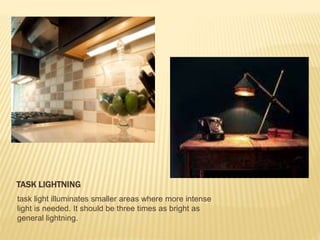
TASK LIGHTNING
task light illuminates smaller areas where more intense
light is needed. It should be three times as bright as
general lightning.
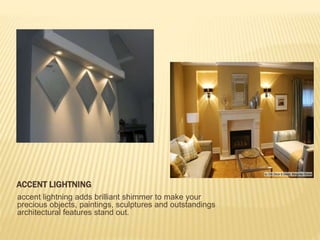
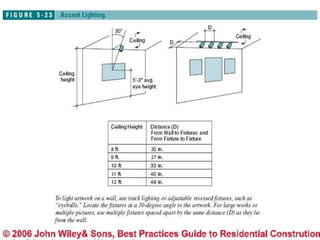
ACCENT LIGHTNING
accent lightning adds brilliant shimmer to make your
precious objects, paintings, sculptures and outstandings
architectural features stand out.
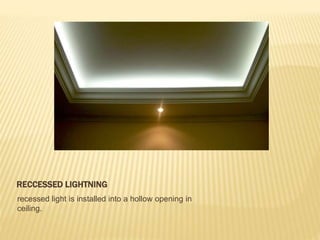
RECCESSED LIGHTNING
recessed light is installed into a hollow opening in
ceiling.
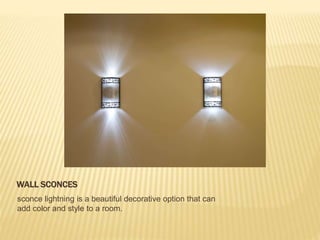
WALL SCONCES
sconce lightning is a beautiful decorative option that can
add color and style to a room.
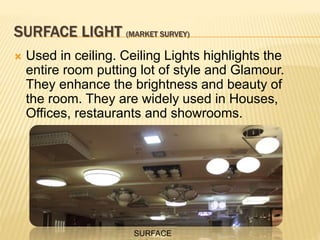
SURFACE LIGHT (MARKET SURVEY)
 Used in ceiling. Ceiling Lights highlights the
entire room putting lot of style and Glamour.
They enhance the brightness and beauty of
the room. They are widely used in Houses,
Offices, restaurants and showrooms.
SURFACE
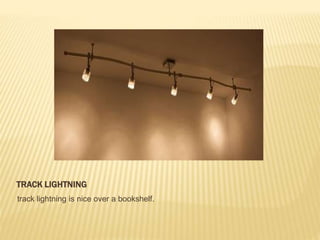
TRACK LIGHTNING
track lightning is nice over a bookshelf.
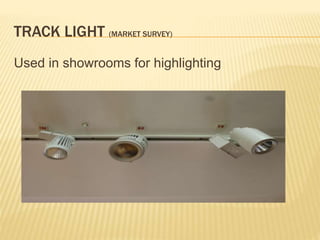
TRACK LIGHT (MARKET SURVEY)
Used in showrooms for highlighting
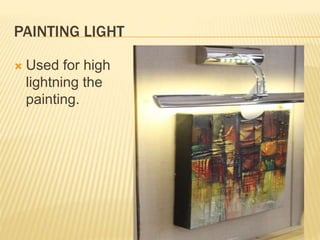
PAINTING LIGHT
 Used for high
lightning the
painting.
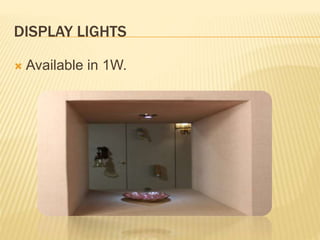
DISPLAY LIGHTS
 Available in 1W.
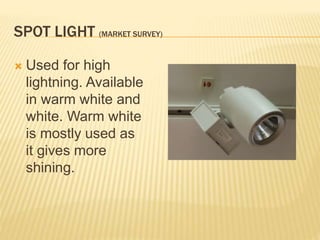
SPOT LIGHT (MARKET SURVEY)
 Used for high
lightning. Available
in warm white and
white. Warm white
is mostly used as
it gives more
shining.
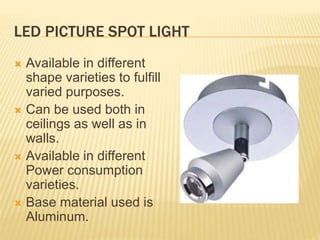
LED PICTURE SPOT LIGHT
 Available in different
shape varieties to fulfill
varied purposes.
 Can be used both in
ceilings as well as in
walls.
 Available in different
Power consumption
varieties.
 Base material used is
Aluminum.
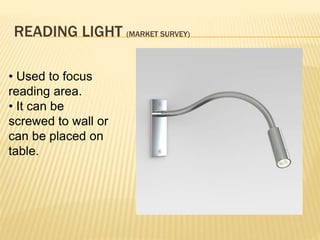
READING LIGHT (MARKET SURVEY)
• Used to focus
reading area.
• It can be
screwed to wall or
can be placed on
table.
READING LIGHT
(VIDEO)
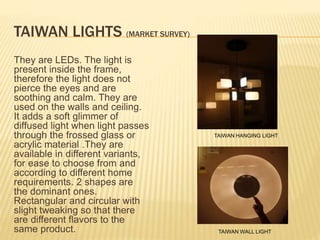
TAIWAN LIGHTS (MARKET SURVEY)
They are LEDs. The light is
present inside the frame,
therefore the light does not
pierce the eyes and are
soothing and calm. They are
used on the walls and ceiling.
It adds a soft glimmer of
diffused light when light passes
through the frossed glass or
acrylic material .They are
available in different variants,
for ease to choose from and
according to different home
requirements. 2 shapes are
the dominant ones.
Rectangular and circular with
slight tweaking so that there
are different flavors to the
same product.
TAIWAN HANGING LIGHT
TAIWAN WALL LIGHT
FALSE CEILING
They are of two types
 Down lighters
 Panel light –
Available in white,
natural white and
warm white colors.
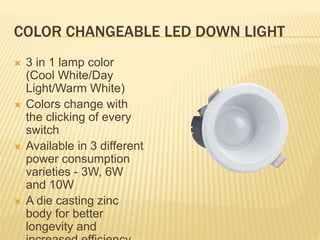
COLOR CHANGEABLE LED DOWN LIGHT
 3 in 1 lamp color
(Cool White/Day
Light/Warm White)
 Colors change with
the clicking of every
switch
 Available in 3 different
power consumption
varieties - 3W, 6W
and 10W
 A die casting zinc
body for better
longevity and
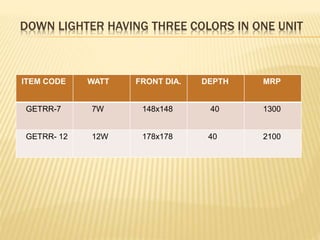
DOWN LIGHTER HAVING THREE COLORS IN ONE UNIT
ITEM CODE WATT FRONT DIA. DEPTH MRP
GETRR-7 7W 148x148 40 1300
GETRR- 12 12W 178x178 40 2100
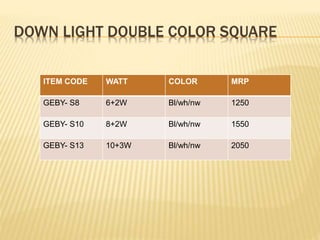
DOWN LIGHT DOUBLE COLOR SQUARE
ITEM CODE WATT COLOR MRP
GEBY- S8 6+2W Bl/wh/nw 1250
GEBY- S10 8+2W Bl/wh/nw 1550
GEBY- S13 10+3W Bl/wh/nw 2050
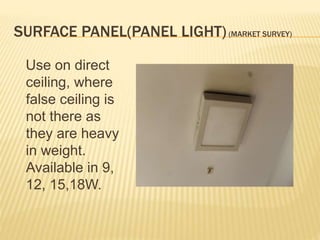
SURFACE PANEL(PANEL LIGHT)(MARKET SURVEY)
Use on direct
ceiling, where
false ceiling is
not there as
they are heavy
in weight.
Available in 9,
12, 15,18W.
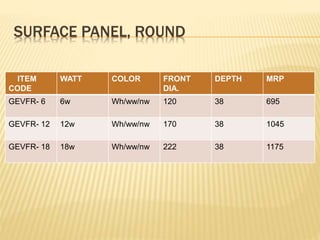
SURFACE PANEL, ROUND
ITEM
CODE
WATT COLOR FRONT
DIA.
DEPTH MRP
GEVFR- 6 6w Wh/ww/nw 120 38 695
GEVFR- 12 12w Wh/ww/nw 170 38 1045
GEVFR- 18 18w Wh/ww/nw 222 38 1175
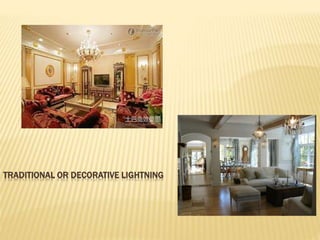
TRADITIONAL OR DECORATIVE LIGHTNING
SOURCE OF ARTIFICIAL LIGHTNING
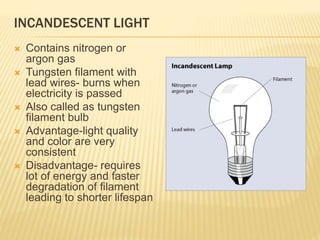
INCANDESCENT LIGHT
 Contains nitrogen or
argon gas
 Tungsten filament with
lead wires- burns when
electricity is passed
 Also called as tungsten
filament bulb
 Advantage-light quality
and color are very
consistent
 Disadvantage- requires
lot of energy and faster
degradation of filament
leading to shorter lifespan
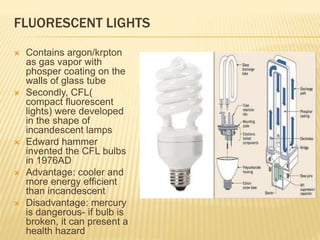
FLUORESCENT LIGHTS
 Contains argon/krpton
as gas vapor with
phosper coating on the
walls of glass tube
 Secondly, CFL(
compact fluorescent
lights) were developed
in the shape of
incandescent lamps
 Edward hammer
invented the CFL bulbs
in 1976AD
 Advantage: cooler and
more energy efficient
than incandescent
 Disadvantage: mercury
is dangerous- if bulb is
broken, it can present a
health hazard
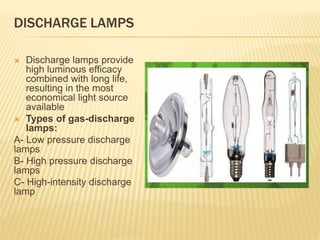
DISCHARGE LAMPS
 Discharge lamps provide
high luminous efficacy
combined with long life,
resulting in the most
economical light source
available
 Types of gas-discharge
lamps:
A- Low pressure discharge
lamps
B- High pressure discharge
lamps
C- High-intensity discharge
lamp
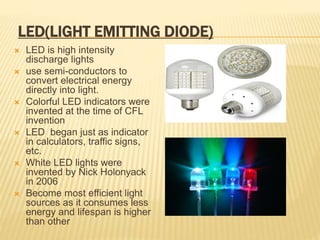
LED(LIGHT EMITTING DIODE)
 LED is high intensity
discharge lights
 use semi-conductors to
convert electrical energy
directly into light.
 Colorful LED indicators were
invented at the time of CFL
invention
 LED began just as indicator
in calculators, traffic signs,
etc.
 White LED lights were
invented by Nick Holonyack
in 2006
 Become most efficient light
sources as it consumes less
energy and lifespan is higher
than other
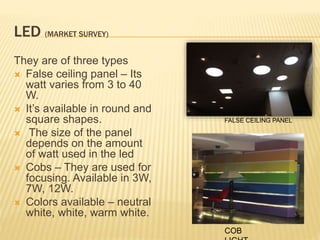
LED (MARKET SURVEY)
They are of three types
 False ceiling panel – Its
watt varies from 3 to 40
W.
 It’s available in round and
square shapes.
 The size of the panel
depends on the amount
of watt used in the led
 Cobs – They are used for
focusing. Available in 3W,
7W, 12W.
 Colors available – neutral
white, white, warm white.
FALSE CEILING PANEL
COB
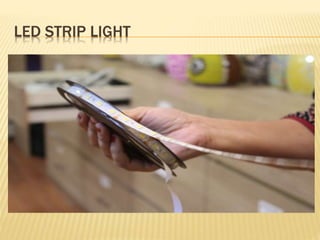
LED STRIP LIGHT
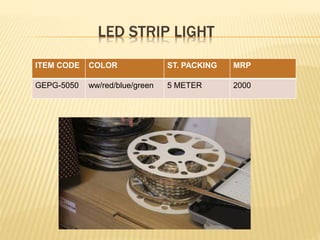
LED STRIP LIGHT
ITEM CODE COLOR ST. PACKING MRP
GEPG-5050 ww/red/blue/green 5 METER 2000
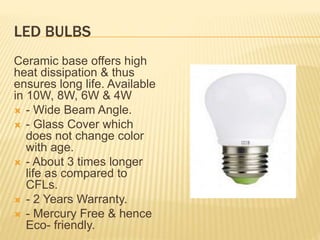
LED BULBS
Ceramic base offers high
heat dissipation & thus
ensures long life. Available
in 10W, 8W, 6W & 4W
 - Wide Beam Angle.
 - Glass Cover which
does not change color
with age.
 - About 3 times longer
life as compared to
CFLs.
 - 2 Years Warranty.
 - Mercury Free & hence
Eco- friendly.
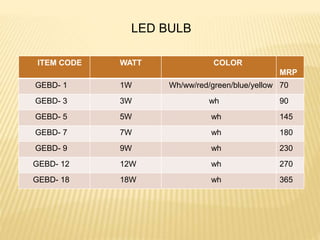
ITEM CODE WATT COLOR
MRP
GEBD- 1 1W Wh/ww/red/green/blue/yellow 70
GEBD- 3 3W wh 90
GEBD- 5 5W wh 145
GEBD- 7 7W wh 180
GEBD- 9 9W wh 230
GEBD- 12 12W wh 270
GEBD- 18 18W wh 365
LED BULB
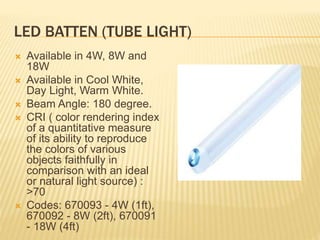
LED BATTEN (TUBE LIGHT)
 Available in 4W, 8W and
18W
 Available in Cool White,
Day Light, Warm White.
 Beam Angle: 180 degree.
 CRI ( color rendering index
of a quantitative measure
of its ability to reproduce
the colors of various
objects faithfully in
comparison with an ideal
or natural light source) :
>70
 Codes: 670093 - 4W (1ft),
670092 - 8W (2ft), 670091
- 18W (4ft)
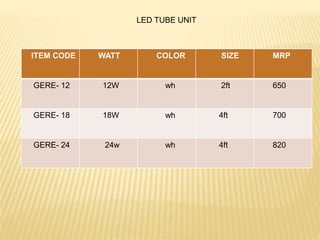
LED TUBE UNIT
ITEM CODE WATT COLOR SIZE MRP
GERE- 12 12W wh 2ft 650
GERE- 18 18W wh 4ft 700
GERE- 24 24w wh 4ft 820
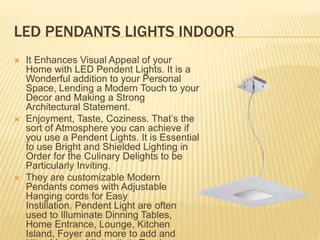
LED PENDANTS LIGHTS INDOOR
 It Enhances Visual Appeal of your
Home with LED Pendent Lights. It is a
Wonderful addition to your Personal
Space, Lending a Modern Touch to your
Decor and Making a Strong
Architectural Statement.
 Enjoyment, Taste, Coziness. That’s the
sort of Atmosphere you can achieve if
you use a Pendent Lights. It is Essential
to use Bright and Shielded Lighting in
Order for the Culinary Delights to be
Particularly Inviting.
 They are customizable Modern
Pendants comes with Adjustable
Hanging cords for Easy
Instillation. Pendent Light are often
used to Illuminate Dinning Tables,
Home Entrance, Lounge, Kitchen
Island, Foyer and more to add and
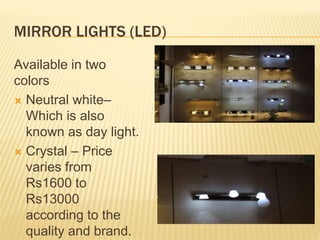
MIRROR LIGHTS (LED)
Available in two
colors
 Neutral white–
Which is also
known as day light.
 Crystal – Price
varies from
Rs1600 to
Rs13000
according to the
quality and brand.
FOR OUTDOORS
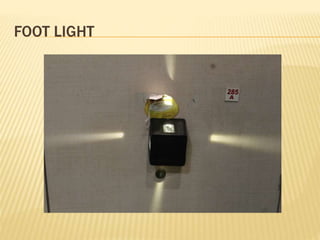
FOOT LIGHT
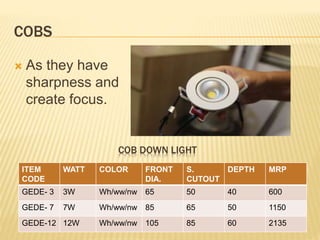
COBS
 As they have
sharpness and
create focus.
ITEM
CODE
WATT COLOR FRONT
DIA.
S.
CUTOUT
DEPTH MRP
GEDE- 3 3W Wh/ww/nw 65 50 40 600
GEDE- 7 7W Wh/ww/nw 85 65 50 1150
GEDE-12 12W Wh/ww/nw 105 85 60 2135
COB DOWN LIGHT
GATE LIGHT OR PILLAR LIGHT
 FIXTURES USED ARE
BULB AND LED –but
LEDs are fixed in the
source, therefore they
are replaced fully if
spoilt.
GARDEN BOLLARDS
 They are used to high
light the pathway.
They are even
available in solar
.They have fixtures
present.
GARDEN BOLLARDS (VIDEO)
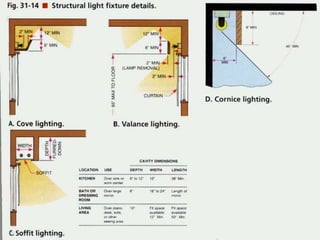
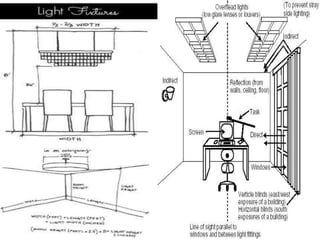
LIGHT FIXTURE DETAILS
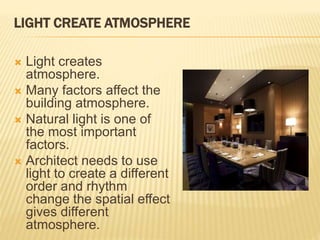
LIGHT CREATE ATMOSPHERE
 Light creates
atmosphere.
 Many factors affect the
building atmosphere.
 Natural light is one of
the most important
factors.
 Architect needs to use
light to create a different
order and rhythm
change the spatial effect
gives different
atmosphere.
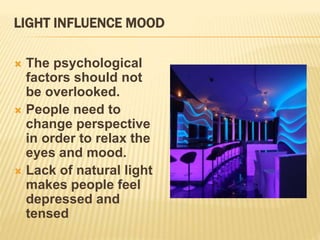
LIGHT INFLUENCE MOOD
 The psychological
factors should not
be overlooked.
 People need to
change perspective
in order to relax the
eyes and mood.
 Lack of natural light
makes people feel
depressed and
tensed
COLORS OF LIGHT
LIGHT REQUIREMENT FOR DIFFERENT AREAS
General need for light is as follows –
 Reception 300 lux
 Halls 150 lux at floor level
 Stairs 100 lux at floor level
 Landings 150 lux at floor level
 Dining tables 100 lux
 Lounges 150 lux
 Food preparation areas150-200 lux
 Bedrooms 50-100 lux
 Reading lamps 150 lux
 Bathroom 100 lux
 Mirror 150 lux
 Writing table 300 lux
 General overall lighting 50 lux
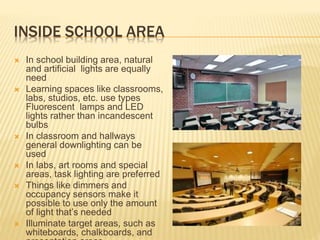
INSIDE SCHOOL AREA
 In school building area, natural
and artificial lights are equally
need
 Learning spaces like classrooms,
labs, studios, etc. use types
Fluorescent lamps and LED
lights rather than incandescent
bulbs
 In classroom and hallways
general downlighting can be
used
 In labs, art rooms and special
areas, task lighting are preferred
 Things like dimmers and
occupancy sensors make it
possible to use only the amount
of light that’s needed
 Illuminate target areas, such as
whiteboards, chalkboards, and
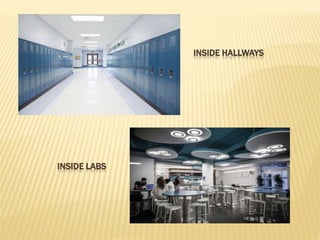
INSIDE HALLWAYS
INSIDE LABS
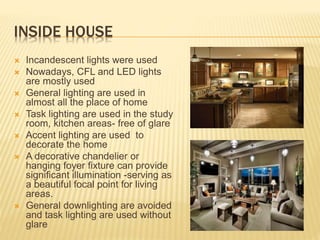
INSIDE HOUSE
 Incandescent lights were used
 Nowadays, CFL and LED lights
are mostly used
 General lighting are used in
almost all the place of home
 Task lighting are used in the study
room, kitchen areas- free of glare
 Accent lighting are used to
decorate the home
 A decorative chandelier or
hanging foyer fixture can provide
significant illumination -serving as
a beautiful focal point for living
areas.
 General downlighting are avoided
and task lighting are used without
glare
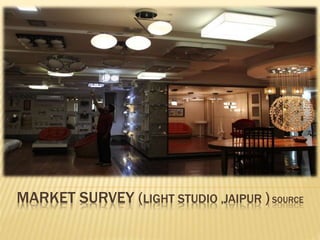
MARKET SURVEY (LIGHT STUDIO ,JAIPUR )SOURCE
Click for video
THANK
YOU

Light

  • 1.
    LIGHT Interior design Prepared by- Radhikasaboo Ridhima goyal Shreya goyal Simran walia Vaishnavi jhala
  • 2.
    INTRODUCTION  Light isthe soul of architecture design.  Light allows us to see, to know where we are and what around us.  Beyond exposing things to view and feel, light models those objects to enhance visual and to help us define the physical world.  Nothing would be visible without light, light also makes it possible to express and show to the mind's eye things that eludes the physical one.  To redefine the relationships of people with the environment and with themselves.  It is divided into natural light and artificial light  Natural light is a gift of nature.  Civilized man learns to use artificial light sources which free him from total dependence on daylight.  Artificial light is seeing both during the day as well as after dark.
  • 3.
    RELATION BETWEEN LIGHTSPACE AND HUMAN  Light is fundamental for space and essential for human well-being and it is the success of any building.  Light quality affects human behaviour, health, comfort and mood.  "Space and light and order. Those are the things that men need just as much as they need bread or a place to sleep“ -Le Corbusier, August27,1965  Light, space and human they effect and work with each other.  Space needs light to illuminate; light needs space to receive it, light within the space change human experience.
  • 4.
    NATURAL LIGHT ANDARCHITECTURE  Natural light keeps changing through times.  However, architects cannot control natural light, which from morning to night, day after day changes.  Its existence gives life to space, modeling the spatial sensibility.  Natural light for the space, like the air for life, these two have symbiotic relationship.  Natural light into interior design have many positive effects, including the considerable financial savings in energy.  Natural light is considered a beneficial design for many reasons: human health, comfort and satisfaction, energy conservation, view.
  • 5.
    LIGHTNING  Lighting withinthe indoor environment can be considered to have three basic purposes:  To enable the occupants to work and move about in safety.  To enable tasks to be performed.  To make the interior look pleasant.  There are two principle ways in which a building can be lit.- Naturally - by daylight received from the sky. Artificially - by electric lamps or other artificial light sources. Natural lightning Artificial lightning
  • 6.
    NATURAL LIGHTNING  Lightingor illumination is the deliberate use of light to achieve a practical or aesthetic effect.  Lighting includes the use of both artificial light as well as natural illumination by capturing daylight.  Daylight as two distinct sources of light:  Sunlight – That part of solar radiation that reaches the earth’s surface as parallel rays after selective attenuation by the atmosphere.  Skylight – That part of solar radiation that reaches the earth’s surface as a result of scattering in the atmosphere.  Sunlight and skylight may therefore be considered as the direct and diffuse  components of daylight. Skylight Sunlight
  • 7.
    ARTIFICIAL LIGHTNING  Itis made by human. It is very useful when lack of natural light. Types of Artificial lighting-  General or Ambient lighting  Accent or Directional lighting  Traditional or Decorative lighting  Task lighting Source of Artificial Light  Incandescent bulbs  Halogen bulbs  Fluorescent bulbs  Led
  • 8.
  • 9.
    GENERAL LIGHTNING – general,or ambient lightning illuminates an entire space for visibility and safety
  • 10.
    TASK LIGHTNING task lightilluminates smaller areas where more intense light is needed. It should be three times as bright as general lightning.
  • 11.
    ACCENT LIGHTNING accent lightningadds brilliant shimmer to make your precious objects, paintings, sculptures and outstandings architectural features stand out.
  • 13.
    RECCESSED LIGHTNING recessed lightis installed into a hollow opening in ceiling.
  • 14.
    WALL SCONCES sconce lightningis a beautiful decorative option that can add color and style to a room.
  • 15.
    SURFACE LIGHT (MARKETSURVEY)  Used in ceiling. Ceiling Lights highlights the entire room putting lot of style and Glamour. They enhance the brightness and beauty of the room. They are widely used in Houses, Offices, restaurants and showrooms. SURFACE
  • 16.
    TRACK LIGHTNING track lightningis nice over a bookshelf.
  • 17.
    TRACK LIGHT (MARKETSURVEY) Used in showrooms for highlighting
  • 18.
    PAINTING LIGHT  Usedfor high lightning the painting.
  • 19.
  • 20.
    SPOT LIGHT (MARKETSURVEY)  Used for high lightning. Available in warm white and white. Warm white is mostly used as it gives more shining.
  • 21.
    LED PICTURE SPOTLIGHT  Available in different shape varieties to fulfill varied purposes.  Can be used both in ceilings as well as in walls.  Available in different Power consumption varieties.  Base material used is Aluminum.
  • 22.
    READING LIGHT (MARKETSURVEY) • Used to focus reading area. • It can be screwed to wall or can be placed on table.
  • 23.
  • 24.
    TAIWAN LIGHTS (MARKETSURVEY) They are LEDs. The light is present inside the frame, therefore the light does not pierce the eyes and are soothing and calm. They are used on the walls and ceiling. It adds a soft glimmer of diffused light when light passes through the frossed glass or acrylic material .They are available in different variants, for ease to choose from and according to different home requirements. 2 shapes are the dominant ones. Rectangular and circular with slight tweaking so that there are different flavors to the same product. TAIWAN HANGING LIGHT TAIWAN WALL LIGHT
  • 25.
    FALSE CEILING They areof two types  Down lighters  Panel light – Available in white, natural white and warm white colors.
  • 26.
    COLOR CHANGEABLE LEDDOWN LIGHT  3 in 1 lamp color (Cool White/Day Light/Warm White)  Colors change with the clicking of every switch  Available in 3 different power consumption varieties - 3W, 6W and 10W  A die casting zinc body for better longevity and
  • 27.
    DOWN LIGHTER HAVINGTHREE COLORS IN ONE UNIT ITEM CODE WATT FRONT DIA. DEPTH MRP GETRR-7 7W 148x148 40 1300 GETRR- 12 12W 178x178 40 2100
  • 28.
    DOWN LIGHT DOUBLECOLOR SQUARE ITEM CODE WATT COLOR MRP GEBY- S8 6+2W Bl/wh/nw 1250 GEBY- S10 8+2W Bl/wh/nw 1550 GEBY- S13 10+3W Bl/wh/nw 2050
  • 29.
    SURFACE PANEL(PANEL LIGHT)(MARKETSURVEY) Use on direct ceiling, where false ceiling is not there as they are heavy in weight. Available in 9, 12, 15,18W.
  • 30.
    SURFACE PANEL, ROUND ITEM CODE WATTCOLOR FRONT DIA. DEPTH MRP GEVFR- 6 6w Wh/ww/nw 120 38 695 GEVFR- 12 12w Wh/ww/nw 170 38 1045 GEVFR- 18 18w Wh/ww/nw 222 38 1175
  • 31.
  • 32.
  • 33.
    INCANDESCENT LIGHT  Containsnitrogen or argon gas  Tungsten filament with lead wires- burns when electricity is passed  Also called as tungsten filament bulb  Advantage-light quality and color are very consistent  Disadvantage- requires lot of energy and faster degradation of filament leading to shorter lifespan
  • 34.
    FLUORESCENT LIGHTS  Containsargon/krpton as gas vapor with phosper coating on the walls of glass tube  Secondly, CFL( compact fluorescent lights) were developed in the shape of incandescent lamps  Edward hammer invented the CFL bulbs in 1976AD  Advantage: cooler and more energy efficient than incandescent  Disadvantage: mercury is dangerous- if bulb is broken, it can present a health hazard
  • 35.
    DISCHARGE LAMPS  Dischargelamps provide high luminous efficacy combined with long life, resulting in the most economical light source available  Types of gas-discharge lamps: A- Low pressure discharge lamps B- High pressure discharge lamps C- High-intensity discharge lamp
  • 36.
    LED(LIGHT EMITTING DIODE) LED is high intensity discharge lights  use semi-conductors to convert electrical energy directly into light.  Colorful LED indicators were invented at the time of CFL invention  LED began just as indicator in calculators, traffic signs, etc.  White LED lights were invented by Nick Holonyack in 2006  Become most efficient light sources as it consumes less energy and lifespan is higher than other
  • 37.
    LED (MARKET SURVEY) Theyare of three types  False ceiling panel – Its watt varies from 3 to 40 W.  It’s available in round and square shapes.  The size of the panel depends on the amount of watt used in the led  Cobs – They are used for focusing. Available in 3W, 7W, 12W.  Colors available – neutral white, white, warm white. FALSE CEILING PANEL COB
  • 38.
  • 39.
    LED STRIP LIGHT ITEMCODE COLOR ST. PACKING MRP GEPG-5050 ww/red/blue/green 5 METER 2000
  • 40.
    LED BULBS Ceramic baseoffers high heat dissipation & thus ensures long life. Available in 10W, 8W, 6W & 4W  - Wide Beam Angle.  - Glass Cover which does not change color with age.  - About 3 times longer life as compared to CFLs.  - 2 Years Warranty.  - Mercury Free & hence Eco- friendly.
  • 41.
    ITEM CODE WATTCOLOR MRP GEBD- 1 1W Wh/ww/red/green/blue/yellow 70 GEBD- 3 3W wh 90 GEBD- 5 5W wh 145 GEBD- 7 7W wh 180 GEBD- 9 9W wh 230 GEBD- 12 12W wh 270 GEBD- 18 18W wh 365 LED BULB
  • 42.
    LED BATTEN (TUBELIGHT)  Available in 4W, 8W and 18W  Available in Cool White, Day Light, Warm White.  Beam Angle: 180 degree.  CRI ( color rendering index of a quantitative measure of its ability to reproduce the colors of various objects faithfully in comparison with an ideal or natural light source) : >70  Codes: 670093 - 4W (1ft), 670092 - 8W (2ft), 670091 - 18W (4ft)
  • 43.
    LED TUBE UNIT ITEMCODE WATT COLOR SIZE MRP GERE- 12 12W wh 2ft 650 GERE- 18 18W wh 4ft 700 GERE- 24 24w wh 4ft 820
  • 44.
    LED PENDANTS LIGHTSINDOOR  It Enhances Visual Appeal of your Home with LED Pendent Lights. It is a Wonderful addition to your Personal Space, Lending a Modern Touch to your Decor and Making a Strong Architectural Statement.  Enjoyment, Taste, Coziness. That’s the sort of Atmosphere you can achieve if you use a Pendent Lights. It is Essential to use Bright and Shielded Lighting in Order for the Culinary Delights to be Particularly Inviting.  They are customizable Modern Pendants comes with Adjustable Hanging cords for Easy Instillation. Pendent Light are often used to Illuminate Dinning Tables, Home Entrance, Lounge, Kitchen Island, Foyer and more to add and
  • 45.
    MIRROR LIGHTS (LED) Availablein two colors  Neutral white– Which is also known as day light.  Crystal – Price varies from Rs1600 to Rs13000 according to the quality and brand.
  • 46.
  • 47.
  • 48.
    COBS  As theyhave sharpness and create focus. ITEM CODE WATT COLOR FRONT DIA. S. CUTOUT DEPTH MRP GEDE- 3 3W Wh/ww/nw 65 50 40 600 GEDE- 7 7W Wh/ww/nw 85 65 50 1150 GEDE-12 12W Wh/ww/nw 105 85 60 2135 COB DOWN LIGHT
  • 49.
    GATE LIGHT ORPILLAR LIGHT  FIXTURES USED ARE BULB AND LED –but LEDs are fixed in the source, therefore they are replaced fully if spoilt.
  • 50.
    GARDEN BOLLARDS  Theyare used to high light the pathway. They are even available in solar .They have fixtures present.
  • 51.
  • 52.
  • 55.
    LIGHT CREATE ATMOSPHERE Light creates atmosphere.  Many factors affect the building atmosphere.  Natural light is one of the most important factors.  Architect needs to use light to create a different order and rhythm change the spatial effect gives different atmosphere.
  • 56.
    LIGHT INFLUENCE MOOD The psychological factors should not be overlooked.  People need to change perspective in order to relax the eyes and mood.  Lack of natural light makes people feel depressed and tensed
  • 57.
  • 65.
    LIGHT REQUIREMENT FORDIFFERENT AREAS General need for light is as follows –  Reception 300 lux  Halls 150 lux at floor level  Stairs 100 lux at floor level  Landings 150 lux at floor level  Dining tables 100 lux  Lounges 150 lux  Food preparation areas150-200 lux  Bedrooms 50-100 lux  Reading lamps 150 lux  Bathroom 100 lux  Mirror 150 lux  Writing table 300 lux  General overall lighting 50 lux
  • 66.
    INSIDE SCHOOL AREA In school building area, natural and artificial lights are equally need  Learning spaces like classrooms, labs, studios, etc. use types Fluorescent lamps and LED lights rather than incandescent bulbs  In classroom and hallways general downlighting can be used  In labs, art rooms and special areas, task lighting are preferred  Things like dimmers and occupancy sensors make it possible to use only the amount of light that’s needed  Illuminate target areas, such as whiteboards, chalkboards, and
  • 67.
  • 68.
    INSIDE HOUSE  Incandescentlights were used  Nowadays, CFL and LED lights are mostly used  General lighting are used in almost all the place of home  Task lighting are used in the study room, kitchen areas- free of glare  Accent lighting are used to decorate the home  A decorative chandelier or hanging foyer fixture can provide significant illumination -serving as a beautiful focal point for living areas.  General downlighting are avoided and task lighting are used without glare
  • 69.
    MARKET SURVEY (LIGHTSTUDIO ,JAIPUR )SOURCE
  • 70.
  • 71.