1
 An antiviral substance & is the first line of defence against
viral attacks.
 Term ‘interferon’ orginated from the ‘interference’ of this
molecule on virus replication.
 Interferons are a family of host coded proteins produced by
cells on induction by viral or non-viral inducers.
 Interferons by itself has no direct action on viruses but it acts
on other cells of the same species, rendering them refractory to
viral infection.
INTERFERONS
2
 Interferons are inactivated by proteolytic enzymes but not by
nucleases or lipases.
 They resist heating at 56-60oC for 30-60mins & stable over a
range of pH 2-10, except gamma IFN which is liable at pH 2.
 Mol.wt of 17000 Da - non dialysable & non-sedimentable.
 Poorly antigenic, so no routine tests are available for their
detection & estimation.
 Interferon assay-based on its biological activity, such as ability
to inhibit plaque formation by sensitive virus.
3
 Potency of IFN is expressed as International Units(IU) per mL.
 Interferons are non-toxic, non-antigenic, diffuses freely in the
body & has a wide spectrum of antiviral activity.
 So it is an ideal candidate for use in prophylaxis & treatment of
viral infection.
 Interferons are stored at 2 – 8°c
4
 Proteins in nature & many of them are glycoproteins.
 Broadly classified into 3 groups- structure & function.
INTERFERONS
Interferon-α
(INF-α)
Interferon-β
(INF-β)
Interferon-γ
(INF-γ)
5
 Alpha interferon
• Also known as Leukocyte interferon.
• Produced by leukocytes following induction by suitable
viruses.
• Non-glycosylated protein.
• Atleast 16 antigenic subtypes have been identified.
 Beta interferon
• Fibroblast interferon.
• Produced by fibroblasts & epithelial cells following stimulation
by viruses or polynucleotides.
• Is a glycoproteins.
6
 Gamma interferon
• Immune interferon
• Produced by T-lymphocytes on stimulation by antigens or
mitogens.
• Is a glycoprotein.
• More concerned with immunomodulatory & antiproliferative
functions than with antiviral defence.
• It also differs from alpha & beta interferons in having a
separate cell receptor.
7
GENERAL ACTION OF INTERFERONS
Tissue cell is infected by a virus
Releases interferon
Interferon will diffuse to the surrounding
cells & binds with receptor.
Production of a protein that prevents the
synthesis of viral proteins.
Prevents the spread of the virus
throughout the body.
PRODUCTION OF RECOMBINANT
INTERFERONS
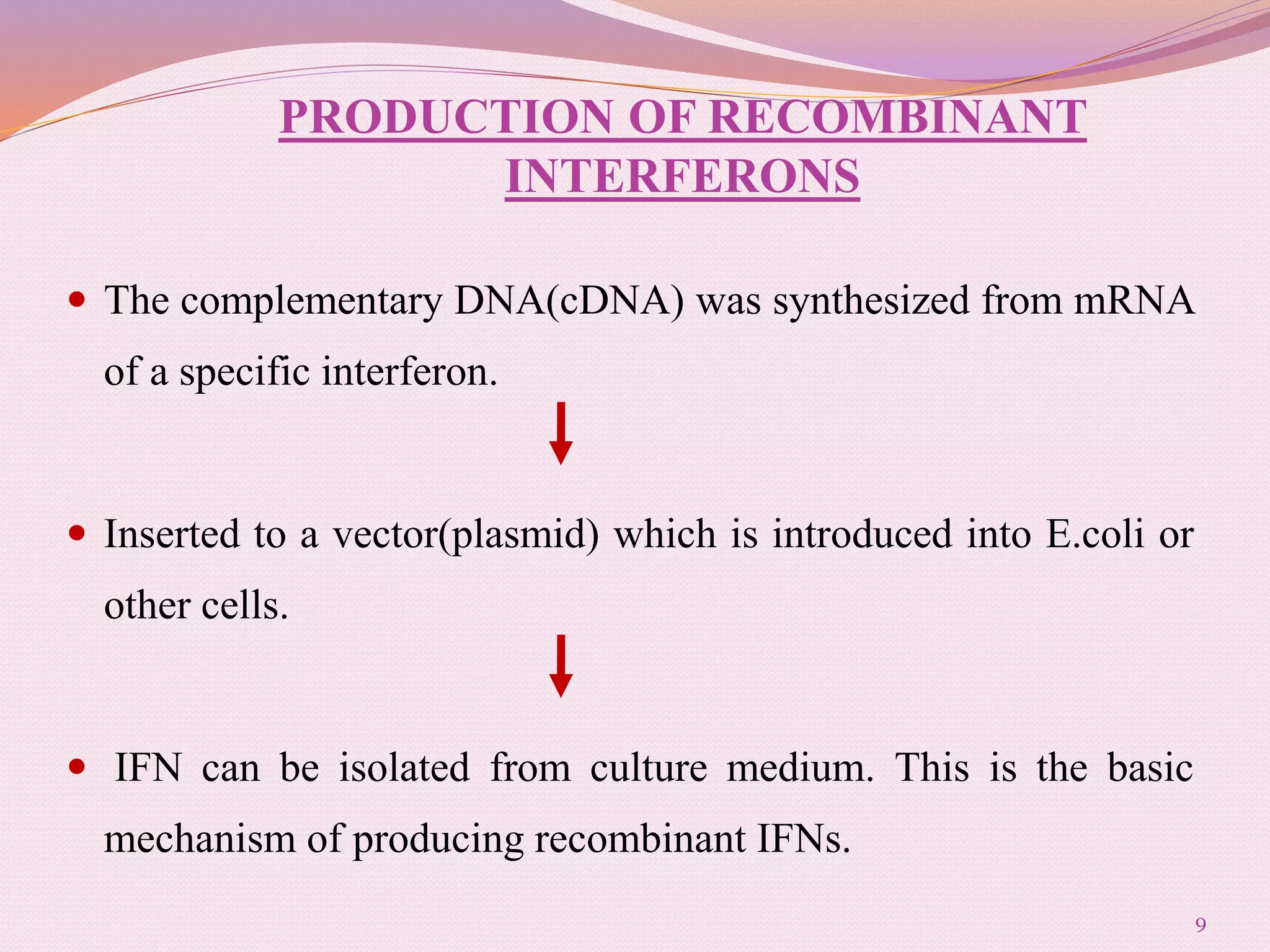
 The complementary DNA(cDNA) was synthesized from mRNA
of a specific interferon.
 Inserted to a vector(plasmid) which is introduced into E.coli or
other cells.
 IFN can be isolated from culture medium. This is the basic
mechanism of producing recombinant IFNs.
9
THERAPEUTIC APPLICATION OF IFNs
 Used for treatment of a large no:of viral diseases & cancers.
 Alpha IFNs Hepatitis B & C, chronic myeloid leukemia,
multiple myeloma, Kaposi’s sarcoma, melanoma.
 Beta IFNs Multiple sclerosis
 Gamma IFNs Chronic granulomatous disease, renal cell
carcinoma, chronic myeloid leukemia.
10
 IFNs cause the death of cancerous cells by stimulating the
action of natural killer(NK) cells, a specialized form of
lymphocytes that can destroy cancer cells.
 Also used for the treatment of common cold & influenza. For
this purpose, IFNs can be used as nasal sprays.
 Common side effects of IFNs fever, malaise, fatigue,
muscle pains. High levels of IFNs cause kidney, liver, bone
marrow & heart toxicity.
11
MARKETED FORMULATIONS
12
BRAND NAME TYPE USE
Alferon N Human leukocyte–
derived interferon alfa-
n3
Genital and perianal
warts
Roferon-A Recombinant interferon
alfa-2a
Hairy cell
leukemia,AIDS
Intron A Recombinant interferon
alfa-2b
Hairy cell
leukemia,AIDS
Avonex, Rebif Recombinant interferon
beta-1a
Multiple sclerosis
Betaseron Recombinant interferon
beta-1b
Multiple sclerosis
INTERLEUKINES
 These are a large group of cytokines produced mainly by T cells,
although some are also produced by mononuclear phagocytes
(or) by tissue cells.
 The interleukins were first described as signals for
communication between white blood cells (leuk- from
leukocytes).
 Currently, it is well-known that these molecules are produced and
used as signalling molecules in many cells of the body, in
addition to immune cells.
13
 Interleukins are secreted rapidly in response to an infectious agent,
it travels to its target cell and binds to the receptor molecule on the
cell’s surface that triggers a cascade of signals within the target cell
altering the cell’s behaviour.
 Interleukins represent a broad family of cytokines that are made by
hematopoietic cells and act primarily on leukocytes.
 Interleukins are stored at 2 – 8°c
 There are currently 35 well-known interleukins, however, there are
many more to be found and characterized.
14
MECHANISM OF ACTION AND DOSE
 Mechanism of action;
 Immunotherapy with IL activates cytotoxic T-cell against RCC
 Dose and adminstration;
 Interleukin administered via intravenous (iv) injection as high
dose (usually defined as 600,000 – 720,000 units/kg).
 Lower dosage iv and subcutaneous IL-2 are also prescribed for
kidney cancer.
15
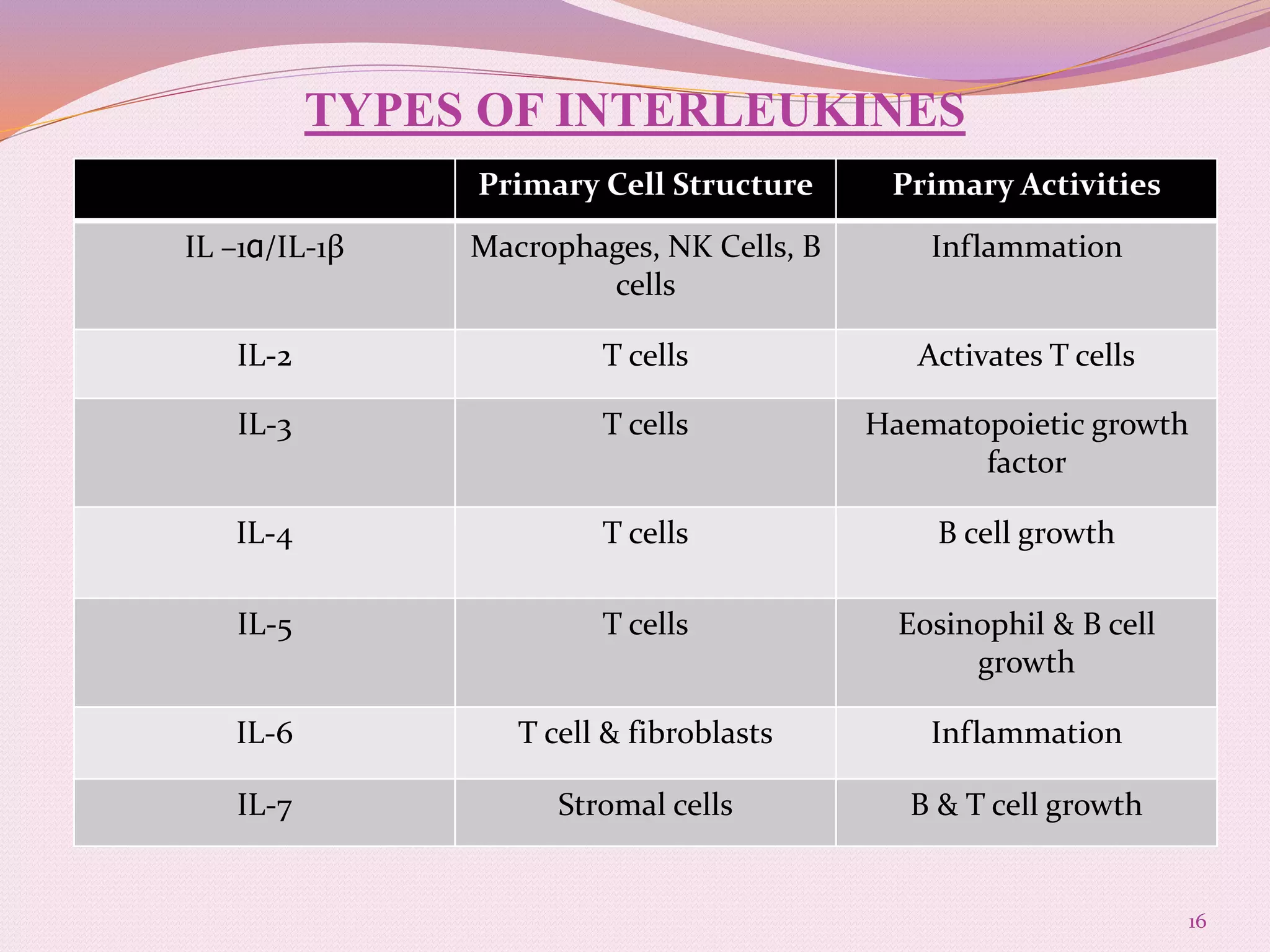
TYPES OF INTERLEUKINES
Interleukin Primary Cell Structure Primary Activities
IL –1α/IL-1β Macrophages, NK Cells, B
cells
Inflammation
IL-2 T cells Activates T cells
IL-3 T cells Haematopoietic growth
factor
IL-4 T cells B cell growth
IL-5 T cells Eosinophil & B cell
growth
IL-6 T cell & fibroblasts Inflammation
IL-7 Stromal cells B & T cell growth
16
Continued ……
Interleukin Primary Cell Structure Primary Activities
IL-8 Macrophages Chemoattractant for
neutrophils
IL-9 Activated T cells T cell growth &
Potentiates IgM, IgG & Ig
E
IL-10 B cells, T cells B cell growth / inhibition
of cytokine synthesis by T
cells
IL-11 Bone marrow stromal
cells
Haematopoietic co-factor
IL-12 Macrophages, B cells Induction of cell
mediated immunity
IL-13 T cells B cell growth
17
PRODUCTION OF INTERLEUKINES
•Antigen is internalized and
degraded by the macrophages,
processed, and then presented on
the macrophage surface to the
resting T lymphocyte in conjunction
with an MHC molecule.
•Once the T-cell receptor engages the
MHC molecule plus antigen, the T
cell becomes activated and secretes
IL-2, IL-3, IL-4, IL-5, and IL-6.
•Interleukins 2,4, 5, and 6 enable
activated T cells to undergo clonal
expansion.
18
THERAPEUTIC APPLICATION OF
INTERLEUKINES
 Used to enhance T-cell activation in immunodeficiency
diseases.
 Used in the treatment of cancers and other infectious diseases.
 Used to reduce graft rejection.
19
MARKETED FORMULATIONS
20
BRAND NAME TYPE USE
ALDESLEUKIN Recombinant human IL-
2 (rIL-2)
Chronic hepatitis C,
and Chronic hepatitis B
OPRELVEKIN Recombinant human IL-
11
Hairy cell
leukemia,AIDS
MUPLESTIM IL-3 Hairy cell
leukemia,AIDS
SIGOSIX IL-6 Multiple sclerosis
CONCLUSION
Interferons(IFN) are cytokines that are responsible for the
activity of the immune system .
Interleukins are biologically active glycoproteins derived
primarily from activated lymphocytes and macrophages.
They mediate their action by binding with high affinity to
receptors which belong to a limited number of structural
families
Immunity are produced mainly by activated macrophages
21
REFERENCES
 Johnson, Howard M., Fuller W. Bazer, Brian E. Szente, et al. "How
Interferons Fight Disease." Scientific American (May 1994): 68–76.
 Meulen, Volkerter, N. Stefan. "Inhibition of Major
Histocompatibility Complex Class II-Dependant Antigen
Presentation by Nutralization of Gamma Interferon Leads to
Breakdown of Resistance against Measles Virus-Induced
Encephalitis." Journal of Virology 75 (2000):1–13.
 Seppa, Nathan. "Interferon Delays Multiple
Sclerosis." Science News 158 (November 2000): 280–281.
 Interferons and Interferon Therapy, R.Priyanka et al /J. Pharm. Sci.
& Res. Vol. 6(12), 2014, 400-403
22
23

Interferons & interleukines

  • 1.
  • 2.
     An antiviralsubstance & is the first line of defence against viral attacks.  Term ‘interferon’ orginated from the ‘interference’ of this molecule on virus replication.  Interferons are a family of host coded proteins produced by cells on induction by viral or non-viral inducers.  Interferons by itself has no direct action on viruses but it acts on other cells of the same species, rendering them refractory to viral infection. INTERFERONS 2
  • 3.
     Interferons areinactivated by proteolytic enzymes but not by nucleases or lipases.  They resist heating at 56-60oC for 30-60mins & stable over a range of pH 2-10, except gamma IFN which is liable at pH 2.  Mol.wt of 17000 Da - non dialysable & non-sedimentable.  Poorly antigenic, so no routine tests are available for their detection & estimation.  Interferon assay-based on its biological activity, such as ability to inhibit plaque formation by sensitive virus. 3
  • 4.
     Potency ofIFN is expressed as International Units(IU) per mL.  Interferons are non-toxic, non-antigenic, diffuses freely in the body & has a wide spectrum of antiviral activity.  So it is an ideal candidate for use in prophylaxis & treatment of viral infection.  Interferons are stored at 2 – 8°c 4
  • 5.
     Proteins innature & many of them are glycoproteins.  Broadly classified into 3 groups- structure & function. INTERFERONS Interferon-α (INF-α) Interferon-β (INF-β) Interferon-γ (INF-γ) 5
  • 6.
     Alpha interferon •Also known as Leukocyte interferon. • Produced by leukocytes following induction by suitable viruses. • Non-glycosylated protein. • Atleast 16 antigenic subtypes have been identified.  Beta interferon • Fibroblast interferon. • Produced by fibroblasts & epithelial cells following stimulation by viruses or polynucleotides. • Is a glycoproteins. 6
  • 7.
     Gamma interferon •Immune interferon • Produced by T-lymphocytes on stimulation by antigens or mitogens. • Is a glycoprotein. • More concerned with immunomodulatory & antiproliferative functions than with antiviral defence. • It also differs from alpha & beta interferons in having a separate cell receptor. 7
  • 8.
    GENERAL ACTION OFINTERFERONS Tissue cell is infected by a virus Releases interferon Interferon will diffuse to the surrounding cells & binds with receptor. Production of a protein that prevents the synthesis of viral proteins. Prevents the spread of the virus throughout the body.
  • 9.
    PRODUCTION OF RECOMBINANT INTERFERONS The complementary DNA(cDNA) was synthesized from mRNA of a specific interferon.  Inserted to a vector(plasmid) which is introduced into E.coli or other cells.  IFN can be isolated from culture medium. This is the basic mechanism of producing recombinant IFNs. 9
  • 10.
    THERAPEUTIC APPLICATION OFIFNs  Used for treatment of a large no:of viral diseases & cancers.  Alpha IFNs Hepatitis B & C, chronic myeloid leukemia, multiple myeloma, Kaposi’s sarcoma, melanoma.  Beta IFNs Multiple sclerosis  Gamma IFNs Chronic granulomatous disease, renal cell carcinoma, chronic myeloid leukemia. 10
  • 11.
     IFNs causethe death of cancerous cells by stimulating the action of natural killer(NK) cells, a specialized form of lymphocytes that can destroy cancer cells.  Also used for the treatment of common cold & influenza. For this purpose, IFNs can be used as nasal sprays.  Common side effects of IFNs fever, malaise, fatigue, muscle pains. High levels of IFNs cause kidney, liver, bone marrow & heart toxicity. 11
  • 12.
    MARKETED FORMULATIONS 12 BRAND NAMETYPE USE Alferon N Human leukocyte– derived interferon alfa- n3 Genital and perianal warts Roferon-A Recombinant interferon alfa-2a Hairy cell leukemia,AIDS Intron A Recombinant interferon alfa-2b Hairy cell leukemia,AIDS Avonex, Rebif Recombinant interferon beta-1a Multiple sclerosis Betaseron Recombinant interferon beta-1b Multiple sclerosis
  • 13.
    INTERLEUKINES  These area large group of cytokines produced mainly by T cells, although some are also produced by mononuclear phagocytes (or) by tissue cells.  The interleukins were first described as signals for communication between white blood cells (leuk- from leukocytes).  Currently, it is well-known that these molecules are produced and used as signalling molecules in many cells of the body, in addition to immune cells. 13
  • 14.
     Interleukins aresecreted rapidly in response to an infectious agent, it travels to its target cell and binds to the receptor molecule on the cell’s surface that triggers a cascade of signals within the target cell altering the cell’s behaviour.  Interleukins represent a broad family of cytokines that are made by hematopoietic cells and act primarily on leukocytes.  Interleukins are stored at 2 – 8°c  There are currently 35 well-known interleukins, however, there are many more to be found and characterized. 14
  • 15.
    MECHANISM OF ACTIONAND DOSE  Mechanism of action;  Immunotherapy with IL activates cytotoxic T-cell against RCC  Dose and adminstration;  Interleukin administered via intravenous (iv) injection as high dose (usually defined as 600,000 – 720,000 units/kg).  Lower dosage iv and subcutaneous IL-2 are also prescribed for kidney cancer. 15
  • 16.
    TYPES OF INTERLEUKINES InterleukinPrimary Cell Structure Primary Activities IL –1α/IL-1β Macrophages, NK Cells, B cells Inflammation IL-2 T cells Activates T cells IL-3 T cells Haematopoietic growth factor IL-4 T cells B cell growth IL-5 T cells Eosinophil & B cell growth IL-6 T cell & fibroblasts Inflammation IL-7 Stromal cells B & T cell growth 16
  • 17.
    Continued …… Interleukin PrimaryCell Structure Primary Activities IL-8 Macrophages Chemoattractant for neutrophils IL-9 Activated T cells T cell growth & Potentiates IgM, IgG & Ig E IL-10 B cells, T cells B cell growth / inhibition of cytokine synthesis by T cells IL-11 Bone marrow stromal cells Haematopoietic co-factor IL-12 Macrophages, B cells Induction of cell mediated immunity IL-13 T cells B cell growth 17
  • 18.
    PRODUCTION OF INTERLEUKINES •Antigenis internalized and degraded by the macrophages, processed, and then presented on the macrophage surface to the resting T lymphocyte in conjunction with an MHC molecule. •Once the T-cell receptor engages the MHC molecule plus antigen, the T cell becomes activated and secretes IL-2, IL-3, IL-4, IL-5, and IL-6. •Interleukins 2,4, 5, and 6 enable activated T cells to undergo clonal expansion. 18
  • 19.
    THERAPEUTIC APPLICATION OF INTERLEUKINES Used to enhance T-cell activation in immunodeficiency diseases.  Used in the treatment of cancers and other infectious diseases.  Used to reduce graft rejection. 19
  • 20.
    MARKETED FORMULATIONS 20 BRAND NAMETYPE USE ALDESLEUKIN Recombinant human IL- 2 (rIL-2) Chronic hepatitis C, and Chronic hepatitis B OPRELVEKIN Recombinant human IL- 11 Hairy cell leukemia,AIDS MUPLESTIM IL-3 Hairy cell leukemia,AIDS SIGOSIX IL-6 Multiple sclerosis
  • 21.
    CONCLUSION Interferons(IFN) are cytokinesthat are responsible for the activity of the immune system . Interleukins are biologically active glycoproteins derived primarily from activated lymphocytes and macrophages. They mediate their action by binding with high affinity to receptors which belong to a limited number of structural families Immunity are produced mainly by activated macrophages 21
  • 22.
    REFERENCES  Johnson, HowardM., Fuller W. Bazer, Brian E. Szente, et al. "How Interferons Fight Disease." Scientific American (May 1994): 68–76.  Meulen, Volkerter, N. Stefan. "Inhibition of Major Histocompatibility Complex Class II-Dependant Antigen Presentation by Nutralization of Gamma Interferon Leads to Breakdown of Resistance against Measles Virus-Induced Encephalitis." Journal of Virology 75 (2000):1–13.  Seppa, Nathan. "Interferon Delays Multiple Sclerosis." Science News 158 (November 2000): 280–281.  Interferons and Interferon Therapy, R.Priyanka et al /J. Pharm. Sci. & Res. Vol. 6(12), 2014, 400-403 22
  • 23.