1
2
 I
Interface
nterface is
is the boundary between two or more phases
the boundary between two or more phases
exist together
exist together
 The properties of the molecules forming the interface are
The properties of the molecules forming the interface are
different from those in the bulk that these molecules are
forming an
forming an interfacial phase.
interfacial phase.
 Several types of interface can exist depending on whether
Several types of interface can exist depending on whether
the two adjacent phases are in solid, liquid or gaseous state.
 Important of Interfacial phenomena in pharmacy:
Important of Interfacial phenomena in pharmacy:
 Adsorption of drugs onto solid adjuncts in dosage forms
Adsorption of drugs onto solid adjuncts in dosage forms
 Penetration of molecules through biological membranes
Penetration of molecules through biological membranes
 Emulsion formation and stability
Emulsion formation and stability
 The dispersion of insoluble particles in liquid media to form
The dispersion of insoluble particles in liquid media to form
suspensions.
suspensions.
3
LIQUID INTERFACES
Surface and Interfacial Tensions
In the liquid state, the cohesive forces between
adjacent molecules are well developed.
For the molecules in the bulk of a liquid
They are surrounded in all directions by other molecules for
which they have an equal attraction.
For the molecules at the surface (at the liquid/air interface)
 Only attractive cohesive forces with other liquid molecules
which are situated below and adjacent to them.
 They can develop adhesive forces of attraction with the
molecules of the other phase in the interface
 The net effect is that the molecules at the surface of the
liquid experience an inward force towards the bulk of the
liquid and pull the molecules and contract the surface with
a force F .
4
To keep the equilibrium, an equal force must be applied to
oppose the inward tension in the surface.
Thus SURFACE TENSION
SURFACE TENSION [γ ] is the force per unit length that must be
applied parallel to the surface so as to counterbalance the net
inward pull and has the units of dyne/cm
INTERFACIAL TENSION
INTERFACIAL TENSION is the force per unit length existing at the
interface between two immiscible liquid phases and has the units
of dyne/cm.
Invariably, interfacial tensions are less than surface tensions
because an adhesive forces, between the two liquid phases
forming the interface are greater than when a liquid and a gas
phase exist together.
If two liquids are completely miscible, no interfacial tension exists
between them.
Greater surface tension reflects higher intermolecular force of
attraction, thus, increase in hydrogen bonds or molecular weight
cause increase in ST
5
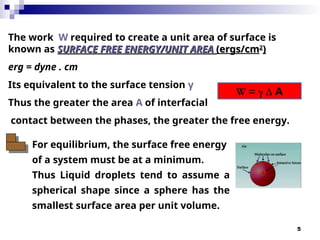
The work W required to create a unit area of surface is
known as SURFACE FREE ENERGY/UNIT AREA
SURFACE FREE ENERGY/UNIT AREA (ergs/cm
(ergs/cm2
2
)
)
erg = dyne . cm
Its equivalent to the surface tension γ
Thus the greater the area A of interfacial
contact between the phases, the greater the free energy.
W = γ ∆ A
For equilibrium, the surface free energy
of a system must be at a minimum.
Thus Liquid droplets tend to assume a
spherical shape since a sphere has the
smallest surface area per unit volume.
6
Methods for measuring surface and interfacial tension
1- Capillary rise method
2- Ring (Du Nouy) tensiometer
3- Drop weight method (Stalagmometer)
The choice of the method for measuring surface
and interfacial tension depend on:
 Whether surface or interfacial tension is to be determined.
 The accuracy desired
 The size of sample.
7
Capillary Rise Method
When a capillary tube is placed in a liquid, it
rises up the tube a certain distance. By measuring
this rise, it is possible to determine the surface
tension of the liquid. It is not possible, to obtain
interfacial tensions using the capillary rise
method.
 Cohesive force is the force existing between like
mole­
cules in the surface of a liquid
Adhesive force is the force existing between
unlike molecules, such as that between a liquid
and the wall of a glass capillary tube
 When the force of Adhesion is greater than the
cohesion, the liquid is said to wet the capillary wall,
spreading over it, and rising in the tube.
The Principle
8
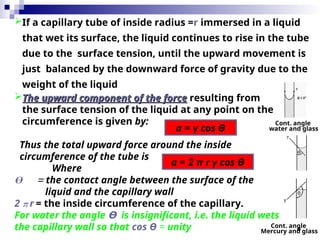
If a capillary tube of inside radius =r immersed in a liquid
that wet its surface, the liquid continues to rise in the tube
due to the surface tension, until the upward movement is
just balanced by the downward force of gravity due to the
weight of the liquid
a = γ cos Ө
a = 2 π r γ cos Ө
The upward component of the force
The upward component of the force resulting from
the surface tension of the liquid at any point on the
circumference is given by:
Thus the total upward force around the inside
circumference of the tube is
Where
Ө = the contact angle between the surface of the
liquid and the capillary wall
2 π r = the inside circumference of the capillary.
For water the angle Ө is insignificant, i.e. the liquid wets
the capillary wall so that cos Ө = unity
Cont. angle
water and glass
Cont. angle
Mercury and glass
9
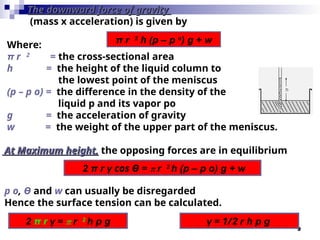
The downward force of gravity
(mass x acceleration) is given by
Where:
π r 2
= the cross-sectional area
h = the height of the liquid column to
the lowest point of the meniscus
(p – p o) = the difference in the density of the
liquid p and its vapor po
g = the acceleration of gravity
w = the weight of the upper part of the meniscus.
At Maximum height,
At Maximum height, the opposing forces are in equilibrium
p o, Ө and w can usually be disregarded
Hence the surface tension can be calculated.
π r 2
h (p – p o
) g + w
2 π r γ cos Ө = π r 2
h (p – p o) g + w
2 π r γ = π r 2
h p g γ = 1/2 r h p g
10
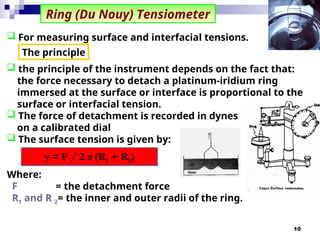
Ring (Du Nouy) Tensiometer
 the principle of the instrument depends on the fact that:
the force necessary to detach a platinum-iridium ring
immersed at the surface or interface is proportional to the
surface or interfacial tension.
 The force of detachment is recorded in dynes
on a calibrated dial
 The surface tension is given by:
Where:
F = the detachment force
R1 and R 2= the inner and outer radii of the ring.
γ = F / 2 π (R1 + R2)
 For measuring surface and interfacial tensions.
The principle
11
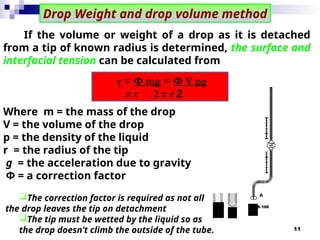
If the volume or weight of a drop as it is detached
from a tip of known radius is determined, the surface and
interfacial tension can be calculated from
Where m = the mass of the drop
V = the volume of the drop
p = the density of the liquid
r = the radius of the tip
g = the acceleration due to gravity
Φ = a correction factor
The correction factor is required as not all
the drop leaves the tip on detachment
The tip must be wetted by the liquid so as
the drop doesn’t climb the outside of the tube.
γ = Φ mg = Φ V pg
2
π r 2 π r
Drop Weight and drop volume method
12
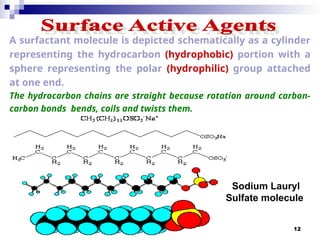
A surfactant molecule is depicted schematically as a cylinder
representing the hydrocarbon (hydrophobic) portion with a
sphere representing the polar (hydrophilic) group attached
at one end.
The hydrocarbon chains are straight because rotation around carbon-
carbon bonds bends, coils and twists them.
Sodium Lauryl
Sulfate molecule
13
Molecules and ions that are adsorbed at interfaces are
termed
termed surface active agents,
surface active agents, surf
surfactants or
actants or amphiphile
amphiphile
The molecule or ion has a certain affinity for both polar and
nonpolar solvents.
nonpolar solvents.
Depending on the number and nature of the polar and
nonpolar groups present, the amphiphile may be
nonpolar groups present, the amphiphile may be hydrophilic,
hydrophilic,
lipophilic
lipophilic or be reasonably well-balanced between
or be reasonably well-balanced between these
these two
two
extremes.
extremes.
It is the amphiphilic nature of surface active agents which
causes them to be adsorbed at interfaces, whether these be
liquid/gas or liquid/liquid.
14
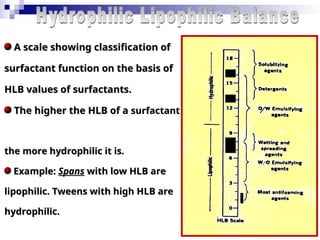
A scale showing classification of
surfactant function on the basis of
HLB values of surfactants.
The higher the HLB of a
The higher the HLB of a surfactant
surfactant
the more hydrophilic it is.
Example:
Example: Spans
Spans with low HLB are
with low HLB are
lipophilic. Tweens with high HLB are
hydrophilic.
hydrophilic.
15
Determination of HLB
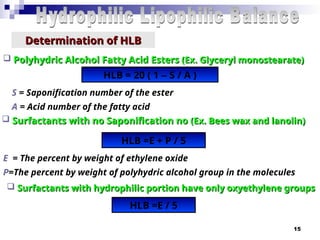
 Polyhydric Alcohol Fatty Acid Esters
Polyhydric Alcohol Fatty Acid Esters (Ex. Glyceryl monostearate)
(Ex. Glyceryl monostearate)
HLB = 20 ( 1 – S / A )
 Surfactants with no Saponification no
Surfactants with no Saponification no (Ex. Bees wax and lanolin)
(Ex. Bees wax and lanolin)
S = Saponification number of the ester
A = Acid number of the fatty acid
HLB =E + P / 5
E = The percent by weight of ethylene oxide
P=The percent by weight of polyhydric alcohol group in the molecules
 Surfactants with hydrophilic portion have only oxyethylene groups
Surfactants with hydrophilic portion have only oxyethylene groups
HLB =E / 5
16
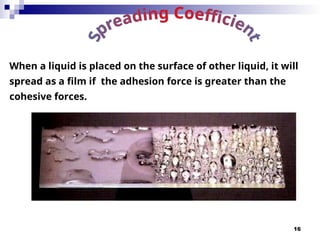
When a liquid is placed on the surface of other liquid, it will
spread as a film if the adhesion force is greater than the
cohesive forces.
17
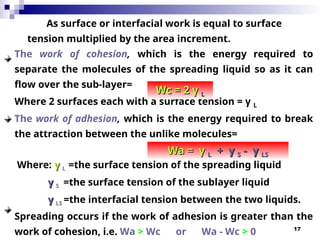
As surface or interfacial work is equal to surface
tension multiplied by the area increment.
The work of cohesion, which is the energy required to
separate the molecules of the spreading liquid so as it can
flow over the sub-layer=
Where 2 surfaces each with a surface tension = γ L
The work of adhesion, which is the energy required to break
the attraction between the unlike molecules=
Where: γ
γ L =the surface tension of the spreading liquid
γ
γ S =the surface tension of the sub­
layer liquid
γ
γ LS =the interfacial tension between the two liquids.
Spreading occurs if the work of adhesion is greater than the
work of cohesion, i.e. Wa > Wc or Wa - Wc > 0
Wc = 2 γ
Wc = 2 γ L
L
Wa = γ
Wa = γ L
L + γ
+ γ S
S - γ
- γ LS
LS
18
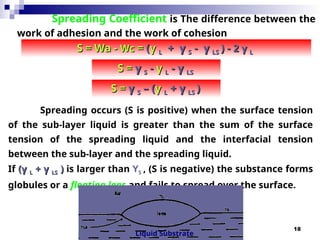
Spreading Coefficient is The difference between the
work of adhesion and the work of cohesion
S = Wa -
S = Wa - Wc
Wc =
= (
(γ
γ L
L + γ
+ γ S
S - γ
- γ LS
LS ) -
) - 2 γ
2 γ L
L
S =
S = γ
γ S
S -
- γ
γ L
L - γ
- γ LS
LS
S =
S = γ
γ S
S – (
– (γ
γ L
L + γ
+ γ LS
LS )
)
Spreading occurs (S is positive) when the surface tension
of the sub-layer liquid is greater than the sum of the surface
tension of the spreading liquid and the interfacial tension
between the sub-layer and the spreading liquid.
If (γ
(γ L
L + γ
+ γ LS
LS )
) is larger than YS , (S is negative) the substance forms
globules or a floating lens and fails to spread over the surface.
Liquid Substrate
19
Factor affecting Spreading Coefficient
Molecular Structural:
o The greater the polarity of the molecule the more positive [S]
as ethyl alcohol and propionic acid
o Non polar substances as Liquid petrolatum have negative [S] fail
to spread on water
o For organic acids, as Oleic acid,
the longer the carbon chain decrease in polar character decrease [S]
o Some oils can spread over water because they contain polar groups
as COOH and OH
Cohesive forces:
Benzene spreads on water not because it is polar but
because the cohesive forces between its molecules are much
weaker than the adhesion for water.
20
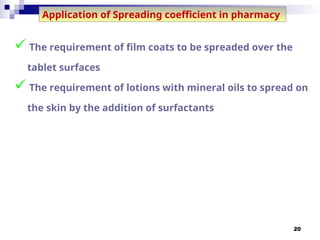
Application of Spreading coefficient in pharmacy
 The requirement of film coats to be spreaded over the
tablet surfaces
 The requirement of lotions with mineral oils to spread on
the skin by the addition of surfactants
21
Functional Classification
According to their pharmaceutical use, surfactants can be
divided into the following groups:
 Wetting agents
 Solubilizing agents
 Emulsifying agents
 Dispersing, Suspending and Defloculating agents
 Foaming and antifoaming agents
 Detergents
22
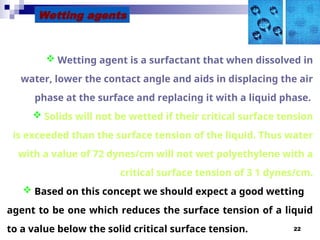
Wetting agents
 Wetting agent is a surfactant that when dissolved in
water, lower the contact angle and aids in displacing the air
phase at the surface and replacing it with a liquid phase.
 Solids will not be wetted if their critical surface tension
is exceeded than the surface tension of the liquid. Thus water
with a value of 72 dynes/cm will not wet polyethylene with a
critical surface tension of 3 1 dynes/cm.
 Based on this concept we should expect a good wetting
agent to be one which reduces the surface tension of a liquid
to a value below the solid critical surface tension.
23
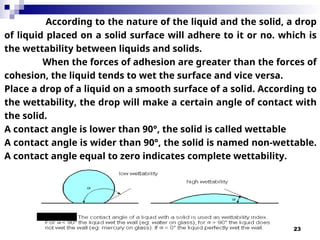
According to the nature of the liquid and the solid, a drop
of liquid placed on a solid surface will adhere to it or no. which is
the wettability between liquids and solids.
When the forces of adhesion are greater than the forces of
cohesion, the liquid tends to wet the surface and vice versa.
Place a drop of a liquid on a smooth surface of a solid. According to
the wettability, the drop will make a certain angle of contact with
the solid.
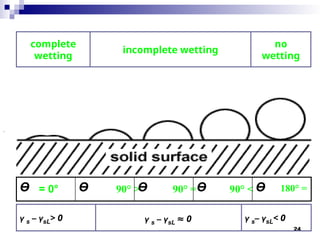
A contact angle is lower than 90°, the solid is called wettable
A contact angle is wider than 90°, the solid is named non-wettable.
A contact angle equal to zero indicates complete wettability.
24
.
no
wetting
incomplete wetting
complete
wetting
= 0° <
90° =
90° >
90° =
180°
Ө
Ө
Ө
Ө
Ө
γ s– γsL< 0
γ s – γsL ≈ 0
γ s – γsL> 0
25
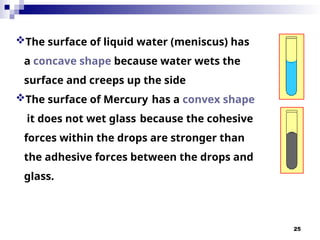
The surface of liquid water (meniscus) has
a concave shape because water wets the
surface and creeps up the side
The surface of Mercury has a convex shape
it does not wet glass because the cohesive
forces within the drops are stronger than
the adhesive forces between the drops and
glass.
26
Micellar Solubilization
Surfactant molecules accumulate in the interfaces between
water and water insoluble compound. Their hydrocarbon
chains penetrate the outermost layer of insoluble compound
which combine with the water­
insoluble molecules. Micelles
which combine with the water­
insoluble molecules. Micelles
form around the molecules of the water­
insoluble compound
form around the molecules of the water­
insoluble compound
inside the micelles’ cores and bring them into solution in an
aqueous medium. This phenomenon is called micellar
solubilization.
solubilization.
The inverted micelles formed by oil
The inverted micelles formed by oil­
­
soluble surfactant which
dissolves in a hydrocarbon solvent can solubilize water-soluble
compound which is located in the center of the micelle, out of
contact with the solvent.
27
Micelles of nonionic surfactants consist of an outer shell
containing their polyethylene glycol moieties mixed with
water and an inner core formed by their hydrocarbon
moieties. Some compounds like phenols and benzoic acid
form complexes
form complexes with polyethylene glycols by hydrogen
with polyethylene glycols by hydrogen
bonding and/or are more soluble in liquids of intermediate
polarity like ethanol or ethyl ether than in liquids of low
polarity like aliphatic hydrocarbons. These compounds locate
in the aqueous polyethylene glycol outer shell of nonionic
micelles on solubilization.
Drugs which are soluble in oils and lipids can be solubilized
by micellar solubilization.
28
As Micellar solubilization depends on the existence of
micelles; it does not take place below the CMC. So dissolution
begins at the CMC. Above the CMC, the amount solubilized is
directly proportional to the surfactant concentration because
all surfactant added to the solution in excess of the CMC
exists in micellar form, and as the number of micelles
increases the extent of solubilization increases .
Compounds that are extensively solubilized increase the
size of micelles in two ways:
o The micelles swell because their core volume is
The micelles swell because their core volume is
augmented by the volume of the solubilizate.
o The number of surfactant molecules per micelle
The number of surfactant molecules per micelle
increases.
increases.
29
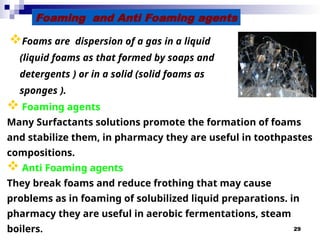
Foams are dispersion of a gas in a liquid
(liquid foams as that formed by soaps and
detergents ) or in a solid (solid foams as
sponges ).
Foaming and Anti Foaming agents
 Foaming agents
Many Surfactants solutions promote the formation of foams
and stabilize them, in pharmacy they are useful in toothpastes
compositions.
 Anti Foaming agents
They break foams and reduce frothing that may cause
problems as in foaming of solubilized liquid preparations. in
pharmacy they are useful in aerobic fermentations, steam
boilers.
30
Detergents
 Detergents are surfactants used for removal of dirt.
 Detergency involves:
•Initial wetting of the dirt and the surface to be
cleaned.
•Deflocculation and suspension, emulsification or
solubilisation of the dirt particles
•Finally washing away the dirt.
31
Structural Classification
 A single surfactant molecule contains one or more
hydrophobic portions and one or more hydrophilic
groups.
 According to the presence of ions in the surfactant
molecule they may be classified into:
 Ionic surfactants
o Anionic surfactants: the surface active part is anion
(negative ion ) e.g. soaps, sodium lauryl sulfate
o Cationic surfactants: the surface active part is cation
(positive ion) e.g. quaternary ammonium salts
o Ampholytic surfactants: contain both positive and
negative ions e.g. dodecyl-B-alanine.
32
Ionic surfactants
They are the metal salts of long ­chain fatty acids as
lauric acid.
Sodium dodecyl sulfate or Sodium Lauryl Sulfate is used
in toothpaste and ointments
Triethanolamine dodecyl sulfate is used in shampoos
and other cosmetic preparations.
Sodium dodecyl benzene sulfonate is a detergent and
has germicidal properties
.
Sodium dialkvlsulfosuccinates are good wetting
agents.
Anionic surfactants
Anionic surfactants
33
Cationic surfactants
These are chiefly quaternary ammonium compounds. They
have bacteriostatic activity probably because they
combine with the carboxyl groups in the cell walls and of
microorganisms by cation exchange, causing lysis.
Among the most popular antiseptics in this category are
benzalkonium chloride, cetylpyridinium chloride and
cetyltrimethylammonium bromide,
Ampholytic Surfactants
These are the least common, e.g. dodecyl-β­
alanine
34
Non-ionic surfactants
Widely used in pharmaceutical formulations e.g.
Tweens, Spans, Brij and Myrj.
They are polyethylene oxide products.
Surfactants based on sorbitan are of pharmaceutical
importance.
Esterification of the primary hydroxyl group with
lauric, palmitic, stearic or oleic acid forms sorbitan
monolaurate, monopalmitate, monostearate or
monooleate
These are water-insoluble surfactants called Span 20,
40, 60 or 80, respectively.
Addition of about 20 ethylene oxide molecules
produces the water-soluble surfactants called
polysorbate or Tween 20, 40. 60 or 80.
35
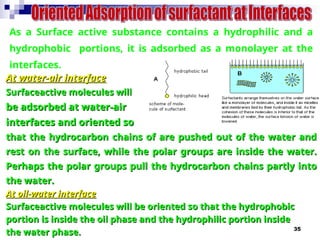
At water-air interface
Surface­
active molecules will
Surface­
active molecules will
be adsorbed at water-air
interfaces and oriented so
that the hydrocarbon chains of are pushed out of the water and
rest on the surface, while the polar groups are inside the water.
Perhaps the polar groups pull the hydrocarbon chains partly into
the water.
the water.
At oil-water interface
Surface­
active molecules will be oriented so that the hydrophobic
Surface­
active molecules will be oriented so that the hydrophobic
portion is inside the oil phase and the hydrophilic portion inside
the water phase.
the water phase.
As a Surface active substance contains a hydrophilic and a
hydrophobic portions, it is adsorbed as a monolayer at the
interfaces.
36
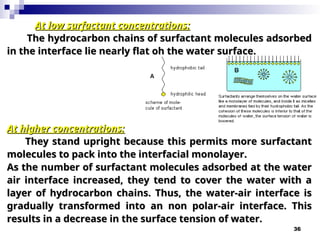
At low surfactant concentrations:
The hydrocarbon chains of surfactant molecules adsorbed
in the interface lie nearly flat oh the water surface.
At higher concentrations:
They stand upright because this permits more surfactant
molecules to pack into the interfacial monolayer.
As the number of surfactant molecules adsorbed at the water­
air interface increased, they tend to cover the water with a
layer of hydrocarbon chains. Thus, the water-air interface is
gradually transformed into an non polar-air interface. This
results in a decrease in the surface tension of water.
37
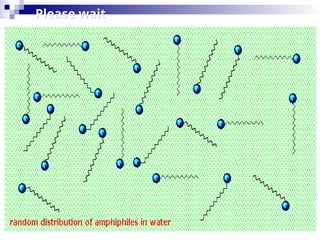
Micelle Formation
Micelle Formation
When the surfactant molecules adsorbed as a monolayer
in the water-air interface have become so closely packed that
additional molecules cannot be accommodated with ease, the
polar groups pull the hydrocarbon chains partly into the water.
At certain concentration the interface and the bulk phase
become saturated with monomers. Excess surfactants add will
begin to agglomerate in the bulk of the solution forming
aggregates called and the free energy of the system
is reduced
The lowest concentration at which micelles first appear is called
the critical concentration for micelle formation [CMC ]
Micelles
Micelles
.
.
38
At a given concentration, temperature, and salt content,
all micelles of a given surfactant usually contain the same
number of molecules, i.e. they are usually monodisperse.
For different surfactants in dilute aqueous solutions, this
number ranges approximately from 25 to 100 molecules.
The diameters of micelles are approximately between 30
and 80 Ao
. Because of their ability to form aggregates of
colloidal size, surfactants are also called association colloids.
Micelles are not permanent aggregates. They form and
disperse continually.
39
Please wait
Please wait
40
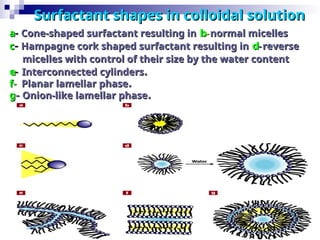
a
a-
- Cone-shaped surfactant resulting in
Cone-shaped surfactant resulting in b
b-
-normal micelles
normal micelles
c
c-
- Hampagne cork shaped surfactant resulting in
Hampagne cork shaped surfactant resulting in d
d-
-reverse
reverse
micelles with control of their size by the water content
e
e-
- Interconnected cylinders
Interconnected cylinders.
.
f-
f- Planar lamellar phase
Planar lamellar phase.
.
g
g-
- Onion-like lamellar phase
Onion-like lamellar phase.
.
Surfactant shapes in colloidal solution
41
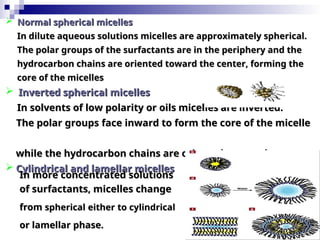
 Normal spherical micelles
Normal spherical micelles
In dilute aqueous solutions micelles are approximately spherical.
The polar groups of the surfactants are in the periphery and the
hydrocarbon chains are oriented toward the center, forming the
core of the micelles
 Inverted
Inverted spherical micelles
spherical micelles
In solvents of low polarity or oils
In solvents of low polarity or oils micelles
micelles are
are inverted.
inverted.
The polar groups
The polar groups face inward to form the core of the micelle
face inward to form the core of the micelle
while the hydrocarbon chains are oriented outward
 Cylindrical and lamellar micelles
Cylindrical and lamellar micelles
In more concentrated solutions
of surfactants, micelles change
from
from spherical
spherical either
either to
to cylindrical
cylindrical
or lamellar
or lamellar phase.
phase.
42
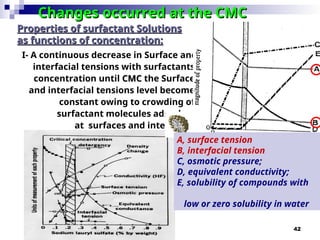
Changes occurred at the CMC
I- A continuous decrease in Surface and
interfacial tensions with surfactants
concentration until CMC
CMC the Surface
and interfacial tensions level become
constant owing to crowding of
surfactant molecules adsorbed
at surfaces and interfaces.
Properties of surfactant Solutions
as functions of concentration:
A, surface tension
B, interfacial tension
C, osmotic pressure;
D, equivalent conductivity;
E, solubility of compounds with
low or zero solubility in water
43
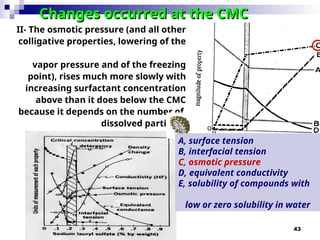
Changes occurred at the CMC
II- The osmotic pressure (and all other
colligative properties, lowering of the
vapor pressure and of the freezing
point), rises much more slowly with
increasing surfactant concentration
above than it does below the CMC
because it depends on the number of
dissolved particles.
A, surface tension
B, interfacial tension
C, osmotic pressure
D, equivalent conductivity
E, solubility of compounds with
low or zero solubility in water
44
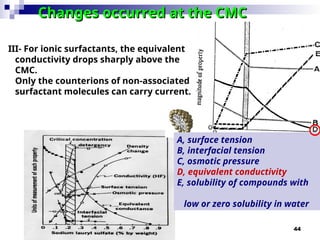
Changes occurred at the CMC
III- For ionic surfactants, the equivalent
conductivity drops sharply above the
CMC.
Only the counterions of non-associated
surfactant molecules can carry current.
A, surface tension
B, interfacial tension
C, osmotic pressure
D, equivalent conductivity
E, solubility of compounds with
low or zero solubility in water
45
Changes occurred at the CMC
IV-Solubility of many drugs are increased
after CMC.
Other solution properties changing at the
CMC: intrinsic viscosity and turbidity
increase, while diffusion coefficient
decreases
A, surface tension
B, interfacial tension
C, osmotic pressure
D, equivalent conductivity
E, solubility of compounds with
low or zero solubility in water
All these properties can be
used to determine the CMC.
46
Factors affecting CMC
For nonionic surfactants
Temperature CMC
Temperature CMC
For ionic surfactants
The CMC are higher for ionic than nonionic surfactants
The charges in the micelle of ionic surfactant are in close,
to overcome the resulting repulsion an electric work is
required but nonionic surfactants have no electric
repulsion to overcome in order to aggregate.
Effect of electrolytes on the CMC of ionic surfactants
The addition of salts to ionic surfactant solutions reduces
the electric repulsion between the charged groups and
lower CMC values
lower CMC values
47
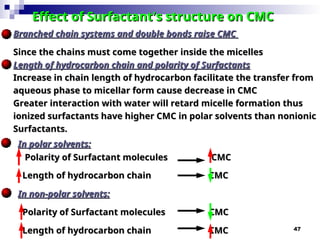
Effect of Surfactant
Effect of Surfactant’
’s structure on CMC
s structure on CMC
Branched chain systems and double bonds raise CMC
Since the chains must come together inside the micelles
Length of hydrocarbon chain and polarity of Surfactants
Increase in chain length of hydrocarbon facilitate the transfer from
aqueous phase to micellar form cause decrease in CMC
Greater interaction with water will retard micelle formation thus
ionized surfactants have higher CMC in polar solvents than nonionic
Surfactants.
Surfactants.
In polar solvents:
In polar solvents:
Polarity of Surfactant molecules CMC
Length of hydrocarbon chain CMC
In non-polar solvents:
Polarity of Surfactant molecules CMC
Length of hydrocarbon chain CMC
48
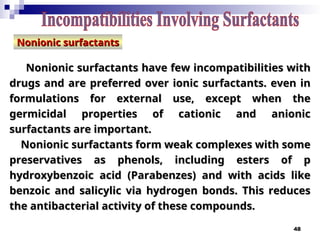
Nonionic surfactants
Nonionic surfactants have few incompatibilities with
have few incompatibilities with
drugs and are preferred over ionic surfactants. even in
formulations for external use, except when the
germicidal properties of cationic and anionic
surfactants are important.
Nonionic surfactants form weak complexes with some
preservatives as phenols, including esters of p­
hydroxybenzoic acid (Parabenzes) and with acids like
benzoic and salicylic via hydrogen bonds. This reduces
the antibacterial activity of these compounds.
Nonionic surfactants
49
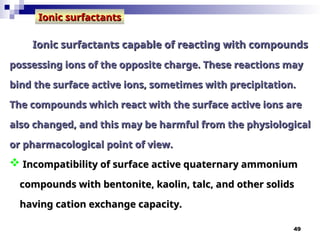
Ionic surfactants
Ionic surfactants
Ionic surfactants capable of reacting with compounds
possessing ions of the opposite charge. These reactions may
bind the surface active ions, sometimes with precipitation.
The compounds which react with the surface active ions are
also changed, and this may be harmful from the physiological
or pharmacological point of view.
 Incompatibility of surface active quaternary ammonium
Incompatibility of surface active quaternary ammonium
compounds with bentonite, kaolin, talc, and other solids
having cation exchange capacity.
50
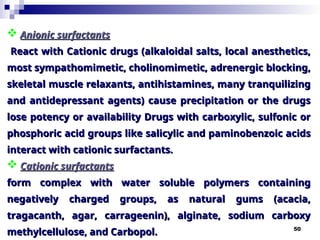
 Anionic surfactants
Anionic surfactants
React with Cationic drugs (alkaloidal salts, local anesthetics,
most sympathomimetic, cholinomimetic, adrenergic blocking,
skeletal muscle relaxants, antihistamines, many tranquilizing
and antidepressant agents) cause precipitation or the drugs
lose potency or availability Drugs with carboxylic, sulfonic or
phosphoric acid groups like salicylic and p­
aminobenzoic acids
phosphoric acid groups like salicylic and p­
aminobenzoic acids
interact with cationic surfactants.
 Cationic surfactants
Cationic surfactants
form complex with water soluble polymers containing
negatively charged groups, as natural gums (acacia,
tragacanth, agar, carrageenin), alginate, sodium carboxy
methylcellulose, and Carbopol.

surface Tension in Physical Pharmacy.ppt

  • 1.
  • 2.
    2  I Interface nterface is isthe boundary between two or more phases the boundary between two or more phases exist together exist together  The properties of the molecules forming the interface are The properties of the molecules forming the interface are different from those in the bulk that these molecules are different from those in the bulk that these molecules are forming an forming an interfacial phase. interfacial phase.  Several types of interface can exist depending on whether Several types of interface can exist depending on whether the two adjacent phases are in solid, liquid or gaseous state. the two adjacent phases are in solid, liquid or gaseous state.  Important of Interfacial phenomena in pharmacy: Important of Interfacial phenomena in pharmacy:  Adsorption of drugs onto solid adjuncts in dosage forms Adsorption of drugs onto solid adjuncts in dosage forms  Penetration of molecules through biological membranes Penetration of molecules through biological membranes  Emulsion formation and stability Emulsion formation and stability  The dispersion of insoluble particles in liquid media to form The dispersion of insoluble particles in liquid media to form suspensions. suspensions.
  • 3.
    3 LIQUID INTERFACES Surface andInterfacial Tensions In the liquid state, the cohesive forces between adjacent molecules are well developed. For the molecules in the bulk of a liquid They are surrounded in all directions by other molecules for which they have an equal attraction. For the molecules at the surface (at the liquid/air interface)  Only attractive cohesive forces with other liquid molecules which are situated below and adjacent to them.  They can develop adhesive forces of attraction with the molecules of the other phase in the interface  The net effect is that the molecules at the surface of the liquid experience an inward force towards the bulk of the liquid and pull the molecules and contract the surface with a force F .
  • 4.
    4 To keep theequilibrium, an equal force must be applied to oppose the inward tension in the surface. Thus SURFACE TENSION SURFACE TENSION [γ ] is the force per unit length that must be applied parallel to the surface so as to counterbalance the net inward pull and has the units of dyne/cm INTERFACIAL TENSION INTERFACIAL TENSION is the force per unit length existing at the interface between two immiscible liquid phases and has the units of dyne/cm. Invariably, interfacial tensions are less than surface tensions because an adhesive forces, between the two liquid phases forming the interface are greater than when a liquid and a gas phase exist together. If two liquids are completely miscible, no interfacial tension exists between them. Greater surface tension reflects higher intermolecular force of attraction, thus, increase in hydrogen bonds or molecular weight cause increase in ST
  • 5.
    5 The work Wrequired to create a unit area of surface is known as SURFACE FREE ENERGY/UNIT AREA SURFACE FREE ENERGY/UNIT AREA (ergs/cm (ergs/cm2 2 ) ) erg = dyne . cm Its equivalent to the surface tension γ Thus the greater the area A of interfacial contact between the phases, the greater the free energy. W = γ ∆ A For equilibrium, the surface free energy of a system must be at a minimum. Thus Liquid droplets tend to assume a spherical shape since a sphere has the smallest surface area per unit volume.
  • 6.
    6 Methods for measuringsurface and interfacial tension 1- Capillary rise method 2- Ring (Du Nouy) tensiometer 3- Drop weight method (Stalagmometer) The choice of the method for measuring surface and interfacial tension depend on:  Whether surface or interfacial tension is to be determined.  The accuracy desired  The size of sample.
  • 7.
    7 Capillary Rise Method Whena capillary tube is placed in a liquid, it rises up the tube a certain distance. By measuring this rise, it is possible to determine the surface tension of the liquid. It is not possible, to obtain interfacial tensions using the capillary rise method.  Cohesive force is the force existing between like mole­ cules in the surface of a liquid Adhesive force is the force existing between unlike molecules, such as that between a liquid and the wall of a glass capillary tube  When the force of Adhesion is greater than the cohesion, the liquid is said to wet the capillary wall, spreading over it, and rising in the tube. The Principle
  • 8.
    8 If a capillarytube of inside radius =r immersed in a liquid that wet its surface, the liquid continues to rise in the tube due to the surface tension, until the upward movement is just balanced by the downward force of gravity due to the weight of the liquid a = γ cos Ө a = 2 π r γ cos Ө The upward component of the force The upward component of the force resulting from the surface tension of the liquid at any point on the circumference is given by: Thus the total upward force around the inside circumference of the tube is Where Ө = the contact angle between the surface of the liquid and the capillary wall 2 π r = the inside circumference of the capillary. For water the angle Ө is insignificant, i.e. the liquid wets the capillary wall so that cos Ө = unity Cont. angle water and glass Cont. angle Mercury and glass
  • 9.
    9 The downward forceof gravity The downward force of gravity (mass x acceleration) is given by Where: π r 2 = the cross-sectional area h = the height of the liquid column to the lowest point of the meniscus (p – p o) = the difference in the density of the liquid p and its vapor po g = the acceleration of gravity w = the weight of the upper part of the meniscus. At Maximum height, At Maximum height, the opposing forces are in equilibrium p o, Ө and w can usually be disregarded Hence the surface tension can be calculated. π r 2 h (p – p o ) g + w 2 π r γ cos Ө = π r 2 h (p – p o) g + w 2 π r γ = π r 2 h p g γ = 1/2 r h p g
  • 10.
    10 Ring (Du Nouy)Tensiometer  the principle of the instrument depends on the fact that: the force necessary to detach a platinum-iridium ring immersed at the surface or interface is proportional to the surface or interfacial tension.  The force of detachment is recorded in dynes on a calibrated dial  The surface tension is given by: Where: F = the detachment force R1 and R 2= the inner and outer radii of the ring. γ = F / 2 π (R1 + R2)  For measuring surface and interfacial tensions. The principle
  • 11.
    11 If the volumeor weight of a drop as it is detached from a tip of known radius is determined, the surface and interfacial tension can be calculated from Where m = the mass of the drop V = the volume of the drop p = the density of the liquid r = the radius of the tip g = the acceleration due to gravity Φ = a correction factor The correction factor is required as not all the drop leaves the tip on detachment The tip must be wetted by the liquid so as the drop doesn’t climb the outside of the tube. γ = Φ mg = Φ V pg 2 π r 2 π r Drop Weight and drop volume method
  • 12.
    12 A surfactant moleculeis depicted schematically as a cylinder representing the hydrocarbon (hydrophobic) portion with a sphere representing the polar (hydrophilic) group attached at one end. The hydrocarbon chains are straight because rotation around carbon- carbon bonds bends, coils and twists them. Sodium Lauryl Sulfate molecule
  • 13.
    13 Molecules and ionsthat are adsorbed at interfaces are Molecules and ions that are adsorbed at interfaces are termed termed surface active agents, surface active agents, surf surfactants or actants or amphiphile amphiphile The molecule or ion has a certain affinity for both polar and The molecule or ion has a certain affinity for both polar and nonpolar solvents. nonpolar solvents. Depending on the number and nature of the polar and Depending on the number and nature of the polar and nonpolar groups present, the amphiphile may be nonpolar groups present, the amphiphile may be hydrophilic, hydrophilic, lipophilic lipophilic or be reasonably well-balanced between or be reasonably well-balanced between these these two two extremes. extremes. It is the amphiphilic nature of surface active agents which It is the amphiphilic nature of surface active agents which causes them to be adsorbed at interfaces, whether these be causes them to be adsorbed at interfaces, whether these be liquid/gas or liquid/liquid. liquid/gas or liquid/liquid.
  • 14.
    14 A scale showingclassification of A scale showing classification of surfactant function on the basis of surfactant function on the basis of HLB values of surfactants. HLB values of surfactants. The higher the HLB of a The higher the HLB of a surfactant surfactant the more hydrophilic it is. the more hydrophilic it is. Example: Example: Spans Spans with low HLB are with low HLB are lipophilic. Tweens with high HLB are lipophilic. Tweens with high HLB are hydrophilic. hydrophilic.
  • 15.
    15 Determination of HLB Determinationof HLB  Polyhydric Alcohol Fatty Acid Esters Polyhydric Alcohol Fatty Acid Esters (Ex. Glyceryl monostearate) (Ex. Glyceryl monostearate) HLB = 20 ( 1 – S / A )  Surfactants with no Saponification no Surfactants with no Saponification no (Ex. Bees wax and lanolin) (Ex. Bees wax and lanolin) S = Saponification number of the ester A = Acid number of the fatty acid HLB =E + P / 5 E = The percent by weight of ethylene oxide P=The percent by weight of polyhydric alcohol group in the molecules  Surfactants with hydrophilic portion have only oxyethylene groups Surfactants with hydrophilic portion have only oxyethylene groups HLB =E / 5
  • 16.
    16 When a liquidis placed on the surface of other liquid, it will spread as a film if the adhesion force is greater than the cohesive forces.
  • 17.
    17 As surface orinterfacial work is equal to surface tension multiplied by the area increment. The work of cohesion, which is the energy required to separate the molecules of the spreading liquid so as it can flow over the sub-layer= Where 2 surfaces each with a surface tension = γ L The work of adhesion, which is the energy required to break the attraction between the unlike molecules= Where: γ γ L =the surface tension of the spreading liquid γ γ S =the surface tension of the sub­ layer liquid γ γ LS =the interfacial tension between the two liquids. Spreading occurs if the work of adhesion is greater than the work of cohesion, i.e. Wa > Wc or Wa - Wc > 0 Wc = 2 γ Wc = 2 γ L L Wa = γ Wa = γ L L + γ + γ S S - γ - γ LS LS
  • 18.
    18 Spreading Coefficient isThe difference between the work of adhesion and the work of cohesion S = Wa - S = Wa - Wc Wc = = ( (γ γ L L + γ + γ S S - γ - γ LS LS ) - ) - 2 γ 2 γ L L S = S = γ γ S S - - γ γ L L - γ - γ LS LS S = S = γ γ S S – ( – (γ γ L L + γ + γ LS LS ) ) Spreading occurs (S is positive) when the surface tension of the sub-layer liquid is greater than the sum of the surface tension of the spreading liquid and the interfacial tension between the sub-layer and the spreading liquid. If (γ (γ L L + γ + γ LS LS ) ) is larger than YS , (S is negative) the substance forms globules or a floating lens and fails to spread over the surface. Liquid Substrate
  • 19.
    19 Factor affecting SpreadingCoefficient Molecular Structural: o The greater the polarity of the molecule the more positive [S] as ethyl alcohol and propionic acid o Non polar substances as Liquid petrolatum have negative [S] fail to spread on water o For organic acids, as Oleic acid, the longer the carbon chain decrease in polar character decrease [S] o Some oils can spread over water because they contain polar groups as COOH and OH Cohesive forces: Benzene spreads on water not because it is polar but because the cohesive forces between its molecules are much weaker than the adhesion for water.
  • 20.
    20 Application of Spreadingcoefficient in pharmacy  The requirement of film coats to be spreaded over the tablet surfaces  The requirement of lotions with mineral oils to spread on the skin by the addition of surfactants
  • 21.
    21 Functional Classification According totheir pharmaceutical use, surfactants can be divided into the following groups:  Wetting agents  Solubilizing agents  Emulsifying agents  Dispersing, Suspending and Defloculating agents  Foaming and antifoaming agents  Detergents
  • 22.
    22 Wetting agents  Wettingagent is a surfactant that when dissolved in water, lower the contact angle and aids in displacing the air phase at the surface and replacing it with a liquid phase.  Solids will not be wetted if their critical surface tension is exceeded than the surface tension of the liquid. Thus water with a value of 72 dynes/cm will not wet polyethylene with a critical surface tension of 3 1 dynes/cm.  Based on this concept we should expect a good wetting agent to be one which reduces the surface tension of a liquid to a value below the solid critical surface tension.
  • 23.
    23 According to thenature of the liquid and the solid, a drop of liquid placed on a solid surface will adhere to it or no. which is the wettability between liquids and solids. When the forces of adhesion are greater than the forces of cohesion, the liquid tends to wet the surface and vice versa. Place a drop of a liquid on a smooth surface of a solid. According to the wettability, the drop will make a certain angle of contact with the solid. A contact angle is lower than 90°, the solid is called wettable A contact angle is wider than 90°, the solid is named non-wettable. A contact angle equal to zero indicates complete wettability.
  • 24.
    24 . no wetting incomplete wetting complete wetting = 0°< 90° = 90° > 90° = 180° Ө Ө Ө Ө Ө γ s– γsL< 0 γ s – γsL ≈ 0 γ s – γsL> 0
  • 25.
    25 The surface ofliquid water (meniscus) has a concave shape because water wets the surface and creeps up the side The surface of Mercury has a convex shape it does not wet glass because the cohesive forces within the drops are stronger than the adhesive forces between the drops and glass.
  • 26.
    26 Micellar Solubilization Surfactant moleculesaccumulate in the interfaces between Surfactant molecules accumulate in the interfaces between water and water insoluble compound. Their hydrocarbon water and water insoluble compound. Their hydrocarbon chains penetrate the outermost layer of insoluble compound chains penetrate the outermost layer of insoluble compound which combine with the water­ insoluble molecules. Micelles which combine with the water­ insoluble molecules. Micelles form around the molecules of the water­ insoluble compound form around the molecules of the water­ insoluble compound inside the micelles’ cores and bring them into solution in an inside the micelles’ cores and bring them into solution in an aqueous medium. This phenomenon is called micellar aqueous medium. This phenomenon is called micellar solubilization. solubilization. The inverted micelles formed by oil The inverted micelles formed by oil­ ­ soluble surfactant which soluble surfactant which dissolves in a hydrocarbon solvent can solubilize water-soluble dissolves in a hydrocarbon solvent can solubilize water-soluble compound which is located in the center of the micelle, out of compound which is located in the center of the micelle, out of contact with the solvent. contact with the solvent.
  • 27.
    27 Micelles of nonionicsurfactants consist of an outer shell Micelles of nonionic surfactants consist of an outer shell containing their polyethylene glycol moieties mixed with containing their polyethylene glycol moieties mixed with water and an inner core formed by their hydrocarbon water and an inner core formed by their hydrocarbon moieties. Some compounds like phenols and benzoic acid moieties. Some compounds like phenols and benzoic acid form complexes form complexes with polyethylene glycols by hydrogen with polyethylene glycols by hydrogen bonding and/or are more soluble in liquids of intermediate bonding and/or are more soluble in liquids of intermediate polarity like ethanol or ethyl ether than in liquids of low polarity like ethanol or ethyl ether than in liquids of low polarity like aliphatic hydrocarbons. These compounds locate polarity like aliphatic hydrocarbons. These compounds locate in the aqueous polyethylene glycol outer shell of nonionic in the aqueous polyethylene glycol outer shell of nonionic micelles on solubilization. micelles on solubilization. Drugs which are soluble in oils and lipids can be solubilized Drugs which are soluble in oils and lipids can be solubilized by micellar solubilization. by micellar solubilization.
  • 28.
    28 As Micellar solubilizationdepends on the existence of As Micellar solubilization depends on the existence of micelles; it does not take place below the CMC. So dissolution micelles; it does not take place below the CMC. So dissolution begins at the CMC. Above the CMC, the amount solubilized is begins at the CMC. Above the CMC, the amount solubilized is directly proportional to the surfactant concentration because directly proportional to the surfactant concentration because all surfactant added to the solution in excess of the CMC all surfactant added to the solution in excess of the CMC exists in micellar form, and as the number of micelles exists in micellar form, and as the number of micelles increases the extent of solubilization increases . increases the extent of solubilization increases . Compounds that are extensively solubilized increase the Compounds that are extensively solubilized increase the size of micelles in two ways: size of micelles in two ways: o The micelles swell because their core volume is The micelles swell because their core volume is augmented by the volume of the solubilizate. augmented by the volume of the solubilizate. o The number of surfactant molecules per micelle The number of surfactant molecules per micelle increases. increases.
  • 29.
    29 Foams are dispersionof a gas in a liquid (liquid foams as that formed by soaps and detergents ) or in a solid (solid foams as sponges ). Foaming and Anti Foaming agents  Foaming agents Many Surfactants solutions promote the formation of foams and stabilize them, in pharmacy they are useful in toothpastes compositions.  Anti Foaming agents They break foams and reduce frothing that may cause problems as in foaming of solubilized liquid preparations. in pharmacy they are useful in aerobic fermentations, steam boilers.
  • 30.
    30 Detergents  Detergents aresurfactants used for removal of dirt.  Detergency involves: •Initial wetting of the dirt and the surface to be cleaned. •Deflocculation and suspension, emulsification or solubilisation of the dirt particles •Finally washing away the dirt.
  • 31.
    31 Structural Classification  Asingle surfactant molecule contains one or more hydrophobic portions and one or more hydrophilic groups.  According to the presence of ions in the surfactant molecule they may be classified into:  Ionic surfactants o Anionic surfactants: the surface active part is anion (negative ion ) e.g. soaps, sodium lauryl sulfate o Cationic surfactants: the surface active part is cation (positive ion) e.g. quaternary ammonium salts o Ampholytic surfactants: contain both positive and negative ions e.g. dodecyl-B-alanine.
  • 32.
    32 Ionic surfactants They arethe metal salts of long ­chain fatty acids as lauric acid. Sodium dodecyl sulfate or Sodium Lauryl Sulfate is used in toothpaste and ointments Triethanolamine dodecyl sulfate is used in shampoos and other cosmetic preparations. Sodium dodecyl benzene sulfonate is a detergent and has germicidal properties . Sodium dialkvlsulfosuccinates are good wetting agents. Anionic surfactants Anionic surfactants
  • 33.
    33 Cationic surfactants Cationic surfactants Theseare chiefly quaternary ammonium compounds. They have bacteriostatic activity probably because they combine with the carboxyl groups in the cell walls and of microorganisms by cation exchange, causing lysis. Among the most popular antiseptics in this category are benzalkonium chloride, cetylpyridinium chloride and cetyltrimethylammonium bromide, Ampholytic Surfactants Ampholytic Surfactants These are the least common, e.g. dodecyl-β­ alanine
  • 34.
    34 Non-ionic surfactants Widely usedin pharmaceutical formulations e.g. Tweens, Spans, Brij and Myrj. They are polyethylene oxide products. Surfactants based on sorbitan are of pharmaceutical importance. Esterification of the primary hydroxyl group with lauric, palmitic, stearic or oleic acid forms sorbitan monolaurate, monopalmitate, monostearate or monooleate These are water-insoluble surfactants called Span 20, 40, 60 or 80, respectively. Addition of about 20 ethylene oxide molecules produces the water-soluble surfactants called polysorbate or Tween 20, 40. 60 or 80.
  • 35.
    35 At water-air interface Atwater-air interface Surface­ active molecules will Surface­ active molecules will be adsorbed at water-air be adsorbed at water-air interfaces and oriented so interfaces and oriented so that the hydrocarbon chains of are pushed out of the water and that the hydrocarbon chains of are pushed out of the water and rest on the surface, while the polar groups are inside the water. rest on the surface, while the polar groups are inside the water. Perhaps the polar groups pull the hydrocarbon chains partly into Perhaps the polar groups pull the hydrocarbon chains partly into the water. the water. At oil-water interface At oil-water interface Surface­ active molecules will be oriented so that the hydrophobic Surface­ active molecules will be oriented so that the hydrophobic portion is inside the oil phase and the hydrophilic portion inside portion is inside the oil phase and the hydrophilic portion inside the water phase. the water phase. As a Surface active substance contains a hydrophilic and a hydrophobic portions, it is adsorbed as a monolayer at the interfaces.
  • 36.
    36 At low surfactantconcentrations: At low surfactant concentrations: The hydrocarbon chains of surfactant molecules adsorbed The hydrocarbon chains of surfactant molecules adsorbed in the interface lie nearly flat oh the water surface. in the interface lie nearly flat oh the water surface. At higher concentrations: At higher concentrations: They stand upright because this permits more surfactant They stand upright because this permits more surfactant molecules to pack into the interfacial monolayer. molecules to pack into the interfacial monolayer. As the number of surfactant molecules adsorbed at the water­ As the number of surfactant molecules adsorbed at the water­ air interface increased, they tend to cover the water with a air interface increased, they tend to cover the water with a layer of hydrocarbon chains. Thus, the water-air interface is layer of hydrocarbon chains. Thus, the water-air interface is gradually transformed into an non polar-air interface. This gradually transformed into an non polar-air interface. This results in a decrease in the surface tension of water. results in a decrease in the surface tension of water.
  • 37.
    37 Micelle Formation Micelle Formation Whenthe surfactant molecules adsorbed as a monolayer in the water-air interface have become so closely packed that additional molecules cannot be accommodated with ease, the polar groups pull the hydrocarbon chains partly into the water. At certain concentration the interface and the bulk phase become saturated with monomers. Excess surfactants add will begin to agglomerate in the bulk of the solution forming aggregates called and the free energy of the system is reduced The lowest concentration at which micelles first appear is called the critical concentration for micelle formation [CMC ] Micelles Micelles . .
  • 38.
    38 At a givenconcentration, temperature, and salt content, all micelles of a given surfactant usually contain the same number of molecules, i.e. they are usually monodisperse. For different surfactants in dilute aqueous solutions, this number ranges approximately from 25 to 100 molecules. The diameters of micelles are approximately between 30 and 80 Ao . Because of their ability to form aggregates of colloidal size, surfactants are also called association colloids. Micelles are not permanent aggregates. They form and disperse continually.
  • 39.
  • 40.
    40 a a- - Cone-shaped surfactantresulting in Cone-shaped surfactant resulting in b b- -normal micelles normal micelles c c- - Hampagne cork shaped surfactant resulting in Hampagne cork shaped surfactant resulting in d d- -reverse reverse micelles with control of their size by the water content micelles with control of their size by the water content e e- - Interconnected cylinders Interconnected cylinders. . f- f- Planar lamellar phase Planar lamellar phase. . g g- - Onion-like lamellar phase Onion-like lamellar phase. . Surfactant shapes in colloidal solution Surfactant shapes in colloidal solution
  • 41.
    41  Normal sphericalmicelles Normal spherical micelles In dilute aqueous solutions micelles are approximately spherical. In dilute aqueous solutions micelles are approximately spherical. The polar groups of the surfactants are in the periphery and the The polar groups of the surfactants are in the periphery and the hydrocarbon chains are oriented toward the center, forming the hydrocarbon chains are oriented toward the center, forming the core of the micelles core of the micelles  Inverted Inverted spherical micelles spherical micelles In solvents of low polarity or oils In solvents of low polarity or oils micelles micelles are are inverted. inverted. The polar groups The polar groups face inward to form the core of the micelle face inward to form the core of the micelle while the hydrocarbon chains are oriented outward while the hydrocarbon chains are oriented outward  Cylindrical and lamellar micelles Cylindrical and lamellar micelles In more concentrated solutions In more concentrated solutions of surfactants, micelles change of surfactants, micelles change from from spherical spherical either either to to cylindrical cylindrical or lamellar or lamellar phase. phase.
  • 42.
    42 Changes occurred atthe CMC Changes occurred at the CMC I- A continuous decrease in Surface and interfacial tensions with surfactants concentration until CMC CMC the Surface and interfacial tensions level become constant owing to crowding of surfactant molecules adsorbed at surfaces and interfaces. Properties of surfactant Solutions Properties of surfactant Solutions as functions of concentration: as functions of concentration: A, surface tension B, interfacial tension C, osmotic pressure; D, equivalent conductivity; E, solubility of compounds with low or zero solubility in water
  • 43.
    43 Changes occurred atthe CMC Changes occurred at the CMC II- The osmotic pressure (and all other colligative properties, lowering of the vapor pressure and of the freezing point), rises much more slowly with increasing surfactant concentration above than it does below the CMC because it depends on the number of dissolved particles. A, surface tension B, interfacial tension C, osmotic pressure D, equivalent conductivity E, solubility of compounds with low or zero solubility in water
  • 44.
    44 Changes occurred atthe CMC Changes occurred at the CMC III- For ionic surfactants, the equivalent conductivity drops sharply above the CMC. Only the counterions of non-associated surfactant molecules can carry current. A, surface tension B, interfacial tension C, osmotic pressure D, equivalent conductivity E, solubility of compounds with low or zero solubility in water
  • 45.
    45 Changes occurred atthe CMC Changes occurred at the CMC IV-Solubility of many drugs are increased after CMC. Other solution properties changing at the CMC: intrinsic viscosity and turbidity increase, while diffusion coefficient decreases A, surface tension B, interfacial tension C, osmotic pressure D, equivalent conductivity E, solubility of compounds with low or zero solubility in water All these properties can be All these properties can be used to determine the CMC. used to determine the CMC.
  • 46.
    46 Factors affecting CMC Factorsaffecting CMC For nonionic surfactants For nonionic surfactants Temperature CMC Temperature CMC For ionic surfactants For ionic surfactants The CMC are higher for ionic than nonionic surfactants The CMC are higher for ionic than nonionic surfactants The charges in the micelle of ionic surfactant are in close, The charges in the micelle of ionic surfactant are in close, to overcome the resulting repulsion an electric work is to overcome the resulting repulsion an electric work is required but nonionic surfactants have no electric required but nonionic surfactants have no electric repulsion to overcome in order to aggregate. repulsion to overcome in order to aggregate. Effect of electrolytes on the CMC of ionic surfactants Effect of electrolytes on the CMC of ionic surfactants The addition of salts to ionic surfactant solutions reduces The addition of salts to ionic surfactant solutions reduces the electric repulsion between the charged groups and the electric repulsion between the charged groups and lower CMC values lower CMC values
  • 47.
    47 Effect of Surfactant Effectof Surfactant’ ’s structure on CMC s structure on CMC Branched chain systems and double bonds raise CMC Branched chain systems and double bonds raise CMC Since the chains must come together inside the micelles Since the chains must come together inside the micelles Length of hydrocarbon chain and polarity of Surfactants Length of hydrocarbon chain and polarity of Surfactants Increase in chain length of hydrocarbon facilitate the transfer from Increase in chain length of hydrocarbon facilitate the transfer from aqueous phase to micellar form cause decrease in CMC aqueous phase to micellar form cause decrease in CMC Greater interaction with water will retard micelle formation thus Greater interaction with water will retard micelle formation thus ionized surfactants have higher CMC in polar solvents than nonionic ionized surfactants have higher CMC in polar solvents than nonionic Surfactants. Surfactants. In polar solvents: In polar solvents: Polarity of Surfactant molecules CMC Polarity of Surfactant molecules CMC Length of hydrocarbon chain CMC Length of hydrocarbon chain CMC In non-polar solvents: In non-polar solvents: Polarity of Surfactant molecules CMC Polarity of Surfactant molecules CMC Length of hydrocarbon chain CMC Length of hydrocarbon chain CMC
  • 48.
    48 Nonionic surfactants Nonionic surfactantshave few incompatibilities with have few incompatibilities with drugs and are preferred over ionic surfactants. even in drugs and are preferred over ionic surfactants. even in formulations for external use, except when the formulations for external use, except when the germicidal properties of cationic and anionic germicidal properties of cationic and anionic surfactants are important. surfactants are important. Nonionic surfactants form weak complexes with some Nonionic surfactants form weak complexes with some preservatives as phenols, including esters of p­ preservatives as phenols, including esters of p­ hydroxybenzoic acid (Parabenzes) and with acids like hydroxybenzoic acid (Parabenzes) and with acids like benzoic and salicylic via hydrogen bonds. This reduces benzoic and salicylic via hydrogen bonds. This reduces the antibacterial activity of these compounds. the antibacterial activity of these compounds. Nonionic surfactants Nonionic surfactants
  • 49.
    49 Ionic surfactants Ionic surfactants Ionicsurfactants capable of reacting with compounds Ionic surfactants capable of reacting with compounds possessing ions of the opposite charge. These reactions may possessing ions of the opposite charge. These reactions may bind the surface active ions, sometimes with precipitation. bind the surface active ions, sometimes with precipitation. The compounds which react with the surface active ions are The compounds which react with the surface active ions are also changed, and this may be harmful from the physiological also changed, and this may be harmful from the physiological or pharmacological point of view. or pharmacological point of view.  Incompatibility of surface active quaternary ammonium Incompatibility of surface active quaternary ammonium compounds with bentonite, kaolin, talc, and other solids compounds with bentonite, kaolin, talc, and other solids having cation exchange capacity. having cation exchange capacity.
  • 50.
    50  Anionic surfactants Anionicsurfactants React with Cationic drugs (alkaloidal salts, local anesthetics, React with Cationic drugs (alkaloidal salts, local anesthetics, most sympathomimetic, cholinomimetic, adrenergic blocking, most sympathomimetic, cholinomimetic, adrenergic blocking, skeletal muscle relaxants, antihistamines, many tranquilizing skeletal muscle relaxants, antihistamines, many tranquilizing and antidepressant agents) cause precipitation or the drugs and antidepressant agents) cause precipitation or the drugs lose potency or availability Drugs with carboxylic, sulfonic or lose potency or availability Drugs with carboxylic, sulfonic or phosphoric acid groups like salicylic and p­ aminobenzoic acids phosphoric acid groups like salicylic and p­ aminobenzoic acids interact with cationic surfactants. interact with cationic surfactants.  Cationic surfactants Cationic surfactants form complex with water soluble polymers containing form complex with water soluble polymers containing negatively charged groups, as natural gums (acacia, negatively charged groups, as natural gums (acacia, tragacanth, agar, carrageenin), alginate, sodium carboxy tragacanth, agar, carrageenin), alginate, sodium carboxy methylcellulose, and Carbopol. methylcellulose, and Carbopol.