SURFACE
AND
INTERFACIAL PHENOMENA
By: Ms. Ashiya Najfath
Assistant Professor
PA College of Pharmacy
INTRODUCTION
 The boundary that forms between 2 phases, say solid and liquid
is called Interface.
 The properties of the molecules forming the interface are often
different from those in the bulk of each phase that they are referred
to as forming an interfacial phase
 The term surface is normally used to denote interface when one
of the phases is gas.
OR
 Surface is the term used to describe either a gas-solid or gas-
liquid interface.
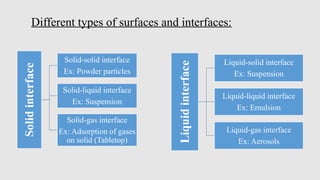
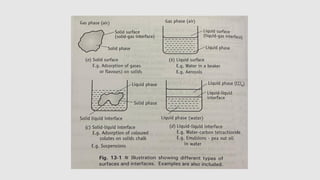
Different types of surfaces and interfaces:
Solid
interface
Solid-solid interface
Ex: Powder particles
Solid-liquid interface
Ex: Suspension
Solid-gas interface
Ex: Adsorption of gases
on solid (Tabletop)
Liquid
interface
Liquid-solid interface
Ex: Suspension
Liquid-liquid interface
Ex: Emulsion
Liquid-gas interface
Ex: Aerosols
Application of surface and interfacial
phenomenon in pharmacy
• Adsorption of drug on solid adjunct in dosage form
• Penetration of molecules through biological membrane
• Formation of emulsion and its stability
• Dispersion of insoluble particle in liquid media forming suspension
• Few process such as wetting of powders and detergency are based on
the principles of interfacial phenomenon.
SURFACE TENSION
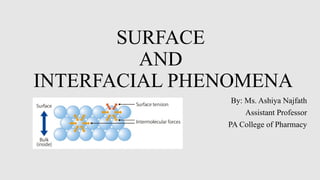
• The tension of the surface film of a liquid caused by the attraction of
the particles in the surface layer by the bulk of the liquid, which tends
to minimize surface area is known as surface tension.
OR
• Surface tension is defined as force in newtons, acting on the surface of
the liquid at right angles to any line of length of the surface, 1 metre.
• Units of surface tension:
 In CGS system- dynes/cm
In MKS system- Newtons/meter
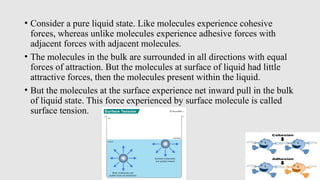
• Consider a pure liquid state. Like molecules experience cohesive
forces, whereas unlike molecules experience adhesive forces with
adjacent forces with adjacent molecules.
• The molecules in the bulk are surrounded in all directions with equal
forces of attraction. But the molecules at surface of liquid had little
attractive forces, then the molecules present within the liquid.
• But the molecules at the surface experience net inward pull in the bulk
of liquid state. This force experienced by surface molecule is called
surface tension.
The phenomenon of surface tension is responsible
for the following process:
a) Formation of spherical globules in emulsions.
b) Formation of nearly spherical shape of falling water droplets.
c) Formation of spherical shape pf mercury particles on flat surface.
d) Rise of liquid in capillary tube.
INTERFACIAL TENSION
• Interfacial tension is defined as the force per unit length that exist at
the interface between two immiscible liquid phases.
• Interfacial tensions are less than surface tensions because an adhesive
forces, between the two liquid phases forming the interface are greater
than when a liquid and a gas phase exist together.
• If two liquids are completely miscible, no interfacial tension exists
between them.
• The units of interfacial tension are same as that of surface tension.
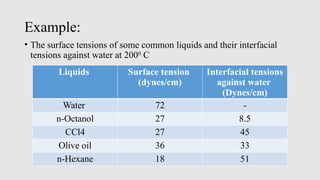
Example:
• The surface tensions of some common liquids and their interfacial
tensions against water at 2000
C
Liquids Surface tension
(dynes/cm)
Interfacial tensions
against water
(Dynes/cm)
Water 72 -
n-Octanol 27 8.5
CCl4 27 45
Olive oil 36 33
n-Hexane 18 51
SURFACE FREE ENERGY
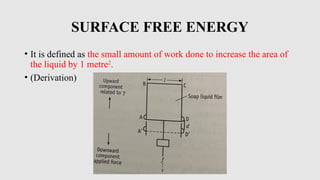
• It is defined as the small amount of work done to increase the area of
the liquid by 1 metre2
.
• (Derivation)
• Consider 3 dimensional soap film over the rectangular wire ABCD.
• The side AD=L is movable. A drop of soap solution is placed on the frame, so that it
forms a film within the frame.
• When force is applied downwards, the film gets stretched as the movable bar AD goes
down until the film breaks.
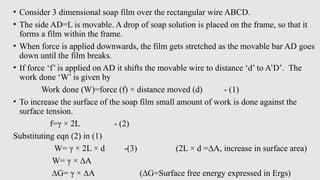
• If force ‘f’ is applied on AD it shifts the movable wire to distance ‘d’ to A’D’. The
work done ‘W’ is given by
Work done (W)=force (f) × distance moved (d) - (1)
• To increase the surface of the soap film small amount of work is done against the
surface tension.
f=γ × 2L - (2)
Substituting eqn (2) in (1)
W= γ × 2L × d -(3) (2L × d =∆A, increase in surface area)
W= γ × ∆A
∆G= γ × ∆A (∆G=Surface free energy expressed in Ergs)
MEASUREMENT OF SURFACE AND
INTERFACIAL TENSIONS
1. Capillary rise method
2. Ring detachment method (Du Nouy tensiometer)
3. Drop weight & drop count method
4. Wilhelmy plate method
5. Bubble pressure method
Capillary Rise Method
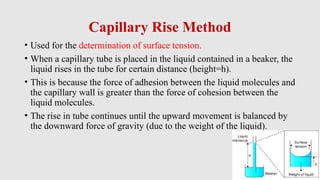
• Used for the determination of surface tension.
• When a capillary tube is placed in the liquid contained in a beaker, the
liquid rises in the tube for certain distance (height=h).
• This is because the force of adhesion between the liquid molecules and
the capillary wall is greater than the force of cohesion between the
liquid molecules.
• The rise in tube continues until the upward movement is balanced by
the downward force of gravity (due to the weight of the liquid).
Upward component (a)
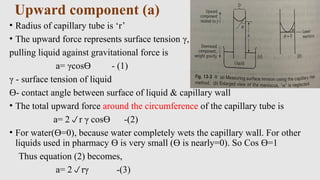
• Radius of capillary tube is ‘r’
• The upward force represents surface tension γ,
pulling liquid against gravitational force is
a= γcosϴ - (1)
γ - surface tension of liquid
ϴ- contact angle between surface of liquid & capillary wall
• The total upward force around the circumference of the capillary tube is
a= 2r γ cosϴ -(2)
• For water(ϴ=0), because water completely wets the capillary wall. For other
liquids used in pharmacy ϴ is very small (ϴ is nearly=0). So Cos ϴ=1
Thus equation (2) becomes,
a= 2rγ -(3)
Downward component (b)
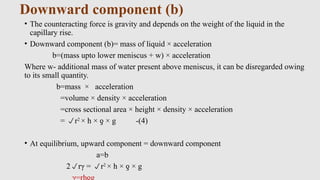
• The counteracting force is gravity and depends on the weight of the liquid in the
capillary rise.
• Downward component (b)= mass of liquid × acceleration
b=(mass upto lower meniscus + w) × acceleration
Where w- additional mass of water present above meniscus, it can be disregarded owing
to its small quantity.
b=mass × acceleration
=volume × density × acceleration
=cross sectional area × height × density × acceleration
= r2
× h × × g -(4)
ƍ
• At equilibrium, upward component = downward component
a=b
2rγ = r2
× h × × g
ƍ
Method:
i. A clean and dry capillary tube is selected and fixed horizontally and fixed
horizontally to a stand.
ii. The diameter of the capillary tube is determined by travelling microscope & then
radius is calculated.
iii. About 50ml of water is placed in 100ml beaker.
iv. The capillary tube is dipped in water, so that it touches the water surface.
v. The liquid rises in the capillary tube upto particular height (h1) – determined by
travelling microscope.
vi. The beaker is then removed, without disturbing the assembly of capillary tube.
vii. Again the height of the liquid is noted (h2)
viii. Difference in the heights (h=h2-h1) denotes rise of liquid in capillary tube.
ix. Density of liquid is determined by specific gravity bottle pycnometer ( )
ƍ
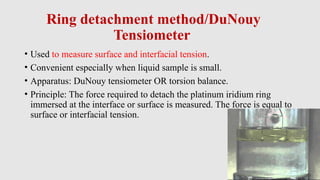
Ring detachment method/DuNouy
Tensiometer
• Used to measure surface and interfacial tension.
• Convenient especially when liquid sample is small.
• Apparatus: DuNouy tensiometer OR torsion balance.
• Principle: The force required to detach the platinum iridium ring
immersed at the interface or surface is measured. The force is equal to
surface or interfacial tension.
Method
• A cleaned platinum-iridium ring is attached to the hook at the torsion lever
arm.
• A more dense liquid is transferred into a clean glass vessel & placed on the
table.
• The table is moved until the ring is immersed in the liquid.
• The torsion lever arm is released by rotating the knob & instrument is
adjusted to 0 reading.
• The light liquid is poured on the surface of the heavier liquid (in interfacial
tension).
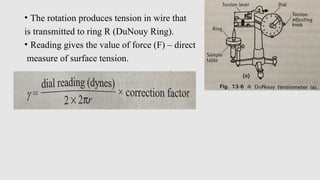
• It consists of tension wire ‘w’ with fixed end ‘A’ and the other end ‘B’
connected to knob ‘K’ that rotates.
• The rotation produces tension in wire that
is transmitted to ring R (DuNouy Ring).
• Reading gives the value of force (F) – direct
measure of surface tension.
Drop formation method
• Determination of surface tension.
• Mechanism is same in both method.
• Apparatus used- Stalagmometer
• Upward force= Surface tension on outer circumference of tube
= 2rγ
• Downward force (on drops)= weight of drop × acceleration
= mg
• If upward force = downward force, then drop breaks
2rγ = mg - (1)
2 subunits
Drop
weight
method
Drop count
method
i. Drop weight method
• By using clean dried stalagmometer, 20 drops of given unknown
liquid are taken in weighing bottle & drop weight is determined (m1).
• Then 20 drops of reference liquid are taken in weighing bottle & drop
weight is determined (m2).
ii. Drop count method
• By using clean dried stalagmometer, the unknown liquid is filled till
mark A & number of drops are counted from point A to point B.
• Similarly, the stalagmometer is filled with reference liquid till mark A &
number of drops are counted from point A to point B.
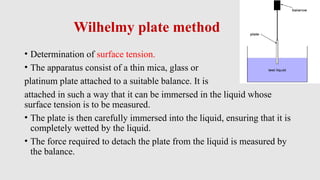
Wilhelmy plate method
• Determination of surface tension.
• The apparatus consist of a thin mica, glass or
platinum plate attached to a suitable balance. It is
attached in such a way that it can be immersed in the liquid whose
surface tension is to be measured.
• The plate is then carefully immersed into the liquid, ensuring that it is
completely wetted by the liquid.
• The force required to detach the plate from the liquid is measured by
the balance.
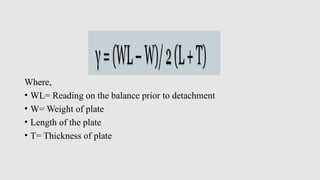
Where,
• WL= Reading on the balance prior to detachment
• W= Weight of plate
• Length of the plate
• T= Thickness of plate
SPREADING COEFFIECIENT
• The ability of one liquid to spread over another is calculated as “spreading
coefficient”.
• It is defined as the difference between work of adhesion and work of cohesion.
S=WA-WC
• Work of Adhesion- Energy required to break attraction between the unlike
molecules.
• Work of cohesion- Energy required to break attraction betwwen like
molecules.
• If WA >> WC → then, S is +ve, A spreads over B
• If WA << WC → then, S is –ve, A forms globules on surface B → No
spreading
Application of spreading coefficient
• Absorption of medicament
• Stabilization of emulsion
• Coating of tablets
ADSORPTION AT LIQUID INTERFACE
• Absorption is a process wherein a substance is uniformly distributed on surface as
well as bulk.
• Cb- Bulk concentration
Cs- Surface concentration
The process of absorption is Cb=Cs
• Adsorption is a surface phenomenon wherein the molecules accumulates on
surface. There is positive adsorption & negative adsorption.
• In positive adsorption, molecules accumulate more on surface than in the bulk, ie.,
Cs is much greater than Cb.
• In negative adsorption, molecules get accumulated in bulk more than on surface,
ie., Cb>>Cs.
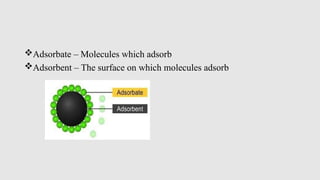
Adsorbate – Molecules which adsorb
Adsorbent – The surface on which molecules adsorb
SURFACE ACTIVE AGENTS/
SURFACTANTS
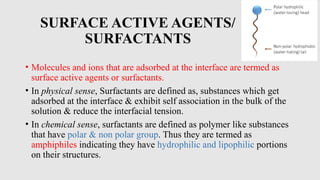
• Molecules and ions that are adsorbed at the interface are termed as
surface active agents or surfactants.
• In physical sense, Surfactants are defined as, substances which get
adsorbed at the interface & exhibit self association in the bulk of the
solution & reduce the interfacial tension.
• In chemical sense, surfactants are defined as polymer like substances
that have polar & non polar group. Thus they are termed as
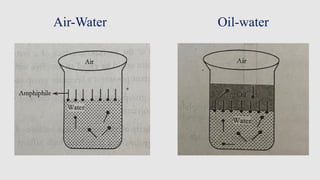
amphiphiles indicating they have hydrophilic and lipophilic portions
on their structures.
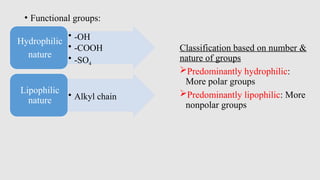
• Functional groups:
Classification based on number &
nature of groups
Predominantly hydrophilic:
More polar groups
Predominantly lipophilic: More
nonpolar groups
• -OH
• -COOH
• -SO4
Hydrophilic
nature
• Alkyl chain
Lipophilic
nature
Air-Water Oil-water
Classification of surfactants
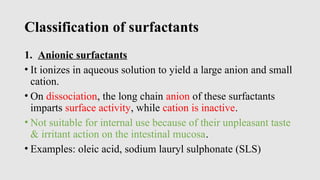
1. Anionic surfactants
• It ionizes in aqueous solution to yield a large anion and small
cation.
• On dissociation, the long chain anion of these surfactants
imparts surface activity, while cation is inactive.
• Not suitable for internal use because of their unpleasant taste
& irritant action on the intestinal mucosa.
• Examples: oleic acid, sodium lauryl sulphonate (SLS)
2. Cationic surfactants:
• They dissociate to form positively charged cations.
• Uses: Disinfecting agent, antiseptics, secondary emulsifying agents for
external application.
• Examples: Quaternary ammonium compounds such as cetrimide,
benzalakonium chloride.
3. Ampholytic surfactants:
• Their ionic characteristics depends on the pH of the system.
• Below certain pH – these are cationic
Above certain pH – these are anionic
Intermediate pH – zwitter ions
• Example: Lecithin & N-dodecyl alanins
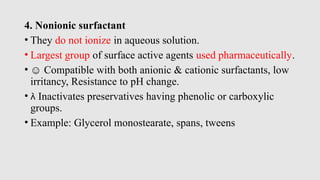
4. Nonionic surfactant
• They do not ionize in aqueous solution.
• Largest group of surface active agents used pharmaceutically.
• ☺ Compatible with both anionic & cationic surfactants, low
irritancy, Resistance to pH change.
•  Inactivates preservatives having phenolic or carboxylic
groups.
• Example: Glycerol monostearate, spans, tweens
HLB SCALE
• HLB- Hydrophilic Lipophilic Balance
• HLB is an arbitrary scale that indicates the extent of
hydrophilic & lipophilic balance.
• It is denoted by simultaneous attraction of the hydrophilic or
lipophilic group towards water or oil phase.
• In general molecules that are oil soluble (lipophilic in nature-
produce in W/O type of emulsion) have low HLB values, those
that are water soluble (hydrophilic in nature- produce in O/W
type of emulsion) have high HLB values.
Methods of estimation
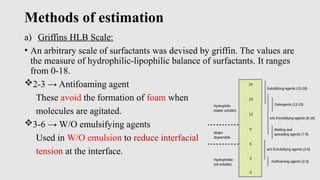
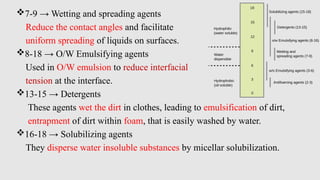
a) Griffins HLB Scale:
• An arbitrary scale of surfactants was devised by griffin. The values are
the measure of hydrophilic-lipophilic balance of surfactants. It ranges
from 0-18.
2-3 → Antifoaming agent
These avoid the formation of foam when
molecules are agitated.
3-6 → W/O emulsifying agents
Used in W/O emulsion to reduce interfacial
tension at the interface.
7-9 → Wetting and spreading agents
Reduce the contact angles and facilitate
uniform spreading of liquids on surfaces.
8-18 → O/W Emulsifying agents
Used in O/W emulsion to reduce interfacial
tension at the interface.
13-15 → Detergents
These agents wet the dirt in clothes, leading to emulsification of dirt,
entrapment of dirt within foam, that is easily washed by water.
16-18 → Solubilizing agents
They disperse water insoluble substances by micellar solubilization.
b) David’s formula:
• The structure of surfactant molecules is split into different component
groups & each group is assigned a number.
• HLB= Σ (hydrophilic group numbers) – Σ (lipophilic group numbers) + 7
• Applicable for ionizing type of surfactant (like SLS).
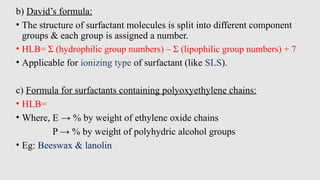
c) Formula for surfactants containing polyoxyethylene chains:
• HLB=
• Where, E → % by weight of ethylene oxide chains
P → % by weight of polyhydric alcohol groups
• Eg: Beeswax & lanolin
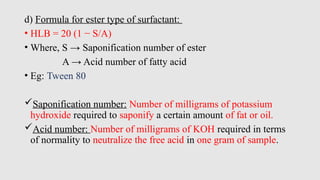
d) Formula for ester type of surfactant:
• HLB = 20 (1 − S/A)
• Where, S → Saponification number of ester
A → Acid number of fatty acid
• Eg: Tween 80
Saponification number: Number of milligrams of potassium
hydroxide required to saponify a certain amount of fat or oil.
Acid number: Number of milligrams of KOH required in terms
of normality to neutralize the free acid in one gram of sample.
WETTING PHENOMENA
• Wetting is adsorption process in which an intimate contact of the
solids with liquid phase is achieved.
• Surfactants are used to aid wetting of powders.
• They lower interfacial tension, contact angle and displace air & permit
intimate contact.
• Contact angle () is defined as angle between the liquid droplet & the
surface over which it spreads.
Application:
• In preparation of suspensions and emulsions.
• In case of granulation, prior to tabeletting, the powders are mixed with
liquid binders.
• Film coating requires the wetting of liquids over the tablet surface.
• Dissolution of tablet.
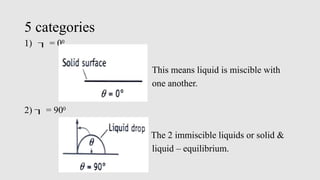
5 categories
1)  = 00
This means liquid is miscible with
one another.
2)  = 900
The 2 immiscible liquids or solid &
liquid – equilibrium.
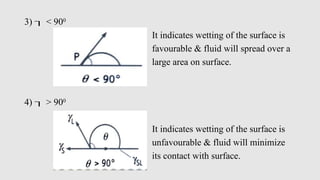
3)  < 900
It indicates wetting of the surface is
favourable & fluid will spread over a
large area on surface.
4)  > 900
It indicates wetting of the surface is
unfavourable & fluid will minimize
its contact with surface.
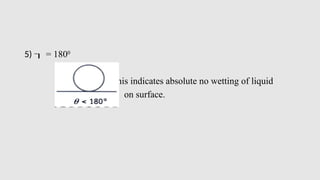
5)  = 1800
This indicates absolute no wetting of liquid
on surface.
SOLUBILIZATION
• It is the process in which, solubility of organic compound is increased
in aqueous medium with the help of surface active agents (surfactant),
this phenomenon is know as solubilization.
OR
• It is defines as the preparation of thermodynamically stable isotropic
solution of substance normally insoluble or very slightly soluble in a
given solvent by addition of components (eg: surfactants) or by
suitable methods(complexation or micronization)
• It is used in many industries for the mixing of two immiscible liquids
and help in making of drug.
Mechanism of micelle formation
• Amphiphiles (surfactants) at low concentration exist as monomers, as
the concentration increases the monomers aggregate themselves &
these aggregates are termed as micelles.
• CMC:- Critical micelle concentration – is defined as the concentration
range of surfactant at which micelles starts forming.
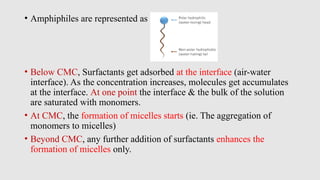
• Amphiphiles are represented as
• Below CMC, Surfactants get adsorbed at the interface (air-water
interface). As the concentration increases, molecules get accumulates
at the interface. At one point the interface & the bulk of the solution
are saturated with monomers.
• At CMC, the formation of micelles starts (ie. The aggregation of
monomers to micelles)
• Beyond CMC, any further addition of surfactants enhances the
formation of micelles only.
DETERGENCY
• Surfactants in aqueous solutions are used to remove the dirt
from substrates such as glass, fabric, skin etc.
• The principle of detergency is based on the formation of
micelle.
• The HLB requirement for the detergency is about 13 to 16.
• Examples:
Cationic type: Zephiran, Cetrimide
Anionic type: Soaps, Sodium lauryl sulphate
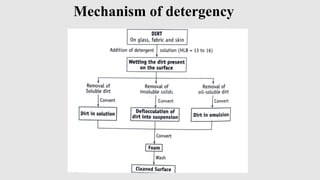
Steps:
1. Initial wetting of the dirt from the surface
2. Solubilizing of the dirt
3. Removing the insoluble dirt as deflocculation particles
4. Suspending the particles in the detergent solution
5. Removing the oil soluble materials and convert into
emulsion
6. Converting the dirt into foam so as to wash easily
Mechanism of detergency
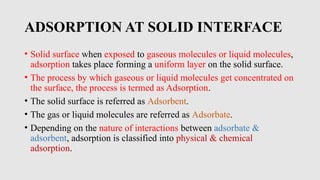
ADSORPTION AT SOLID INTERFACE
• Solid surface when exposed to gaseous molecules or liquid molecules,
adsorption takes place forming a uniform layer on the solid surface.
• The process by which gaseous or liquid molecules get concentrated on
the surface, the process is termed as Adsorption.
• The solid surface is referred as Adsorbent.
• The gas or liquid molecules are referred as Adsorbate.
• Depending on the nature of interactions between adsorbate &
adsorbent, adsorption is classified into physical & chemical
adsorption.
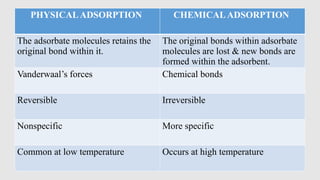
PHYSICALADSORPTION CHEMICALADSORPTION
The adsorbate molecules retains the
original bond within it.
The original bonds within adsorbate
molecules are lost & new bonds are
formed within the adsorbent.
Vanderwaal’s forces Chemical bonds
Reversible Irreversible
Nonspecific More specific
Common at low temperature Occurs at high temperature
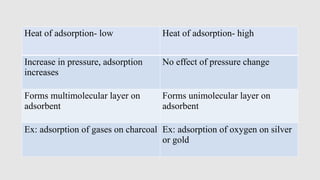
Heat of adsorption- low Heat of adsorption- high
Increase in pressure, adsorption
increases
No effect of pressure change
Forms multimolecular layer on
adsorbent
Forms unimolecular layer on
adsorbent
Ex: adsorption of gases on charcoal Ex: adsorption of oxygen on silver
or gold
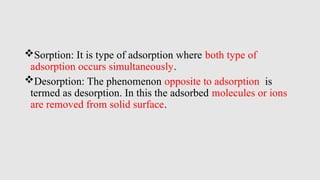
Sorption: It is type of adsorption where both type of
adsorption occurs simultaneously.
Desorption: The phenomenon opposite to adsorption is
termed as desorption. In this the adsorbed molecules or ions
are removed from solid surface.
Applications of solid/gas interface:
Removal of objectionable odors from rooms.
Prevention of obnoxious gases entering into the body (gas
masks)
Estimation of surface area & particle size of powders.
Adsorption isotherm
• In the study of adsorption, the amount of gas adsorbed per unit area, or unit
mass of solid is measured at different pressures of the gas. The study is
usually conducted at constant temperature & graphs are plotted. These plots
are called adsorption isotherm.
OR
• The relationship between the adsorbate (gas) physically adsorbed on
adsorbent (solid) (Y axis) as a function of its pressure or concentration (X
axis), at constant temperature yields an adsorption isotherm.
• The term isotherm refers to a plot or graph at constant temperature.
• The number of moles, grams, or milliliters x of gas adsorbed on m grams of
adsorbent at standard temperature and pressure is plotted on the vertical axis
against the equilibrium pressure of the gas in mmHg on the horizontal axis.
Concepts of adsorption isotherm :
Freundlich adsorption isotherm
Langmuir adsorption isotherm
BET equation
Freundlich adsorption isotherm
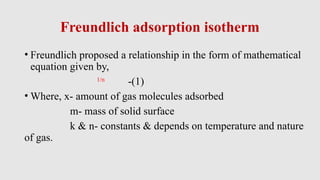
• Freundlich proposed a relationship in the form of mathematical
equation given by,
1/n
-(1)
• Where, x- amount of gas molecules adsorbed
m- mass of solid surface
k & n- constants & depends on temperature and nature
of gas.
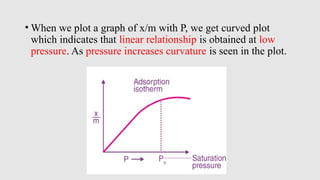
• When we plot a graph of x/m with P, we get curved plot
which indicates that linear relationship is obtained at low
pressure. As pressure increases curvature is seen in the plot.
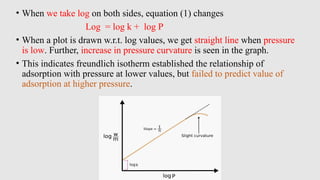
• When we take log on both sides, equation (1) changes
Log = log k + log P
• When a plot is drawn w.r.t. log values, we get straight line when pressure
is low. Further, increase in pressure curvature is seen in the graph.
• This indicates freundlich isotherm established the relationship of
adsorption with pressure at lower values, but failed to predict value of
adsorption at higher pressure.
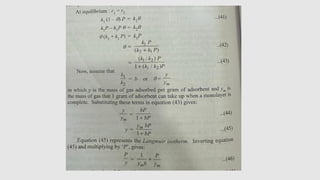
Langmuir adsorption isotherm
Assumptions:
The surface of solid possess fixed number of active sites for
the adsorption of gases
At maximum adsorption, the gas layer is found around the
solid and only one molecule thick
The rate of adsorption  number of sites unoccupied
The rate of evaporation (desorption)  number of occupied
sites
• Closed vessel is taken with the solid surface in which gas
molecules are introduced at constant pressure.
• Initially the concentration of free gas molecules is on the
greater side, but with the time they get adsorbed on the solid
surface.
• Simultaneously some gas molecules get evaporated from the
surface to free molecule state.
• This at equilibrium. Adsorption = desorption
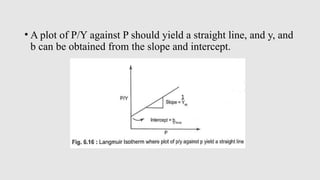
• A plot of P/Y against P should yield a straight line, and y, and
b can be obtained from the slope and intercept.
1/Ymb
1
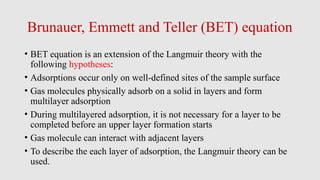
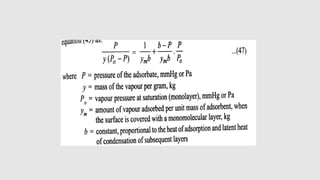
Brunauer, Emmett and Teller (BET) equation
• BET equation is an extension of the Langmuir theory with the
following hypotheses:
• Adsorptions occur only on well-defined sites of the sample surface
• Gas molecules physically adsorb on a solid in layers and form
multilayer adsorption
• During multilayered adsorption, it is not necessary for a layer to be
completed before an upper layer formation starts
• Gas molecule can interact with adjacent layers
• To describe the each layer of adsorption, the Langmuir theory can be
used.
Types of adsorption isotherm
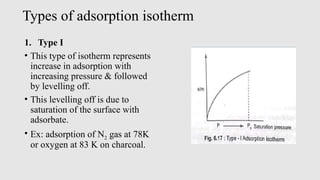
1. Type I
• This type of isotherm represents
increase in adsorption with
increasing pressure & followed
by levelling off.
• This levelling off is due to
saturation of the surface with
adsorbate.
• Ex: adsorption of N2 gas at 78K
or oxygen at 83 K on charcoal.
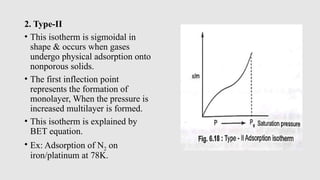
2. Type-II
• This isotherm is sigmoidal in
shape & occurs when gases
undergo physical adsorption onto
nonporous solids.
• The first inflection point
represents the formation of
monolayer, When the pressure is
increased multilayer is formed.
• This isotherm is explained by
BET equation.
• Ex: Adsorption of N2 on
iron/platinum at 78K.
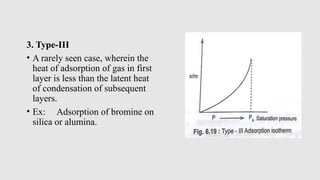
3. Type-III
• A rarely seen case, wherein the
heat of adsorption of gas in first
layer is less than the latent heat
of condensation of subsequent
layers.
• Ex: Adsorption of bromine on
silica or alumina.
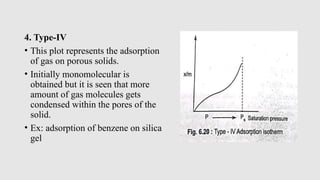
4. Type-IV
• This plot represents the adsorption
of gas on porous solids.
• Initially monomolecular is
obtained but it is seen that more
amount of gas molecules gets
condensed within the pores of the
solid.
• Ex: adsorption of benzene on silica
gel
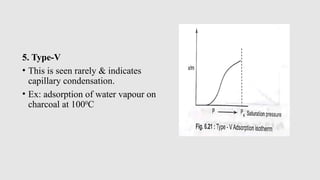
5. Type-V
• This is seen rarely & indicates
capillary condensation.
• Ex: adsorption of water vapour on
charcoal at 1000
C
Applications of adsorption at solid/liquid
interface
• Gas mask
• Antidote in poisoning
• Removal of coloring matter from solution
• Chromatographic analysis
THANK YOU