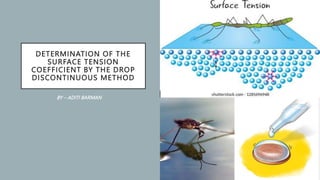
DETERMINATION OF THE
SURFACE TENSION
COEFFICIENT BY THE DROP
DISCONTINUOUS METHOD
BY – ADITI BARMAN
WHAT IS SURFACE TENSION ?
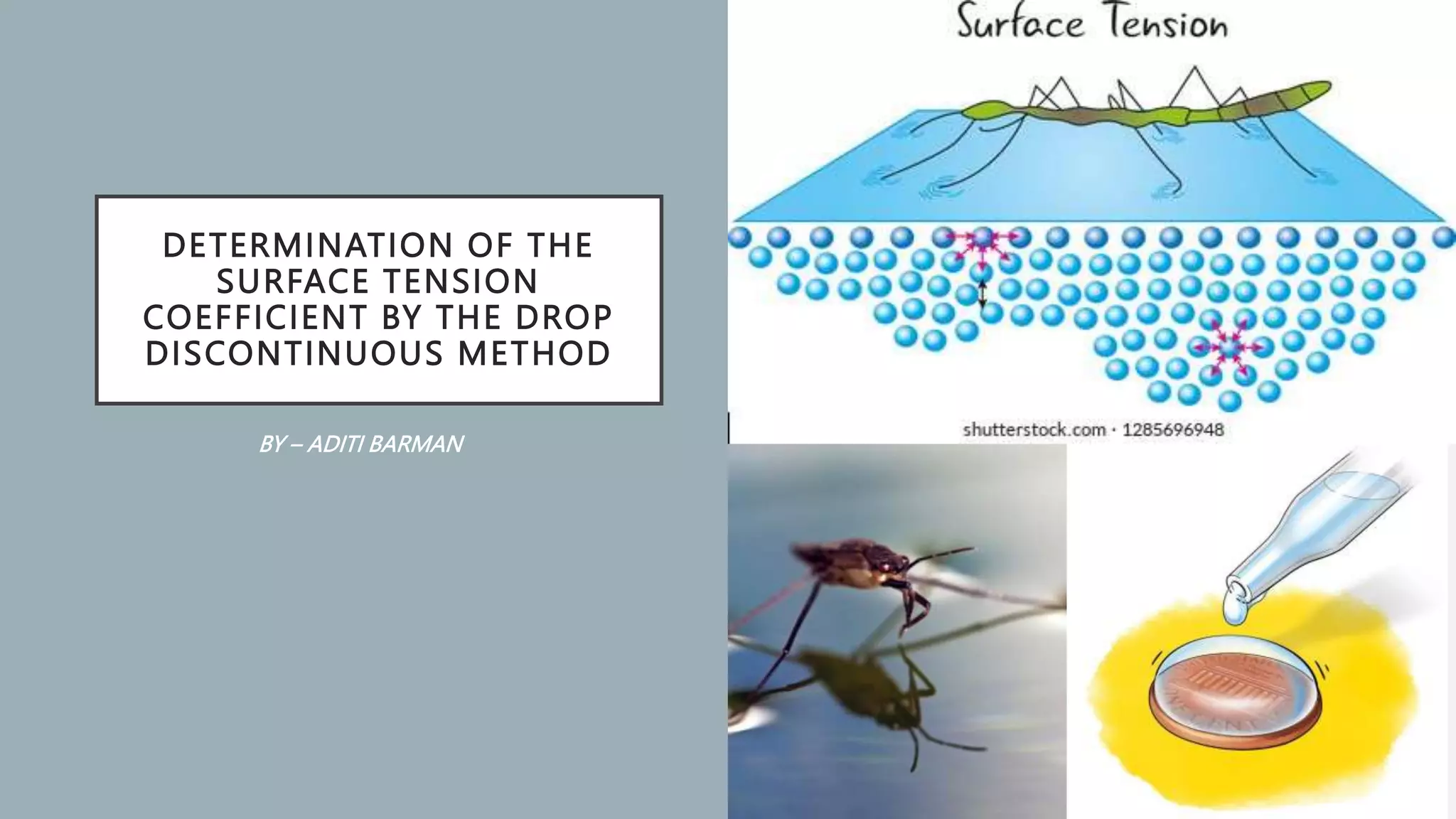
• Surface tension is defined as the tension of the
surface film of a liquid caused by the attraction of
the particles in the surface layer by the bulk of
the liquid , which tends to minimize surface area .
• It is due to the phenomenon of surface tension
that the drops of water tend to assume a
spherical shape to attain minimum surface area .
• At liquid – air interfaces , surface tension results from the greater attraction of liquid molecules to each
other ( due to cohesion ) than to molecules in the air ( due to adhesion ) .
• Surface tension has the dimension of force per unit length or energy per unit area . The two are
equivalent , but when referring to energy per unit area , it is common to use the term surface energy ,
which is more general term in the sense that it applies also to solids .
• In material science, surface tension is used for either surface stress or surface free energy.
• SI unit of Surface Tension is (N/m) or (J/m²)
• Its dimension is [M⁰ L¹ T ‐ ² ]
• Angle of contact : The angle measured from the side of the liquid , between the tangent to the solid
surface inside the liquid and tangent to the free liquid surface at the point of contact between solid
and liquid surfaces .
HOW CAN WE EXPLAIN SURFACE TENSION ?
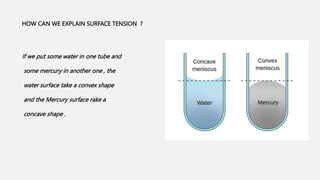
If we put some water in one tube and
some mercury in another one , the
water surface take a convex shape
and the Mercury surface rake a
concave shape .
EXAMPLES OF SURFACE TENSION
WALKING ON WATER :
Small insects such as
the water strider can
walk on water because
their weight is not
enough to penetrate
the surface
FLOATING NEEDLE : A carefully
placed small needle can be made
to float on the surface of water
even though it is several times as
dense as water . If the surface is
agitated to break up the surface
tension , then needle will quickly
sink
SURFACE TENSION AND
DROPLETS : Surface tension is
responsible for the shape of
liquid droplets . Although easily
deformed , droplets of water
tend to be pulled into a spherical
shape by the cohesive forces of
the surface layer
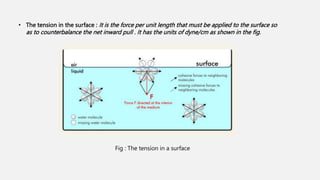
• The tension in the surface : It is the force per unit length that must be applied to the surface so
as to counterbalance the net inward pull . It has the units of dyne/cm as shown in the fig.
Fig : The tension in a surface
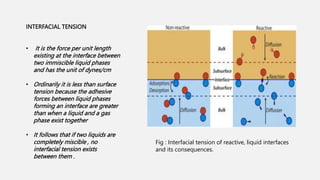
INTERFACIAL TENSION
• It is the force per unit length
existing at the interface between
two immiscible liquid phases
and has the unit of dynes/cm
• Ordinarily it is less than surface
tension because the adhesive
forces between liquid phases
forming an interface are greater
than when a liquid and a gas
phase exist together
• It follows that if two liquids are
completely miscible , no
interfacial tension exists
between them .
Fig : Interfacial tension of reactive, liquid interfaces
and its consequences.
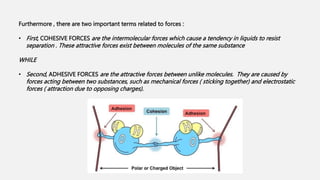
Furthermore , there are two important terms related to forces :
• First, COHESIVE FORCES are the intermolecular forces which cause a tendency in liquids to resist
separation . These attractive forces exist between molecules of the same substance
WHILE
• Second, ADHESIVE FORCES are the attractive forces between unlike molecules. They are caused by
forces acting between two substances, such as mechanical forces ( sticking together) and electrostatic
forces ( attraction due to opposing charges).
FACTORS AFFECTING SURFACE TENSION
• Impurities present in a liquid appreciably affect surface tension . A highly soluble substance like salt
increases the surface tension whereas sparingly soluble substances like soap decreases the surface
tension .
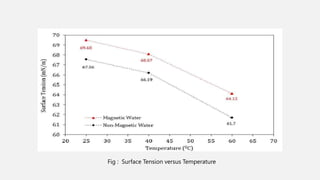
• The surface tension decreases with rise in temperature. The temperature at which the surface
tension of a liquid becomes zero is called critical temperature of the liquid .
• EFFECT OF TEMPERATURE
• Oxygen in the atmosphere is known to decrease the surface tension of various substances.
• With increase in Temperature, Surface Tension decreases .
• At critical temperature , Surface Tension is Zero.
• Critical temperature of water is 3744K.
• Surface tension increases with impurity.
Fig : Surface Tension versus Temperature
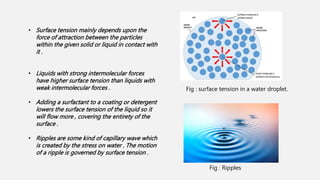
• Surface tension mainly depends upon the
force of attraction between the particles
within the given solid or liquid in contact with
it .
• Liquids with strong intermolecular forces
have higher surface tension than liquids with
weak intermolecular forces .
• Adding a surfactant to a coating or detergent
lowers the surface tension of the liquid so it
will flow more , covering the entirety of the
surface .
• Ripples are some kind of capillary wave which
is created by the stress on water . The motion
of a ripple is governed by surface tension .
Fig : surface tension in a water droplet.
Fig : Ripples
APPLICATION OF SURFACE TENSION
• Surface tension of soap solution is less , it can spread over large areas and wash clothes more
effectively, since the dirt particles stick to the soap molecules .
• In soldering , addition of flux reduces the surface tension of molten tin . Hence , it spreads .
• Antiseptics like dettol have low surface tension , so they spread faster .
• Surface Tension prevents water from passing through pores of an umbrella .
• A duck is able to float on water as its feathers secrete oil that lowers the surface tension of water .
METHODS TO MEASURE SURFACE TENSION
• Various methods can be used for determination of the surface and interface tensions .
• Some of these methods determine the surface tension only , and some are used for
determination of both surface and interface tensions
• The main methods used are
1. Capillary method
2. Wilhelmy plate method
3. Ring detachment method
4. Drop method
• Simple dropper method
• Donnan pipette method
• Pendant drop method
• Sessile drop method
5. Oscillating jet method
6. Maximum bubble pressure method
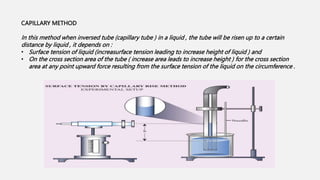
CAPILLARY METHOD
In this method when inversed tube (capillary tube ) in a liquid , the tube will be risen up to a certain
distance by liquid , it depends on :
• Surface tension of liquid (increasurface tension leading to increase height of liquid ) and
• On the cross section area of the tube ( increase area leads to increase height ) for the cross section
area at any point upward force resulting from the surface tension of the liquid on the circumference .
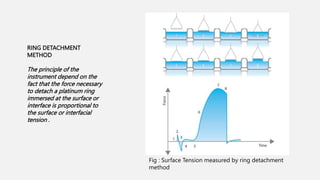
RING DETACHMENT
METHOD
The principle of the
instrument depend on the
fact that the force necessary
to detach a platinum ring
immersed at the surface or
interface is proportional to
the surface or interfacial
tension .
Fig : Surface Tension measured by ring detachment
method
DETERMINATION OF SURFACE TENSION OF LIQUID BY DROP WEIGHT METHOD ( drop discontinuous)
The surface tension of the liquid is related to the weight of a drop of that liquid which falls freely from the
end of the tube by the expression :
y = (MG ×F ) / R
y = surface tension (gm.cm/sec²=dyne/cm)
M = mass of one drop ,
R = radius ,
F= correction factor
G= 980cm/sec² or 9.8 m/sec²
PROCEDURE
1. Check that the glass tip is very clean and free from any defect particularly around the edges .
2. Allow the drop (e.g. Water) to detach slowly from the tip & collect 10-15 drops in a beaker under
constant conditions ( constant temperature ) .
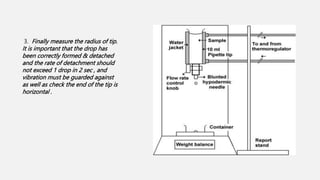
3. Finally measure the radius of tip.
It is important that the drop has
been correctly formed & detached
and the rate of detachment should
not exceed 1 drop in 2 sec , and
vibration must be guarded against
as well as check the end of the tip is
horizontal .
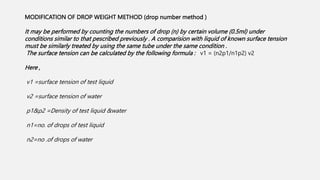
MODIFICATION OF DROP WEIGHT METHOD (drop number method )
It may be performed by counting the numbers of drop (n) by certain volume (0.5ml) under
conditions similar to that pescribed previously . A comparision with liquid of known surface tension
must be similarly treated by using the same tube under the same condition .
The surface tension can be calculated by the following formula : v1 = (n2p1/n1p2) v2
Here ,
v1 =surface tension of test liquid
v2 =surface tension of water
p1&ρ2 =Density of test liquid &water
n1=no. of drops of test liquid
n2=no .of drops of water
THANK YOU

Surface tension.pptx

  • 1.
    DETERMINATION OF THE SURFACETENSION COEFFICIENT BY THE DROP DISCONTINUOUS METHOD BY – ADITI BARMAN
  • 2.
    WHAT IS SURFACETENSION ? • Surface tension is defined as the tension of the surface film of a liquid caused by the attraction of the particles in the surface layer by the bulk of the liquid , which tends to minimize surface area . • It is due to the phenomenon of surface tension that the drops of water tend to assume a spherical shape to attain minimum surface area .
  • 3.
    • At liquid– air interfaces , surface tension results from the greater attraction of liquid molecules to each other ( due to cohesion ) than to molecules in the air ( due to adhesion ) . • Surface tension has the dimension of force per unit length or energy per unit area . The two are equivalent , but when referring to energy per unit area , it is common to use the term surface energy , which is more general term in the sense that it applies also to solids . • In material science, surface tension is used for either surface stress or surface free energy. • SI unit of Surface Tension is (N/m) or (J/m²) • Its dimension is [M⁰ L¹ T ‐ ² ] • Angle of contact : The angle measured from the side of the liquid , between the tangent to the solid surface inside the liquid and tangent to the free liquid surface at the point of contact between solid and liquid surfaces .
  • 4.
    HOW CAN WEEXPLAIN SURFACE TENSION ? If we put some water in one tube and some mercury in another one , the water surface take a convex shape and the Mercury surface rake a concave shape .
  • 5.
    EXAMPLES OF SURFACETENSION WALKING ON WATER : Small insects such as the water strider can walk on water because their weight is not enough to penetrate the surface FLOATING NEEDLE : A carefully placed small needle can be made to float on the surface of water even though it is several times as dense as water . If the surface is agitated to break up the surface tension , then needle will quickly sink SURFACE TENSION AND DROPLETS : Surface tension is responsible for the shape of liquid droplets . Although easily deformed , droplets of water tend to be pulled into a spherical shape by the cohesive forces of the surface layer
  • 6.
    • The tensionin the surface : It is the force per unit length that must be applied to the surface so as to counterbalance the net inward pull . It has the units of dyne/cm as shown in the fig. Fig : The tension in a surface
  • 7.
    INTERFACIAL TENSION • Itis the force per unit length existing at the interface between two immiscible liquid phases and has the unit of dynes/cm • Ordinarily it is less than surface tension because the adhesive forces between liquid phases forming an interface are greater than when a liquid and a gas phase exist together • It follows that if two liquids are completely miscible , no interfacial tension exists between them . Fig : Interfacial tension of reactive, liquid interfaces and its consequences.
  • 8.
    Furthermore , thereare two important terms related to forces : • First, COHESIVE FORCES are the intermolecular forces which cause a tendency in liquids to resist separation . These attractive forces exist between molecules of the same substance WHILE • Second, ADHESIVE FORCES are the attractive forces between unlike molecules. They are caused by forces acting between two substances, such as mechanical forces ( sticking together) and electrostatic forces ( attraction due to opposing charges).
  • 9.
    FACTORS AFFECTING SURFACETENSION • Impurities present in a liquid appreciably affect surface tension . A highly soluble substance like salt increases the surface tension whereas sparingly soluble substances like soap decreases the surface tension . • The surface tension decreases with rise in temperature. The temperature at which the surface tension of a liquid becomes zero is called critical temperature of the liquid . • EFFECT OF TEMPERATURE • Oxygen in the atmosphere is known to decrease the surface tension of various substances. • With increase in Temperature, Surface Tension decreases . • At critical temperature , Surface Tension is Zero. • Critical temperature of water is 3744K. • Surface tension increases with impurity.
  • 10.
    Fig : SurfaceTension versus Temperature
  • 11.
    • Surface tensionmainly depends upon the force of attraction between the particles within the given solid or liquid in contact with it . • Liquids with strong intermolecular forces have higher surface tension than liquids with weak intermolecular forces . • Adding a surfactant to a coating or detergent lowers the surface tension of the liquid so it will flow more , covering the entirety of the surface . • Ripples are some kind of capillary wave which is created by the stress on water . The motion of a ripple is governed by surface tension . Fig : surface tension in a water droplet. Fig : Ripples
  • 12.
    APPLICATION OF SURFACETENSION • Surface tension of soap solution is less , it can spread over large areas and wash clothes more effectively, since the dirt particles stick to the soap molecules . • In soldering , addition of flux reduces the surface tension of molten tin . Hence , it spreads . • Antiseptics like dettol have low surface tension , so they spread faster . • Surface Tension prevents water from passing through pores of an umbrella . • A duck is able to float on water as its feathers secrete oil that lowers the surface tension of water .
  • 13.
    METHODS TO MEASURESURFACE TENSION • Various methods can be used for determination of the surface and interface tensions . • Some of these methods determine the surface tension only , and some are used for determination of both surface and interface tensions • The main methods used are 1. Capillary method 2. Wilhelmy plate method 3. Ring detachment method 4. Drop method • Simple dropper method • Donnan pipette method • Pendant drop method • Sessile drop method 5. Oscillating jet method 6. Maximum bubble pressure method
  • 14.
    CAPILLARY METHOD In thismethod when inversed tube (capillary tube ) in a liquid , the tube will be risen up to a certain distance by liquid , it depends on : • Surface tension of liquid (increasurface tension leading to increase height of liquid ) and • On the cross section area of the tube ( increase area leads to increase height ) for the cross section area at any point upward force resulting from the surface tension of the liquid on the circumference .
  • 15.
    RING DETACHMENT METHOD The principleof the instrument depend on the fact that the force necessary to detach a platinum ring immersed at the surface or interface is proportional to the surface or interfacial tension . Fig : Surface Tension measured by ring detachment method
  • 16.
    DETERMINATION OF SURFACETENSION OF LIQUID BY DROP WEIGHT METHOD ( drop discontinuous) The surface tension of the liquid is related to the weight of a drop of that liquid which falls freely from the end of the tube by the expression : y = (MG ×F ) / R y = surface tension (gm.cm/sec²=dyne/cm) M = mass of one drop , R = radius , F= correction factor G= 980cm/sec² or 9.8 m/sec² PROCEDURE 1. Check that the glass tip is very clean and free from any defect particularly around the edges . 2. Allow the drop (e.g. Water) to detach slowly from the tip & collect 10-15 drops in a beaker under constant conditions ( constant temperature ) .
  • 17.
    3. Finally measurethe radius of tip. It is important that the drop has been correctly formed & detached and the rate of detachment should not exceed 1 drop in 2 sec , and vibration must be guarded against as well as check the end of the tip is horizontal .
  • 18.
    MODIFICATION OF DROPWEIGHT METHOD (drop number method ) It may be performed by counting the numbers of drop (n) by certain volume (0.5ml) under conditions similar to that pescribed previously . A comparision with liquid of known surface tension must be similarly treated by using the same tube under the same condition . The surface tension can be calculated by the following formula : v1 = (n2p1/n1p2) v2 Here , v1 =surface tension of test liquid v2 =surface tension of water p1&ρ2 =Density of test liquid &water n1=no. of drops of test liquid n2=no .of drops of water
  • 19.