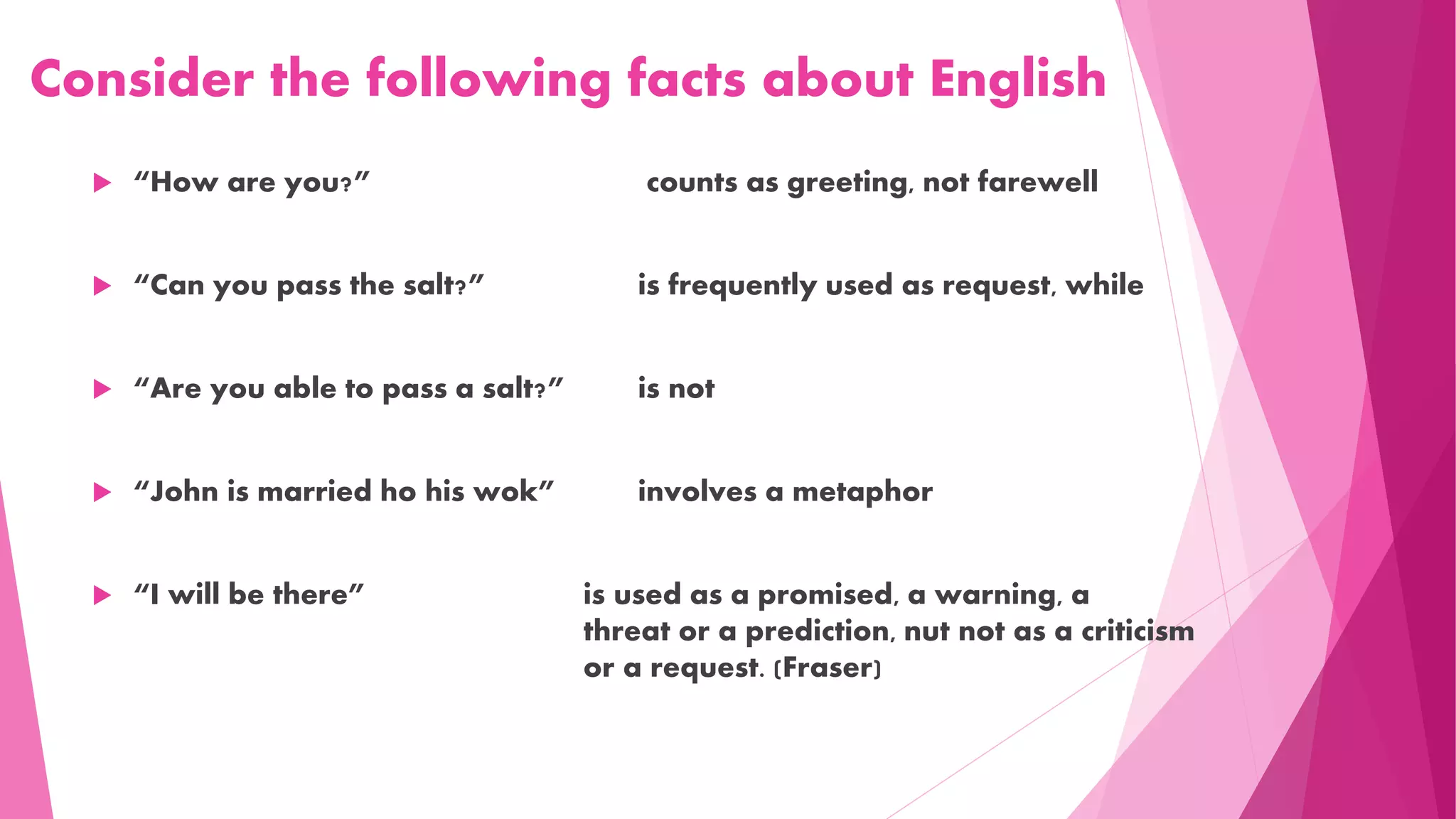
Consider the following facts about English
 “How are you?” counts as greeting, not farewell
 “Can you pass the salt?” is frequently used as request, while
 “Are you able to pass a salt?” is not
 “John is married ho his wok” involves a metaphor
 “I will be there” is used as a promised, a warning, a
threat or a prediction, nut not as a criticism
or a request. (Fraser)
PRAGMATICS
Dhanne Mae C. Cabilitasan
“An operational definition of
an insecure science is: a science
whose leaders say they are in
quest for a paradigm, or have
just found a paradigm. “
(Hacking 1995)
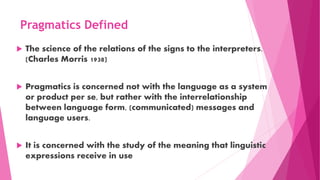
Pragmatics Defined
 The science of the relations of the signs to the interpreters.
(Charles Morris 1938)
 Pragmatics is concerned not with the language as a system
or product per se, but rather with the interrelationship
between language form, (communicated) messages and
language users.
 It is concerned with the study of the meaning that linguistic
expressions receive in use
Pragmatics Defined
 The word pragmatics derives via Latin pragmaticus from
the Greek πραγματικός (pragmatikos), meaning amongst
others "fit for action",which comes from πρᾶγμα
(pragma), "deed, act", and that from πράσσω (prassō), "to
pass over, to practise, to achieve". (Wikipedia)
 Pragmatics is a subfield
of linguistics and semiotics which studies the ways in
which context contributes to meaning. Pragmatics
encompasses speech act theory,
conversational implicature, talk in interaction and other
approaches to language behavior
inphilosophy, sociology, linguistics and anthropology.
(Wikipedia)
 How do people communicate more than what the words or
phrases of their utterances might mean by themselves, and how
do people make these interpretations?
 Why do people choose to say or interpret something in a way
rather than another?
 How do people’s perception of contextual factors influence the
process of producing and interpreting language?s
Pragmatics Defined
A Sample Dialogue
(1) Kiki: Where are you going tonight?
(2) Sharon : Ministry.
(3) Kiki: Ministry?
(4) Sharon: Ministry of sound. A club in London. Heard of it?
(5) Kiki: I’ve been clubbing in London before.
(6) Sharon: Where to..?
(7) Kiki: why do you want to know?
(8) Sharon: Well, I may have been there.
(9) Kiki: It was called “The End”
(10) Sharon: Nice one!
(11) Kiki : I hope you have a good time at the Ministry.
Assigning Reference
 The relationship between meaning of a word or phrase and the
objector person in the world
 also involves the interpretation of ‘deictic expressions’. These
are linguistic items that point to contextually salient referents
without naming them explicitly. There are several types of deictic
expressions in the dialogue: person deictics (for example, the
personal pronouns you , it , I , place deictics (for example, there ,
and time deictics (for example, the tensed forms of the verbs).
Aspects of Decontextualizing Meaning
Figuring out what is communicated directly
 Contextually determined aspects of utterances
meaning
 Sometimes the process of identifying pragmatic
meaning (that is, contextually determined aspects of
utterance meaning) involves interpreting ambiguous
and vague linguistic expressions in order to establish
which concepts and thoughts they express
Figuring out what is communicated indirectly
 What is implied?
 The main import of an utterance may, in fact, easily
lie not with the thought expressed by the utterance
(that is, with what is communicated directly) but
rather with the thought(s) that the hearer assumes
the speaker intends to suggest or hint at. More
technically, it lies with what is implicated, or
communicated indirectly.
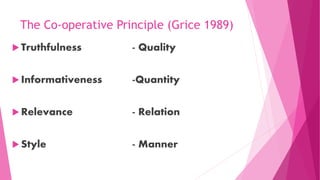
The Co-operative Principle (Grice 1989)
 Truthfulness - Quality
 Informativeness -Quantity
 Relevance - Relation
 Style - Manner
Impact of Social Factors
Politeness Principle (Leech 1983)
Politeness Maxims
Modesty Maxims
Agreement Maxims
Impact of Social Factors
Parmalinguistics Perpecrive
The pragmalinguistic perspective focuses on the
linguistic strategies that are used to convey a given
pragmatic meaning
Sociopragmatic Perpective
the sociopragmatic perspective focuses on the socially-
based assessments, beliefs and interactional principles
that underlie people’s choice of strategies
“Face” Model of Politeness (Brown and Levinson,
1978/1987)
Positive Face
Positive face reflects every person’s need that
his/her self-image is appreciated and
approved of.
Negative Face
Negative face reflects every person’s ‘basic
claim to territories, personal preserves, rights
to non-distraction
Impact of Social Factors
Three main variable in deciding
FACE THREATENING utterance
 The power differential between hearer and
speaker (P)
 The distance-closeness between them (D)
 The degree of imposition of the content of
utterance
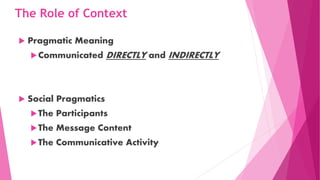
The Role of Context
 Pragmatic Meaning
Communicated DIRECTLY and INDIRECTLY
 Social Pragmatics
The Participants
The Message Content
The Communicative Activity
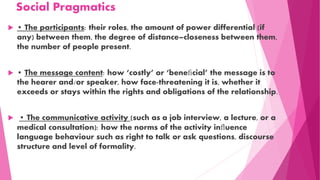
Social Pragmatics
 • The participants: their roles, the amount of power differential (if
any) between them, the degree of distance–closeness between them,
the number of people present.
 • The message content: how ‘costly’ or ‘beneficial’ the message is to
the hearer and/or speaker, how face-threatening it is, whether it
exceeds or stays within the rights and obligations of the relationship.
 • The communicative activity (such as a job interview, a lecture, or a
medical consultation): how the norms of the activity influence
language behaviour such as right to talk or ask questions, discourse
structure and level of formality.
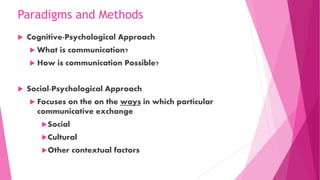
Paradigms and Methods
 Cognitive-Psychological Approach
 What is communication?
 How is communication Possible?
 Social-Psychological Approach
 Focuses on the on the ways in which particular
communicative exchange
Social
Cultural
Other contextual factors
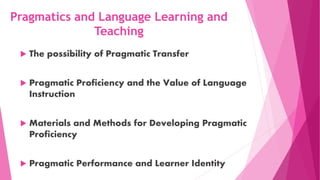
Pragmatics and Language Learning and
Teaching
 The possibility of Pragmatic Transfer
 Pragmatic Proficiency and the Value of Language
Instruction
 Materials and Methods for Developing Pragmatic
Proficiency
 Pragmatic Performance and Learner Identity
The possibility of Pragmatic Transfer
 What cultural difference (if any) are there in the effect
of context on the performance of speech acts?
 What cultural difference (if any) are there in the impact
of sociopragmatic principle on people’s performance of
speech acts?
 What language differences (if any) are there in the
influence of pragmalinguistic conventions on the
performance of speech acts?
Pragmatic Proficiency and the Value of
Language Instruction
 Is the pragmatic feature teachable to all?
 Is instruction in the targeted feature more
effective that no instruction?
 Are different teaching approaches differentially
effective?
What is pragmatics?
 “It is the study of speaker meaning”
 It is concerned with the study of meaning as communicated by
speaker and interpreted by listener.
 “It is the study of contextual meaning”
 It involves interpretation of what people mean in a particular
context and how the context influences what is said.
What is pragmatics?
 “It is the study of how more gets communicated than is said”
 This type of study explores how great deal of what is unsaid
is recognized as part of what is communicated.
 “It is the study of the expression of relative distance “
 On the assumption of how close and distant the listener is
speakers determine how much needs to be said.
Pragmatics

Pragmatics

  • 1.
    Consider the followingfacts about English  “How are you?” counts as greeting, not farewell  “Can you pass the salt?” is frequently used as request, while  “Are you able to pass a salt?” is not  “John is married ho his wok” involves a metaphor  “I will be there” is used as a promised, a warning, a threat or a prediction, nut not as a criticism or a request. (Fraser)
  • 2.
  • 3.
    “An operational definitionof an insecure science is: a science whose leaders say they are in quest for a paradigm, or have just found a paradigm. “ (Hacking 1995)
  • 4.
    Pragmatics Defined  Thescience of the relations of the signs to the interpreters. (Charles Morris 1938)  Pragmatics is concerned not with the language as a system or product per se, but rather with the interrelationship between language form, (communicated) messages and language users.  It is concerned with the study of the meaning that linguistic expressions receive in use
  • 5.
    Pragmatics Defined  Theword pragmatics derives via Latin pragmaticus from the Greek πραγματικός (pragmatikos), meaning amongst others "fit for action",which comes from πρᾶγμα (pragma), "deed, act", and that from πράσσω (prassō), "to pass over, to practise, to achieve". (Wikipedia)
  • 6.
     Pragmatics isa subfield of linguistics and semiotics which studies the ways in which context contributes to meaning. Pragmatics encompasses speech act theory, conversational implicature, talk in interaction and other approaches to language behavior inphilosophy, sociology, linguistics and anthropology. (Wikipedia)
  • 7.
     How dopeople communicate more than what the words or phrases of their utterances might mean by themselves, and how do people make these interpretations?  Why do people choose to say or interpret something in a way rather than another?  How do people’s perception of contextual factors influence the process of producing and interpreting language?s Pragmatics Defined
  • 8.
    A Sample Dialogue (1)Kiki: Where are you going tonight? (2) Sharon : Ministry. (3) Kiki: Ministry? (4) Sharon: Ministry of sound. A club in London. Heard of it? (5) Kiki: I’ve been clubbing in London before. (6) Sharon: Where to..? (7) Kiki: why do you want to know? (8) Sharon: Well, I may have been there. (9) Kiki: It was called “The End” (10) Sharon: Nice one! (11) Kiki : I hope you have a good time at the Ministry.
  • 9.
    Assigning Reference  Therelationship between meaning of a word or phrase and the objector person in the world  also involves the interpretation of ‘deictic expressions’. These are linguistic items that point to contextually salient referents without naming them explicitly. There are several types of deictic expressions in the dialogue: person deictics (for example, the personal pronouns you , it , I , place deictics (for example, there , and time deictics (for example, the tensed forms of the verbs). Aspects of Decontextualizing Meaning
  • 10.
    Figuring out whatis communicated directly  Contextually determined aspects of utterances meaning  Sometimes the process of identifying pragmatic meaning (that is, contextually determined aspects of utterance meaning) involves interpreting ambiguous and vague linguistic expressions in order to establish which concepts and thoughts they express
  • 11.
    Figuring out whatis communicated indirectly  What is implied?  The main import of an utterance may, in fact, easily lie not with the thought expressed by the utterance (that is, with what is communicated directly) but rather with the thought(s) that the hearer assumes the speaker intends to suggest or hint at. More technically, it lies with what is implicated, or communicated indirectly.
  • 12.
    The Co-operative Principle(Grice 1989)  Truthfulness - Quality  Informativeness -Quantity  Relevance - Relation  Style - Manner
  • 13.
    Impact of SocialFactors Politeness Principle (Leech 1983) Politeness Maxims Modesty Maxims Agreement Maxims
  • 14.
    Impact of SocialFactors Parmalinguistics Perpecrive The pragmalinguistic perspective focuses on the linguistic strategies that are used to convey a given pragmatic meaning Sociopragmatic Perpective the sociopragmatic perspective focuses on the socially- based assessments, beliefs and interactional principles that underlie people’s choice of strategies
  • 15.
    “Face” Model ofPoliteness (Brown and Levinson, 1978/1987) Positive Face Positive face reflects every person’s need that his/her self-image is appreciated and approved of. Negative Face Negative face reflects every person’s ‘basic claim to territories, personal preserves, rights to non-distraction Impact of Social Factors
  • 16.
    Three main variablein deciding FACE THREATENING utterance  The power differential between hearer and speaker (P)  The distance-closeness between them (D)  The degree of imposition of the content of utterance
  • 17.
    The Role ofContext  Pragmatic Meaning Communicated DIRECTLY and INDIRECTLY  Social Pragmatics The Participants The Message Content The Communicative Activity
  • 18.
    Social Pragmatics  •The participants: their roles, the amount of power differential (if any) between them, the degree of distance–closeness between them, the number of people present.  • The message content: how ‘costly’ or ‘beneficial’ the message is to the hearer and/or speaker, how face-threatening it is, whether it exceeds or stays within the rights and obligations of the relationship.  • The communicative activity (such as a job interview, a lecture, or a medical consultation): how the norms of the activity influence language behaviour such as right to talk or ask questions, discourse structure and level of formality.
  • 19.
    Paradigms and Methods Cognitive-Psychological Approach  What is communication?  How is communication Possible?  Social-Psychological Approach  Focuses on the on the ways in which particular communicative exchange Social Cultural Other contextual factors
  • 20.
    Pragmatics and LanguageLearning and Teaching  The possibility of Pragmatic Transfer  Pragmatic Proficiency and the Value of Language Instruction  Materials and Methods for Developing Pragmatic Proficiency  Pragmatic Performance and Learner Identity
  • 21.
    The possibility ofPragmatic Transfer  What cultural difference (if any) are there in the effect of context on the performance of speech acts?  What cultural difference (if any) are there in the impact of sociopragmatic principle on people’s performance of speech acts?  What language differences (if any) are there in the influence of pragmalinguistic conventions on the performance of speech acts?
  • 22.
    Pragmatic Proficiency andthe Value of Language Instruction  Is the pragmatic feature teachable to all?  Is instruction in the targeted feature more effective that no instruction?  Are different teaching approaches differentially effective?
  • 23.
    What is pragmatics? “It is the study of speaker meaning”  It is concerned with the study of meaning as communicated by speaker and interpreted by listener.  “It is the study of contextual meaning”  It involves interpretation of what people mean in a particular context and how the context influences what is said.
  • 24.
    What is pragmatics? “It is the study of how more gets communicated than is said”  This type of study explores how great deal of what is unsaid is recognized as part of what is communicated.  “It is the study of the expression of relative distance “  On the assumption of how close and distant the listener is speakers determine how much needs to be said.