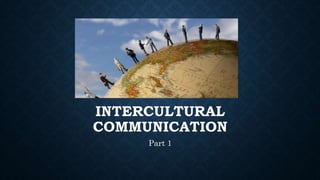
INTERCULTURAL
COMMUNICATION
Part 1
Defining Intercultural Communication:
According to Ting-Toorney (1999) :
Intercultural communication takes place when individuals influenced by different
cultural communities negotiate shared meanings in interaction. What counts as
intercultural communication depends in part on what one considers a culture, and the
definition of culture itself is quite contestable.
Ting-toomey, S. (1999). Communicating across cultures. New York: The Guilford Press
«Certainly proficiency in the host culture language is valuable for intercultural
competence. But it is not enough to know the grammar and vocabulary of that
language; the competent communicator will also understand language pragmatics like
how to use politeness strategies in making requests or how to avoid giving out too
much information.» (Gass&Neu, 1996)
«Equally important, competent communicators are sensitive to nonverbal
communication patterns in other cultures.» (Anderson, 2003)
Gass, S. M., & Neu, J. (Eds.). (1996). Speect act across cultures: Challenges to
communication in a second language. Berlin: Mouton De Gruyter.
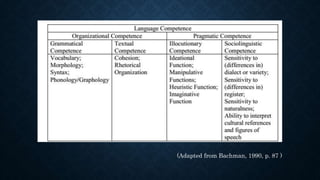
(Adapted from Bachman, 1990, p. 87 )
The importance of pragmatic competence can be explained within
a language situation; for example in Japan saying, “I am sorry” might be enough of an
apology in many situations, whereas in other cultures such as that of Jordan, an
explanation for the offense might be required (Bataineh & Bataineh, 2008).
WHAT IS ETHNOCENTRISM?
«The foundation of intercultural communication competence is the capacity to avoid
ethnocentrism. Ethnocentrism is the inclination to view one’s own group as natural
and correct, and all others as aberrant. We tend to think prescriptively, that all groups
should behave as our own group behaves. And we are naturally proud of our own
group and distrustful of others. Obviously a person who is highly ethnocentric cannot
adapt to diverse people, and cannot communicate in an interculturally competent
manner.» (Gudykunst, 2005)
Gudykunst, W. B. (2005). An anxiety/uncertainty management (AUM) theory of
effective communication: Making the mesh of the net finer. In W.R. Gudykunst (Ed.),
Theorizing about intercultural communication, 281–322. Thousand Oaks, CA: Sage.
COMMUNICATING ACROSS DIVERSE WORLD VIEWS AND VALUES
• Hall (1983) explained that some cultures are mono-chronic. They regard time as
segmentable, an almost tangible commodity. Monochronic cultures value schedules
and can evolve efficient bureaucracies. Polychroniccultures, on the other hand,
regard events as embedded in more of a simultaneous matrix of occurrences. Little
value is placed on demarcating work time as opposed to socialization time, for
instance. People in polychromic cultures are little concerned with promptness or
deadlines.
Hall, E. T. (1983). The dance of life: The other dimension of time. New York: Random
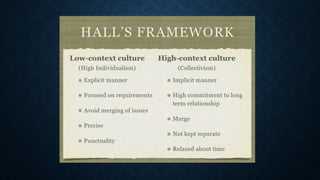
House.
THEORIES
HALL: CONTEXT THEORY
HIGH-CONTEXT & LOW-CONTEXT
« Communication varies according to its degree of field dependence, and that it can be
classified two general categories = High-context and Low-context»
Le Baron, 2003
«High-context and Low-context Communication refers to the degree to which speakers
rely on factors other than explicit speech to convey their message.»
Hall, 1971
Hall, E. (2011). Nonverbal communication; Intercultural relations; Anthropology,
Edward T. Hall. Avaliable at http://www.edwardthall.com
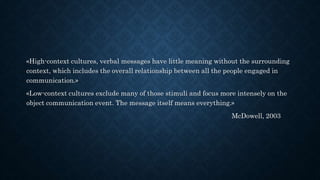
«High-context cultures, verbal messages have little meaning without the surrounding
context, which includes the overall relationship between all the people engaged in
communication.»
«Low-context cultures exclude many of those stimuli and focus more intensely on the
object communication event. The message itself means everything.»
McDowell, 2003
GUDYKUNST AND KIM: COMMUNICATING WITH STRANGERS
«We focus on theoretical issues more than most authors of existing texts on
intercultural communication. We believe that in order to understand the process of
intercultural communication and to improve our intercultural effectiveness, we must
have the conceptual tools to understand what is happening.»
(Gudykunst and Kim, 1997, p. xii).
• Gudykunst, W.B. & Kim, Y.Y. (1997). Communicating with strangers: An approach to
intercultural communication (3rd ed.). New York: McGraw-Hill.
• Pragmatics?
• appropriate language use in particular social and/or situational contexts
• Speech acts?
• ways of “doing things with words” (Austin, 1962)
• Using language for functional purposes
• Examples: Requests, apologies, refusals, invitations, complaints, compliments,
suggestions, giving advice, critiques, greetings, leave-takings
THE DEFINITION OF SPEECH ACT
The development of speech-act theory (Austin 1962;Searle 1969,1975, 1976; Sinclair
and Coultlıard 1975) has given us a better understanding of what a speaker needs to
know in order to perform effectively and appropriately in the act of communicating.
• A speech act is a functional unit in a communication. According to Austin’s theory of
speech acts (1962), utterances have three kinds of meaning.
• Propositional or locutionary (the literal meaning of the utterance)
• Illocutionary ( the social function that the utterance or written text has.)
• Austin adds the notion of prelocutionary force, that is, the result or effect that is
produced by the utterance in that given context.
Austin, J. L. (1962). How to do things with words. Cambridge, MA: Harvard University
Press
CAN WE LEARN INTERCULTURAL
PRAGMATICS?
CAN A NATIVE SPEAKER MODEL
SERVE AS A VIABLE MODEL FOR THE
ACQUISITION OF PRAGMATICS?
According to Anna Wierzbicka (1985):
‘Different cultures, different languages, different speech acts: English vs. Polish’, to
understand speech practices from the perspective of the speakers themselves. For this
purpose, the techniques of cross-cultural semantics are also essential because to
understand speech practices in terms which make sense to the people concerned, we
must be able to understand the meanings of the relevant culturally important words—
words for local values, social categories, speech-acts, and so on.
Wierzbicka, Anna. 1985. Different languages, different cultures, different speech acts:
English vs. Polish. Journal of Pragmatics 9: 145–178
According to Kasper (1997, as cited in McKay, 2002, p. 74-75), there are several reasons
why a native speaker model cannot serve as a viable model for the acquisition of
pragmatics:
• “native speaker of English” is not a homogeneous group, and conversational
• styles can differ greatly among the speakers sharing a common culture;
• adult learners of English might not be able to develop native-like pragmatic
competence because pragmatic competence in L2 appears to be increasingly difficult to
acquire with age;
• in some contexts English language learners might lack the input and opportunities
necessary for gaining a native-like degree of pragmatic competence;
• some sociopragmatic aspects of the target language and culture might conflict
• with the learner’s values and beliefs; native-like pragmatic competence exhibited by
English language learners might be seen negatively by some native speakers of English.
INTERCULTURAL PRAGMATICS
(IN TERMS OF SPEECH ACTS)
Definition of Pragmatics
• «the study of the practical aspects of human action and thought.»
• «the study of the use of linguistic signs, (words and sentences), in actual situations.»
• «Pragmatics outlines the study of meaning in the interactional context»
(OED Online, 2012)
It looks beyond the literal meaning of an utterance and considers how meaning is constructed as well as
focusing on implied meanings. It considers language as an instrument of interaction, what people mean
when they use language and how we communicate and understand each other.
• Jenny Thomas (1995) says that pragmatics considers:
• the negotiation of meaning between speaker and listener.
• the context of the utterance.
• the meaning potential of an utterance.
Cohen (1996) states that the speaker may need to take into consideration ;
a) the culture involved
b) the age and sex of the speakers
c) their social class and occupations
d) their roles and status in the interaction.
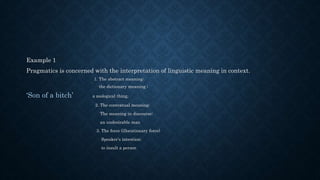
Example 1
Pragmatics is concerned with the interpretation of linguistic meaning in context.
1. The abstract meaning:
the dictionary meaning ;
‘Son of a bitch’ a zoological thing,
2. The contextual meaning:
The meaning in discourse;
an undesirable man
3. The force (illocutionary force)
Speaker’s intention;
to insult a person
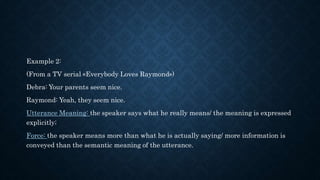
Example 2:
(From a TV serial «Everybody Loves Raymond»)
Debra: Your parents seem nice.
Raymond: Yeah, they seem nice.
Utterance Meaning: the speaker says what he really means/ the meaning is expressed
explicitly;
Force: the speaker means more than what he is actually saying/ more information is
conveyed than the semantic meaning of the utterance.
WHAT IS INTERCULTURAL PRAGMATICS?
Cross-cultural comparative studies of discourse (e.g., Gumperz and Tannen 1979,
Tannen 1982, Blum-Kulka 1982, Cohen and Olshtain 1981, Olshtain 1983, Blum-
Kulka and Olshtain 1984) have shown that rules of appropriateness vary across
cultures. Thus, for learners to become truly effective communicators in a second
language, they need to acquire these rules of appropriateness in addition to what we
have come to call linguistic competence. Modern language courses are increasingly
regarding as their ultimate goal that of affording their learners a sense of
«communicative competence" (Hymes 1964) — i.e., providing them with knowledge
about and experience in using the sociocultural rules of the new language.
One of the most important projects in the field of cross-cultural pragmatics is the
Cross Cultural Speech Acts Realization Project (CCSARP), which focused on many
languages in various contexts. Blum-Kulka & Olshtain (1984) reported on the
CCSARP, which was being conducted by many 15 researchers on different languages
(Australian English by Eija Ventola, American English by Nessa Wolfson and Ellen
Rintel, British English by Jenny Thomas, Canadian French by Elda Weizman, Danish
by Claus Faerch and Gabriele Kasper, German by Juliane House-Edmondson and
Helmut Vollmer, Hebrew by Shoshana Blum-Kulka and Elite Olshtain, and Russian
by Jenny Thomas) by using the same methodology from native and non-native
speakers of these languages to investigate speech acts of apology and requests.
INTERCULTURAL FAILURES
1) Sociopragmatic failure:
«Sociopragmatic failure: It is caused by an inadequate knowledge
of culture and social values. Let us look at an example:
Complimenter: What a big family you have!
Recipient: Yes, but it has its advantages, too.»
((Tsuda,1992)
INTERCULTURAL FAILURES
1) Pragmalinguistic failure:
«The following example illustrates a pragmalinguistic failure in which one lady shows
concern about her friend losing weight, but the friend takes it as a compliment.
Complimenter: You've lost a lot of weight. What have you been doing?
Recipient: Thank you. I've started jogging regularly and it seems to work.
Complimenter: You shouldn't overdo it. You are looking quite thin.»
(Tsuda, 1992)
DIRECT APOLOGIES
According to Cohen & Olshtain (1983), an expression of apology mostly includes
explicit illocutionary force indicating devices (IFID), which are utterances or formulaic
expressions which convey the meaning of apology or regret. These formulaic
expressions include performative verbs such as “ be sorry,” “apologize,” or “excuse.”
Since this type of apology includes direct utterances of regret and apology, they are
considered to be direct apologies.
INDIRECT APOLOGIES
Apologies do not always include a performative verb or an IFID. A variety of verbs
or statements can be used to convey the meaning of a speech act (Searle, 1976). In the
case of apologies, indirect apologies can be provided in different manners. Cohen &
Olshtain (1983) categorized the indirect apologies in the following ways: providing an
explanation, an acknowledgement of responsibility, an offer of repair, a promise of
forbearance.
The apology speech act set (according to its development in Olshtain, 1983, and in
Olshtain &. Cohen, 1983) consists of fîve strategies:
1. An expression of an apology, whereby the speaker uses a word, expession, or
sentence which contains a relevant performative verb such as "apologize,"
"forgive," "excuse," "be sorry.«
2. An explanation or account of the situation which indirectly caused the apologizer
to commit the offense and which is used by the speaker as an indirect speech act of
apologizing.
3. Acknouıledgment of responsibility, whereby the offender recognizes his or her
fault in causing the infraction. The intensity of such recognition on the part of the
apologizer can be placed on a scale. The highest level of intensity is an acceptance
of the blame: "It's my fault," or an expression of self-deficiency: "I was confused"/"!
didn't seeV'You are right." A lower level of intensity in accepting responsibility is
the expression of lack of intent: "I didn't mean to."
4. An offer of repair, whereby the apologizer makes a bid to carry out an action or
provide payment for some kind of damage which resulted from his or her infraction.
This strategy is situation-specific and is only appropriate when actual damage has
occurred.
5. A promise of forebearance, whereby the apologizer commits himself or herself to not
having the offense happen again.
1. Situation — bumping into a lady in the way: 'Tm very sorry but what can I do? it can't be
stopped." The speaker meant to use the word "avoided", but did not know it and therefore
chose "stopped", creating a deviant explanation.
2. Situation — insulting someone at a meeting: "O.K., I will spoke when the meeting
stopped." Here the tense as well as the choice of words were wrong, and it is very possible
that the hearer, being busy with interpreting the utterance verbatim, vvould. miss the fact
that the speaker was offering repair.
3. Situation — backing into someone else's car: "Oh, Vm very sorry. What can I do? I didn't
sav» you." Here there are two verb tense problems, both in the modal ."can" and in the verb
"saw" after the aıuciliary. There is the distinct possibility that these errors could.annoy or
even infuriate the already perturbed recipient of damage.
Holmes (1990) states that providing an explanation for the action
was the second dominant apology strategy used in New Zealand English, and the most
used indirect apology strategy.
4. Situation — bumping into a lady, hurting her, spilling packages: 'Tm very sorry. Does it
something happen?" The speaker here meant to inmıire about the damage — "did anything
happen?" but the linguistically deviant form vvould make it hard to recognize this as
vvillingness to take responsibility.
5. Situation — insulting someone at a meeting: "I 'm sorry. I didn't mean to offense you."
Here the speaker mistakenly selected the noun form of the corresponding verb.
The question arises here as to how socioculturally acceptable natives vvould find
utterances such as these, which attend to the sociocultural rules but which are
linguistically erroneous.
What’s the problem here ?
Here, the use of the form "understand?" is a direct translation from Hebrew. When
used with the question intonation, the form would call for cooperation, and would
create a feeling of solidarity between speaker and hearer. In English the effect may be
the exact opposite since this use of "understand?" may sound impertinent.
"I really very sorry. I just forgot. I
fell asleep. Understand?"
WHAT IS PRAGMATIC FAILURE?
• Thomas (1983), in her discussion of “pragmatic failure”, has identified two types of
failure, one of them being “pragmalinguistic failure”, which “occurs when the pragmatic
force mapped by [the speaker] onto a given utterance is systematically different from the
force most frequently assigned to it by native speakers of the target language, or when
speech act strategies are inappropriately transferred from L1 to L2” (p. 99). Such
“inappropriate” transfer has also been labeled “negative transfer” - “the influence of L1
pragmatic competence on [interlanguage] pragmatic knowledge that differs from the L2
target” (Kasper & Blum-Kulka, 1993, p. 10). Transfer can also be “positive”, which refers
to the instances of “pragmatic behaviors … consistent across L1, [interlanguage], and
L2” (ibid.). However, whether positive or negative, both definitions of transfer make it
obvious that the appropriateness of language use is judged by the “native speakers” of
the L2.
• Kasper and Blum-Kulka (1993) have pointed out that negative pragmatic transfer
does not necessarily imply lack of competence in the pragmatics of the target
language/community, since it can be a matter of choice, for example, used as a
marker of cultural identity (p. 11). In addition, they point out that negative
pragmatic transfer does not necessarily result in pragmatic failure (p. 13).
JAPANESE VS. ENGLISH REQUESTS
WHAT’S THE DIFFERENCE?
Kobayashi and Rinnert (2003), in their study of the performance of requests by Japanese learners of
English, have compared the performance of requests in English by Japanese learners with the performance
of requests in Japanese and performance of requests in English by L1 speakers of English. They have
observed some evidence of pragmatic transfer, for example, in the use of grounders, learners tended to place
grounders before the requests, just like Japanese speakers do when speaking in Japanese and opposite to
English speakers who tend to place grounders after requests when speaking in English (pp. 169-170).
A grounder is an explanation/reason/justification for why a request is being made.
Kobayashi, H, & Rinnert, C. (2003). Coping with high imposition requests: High vs. low
proficiency EFL students in Japan. In A. Martínez, E. Usó & A. Fernández (Eds.),
Pragmatic competence and foreign language teaching (pp. 161-184). Castelló de
la Plana: Publicacions de la Universitat Jaume I.
AMERICAN VS. CHINESE
Here is an interview of Mei;
«Mei is a 19-year-old female from China, a native speaker of Mandarin. She had been studying English in China for about
8 years and had been in the United States as a university student for about 2 years at the time of the study.
Mei: I think it’s - I think it’s different American than China- Chinese culture
R: what is the difference?
Mei: I think American people say all- most - most of all the things directly
[uhum] but Chinese people we’re kind of like - not very directly find some like
uhh softer way to say that [uhum] but not too directly
R: uhum and why is that?
Mei: I don’t know I think the culture I grew up it’s like this so - our thoughts and
our opinion is - that -- yeah [uhum] cause when I come here I think American
people say all things so directly but not a- Chinese people won’t say that»
(Kuchuk, 2012)
HEBREW & ENGLISH APOLOGY
How a Hebrew will translate How a native speaker of English will apologize
Oh, I am very, very sorry Oh, I am really very sorry
Oh, excuse. Oh, excuse me!
I’m very sorry. What can we do? I’m very sorry. What can I do to help?
Did something happen to you? Not accepted as an apology
Lady, it was your fault, but never mind. Not accepted as an apology
I’ll forget it.
TURKISH & AMERICAN APOLOGIES
Situation 1: Imagine you are a university professor. You promised to return a
student’s essay today but you haven’t finished reading it. The student showed up and
asked for the essay. What would you say to the student?
There is a high-low power relationship between the communicators.
The person who is apologizing is the professor so the higher power in the situation is the
offender. In Turkish culture, power relationships are considered very strict, such that it
might be considered in this situation that the professor does not need to offer an explicit
apology for the offense.
In American culture where the power relationship is more flexible, the apologies can differ.
The offense can be considered as not severe.
TURKISH & AMERICAN APOLOGIES
Situation 2: Imagine you are a student. You borrowed a book from one of your
professors but you forgot to return it on time. You went to a meeting with the professor
and the professor asked for the book. What would you say to the professor?
Situation 2 includes a different power relationship than situation one because in
situation two the offender has the lower power status. The offense is still not the very
severe, though in Turkish culture power relationship can be more distinctive than in
American culture.
American participants used intensifiers such as “so sorry” or “very sorry,” but no
intensifiers could be found in the responses of the Turkish participants.
TURKISH & AMERICAN APOLOGIES
Situation 3: Imagine you are the manager of a café. Today you have an interview
with a student who wants to a job in the café. However you are half an hour late for
the
interview because of a meeting. The student is waiting for you in the café. What would
you say to the student?
Americans chose “I am sorry” whereas it was very interesting to see that some Turkish
participants did not see an apology as necessary in the situation. One of the non-
apologies was “Sabırlı olmak iyidir” which means “it is good to be patient.”
JAPANESE & AMERICAN COMPLIMENTS
«As a speaker of Japanese, I have always felt that the native speakers of American
English are very good at complimenting others by using somewhat exaggerated
expressions. For instance, a Japanese man would scarcely compliment his wife or
friend
about her cooking as follows:
"No one can cook a chestnut soup like you do, Lisa." (NHK Radio English
Conversation, 1989, March 8)»
( Tsuda, 1992)
Mizutani and Mizutani (1987) explain that the Japanese compliment another's ability
when they talk to younger people but not when they talk to their elders. They try not
to compliment the elders directly and employ a more polite way of showing their
praises an appreciation. For instance:
To friends: ii happyoo deshita yo (your presentation was good.)
To elders: (kono happyoo o kiite) benkyoo ni narimashita(Your presentation helped
me a lot.)
«Mother A: Otaku no ojoosan wa yoku odekininaru kara iidesu wa. Uchi no konanka
dekinakute hontoni komarimasu.
(Your daughter is really good at school. Compared to her, my daughter is no good at
all.)
Mother B: Iie, tondemo arimasen. Otaku no ojoosan no hooga yoku odekini
narimasu mono.
(Oh, no. Your daughter is far better than my daughter.)»
(Tsudo, 1992)
«In Japanese compliments, the recipient almost always uses an expression of disclaimer,
tondemo arimasen (no, that is not true) or its equivalent in a polite conversation, because
to accept such a compliment means that the recipient does not acknowledge the part of
humility.»
(Tsudo, 1992)
Doi (1971) illustrates an instance from his own experience. When he first came
to the States, he was invited to a professor's house and was asked if he were hungry and
if he cared to have some ice cream. He politely declined it expecting the professor to ask
him again, but he found that the professor literally took his word as refusal. Naturally,
he did not receive any ice cream. It was culture shock to him that the Americans took his
words literally. Similar psychological dependency can be found in Japanese compliments
in that recipients are expected to understand the real intention of the humility of the
complimenters.
ARE PRAGMATIC FEATURES TEACHABLE?
CULTURAL / PRAGMATIC MATERIALS
• Web 2.0 provides “a wealth of authentic cultural resources available in a multiplicity
of media” in an accessible way (Guth & Helm, 2012).
• Language learners nowadays can interact with people from a different country
easily via CMC/SCMC tools.
• Materials can be easily created by users of the internet, which largely enriches the
cultural/pragmatic information that could be found online. (e.g., blogs )
TECHNOLOGY-ENHANCED PRAGMATIC
INSTRUCTION (ISHIHARA, 2010)
• Using feature films and situational comedies
• Using audio/video materials
• Using CMC tools (e.g., emails, blogs, discussion forums, written or voiced chat, video
conferencing, gaming & virtual interaction)
• But there are some difficulties, too;
• Limited time and resources
• Textbooks without proposals for intercultural activities
• Syllabuses that emphasize linguistic goala
• Lack of teacher knowledge
Learning speech acts in the classroom may be a challenge depending on the extent to
which cultural and contextual meanings can be made clear and accessible, such as
through effective use of the Internet (see Belz & Thorne 2006).
« With regard to acquiring speech acts through submersion in the language
community, what if the speech act is low-frequency, like knowing how to extend
condolences to the family of a deceased person at a funeral? Even the best corpus may
not have useful data for teachers and learners to draw on with regard to domains such
as this one.»
(Cohen,2008)
Andrew D. Cohen (2008) states that thirty sample pragmatics lessons were collected
and posted on the Internet by Bardovi-Harlig & Mahan-Taylor (2003).
«They were all intended to help English learners use socially appropriate language in
a variety of informal and formal situations. They cover awareness, conversational
management,opening and closings, requests, refusals, compliments, and complaints.
Where else might teachers find pragmatic material? Films and TV shows usually
provide larger-than-lifelanguage. They are heavily scripted and rehearsed.»
(Cohen, 2008)
«It has been found, for example, that in data from Larry King Live (an American talk
show hosted by Larry King on CNN),males give and receive as many compliments as
females, whereas in naturally-occurring data females give and receive them more than
males. And in films, it is males who are seen to give and receive more compliments
than females (Tatsuki & Nishizawa 2005). So, contrived media samples of pragmatics
may not be true to life.» (Cohen, 2008)
REFERENCES
1. Ting-toomey, S. (1999). Communicating across cultures. New York: The Guilford Press
2. Gass, S. M., & Neu, J. (Eds.). (1996). Speect act across cultures: Challenges to communication in a second language. Berlin: Mouton De
Gruyter.
3. Gudykunst, W. B. (2005). An anxiety/uncertainty management (AUM) theory of effective communication: Making the mesh of the net
finer. In W.R. Gudykunst (Ed.), Theorizing about intercultural communication, 281–322. Thousand Oaks, CA: Sage.
4. Hall, E. T. (1983). The dance of life: The other dimension of time. New York: Random House.
5. Hall, E. (2011). Nonverbal communication; Intercultural relations; Anthropology, Edward T. Hall. Avaliable at
http://www.edwardthall.com
6. Gudykunst, W.B. & Kim, Y.Y. (1997). Communicating with strangers: An approach to intercultural communication (3rd ed.). New York:
McGraw-Hill.
7. Austin, J. L. (1962). How to do things with words. Cambridge, MA: Harvard University Press
8. Reference: Guth & Helm (2012) Teaching culture through CALL
Intercultural Pragmatics

Intercultural Pragmatics

  • 1.
  • 2.
    Defining Intercultural Communication: Accordingto Ting-Toorney (1999) : Intercultural communication takes place when individuals influenced by different cultural communities negotiate shared meanings in interaction. What counts as intercultural communication depends in part on what one considers a culture, and the definition of culture itself is quite contestable. Ting-toomey, S. (1999). Communicating across cultures. New York: The Guilford Press
  • 3.
    «Certainly proficiency inthe host culture language is valuable for intercultural competence. But it is not enough to know the grammar and vocabulary of that language; the competent communicator will also understand language pragmatics like how to use politeness strategies in making requests or how to avoid giving out too much information.» (Gass&Neu, 1996) «Equally important, competent communicators are sensitive to nonverbal communication patterns in other cultures.» (Anderson, 2003) Gass, S. M., & Neu, J. (Eds.). (1996). Speect act across cultures: Challenges to communication in a second language. Berlin: Mouton De Gruyter.
  • 4.
  • 5.
    The importance ofpragmatic competence can be explained within a language situation; for example in Japan saying, “I am sorry” might be enough of an apology in many situations, whereas in other cultures such as that of Jordan, an explanation for the offense might be required (Bataineh & Bataineh, 2008).
  • 6.
    WHAT IS ETHNOCENTRISM? «Thefoundation of intercultural communication competence is the capacity to avoid ethnocentrism. Ethnocentrism is the inclination to view one’s own group as natural and correct, and all others as aberrant. We tend to think prescriptively, that all groups should behave as our own group behaves. And we are naturally proud of our own group and distrustful of others. Obviously a person who is highly ethnocentric cannot adapt to diverse people, and cannot communicate in an interculturally competent manner.» (Gudykunst, 2005) Gudykunst, W. B. (2005). An anxiety/uncertainty management (AUM) theory of effective communication: Making the mesh of the net finer. In W.R. Gudykunst (Ed.), Theorizing about intercultural communication, 281–322. Thousand Oaks, CA: Sage.
  • 7.
    COMMUNICATING ACROSS DIVERSEWORLD VIEWS AND VALUES • Hall (1983) explained that some cultures are mono-chronic. They regard time as segmentable, an almost tangible commodity. Monochronic cultures value schedules and can evolve efficient bureaucracies. Polychroniccultures, on the other hand, regard events as embedded in more of a simultaneous matrix of occurrences. Little value is placed on demarcating work time as opposed to socialization time, for instance. People in polychromic cultures are little concerned with promptness or deadlines. Hall, E. T. (1983). The dance of life: The other dimension of time. New York: Random House.
  • 8.
  • 9.
    HALL: CONTEXT THEORY HIGH-CONTEXT& LOW-CONTEXT « Communication varies according to its degree of field dependence, and that it can be classified two general categories = High-context and Low-context» Le Baron, 2003 «High-context and Low-context Communication refers to the degree to which speakers rely on factors other than explicit speech to convey their message.» Hall, 1971 Hall, E. (2011). Nonverbal communication; Intercultural relations; Anthropology, Edward T. Hall. Avaliable at http://www.edwardthall.com
  • 11.
    «High-context cultures, verbalmessages have little meaning without the surrounding context, which includes the overall relationship between all the people engaged in communication.» «Low-context cultures exclude many of those stimuli and focus more intensely on the object communication event. The message itself means everything.» McDowell, 2003
  • 12.
    GUDYKUNST AND KIM:COMMUNICATING WITH STRANGERS «We focus on theoretical issues more than most authors of existing texts on intercultural communication. We believe that in order to understand the process of intercultural communication and to improve our intercultural effectiveness, we must have the conceptual tools to understand what is happening.» (Gudykunst and Kim, 1997, p. xii). • Gudykunst, W.B. & Kim, Y.Y. (1997). Communicating with strangers: An approach to intercultural communication (3rd ed.). New York: McGraw-Hill.
  • 13.
    • Pragmatics? • appropriatelanguage use in particular social and/or situational contexts • Speech acts? • ways of “doing things with words” (Austin, 1962) • Using language for functional purposes • Examples: Requests, apologies, refusals, invitations, complaints, compliments, suggestions, giving advice, critiques, greetings, leave-takings
  • 14.
    THE DEFINITION OFSPEECH ACT The development of speech-act theory (Austin 1962;Searle 1969,1975, 1976; Sinclair and Coultlıard 1975) has given us a better understanding of what a speaker needs to know in order to perform effectively and appropriately in the act of communicating. • A speech act is a functional unit in a communication. According to Austin’s theory of speech acts (1962), utterances have three kinds of meaning. • Propositional or locutionary (the literal meaning of the utterance) • Illocutionary ( the social function that the utterance or written text has.) • Austin adds the notion of prelocutionary force, that is, the result or effect that is produced by the utterance in that given context. Austin, J. L. (1962). How to do things with words. Cambridge, MA: Harvard University Press
  • 15.
    CAN WE LEARNINTERCULTURAL PRAGMATICS? CAN A NATIVE SPEAKER MODEL SERVE AS A VIABLE MODEL FOR THE ACQUISITION OF PRAGMATICS?
  • 16.
    According to AnnaWierzbicka (1985): ‘Different cultures, different languages, different speech acts: English vs. Polish’, to understand speech practices from the perspective of the speakers themselves. For this purpose, the techniques of cross-cultural semantics are also essential because to understand speech practices in terms which make sense to the people concerned, we must be able to understand the meanings of the relevant culturally important words— words for local values, social categories, speech-acts, and so on. Wierzbicka, Anna. 1985. Different languages, different cultures, different speech acts: English vs. Polish. Journal of Pragmatics 9: 145–178
  • 17.
    According to Kasper(1997, as cited in McKay, 2002, p. 74-75), there are several reasons why a native speaker model cannot serve as a viable model for the acquisition of pragmatics: • “native speaker of English” is not a homogeneous group, and conversational • styles can differ greatly among the speakers sharing a common culture; • adult learners of English might not be able to develop native-like pragmatic competence because pragmatic competence in L2 appears to be increasingly difficult to acquire with age; • in some contexts English language learners might lack the input and opportunities necessary for gaining a native-like degree of pragmatic competence; • some sociopragmatic aspects of the target language and culture might conflict • with the learner’s values and beliefs; native-like pragmatic competence exhibited by English language learners might be seen negatively by some native speakers of English.
  • 18.
    INTERCULTURAL PRAGMATICS (IN TERMSOF SPEECH ACTS) Definition of Pragmatics • «the study of the practical aspects of human action and thought.» • «the study of the use of linguistic signs, (words and sentences), in actual situations.» • «Pragmatics outlines the study of meaning in the interactional context» (OED Online, 2012) It looks beyond the literal meaning of an utterance and considers how meaning is constructed as well as focusing on implied meanings. It considers language as an instrument of interaction, what people mean when they use language and how we communicate and understand each other. • Jenny Thomas (1995) says that pragmatics considers: • the negotiation of meaning between speaker and listener. • the context of the utterance. • the meaning potential of an utterance.
  • 19.
    Cohen (1996) statesthat the speaker may need to take into consideration ; a) the culture involved b) the age and sex of the speakers c) their social class and occupations d) their roles and status in the interaction.
  • 20.
    Example 1 Pragmatics isconcerned with the interpretation of linguistic meaning in context. 1. The abstract meaning: the dictionary meaning ; ‘Son of a bitch’ a zoological thing, 2. The contextual meaning: The meaning in discourse; an undesirable man 3. The force (illocutionary force) Speaker’s intention; to insult a person
  • 21.
    Example 2: (From aTV serial «Everybody Loves Raymond») Debra: Your parents seem nice. Raymond: Yeah, they seem nice. Utterance Meaning: the speaker says what he really means/ the meaning is expressed explicitly; Force: the speaker means more than what he is actually saying/ more information is conveyed than the semantic meaning of the utterance.
  • 22.
    WHAT IS INTERCULTURALPRAGMATICS? Cross-cultural comparative studies of discourse (e.g., Gumperz and Tannen 1979, Tannen 1982, Blum-Kulka 1982, Cohen and Olshtain 1981, Olshtain 1983, Blum- Kulka and Olshtain 1984) have shown that rules of appropriateness vary across cultures. Thus, for learners to become truly effective communicators in a second language, they need to acquire these rules of appropriateness in addition to what we have come to call linguistic competence. Modern language courses are increasingly regarding as their ultimate goal that of affording their learners a sense of «communicative competence" (Hymes 1964) — i.e., providing them with knowledge about and experience in using the sociocultural rules of the new language.
  • 23.
    One of themost important projects in the field of cross-cultural pragmatics is the Cross Cultural Speech Acts Realization Project (CCSARP), which focused on many languages in various contexts. Blum-Kulka & Olshtain (1984) reported on the CCSARP, which was being conducted by many 15 researchers on different languages (Australian English by Eija Ventola, American English by Nessa Wolfson and Ellen Rintel, British English by Jenny Thomas, Canadian French by Elda Weizman, Danish by Claus Faerch and Gabriele Kasper, German by Juliane House-Edmondson and Helmut Vollmer, Hebrew by Shoshana Blum-Kulka and Elite Olshtain, and Russian by Jenny Thomas) by using the same methodology from native and non-native speakers of these languages to investigate speech acts of apology and requests.
  • 24.
    INTERCULTURAL FAILURES 1) Sociopragmaticfailure: «Sociopragmatic failure: It is caused by an inadequate knowledge of culture and social values. Let us look at an example: Complimenter: What a big family you have! Recipient: Yes, but it has its advantages, too.» ((Tsuda,1992)
  • 25.
    INTERCULTURAL FAILURES 1) Pragmalinguisticfailure: «The following example illustrates a pragmalinguistic failure in which one lady shows concern about her friend losing weight, but the friend takes it as a compliment. Complimenter: You've lost a lot of weight. What have you been doing? Recipient: Thank you. I've started jogging regularly and it seems to work. Complimenter: You shouldn't overdo it. You are looking quite thin.» (Tsuda, 1992)
  • 26.
    DIRECT APOLOGIES According toCohen & Olshtain (1983), an expression of apology mostly includes explicit illocutionary force indicating devices (IFID), which are utterances or formulaic expressions which convey the meaning of apology or regret. These formulaic expressions include performative verbs such as “ be sorry,” “apologize,” or “excuse.” Since this type of apology includes direct utterances of regret and apology, they are considered to be direct apologies.
  • 27.
    INDIRECT APOLOGIES Apologies donot always include a performative verb or an IFID. A variety of verbs or statements can be used to convey the meaning of a speech act (Searle, 1976). In the case of apologies, indirect apologies can be provided in different manners. Cohen & Olshtain (1983) categorized the indirect apologies in the following ways: providing an explanation, an acknowledgement of responsibility, an offer of repair, a promise of forbearance.
  • 28.
    The apology speechact set (according to its development in Olshtain, 1983, and in Olshtain &. Cohen, 1983) consists of fîve strategies: 1. An expression of an apology, whereby the speaker uses a word, expession, or sentence which contains a relevant performative verb such as "apologize," "forgive," "excuse," "be sorry.« 2. An explanation or account of the situation which indirectly caused the apologizer to commit the offense and which is used by the speaker as an indirect speech act of apologizing. 3. Acknouıledgment of responsibility, whereby the offender recognizes his or her fault in causing the infraction. The intensity of such recognition on the part of the apologizer can be placed on a scale. The highest level of intensity is an acceptance of the blame: "It's my fault," or an expression of self-deficiency: "I was confused"/"! didn't seeV'You are right." A lower level of intensity in accepting responsibility is the expression of lack of intent: "I didn't mean to."
  • 29.
    4. An offerof repair, whereby the apologizer makes a bid to carry out an action or provide payment for some kind of damage which resulted from his or her infraction. This strategy is situation-specific and is only appropriate when actual damage has occurred. 5. A promise of forebearance, whereby the apologizer commits himself or herself to not having the offense happen again.
  • 30.
    1. Situation —bumping into a lady in the way: 'Tm very sorry but what can I do? it can't be stopped." The speaker meant to use the word "avoided", but did not know it and therefore chose "stopped", creating a deviant explanation. 2. Situation — insulting someone at a meeting: "O.K., I will spoke when the meeting stopped." Here the tense as well as the choice of words were wrong, and it is very possible that the hearer, being busy with interpreting the utterance verbatim, vvould. miss the fact that the speaker was offering repair. 3. Situation — backing into someone else's car: "Oh, Vm very sorry. What can I do? I didn't sav» you." Here there are two verb tense problems, both in the modal ."can" and in the verb "saw" after the aıuciliary. There is the distinct possibility that these errors could.annoy or even infuriate the already perturbed recipient of damage.
  • 31.
    Holmes (1990) statesthat providing an explanation for the action was the second dominant apology strategy used in New Zealand English, and the most used indirect apology strategy.
  • 32.
    4. Situation —bumping into a lady, hurting her, spilling packages: 'Tm very sorry. Does it something happen?" The speaker here meant to inmıire about the damage — "did anything happen?" but the linguistically deviant form vvould make it hard to recognize this as vvillingness to take responsibility. 5. Situation — insulting someone at a meeting: "I 'm sorry. I didn't mean to offense you." Here the speaker mistakenly selected the noun form of the corresponding verb. The question arises here as to how socioculturally acceptable natives vvould find utterances such as these, which attend to the sociocultural rules but which are linguistically erroneous.
  • 33.
    What’s the problemhere ? Here, the use of the form "understand?" is a direct translation from Hebrew. When used with the question intonation, the form would call for cooperation, and would create a feeling of solidarity between speaker and hearer. In English the effect may be the exact opposite since this use of "understand?" may sound impertinent. "I really very sorry. I just forgot. I fell asleep. Understand?"
  • 34.
    WHAT IS PRAGMATICFAILURE? • Thomas (1983), in her discussion of “pragmatic failure”, has identified two types of failure, one of them being “pragmalinguistic failure”, which “occurs when the pragmatic force mapped by [the speaker] onto a given utterance is systematically different from the force most frequently assigned to it by native speakers of the target language, or when speech act strategies are inappropriately transferred from L1 to L2” (p. 99). Such “inappropriate” transfer has also been labeled “negative transfer” - “the influence of L1 pragmatic competence on [interlanguage] pragmatic knowledge that differs from the L2 target” (Kasper & Blum-Kulka, 1993, p. 10). Transfer can also be “positive”, which refers to the instances of “pragmatic behaviors … consistent across L1, [interlanguage], and L2” (ibid.). However, whether positive or negative, both definitions of transfer make it obvious that the appropriateness of language use is judged by the “native speakers” of the L2.
  • 35.
    • Kasper andBlum-Kulka (1993) have pointed out that negative pragmatic transfer does not necessarily imply lack of competence in the pragmatics of the target language/community, since it can be a matter of choice, for example, used as a marker of cultural identity (p. 11). In addition, they point out that negative pragmatic transfer does not necessarily result in pragmatic failure (p. 13).
  • 36.
    JAPANESE VS. ENGLISHREQUESTS WHAT’S THE DIFFERENCE? Kobayashi and Rinnert (2003), in their study of the performance of requests by Japanese learners of English, have compared the performance of requests in English by Japanese learners with the performance of requests in Japanese and performance of requests in English by L1 speakers of English. They have observed some evidence of pragmatic transfer, for example, in the use of grounders, learners tended to place grounders before the requests, just like Japanese speakers do when speaking in Japanese and opposite to English speakers who tend to place grounders after requests when speaking in English (pp. 169-170). A grounder is an explanation/reason/justification for why a request is being made. Kobayashi, H, & Rinnert, C. (2003). Coping with high imposition requests: High vs. low proficiency EFL students in Japan. In A. Martínez, E. Usó & A. Fernández (Eds.), Pragmatic competence and foreign language teaching (pp. 161-184). Castelló de la Plana: Publicacions de la Universitat Jaume I.
  • 37.
    AMERICAN VS. CHINESE Hereis an interview of Mei; «Mei is a 19-year-old female from China, a native speaker of Mandarin. She had been studying English in China for about 8 years and had been in the United States as a university student for about 2 years at the time of the study. Mei: I think it’s - I think it’s different American than China- Chinese culture R: what is the difference? Mei: I think American people say all- most - most of all the things directly [uhum] but Chinese people we’re kind of like - not very directly find some like uhh softer way to say that [uhum] but not too directly R: uhum and why is that? Mei: I don’t know I think the culture I grew up it’s like this so - our thoughts and our opinion is - that -- yeah [uhum] cause when I come here I think American people say all things so directly but not a- Chinese people won’t say that» (Kuchuk, 2012)
  • 38.
    HEBREW & ENGLISHAPOLOGY How a Hebrew will translate How a native speaker of English will apologize Oh, I am very, very sorry Oh, I am really very sorry Oh, excuse. Oh, excuse me! I’m very sorry. What can we do? I’m very sorry. What can I do to help? Did something happen to you? Not accepted as an apology Lady, it was your fault, but never mind. Not accepted as an apology I’ll forget it.
  • 39.
    TURKISH & AMERICANAPOLOGIES Situation 1: Imagine you are a university professor. You promised to return a student’s essay today but you haven’t finished reading it. The student showed up and asked for the essay. What would you say to the student? There is a high-low power relationship between the communicators. The person who is apologizing is the professor so the higher power in the situation is the offender. In Turkish culture, power relationships are considered very strict, such that it might be considered in this situation that the professor does not need to offer an explicit apology for the offense. In American culture where the power relationship is more flexible, the apologies can differ. The offense can be considered as not severe.
  • 40.
    TURKISH & AMERICANAPOLOGIES Situation 2: Imagine you are a student. You borrowed a book from one of your professors but you forgot to return it on time. You went to a meeting with the professor and the professor asked for the book. What would you say to the professor? Situation 2 includes a different power relationship than situation one because in situation two the offender has the lower power status. The offense is still not the very severe, though in Turkish culture power relationship can be more distinctive than in American culture. American participants used intensifiers such as “so sorry” or “very sorry,” but no intensifiers could be found in the responses of the Turkish participants.
  • 41.
    TURKISH & AMERICANAPOLOGIES Situation 3: Imagine you are the manager of a café. Today you have an interview with a student who wants to a job in the café. However you are half an hour late for the interview because of a meeting. The student is waiting for you in the café. What would you say to the student? Americans chose “I am sorry” whereas it was very interesting to see that some Turkish participants did not see an apology as necessary in the situation. One of the non- apologies was “Sabırlı olmak iyidir” which means “it is good to be patient.”
  • 42.
    JAPANESE & AMERICANCOMPLIMENTS «As a speaker of Japanese, I have always felt that the native speakers of American English are very good at complimenting others by using somewhat exaggerated expressions. For instance, a Japanese man would scarcely compliment his wife or friend about her cooking as follows: "No one can cook a chestnut soup like you do, Lisa." (NHK Radio English Conversation, 1989, March 8)» ( Tsuda, 1992)
  • 43.
    Mizutani and Mizutani(1987) explain that the Japanese compliment another's ability when they talk to younger people but not when they talk to their elders. They try not to compliment the elders directly and employ a more polite way of showing their praises an appreciation. For instance: To friends: ii happyoo deshita yo (your presentation was good.) To elders: (kono happyoo o kiite) benkyoo ni narimashita(Your presentation helped me a lot.)
  • 44.
    «Mother A: Otakuno ojoosan wa yoku odekininaru kara iidesu wa. Uchi no konanka dekinakute hontoni komarimasu. (Your daughter is really good at school. Compared to her, my daughter is no good at all.) Mother B: Iie, tondemo arimasen. Otaku no ojoosan no hooga yoku odekini narimasu mono. (Oh, no. Your daughter is far better than my daughter.)» (Tsudo, 1992) «In Japanese compliments, the recipient almost always uses an expression of disclaimer, tondemo arimasen (no, that is not true) or its equivalent in a polite conversation, because to accept such a compliment means that the recipient does not acknowledge the part of humility.» (Tsudo, 1992)
  • 45.
    Doi (1971) illustratesan instance from his own experience. When he first came to the States, he was invited to a professor's house and was asked if he were hungry and if he cared to have some ice cream. He politely declined it expecting the professor to ask him again, but he found that the professor literally took his word as refusal. Naturally, he did not receive any ice cream. It was culture shock to him that the Americans took his words literally. Similar psychological dependency can be found in Japanese compliments in that recipients are expected to understand the real intention of the humility of the complimenters.
  • 46.
  • 47.
    CULTURAL / PRAGMATICMATERIALS • Web 2.0 provides “a wealth of authentic cultural resources available in a multiplicity of media” in an accessible way (Guth & Helm, 2012). • Language learners nowadays can interact with people from a different country easily via CMC/SCMC tools. • Materials can be easily created by users of the internet, which largely enriches the cultural/pragmatic information that could be found online. (e.g., blogs )
  • 48.
    TECHNOLOGY-ENHANCED PRAGMATIC INSTRUCTION (ISHIHARA,2010) • Using feature films and situational comedies • Using audio/video materials • Using CMC tools (e.g., emails, blogs, discussion forums, written or voiced chat, video conferencing, gaming & virtual interaction) • But there are some difficulties, too; • Limited time and resources • Textbooks without proposals for intercultural activities • Syllabuses that emphasize linguistic goala • Lack of teacher knowledge
  • 49.
    Learning speech actsin the classroom may be a challenge depending on the extent to which cultural and contextual meanings can be made clear and accessible, such as through effective use of the Internet (see Belz & Thorne 2006). « With regard to acquiring speech acts through submersion in the language community, what if the speech act is low-frequency, like knowing how to extend condolences to the family of a deceased person at a funeral? Even the best corpus may not have useful data for teachers and learners to draw on with regard to domains such as this one.» (Cohen,2008)
  • 50.
    Andrew D. Cohen(2008) states that thirty sample pragmatics lessons were collected and posted on the Internet by Bardovi-Harlig & Mahan-Taylor (2003). «They were all intended to help English learners use socially appropriate language in a variety of informal and formal situations. They cover awareness, conversational management,opening and closings, requests, refusals, compliments, and complaints. Where else might teachers find pragmatic material? Films and TV shows usually provide larger-than-lifelanguage. They are heavily scripted and rehearsed.» (Cohen, 2008) «It has been found, for example, that in data from Larry King Live (an American talk show hosted by Larry King on CNN),males give and receive as many compliments as females, whereas in naturally-occurring data females give and receive them more than males. And in films, it is males who are seen to give and receive more compliments than females (Tatsuki & Nishizawa 2005). So, contrived media samples of pragmatics may not be true to life.» (Cohen, 2008)
  • 51.
    REFERENCES 1. Ting-toomey, S.(1999). Communicating across cultures. New York: The Guilford Press 2. Gass, S. M., & Neu, J. (Eds.). (1996). Speect act across cultures: Challenges to communication in a second language. Berlin: Mouton De Gruyter. 3. Gudykunst, W. B. (2005). An anxiety/uncertainty management (AUM) theory of effective communication: Making the mesh of the net finer. In W.R. Gudykunst (Ed.), Theorizing about intercultural communication, 281–322. Thousand Oaks, CA: Sage. 4. Hall, E. T. (1983). The dance of life: The other dimension of time. New York: Random House. 5. Hall, E. (2011). Nonverbal communication; Intercultural relations; Anthropology, Edward T. Hall. Avaliable at http://www.edwardthall.com 6. Gudykunst, W.B. & Kim, Y.Y. (1997). Communicating with strangers: An approach to intercultural communication (3rd ed.). New York: McGraw-Hill. 7. Austin, J. L. (1962). How to do things with words. Cambridge, MA: Harvard University Press 8. Reference: Guth & Helm (2012) Teaching culture through CALL