







MMDG III-17 BSE ENGLISH
 LASTTIME:
 We discussed
aboutTEXTUAL
ENHANCEMENT
as a tool to focus
on grammar in
communicative
context…
 This approach was concerned with
raising learners’ attention to
grammatical forms by making
target forms perceptually more
salient through typographical
manipulation of certain aspects of
the input.
 TODAY:
We will discuss
 This approach is based on an
interactionist perspective to SLA
and the assumption that negotiated
interaction (i.e., interactional
modifications made in the course of
conversation) is essential for
language acquisition.
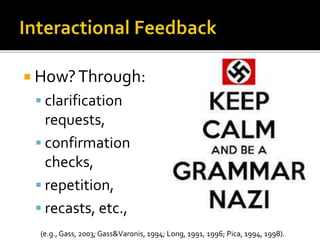
 How?Through:
 clarification
requests,
 confirmation
checks,
 repetition,
 recasts, etc.,
(e.g., Gass, 2003; Gass&Varonis, 1994; Long, 1991, 1996; Pica, 1994, 1998).
 Corrective feedback
refers to utterances
that indicate to the
learner that his or her
output is erroneous in
some way
(Lightbown&Spada,
1999).
 Also called negative
evidence
 In order to learn language, children rely
mainly on some innate principles, or what is
called
(e.g., Chomsky, 1965).
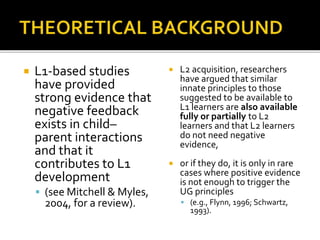
 L1-based studies
have provided
strong evidence that
negative feedback
exists in child–
parent interactions
and that it
contributes to L1
development
 (see Mitchell & Myles,
2004, for a review).
 L2 acquisition, researchers
have argued that similar
innate principles to those
suggested to be available to
L1 learners are also available
fully or partially to L2
learners and that L2 learners
do not need negative
evidence,
 or if they do, it is only in rare
cases where positive evidence
is not enough to trigger the
UG principles
 (e.g., Flynn, 1996; Schwartz,
1993).
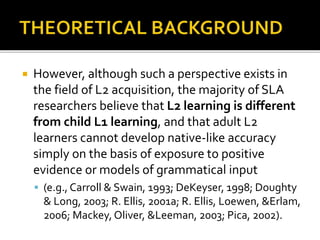
 However, although such a perspective exists in
the field of L2 acquisition, the majority of SLA
researchers believe that L2 learning is different
from child L1 learning, and that adult L2
learners cannot develop native-like accuracy
simply on the basis of exposure to positive
evidence or models of grammatical input
 (e.g., Carroll & Swain, 1993; DeKeyser, 1998; Doughty
& Long, 2003; R. Ellis, 2001a; R. Ellis, Loewen, &Erlam,
2006; Mackey,Oliver, &Leeman, 2003; Pica, 2002).
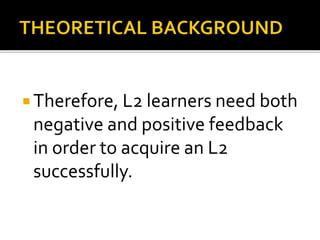
 Therefore, L2 learners need both
negative and positive feedback
in order to acquire an L2
successfully.
Interactional Feedback intro and TH BG

Interactional Feedback intro and TH BG

  • 1.
  • 2.
     LASTTIME:  Wediscussed aboutTEXTUAL ENHANCEMENT as a tool to focus on grammar in communicative context…
  • 3.
     This approachwas concerned with raising learners’ attention to grammatical forms by making target forms perceptually more salient through typographical manipulation of certain aspects of the input.
  • 4.
  • 5.
     This approachis based on an interactionist perspective to SLA and the assumption that negotiated interaction (i.e., interactional modifications made in the course of conversation) is essential for language acquisition.
  • 8.
     How?Through:  clarification requests, confirmation checks,  repetition,  recasts, etc., (e.g., Gass, 2003; Gass&Varonis, 1994; Long, 1991, 1996; Pica, 1994, 1998).
  • 10.
     Corrective feedback refersto utterances that indicate to the learner that his or her output is erroneous in some way (Lightbown&Spada, 1999).  Also called negative evidence
  • 11.
     In orderto learn language, children rely mainly on some innate principles, or what is called (e.g., Chomsky, 1965).
  • 12.
     L1-based studies haveprovided strong evidence that negative feedback exists in child– parent interactions and that it contributes to L1 development  (see Mitchell & Myles, 2004, for a review).  L2 acquisition, researchers have argued that similar innate principles to those suggested to be available to L1 learners are also available fully or partially to L2 learners and that L2 learners do not need negative evidence,  or if they do, it is only in rare cases where positive evidence is not enough to trigger the UG principles  (e.g., Flynn, 1996; Schwartz, 1993).
  • 13.
     However, althoughsuch a perspective exists in the field of L2 acquisition, the majority of SLA researchers believe that L2 learning is different from child L1 learning, and that adult L2 learners cannot develop native-like accuracy simply on the basis of exposure to positive evidence or models of grammatical input  (e.g., Carroll & Swain, 1993; DeKeyser, 1998; Doughty & Long, 2003; R. Ellis, 2001a; R. Ellis, Loewen, &Erlam, 2006; Mackey,Oliver, &Leeman, 2003; Pica, 2002).
  • 14.
     Therefore, L2learners need both negative and positive feedback in order to acquire an L2 successfully.