APPLIED LINGUISTICS
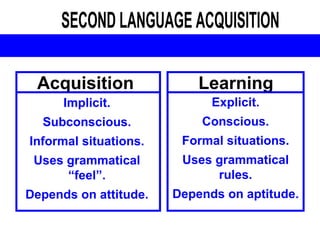
SECOND LANGUAGE ACQUISITION 1 Acquisition  Learning  Implicit. Subconscious. Informal situations. Uses grammatical “feel”. Depends on attitude. Explicit. Conscious. Formal situations. Uses grammatical rules. Depends on aptitude.
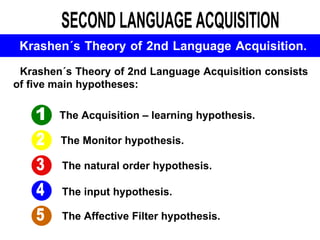
SECOND LANGUAGE ACQUISITION 1 Krashen´s Theory of 2nd Language Acquisition.   Krashen´s Theory of 2nd Language Acquisition consists of five main hypotheses:  1 2 3 4 5 The Acquisition – learning hypothesis. The Monitor hypothesis. The natural order hypothesis. The input hypothesis. The Affective Filter hypothesis.
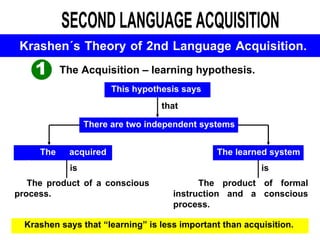
SECOND LANGUAGE ACQUISITION 1 Krashen´s Theory of 2nd Language Acquisition.   1 The Acquisition – learning hypothesis. This hypothesis says that There are two independent systems The learned system The acquired system is The product of formal instruction and a conscious process.  is The product of a conscious process. Krashen says that “learning” is less important than acquisition.
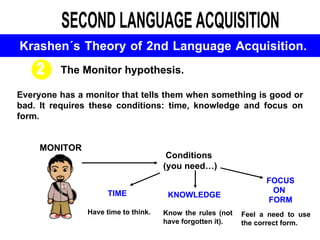
SECOND LANGUAGE ACQUISITION Krashen´s Theory of 2nd Language Acquisition.   1 2 The Monitor hypothesis. Everyone has a monitor that tells them when something is good or bad. It requires these conditions: time, knowledge and focus on form. MONITOR Conditions (you need…) TIME KNOWLEDGE FOCUS ON FORM Have time to think. Know the rules (not have forgotten it). Feel a need to use the correct form.
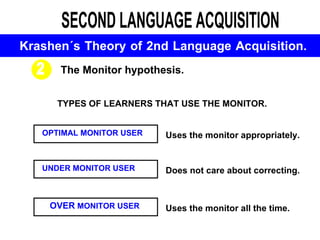
SECOND LANGUAGE ACQUISITION Krashen´s Theory of 2nd Language Acquisition.   1 2 The Monitor hypothesis. TYPES OF LEARNERS THAT USE THE MONITOR. OPTIMAL MONITOR USER Uses the monitor appropriately. UNDER MONITOR USER Does not care about correcting. OVER  MONITOR USER Uses the monitor all the time.
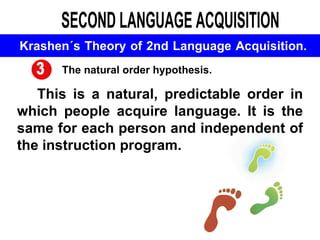
SECOND LANGUAGE ACQUISITION Krashen´s Theory of 2nd Language Acquisition.   1 2 3 The natural order hypothesis. This is a natural, predictable order in which people acquire language. It is the same for each person and independent of the instruction program.
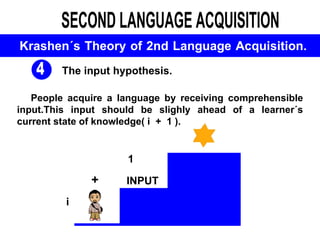
SECOND LANGUAGE ACQUISITION Krashen´s Theory of 2nd Language Acquisition.   1 2 3 4 The input hypothesis. People acquire a language by receiving comprehensible input.This input should be slighly ahead of a learner´s current state of knowledge( i  +  1 ). + INPUT 1 i
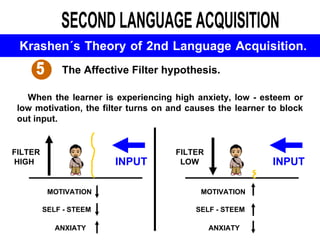
SECOND LANGUAGE ACQUISITION Krashen´s Theory of 2nd Language Acquisition.   1 2 3 5 The Affective Filter hypothesis. When the learner is experiencing high anxiety, low - esteem or low motivation, the filter turns on and causes the learner to block out input. INPUT INPUT MOTIVATION SELF - STEEM ANXIATY FILTER HIGH FILTER LOW MOTIVATION SELF - STEEM ANXIATY
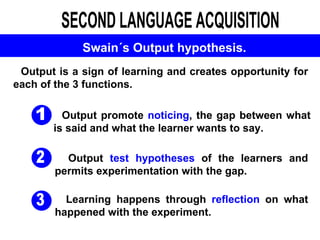
SECOND LANGUAGE ACQUISITION 1 Swain´s Output hypothesis.   Output is a sign of learning and creates opportunity for each of the 3 functions.  1 2 Output promote  noticing , the gap between what is said and what the learner wants to say. Output  test hypotheses  of the learners and permits experimentation with the gap. Learning happens through  reflection  on what happened with the experiment. 3
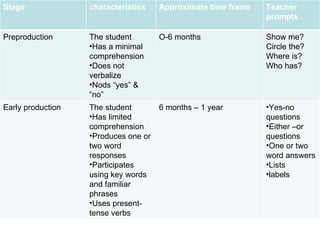
Stage characteristics Approximate time frame Teacher prompts Preproduction The student Has a minimal comprehension  Does not verbalize Nods “yes” & “no” O-6 months Show me? Circle the? Where is? Who has? Early production The student Has limited comprehension Produces one or two word responses Participates using key words and familiar phrases Uses present-tense verbs 6 months – 1 year Yes-no questions Either –or questions One or two word answers Lists labels
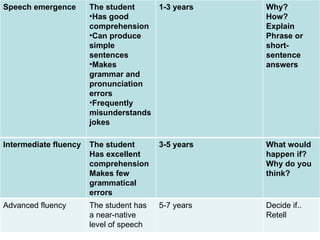
Intermediate fluency The student Has excellent comprehension Makes few grammatical errors 3-5 years What would happen if? Why do you think? Advanced fluency The student has a near-native level of speech 5-7 years Decide if.. Retell Speech emergence The student  Has good comprehension Can produce simple sentences Makes  grammar and pronunciation errors  Frequently misunderstands jokes 1-3 years Why? How? Explain Phrase or short-sentence answers
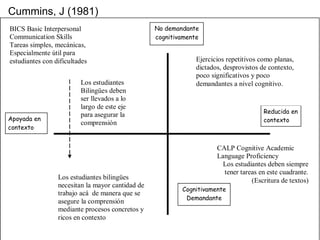
Cummins, J (1981)
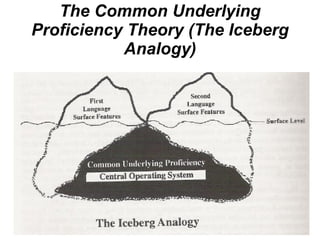
The Common Underlying Proficiency Theory (The Iceberg Analogy)
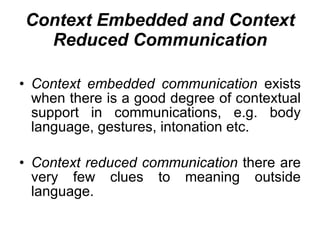
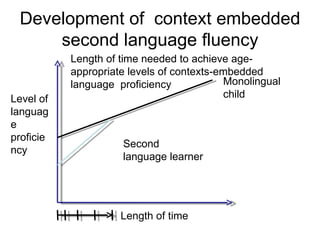
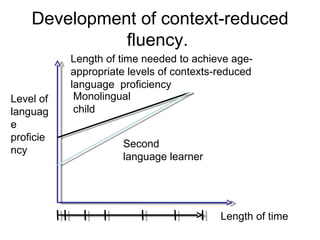
Context Embedded and Context Reduced Communication Context embedded communication  exists when there is a good degree of contextual support in communications, e.g. body language, gestures, intonation etc. Context reduced communication  there are very few clues to meaning outside language.
Length of time needed to achieve age-appropriate levels of contexts-embedded  language  proficiency Level of language proficiency Monolingual child Second language learner Length of time Development of  context embedded second language fluency
Length of time needed to achieve age-appropriate levels of contexts-reduced  language  proficiency Level of language proficiency Monolingual child Second language learner Length of time Development of context-reduced fluency.

Applied-linguistics-and sla

  • 1.
  • 2.
    SECOND LANGUAGE ACQUISITION1 Acquisition Learning Implicit. Subconscious. Informal situations. Uses grammatical “feel”. Depends on attitude. Explicit. Conscious. Formal situations. Uses grammatical rules. Depends on aptitude.
  • 3.
    SECOND LANGUAGE ACQUISITION1 Krashen´s Theory of 2nd Language Acquisition. Krashen´s Theory of 2nd Language Acquisition consists of five main hypotheses: 1 2 3 4 5 The Acquisition – learning hypothesis. The Monitor hypothesis. The natural order hypothesis. The input hypothesis. The Affective Filter hypothesis.
  • 4.
    SECOND LANGUAGE ACQUISITION1 Krashen´s Theory of 2nd Language Acquisition. 1 The Acquisition – learning hypothesis. This hypothesis says that There are two independent systems The learned system The acquired system is The product of formal instruction and a conscious process. is The product of a conscious process. Krashen says that “learning” is less important than acquisition.
  • 5.
    SECOND LANGUAGE ACQUISITIONKrashen´s Theory of 2nd Language Acquisition. 1 2 The Monitor hypothesis. Everyone has a monitor that tells them when something is good or bad. It requires these conditions: time, knowledge and focus on form. MONITOR Conditions (you need…) TIME KNOWLEDGE FOCUS ON FORM Have time to think. Know the rules (not have forgotten it). Feel a need to use the correct form.
  • 6.
    SECOND LANGUAGE ACQUISITIONKrashen´s Theory of 2nd Language Acquisition. 1 2 The Monitor hypothesis. TYPES OF LEARNERS THAT USE THE MONITOR. OPTIMAL MONITOR USER Uses the monitor appropriately. UNDER MONITOR USER Does not care about correcting. OVER MONITOR USER Uses the monitor all the time.
  • 7.
    SECOND LANGUAGE ACQUISITIONKrashen´s Theory of 2nd Language Acquisition. 1 2 3 The natural order hypothesis. This is a natural, predictable order in which people acquire language. It is the same for each person and independent of the instruction program.
  • 8.
    SECOND LANGUAGE ACQUISITIONKrashen´s Theory of 2nd Language Acquisition. 1 2 3 4 The input hypothesis. People acquire a language by receiving comprehensible input.This input should be slighly ahead of a learner´s current state of knowledge( i + 1 ). + INPUT 1 i
  • 9.
    SECOND LANGUAGE ACQUISITIONKrashen´s Theory of 2nd Language Acquisition. 1 2 3 5 The Affective Filter hypothesis. When the learner is experiencing high anxiety, low - esteem or low motivation, the filter turns on and causes the learner to block out input. INPUT INPUT MOTIVATION SELF - STEEM ANXIATY FILTER HIGH FILTER LOW MOTIVATION SELF - STEEM ANXIATY
  • 10.
    SECOND LANGUAGE ACQUISITION1 Swain´s Output hypothesis. Output is a sign of learning and creates opportunity for each of the 3 functions. 1 2 Output promote noticing , the gap between what is said and what the learner wants to say. Output test hypotheses of the learners and permits experimentation with the gap. Learning happens through reflection on what happened with the experiment. 3
  • 11.
    Stage characteristics Approximatetime frame Teacher prompts Preproduction The student Has a minimal comprehension Does not verbalize Nods “yes” & “no” O-6 months Show me? Circle the? Where is? Who has? Early production The student Has limited comprehension Produces one or two word responses Participates using key words and familiar phrases Uses present-tense verbs 6 months – 1 year Yes-no questions Either –or questions One or two word answers Lists labels
  • 12.
    Intermediate fluency Thestudent Has excellent comprehension Makes few grammatical errors 3-5 years What would happen if? Why do you think? Advanced fluency The student has a near-native level of speech 5-7 years Decide if.. Retell Speech emergence The student Has good comprehension Can produce simple sentences Makes grammar and pronunciation errors Frequently misunderstands jokes 1-3 years Why? How? Explain Phrase or short-sentence answers
  • 13.
  • 14.
    The Common UnderlyingProficiency Theory (The Iceberg Analogy)
  • 15.
    Context Embedded andContext Reduced Communication Context embedded communication exists when there is a good degree of contextual support in communications, e.g. body language, gestures, intonation etc. Context reduced communication there are very few clues to meaning outside language.
  • 16.
    Length of timeneeded to achieve age-appropriate levels of contexts-embedded language proficiency Level of language proficiency Monolingual child Second language learner Length of time Development of context embedded second language fluency
  • 17.
    Length of timeneeded to achieve age-appropriate levels of contexts-reduced language proficiency Level of language proficiency Monolingual child Second language learner Length of time Development of context-reduced fluency.