GLOSSARY
Anais
Noemi
2nd year of Childhood Education
ÍNDEX
 Page 1: Cover page.
 Page 2: Index:
 Page 3: ZPD (Zone of proximal development)
 Page 4: TPR (Total physical response )
 Page 5: Target language
 Page 6: Mother langue
 Page 7: Approach
 Page 8: Acquisition vs Learning
 Page 9: Silent period
 Page 10: The critical period
 Page 11: LAD(Language acquisition device)
 Page 12: EFL, ESL
 Page 13: Phonics
 Page 14: Multiple Intelligencies theory
 Page 15: Digital literacy
 Page 16: Literacy
ZPD
(Zone of Proximal Development)
 It was developed by Vigotsky.
 He said that social interaction is critical to
learning.
 The zone of proximal development is what
a learner has already mastered (the actual
level of development) and what he or she
can achieve when provided with
educational support (potential
development).
Vygotsky, Lev
TPR
(Total Physical Response )
 TPR is a language-teaching method
developed by James Asher, a professor
emeritus of psychology at San José State
University. It is based on the coordination of
language and physical movement. In TPR,
instructors give commands to students in the
target language, and students respond with
whole-body actions.
James Asher
Target language
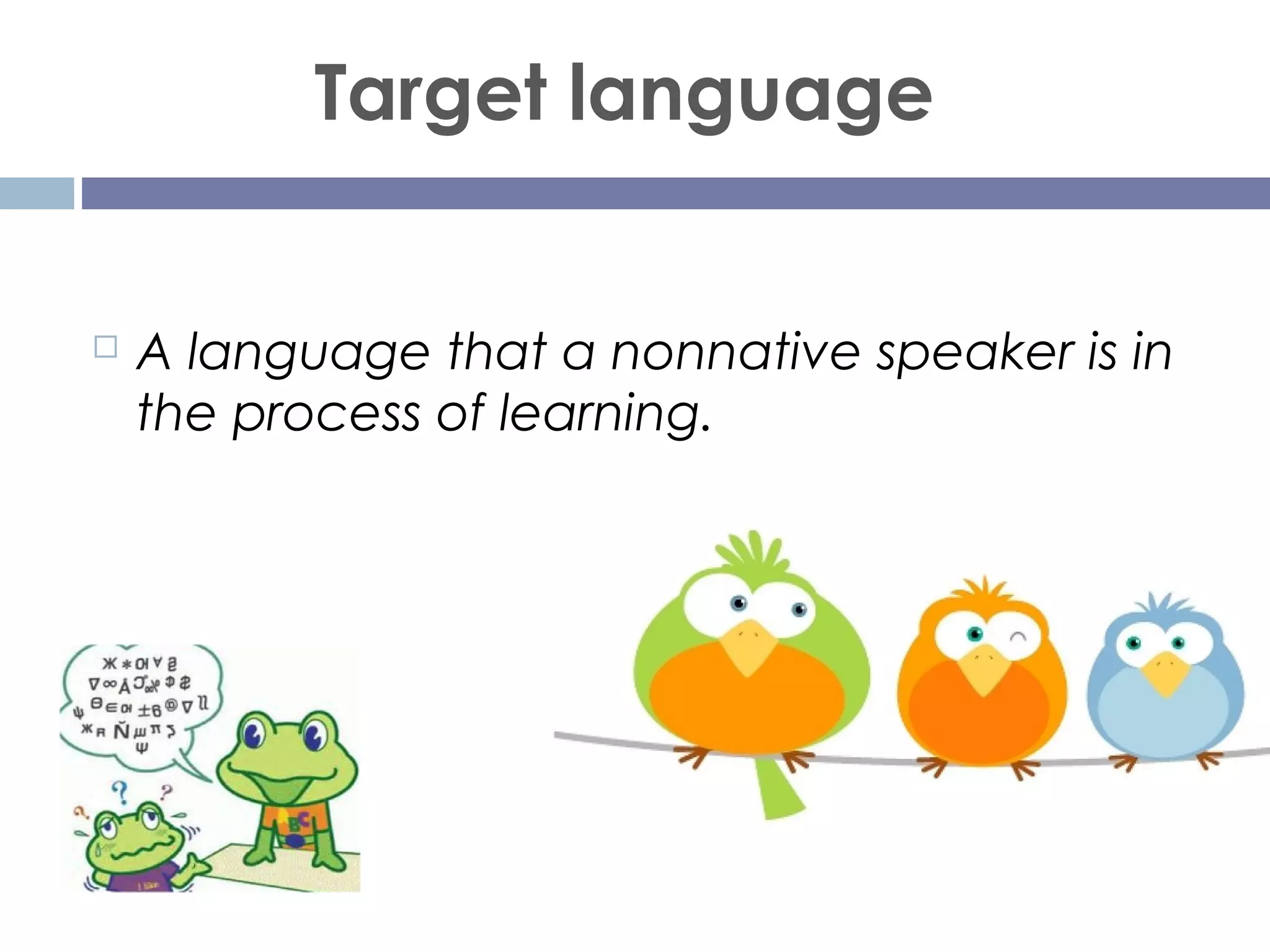
 A language that a nonnative speaker is in
the process of learning.
Mother tongue
 The language which a person has grown
up speaking from early childhood.
Approach
 A set of principles about teaching including
views on method, syllabus, and a
philosophy of language and learning.
Approaches have theoretical backing with
practical applications.
Acquisition vs Learning
LEARNING ACQUISITION
Artificial Natural
Technical Personal
Priority on the written
language
Priority on the spoken
language
Theory (language analysis) Practice (language in use)
Deductive teaching (rule-
driven; top-down)
Inductive coaching (rule-
discovery; bottom-up)
Preset syllabus Improvised activities
Activities about the language Activities in the language
Focus on form Focus on communication
Silent period hyphotesis
 The silent period hyphotesis is the idea that
when a language is learned, there should
be a period in which the learner is not
expected to actively produce any
language. This is based on observations of a
listening period in infants when they learn a
first language.
The Critical Period
 The hypothesis that if somebody does not
acquire a first language before a certain
time (around puberty), they will lose the
ability to acquire language.
LAD
(Language Acquisition Device)
 The LAD is a system of principles that
children are born with that helps them learn
language, and accounts for the order in
which children learn structures, and the
mistakes they make as they learn. Second
language learning theory proposes that
acquisition is possible in second and
subsequent languages, and that learning
programmes have to create the conditions
for it.

Glossary

  • 1.
  • 2.
    ÍNDEX  Page 1:Cover page.  Page 2: Index:  Page 3: ZPD (Zone of proximal development)  Page 4: TPR (Total physical response )  Page 5: Target language  Page 6: Mother langue  Page 7: Approach  Page 8: Acquisition vs Learning  Page 9: Silent period  Page 10: The critical period  Page 11: LAD(Language acquisition device)  Page 12: EFL, ESL  Page 13: Phonics  Page 14: Multiple Intelligencies theory  Page 15: Digital literacy  Page 16: Literacy
  • 3.
    ZPD (Zone of ProximalDevelopment)  It was developed by Vigotsky.  He said that social interaction is critical to learning.  The zone of proximal development is what a learner has already mastered (the actual level of development) and what he or she can achieve when provided with educational support (potential development). Vygotsky, Lev
  • 4.
    TPR (Total Physical Response)  TPR is a language-teaching method developed by James Asher, a professor emeritus of psychology at San José State University. It is based on the coordination of language and physical movement. In TPR, instructors give commands to students in the target language, and students respond with whole-body actions. James Asher
  • 5.
    Target language  Alanguage that a nonnative speaker is in the process of learning.
  • 6.
    Mother tongue  Thelanguage which a person has grown up speaking from early childhood.
  • 7.
    Approach  A setof principles about teaching including views on method, syllabus, and a philosophy of language and learning. Approaches have theoretical backing with practical applications.
  • 8.
    Acquisition vs Learning LEARNINGACQUISITION Artificial Natural Technical Personal Priority on the written language Priority on the spoken language Theory (language analysis) Practice (language in use) Deductive teaching (rule- driven; top-down) Inductive coaching (rule- discovery; bottom-up) Preset syllabus Improvised activities Activities about the language Activities in the language Focus on form Focus on communication
  • 9.
    Silent period hyphotesis The silent period hyphotesis is the idea that when a language is learned, there should be a period in which the learner is not expected to actively produce any language. This is based on observations of a listening period in infants when they learn a first language.
  • 10.
    The Critical Period The hypothesis that if somebody does not acquire a first language before a certain time (around puberty), they will lose the ability to acquire language.
  • 11.
    LAD (Language Acquisition Device) The LAD is a system of principles that children are born with that helps them learn language, and accounts for the order in which children learn structures, and the mistakes they make as they learn. Second language learning theory proposes that acquisition is possible in second and subsequent languages, and that learning programmes have to create the conditions for it.