11
3
4
5
6
2
7
Universal Usability
(Introduction)
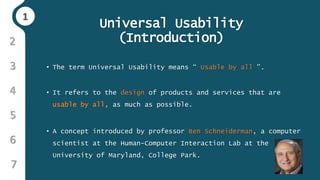
• The term Universal Usability means “ Usable by all ”.
• It refers to the design of products and services that are
usable by all, as much as possible.
• A concept introduced by professor Ben Schneiderman, a computer
scientist at the Human-Computer Interaction Lab at the
University of Maryland, College Park.
2
1
3
4
5
6
2
7
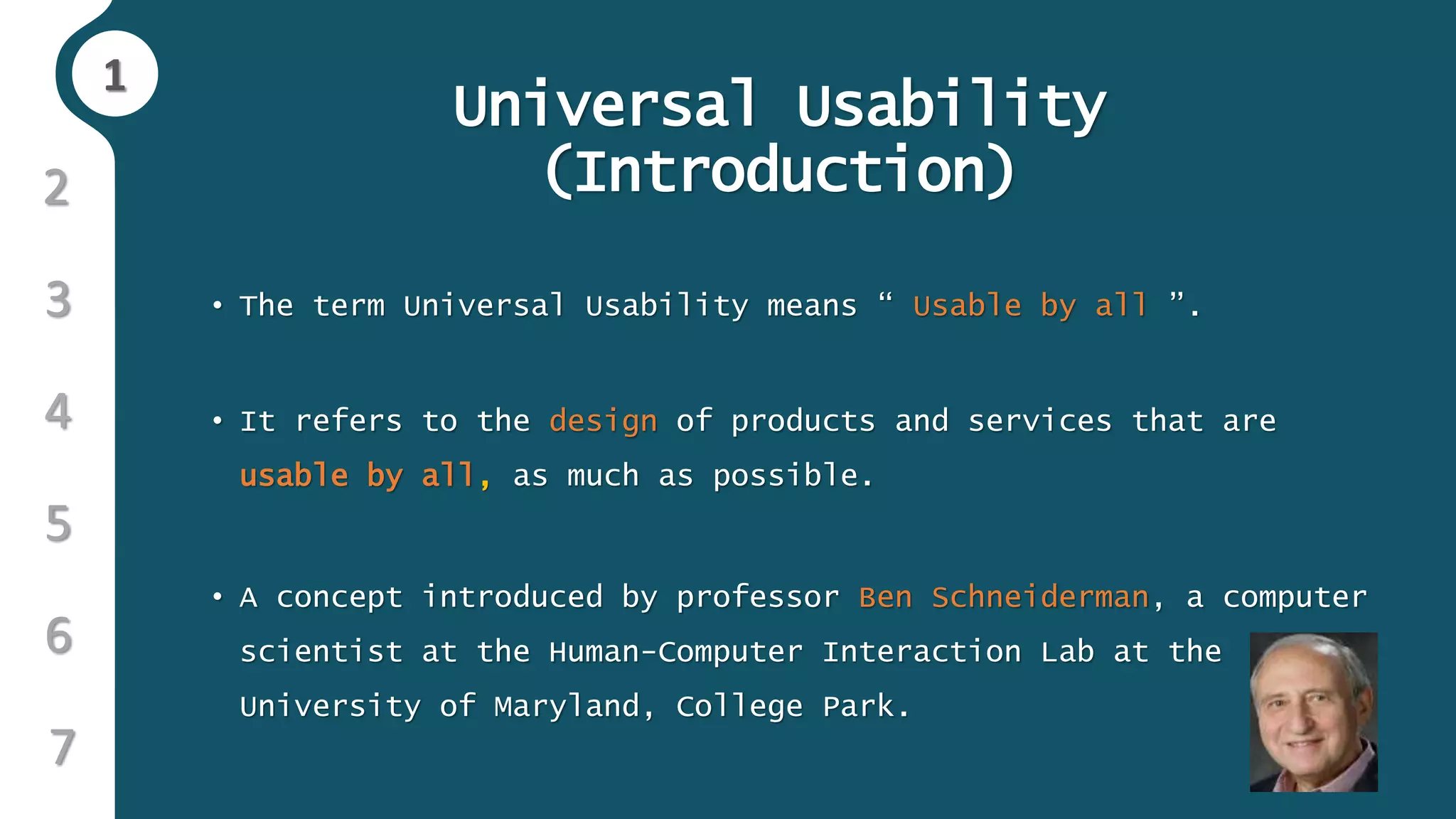
Quality Components
• Learnability :- Do users find it easy to complete basic tasks?
• Efficiency :- How quick users can perform tasks?
• Memorability :- Are users easily able to re – establish
proficiency after a long gap?
• Errors :- How many errors do users make, It’s severity, and
are they able to recover speedily?
• Satisfaction :- Did users have a delightful experience?
3
1
3
4
5
6
2
7
3
1
3
4
5
6
2
7
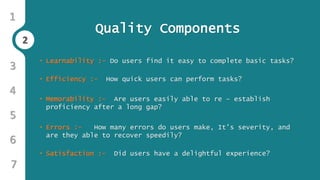
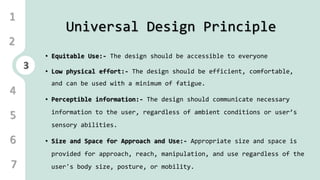
Universal Design Principle
• Equitable Use:- The design should be accessible to everyone
• Low physical effort:- The design should be efficient, comfortable,
and can be used with a minimum of fatigue.
• Perceptible information:- The design should communicate necessary
information to the user, regardless of ambient conditions or user’s
sensory abilities.
• Size and Space for Approach and Use:- Appropriate size and space is
provided for approach, reach, manipulation, and use regardless of the
user's body size, posture, or mobility.
3
1
3
4
5
6
2
7
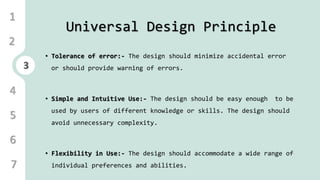
Universal Design Principle
• Tolerance of error:- The design should minimize accidental error
or should provide warning of errors.
• Simple and Intuitive Use:- The design should be easy enough to be
used by users of different knowledge or skills. The design should
avoid unnecessary complexity.
• Flexibility in Use:- The design should accommodate a wide range of
individual preferences and abilities.
4
1
3
4
5
6
2
7
4
1
3
4
5
6
2
7
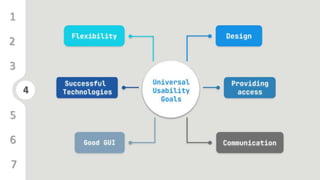
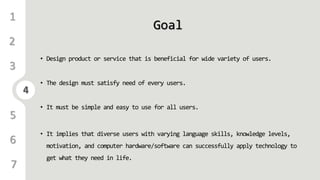
Goal
• Design product or service that is beneficial for wide variety of users.
• The design must satisfy need of every users.
• It must be simple and easy to use for all users.
• It implies that diverse users with varying language skills, knowledge levels,
motivation, and computer hardware/software can successfully apply technology to
get what they need in life.
5
1
3
4
5
6
2
7
Accessibility vs
Universal Usability
• Accessibility addresses discriminatory aspects related to
equivalent user experience for people with disabilities.
• Web accessibility means that people with disabilities can equally
perceive, understand, navigate, and interact with websites and
tools.
• It also means that they can contribute equally without barriers.
5
1
3
4
5
6
2
7
Accessibility vs
Universal Usability
• Universal usability on the other hand strives to make the content
and functionality accessible and usable by all.
• It is about designing products to be effective, efficient, and
satisfying.
• Usability includes user experience design.
• This may include general aspects that impact everyone and do not
disproportionally impact people with disabilities.
6
1
3
4
5
6
2
7
Challenges of Universal Usability
According to Schneiderman, Designer can focus on three given Challenges : -
 Technology variety:- Support broad range of hardware, software, and
network access.
 User diversity:- Accommodating users with different skills, knowledge, age,
gender, disabilities, disabling conditions mobility, sunlight, noise, literacy,
culture, income, etc.
 Gaps in user knowledge:- Bridge the gap between what users know and what they
need to know.
7
1
3
4
5
6
2
7
References
• https://en.wikipedia.org/wiki/Universal_usability
• http://www.cs.umd.edu/hcil/trs/99-17/99-17.html
• https://simplicable.com/new/universal-usability
• http://universalusability.com/
• http://universaldesign.ie/What-is-Universal-Design/The-7-Principles/

Universal Usability

  • 1.
    11 3 4 5 6 2 7 Universal Usability (Introduction) • Theterm Universal Usability means “ Usable by all ”. • It refers to the design of products and services that are usable by all, as much as possible. • A concept introduced by professor Ben Schneiderman, a computer scientist at the Human-Computer Interaction Lab at the University of Maryland, College Park.
  • 2.
    2 1 3 4 5 6 2 7 Quality Components • Learnability:- Do users find it easy to complete basic tasks? • Efficiency :- How quick users can perform tasks? • Memorability :- Are users easily able to re – establish proficiency after a long gap? • Errors :- How many errors do users make, It’s severity, and are they able to recover speedily? • Satisfaction :- Did users have a delightful experience?
  • 3.
  • 4.
    3 1 3 4 5 6 2 7 Universal Design Principle •Equitable Use:- The design should be accessible to everyone • Low physical effort:- The design should be efficient, comfortable, and can be used with a minimum of fatigue. • Perceptible information:- The design should communicate necessary information to the user, regardless of ambient conditions or user’s sensory abilities. • Size and Space for Approach and Use:- Appropriate size and space is provided for approach, reach, manipulation, and use regardless of the user's body size, posture, or mobility.
  • 5.
    3 1 3 4 5 6 2 7 Universal Design Principle •Tolerance of error:- The design should minimize accidental error or should provide warning of errors. • Simple and Intuitive Use:- The design should be easy enough to be used by users of different knowledge or skills. The design should avoid unnecessary complexity. • Flexibility in Use:- The design should accommodate a wide range of individual preferences and abilities.
  • 6.
  • 7.
    4 1 3 4 5 6 2 7 Goal • Design productor service that is beneficial for wide variety of users. • The design must satisfy need of every users. • It must be simple and easy to use for all users. • It implies that diverse users with varying language skills, knowledge levels, motivation, and computer hardware/software can successfully apply technology to get what they need in life.
  • 8.
    5 1 3 4 5 6 2 7 Accessibility vs Universal Usability •Accessibility addresses discriminatory aspects related to equivalent user experience for people with disabilities. • Web accessibility means that people with disabilities can equally perceive, understand, navigate, and interact with websites and tools. • It also means that they can contribute equally without barriers.
  • 9.
    5 1 3 4 5 6 2 7 Accessibility vs Universal Usability •Universal usability on the other hand strives to make the content and functionality accessible and usable by all. • It is about designing products to be effective, efficient, and satisfying. • Usability includes user experience design. • This may include general aspects that impact everyone and do not disproportionally impact people with disabilities.
  • 10.
    6 1 3 4 5 6 2 7 Challenges of UniversalUsability According to Schneiderman, Designer can focus on three given Challenges : -  Technology variety:- Support broad range of hardware, software, and network access.  User diversity:- Accommodating users with different skills, knowledge, age, gender, disabilities, disabling conditions mobility, sunlight, noise, literacy, culture, income, etc.  Gaps in user knowledge:- Bridge the gap between what users know and what they need to know.
  • 11.
    7 1 3 4 5 6 2 7 References • https://en.wikipedia.org/wiki/Universal_usability • http://www.cs.umd.edu/hcil/trs/99-17/99-17.html •https://simplicable.com/new/universal-usability • http://universalusability.com/ • http://universaldesign.ie/What-is-Universal-Design/The-7-Principles/