

GOOD MORNINGGOOD MORNING
www.indiandentalacademy.comwww.indiandentalacademy.com
INTERACTION BETWEEN X-RAYSINTERACTION BETWEEN X-RAYS
AND MATTERAND MATTER
www.indiandentalacademy.comwww.indiandentalacademy.com
X – ray photonsX – ray photons
 Orbital electrons (In diagnostic range)Orbital electrons (In diagnostic range)
 Nucleus.Nucleus.
www.indiandentalacademy.comwww.indiandentalacademy.com
 1897 J.J Thomson1897 J.J Thomson electron.electron.
 Rutherford & BohrRutherford & Bohr model of atom.model of atom.
www.indiandentalacademy.comwww.indiandentalacademy.com
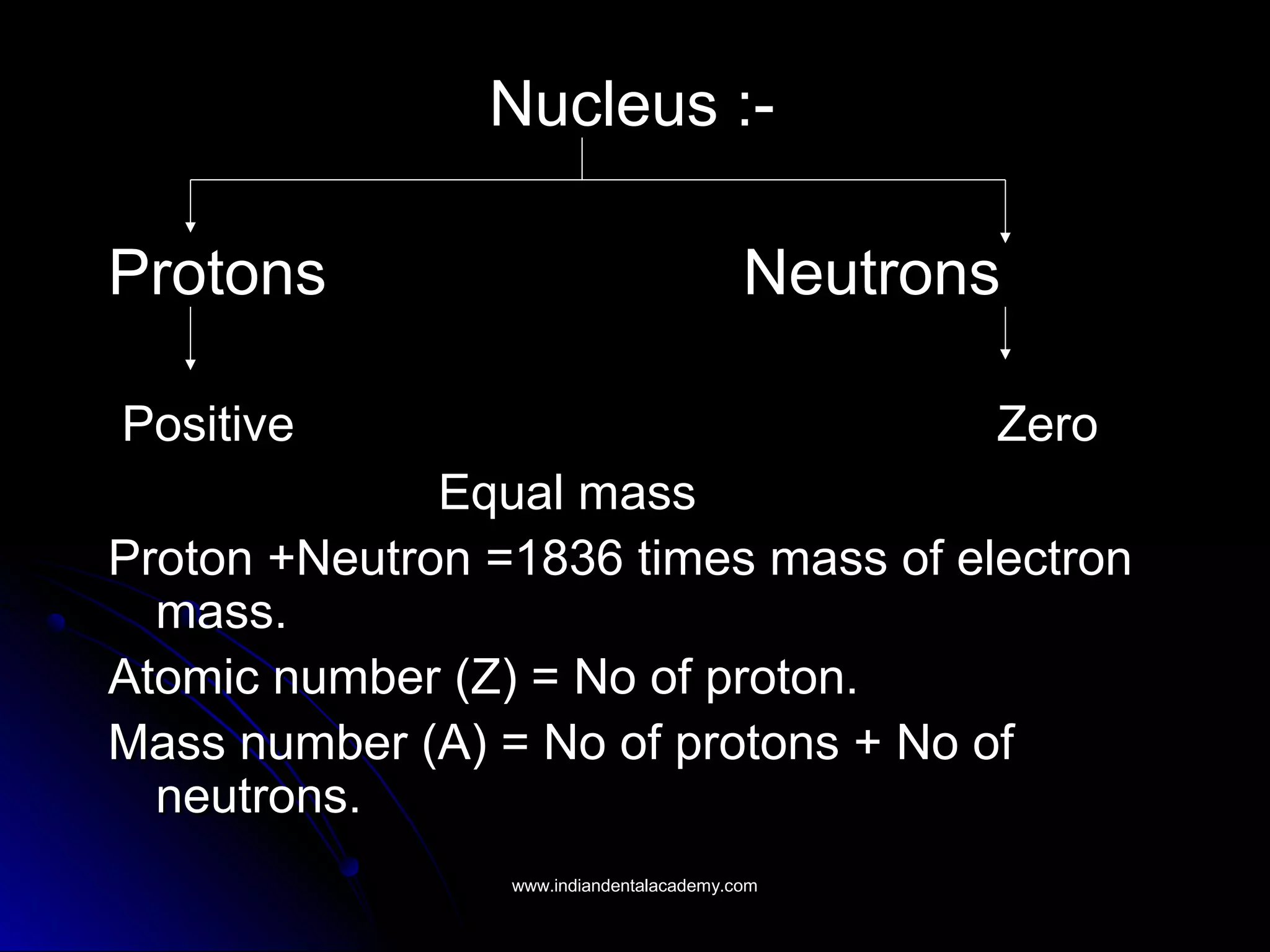
Nucleus :-Nucleus :-
ProtonsProtons NeutronsNeutrons
PositivePositive ZeroZero
Equal massEqual mass
Proton +Neutron =1836 times mass of electronProton +Neutron =1836 times mass of electron
mass.mass.
Atomic number (Z) = No of proton.Atomic number (Z) = No of proton.
Mass number (A) = No of protons + No ofMass number (A) = No of protons + No of
neutrons.neutrons.
www.indiandentalacademy.comwww.indiandentalacademy.com
Atom – A Tiny planetary modelAtom – A Tiny planetary model
www.indiandentalacademy.comwww.indiandentalacademy.com
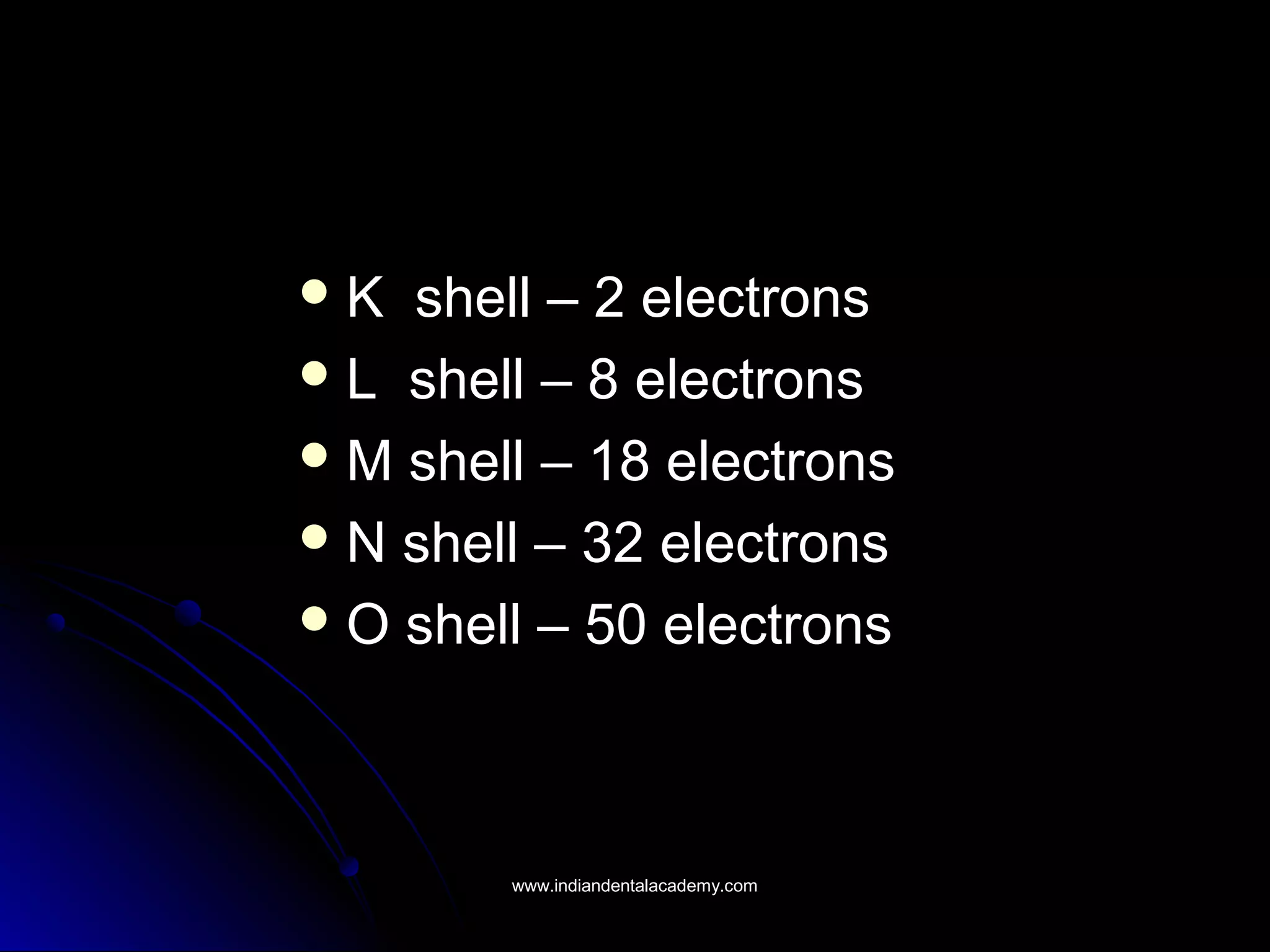
 K shell – 2 electronsK shell – 2 electrons
 L shell – 8 electronsL shell – 8 electrons
 M shell – 18 electronsM shell – 18 electrons
 N shell – 32 electronsN shell – 32 electrons
 O shell – 50 electronsO shell – 50 electrons
www.indiandentalacademy.comwww.indiandentalacademy.com
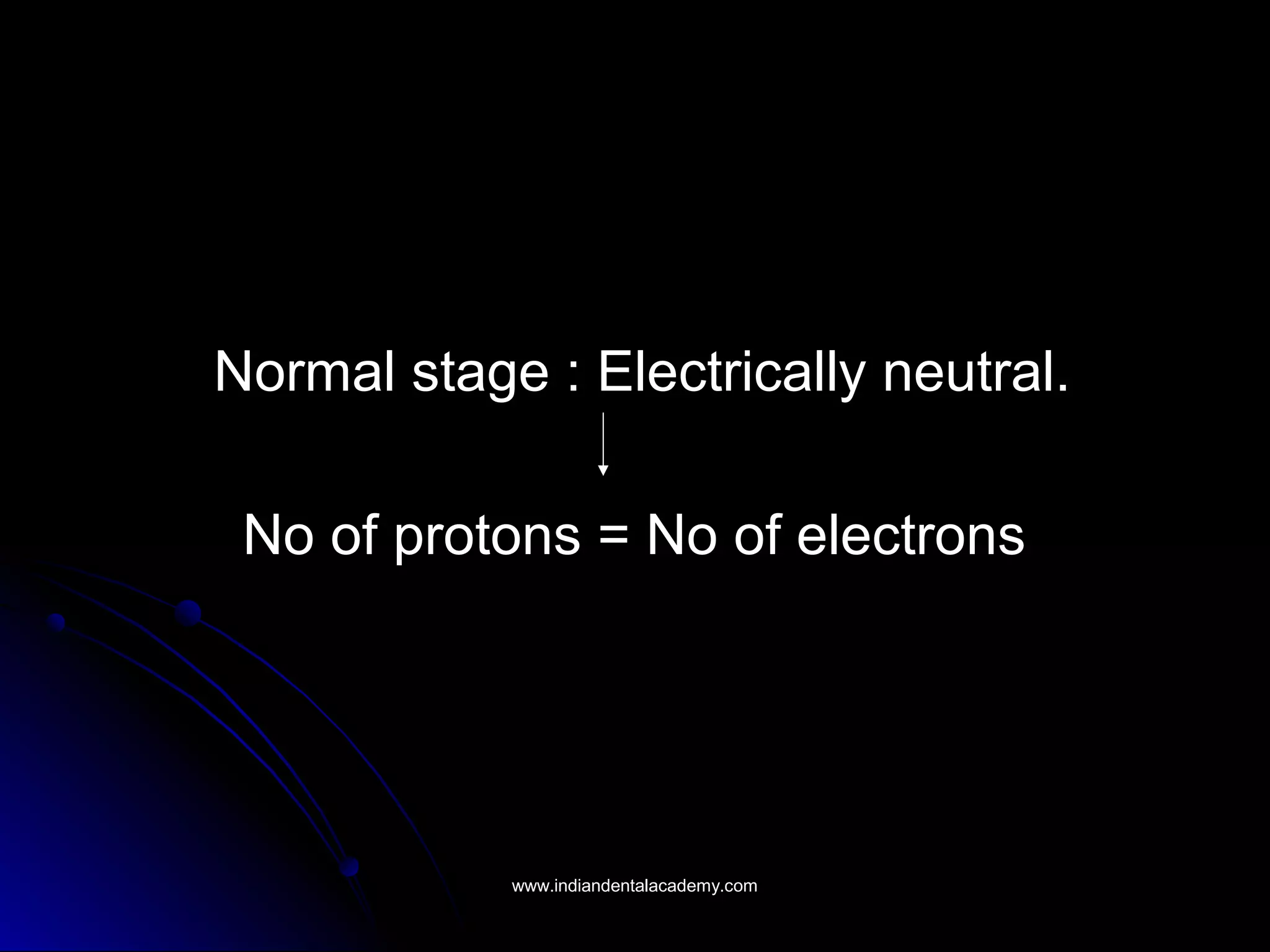
Normal stage : Electrically neutral.Normal stage : Electrically neutral.
No of protons = No of electronsNo of protons = No of electrons
www.indiandentalacademy.comwww.indiandentalacademy.com
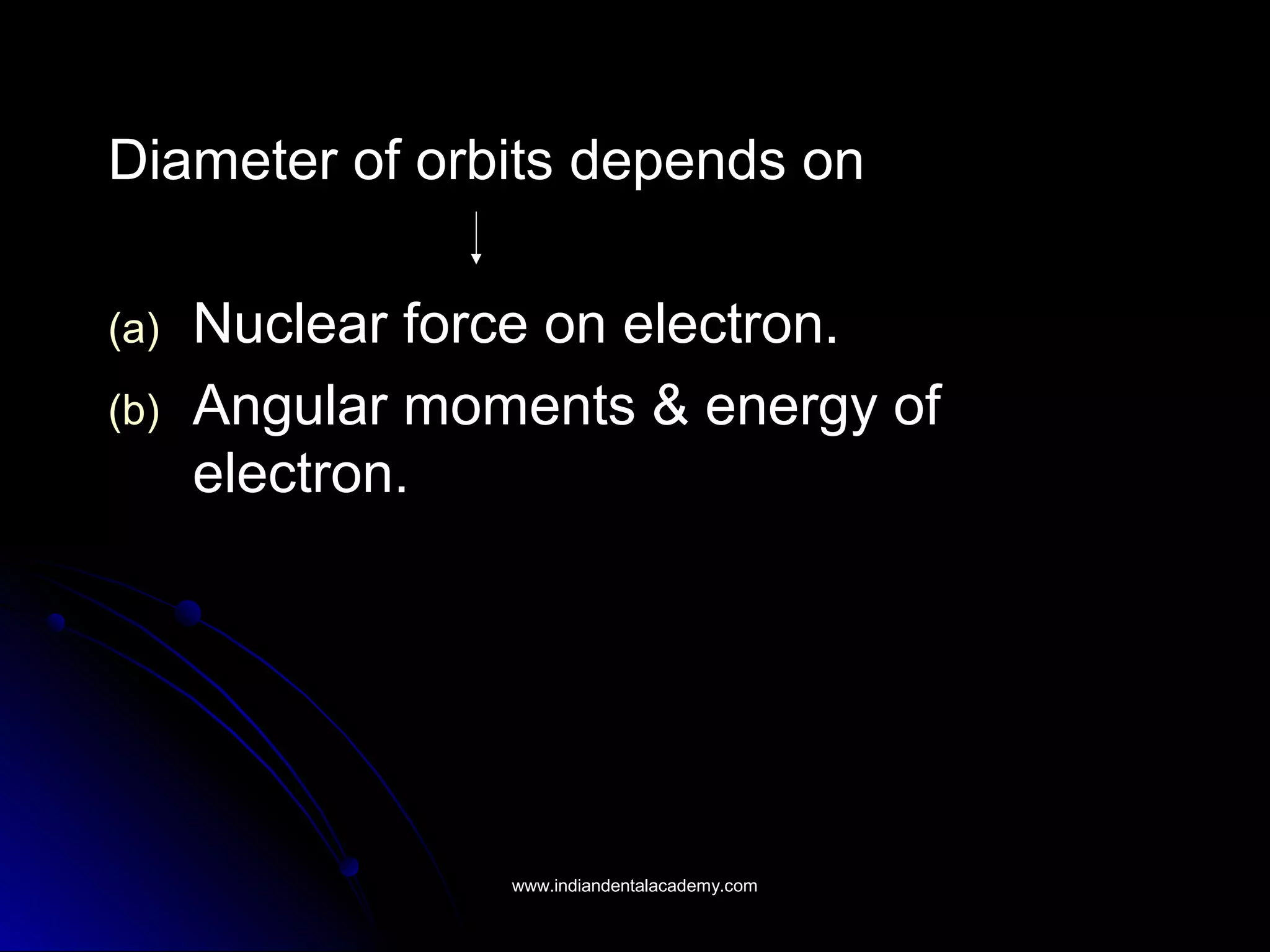
Diameter of orbits depends onDiameter of orbits depends on
(a)(a) Nuclear force on electron.Nuclear force on electron.
(b)(b) Angular moments & energy ofAngular moments & energy of
electron.electron.
www.indiandentalacademy.comwww.indiandentalacademy.com
Binding force:Binding force:
Definition : the negatively changedDefinition : the negatively changed
electrons held in a particular atom by anelectrons held in a particular atom by an
attractive force of positively changedattractive force of positively changed
nucleus.nucleus.
 Binding force of electronBinding force of electron αα Square ofSquare of
distance between nucleus & electrons.distance between nucleus & electrons.
 Binding force is grater with electrons ofBinding force is grater with electrons of
nearest shell than in outer orbit.nearest shell than in outer orbit.
www.indiandentalacademy.comwww.indiandentalacademy.com
Nuclear force – e in an orbit.Nuclear force – e in an orbit.
Binding force – e in an atom.Binding force – e in an atom.
www.indiandentalacademy.comwww.indiandentalacademy.com
Binding energy of electronBinding energy of electron
 To free an electron from an atom, theTo free an electron from an atom, the
energy must be raised to zero or to aenergy must be raised to zero or to a
positive value.positive value.
 The energy that an electron in a shellThe energy that an electron in a shell
must be given to raise the energy value tomust be given to raise the energy value to
zero is called is called the “bindingzero is called is called the “binding
energy” of the electron, which alsoenergy” of the electron, which also
translates into the atomic Energy shellstranslates into the atomic Energy shells
as they house electronsas they house electrons
www.indiandentalacademy.comwww.indiandentalacademy.com
 Tungsten has a k-shell energy of-70 keVTungsten has a k-shell energy of-70 keV
 L shell has an energy of-11 keV.L shell has an energy of-11 keV.
 The L electronhas 59 Kev more energy thanThe L electronhas 59 Kev more energy than
the k electron.the k electron.
www.indiandentalacademy.comwww.indiandentalacademy.com
 In sight:In sight:
An electron cannot have any more or lessAn electron cannot have any more or less
energy than that associated with itsenergy than that associated with its
energy shell.energy shell.
www.indiandentalacademy.comwww.indiandentalacademy.com
 None the less, an electron may jumpNone the less, an electron may jump
from one energy shell to anotherfrom one energy shell to another
(higher or lower), if the shell of which it(higher or lower), if the shell of which it
jumps is already not filled.jumps is already not filled.
 Electron, when it jumps to a lowerElectron, when it jumps to a lower
energy shell (e.g.from L to K), emitsenergy shell (e.g.from L to K), emits
energy, which is equal to the differenceenergy, which is equal to the difference
in binding energy between 2 shells. Thisin binding energy between 2 shells. This
emitted energy may take the from ofemitted energy may take the from of
photon, which if it of sufficient quantity,photon, which if it of sufficient quantity,
may be called an x-ray photon.may be called an x-ray photon.
www.indiandentalacademy.comwww.indiandentalacademy.com
 Electron, to jump to a higher energyElectron, to jump to a higher energy
shell (e.g. from K and L) requires theshell (e.g. from K and L) requires the
addition of energy to it and byaddition of energy to it and by
absorbing an X-ray photon. The energyabsorbing an X-ray photon. The energy
value of electronic shell is determinedvalue of electronic shell is determined
by atomic number of the atom.by atomic number of the atom.
www.indiandentalacademy.comwww.indiandentalacademy.com
General RadiationGeneral Radiation
 When an electron passes near theWhen an electron passes near the
nucleus of a tungsten atom, the positivenucleus of a tungsten atom, the positive
charge of the nucleus attracts thecharge of the nucleus attracts the
electron towards it and thus deflects itselectron towards it and thus deflects its
direction, due to which the electrondirection, due to which the electron
looses it energy and slow down. Thelooses it energy and slow down. The
kinetic energy lost by the electron iskinetic energy lost by the electron is
emitted as photon. This type ofemitted as photon. This type of
radiation is called general radiation.radiation is called general radiation.
www.indiandentalacademy.comwww.indiandentalacademy.com
 The electron that has lost energy,The electron that has lost energy,
speed and changed direction, when itspeed and changed direction, when it
passes through the nuclei of otherpasses through the nuclei of other
atoms undergoes similar changes till itatoms undergoes similar changes till it
looses all its energy. Thus the energieslooses all its energy. Thus the energies
lost are small, variable during eachlost are small, variable during each
break and the radiation thus producedbreak and the radiation thus produced
(I.e.,photons) will appears as(I.e.,photons) will appears as heatheat
upto99% and has longer wave lengths.upto99% and has longer wave lengths.
www.indiandentalacademy.comwww.indiandentalacademy.com
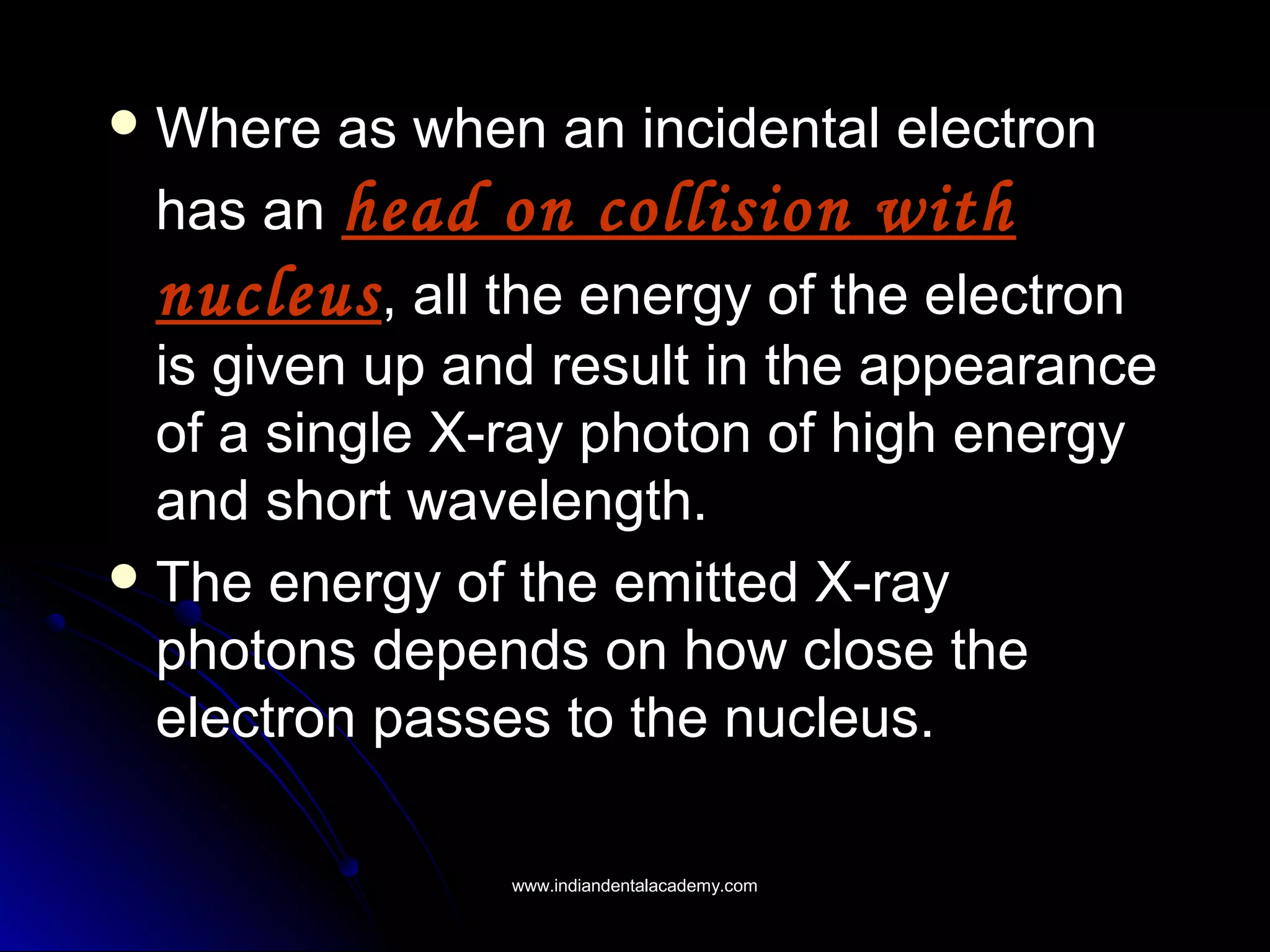
 Where as when an incidental electronWhere as when an incidental electron
has anhas an head on collision withhead on collision with
nucleusnucleus, all the energy of the electron, all the energy of the electron
is given up and result in the appearanceis given up and result in the appearance
of a single X-ray photon of high energyof a single X-ray photon of high energy
and short wavelength.and short wavelength.
 The energy of the emitted X-rayThe energy of the emitted X-ray
photons depends on how close thephotons depends on how close the
electron passes to the nucleus.electron passes to the nucleus.
www.indiandentalacademy.comwww.indiandentalacademy.com
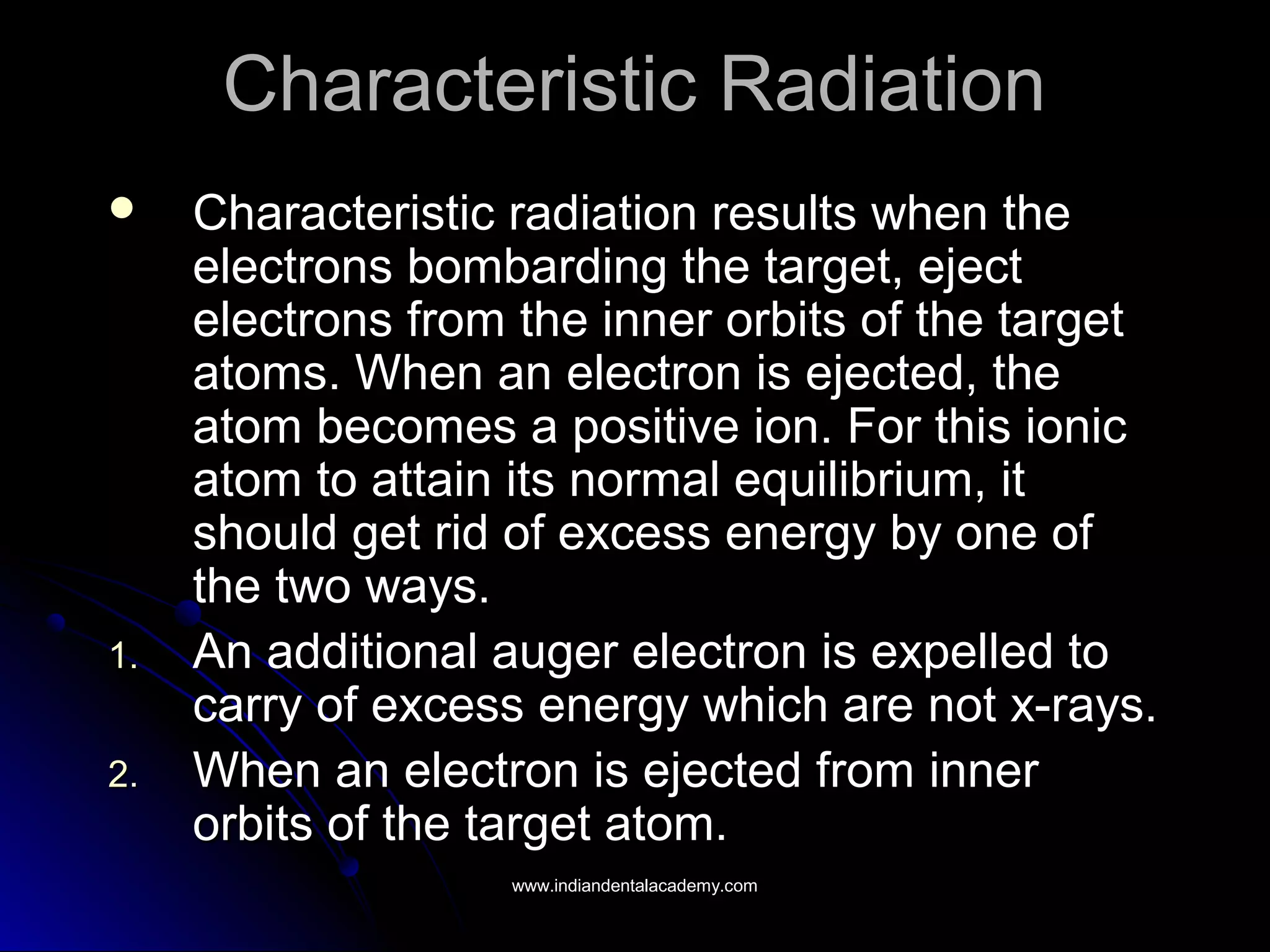
Characteristic RadiationCharacteristic Radiation
 Characteristic radiation results when theCharacteristic radiation results when the
electrons bombarding the target, ejectelectrons bombarding the target, eject
electrons from the inner orbits of the targetelectrons from the inner orbits of the target
atoms. When an electron is ejected, theatoms. When an electron is ejected, the
atom becomes a positive ion. For this ionicatom becomes a positive ion. For this ionic
atom to attain its normal equilibrium, itatom to attain its normal equilibrium, it
should get rid of excess energy by one ofshould get rid of excess energy by one of
the two ways.the two ways.
1.1. An additional auger electron is expelled toAn additional auger electron is expelled to
carry of excess energy which are not x-rays.carry of excess energy which are not x-rays.
2.2. When an electron is ejected from innerWhen an electron is ejected from inner
orbits of the target atom.orbits of the target atom.
www.indiandentalacademy.comwww.indiandentalacademy.com
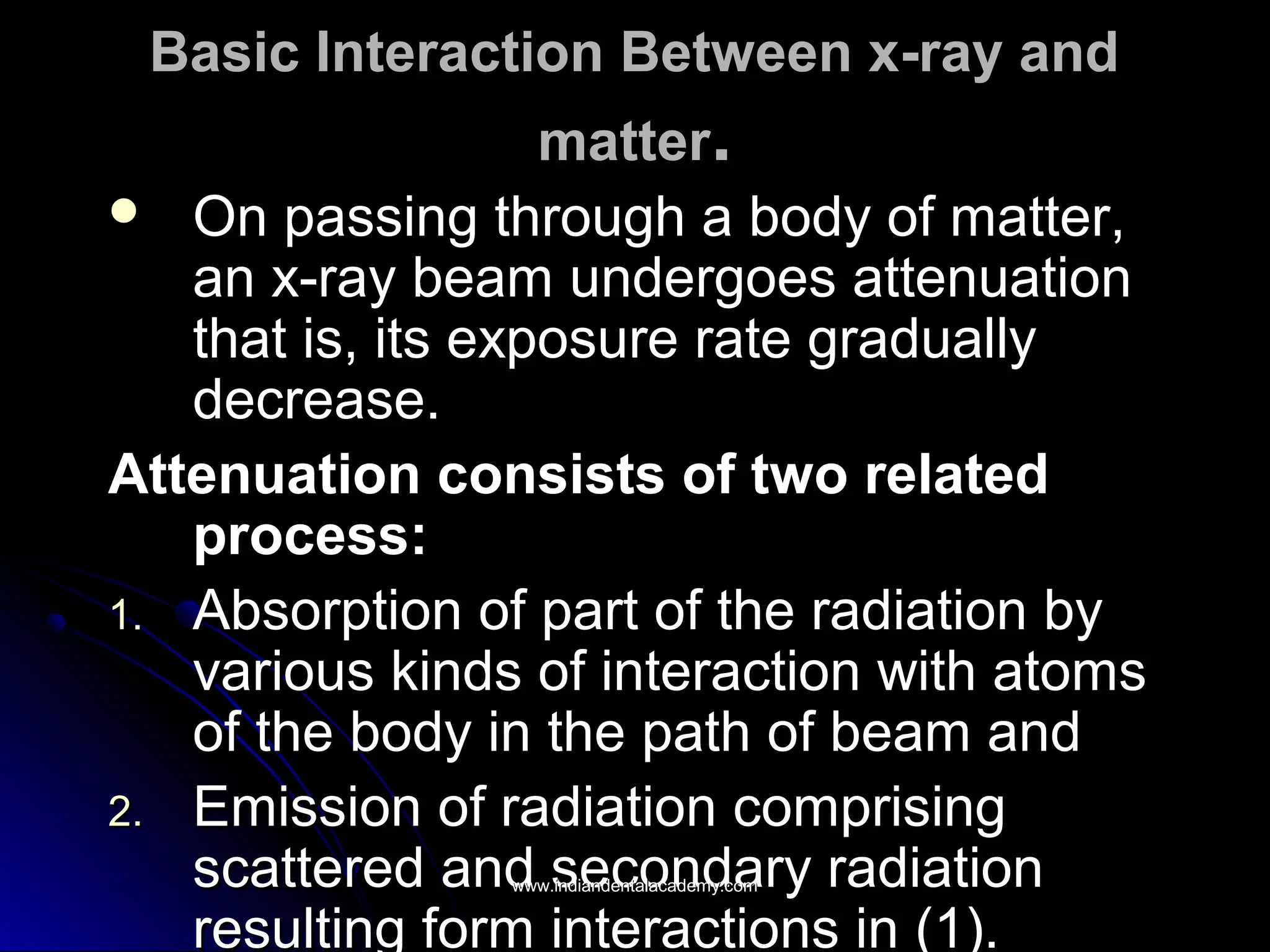
Basic Interaction Between x-ray andBasic Interaction Between x-ray and
mattermatter..
 On passing through a body of matter,On passing through a body of matter,
an x-ray beam undergoes attenuationan x-ray beam undergoes attenuation
that is, its exposure rate graduallythat is, its exposure rate gradually
decrease.decrease.
Attenuation consists of two relatedAttenuation consists of two related
process:process:
1.1. Absorption of part of the radiation byAbsorption of part of the radiation by
various kinds of interaction with atomsvarious kinds of interaction with atoms
of the body in the path of beam andof the body in the path of beam and
2.2. Emission of radiation comprisingEmission of radiation comprising
scattered and secondary radiationscattered and secondary radiation
resulting form interactions in (1).resulting form interactions in (1).
www.indiandentalacademy.comwww.indiandentalacademy.com
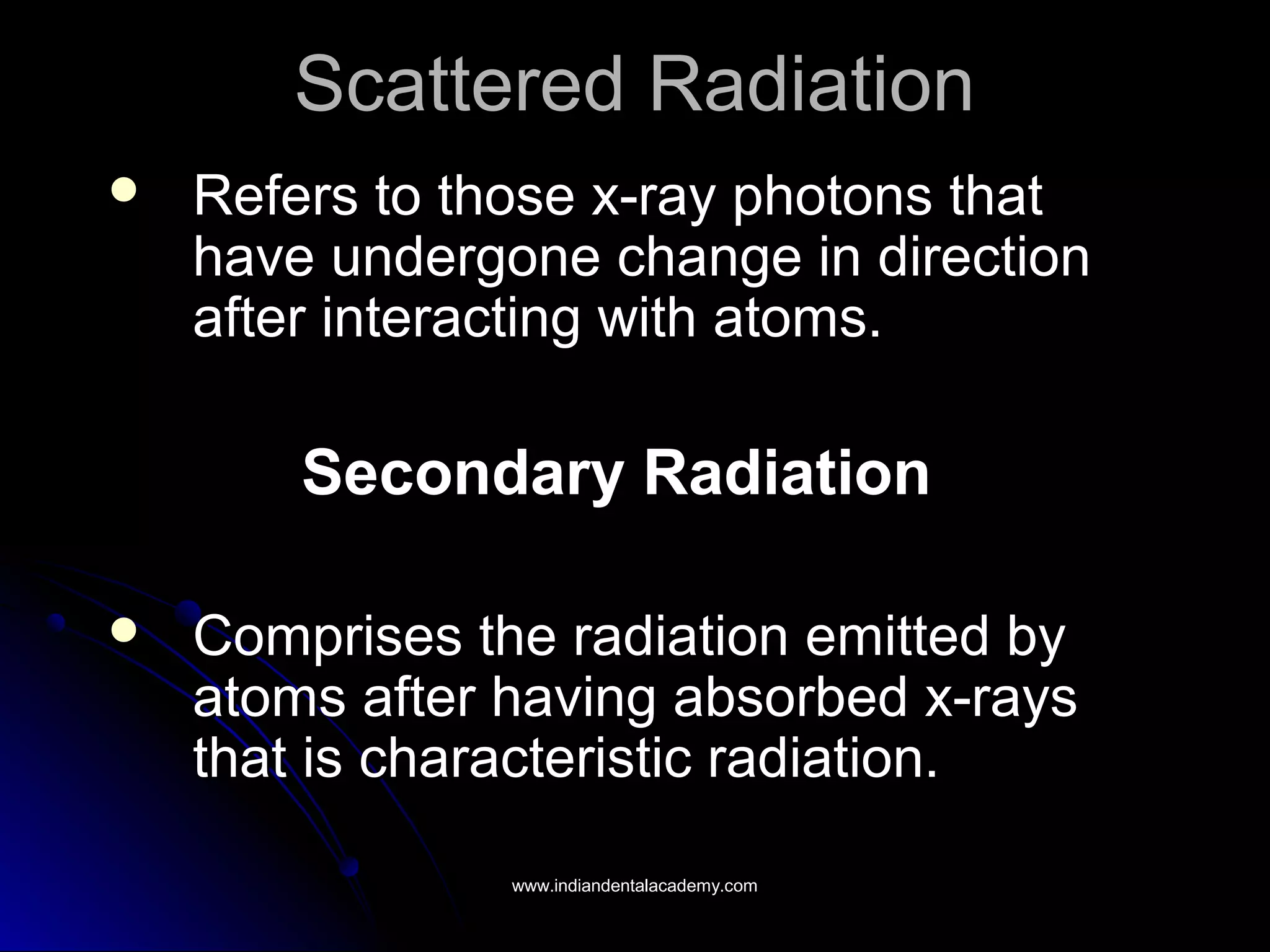
Scattered RadiationScattered Radiation
 Refers to those x-ray photons thatRefers to those x-ray photons that
have undergone change in directionhave undergone change in direction
after interacting with atoms.after interacting with atoms.
Secondary RadiationSecondary Radiation
 Comprises the radiation emitted byComprises the radiation emitted by
atoms after having absorbed x-raysatoms after having absorbed x-rays
that is characteristic radiation.that is characteristic radiation.
www.indiandentalacademy.comwww.indiandentalacademy.com
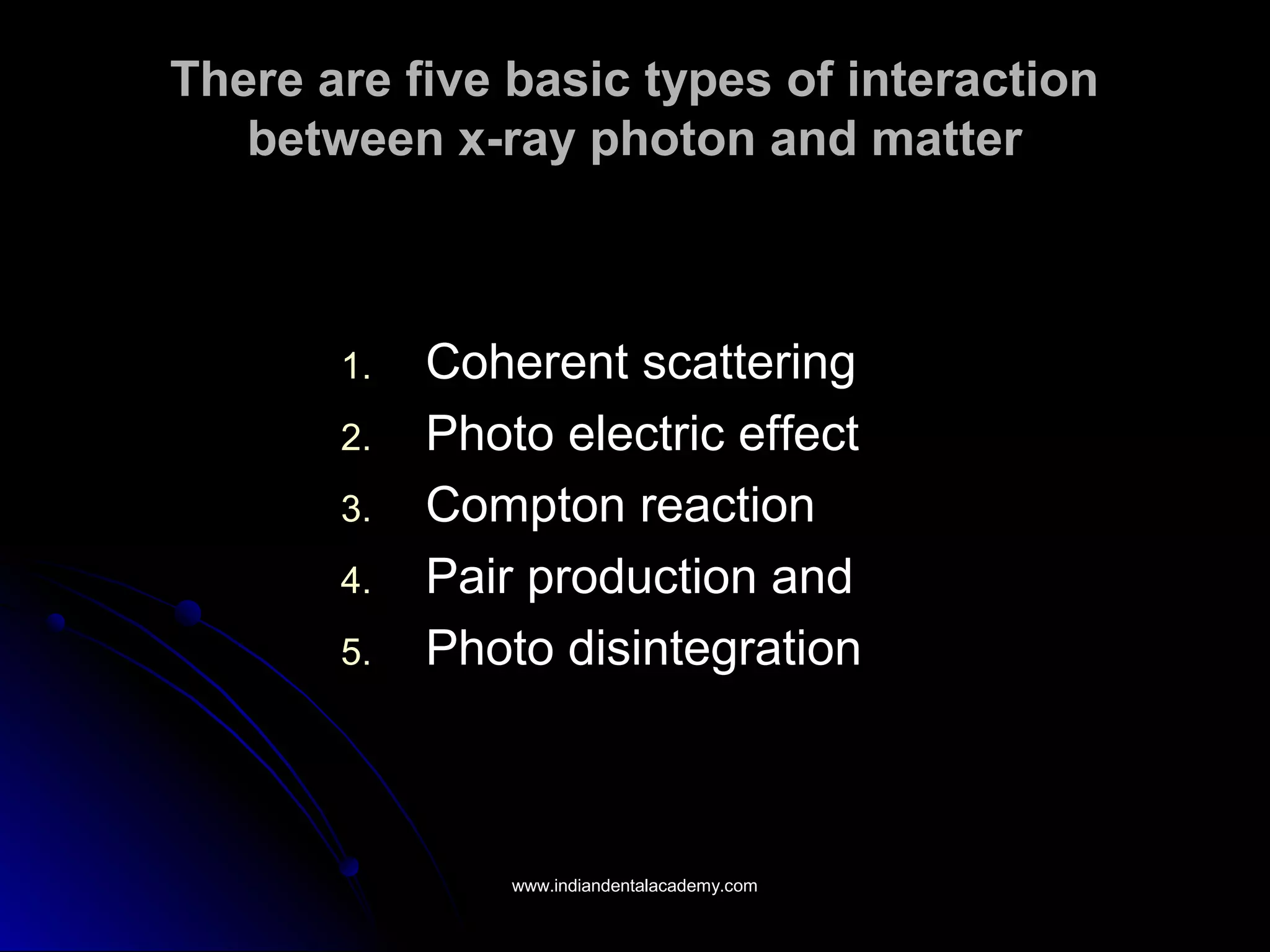
There are five basic types of interactionThere are five basic types of interaction
between x-ray photon and matterbetween x-ray photon and matter
1.1. Coherent scatteringCoherent scattering
2.2. Photo electric effectPhoto electric effect
3.3. Compton reactionCompton reaction
4.4. Pair production andPair production and
5.5. Photo disintegrationPhoto disintegration
www.indiandentalacademy.comwww.indiandentalacademy.com
we see at times these x-ray photons arewe see at times these x-ray photons are
either absorbed or merely scattered.either absorbed or merely scattered.
When photons are absorbed they areWhen photons are absorbed they are
completely removed from x-ray beamcompletely removed from x-ray beam
and cease to exist. When photons areand cease to exist. When photons are
scattered they are deflected into ascattered they are deflected into a
random course, and becomes uselessrandom course, and becomes useless
as these cannot be focused to produceas these cannot be focused to produce
an image. Where as these scatteredan image. Where as these scattered
photons produced blackness (noise) onphotons produced blackness (noise) on
a film. Called as “film fog”, and destroysa film. Called as “film fog”, and destroys
image quality.image quality.
www.indiandentalacademy.comwww.indiandentalacademy.com
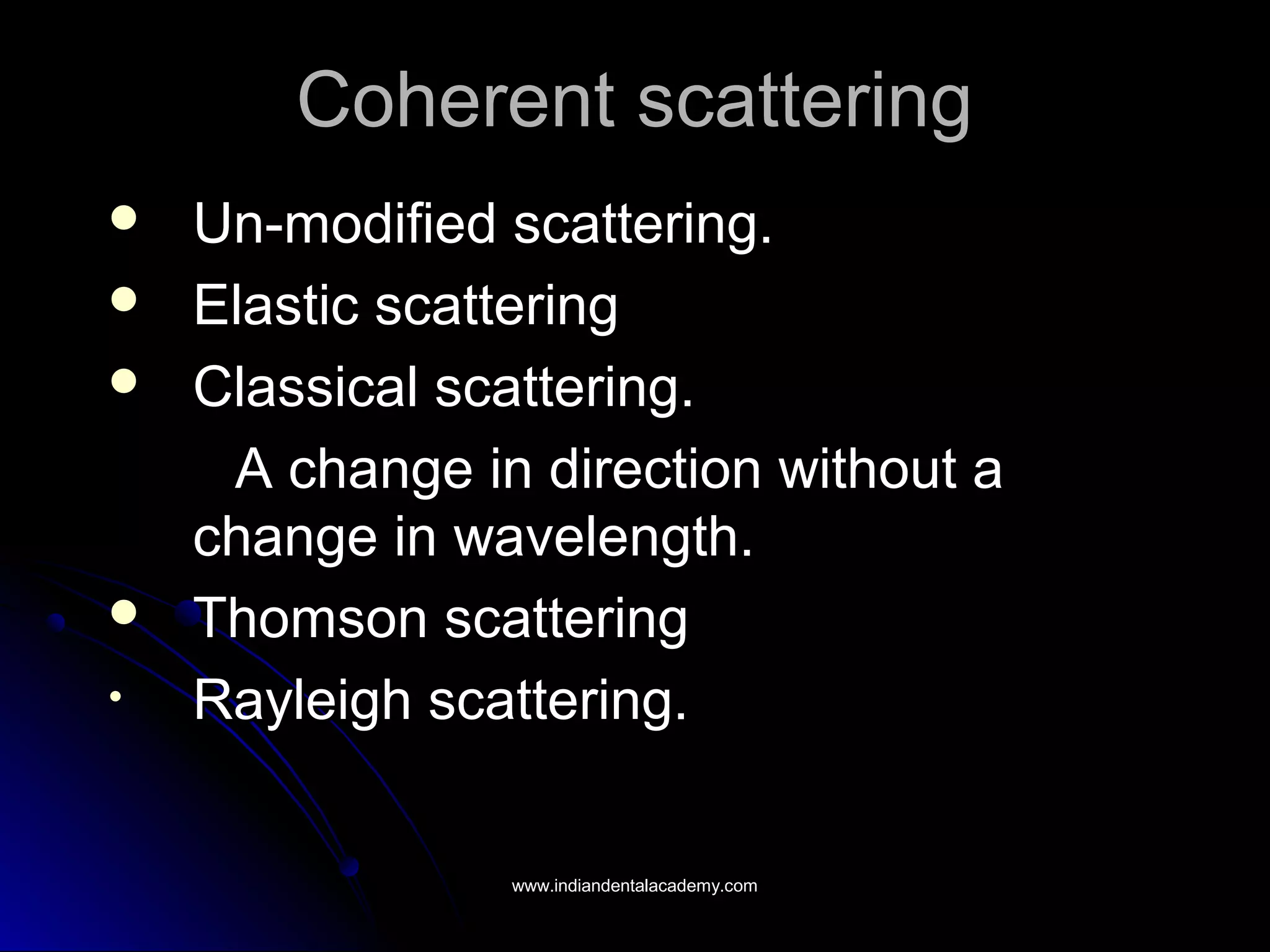
Coherent scatteringCoherent scattering
 Un-modified scattering.Un-modified scattering.
 Elastic scatteringElastic scattering
 Classical scattering.Classical scattering.
A change in direction without aA change in direction without a
change in wavelength.change in wavelength.
 Thomson scatteringThomson scattering
• Rayleigh scattering.Rayleigh scattering.
www.indiandentalacademy.comwww.indiandentalacademy.com
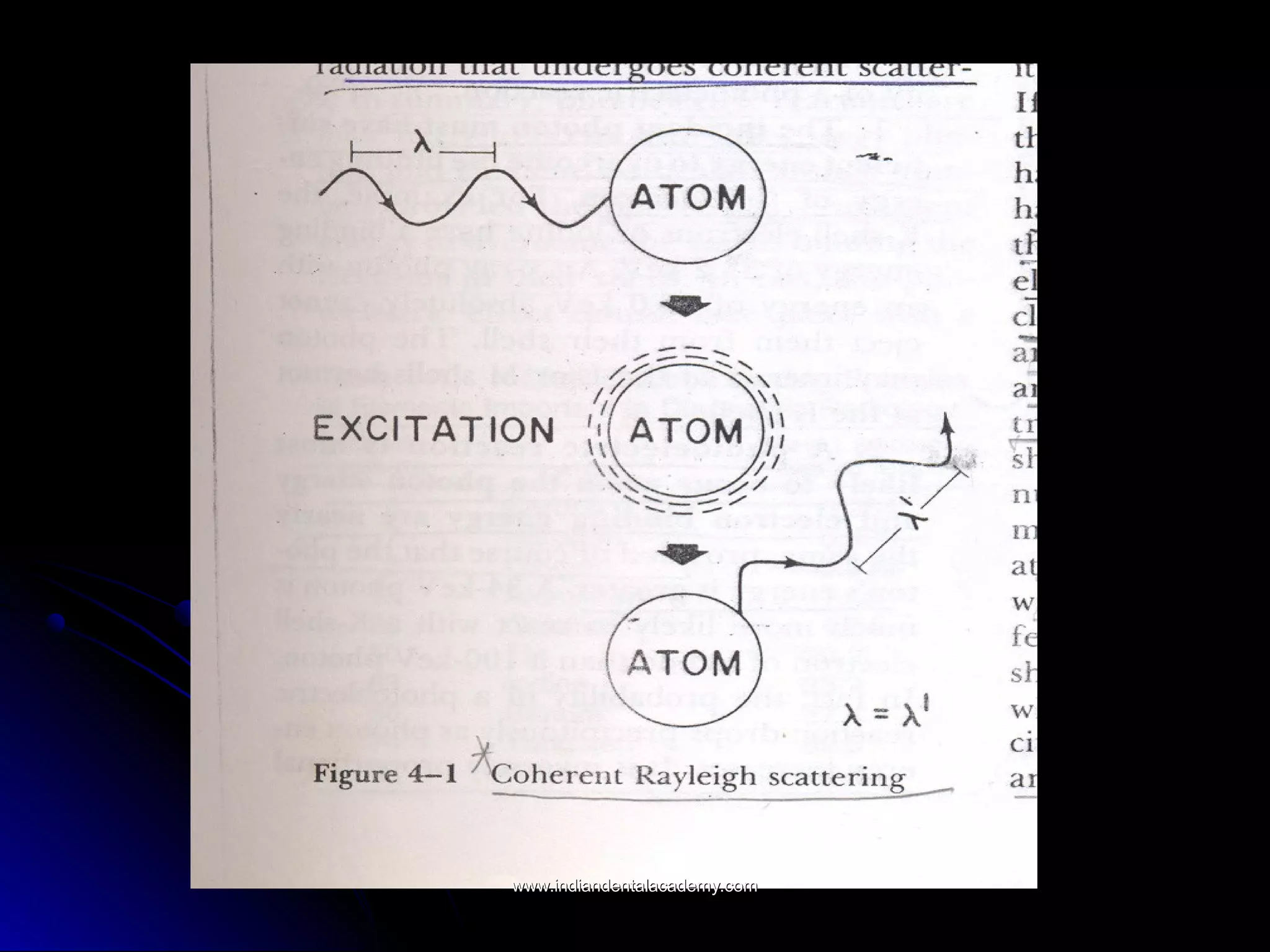
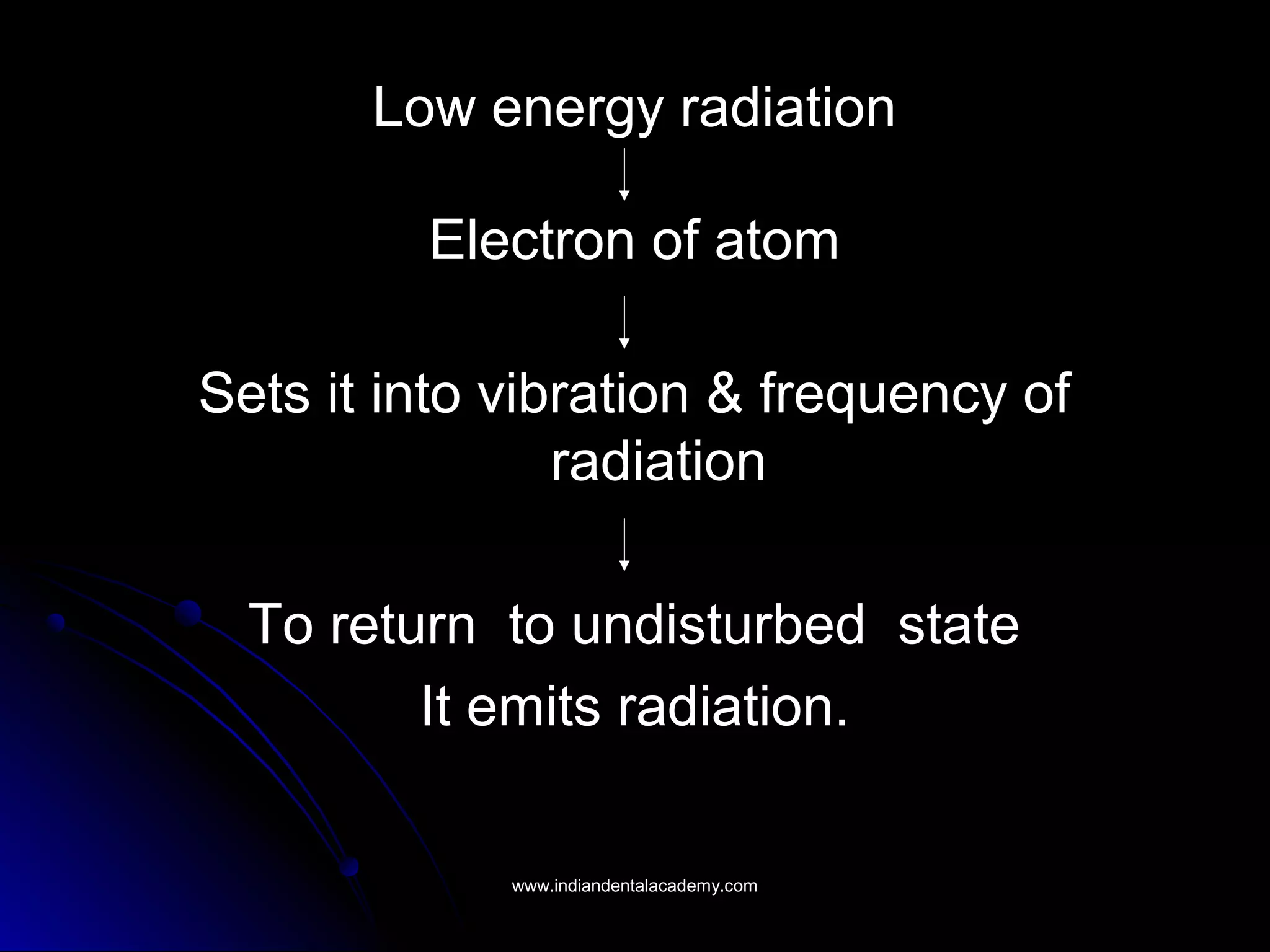
Low energy radiationLow energy radiation
Electron of atomElectron of atom
Sets it into vibration & frequency ofSets it into vibration & frequency of
radiationradiation
To return to undisturbed stateTo return to undisturbed state
It emits radiation.It emits radiation.
www.indiandentalacademy.comwww.indiandentalacademy.com
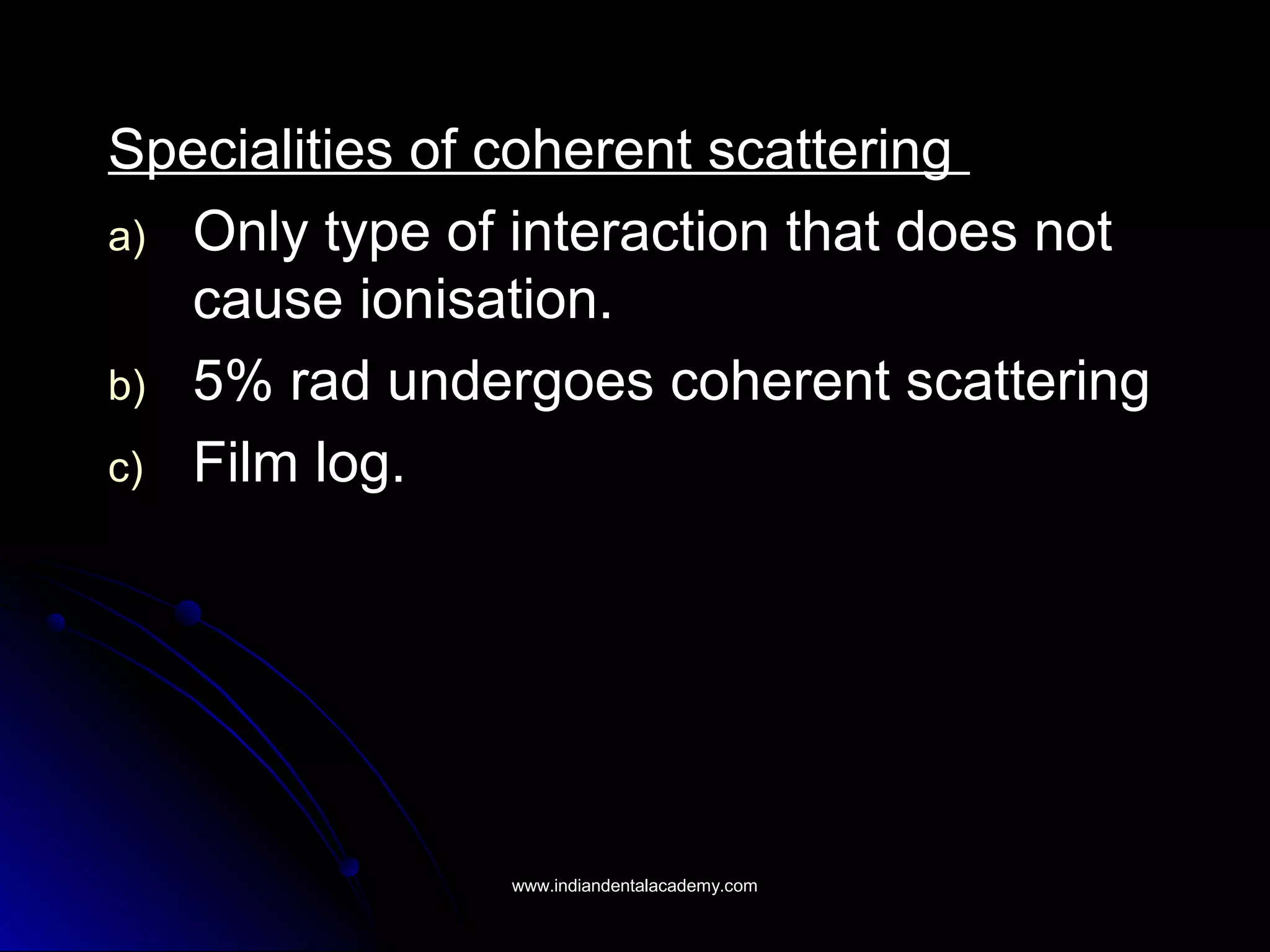
Specialities of coherent scatteringSpecialities of coherent scattering
a)a) Only type of interaction that does notOnly type of interaction that does not
cause ionisation.cause ionisation.
b)b) 5% rad undergoes coherent scattering5% rad undergoes coherent scattering
c)c) Film log.Film log.
www.indiandentalacademy.comwww.indiandentalacademy.com
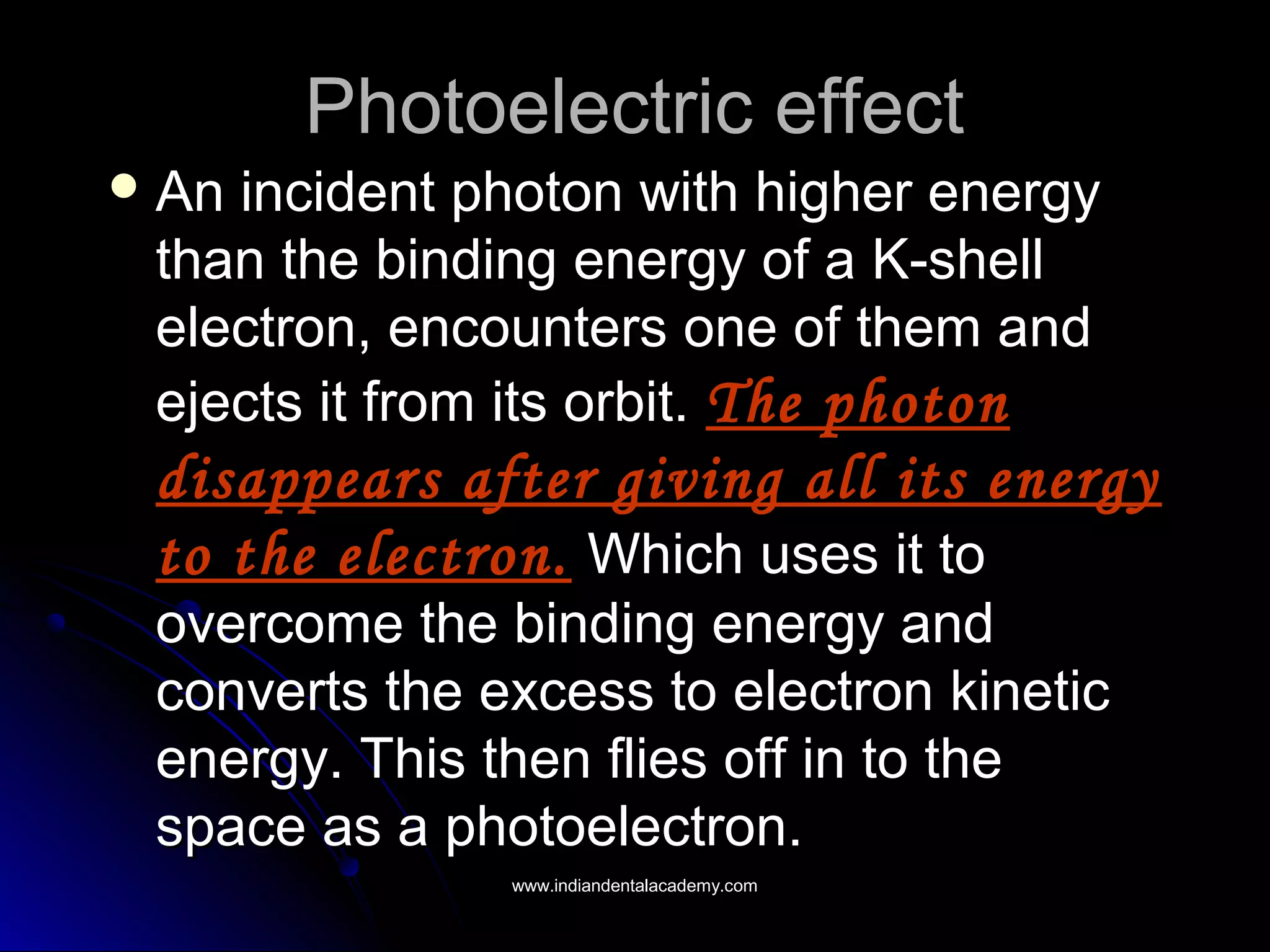
Photoelectric effectPhotoelectric effect
 An incident photon with higher energyAn incident photon with higher energy
than the binding energy of a K-shellthan the binding energy of a K-shell
electron, encounters one of them andelectron, encounters one of them and
ejects it from its orbit.ejects it from its orbit. The photonThe photon
disappears after giving all its energydisappears after giving all its energy
to the electron.to the electron. Which uses it toWhich uses it to
overcome the binding energy andovercome the binding energy and
converts the excess to electron kineticconverts the excess to electron kinetic
energy. This then flies off in to theenergy. This then flies off in to the
space as a photoelectron.space as a photoelectron.
www.indiandentalacademy.comwww.indiandentalacademy.com
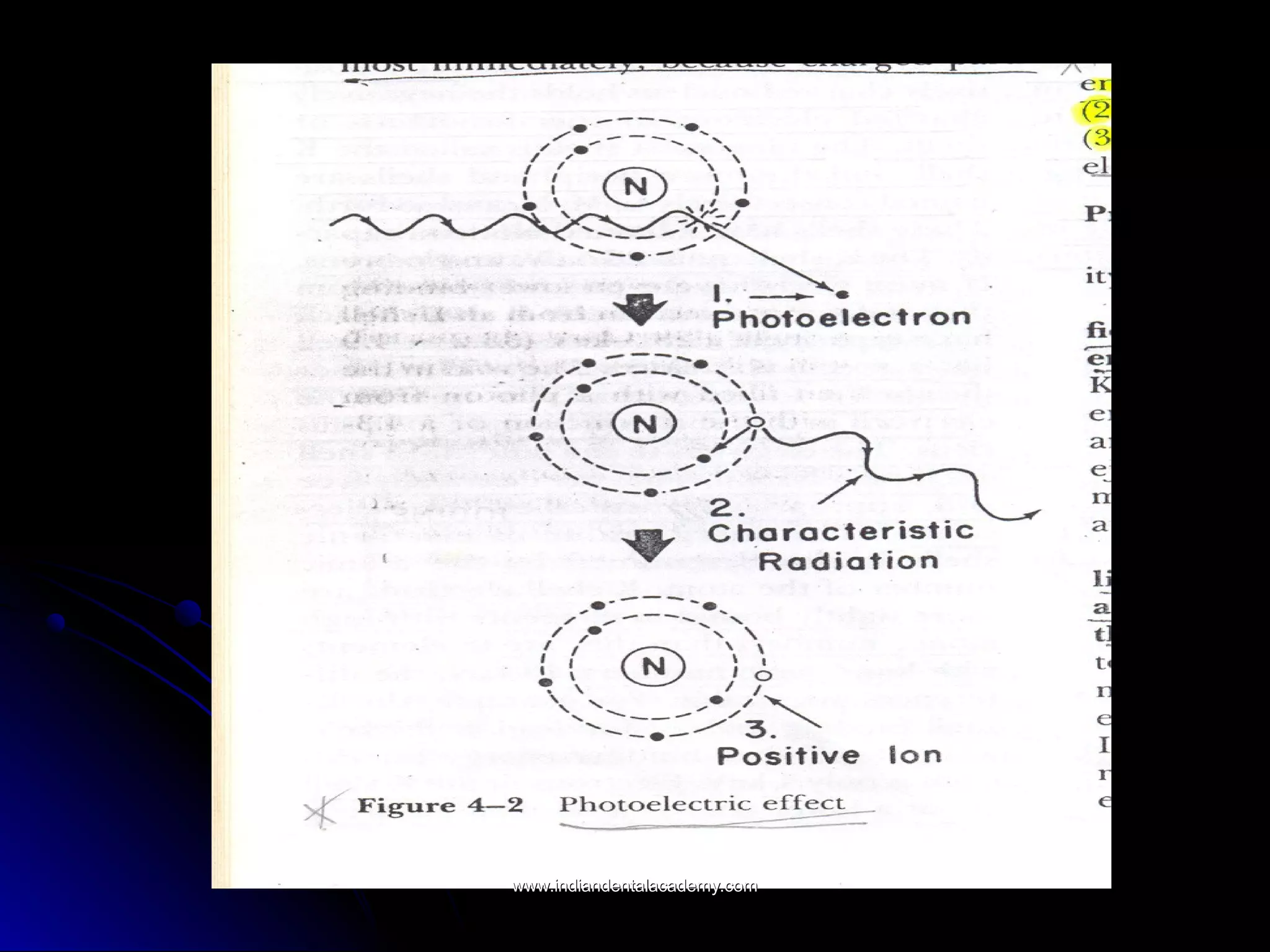
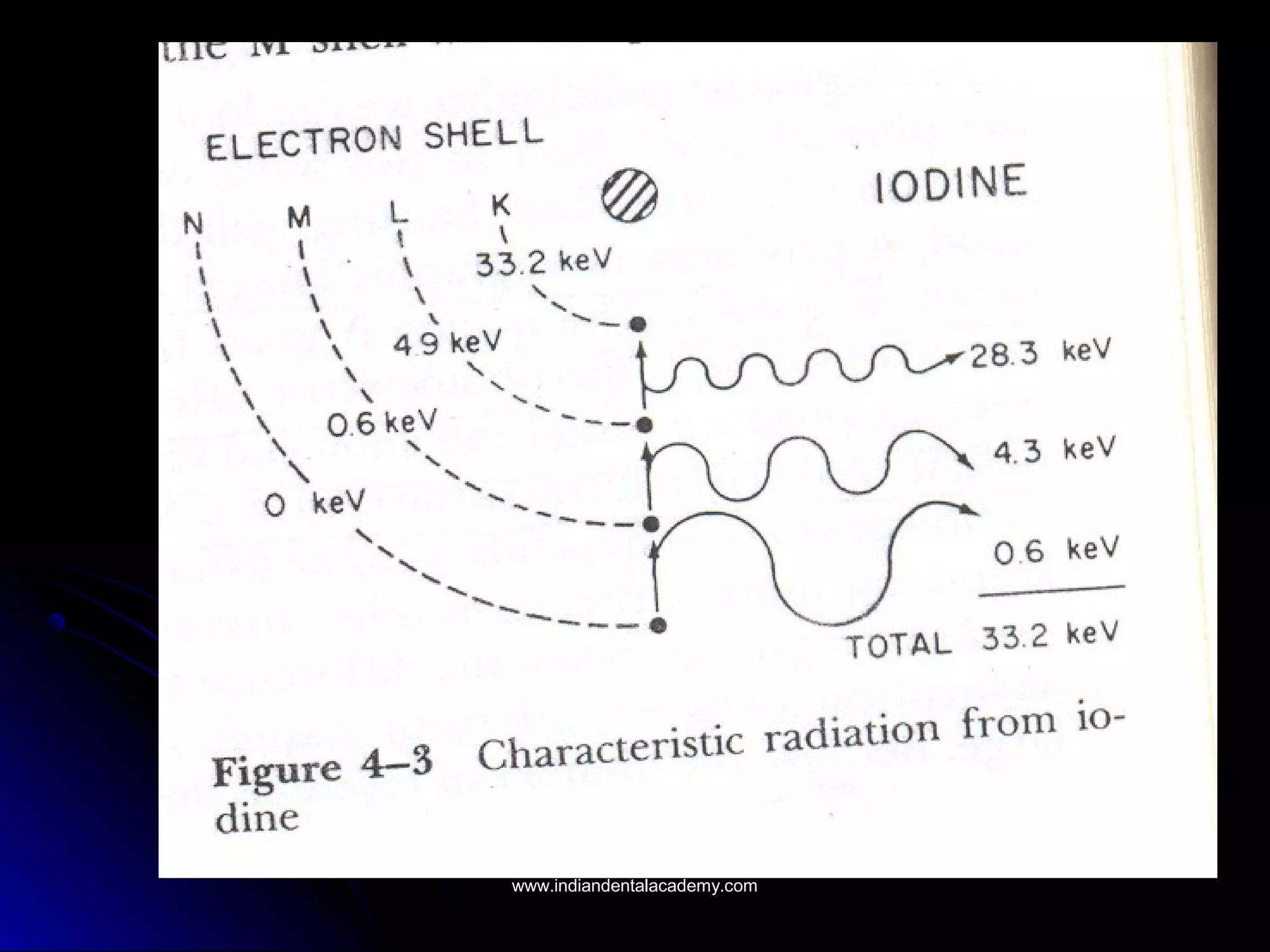
 Now, a L-shell electron jumps down toNow, a L-shell electron jumps down to
K-shell to fill the void, in which processK-shell to fill the void, in which process
an x-ray photon is released. Thisan x-ray photon is released. This
amount of energy is characteristic to K-amount of energy is characteristic to K-
shell electron, and the radiation thusshell electron, and the radiation thus
produced is called “characteristicproduced is called “characteristic
radiation”radiation”
www.indiandentalacademy.comwww.indiandentalacademy.com
The photoelectric effect yields 3 endThe photoelectric effect yields 3 end
products.products.
i)i) A negative ion (the photo electron)A negative ion (the photo electron)
ii)ii) Characteristic radiation andCharacteristic radiation and
iii)iii) A positive ion (the atom minus oneA positive ion (the atom minus one
electron).electron).
www.indiandentalacademy.comwww.indiandentalacademy.com
Probability of occurrence:Probability of occurrence:
1.1. The incident photon must have sufficientThe incident photon must have sufficient
energy to overcome the binding energy ofenergy to overcome the binding energy of
the electron.the electron.
2.2. A photo electric effect is likely to occurA photo electric effect is likely to occur
when. The photon energy and electronwhen. The photon energy and electron
binding energy are nearly the same.binding energy are nearly the same.
(provided of course that photons energy is(provided of course that photons energy is
aerates.aerates.
3.3. The tighter an electron is bound in its orbit,The tighter an electron is bound in its orbit,
the more likely it is to be involved in a P-Ethe more likely it is to be involved in a P-E
reaction.reaction.
www.indiandentalacademy.comwww.indiandentalacademy.com
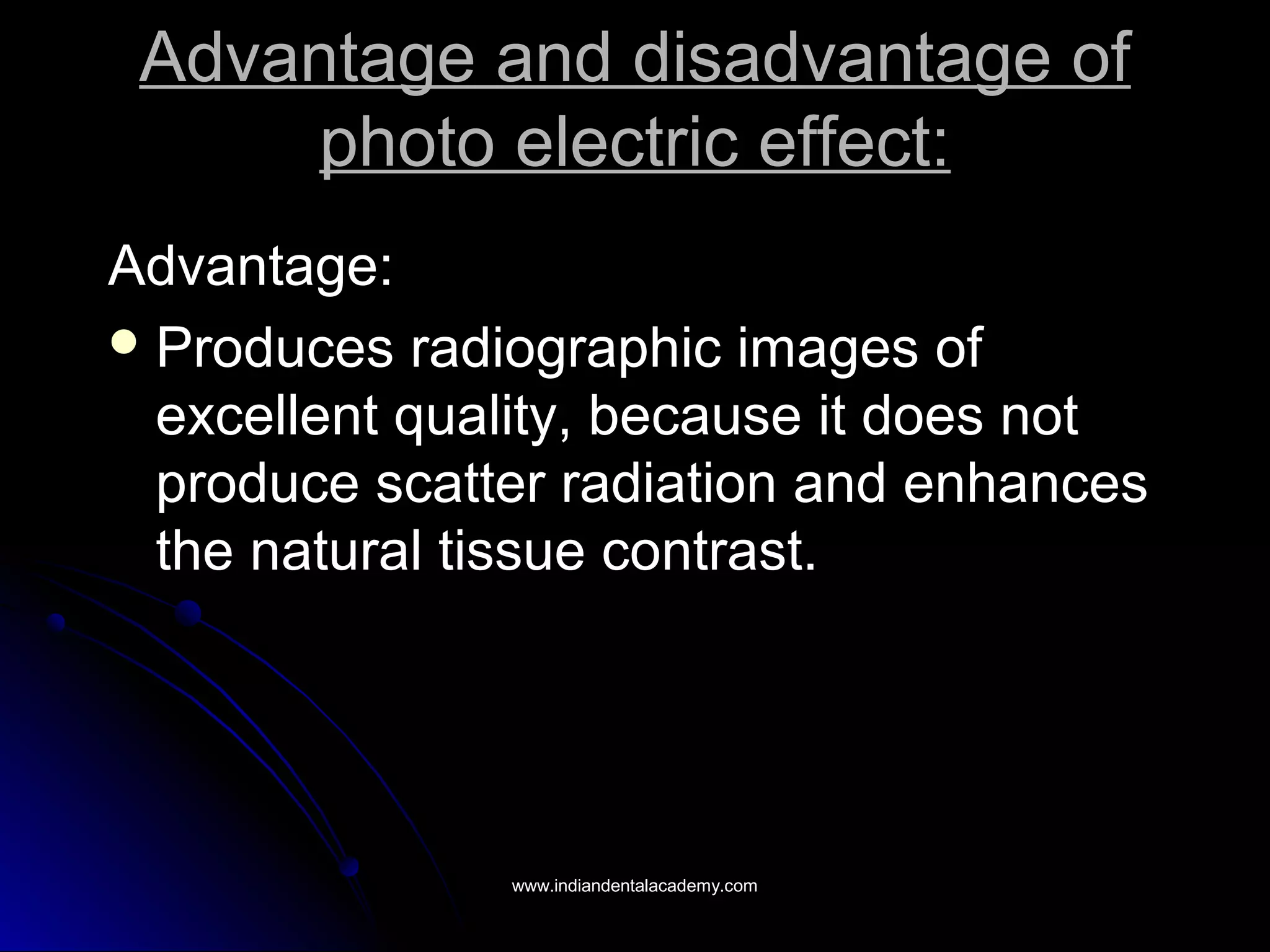
Advantage and disadvantage ofAdvantage and disadvantage of
photo electric effect:photo electric effect:
Advantage:Advantage:
 Produces radiographic images ofProduces radiographic images of
excellent quality, because it does notexcellent quality, because it does not
produce scatter radiation and enhancesproduce scatter radiation and enhances
the natural tissue contrast.the natural tissue contrast.
www.indiandentalacademy.comwww.indiandentalacademy.com
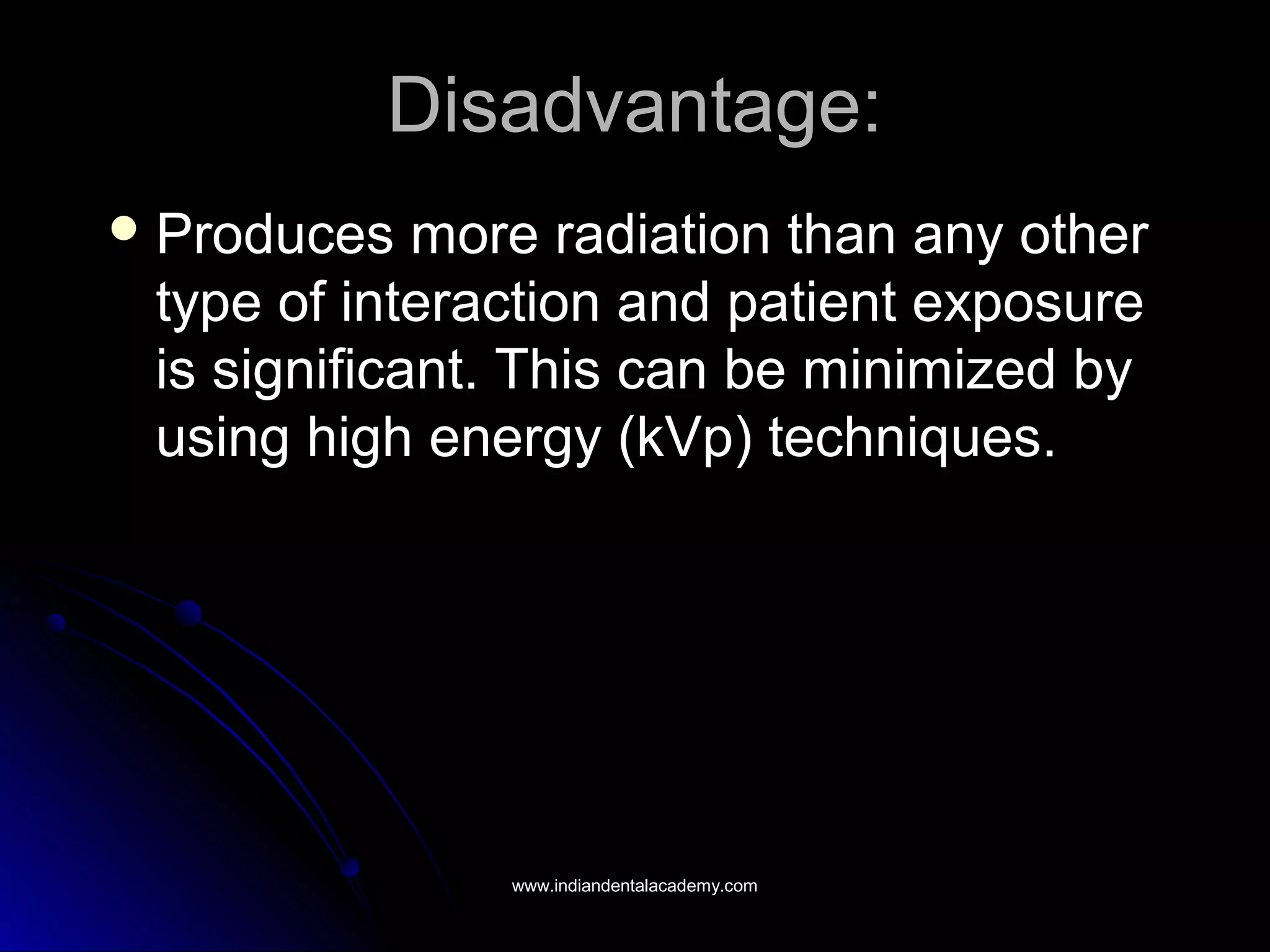
Disadvantage:Disadvantage:
 Produces more radiation than any otherProduces more radiation than any other
type of interaction and patient exposuretype of interaction and patient exposure
is significant. This can be minimized byis significant. This can be minimized by
using high energy (kVp) techniques.using high energy (kVp) techniques.
www.indiandentalacademy.comwww.indiandentalacademy.com
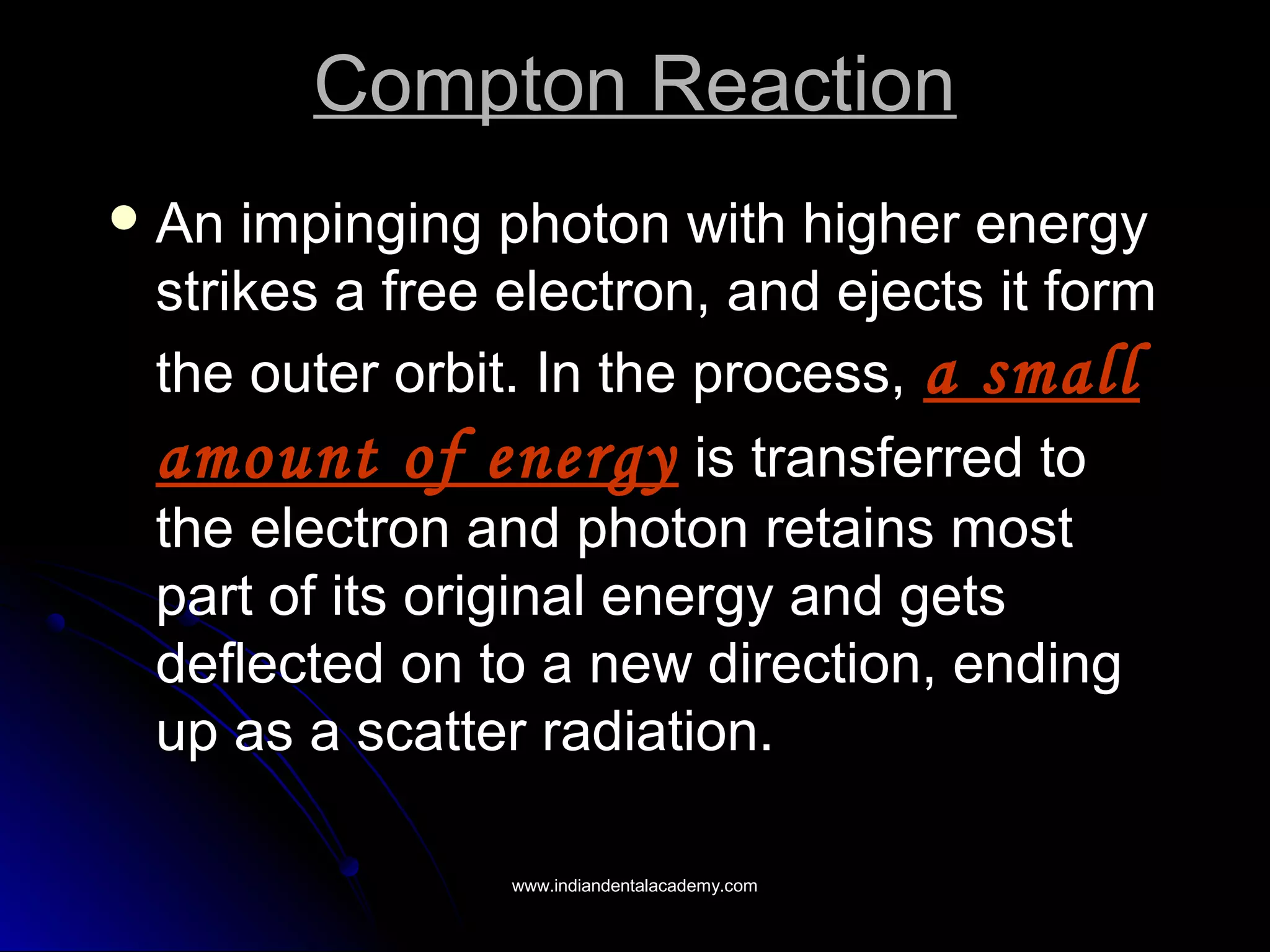
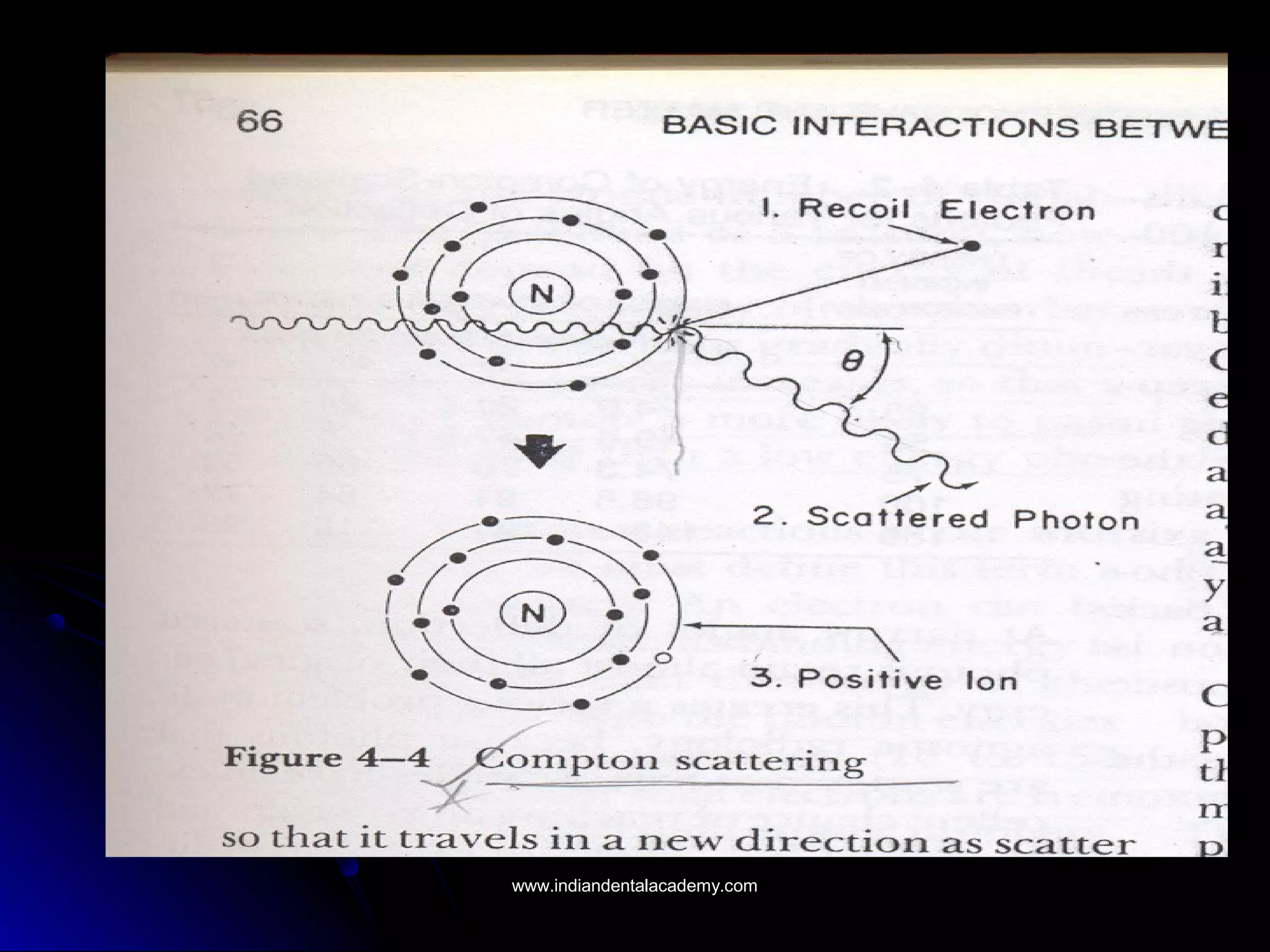
Compton ReactionCompton Reaction
 An impinging photon with higher energyAn impinging photon with higher energy
strikes a free electron, and ejects it formstrikes a free electron, and ejects it form
the outer orbit. In the process,the outer orbit. In the process, a smalla small
amount of energyamount of energy is transferred tois transferred to
the electron and photon retains mostthe electron and photon retains most
part of its original energy and getspart of its original energy and gets
deflected on to a new direction, endingdeflected on to a new direction, ending
up as a scatter radiation.up as a scatter radiation.
www.indiandentalacademy.comwww.indiandentalacademy.com
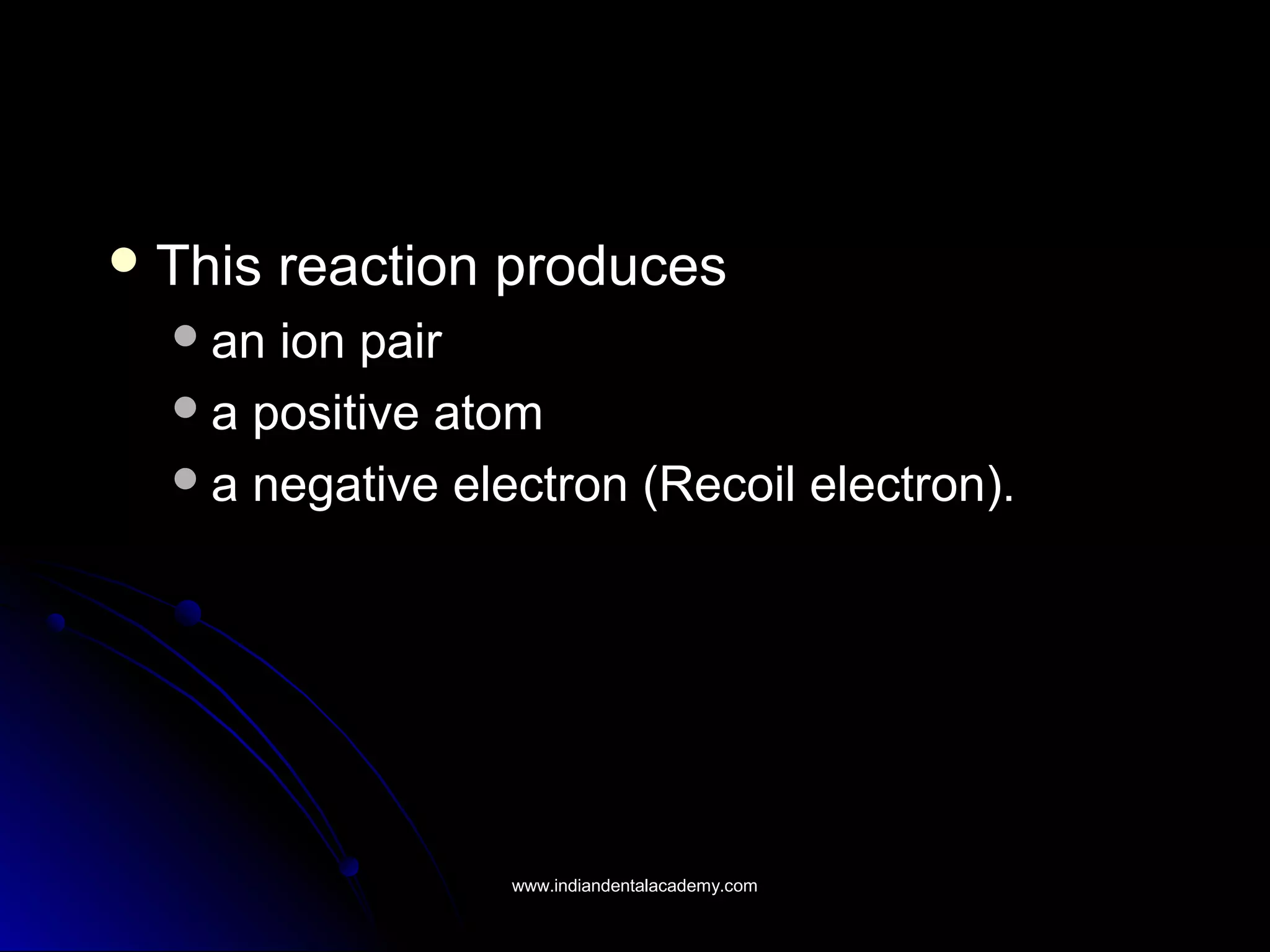
 This reaction producesThis reaction produces
an ion pairan ion pair
a positive atoma positive atom
a negative electron (Recoil electron).a negative electron (Recoil electron).
www.indiandentalacademy.comwww.indiandentalacademy.com
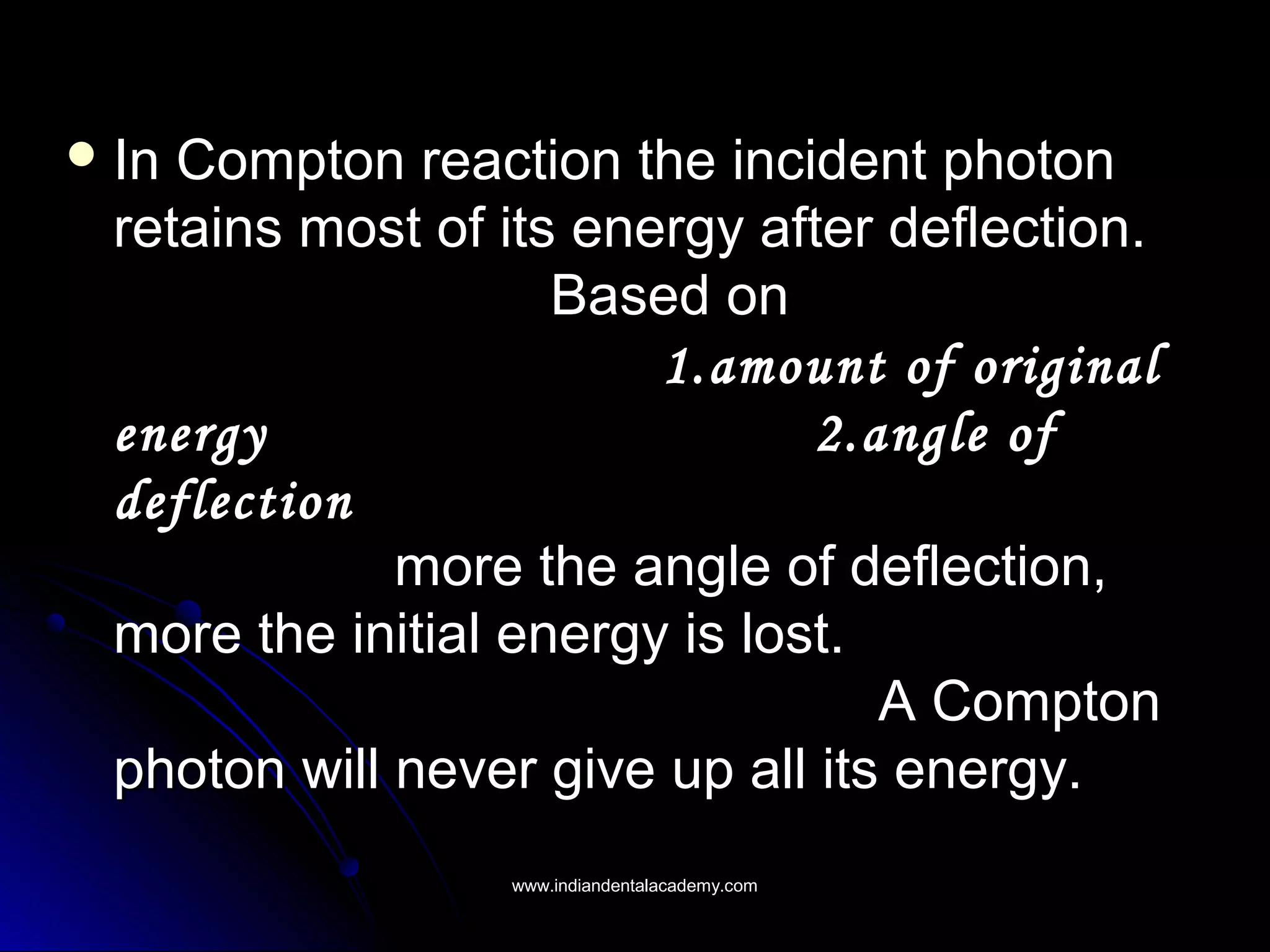
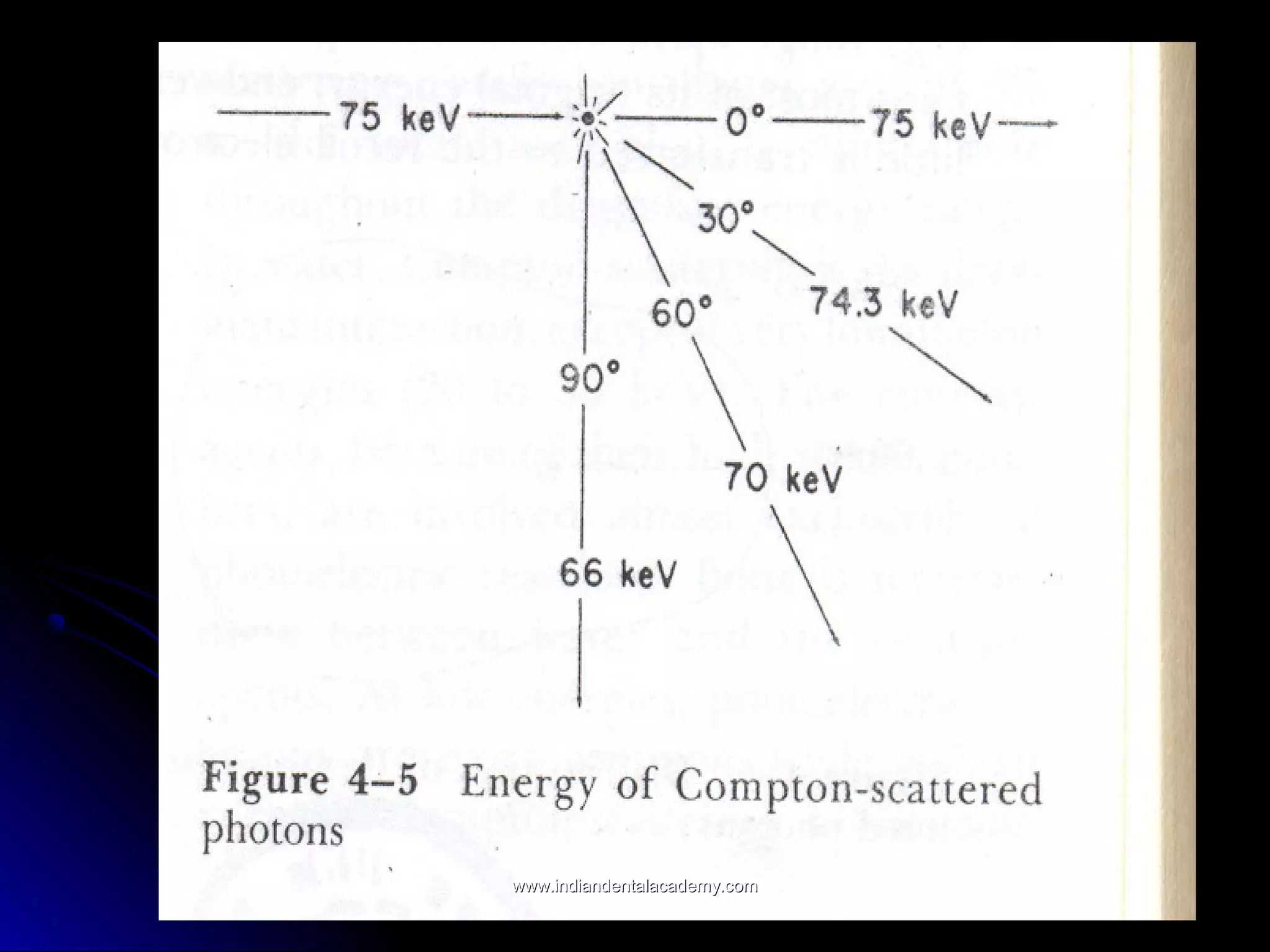
 In Compton reaction the incident photonIn Compton reaction the incident photon
retains most of its energy after deflection.retains most of its energy after deflection.
Based onBased on
1.amount of original1.amount of original
energy 2.angle ofenergy 2.angle of
deflectiondeflection
more the angle of deflection,more the angle of deflection,
more the initial energy is lost.more the initial energy is lost.
A ComptonA Compton
photon will never give up all its energy.photon will never give up all its energy.
www.indiandentalacademy.comwww.indiandentalacademy.com
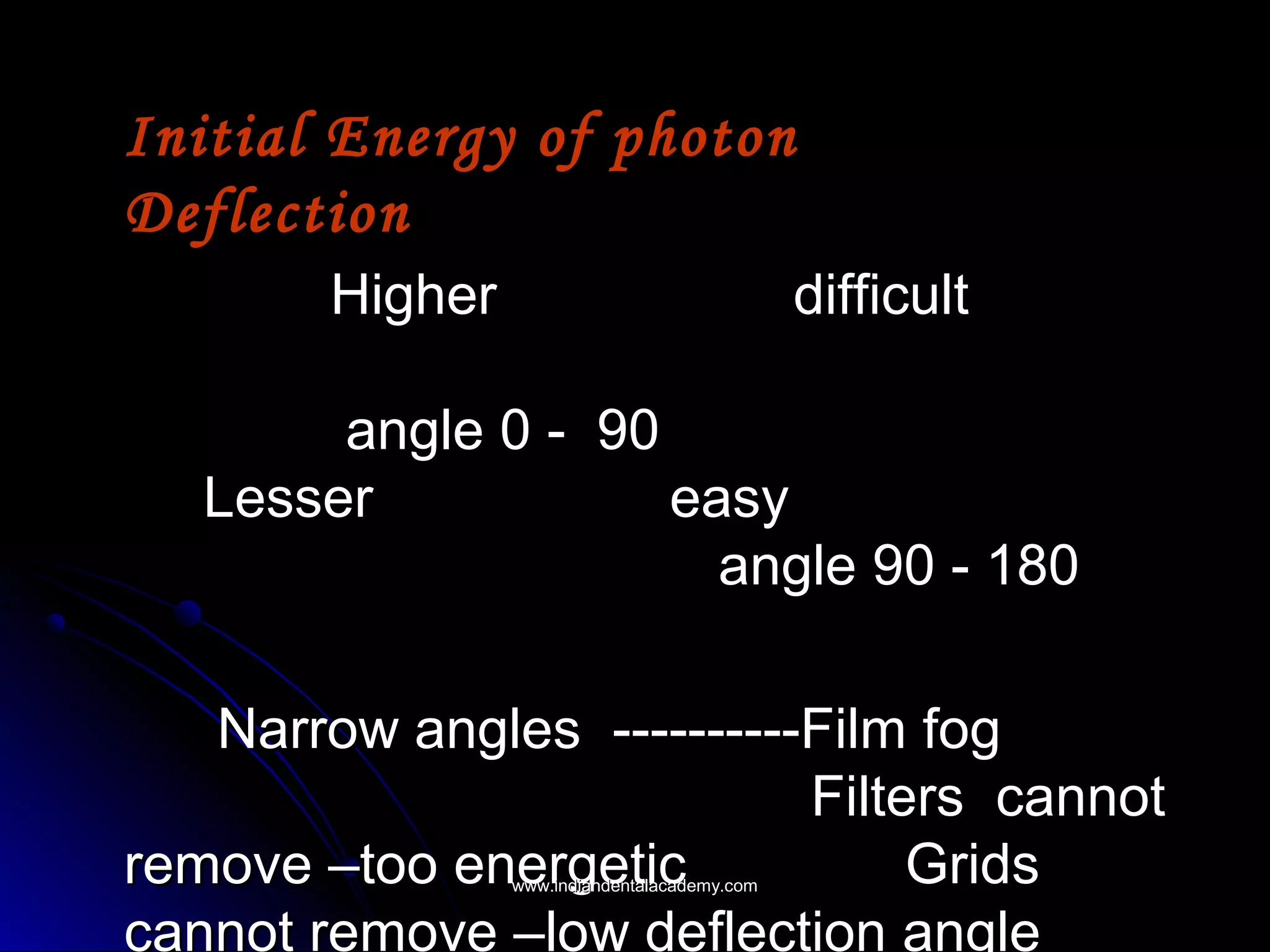
Initial Energy of photonInitial Energy of photon
DeflectionDeflection
Higher difficultHigher difficult
angle 0 - 90angle 0 - 90
Lesser easyLesser easy
angle 90 - 180angle 90 - 180
Narrow angles ----------Film fogNarrow angles ----------Film fog
Filters cannotFilters cannot
remove –too energetic Gridsremove –too energetic Grids
cannot remove –low deflection angle
www.indiandentalacademy.comwww.indiandentalacademy.com
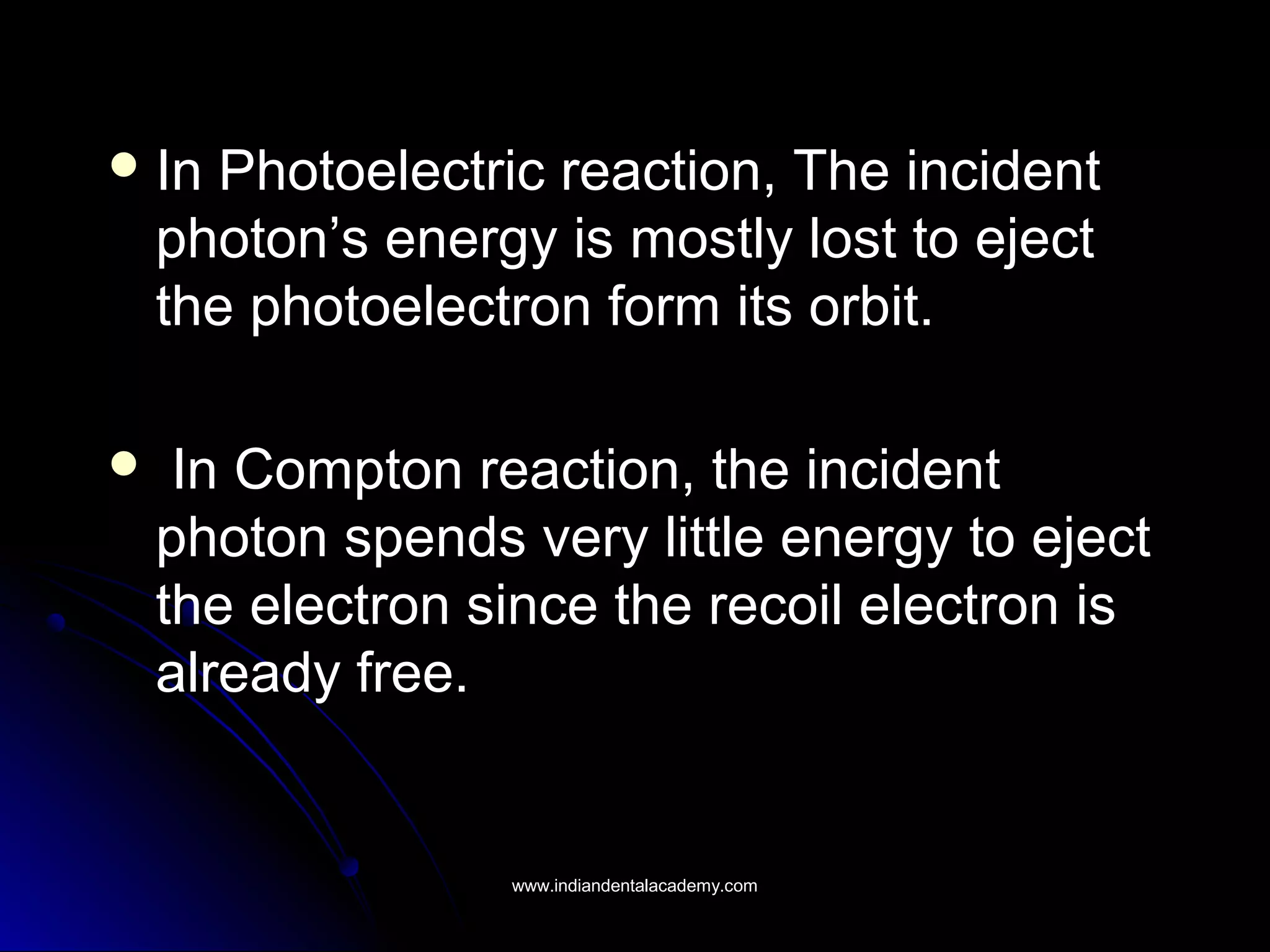
 In Photoelectric reaction, The incidentIn Photoelectric reaction, The incident
photon’s energy is mostly lost to ejectphoton’s energy is mostly lost to eject
the photoelectron form its orbit.the photoelectron form its orbit.
 In Compton reaction, the incidentIn Compton reaction, the incident
photon spends very little energy to ejectphoton spends very little energy to eject
the electron since the recoil electron isthe electron since the recoil electron is
already free.already free.
www.indiandentalacademy.comwww.indiandentalacademy.com
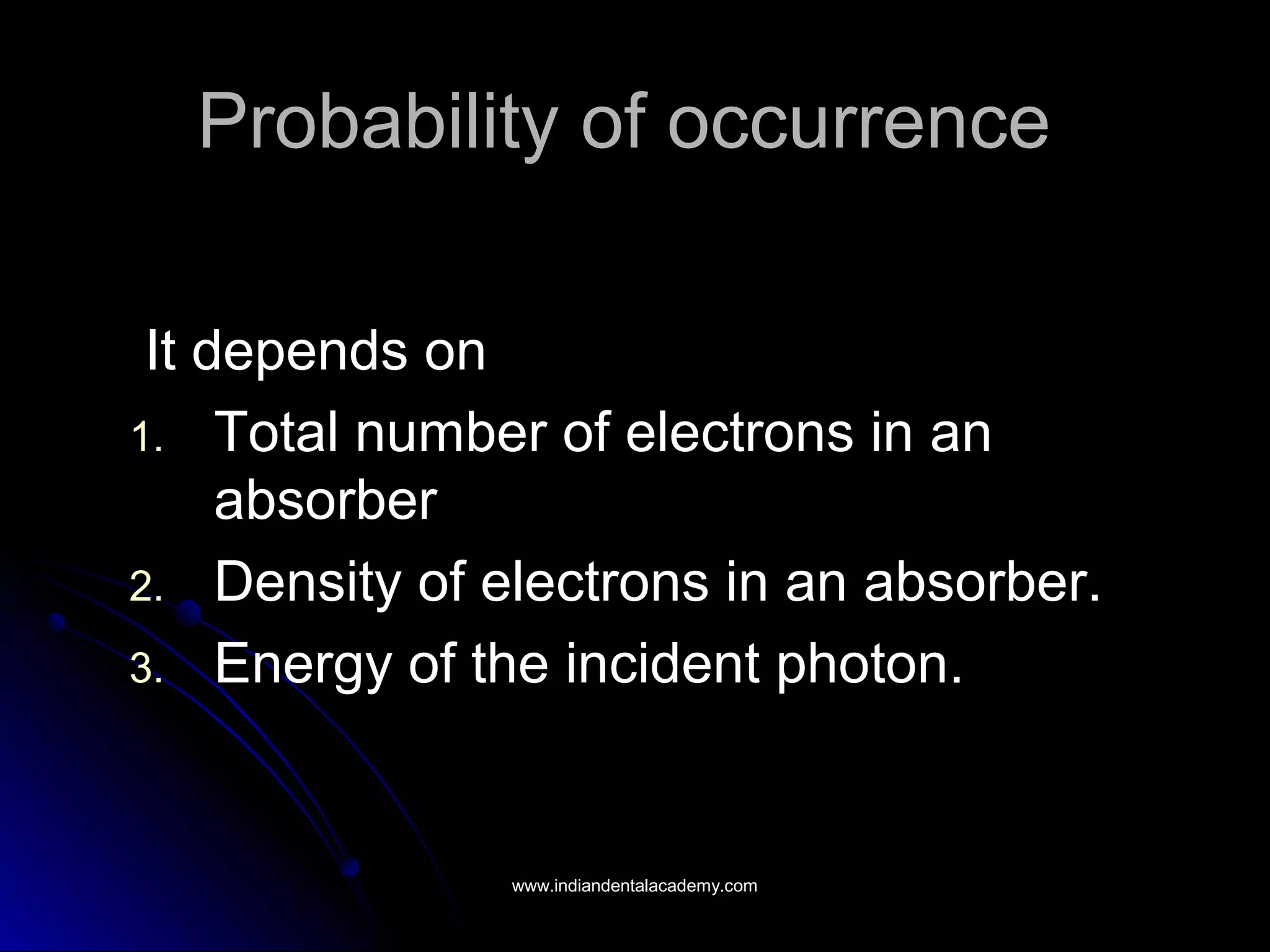
Probability of occurrenceProbability of occurrence
It depends onIt depends on
1.1. Total number of electrons in anTotal number of electrons in an
absorberabsorber
2.2. Density of electrons in an absorber.Density of electrons in an absorber.
3.3. Energy of the incident photon.Energy of the incident photon.
www.indiandentalacademy.comwww.indiandentalacademy.com
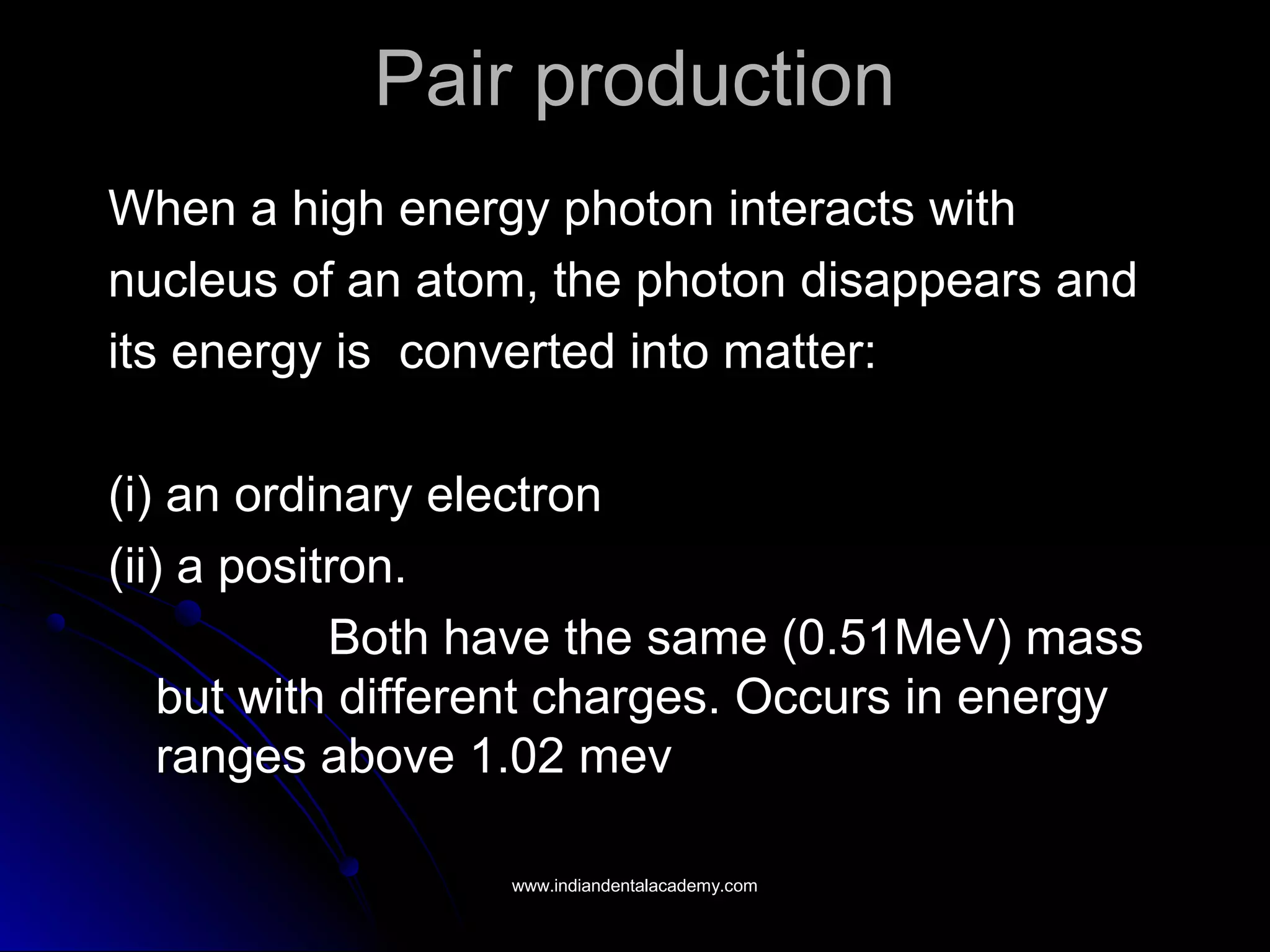
Pair productionPair production
When a high energy photon interacts withWhen a high energy photon interacts with
nucleus of an atom, the photon disappears andnucleus of an atom, the photon disappears and
its energy is converted into matter:its energy is converted into matter:
(i) an ordinary electron(i) an ordinary electron
(ii) a positron.(ii) a positron.
Both have the same (0.51MeV) massBoth have the same (0.51MeV) mass
but with different charges. Occurs in energybut with different charges. Occurs in energy
ranges above 1.02 mevranges above 1.02 mev
www.indiandentalacademy.comwww.indiandentalacademy.com
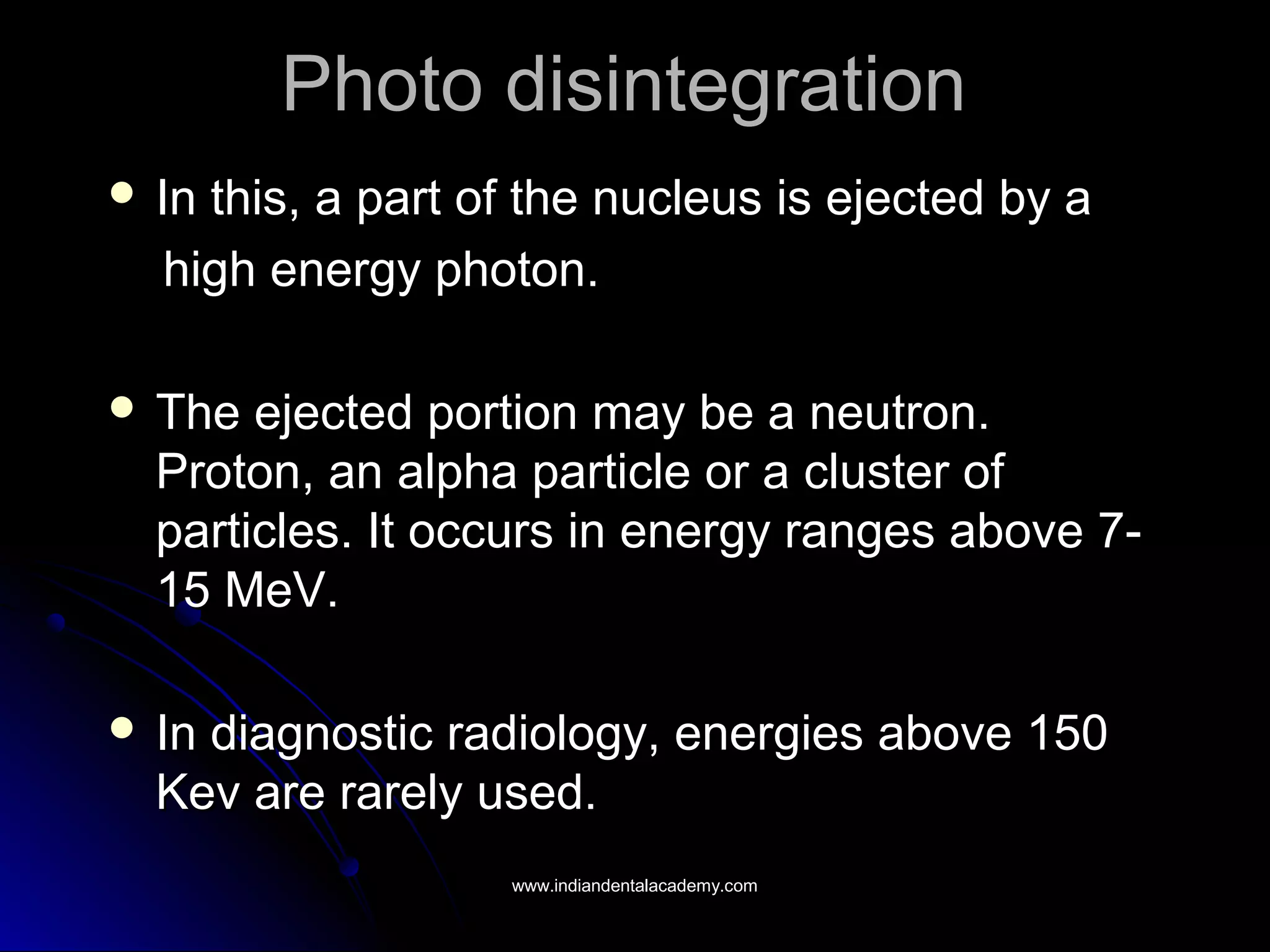
Photo disintegrationPhoto disintegration
 In this, a part of the nucleus is ejected by aIn this, a part of the nucleus is ejected by a
high energy photon.high energy photon.
 The ejected portion may be a neutron.The ejected portion may be a neutron.
Proton, an alpha particle or a cluster ofProton, an alpha particle or a cluster of
particles. It occurs in energy ranges above 7-particles. It occurs in energy ranges above 7-
15 MeV.15 MeV.
 In diagnostic radiology, energies above 150In diagnostic radiology, energies above 150
Kev are rarely used.Kev are rarely used.
www.indiandentalacademy.comwww.indiandentalacademy.com
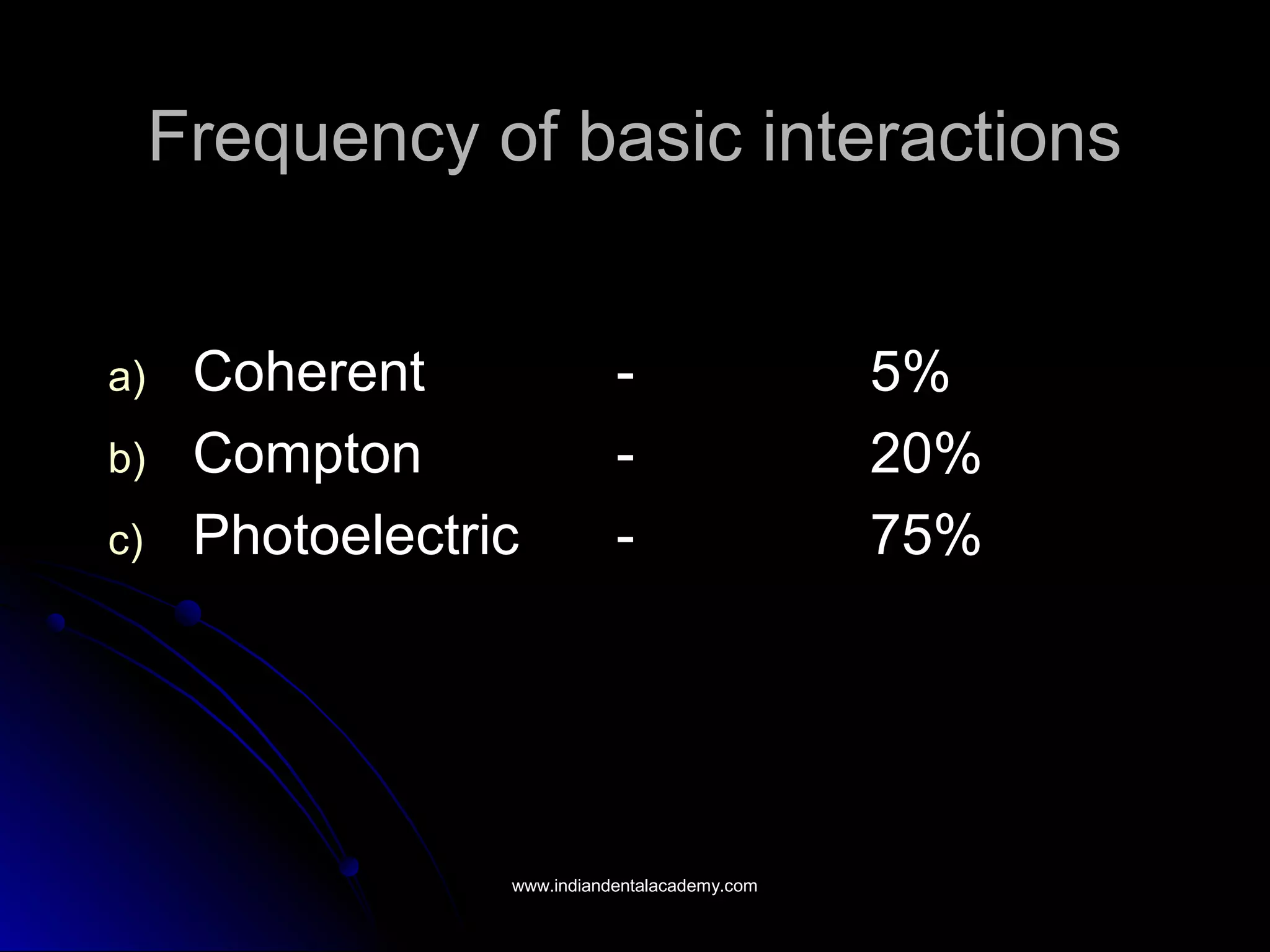
Frequency of basic interactionsFrequency of basic interactions
a)a) CoherentCoherent -- 5%5%
b)b) ComptonCompton -- 20%20%
c)c) PhotoelectricPhotoelectric -- 75%75%
www.indiandentalacademy.comwww.indiandentalacademy.com
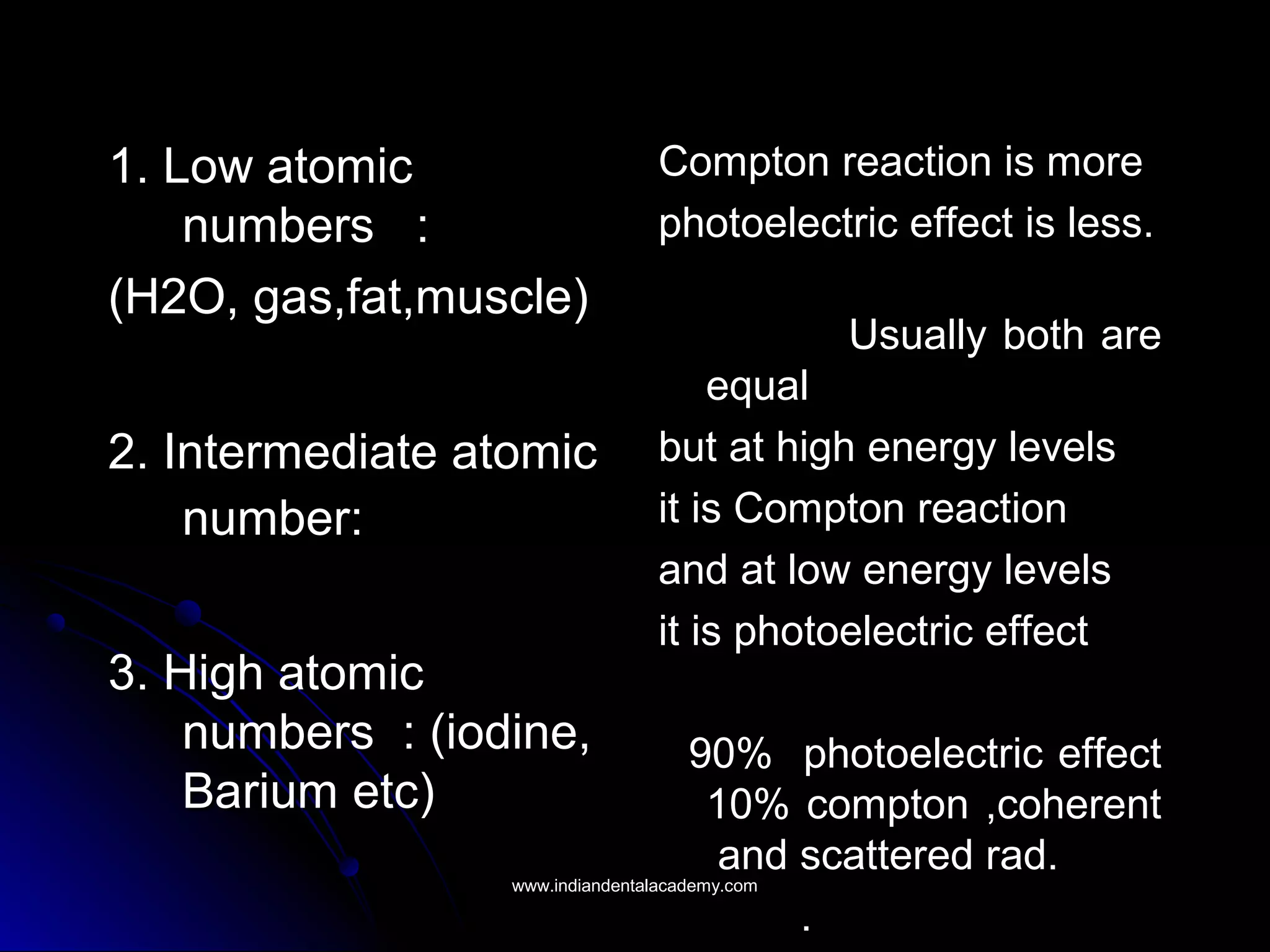
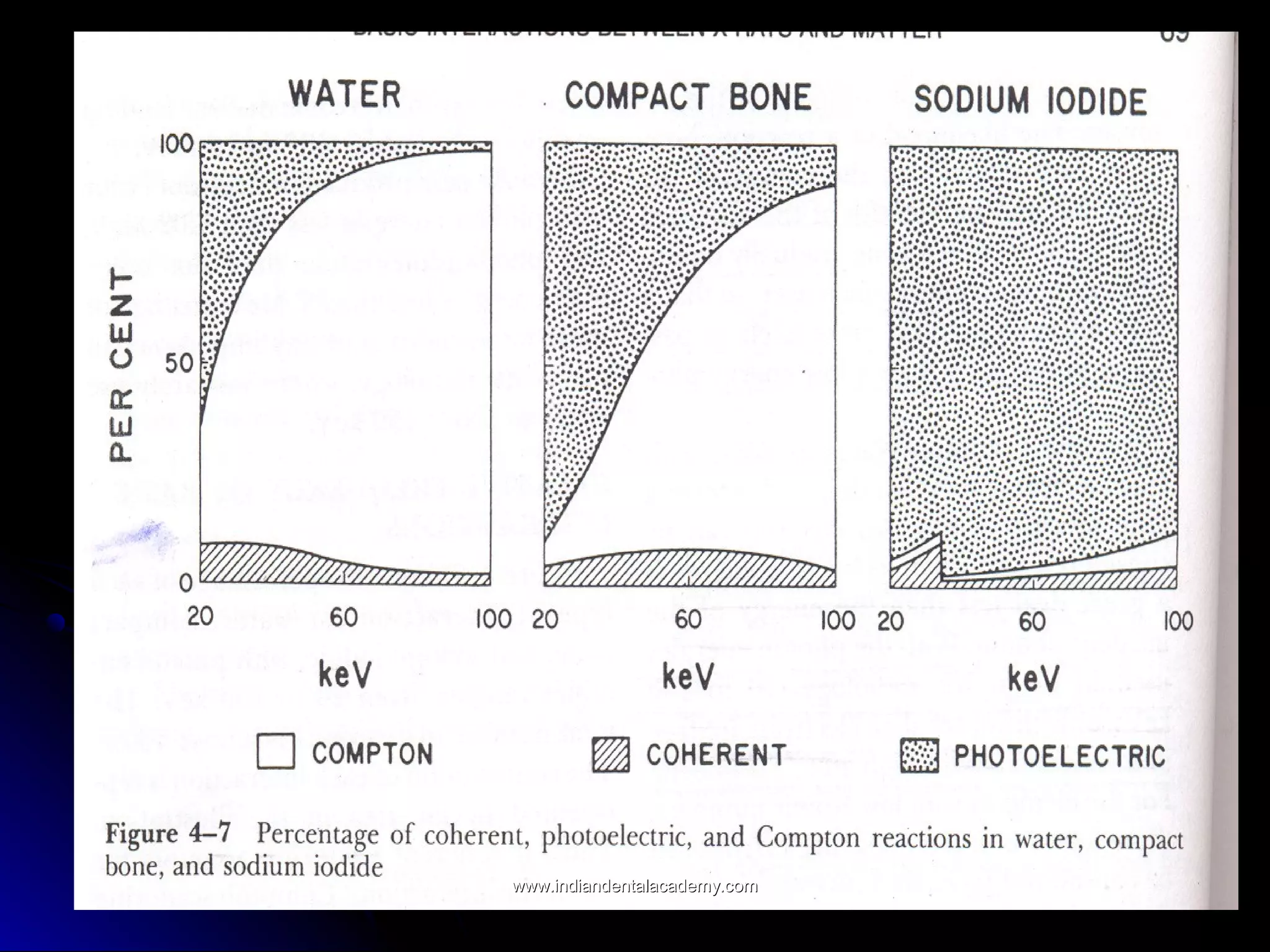
1. Low atomic1. Low atomic
numbers :numbers :
(H2O, gas,fat,muscle)(H2O, gas,fat,muscle)
2. Intermediate atomic2. Intermediate atomic
number:number:
3. High atomic3. High atomic
numbers : (iodine,numbers : (iodine,
Barium etc)Barium etc)
Compton reaction is moreCompton reaction is more
photoelectric effect is less.photoelectric effect is less.
Usually both areUsually both are
equalequal
but at high energy levelsbut at high energy levels
it is Compton reactionit is Compton reaction
and at low energy levelsand at low energy levels
it is photoelectric effectit is photoelectric effect
90% photoelectric effect90% photoelectric effect
10% compton ,coherent10% compton ,coherent
and scattered rad.and scattered rad.
..
www.indiandentalacademy.comwww.indiandentalacademy.com
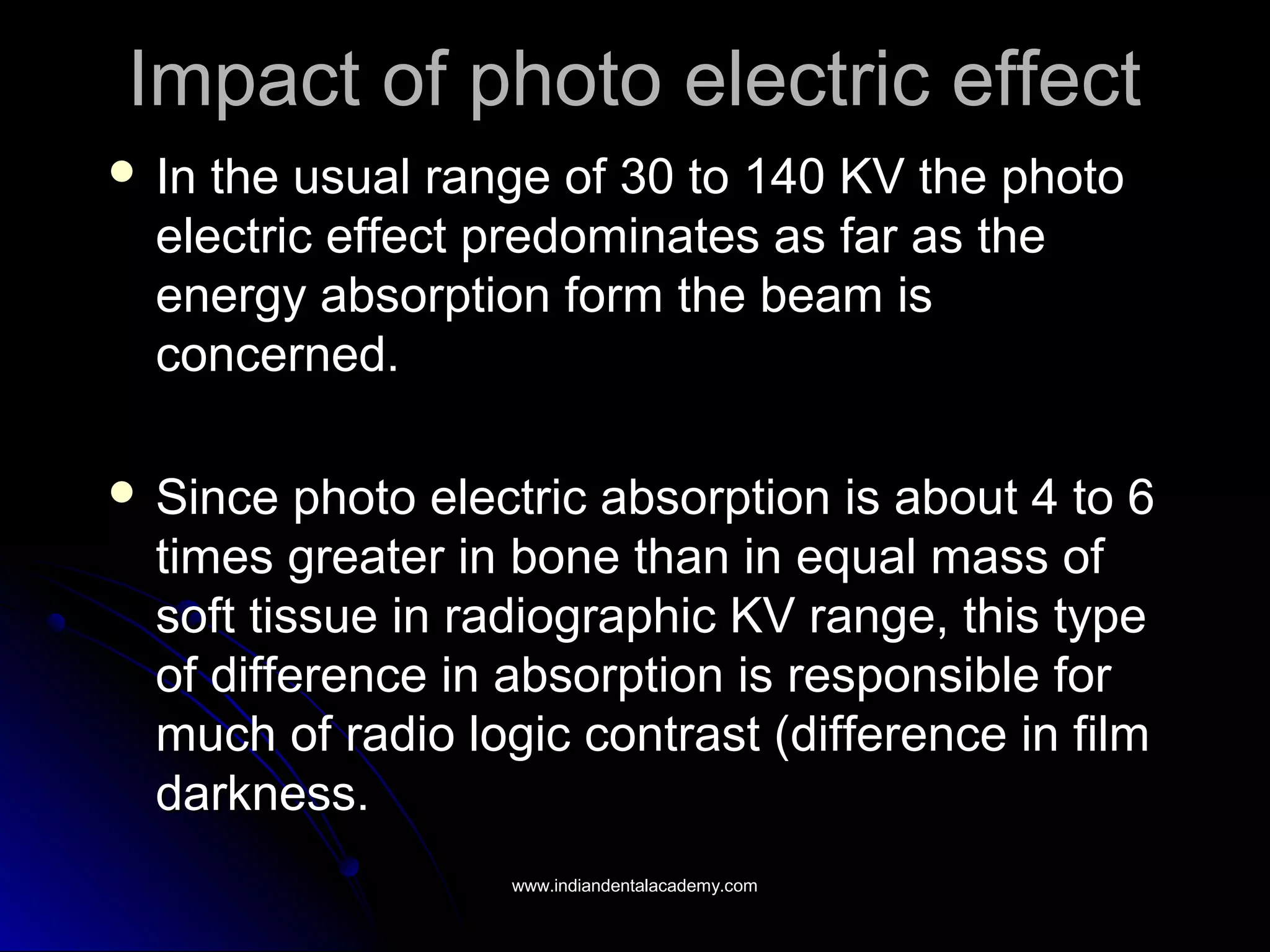
Impact of photo electric effectImpact of photo electric effect
 In the usual range of 30 to 140 KV the photoIn the usual range of 30 to 140 KV the photo
electric effect predominates as far as theelectric effect predominates as far as the
energy absorption form the beam isenergy absorption form the beam is
concerned.concerned.
 Since photo electric absorption is about 4 to 6Since photo electric absorption is about 4 to 6
times greater in bone than in equal mass oftimes greater in bone than in equal mass of
soft tissue in radiographic KV range, this typesoft tissue in radiographic KV range, this type
of difference in absorption is responsible forof difference in absorption is responsible for
much of radio logic contrast (difference in filmmuch of radio logic contrast (difference in film
darkness.darkness.
www.indiandentalacademy.comwww.indiandentalacademy.com
Compton ReactionCompton Reaction
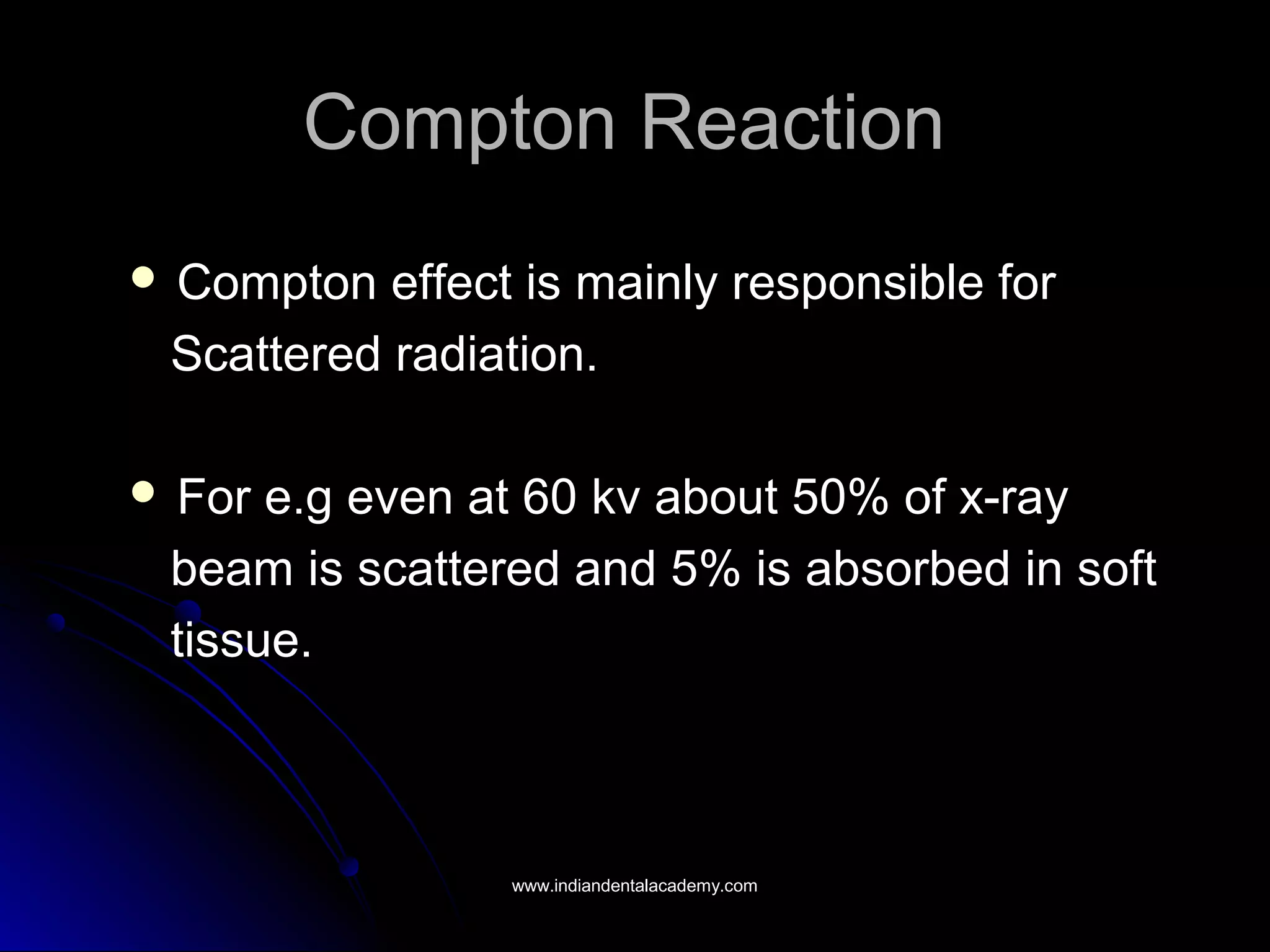
 Compton effect is mainly responsible forCompton effect is mainly responsible for
Scattered radiation.Scattered radiation.
 For e.g even at 60 kv about 50% of x-rayFor e.g even at 60 kv about 50% of x-ray
beam is scattered and 5% is absorbed in softbeam is scattered and 5% is absorbed in soft
tissue.tissue.
www.indiandentalacademy.comwww.indiandentalacademy.com
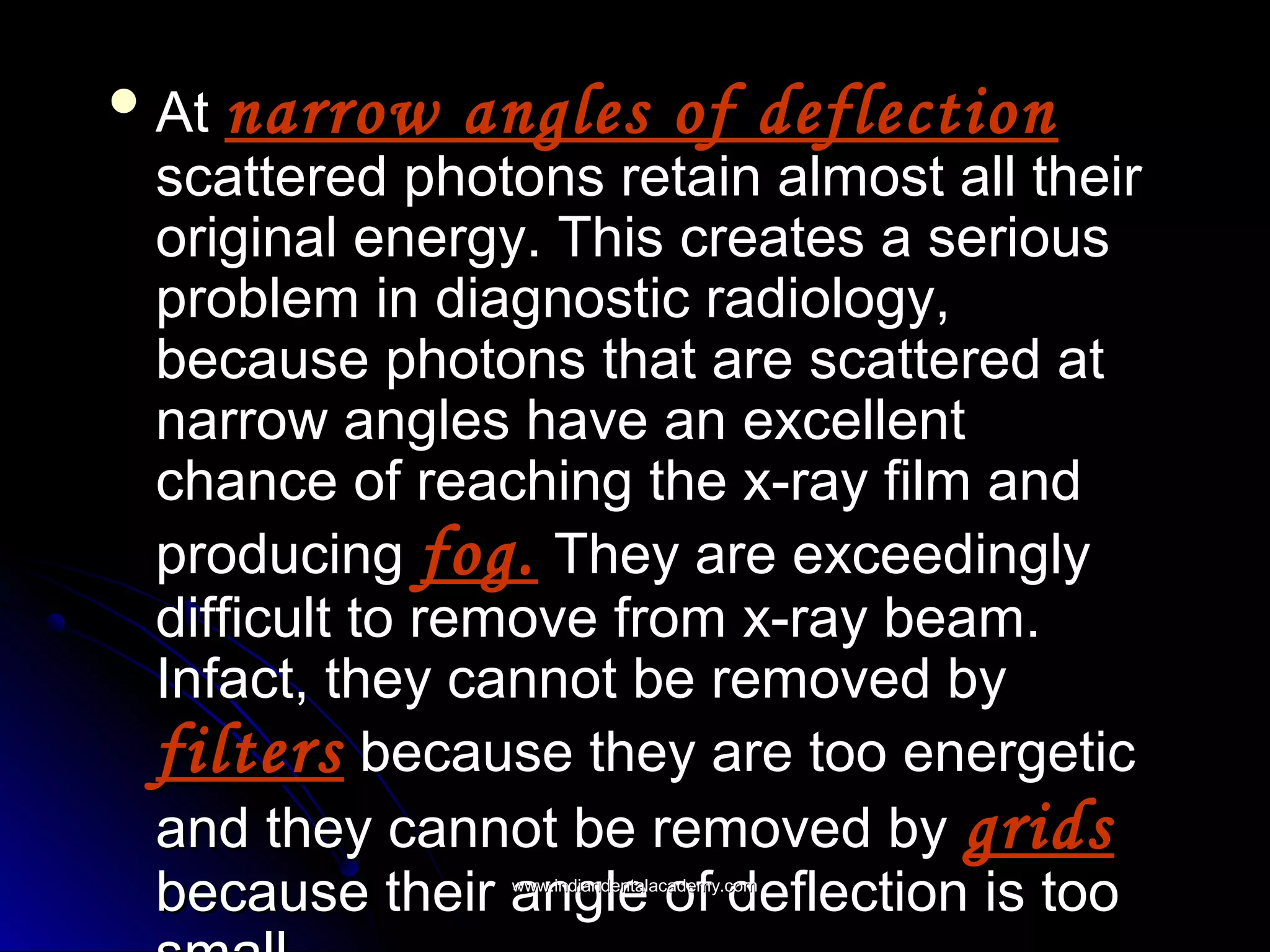
 AtAt narrow angles of deflectionnarrow angles of deflection
scattered photons retain almost all theirscattered photons retain almost all their
original energy. This creates a seriousoriginal energy. This creates a serious
problem in diagnostic radiology,problem in diagnostic radiology,
because photons that are scattered atbecause photons that are scattered at
narrow angles have an excellentnarrow angles have an excellent
chance of reaching the x-ray film andchance of reaching the x-ray film and
producingproducing fog.fog. They are exceedinglyThey are exceedingly
difficult to remove from x-ray beam.difficult to remove from x-ray beam.
Infact, they cannot be removed byInfact, they cannot be removed by
filtersfilters because they are too energeticbecause they are too energetic
and they cannot be removed byand they cannot be removed by gridsgrids
because their angle of deflection is toobecause their angle of deflection is toowww.indiandentalacademy.comwww.indiandentalacademy.com
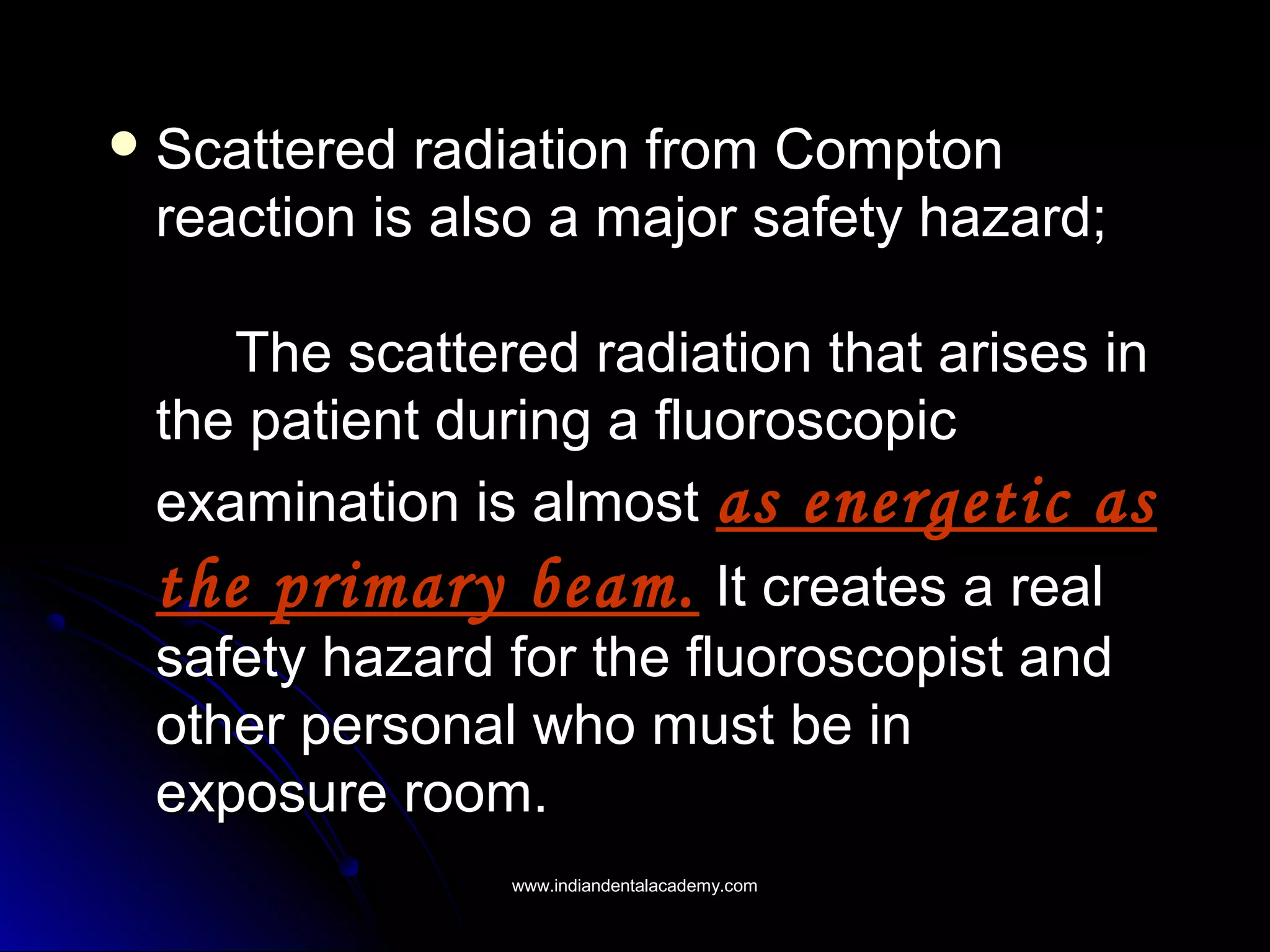
 Scattered radiation from ComptonScattered radiation from Compton
reaction is also a major safety hazard;reaction is also a major safety hazard;
The scattered radiation that arises inThe scattered radiation that arises in
the patient during a fluoroscopicthe patient during a fluoroscopic
examination is almostexamination is almost as energetic asas energetic as
the primary beam.the primary beam. It creates a realIt creates a real
safety hazard for the fluoroscopist andsafety hazard for the fluoroscopist and
other personal who must be inother personal who must be in
exposure room.exposure room.
www.indiandentalacademy.comwww.indiandentalacademy.com
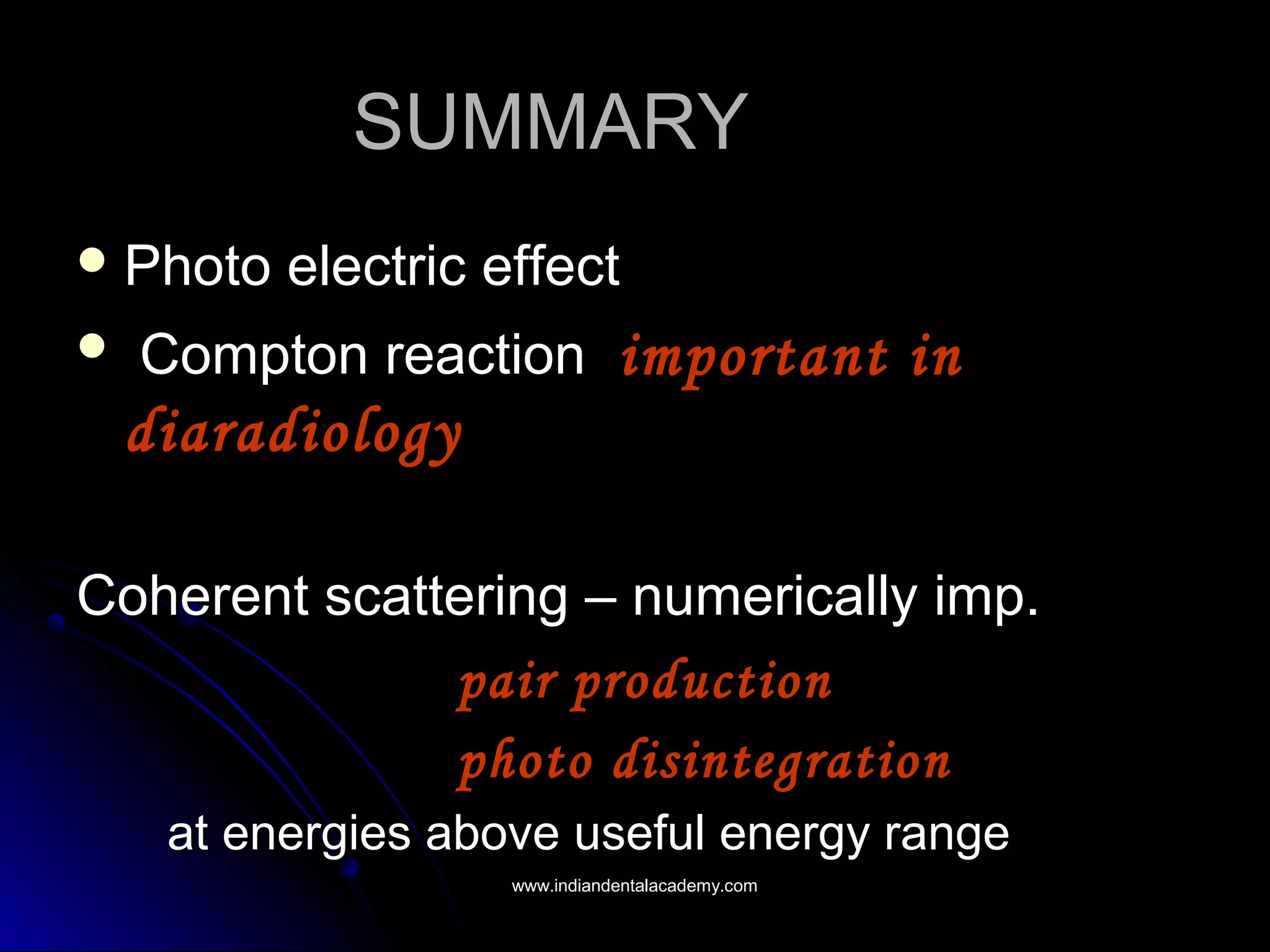
SUMMARYSUMMARY
 Photo electric effectPhoto electric effect
 Compton reactionCompton reaction important inimportant in
diaradiologydiaradiology
Coherent scattering – numerically imp.Coherent scattering – numerically imp.
pair productionpair production
photo disintegrationphoto disintegration
at energies above useful energy rangeat energies above useful energy range
www.indiandentalacademy.comwww.indiandentalacademy.com
 PredominantPredominant
Photo electric effect lowPhoto electric effect low
energy radenergy rad
high atomic absorberhigh atomic absorber
Compton reaction high energy radCompton reaction high energy rad
low atomic absorberslow atomic absorbers
www.indiandentalacademy.comwww.indiandentalacademy.com
ReferencesReferences
 CHRISTENSEN’S PHYSICS OFCHRISTENSEN’S PHYSICS OF
DIAGNOSTIC RADIOLOGYDIAGNOSTIC RADIOLOGY
 THE FUNDAMENTALS OF X-RAY ANDTHE FUNDAMENTALS OF X-RAY AND
RADIUM PHYSICS – JOSEPH SELMENRADIUM PHYSICS – JOSEPH SELMEN
www.indiandentalacademy.comwww.indiandentalacademy.com

Interaction between x rays and matter 16

  • 1.
  • 2.
    INTERACTION BETWEEN X-RAYSINTERACTIONBETWEEN X-RAYS AND MATTERAND MATTER www.indiandentalacademy.comwww.indiandentalacademy.com
  • 3.
    X – rayphotonsX – ray photons  Orbital electrons (In diagnostic range)Orbital electrons (In diagnostic range)  Nucleus.Nucleus. www.indiandentalacademy.comwww.indiandentalacademy.com
  • 4.
     1897 J.JThomson1897 J.J Thomson electron.electron.  Rutherford & BohrRutherford & Bohr model of atom.model of atom. www.indiandentalacademy.comwww.indiandentalacademy.com
  • 5.
    Nucleus :-Nucleus :- ProtonsProtonsNeutronsNeutrons PositivePositive ZeroZero Equal massEqual mass Proton +Neutron =1836 times mass of electronProton +Neutron =1836 times mass of electron mass.mass. Atomic number (Z) = No of proton.Atomic number (Z) = No of proton. Mass number (A) = No of protons + No ofMass number (A) = No of protons + No of neutrons.neutrons. www.indiandentalacademy.comwww.indiandentalacademy.com
  • 6.
    Atom – ATiny planetary modelAtom – A Tiny planetary model www.indiandentalacademy.comwww.indiandentalacademy.com
  • 7.
     K shell– 2 electronsK shell – 2 electrons  L shell – 8 electronsL shell – 8 electrons  M shell – 18 electronsM shell – 18 electrons  N shell – 32 electronsN shell – 32 electrons  O shell – 50 electronsO shell – 50 electrons www.indiandentalacademy.comwww.indiandentalacademy.com
  • 8.
    Normal stage :Electrically neutral.Normal stage : Electrically neutral. No of protons = No of electronsNo of protons = No of electrons www.indiandentalacademy.comwww.indiandentalacademy.com
  • 9.
    Diameter of orbitsdepends onDiameter of orbits depends on (a)(a) Nuclear force on electron.Nuclear force on electron. (b)(b) Angular moments & energy ofAngular moments & energy of electron.electron. www.indiandentalacademy.comwww.indiandentalacademy.com
  • 10.
    Binding force:Binding force: Definition: the negatively changedDefinition : the negatively changed electrons held in a particular atom by anelectrons held in a particular atom by an attractive force of positively changedattractive force of positively changed nucleus.nucleus.  Binding force of electronBinding force of electron αα Square ofSquare of distance between nucleus & electrons.distance between nucleus & electrons.  Binding force is grater with electrons ofBinding force is grater with electrons of nearest shell than in outer orbit.nearest shell than in outer orbit. www.indiandentalacademy.comwww.indiandentalacademy.com
  • 11.
    Nuclear force –e in an orbit.Nuclear force – e in an orbit. Binding force – e in an atom.Binding force – e in an atom. www.indiandentalacademy.comwww.indiandentalacademy.com
  • 12.
    Binding energy ofelectronBinding energy of electron  To free an electron from an atom, theTo free an electron from an atom, the energy must be raised to zero or to aenergy must be raised to zero or to a positive value.positive value.  The energy that an electron in a shellThe energy that an electron in a shell must be given to raise the energy value tomust be given to raise the energy value to zero is called is called the “bindingzero is called is called the “binding energy” of the electron, which alsoenergy” of the electron, which also translates into the atomic Energy shellstranslates into the atomic Energy shells as they house electronsas they house electrons www.indiandentalacademy.comwww.indiandentalacademy.com
  • 13.
     Tungsten hasa k-shell energy of-70 keVTungsten has a k-shell energy of-70 keV  L shell has an energy of-11 keV.L shell has an energy of-11 keV.  The L electronhas 59 Kev more energy thanThe L electronhas 59 Kev more energy than the k electron.the k electron. www.indiandentalacademy.comwww.indiandentalacademy.com
  • 14.
     In sight:Insight: An electron cannot have any more or lessAn electron cannot have any more or less energy than that associated with itsenergy than that associated with its energy shell.energy shell. www.indiandentalacademy.comwww.indiandentalacademy.com
  • 15.
     None theless, an electron may jumpNone the less, an electron may jump from one energy shell to anotherfrom one energy shell to another (higher or lower), if the shell of which it(higher or lower), if the shell of which it jumps is already not filled.jumps is already not filled.  Electron, when it jumps to a lowerElectron, when it jumps to a lower energy shell (e.g.from L to K), emitsenergy shell (e.g.from L to K), emits energy, which is equal to the differenceenergy, which is equal to the difference in binding energy between 2 shells. Thisin binding energy between 2 shells. This emitted energy may take the from ofemitted energy may take the from of photon, which if it of sufficient quantity,photon, which if it of sufficient quantity, may be called an x-ray photon.may be called an x-ray photon. www.indiandentalacademy.comwww.indiandentalacademy.com
  • 16.
     Electron, tojump to a higher energyElectron, to jump to a higher energy shell (e.g. from K and L) requires theshell (e.g. from K and L) requires the addition of energy to it and byaddition of energy to it and by absorbing an X-ray photon. The energyabsorbing an X-ray photon. The energy value of electronic shell is determinedvalue of electronic shell is determined by atomic number of the atom.by atomic number of the atom. www.indiandentalacademy.comwww.indiandentalacademy.com
  • 17.
    General RadiationGeneral Radiation When an electron passes near theWhen an electron passes near the nucleus of a tungsten atom, the positivenucleus of a tungsten atom, the positive charge of the nucleus attracts thecharge of the nucleus attracts the electron towards it and thus deflects itselectron towards it and thus deflects its direction, due to which the electrondirection, due to which the electron looses it energy and slow down. Thelooses it energy and slow down. The kinetic energy lost by the electron iskinetic energy lost by the electron is emitted as photon. This type ofemitted as photon. This type of radiation is called general radiation.radiation is called general radiation. www.indiandentalacademy.comwww.indiandentalacademy.com
  • 18.
     The electronthat has lost energy,The electron that has lost energy, speed and changed direction, when itspeed and changed direction, when it passes through the nuclei of otherpasses through the nuclei of other atoms undergoes similar changes till itatoms undergoes similar changes till it looses all its energy. Thus the energieslooses all its energy. Thus the energies lost are small, variable during eachlost are small, variable during each break and the radiation thus producedbreak and the radiation thus produced (I.e.,photons) will appears as(I.e.,photons) will appears as heatheat upto99% and has longer wave lengths.upto99% and has longer wave lengths. www.indiandentalacademy.comwww.indiandentalacademy.com
  • 19.
     Where aswhen an incidental electronWhere as when an incidental electron has anhas an head on collision withhead on collision with nucleusnucleus, all the energy of the electron, all the energy of the electron is given up and result in the appearanceis given up and result in the appearance of a single X-ray photon of high energyof a single X-ray photon of high energy and short wavelength.and short wavelength.  The energy of the emitted X-rayThe energy of the emitted X-ray photons depends on how close thephotons depends on how close the electron passes to the nucleus.electron passes to the nucleus. www.indiandentalacademy.comwww.indiandentalacademy.com
  • 20.
    Characteristic RadiationCharacteristic Radiation Characteristic radiation results when theCharacteristic radiation results when the electrons bombarding the target, ejectelectrons bombarding the target, eject electrons from the inner orbits of the targetelectrons from the inner orbits of the target atoms. When an electron is ejected, theatoms. When an electron is ejected, the atom becomes a positive ion. For this ionicatom becomes a positive ion. For this ionic atom to attain its normal equilibrium, itatom to attain its normal equilibrium, it should get rid of excess energy by one ofshould get rid of excess energy by one of the two ways.the two ways. 1.1. An additional auger electron is expelled toAn additional auger electron is expelled to carry of excess energy which are not x-rays.carry of excess energy which are not x-rays. 2.2. When an electron is ejected from innerWhen an electron is ejected from inner orbits of the target atom.orbits of the target atom. www.indiandentalacademy.comwww.indiandentalacademy.com
  • 21.
    Basic Interaction Betweenx-ray andBasic Interaction Between x-ray and mattermatter..  On passing through a body of matter,On passing through a body of matter, an x-ray beam undergoes attenuationan x-ray beam undergoes attenuation that is, its exposure rate graduallythat is, its exposure rate gradually decrease.decrease. Attenuation consists of two relatedAttenuation consists of two related process:process: 1.1. Absorption of part of the radiation byAbsorption of part of the radiation by various kinds of interaction with atomsvarious kinds of interaction with atoms of the body in the path of beam andof the body in the path of beam and 2.2. Emission of radiation comprisingEmission of radiation comprising scattered and secondary radiationscattered and secondary radiation resulting form interactions in (1).resulting form interactions in (1). www.indiandentalacademy.comwww.indiandentalacademy.com
  • 22.
    Scattered RadiationScattered Radiation Refers to those x-ray photons thatRefers to those x-ray photons that have undergone change in directionhave undergone change in direction after interacting with atoms.after interacting with atoms. Secondary RadiationSecondary Radiation  Comprises the radiation emitted byComprises the radiation emitted by atoms after having absorbed x-raysatoms after having absorbed x-rays that is characteristic radiation.that is characteristic radiation. www.indiandentalacademy.comwww.indiandentalacademy.com
  • 23.
    There are fivebasic types of interactionThere are five basic types of interaction between x-ray photon and matterbetween x-ray photon and matter 1.1. Coherent scatteringCoherent scattering 2.2. Photo electric effectPhoto electric effect 3.3. Compton reactionCompton reaction 4.4. Pair production andPair production and 5.5. Photo disintegrationPhoto disintegration www.indiandentalacademy.comwww.indiandentalacademy.com
  • 24.
    we see attimes these x-ray photons arewe see at times these x-ray photons are either absorbed or merely scattered.either absorbed or merely scattered. When photons are absorbed they areWhen photons are absorbed they are completely removed from x-ray beamcompletely removed from x-ray beam and cease to exist. When photons areand cease to exist. When photons are scattered they are deflected into ascattered they are deflected into a random course, and becomes uselessrandom course, and becomes useless as these cannot be focused to produceas these cannot be focused to produce an image. Where as these scatteredan image. Where as these scattered photons produced blackness (noise) onphotons produced blackness (noise) on a film. Called as “film fog”, and destroysa film. Called as “film fog”, and destroys image quality.image quality. www.indiandentalacademy.comwww.indiandentalacademy.com
  • 25.
    Coherent scatteringCoherent scattering Un-modified scattering.Un-modified scattering.  Elastic scatteringElastic scattering  Classical scattering.Classical scattering. A change in direction without aA change in direction without a change in wavelength.change in wavelength.  Thomson scatteringThomson scattering • Rayleigh scattering.Rayleigh scattering. www.indiandentalacademy.comwww.indiandentalacademy.com
  • 26.
  • 27.
    Low energy radiationLowenergy radiation Electron of atomElectron of atom Sets it into vibration & frequency ofSets it into vibration & frequency of radiationradiation To return to undisturbed stateTo return to undisturbed state It emits radiation.It emits radiation. www.indiandentalacademy.comwww.indiandentalacademy.com
  • 28.
    Specialities of coherentscatteringSpecialities of coherent scattering a)a) Only type of interaction that does notOnly type of interaction that does not cause ionisation.cause ionisation. b)b) 5% rad undergoes coherent scattering5% rad undergoes coherent scattering c)c) Film log.Film log. www.indiandentalacademy.comwww.indiandentalacademy.com
  • 29.
    Photoelectric effectPhotoelectric effect An incident photon with higher energyAn incident photon with higher energy than the binding energy of a K-shellthan the binding energy of a K-shell electron, encounters one of them andelectron, encounters one of them and ejects it from its orbit.ejects it from its orbit. The photonThe photon disappears after giving all its energydisappears after giving all its energy to the electron.to the electron. Which uses it toWhich uses it to overcome the binding energy andovercome the binding energy and converts the excess to electron kineticconverts the excess to electron kinetic energy. This then flies off in to theenergy. This then flies off in to the space as a photoelectron.space as a photoelectron. www.indiandentalacademy.comwww.indiandentalacademy.com
  • 30.
  • 31.
     Now, aL-shell electron jumps down toNow, a L-shell electron jumps down to K-shell to fill the void, in which processK-shell to fill the void, in which process an x-ray photon is released. Thisan x-ray photon is released. This amount of energy is characteristic to K-amount of energy is characteristic to K- shell electron, and the radiation thusshell electron, and the radiation thus produced is called “characteristicproduced is called “characteristic radiation”radiation” www.indiandentalacademy.comwww.indiandentalacademy.com
  • 32.
  • 33.
    The photoelectric effectyields 3 endThe photoelectric effect yields 3 end products.products. i)i) A negative ion (the photo electron)A negative ion (the photo electron) ii)ii) Characteristic radiation andCharacteristic radiation and iii)iii) A positive ion (the atom minus oneA positive ion (the atom minus one electron).electron). www.indiandentalacademy.comwww.indiandentalacademy.com
  • 34.
    Probability of occurrence:Probabilityof occurrence: 1.1. The incident photon must have sufficientThe incident photon must have sufficient energy to overcome the binding energy ofenergy to overcome the binding energy of the electron.the electron. 2.2. A photo electric effect is likely to occurA photo electric effect is likely to occur when. The photon energy and electronwhen. The photon energy and electron binding energy are nearly the same.binding energy are nearly the same. (provided of course that photons energy is(provided of course that photons energy is aerates.aerates. 3.3. The tighter an electron is bound in its orbit,The tighter an electron is bound in its orbit, the more likely it is to be involved in a P-Ethe more likely it is to be involved in a P-E reaction.reaction. www.indiandentalacademy.comwww.indiandentalacademy.com
  • 35.
    Advantage and disadvantageofAdvantage and disadvantage of photo electric effect:photo electric effect: Advantage:Advantage:  Produces radiographic images ofProduces radiographic images of excellent quality, because it does notexcellent quality, because it does not produce scatter radiation and enhancesproduce scatter radiation and enhances the natural tissue contrast.the natural tissue contrast. www.indiandentalacademy.comwww.indiandentalacademy.com
  • 36.
    Disadvantage:Disadvantage:  Produces moreradiation than any otherProduces more radiation than any other type of interaction and patient exposuretype of interaction and patient exposure is significant. This can be minimized byis significant. This can be minimized by using high energy (kVp) techniques.using high energy (kVp) techniques. www.indiandentalacademy.comwww.indiandentalacademy.com
  • 37.
    Compton ReactionCompton Reaction An impinging photon with higher energyAn impinging photon with higher energy strikes a free electron, and ejects it formstrikes a free electron, and ejects it form the outer orbit. In the process,the outer orbit. In the process, a smalla small amount of energyamount of energy is transferred tois transferred to the electron and photon retains mostthe electron and photon retains most part of its original energy and getspart of its original energy and gets deflected on to a new direction, endingdeflected on to a new direction, ending up as a scatter radiation.up as a scatter radiation. www.indiandentalacademy.comwww.indiandentalacademy.com
  • 38.
     This reactionproducesThis reaction produces an ion pairan ion pair a positive atoma positive atom a negative electron (Recoil electron).a negative electron (Recoil electron). www.indiandentalacademy.comwww.indiandentalacademy.com
  • 39.
  • 40.
     In Comptonreaction the incident photonIn Compton reaction the incident photon retains most of its energy after deflection.retains most of its energy after deflection. Based onBased on 1.amount of original1.amount of original energy 2.angle ofenergy 2.angle of deflectiondeflection more the angle of deflection,more the angle of deflection, more the initial energy is lost.more the initial energy is lost. A ComptonA Compton photon will never give up all its energy.photon will never give up all its energy. www.indiandentalacademy.comwww.indiandentalacademy.com
  • 41.
  • 42.
    Initial Energy ofphotonInitial Energy of photon DeflectionDeflection Higher difficultHigher difficult angle 0 - 90angle 0 - 90 Lesser easyLesser easy angle 90 - 180angle 90 - 180 Narrow angles ----------Film fogNarrow angles ----------Film fog Filters cannotFilters cannot remove –too energetic Gridsremove –too energetic Grids cannot remove –low deflection angle www.indiandentalacademy.comwww.indiandentalacademy.com
  • 43.
     In Photoelectricreaction, The incidentIn Photoelectric reaction, The incident photon’s energy is mostly lost to ejectphoton’s energy is mostly lost to eject the photoelectron form its orbit.the photoelectron form its orbit.  In Compton reaction, the incidentIn Compton reaction, the incident photon spends very little energy to ejectphoton spends very little energy to eject the electron since the recoil electron isthe electron since the recoil electron is already free.already free. www.indiandentalacademy.comwww.indiandentalacademy.com
  • 44.
    Probability of occurrenceProbabilityof occurrence It depends onIt depends on 1.1. Total number of electrons in anTotal number of electrons in an absorberabsorber 2.2. Density of electrons in an absorber.Density of electrons in an absorber. 3.3. Energy of the incident photon.Energy of the incident photon. www.indiandentalacademy.comwww.indiandentalacademy.com
  • 45.
    Pair productionPair production Whena high energy photon interacts withWhen a high energy photon interacts with nucleus of an atom, the photon disappears andnucleus of an atom, the photon disappears and its energy is converted into matter:its energy is converted into matter: (i) an ordinary electron(i) an ordinary electron (ii) a positron.(ii) a positron. Both have the same (0.51MeV) massBoth have the same (0.51MeV) mass but with different charges. Occurs in energybut with different charges. Occurs in energy ranges above 1.02 mevranges above 1.02 mev www.indiandentalacademy.comwww.indiandentalacademy.com
  • 46.
    Photo disintegrationPhoto disintegration In this, a part of the nucleus is ejected by aIn this, a part of the nucleus is ejected by a high energy photon.high energy photon.  The ejected portion may be a neutron.The ejected portion may be a neutron. Proton, an alpha particle or a cluster ofProton, an alpha particle or a cluster of particles. It occurs in energy ranges above 7-particles. It occurs in energy ranges above 7- 15 MeV.15 MeV.  In diagnostic radiology, energies above 150In diagnostic radiology, energies above 150 Kev are rarely used.Kev are rarely used. www.indiandentalacademy.comwww.indiandentalacademy.com
  • 47.
    Frequency of basicinteractionsFrequency of basic interactions a)a) CoherentCoherent -- 5%5% b)b) ComptonCompton -- 20%20% c)c) PhotoelectricPhotoelectric -- 75%75% www.indiandentalacademy.comwww.indiandentalacademy.com
  • 48.
    1. Low atomic1.Low atomic numbers :numbers : (H2O, gas,fat,muscle)(H2O, gas,fat,muscle) 2. Intermediate atomic2. Intermediate atomic number:number: 3. High atomic3. High atomic numbers : (iodine,numbers : (iodine, Barium etc)Barium etc) Compton reaction is moreCompton reaction is more photoelectric effect is less.photoelectric effect is less. Usually both areUsually both are equalequal but at high energy levelsbut at high energy levels it is Compton reactionit is Compton reaction and at low energy levelsand at low energy levels it is photoelectric effectit is photoelectric effect 90% photoelectric effect90% photoelectric effect 10% compton ,coherent10% compton ,coherent and scattered rad.and scattered rad. .. www.indiandentalacademy.comwww.indiandentalacademy.com
  • 49.
  • 50.
    Impact of photoelectric effectImpact of photo electric effect  In the usual range of 30 to 140 KV the photoIn the usual range of 30 to 140 KV the photo electric effect predominates as far as theelectric effect predominates as far as the energy absorption form the beam isenergy absorption form the beam is concerned.concerned.  Since photo electric absorption is about 4 to 6Since photo electric absorption is about 4 to 6 times greater in bone than in equal mass oftimes greater in bone than in equal mass of soft tissue in radiographic KV range, this typesoft tissue in radiographic KV range, this type of difference in absorption is responsible forof difference in absorption is responsible for much of radio logic contrast (difference in filmmuch of radio logic contrast (difference in film darkness.darkness. www.indiandentalacademy.comwww.indiandentalacademy.com
  • 51.
    Compton ReactionCompton Reaction Compton effect is mainly responsible forCompton effect is mainly responsible for Scattered radiation.Scattered radiation.  For e.g even at 60 kv about 50% of x-rayFor e.g even at 60 kv about 50% of x-ray beam is scattered and 5% is absorbed in softbeam is scattered and 5% is absorbed in soft tissue.tissue. www.indiandentalacademy.comwww.indiandentalacademy.com
  • 52.
     AtAt narrowangles of deflectionnarrow angles of deflection scattered photons retain almost all theirscattered photons retain almost all their original energy. This creates a seriousoriginal energy. This creates a serious problem in diagnostic radiology,problem in diagnostic radiology, because photons that are scattered atbecause photons that are scattered at narrow angles have an excellentnarrow angles have an excellent chance of reaching the x-ray film andchance of reaching the x-ray film and producingproducing fog.fog. They are exceedinglyThey are exceedingly difficult to remove from x-ray beam.difficult to remove from x-ray beam. Infact, they cannot be removed byInfact, they cannot be removed by filtersfilters because they are too energeticbecause they are too energetic and they cannot be removed byand they cannot be removed by gridsgrids because their angle of deflection is toobecause their angle of deflection is toowww.indiandentalacademy.comwww.indiandentalacademy.com
  • 53.
     Scattered radiationfrom ComptonScattered radiation from Compton reaction is also a major safety hazard;reaction is also a major safety hazard; The scattered radiation that arises inThe scattered radiation that arises in the patient during a fluoroscopicthe patient during a fluoroscopic examination is almostexamination is almost as energetic asas energetic as the primary beam.the primary beam. It creates a realIt creates a real safety hazard for the fluoroscopist andsafety hazard for the fluoroscopist and other personal who must be inother personal who must be in exposure room.exposure room. www.indiandentalacademy.comwww.indiandentalacademy.com
  • 54.
    SUMMARYSUMMARY  Photo electriceffectPhoto electric effect  Compton reactionCompton reaction important inimportant in diaradiologydiaradiology Coherent scattering – numerically imp.Coherent scattering – numerically imp. pair productionpair production photo disintegrationphoto disintegration at energies above useful energy rangeat energies above useful energy range www.indiandentalacademy.comwww.indiandentalacademy.com
  • 55.
     PredominantPredominant Photo electriceffect lowPhoto electric effect low energy radenergy rad high atomic absorberhigh atomic absorber Compton reaction high energy radCompton reaction high energy rad low atomic absorberslow atomic absorbers www.indiandentalacademy.comwww.indiandentalacademy.com
  • 56.
    ReferencesReferences  CHRISTENSEN’S PHYSICSOFCHRISTENSEN’S PHYSICS OF DIAGNOSTIC RADIOLOGYDIAGNOSTIC RADIOLOGY  THE FUNDAMENTALS OF X-RAY ANDTHE FUNDAMENTALS OF X-RAY AND RADIUM PHYSICS – JOSEPH SELMENRADIUM PHYSICS – JOSEPH SELMEN www.indiandentalacademy.comwww.indiandentalacademy.com
  • 57.