X RAY TUBES &
PRODUCTION OF X-RAYS
MODERATOR-DR
PRESENTER-DR.JAYA ADITYA.P
Glass Enclosure
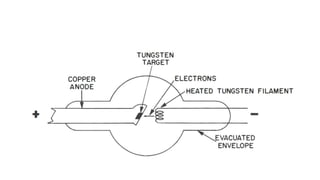
• It is necessary to seal the two electrodes of the x-ray tube in vacuum.
• If gas were present inside the tube the electrons accelerated toward
the anode target would collide with the gas molecules, lose energy
and cause secondary electrons to be ejected from the gas molecules.
• This results in variation in the number and in the reduced speed of
the electrons impinging on the target. This would cause a wide
variation in the energy of the x rays produced.
CATHODE
• The negative terminal of the x-ray tube.
• In addition to the filament, the cathode has two other elements.
• The connecting wires, which supply both the voltage and the
amperage and focussing cup.
THERMIONIC EMISSION
• Defined as the emission of electrons resulting from the absorption of
thermal energy.
• When a metal is heated its atoms absorb thermal energy and some of
the electrons in the metal acquire enough energy to allow them to
escape from the surface of the metal.
EDISON EFFECT SPACE CHARGE
• The electron cloud surrounding
the filament,produced by
thermionic emission.
• Electrons emitted from the
tungsten filament form a small
cloud in the immediate vicinty of
the filament. This collection of
negatively charged electrons
forms the SPACE CHARGE.
SPACE CHARGE EFFECT
• The cloud of negative charges tends to prevent other electrons from
being emitted from the filament until they have acquired sufficient
thermal energy to overcome the force caused by the space charge.
FOCUSSING CUP
• Surrounds the filament.
• Because of the forces of mutual repulsion, this electron stream would
tend to spread itself out and result in bombardment of an
unacceptably large area on the anode.
• This is prevented by focussing cup which is maintained at negative
potential.
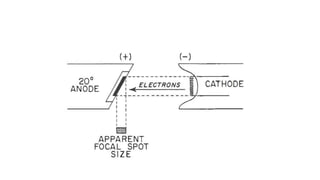
LINE FOCUS PRINCIPLE
• It is the principle which is used to decrease the effective area of focal
spot.
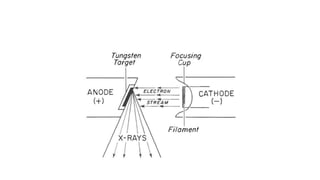
• The focal spot is the area of the tungsten target (anode) that is
bombarded by electrons from the cathode.
• Most of the energy of the electrons is converted into heat, with less
than 1 % being converted into X rays.
• This heat is uniformly distributed over the focal spot, a large focal
spot allows the accumulation of larger amounts of heat.
• The problems posed by the need for a large focal spot to allow
greater heat loading and the conflicting need for a small focal area to
produce good radiographic detail is resolved by the line focus
principle.
• Anode angle- The electron stream bombards the target, the surface
of which is inclined so that it forms an angle with the plane
perpendicular to the incident beam.
• The anode angle differs according to individual tube design and may
vary from 6 to 20°.
• Size of the projected focal spot is directly related to the sine of the
angle of the anode.
• Sine 20° = 0.342 and sine l6.SO = 0.284, an anode angle of 16.5° will
produce a smaller focal spot.
ANODE
• Positive electrode
• Tungsten is chosen as the target material because high atomic
number, which makes it more efficient for the production of x rays.
• And high melting point (good material for the absorption of heat and
for the rapid dissipation of the heat).
• Types of anode- Stationary and Rotating.
Stationary Anode
• It consists of a small plate of tungsten, 2-3 mm thick that is
embedded in a large mass of copper which aids to facilitate heat
dissipation.
• Copper is a better conductor of heat than tungsten, so the massive
copper anode acts to increase the total thermal capacity of the anode
and so speeds its rate of cooling.
• The actual size of the tungsten target is considerably larger than that
the area bombarded by the electron stream (because of the relatively
low melting point of copper).
ROTATING ANODE
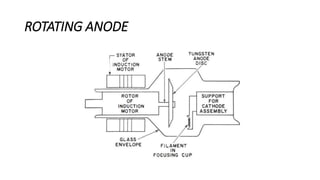
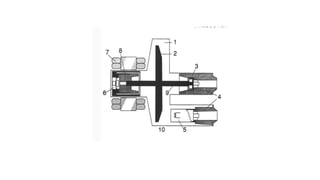
• The rotating anode principle is used to produce X ray tubes capable of
withstanding the heat generated by large exposures.
• Rotating anode tube consists of a large disc of tungsten, or an alloy of
tungsten.
• The tungsten disc has a beveled edge. The angle of the bevel may
vary from 6 to 20 degree.
• The purpose of the rotating anode is to spread the heat produced
during an exposure over a large area of the anode.
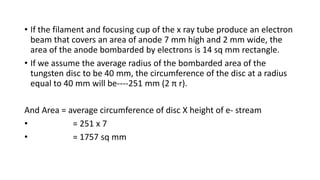
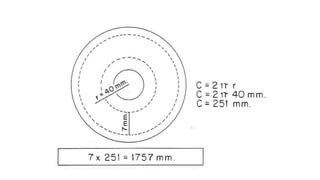
• If the filament and focusing cup of the x ray tube produce an electron
beam that covers an area of anode 7 mm high and 2 mm wide, the
area of the anode bombarded by electrons is 14 sq mm rectangle.
• If we assume the average radius of the bombarded area of the
tungsten disc to be 40 mm, the circumference of the disc at a radius
equal to 40 mm will be----251 mm (2 π r).
And Area = average circumference of disc X height of e- stream
• = 251 x 7
• = 1757 sq mm
• Now at a speed of 3600 rpm (60 rps), any given area on the tungsten
disc is found opposite the e- stream only once every 1/60 sec and the
remainder of the time- generated heat can be dissipated.
• During 1/60 sec exposure , the entire circumference of the tungsten
disc will be exposed to the electron beam.
• In stationary anode heat is dissipated by absorption and conductivity
is provided by the massive copper anode.
• But in the rotating anode tube, absorption of heat by the anode
assembly is undesirable because heat absorbed by the bearings of the
anode assembly would cause them to expand and bind.
• To overcome this problem the stem which connects the tungsten
target to the remainder of the anode assembly is made of
molybdenum.
• This is because Mo has high melting point and is a poor conductor of
heat.
• (ATOMIC NUMBER-42)
GRID CONTROLLED XRAY TUBES
• A grid controlled x-ray tube contains its own switch, which allows the
x-ray tube to be turned on and off rapidly.
• A third electrode is used in the grid controlled tube to control the
flow of electrons from the filament to the target.
• This third electrode is the focussing cup that surrounds the filament.
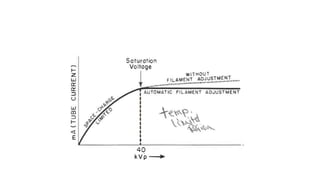
SATURATION VOLTAGE
• If the potential applied across the tube is insufficient to cause all
electrons to be pulled away from the filament, a residual space
charge will exist about the filament.
• This residual space charge acts to limit the number of electrons
available.
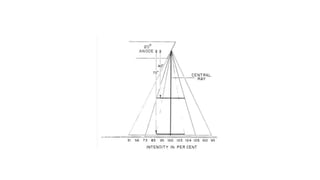
HEEL EFFECT
• The intensity of the x-ray beam that leaves the x-ray tube is not
uniform throughout all portions of the beam.
• The intensity of the beam depends on the angle at which the x rays
are emitted from the focal spot-Heel Effect
• Three clinically important aspects of the heel
• effect are----
• 1) The intensity of film exposure on the anode side of the X ray tube
is significantly less than that on the cathode side of the tube.
• 2) the heel effect is less noticeable when larger focus film distances
are used.
• 3) For equal target film distances , the heel effect will be less for
smaller films.
Tube Shielding
• The tube housing is lined with lead -absorbs primary and secondary x-
rays that would otherwise produce a high intensity of radiation
around the tube, resulting in needless exposure.
• It also provide shielding for the high voltages required to produce x
rays.
Metal/Ceramic X-Ray Tubes
• This tube has a metal casing instead of the usual glass envelope, and
has three ceramic insulators.
• Two insulators provide insulation for the two (positive and negative)
high-voltage cables, and one supports the anode stem.
• Ceramic insulators are used to insulate the high voltage parts of the x-
ray tube from the metal tube envelope.
PROCESS OF XRAY GENERATION
• X rays are produced by energy conversion when fast-moving electrons
from the filament of the x-ray tube interact with the tungsten anode.
• E = eV
• Increasing the voltage across the x-ray tube will increase the kinetic
energy of the electron.
X ray s are generated by two different
processes-
• General Radiation (Bremsstrahlung)
• Characteristic Radiation
General Radiation (Bremsstrahlung)
• When an electron passes near the nucleus of a tungsten atom, the
positive charge of the nucleus acts on the negative charge of the
electron.
• The electron deflected from its original direction.
• The electron may lose energy and be slowed down.
• The kinetic energy lost by the electron is emitted directly in the form
of a photon of radiation.
Characteristic Radiation
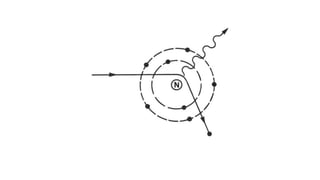
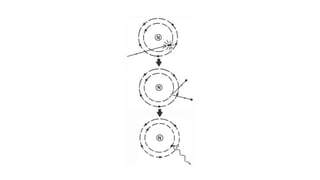
• Characteristic radiation results when the electrons bombarding the
target eject electrons from the inner orbits of the target atoms.
• Removal of an electron from a tungsten atom causes the atom to
have an excess positive charge.
• In the process of returning to its normal state, the ionized atom of
tungsten may get rid of excess energy in one of two ways.
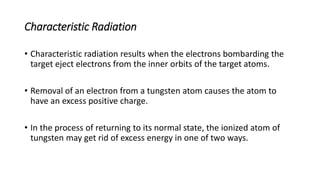
• An additional electron may be expelled by the atom and carry off the
excess energy.
• This electron is k/a Auger electron.
• The ejection of Auger electrons does not produce x rays.
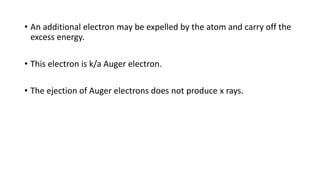
• An alternative way to get rid of excess energy is for the atom to emit
radiation that has wavelengths within the x-ray range.
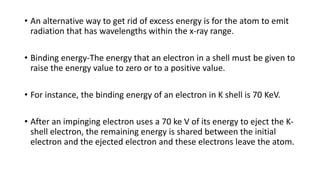
• Binding energy-The energy that an electron in a shell must be given to
raise the energy value to zero or to a positive value.
• For instance, the binding energy of an electron in K shell is 70 KeV.
• After an impinging electron uses a 70 ke V of its energy to eject the K-
shell electron, the remaining energy is shared between the initial
electron and the ejected electron and these electrons leave the atom.
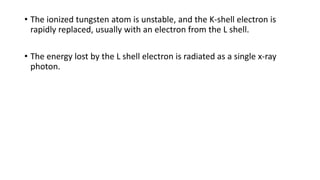
• The ionized tungsten atom is unstable, and the K-shell electron is
rapidly replaced, usually with an electron from the L shell.
• The energy lost by the L shell electron is radiated as a single x-ray
photon.
Intensity of X-Ray Beams
• The intensity of an x-ray beam is defined as the number of photons in
the beam multiplied by the energy of each photon.
• The intensity is commonly measured in roentgens per minute (R/min)
• Target Material-
• The higher the atomic number of the target atoms, the greater will be
the efficiency of the production of x rays.
• The atomic number of the target material determines the energy, or
quality, of characteristic x rays produced.
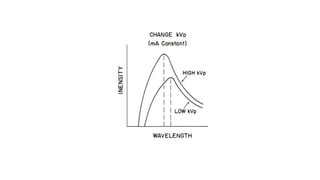
EFFECT OF kVp ON XRAY BEAM
• The energy of the electrons is determined by the peak kilovoltage
(kVp) used.
• Determines the maximum energy (quality) of the x rays produced.
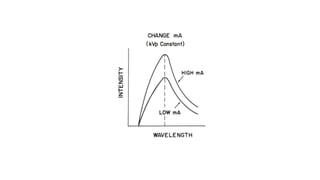
X-Ray Tube Current
• The number of electrons depends directly on the tube current (mA)
used.
• The greater the mA the more electrons that are produced;
consequently, more x rays will be produced .
THANK YOU

X RAY TUBES & PRODUCTION OF.pptx

  • 1.
    X RAY TUBES& PRODUCTION OF X-RAYS MODERATOR-DR PRESENTER-DR.JAYA ADITYA.P
  • 3.
    Glass Enclosure • Itis necessary to seal the two electrodes of the x-ray tube in vacuum. • If gas were present inside the tube the electrons accelerated toward the anode target would collide with the gas molecules, lose energy and cause secondary electrons to be ejected from the gas molecules. • This results in variation in the number and in the reduced speed of the electrons impinging on the target. This would cause a wide variation in the energy of the x rays produced.
  • 4.
    CATHODE • The negativeterminal of the x-ray tube. • In addition to the filament, the cathode has two other elements. • The connecting wires, which supply both the voltage and the amperage and focussing cup.
  • 5.
    THERMIONIC EMISSION • Definedas the emission of electrons resulting from the absorption of thermal energy. • When a metal is heated its atoms absorb thermal energy and some of the electrons in the metal acquire enough energy to allow them to escape from the surface of the metal.
  • 6.
    EDISON EFFECT SPACECHARGE • The electron cloud surrounding the filament,produced by thermionic emission. • Electrons emitted from the tungsten filament form a small cloud in the immediate vicinty of the filament. This collection of negatively charged electrons forms the SPACE CHARGE.
  • 7.
    SPACE CHARGE EFFECT •The cloud of negative charges tends to prevent other electrons from being emitted from the filament until they have acquired sufficient thermal energy to overcome the force caused by the space charge.
  • 8.
    FOCUSSING CUP • Surroundsthe filament. • Because of the forces of mutual repulsion, this electron stream would tend to spread itself out and result in bombardment of an unacceptably large area on the anode. • This is prevented by focussing cup which is maintained at negative potential.
  • 9.
    LINE FOCUS PRINCIPLE •It is the principle which is used to decrease the effective area of focal spot. • The focal spot is the area of the tungsten target (anode) that is bombarded by electrons from the cathode. • Most of the energy of the electrons is converted into heat, with less than 1 % being converted into X rays. • This heat is uniformly distributed over the focal spot, a large focal spot allows the accumulation of larger amounts of heat.
  • 11.
    • The problemsposed by the need for a large focal spot to allow greater heat loading and the conflicting need for a small focal area to produce good radiographic detail is resolved by the line focus principle. • Anode angle- The electron stream bombards the target, the surface of which is inclined so that it forms an angle with the plane perpendicular to the incident beam. • The anode angle differs according to individual tube design and may vary from 6 to 20°.
  • 12.
    • Size ofthe projected focal spot is directly related to the sine of the angle of the anode. • Sine 20° = 0.342 and sine l6.SO = 0.284, an anode angle of 16.5° will produce a smaller focal spot.
  • 13.
    ANODE • Positive electrode •Tungsten is chosen as the target material because high atomic number, which makes it more efficient for the production of x rays. • And high melting point (good material for the absorption of heat and for the rapid dissipation of the heat). • Types of anode- Stationary and Rotating.
  • 14.
    Stationary Anode • Itconsists of a small plate of tungsten, 2-3 mm thick that is embedded in a large mass of copper which aids to facilitate heat dissipation. • Copper is a better conductor of heat than tungsten, so the massive copper anode acts to increase the total thermal capacity of the anode and so speeds its rate of cooling. • The actual size of the tungsten target is considerably larger than that the area bombarded by the electron stream (because of the relatively low melting point of copper).
  • 16.
  • 17.
    • The rotatinganode principle is used to produce X ray tubes capable of withstanding the heat generated by large exposures. • Rotating anode tube consists of a large disc of tungsten, or an alloy of tungsten. • The tungsten disc has a beveled edge. The angle of the bevel may vary from 6 to 20 degree. • The purpose of the rotating anode is to spread the heat produced during an exposure over a large area of the anode.
  • 18.
    • If thefilament and focusing cup of the x ray tube produce an electron beam that covers an area of anode 7 mm high and 2 mm wide, the area of the anode bombarded by electrons is 14 sq mm rectangle. • If we assume the average radius of the bombarded area of the tungsten disc to be 40 mm, the circumference of the disc at a radius equal to 40 mm will be----251 mm (2 π r). And Area = average circumference of disc X height of e- stream • = 251 x 7 • = 1757 sq mm
  • 20.
    • Now ata speed of 3600 rpm (60 rps), any given area on the tungsten disc is found opposite the e- stream only once every 1/60 sec and the remainder of the time- generated heat can be dissipated. • During 1/60 sec exposure , the entire circumference of the tungsten disc will be exposed to the electron beam. • In stationary anode heat is dissipated by absorption and conductivity is provided by the massive copper anode. • But in the rotating anode tube, absorption of heat by the anode assembly is undesirable because heat absorbed by the bearings of the anode assembly would cause them to expand and bind.
  • 21.
    • To overcomethis problem the stem which connects the tungsten target to the remainder of the anode assembly is made of molybdenum. • This is because Mo has high melting point and is a poor conductor of heat. • (ATOMIC NUMBER-42)
  • 22.
    GRID CONTROLLED XRAYTUBES • A grid controlled x-ray tube contains its own switch, which allows the x-ray tube to be turned on and off rapidly. • A third electrode is used in the grid controlled tube to control the flow of electrons from the filament to the target. • This third electrode is the focussing cup that surrounds the filament.
  • 23.
    SATURATION VOLTAGE • Ifthe potential applied across the tube is insufficient to cause all electrons to be pulled away from the filament, a residual space charge will exist about the filament. • This residual space charge acts to limit the number of electrons available.
  • 25.
    HEEL EFFECT • Theintensity of the x-ray beam that leaves the x-ray tube is not uniform throughout all portions of the beam. • The intensity of the beam depends on the angle at which the x rays are emitted from the focal spot-Heel Effect
  • 27.
    • Three clinicallyimportant aspects of the heel • effect are---- • 1) The intensity of film exposure on the anode side of the X ray tube is significantly less than that on the cathode side of the tube. • 2) the heel effect is less noticeable when larger focus film distances are used. • 3) For equal target film distances , the heel effect will be less for smaller films.
  • 28.
    Tube Shielding • Thetube housing is lined with lead -absorbs primary and secondary x- rays that would otherwise produce a high intensity of radiation around the tube, resulting in needless exposure. • It also provide shielding for the high voltages required to produce x rays.
  • 29.
    Metal/Ceramic X-Ray Tubes •This tube has a metal casing instead of the usual glass envelope, and has three ceramic insulators. • Two insulators provide insulation for the two (positive and negative) high-voltage cables, and one supports the anode stem. • Ceramic insulators are used to insulate the high voltage parts of the x- ray tube from the metal tube envelope.
  • 31.
    PROCESS OF XRAYGENERATION • X rays are produced by energy conversion when fast-moving electrons from the filament of the x-ray tube interact with the tungsten anode. • E = eV • Increasing the voltage across the x-ray tube will increase the kinetic energy of the electron.
  • 32.
    X ray sare generated by two different processes- • General Radiation (Bremsstrahlung) • Characteristic Radiation
  • 33.
    General Radiation (Bremsstrahlung) •When an electron passes near the nucleus of a tungsten atom, the positive charge of the nucleus acts on the negative charge of the electron. • The electron deflected from its original direction. • The electron may lose energy and be slowed down. • The kinetic energy lost by the electron is emitted directly in the form of a photon of radiation.
  • 35.
    Characteristic Radiation • Characteristicradiation results when the electrons bombarding the target eject electrons from the inner orbits of the target atoms. • Removal of an electron from a tungsten atom causes the atom to have an excess positive charge. • In the process of returning to its normal state, the ionized atom of tungsten may get rid of excess energy in one of two ways.
  • 36.
    • An additionalelectron may be expelled by the atom and carry off the excess energy. • This electron is k/a Auger electron. • The ejection of Auger electrons does not produce x rays.
  • 37.
    • An alternativeway to get rid of excess energy is for the atom to emit radiation that has wavelengths within the x-ray range. • Binding energy-The energy that an electron in a shell must be given to raise the energy value to zero or to a positive value. • For instance, the binding energy of an electron in K shell is 70 KeV. • After an impinging electron uses a 70 ke V of its energy to eject the K- shell electron, the remaining energy is shared between the initial electron and the ejected electron and these electrons leave the atom.
  • 38.
    • The ionizedtungsten atom is unstable, and the K-shell electron is rapidly replaced, usually with an electron from the L shell. • The energy lost by the L shell electron is radiated as a single x-ray photon.
  • 40.
    Intensity of X-RayBeams • The intensity of an x-ray beam is defined as the number of photons in the beam multiplied by the energy of each photon. • The intensity is commonly measured in roentgens per minute (R/min) • Target Material- • The higher the atomic number of the target atoms, the greater will be the efficiency of the production of x rays. • The atomic number of the target material determines the energy, or quality, of characteristic x rays produced.
  • 41.
    EFFECT OF kVpON XRAY BEAM • The energy of the electrons is determined by the peak kilovoltage (kVp) used. • Determines the maximum energy (quality) of the x rays produced.
  • 43.
    X-Ray Tube Current •The number of electrons depends directly on the tube current (mA) used. • The greater the mA the more electrons that are produced; consequently, more x rays will be produced .
  • 45.

Editor's Notes

  • #5 the terms cathode and filament may be used interchangeably
  • #9 Made out of nickel . its electrical forces cause the electron stream to converge onto the target anode in the required size and shape
  • #12 High melting point 3600 but xray heats the anode to 3000 degrees.
  • #15 Melting point of copper 1070 degrees.
  • #18 Theoritically rotates at 3600,but practically reaches upto 3000 but mechanical factors such as bearings and all play a major role.
  • #22 2600 degree c Thus the Mo stem provides a partial heat barrier between the tungsten disc and the bearings of the anode assembly
  • #24 When a potential difference is applied between the cathode and anode, electrons flow from the filament to the anode.
  • #25 up to about 40 kVp, an increase in kilovoltage_ produces a significant increase in x-ray tube current even though filament heating remains the same. Above 40 kVp, however, further increases in kilovoltage produce very little change in tube current. In our example, 40 kVp defines the location of the saturation point of this x-ray tube. Below 40 kVp, the current flowing in the tube is limited by the space charge effect (space-charge-limited).
  • #28 Explain point 1-upper thoracic is less thick so placed opposite anode side and vice versa
  • #29 -the x-ray tube is contained within the tube housing, and oil inside the housing surrounds the tube. -The high-voltage cables, which are connected to the tube through appropriate receptacles in the tube housing, contain a grounding sheath of wires to provide proper grounding of the tube to the earth. To prevent shortcircuiting between the grounding wires and the tube, the space between them is filled with extremely thick mineral oil. -Heat from the oil is absorbed through the metal of the tube shield to be dissipated into the atmosphere.
  • #31 the anode rotates on an axle which has bearings at each end to provide greater stability and reduce stress on the shaft. T
  • #37 So this is not of any practical importance
  • #39 -Explain about the why the L shell has more energy -When the L-shell electron moves into the K shell, a vacancy is created. The vacancy may be filled from the M shell, and another x-ray photon will be produced. The energy of the L-characteristic radiation, however, will be much less than that of the K-characteristic radiation.
  • #41 For example, tungsten (Z = 74) would produce much more bremsstrahlung than tin (Z = 50) if both were used as the target of an x-ray tube and compared at identical tube potential (kVp) and current (rnA)
  • #42 the energy of the photons emitted from the x-ray tube depends on the energy of the electrons in the electron stream that bombards the target of the x-ray tube.
  • #44 The number of x rays produced obviously depends on the number of electrons that strike the target of the x-ray tube.