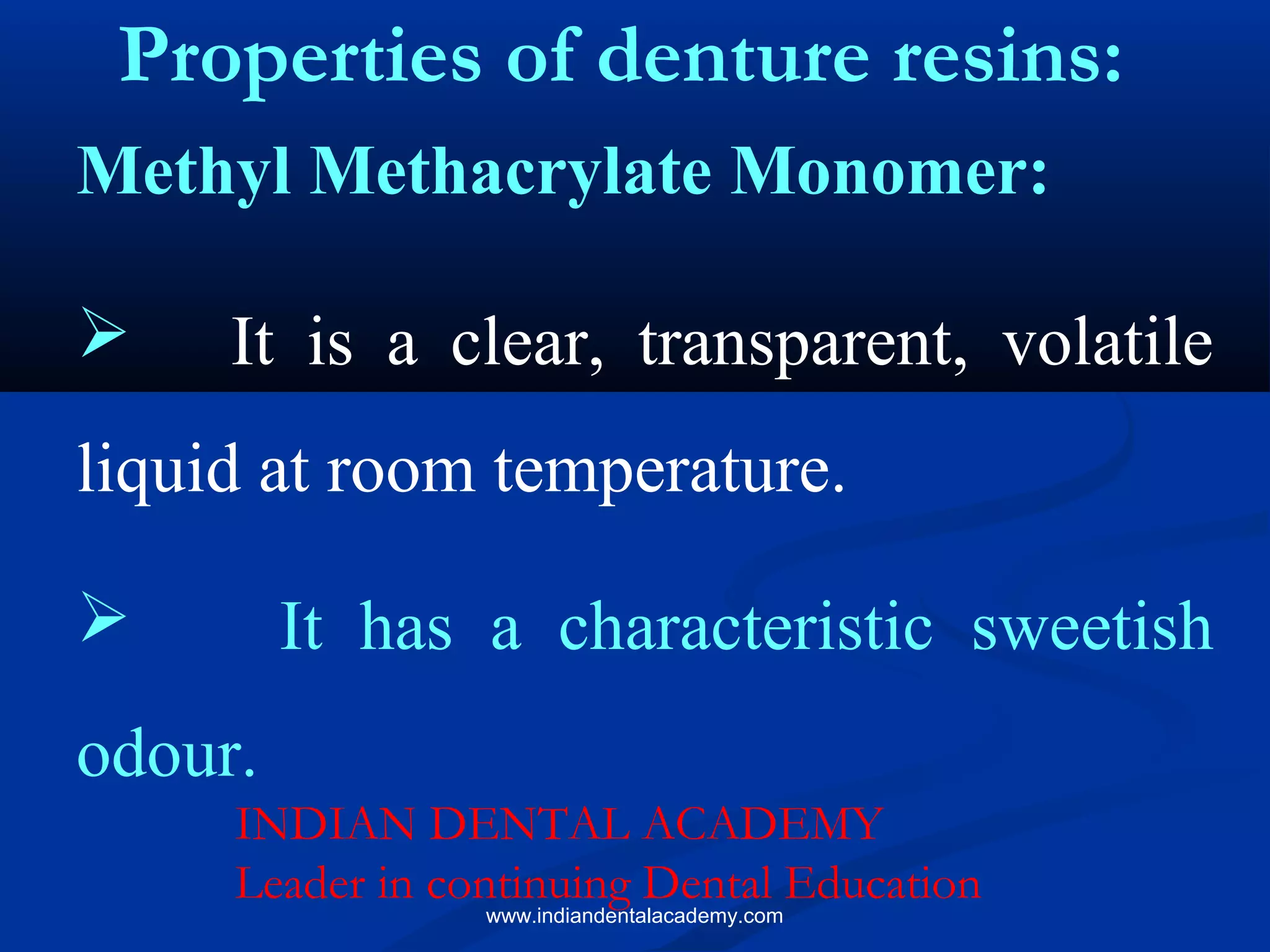
Methyl Methacrylate Monomer:
 It is a clear, transparent, volatile
liquid at room temperature.
 It has a characteristic sweetish
odour.
Properties of denture resins:
INDIAN DENTAL ACADEMY
Leader in continuing Dental Education
www.indiandentalacademy.com
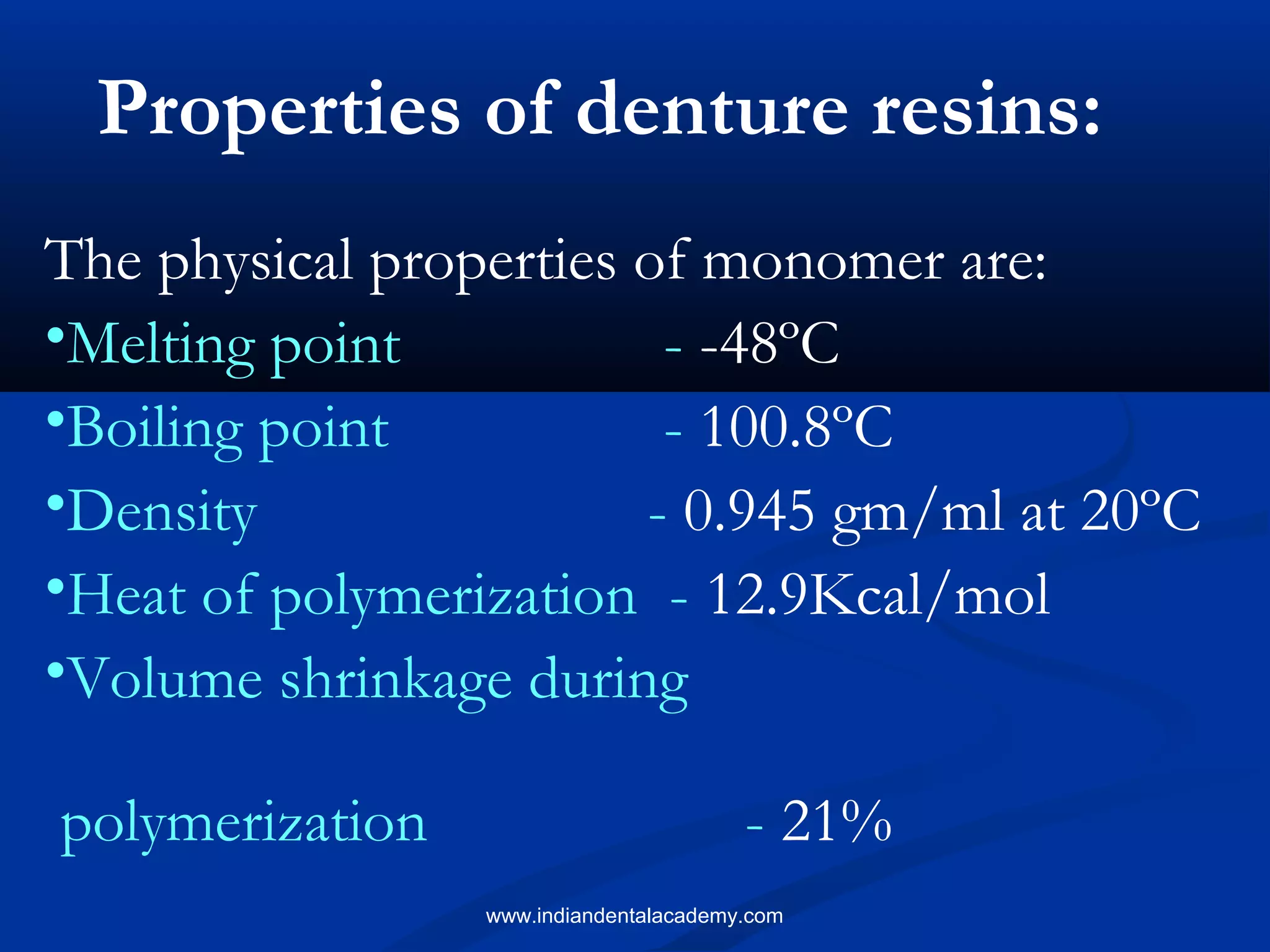
The physical properties of monomer are:
•Melting point - -48ºC
•Boiling point - 100.8ºC
•Density - 0.945 gm/ml at 20ºC
•Heat of polymerization - 12.9Kcal/mol
•Volume shrinkage during
polymerization - 21%
Properties of denture resins:
www.indiandentalacademy.com
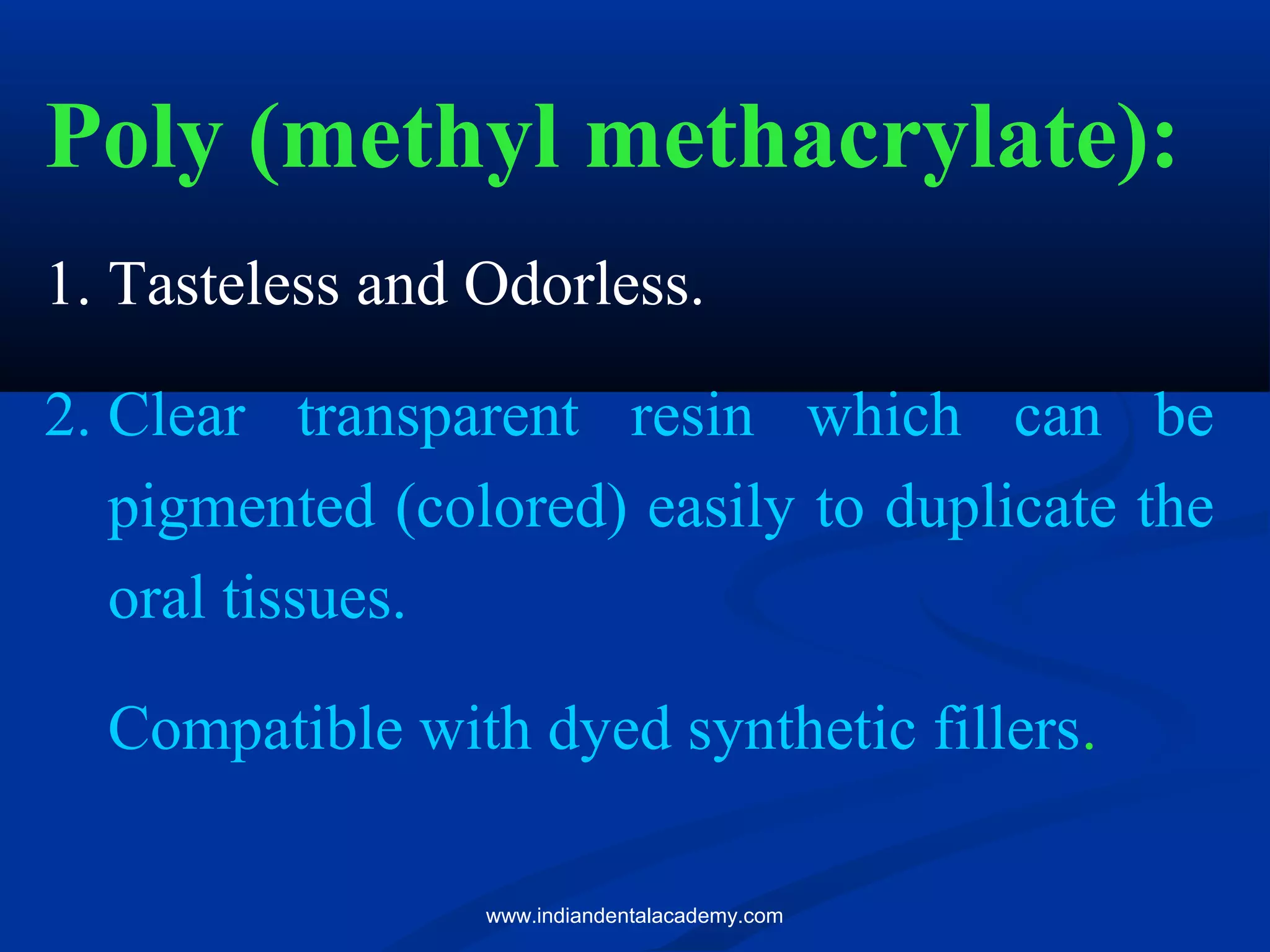
Poly (methyl methacrylate):
1. Tasteless and Odorless.
2. Clear transparent resin which can be
pigmented (colored) easily to duplicate the
oral tissues.
Compatible with dyed synthetic fillers.
www.indiandentalacademy.com
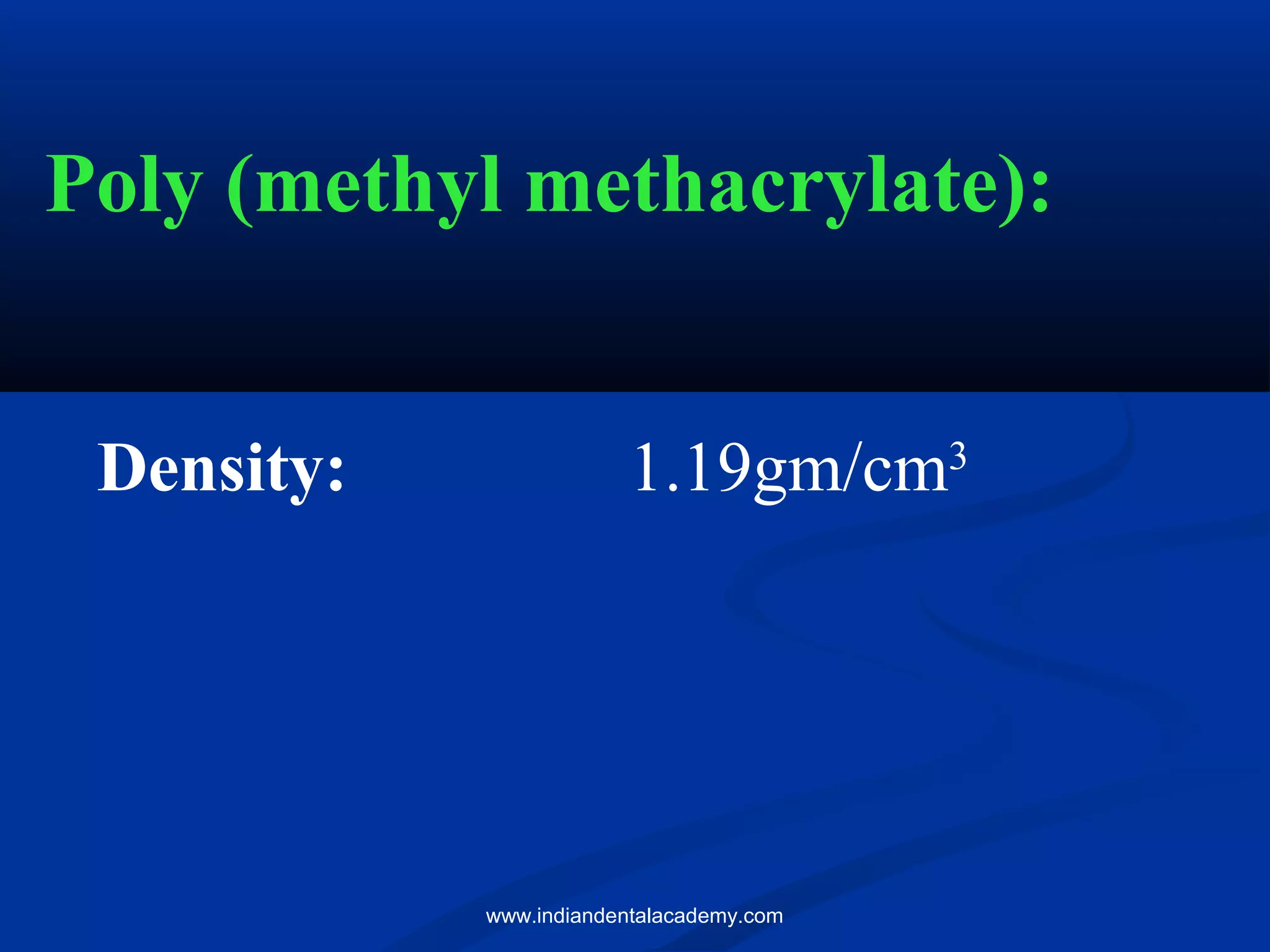
Poly (methyl methacrylate):
Density: 1.19gm/cm3
www.indiandentalacademy.com
Strength:
Compressive and Tensile strength:
 Low in strength.
 Adequate compressive and tensile
strength for complete or partial denture
applications.
www.indiandentalacademy.com
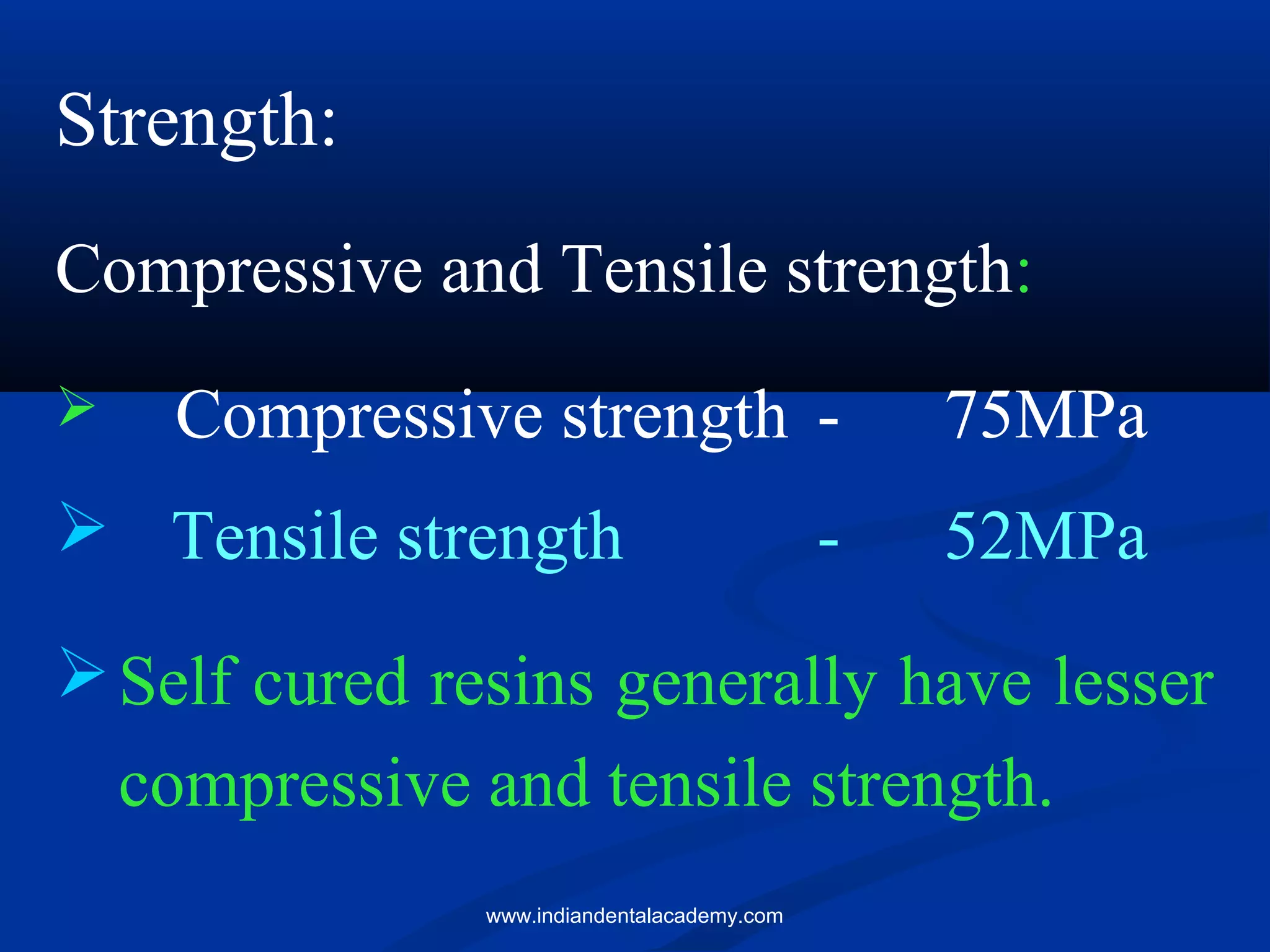
Strength:
Compressive and Tensile strength:
 Compressive strength - 75MPa
 Tensile strength - 52MPa
Self cured resins generally have lesser
compressive and tensile strength.
www.indiandentalacademy.com
The strength is affected by:
1. Composition of the resin.
2. Technique of processing
3. Degree of polymerization
4. Water sorption
5. Subsequent environment of the
denture.
www.indiandentalacademy.com
Impact strength:
 It is a measure of energy absorbed by a materials
when it is broken by a sudden blow.
 Ideally denture base resins should have high
impact strength to prevent breakage when it is
accidentally dropped.
 Addition of plasticizers increase the impact
strength.
 Self cured resins have a lower impact strength.www.indiandentalacademy.com
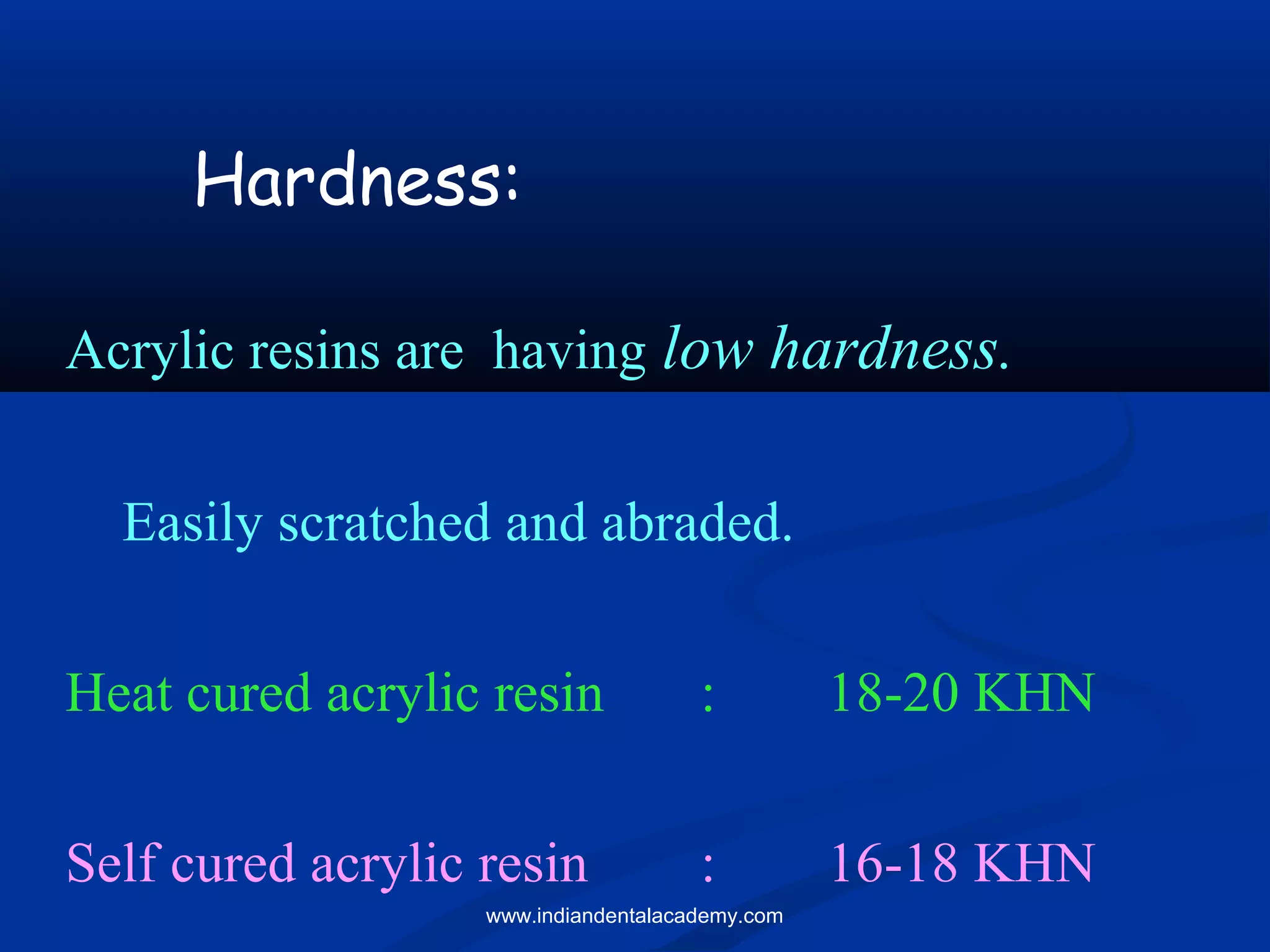
Acrylic resins are having low hardness.
Easily scratched and abraded.
Heat cured acrylic resin : 18-20 KHN
Self cured acrylic resin : 16-18 KHN
Hardness:
www.indiandentalacademy.com
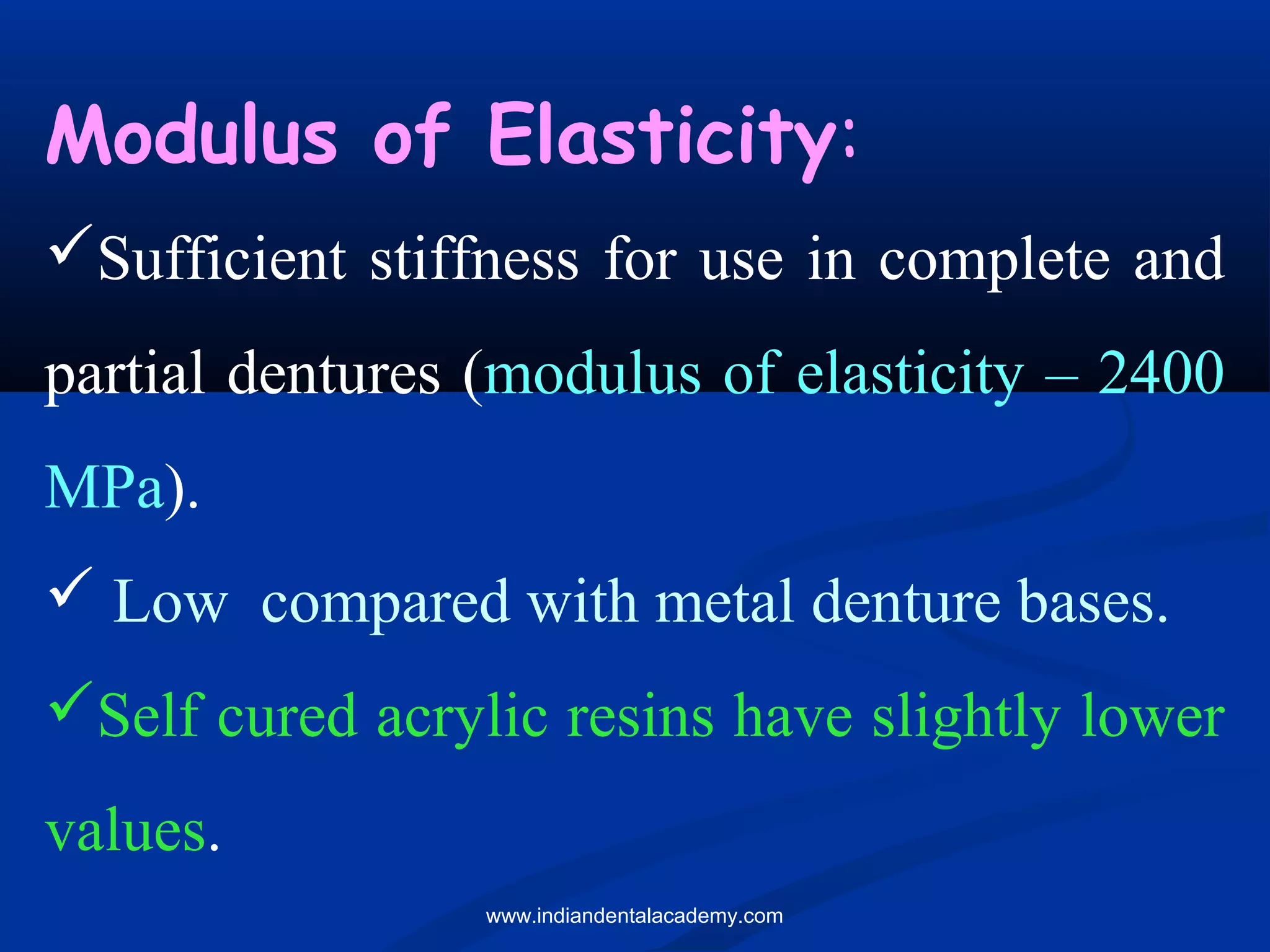
Modulus of Elasticity:
Sufficient stiffness for use in complete and
partial dentures (modulus of elasticity – 2400
MPa).
 Low compared with metal denture bases.
Self cured acrylic resins have slightly lower
values.
www.indiandentalacademy.com
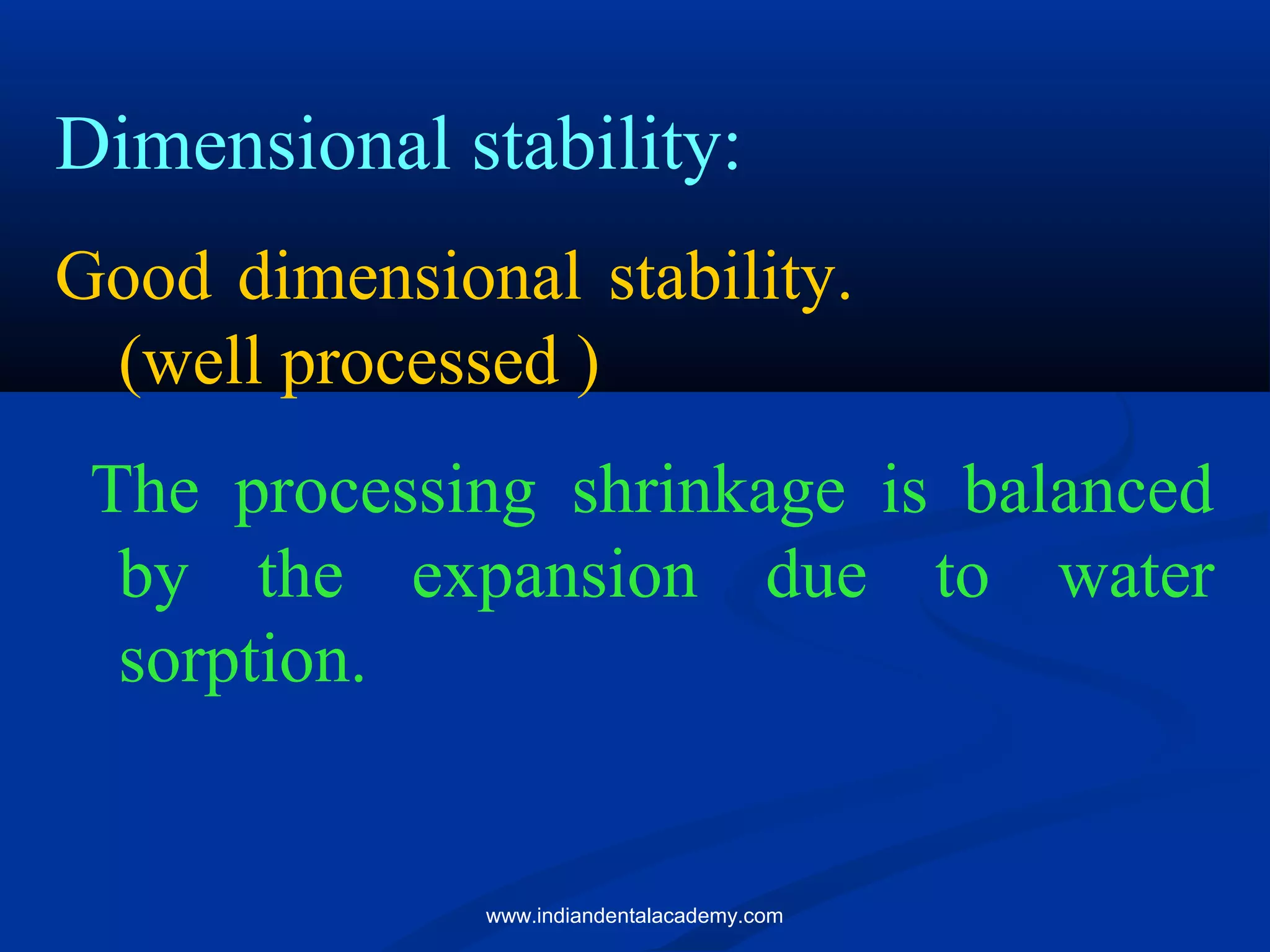
Dimensional stability:
Good dimensional stability.
(well processed )
The processing shrinkage is balanced
by the expansion due to water
sorption.
www.indiandentalacademy.com
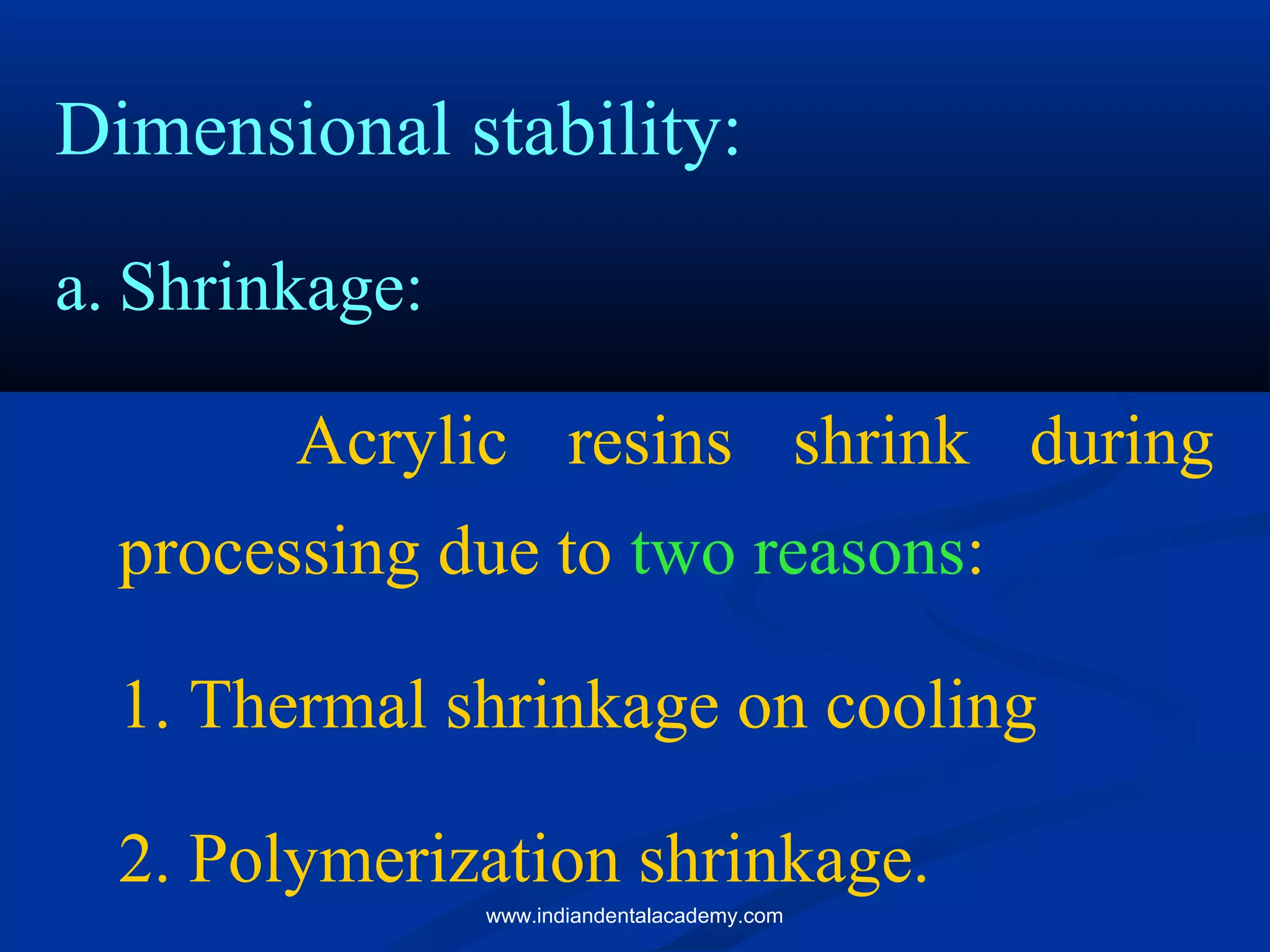
Dimensional stability:
a. Shrinkage:
Acrylic resins shrink during
processing due to two reasons:
1. Thermal shrinkage on cooling
2. Polymerization shrinkage.
www.indiandentalacademy.com
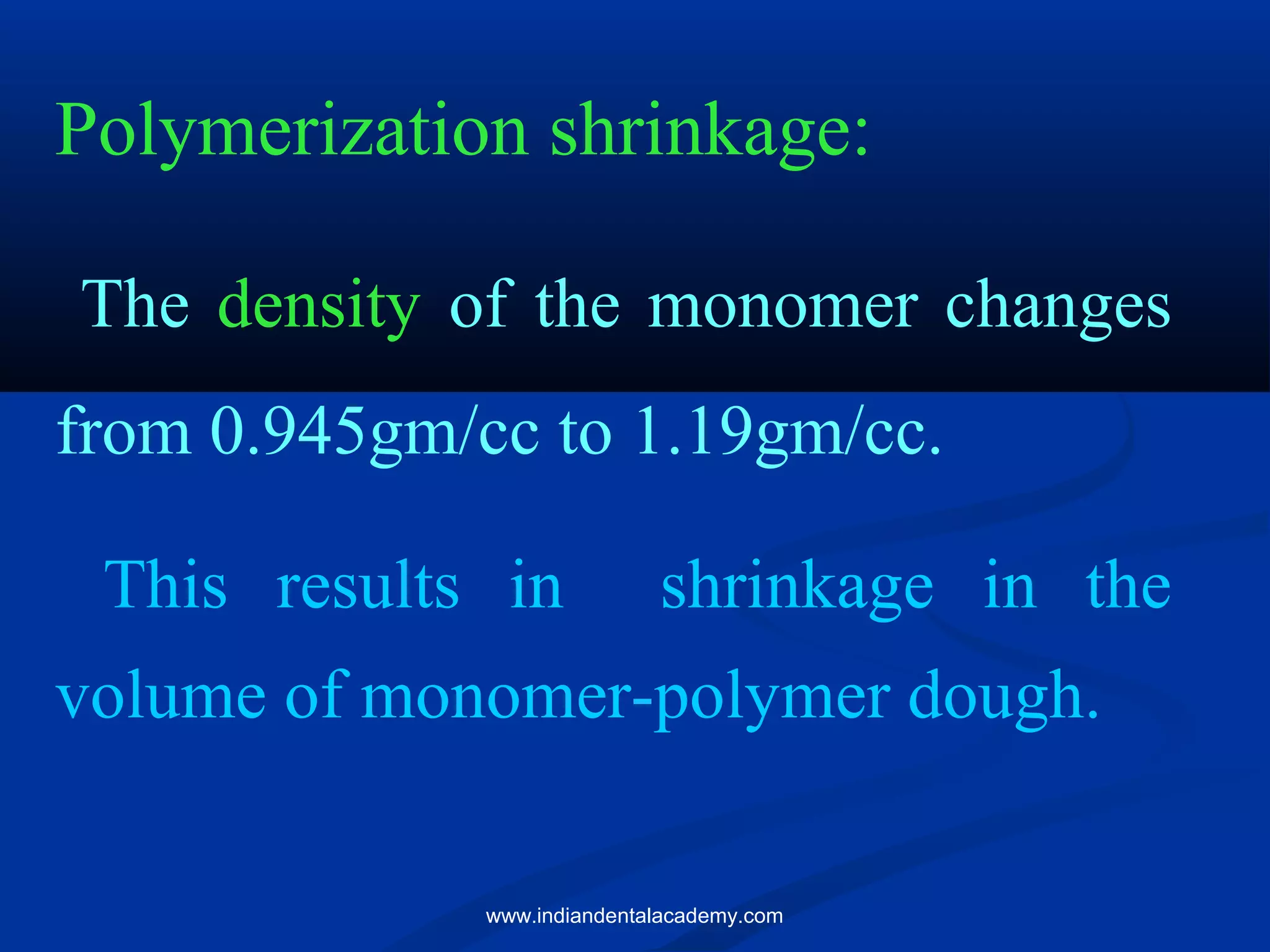
Polymerization shrinkage:
The density of the monomer changes
from 0.945gm/cc to 1.19gm/cc.
This results in shrinkage in the
volume of monomer-polymer dough.
www.indiandentalacademy.com
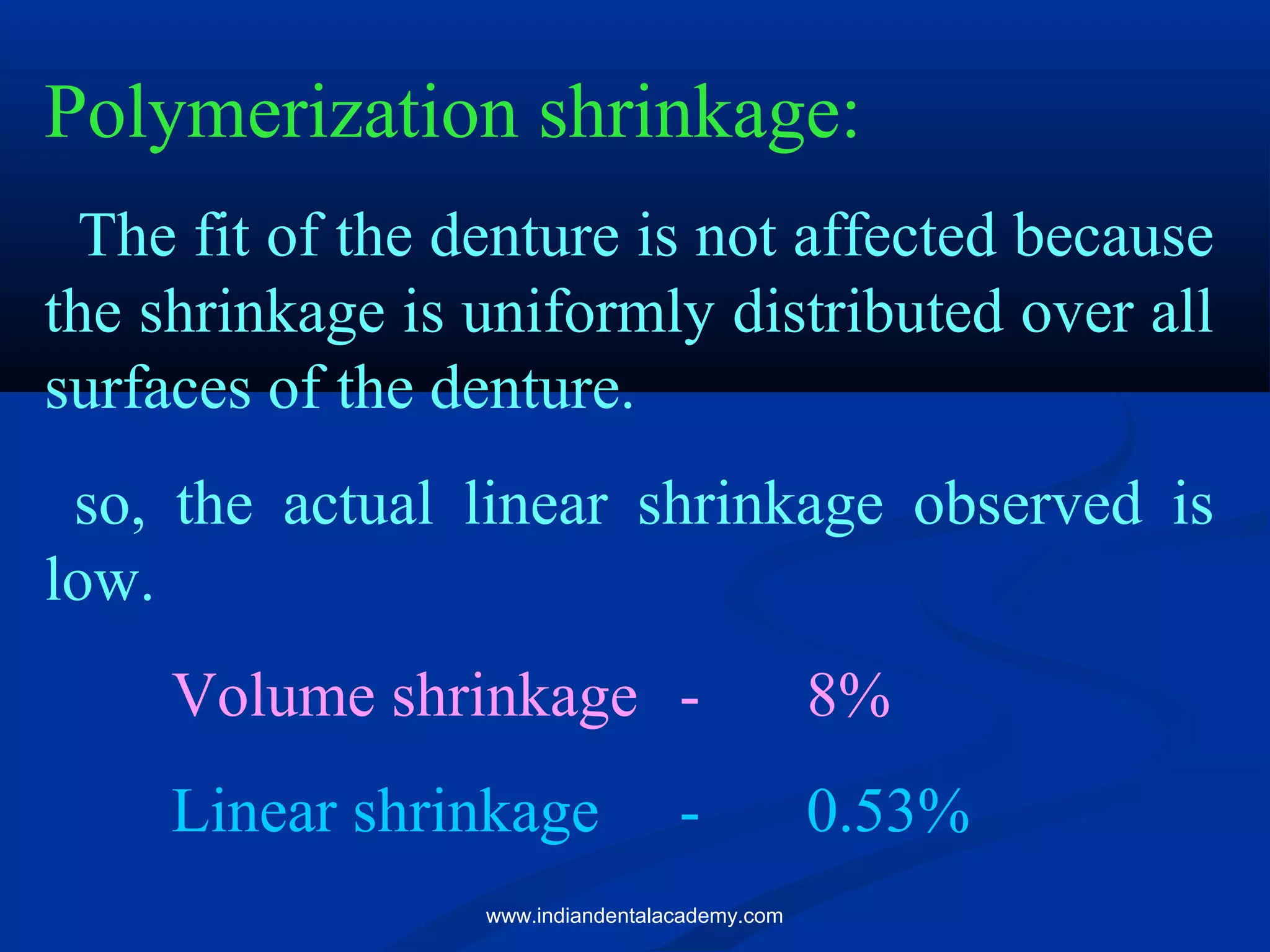
Polymerization shrinkage:
The fit of the denture is not affected because
the shrinkage is uniformly distributed over all
surfaces of the denture.
so, the actual linear shrinkage observed is
low.
Volume shrinkage - 8%
Linear shrinkage - 0.53%
www.indiandentalacademy.com
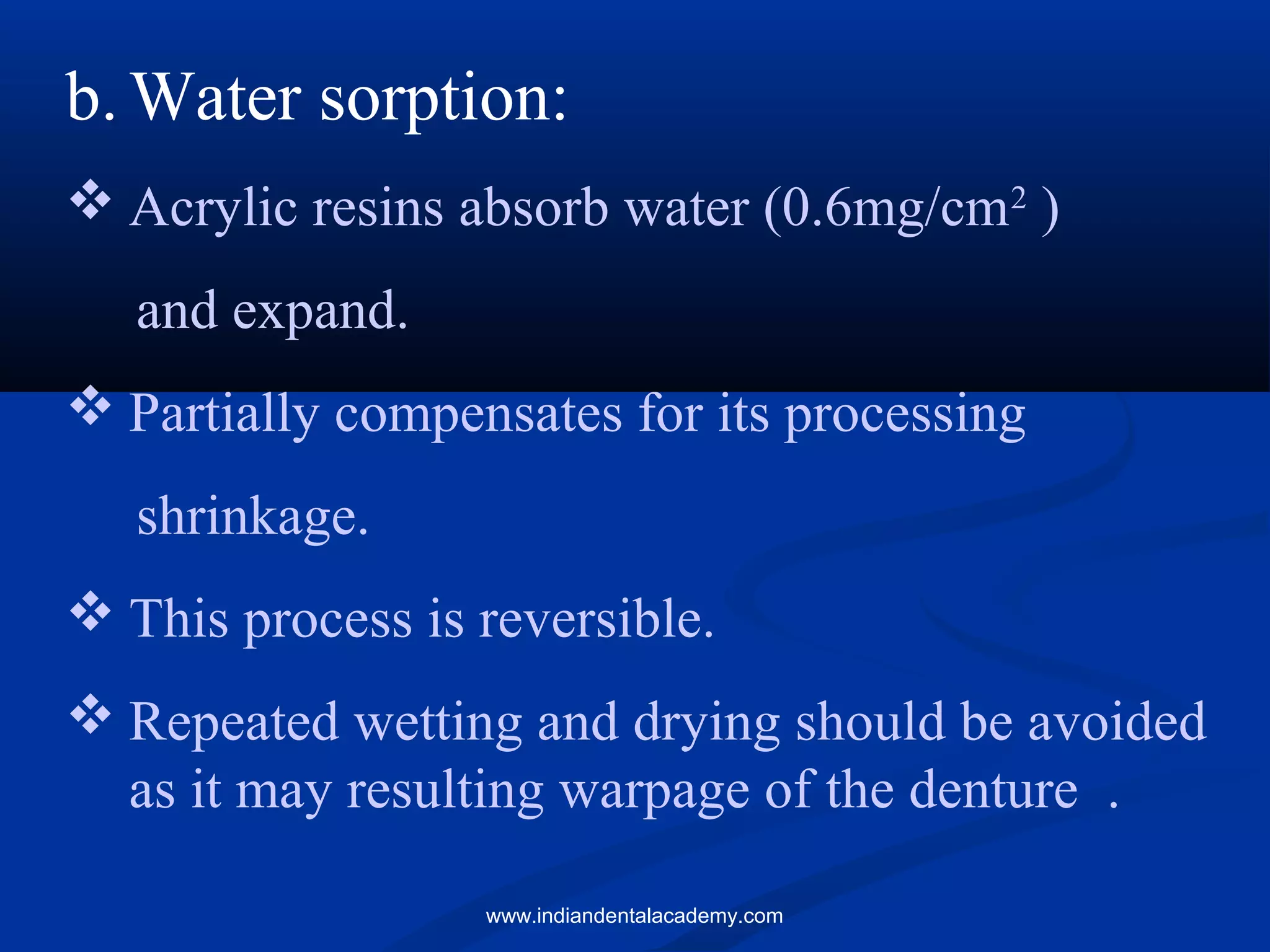
b.Water sorption:
 Acrylic resins absorb water (0.6mg/cm2
)
and expand.
 Partially compensates for its processing
shrinkage.
 This process is reversible.
 Repeated wetting and drying should be avoided
as it may resulting warpage of the denture .
www.indiandentalacademy.com
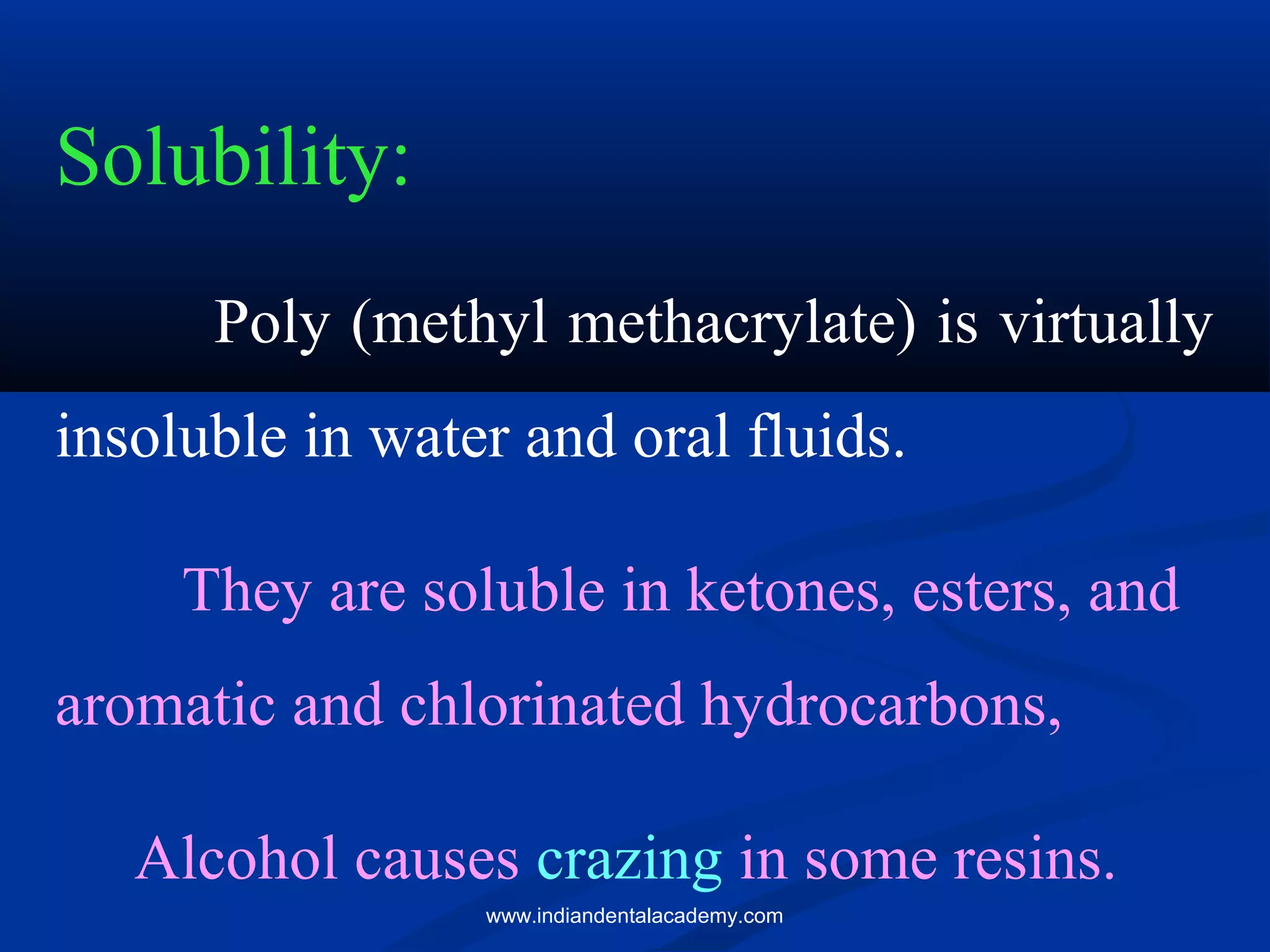
Solubility:
Poly (methyl methacrylate) is virtually
insoluble in water and oral fluids.
They are soluble in ketones, esters, and
aromatic and chlorinated hydrocarbons,
Alcohol causes crazing in some resins.
www.indiandentalacademy.com
Thermal properties:
a.Stability to heat:
 Poly (methyl methacrylate) is chemically
stable to heat.
 It softens at 125º C.
 It begins to depolymerize between 125ºC and
200ºC
 At 450ºC, 90% of the polymer will
depolymerize to monomer.www.indiandentalacademy.com
Thermal properties:
b. Thermal conductivity:
They are poor conductors of heat and
electricity.
www.indiandentalacademy.com
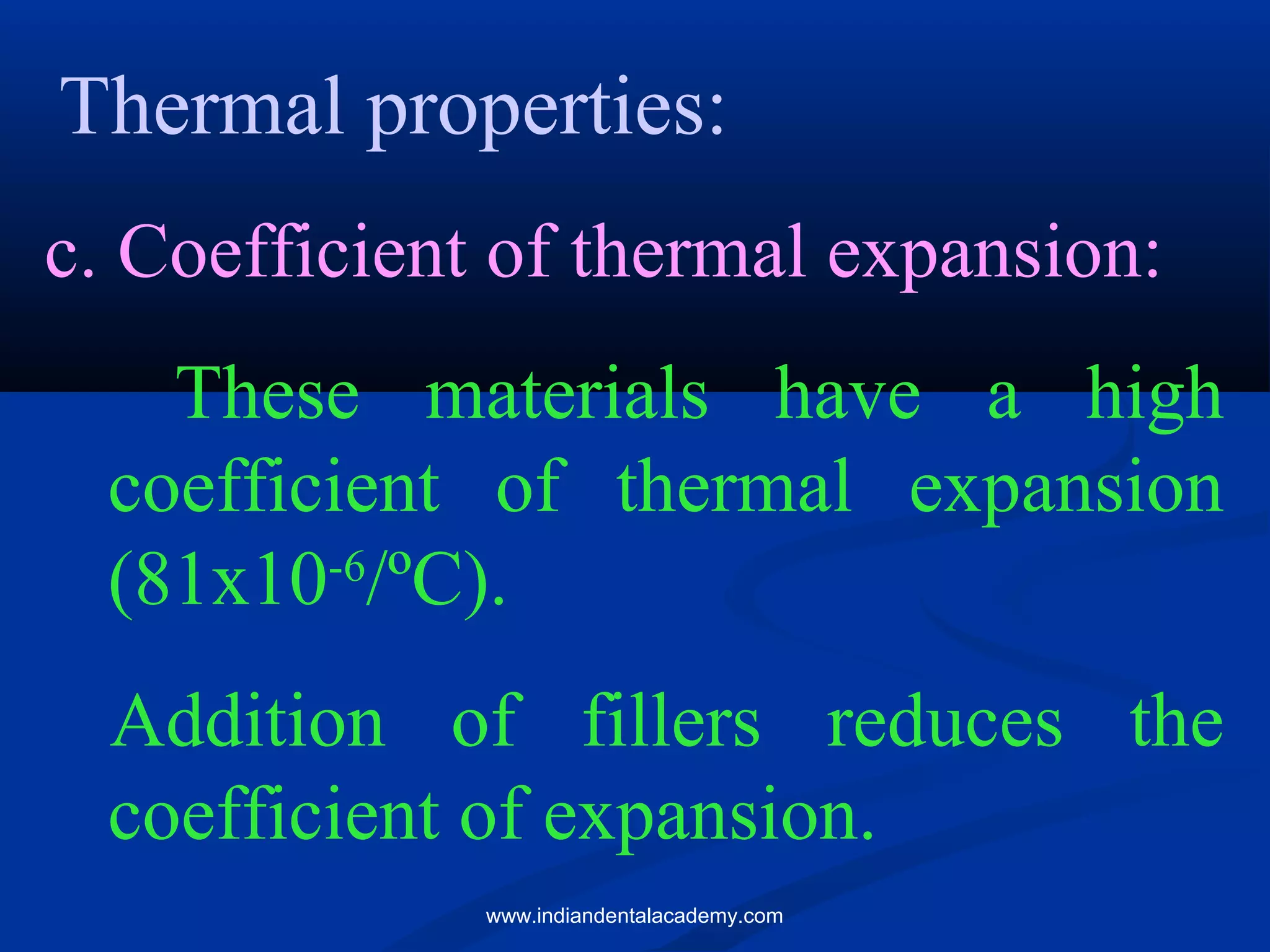
Thermal properties:
c. Coefficient of thermal expansion:
These materials have a high
coefficient of thermal expansion
(81x10-6
/ºC).
Addition of fillers reduces the
coefficient of expansion.
www.indiandentalacademy.com
•Color stability:
Heat cure acrylic resins -
good colour stability.
Self cure resins is slightly lower
www.indiandentalacademy.com
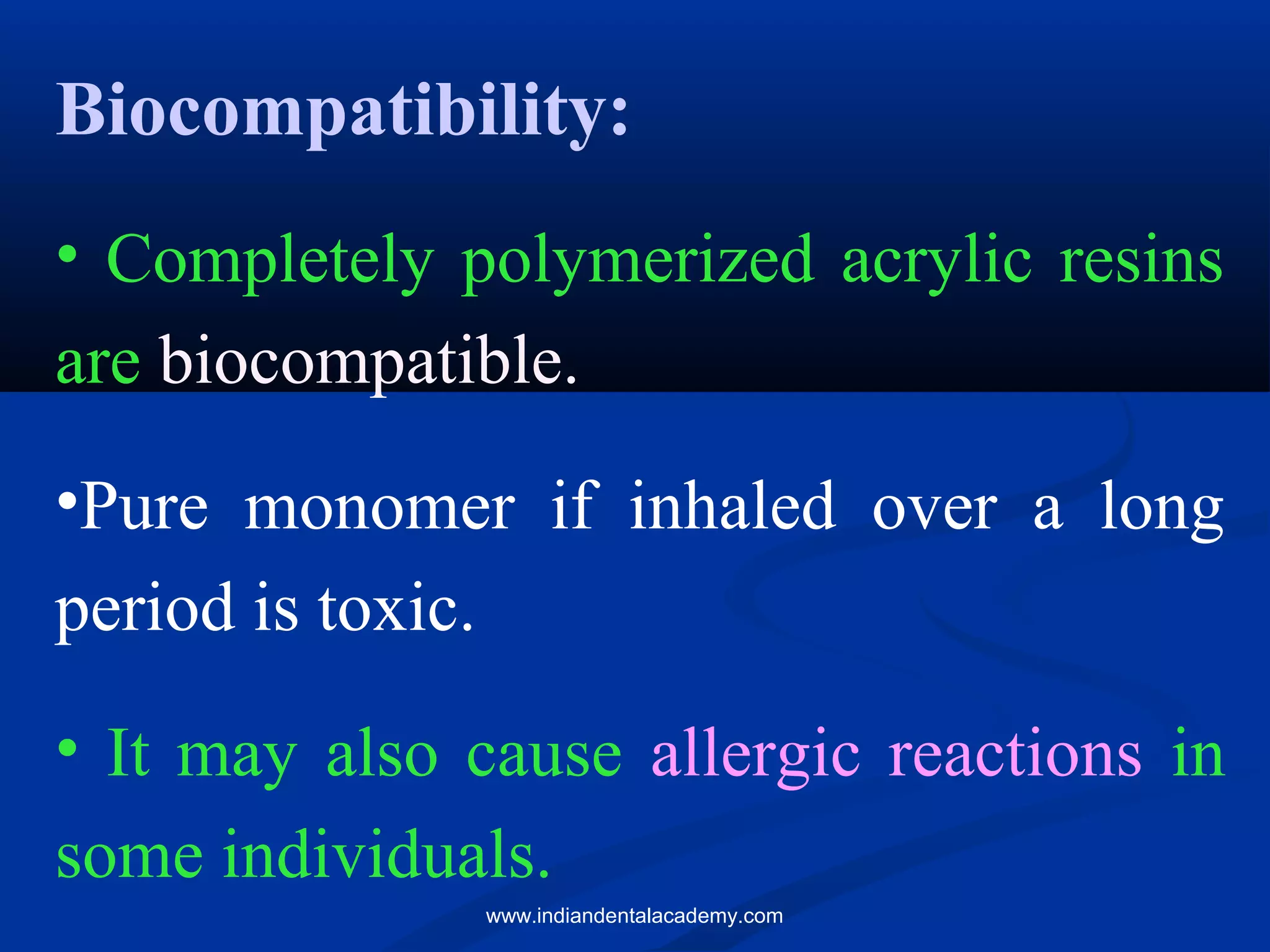
Biocompatibility:
• Completely polymerized acrylic resins
are biocompatible.
•Pure monomer if inhaled over a long
period is toxic.
• It may also cause allergic reactions in
some individuals.
www.indiandentalacademy.com
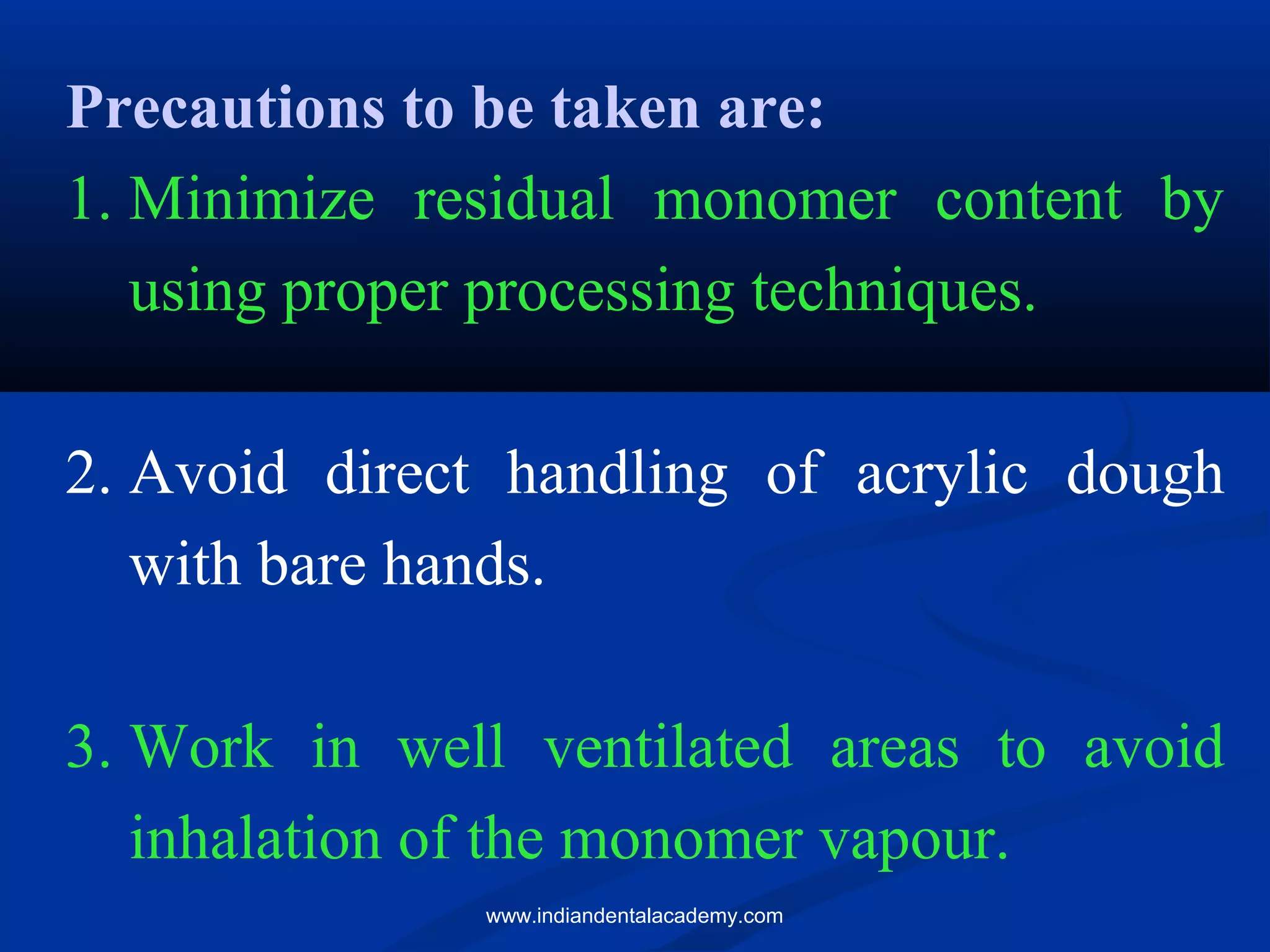
Precautions to be taken are:
1. Minimize residual monomer content by
using proper processing techniques.
2. Avoid direct handling of acrylic dough
with bare hands.
3. Work in well ventilated areas to avoid
inhalation of the monomer vapour.
www.indiandentalacademy.com
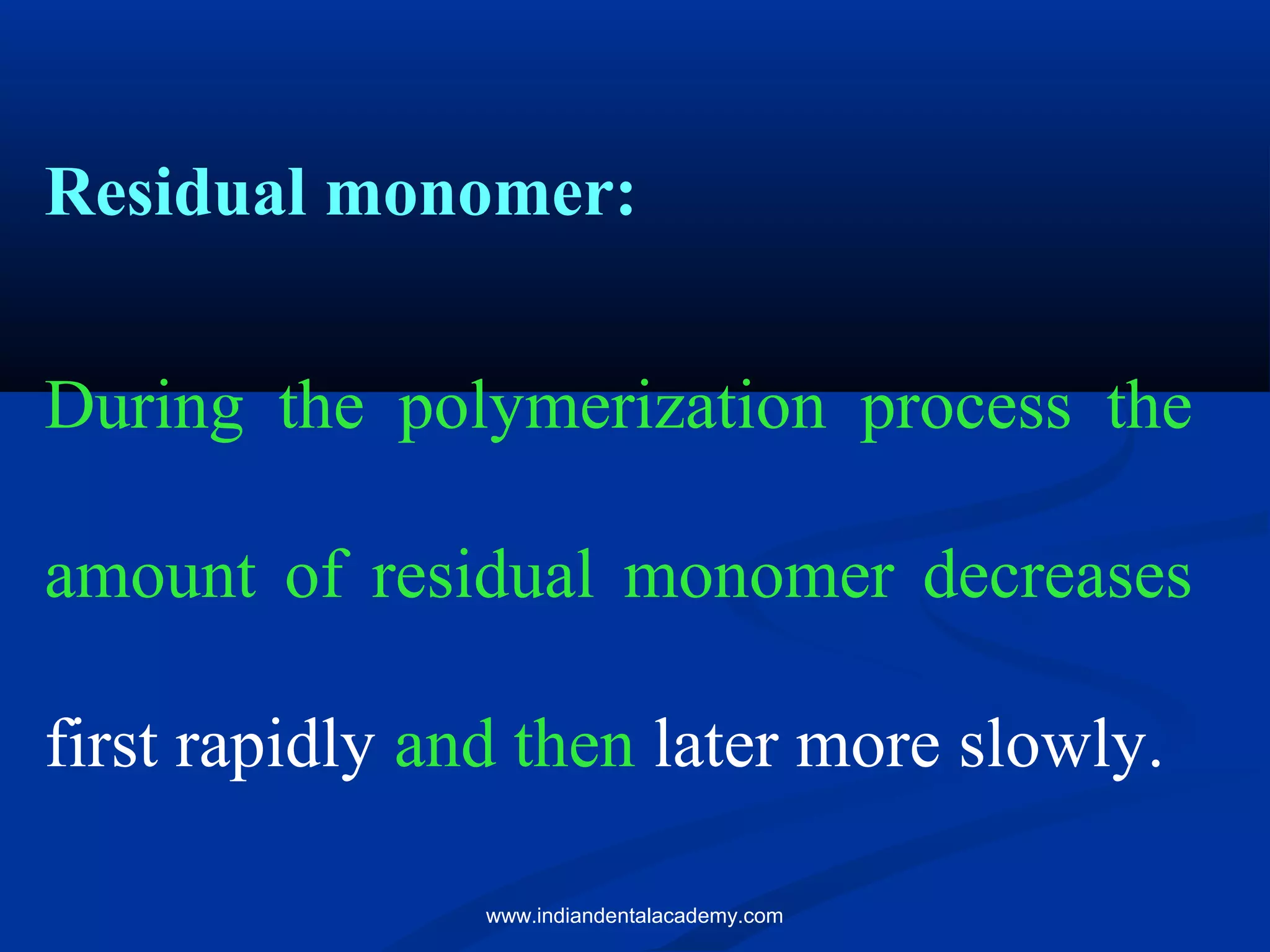
Residual monomer:
During the polymerization process the
amount of residual monomer decreases
first rapidly and then later more slowly.
www.indiandentalacademy.com
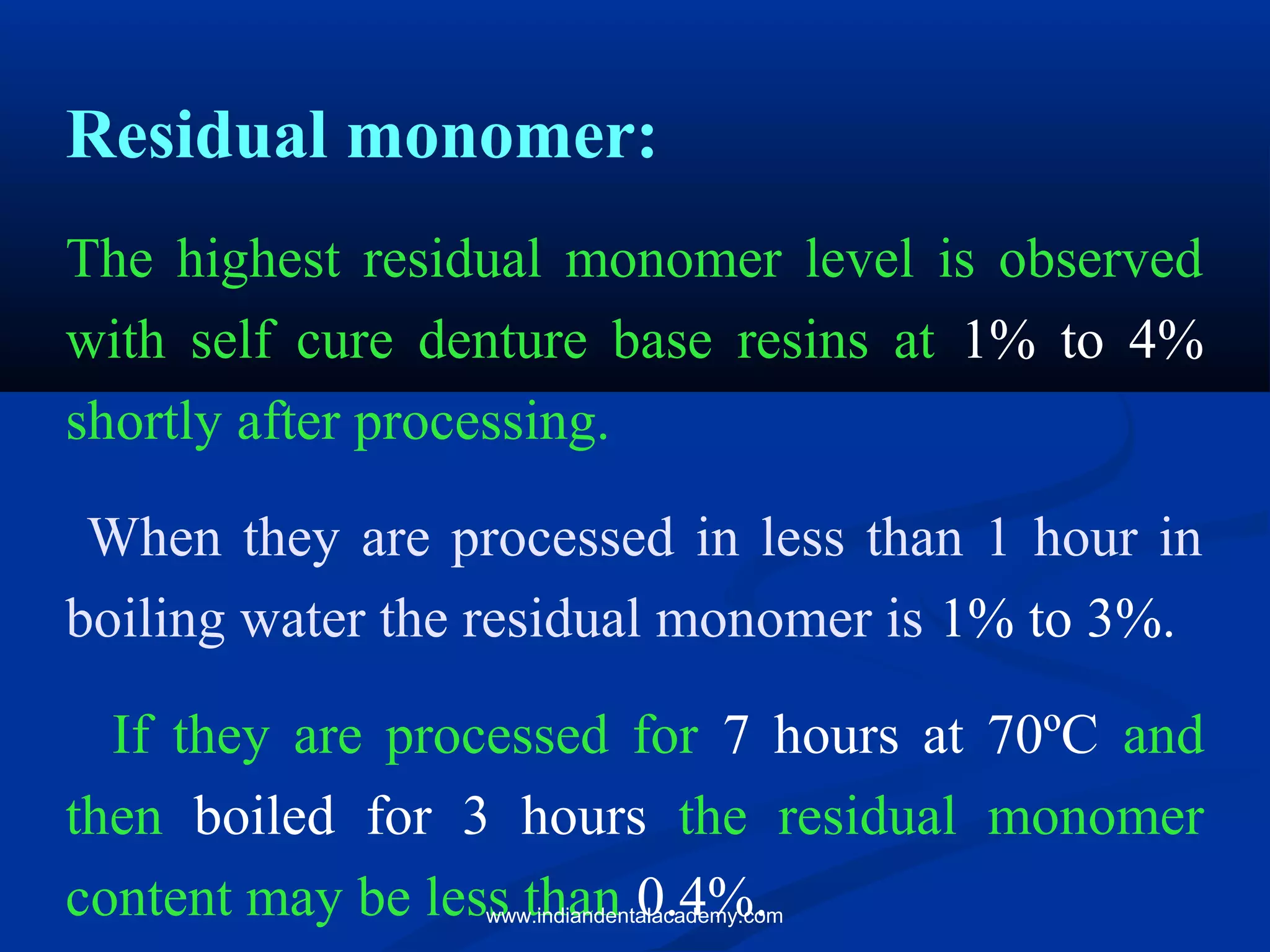
Residual monomer:
The highest residual monomer level is observed
with self cure denture base resins at 1% to 4%
shortly after processing.
When they are processed in less than 1 hour in
boiling water the residual monomer is 1% to 3%.
If they are processed for 7 hours at 70ºC and
then boiled for 3 hours the residual monomer
content may be less than 0.4%.www.indiandentalacademy.com
Adhesion:
The adhesion of acrylic to metal and
porcelain is poor, so mechanical retention is
required.
Adhesion to plastic denture teeth is good.
www.indiandentalacademy.com
Shelf life:
It varies considerably.
The acrylic resins dispensed as powder/liquid
have the best shelf life.
The gel type has a lower shelf life and has to
be stored in a refrigerator
www.indiandentalacademy.com
In heat cured acrylic before the start of curing the
residual monomer is 26.2%.
In 1 hour at 70ºC it decreased to 6.6% and at
100ºC it was 0.29%
In order to reduce the residual monomer in heat
cured dentures it should be processed for a longer
time in boiling water.
www.indiandentalacademy.com
The processing temperature should be
raised to boiling when most of the
polymerization is completed otherwise
porosity may result.
www.indiandentalacademy.com
Porosity:
Porosity is a processing error in acrylic resins.
When porosity is present on the surface, it makes
the appearance of denture base unsightly.
Proper cleaning of the denture is not possible, so
the denture hygiene and thus the oral hygiene
suffers. www.indiandentalacademy.com
Porosity:
Even when it appears as internal porosity in
the form of pores or blebs,
it weaken the denture base and areas of
stress concentration,
thus the denture warps as the stresses relax.
www.indiandentalacademy.com
Porosity may be:
1. Internal porosity
2. External porosity
www.indiandentalacademy.com
Internal porosity:
 Is in the form of voids or bubbles within the
mass of the polymerized acrylic.
 It is usually not present on the surface of a
denture.
It is confined to the thick portions of the
denture base and
 it may not occur equally throughout the
affected area. www.indiandentalacademy.com
Cause:
Internal porosity is due to the vaporization of
monomer when the temperature of the resin
increases above the boiling point of monomer
(100.8ºC) or very low molecular weight
polymers.
www.indiandentalacademy.com
In the centre of the thick portion, the heat
cannot be conducted away therefore the
temperature in the thick portions may rise
above the boiling point of monomer.
Inter porosity can be avoided by using long
and low temperature curing cycle.
 The denture is processed for 9 hours at
74ºC, without bringing the water to boil.
www.indiandentalacademy.com
External porosity:
It can occur due to two reasons:
1. Lack of homogeneity :
If the dough is not homogenous at the time of
polymerization, the portions containing more
monomer will shrink more than the adjacent
areas.
This localized shrinkage results in voids.
The resin appears white.
www.indiandentalacademy.com
External porosity:
It can be avoided or minimized by using
proper powder-liquid ratio and mixing it well.
The mix is more homogenous in the dough
stage,
so packing should be done in the dough stage.
www.indiandentalacademy.com
Lack of adequate pressure:
During polymerization or due to lack of
dough in the mould during final closure.
Bubbles appear which are not spherical and
the resin appears white.
A pigmented resin appears lighter in colour
due to lack of pressure during
polymerization.
www.indiandentalacademy.com
Lack of adequate pressure:
This is avoided by using the required
amount of dough and distributing it correctly
in the mould cavity.
Check for excess or flash during trial
closure.
Flash indicates adequate material within the
mold cavity.
www.indiandentalacademy.com
Problems in addition to porosity are attendant
with rapid initial heating of acrylic dough above
70ºC such as production of internal stress with
subsequent warpage of the denture after
deflasking, and the checking or crazing around
the necks of the artificial teeth.
www.indiandentalacademy.com
Crazing:
Crazing is formation of surface cracks on the
denture base resin.
These cracks may be microscopic or
macroscopic in size.
In some cases it has a hazy or foggy appearance
rather than cracks.
www.indiandentalacademy.com
Crazing:
Crazing has a weakening effect on the
resin and reduces the esthetic qualities.
Cracks formed on crazing are indicative of
he beginning of a fracture.
www.indiandentalacademy.com
Causes:
Crazing is due to
1.Mechanical stresses or
2.Attack by a solvent.
www.indiandentalacademy.com
Causes:
In poly (methyl methacrylate) crazing
occurs when tensile stresses are present.
The cracks are at right angles to the
direction of tensile stress.
Crazing is a mechanical separation of the
polymer chains or groups under tensile
stress. www.indiandentalacademy.com
Crazing is visible around the porcelain teeth in the
denture.
The tensile stress is due to the contraction of the
resin around the porcelain tooth during cooling of
the denture after processing.
Due to the action of solvents the cracks are
randomly placed. Eg. Weak solvents i.e. alcohol.
www.indiandentalacademy.com
Incorporation of water during
processing will form stresses due to
evaporation of water after processing.
Thus the denture will craze.
www.indiandentalacademy.com
Crazing can be avoided by:
1. Using cross-linked acrylics.
2. Tinfoil separating medium
3. Metal Molds.
www.indiandentalacademy.com

Properties of Denture base materials /rotary endodontic courses

  • 1.
    Methyl Methacrylate Monomer: It is a clear, transparent, volatile liquid at room temperature.  It has a characteristic sweetish odour. Properties of denture resins: INDIAN DENTAL ACADEMY Leader in continuing Dental Education www.indiandentalacademy.com
  • 2.
    The physical propertiesof monomer are: •Melting point - -48ºC •Boiling point - 100.8ºC •Density - 0.945 gm/ml at 20ºC •Heat of polymerization - 12.9Kcal/mol •Volume shrinkage during polymerization - 21% Properties of denture resins: www.indiandentalacademy.com
  • 3.
    Poly (methyl methacrylate): 1.Tasteless and Odorless. 2. Clear transparent resin which can be pigmented (colored) easily to duplicate the oral tissues. Compatible with dyed synthetic fillers. www.indiandentalacademy.com
  • 4.
    Poly (methyl methacrylate): Density:1.19gm/cm3 www.indiandentalacademy.com
  • 5.
    Strength: Compressive and Tensilestrength:  Low in strength.  Adequate compressive and tensile strength for complete or partial denture applications. www.indiandentalacademy.com
  • 6.
    Strength: Compressive and Tensilestrength:  Compressive strength - 75MPa  Tensile strength - 52MPa Self cured resins generally have lesser compressive and tensile strength. www.indiandentalacademy.com
  • 7.
    The strength isaffected by: 1. Composition of the resin. 2. Technique of processing 3. Degree of polymerization 4. Water sorption 5. Subsequent environment of the denture. www.indiandentalacademy.com
  • 8.
    Impact strength:  Itis a measure of energy absorbed by a materials when it is broken by a sudden blow.  Ideally denture base resins should have high impact strength to prevent breakage when it is accidentally dropped.  Addition of plasticizers increase the impact strength.  Self cured resins have a lower impact strength.www.indiandentalacademy.com
  • 9.
    Acrylic resins arehaving low hardness. Easily scratched and abraded. Heat cured acrylic resin : 18-20 KHN Self cured acrylic resin : 16-18 KHN Hardness: www.indiandentalacademy.com
  • 10.
    Modulus of Elasticity: Sufficientstiffness for use in complete and partial dentures (modulus of elasticity – 2400 MPa).  Low compared with metal denture bases. Self cured acrylic resins have slightly lower values. www.indiandentalacademy.com
  • 11.
    Dimensional stability: Good dimensionalstability. (well processed ) The processing shrinkage is balanced by the expansion due to water sorption. www.indiandentalacademy.com
  • 12.
    Dimensional stability: a. Shrinkage: Acrylicresins shrink during processing due to two reasons: 1. Thermal shrinkage on cooling 2. Polymerization shrinkage. www.indiandentalacademy.com
  • 13.
    Polymerization shrinkage: The densityof the monomer changes from 0.945gm/cc to 1.19gm/cc. This results in shrinkage in the volume of monomer-polymer dough. www.indiandentalacademy.com
  • 14.
    Polymerization shrinkage: The fitof the denture is not affected because the shrinkage is uniformly distributed over all surfaces of the denture. so, the actual linear shrinkage observed is low. Volume shrinkage - 8% Linear shrinkage - 0.53% www.indiandentalacademy.com
  • 15.
    b.Water sorption:  Acrylicresins absorb water (0.6mg/cm2 ) and expand.  Partially compensates for its processing shrinkage.  This process is reversible.  Repeated wetting and drying should be avoided as it may resulting warpage of the denture . www.indiandentalacademy.com
  • 16.
    Solubility: Poly (methyl methacrylate)is virtually insoluble in water and oral fluids. They are soluble in ketones, esters, and aromatic and chlorinated hydrocarbons, Alcohol causes crazing in some resins. www.indiandentalacademy.com
  • 17.
    Thermal properties: a.Stability toheat:  Poly (methyl methacrylate) is chemically stable to heat.  It softens at 125º C.  It begins to depolymerize between 125ºC and 200ºC  At 450ºC, 90% of the polymer will depolymerize to monomer.www.indiandentalacademy.com
  • 18.
    Thermal properties: b. Thermalconductivity: They are poor conductors of heat and electricity. www.indiandentalacademy.com
  • 19.
    Thermal properties: c. Coefficientof thermal expansion: These materials have a high coefficient of thermal expansion (81x10-6 /ºC). Addition of fillers reduces the coefficient of expansion. www.indiandentalacademy.com
  • 20.
    •Color stability: Heat cureacrylic resins - good colour stability. Self cure resins is slightly lower www.indiandentalacademy.com
  • 21.
    Biocompatibility: • Completely polymerizedacrylic resins are biocompatible. •Pure monomer if inhaled over a long period is toxic. • It may also cause allergic reactions in some individuals. www.indiandentalacademy.com
  • 22.
    Precautions to betaken are: 1. Minimize residual monomer content by using proper processing techniques. 2. Avoid direct handling of acrylic dough with bare hands. 3. Work in well ventilated areas to avoid inhalation of the monomer vapour. www.indiandentalacademy.com
  • 23.
    Residual monomer: During thepolymerization process the amount of residual monomer decreases first rapidly and then later more slowly. www.indiandentalacademy.com
  • 24.
    Residual monomer: The highestresidual monomer level is observed with self cure denture base resins at 1% to 4% shortly after processing. When they are processed in less than 1 hour in boiling water the residual monomer is 1% to 3%. If they are processed for 7 hours at 70ºC and then boiled for 3 hours the residual monomer content may be less than 0.4%.www.indiandentalacademy.com
  • 25.
    Adhesion: The adhesion ofacrylic to metal and porcelain is poor, so mechanical retention is required. Adhesion to plastic denture teeth is good. www.indiandentalacademy.com
  • 26.
    Shelf life: It variesconsiderably. The acrylic resins dispensed as powder/liquid have the best shelf life. The gel type has a lower shelf life and has to be stored in a refrigerator www.indiandentalacademy.com
  • 27.
    In heat curedacrylic before the start of curing the residual monomer is 26.2%. In 1 hour at 70ºC it decreased to 6.6% and at 100ºC it was 0.29% In order to reduce the residual monomer in heat cured dentures it should be processed for a longer time in boiling water. www.indiandentalacademy.com
  • 28.
    The processing temperatureshould be raised to boiling when most of the polymerization is completed otherwise porosity may result. www.indiandentalacademy.com
  • 29.
    Porosity: Porosity is aprocessing error in acrylic resins. When porosity is present on the surface, it makes the appearance of denture base unsightly. Proper cleaning of the denture is not possible, so the denture hygiene and thus the oral hygiene suffers. www.indiandentalacademy.com
  • 30.
    Porosity: Even when itappears as internal porosity in the form of pores or blebs, it weaken the denture base and areas of stress concentration, thus the denture warps as the stresses relax. www.indiandentalacademy.com
  • 31.
    Porosity may be: 1.Internal porosity 2. External porosity www.indiandentalacademy.com
  • 32.
    Internal porosity:  Isin the form of voids or bubbles within the mass of the polymerized acrylic.  It is usually not present on the surface of a denture. It is confined to the thick portions of the denture base and  it may not occur equally throughout the affected area. www.indiandentalacademy.com
  • 33.
    Cause: Internal porosity isdue to the vaporization of monomer when the temperature of the resin increases above the boiling point of monomer (100.8ºC) or very low molecular weight polymers. www.indiandentalacademy.com
  • 34.
    In the centreof the thick portion, the heat cannot be conducted away therefore the temperature in the thick portions may rise above the boiling point of monomer. Inter porosity can be avoided by using long and low temperature curing cycle.  The denture is processed for 9 hours at 74ºC, without bringing the water to boil. www.indiandentalacademy.com
  • 35.
    External porosity: It canoccur due to two reasons: 1. Lack of homogeneity : If the dough is not homogenous at the time of polymerization, the portions containing more monomer will shrink more than the adjacent areas. This localized shrinkage results in voids. The resin appears white. www.indiandentalacademy.com
  • 36.
    External porosity: It canbe avoided or minimized by using proper powder-liquid ratio and mixing it well. The mix is more homogenous in the dough stage, so packing should be done in the dough stage. www.indiandentalacademy.com
  • 37.
    Lack of adequatepressure: During polymerization or due to lack of dough in the mould during final closure. Bubbles appear which are not spherical and the resin appears white. A pigmented resin appears lighter in colour due to lack of pressure during polymerization. www.indiandentalacademy.com
  • 38.
    Lack of adequatepressure: This is avoided by using the required amount of dough and distributing it correctly in the mould cavity. Check for excess or flash during trial closure. Flash indicates adequate material within the mold cavity. www.indiandentalacademy.com
  • 39.
    Problems in additionto porosity are attendant with rapid initial heating of acrylic dough above 70ºC such as production of internal stress with subsequent warpage of the denture after deflasking, and the checking or crazing around the necks of the artificial teeth. www.indiandentalacademy.com
  • 40.
    Crazing: Crazing is formationof surface cracks on the denture base resin. These cracks may be microscopic or macroscopic in size. In some cases it has a hazy or foggy appearance rather than cracks. www.indiandentalacademy.com
  • 41.
    Crazing: Crazing has aweakening effect on the resin and reduces the esthetic qualities. Cracks formed on crazing are indicative of he beginning of a fracture. www.indiandentalacademy.com
  • 42.
    Causes: Crazing is dueto 1.Mechanical stresses or 2.Attack by a solvent. www.indiandentalacademy.com
  • 43.
    Causes: In poly (methylmethacrylate) crazing occurs when tensile stresses are present. The cracks are at right angles to the direction of tensile stress. Crazing is a mechanical separation of the polymer chains or groups under tensile stress. www.indiandentalacademy.com
  • 44.
    Crazing is visiblearound the porcelain teeth in the denture. The tensile stress is due to the contraction of the resin around the porcelain tooth during cooling of the denture after processing. Due to the action of solvents the cracks are randomly placed. Eg. Weak solvents i.e. alcohol. www.indiandentalacademy.com
  • 45.
    Incorporation of waterduring processing will form stresses due to evaporation of water after processing. Thus the denture will craze. www.indiandentalacademy.com
  • 46.
    Crazing can beavoided by: 1. Using cross-linked acrylics. 2. Tinfoil separating medium 3. Metal Molds. www.indiandentalacademy.com