Thread Lifecycle and Thread Methods


                                      1
Objective


On completion of this period, you would be
able to learn

• Thread Lifecycle
• Thread methods
• Example Programs


                                             2
Recap

• In the previous class we have seen how to set the
  priorities of threads
• Thread class provides 3 constants for setting
  priorities
  • Thread.NORM_PRIORITY
  • Thread.MAX_PRIORITY
  • Thread.MIN_PRIORITY
• Thread class also provides two methods
  • setPriority()
  • getPriority()


                                                      3
Thread Life Cycle

• Just like a Process has life cycle
   • Thread also has a life cycle
   • A Thread under goes different states while it is
     executing

• We know the process state diagram
   • It is used to represent the life cycle of a process
   • Similarly the life cycle of a thread can be represented by
     thread state diagram


                                                              4
Thread Life Cycle
                                     Contd . . .


• A Thread can be in one of the following states
  •   New born
  •   Running
  •   Ready to run
  •   Blocked
  •   Dead


                                                   5
Thread Life Cycle
                                                               Contd . . .
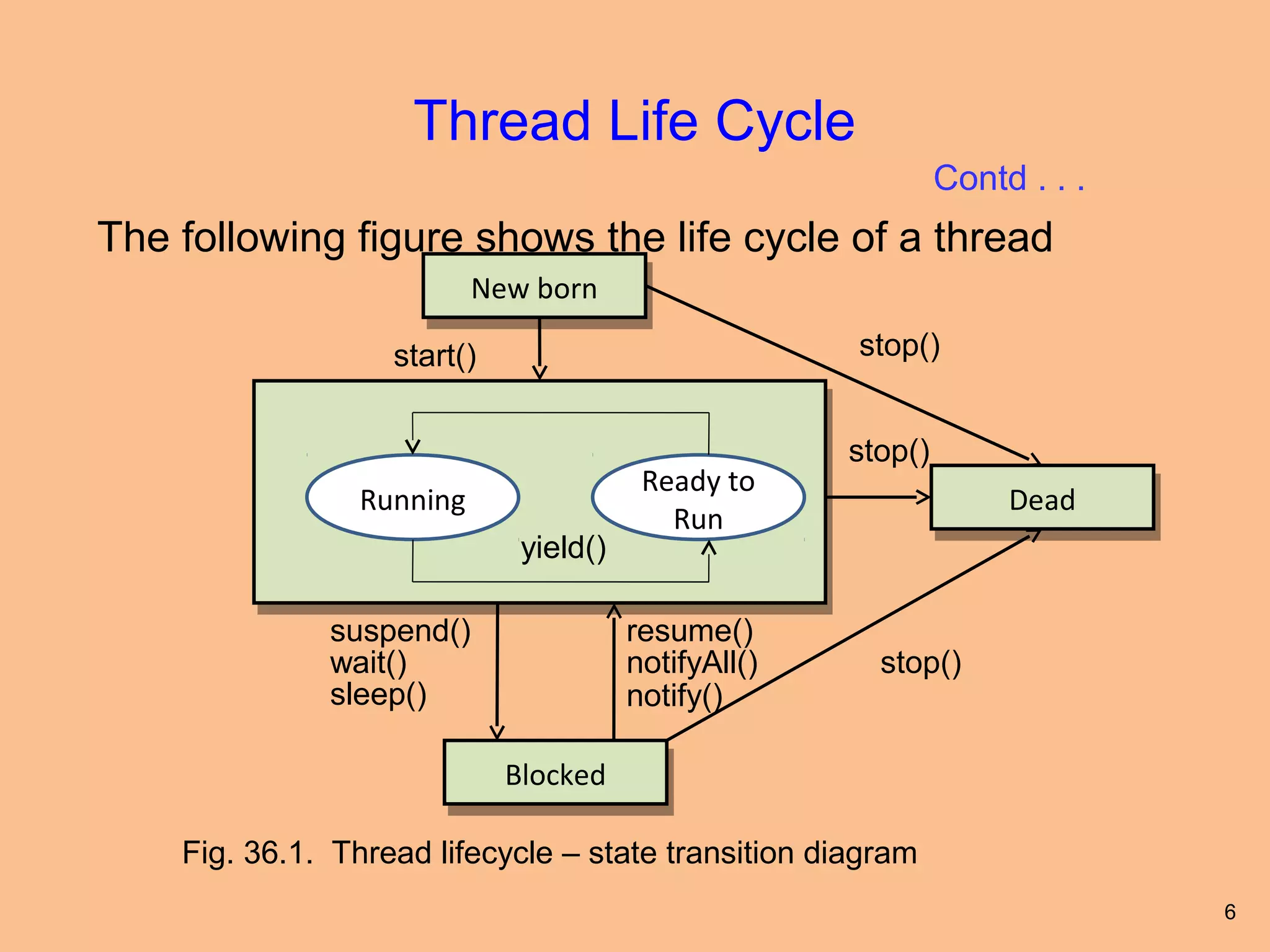
The following figure shows the life cycle of a thread
                           New born
                           New born
                   start()                            stop()


                                                      stop()
                                         Ready to
                 Running                                            Dead
                                                                    Dead
                                           Run
                              yield()

              suspend()                 resume()
              wait()                    notifyAll()     stop()
              sleep()                   notify()

                             Blocked
                             Blocked

    Fig. 36.1. Thread lifecycle – state transition diagram
                                                                             6
Thread Life Cycle
                                              Contd . . .

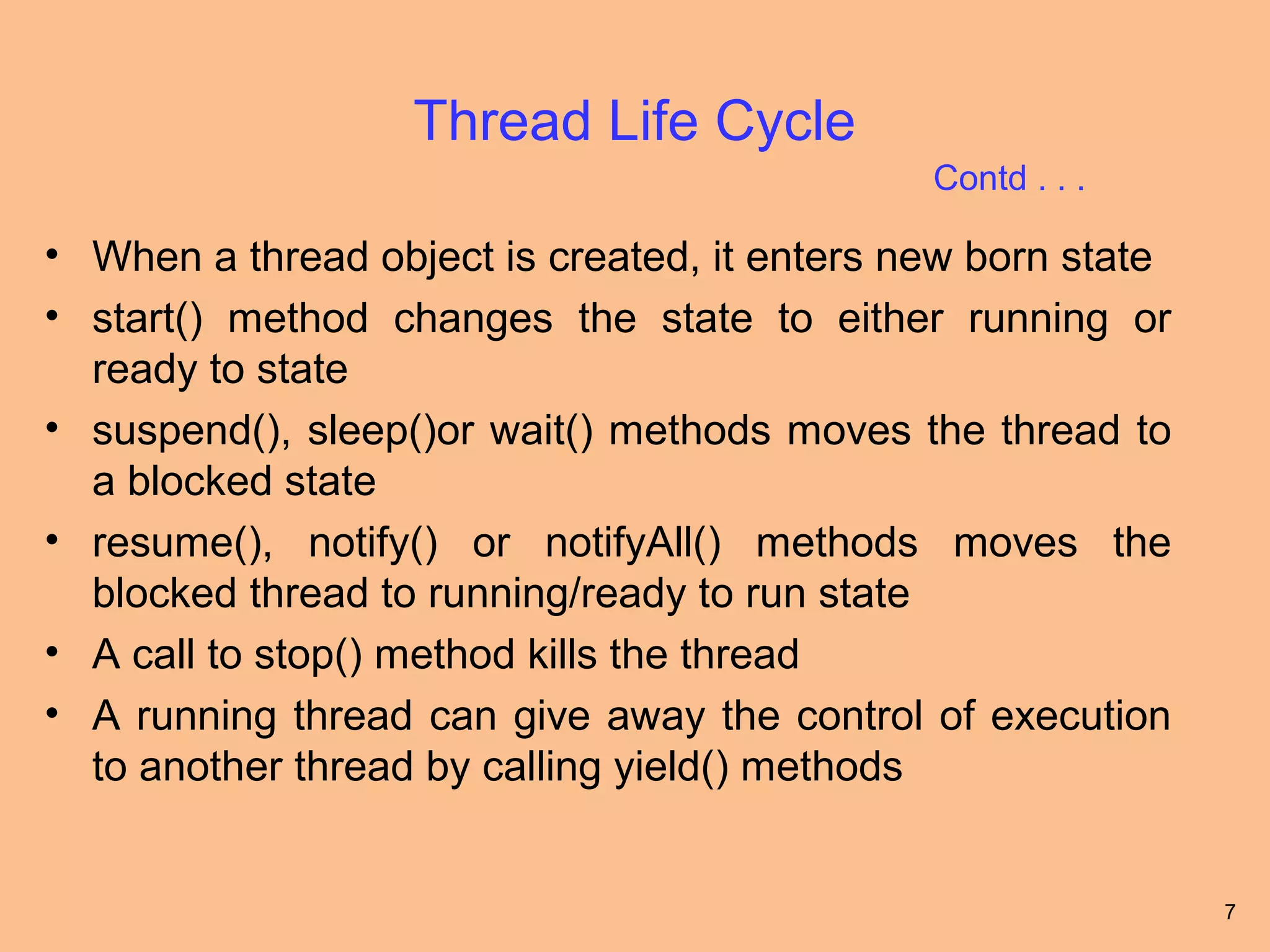
• When a thread object is created, it enters new born state
• start() method changes the state to either running or
  ready to state
• suspend(), sleep()or wait() methods moves the thread to
  a blocked state
• resume(), notify() or notifyAll() methods moves the
  blocked thread to running/ready to run state
• A call to stop() method kills the thread
• A running thread can give away the control of execution
  to another thread by calling yield() methods


                                                              7
Methods of Thread
•Some of the methods of the Thread class are
   • start()
   • stop()
   • suspend()
   • resume()
   • wait()
   • notify()
   • notifyAll()
   • isAlive()
   • yield()
   • join()


                                               8
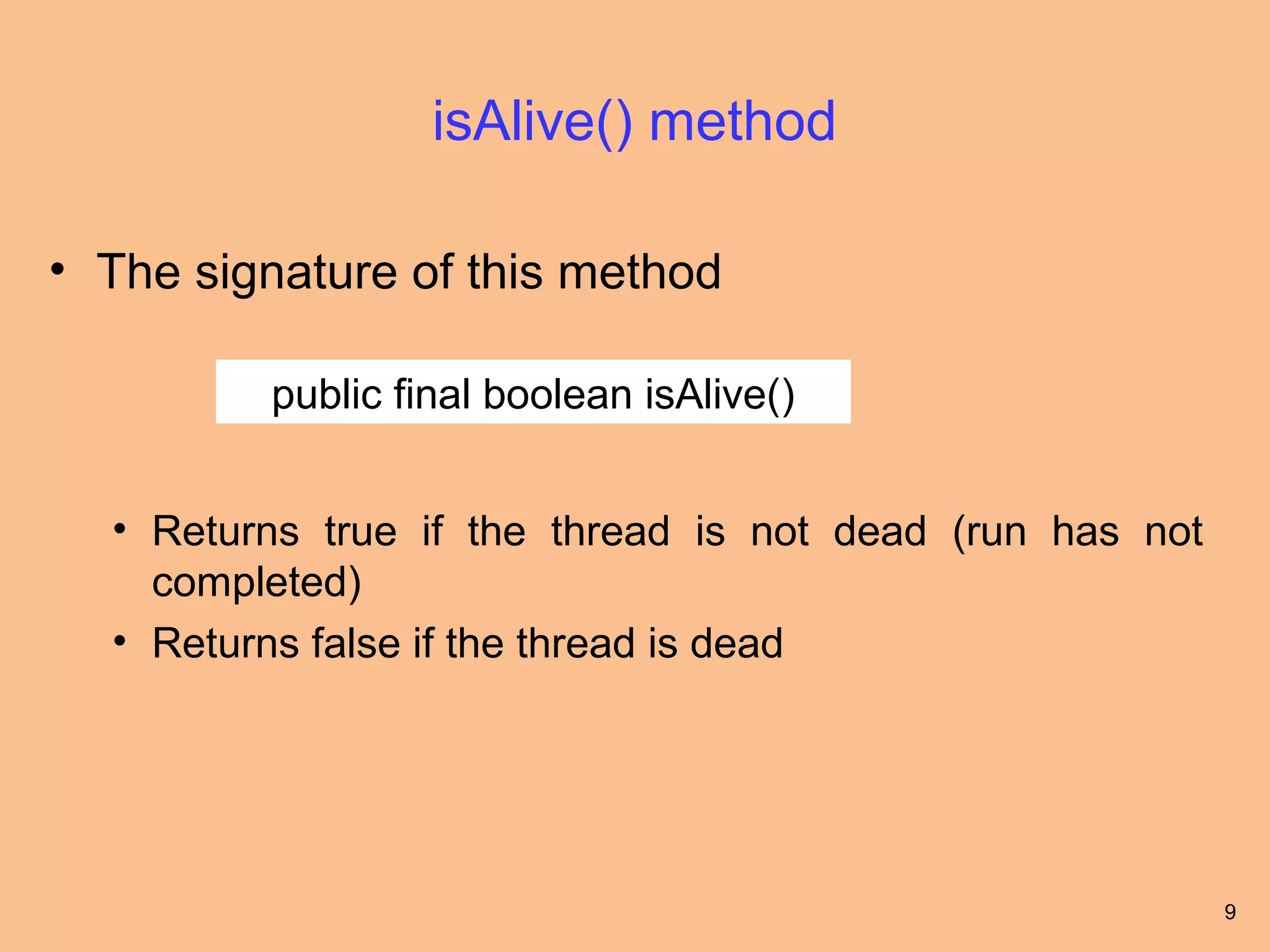
isAlive() method

• The signature of this method

         public final boolean isAlive()


  • Returns true if the thread is not dead (run has not
    completed)
  • Returns false if the thread is dead


                                                          9
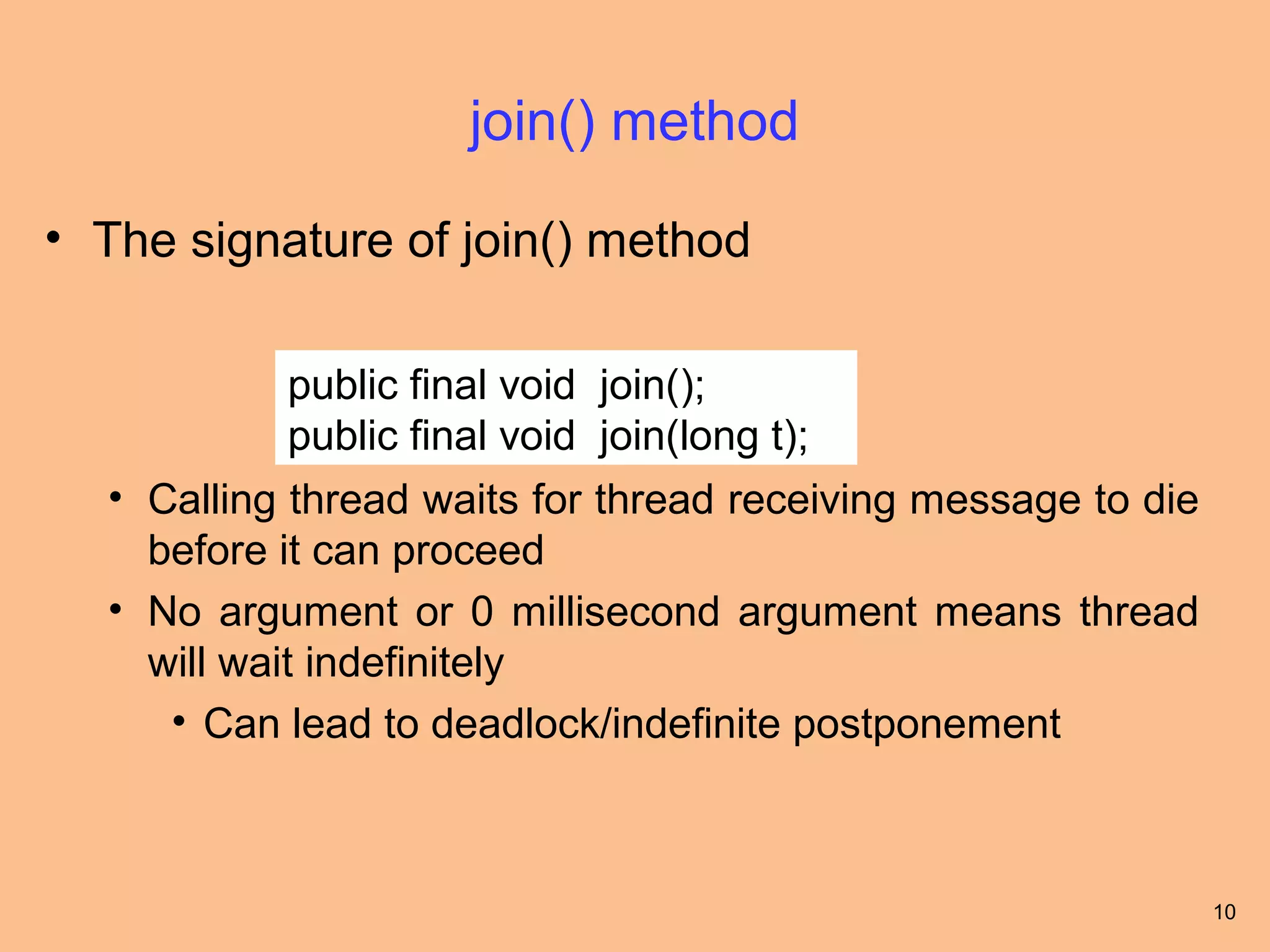
join() method

• The signature of join() method

           public final void join();
           public final void join(long t);
  • Calling thread waits for thread receiving message to die
    before it can proceed
  • No argument or 0 millisecond argument means thread
    will wait indefinitely
     • Can lead to deadlock/indefinite postponement


                                                               10
Example Program

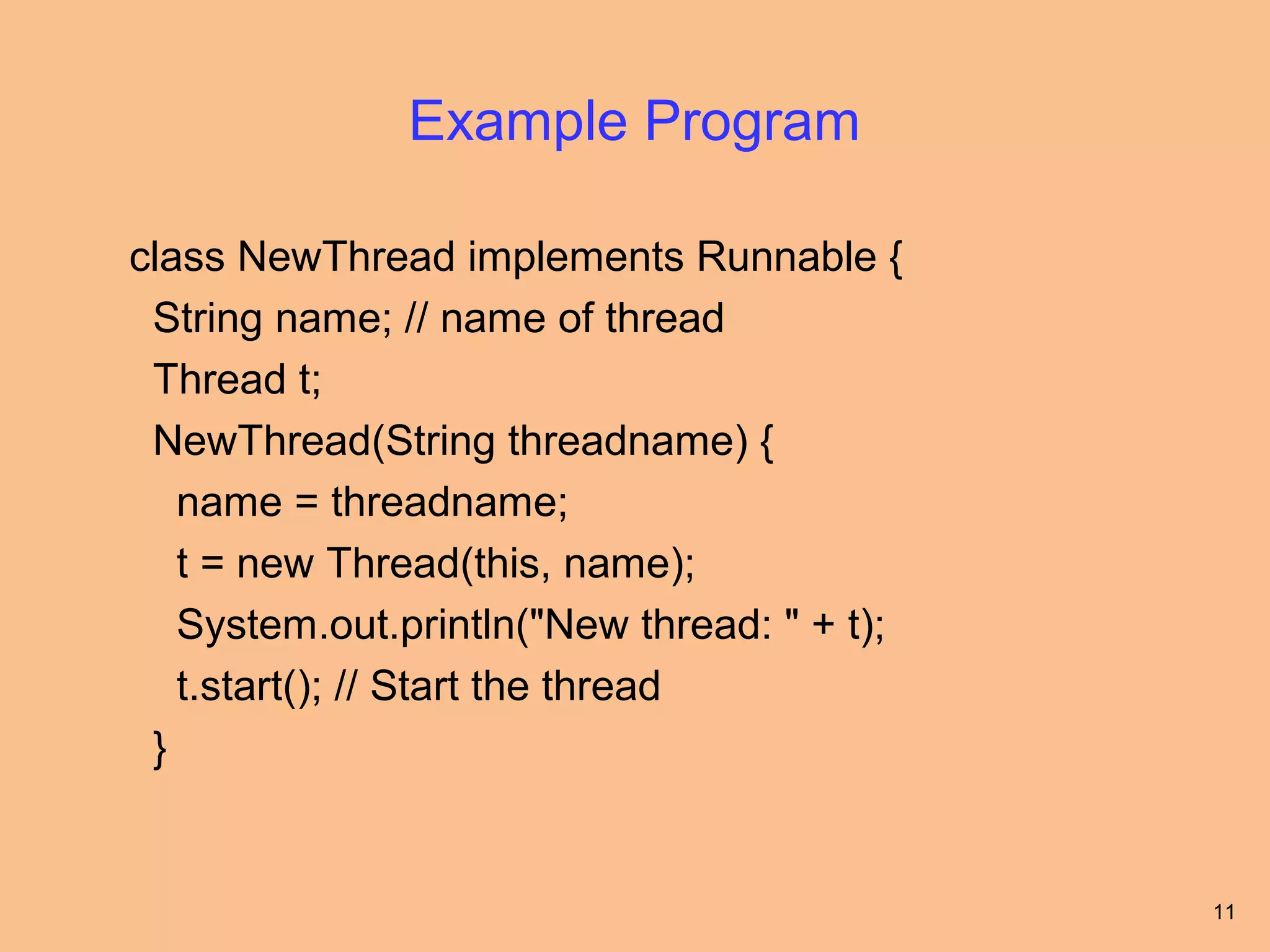
class NewThread implements Runnable {
 String name; // name of thread
 Thread t;
 NewThread(String threadname) {
   name = threadname;
   t = new Thread(this, name);
   System.out.println("New thread: " + t);
   t.start(); // Start the thread
 }


                                             11
Example Program
                                  Contd . . .
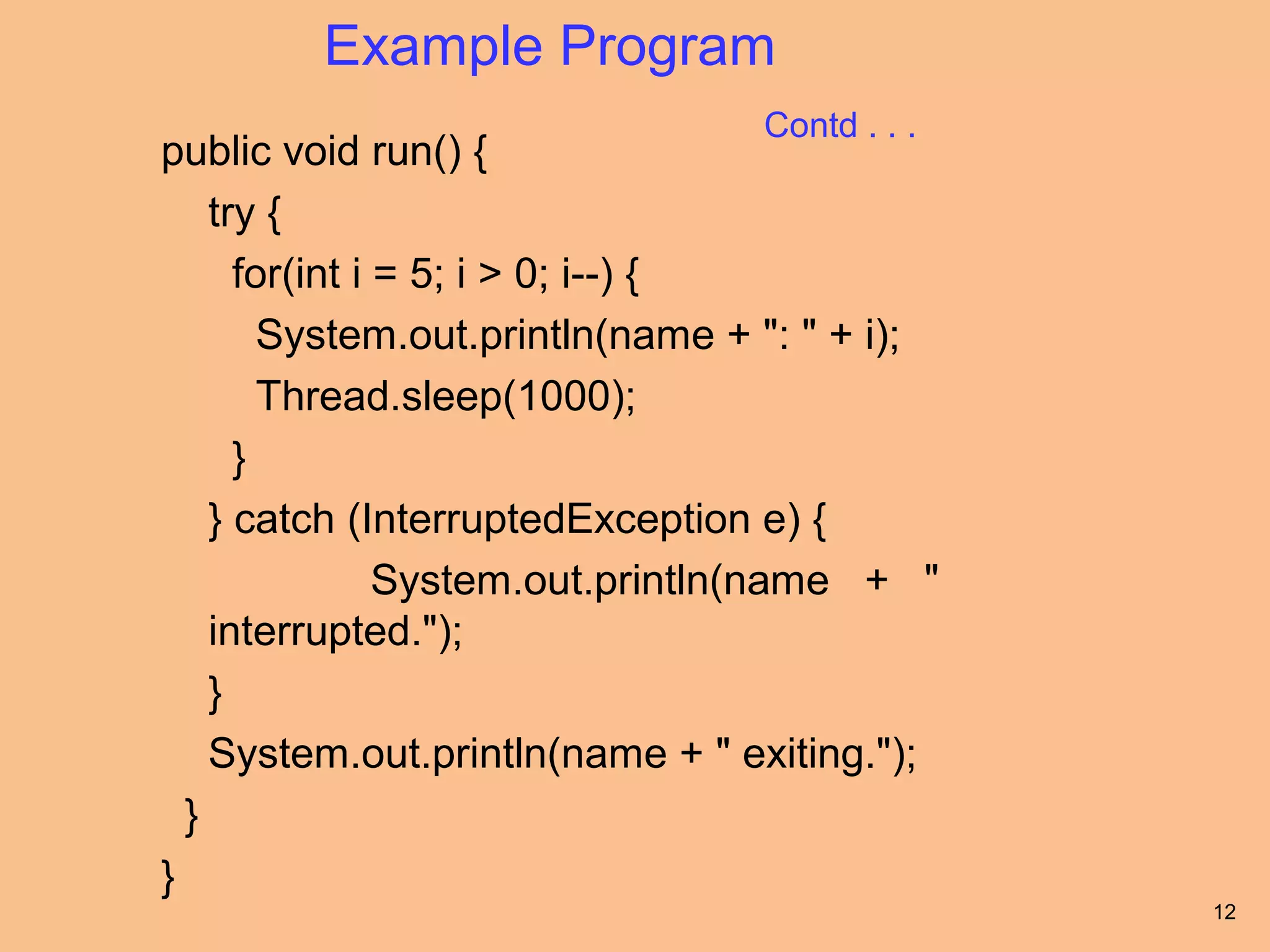
public void run() {
    try {
      for(int i = 5; i > 0; i--) {
        System.out.println(name + ": " + i);
        Thread.sleep(1000);
      }
    } catch (InterruptedException e) {
                System.out.println(name + "
    interrupted.");
    }
    System.out.println(name + " exiting.");
  }
}
                                                12
Example Program
                                                       Contd . . .

class DemoJoin {
 public static void main(String args[]) {
   NewThread ob1 = new NewThread("One");
   NewThread ob2 = new NewThread("Two");
   NewThread ob3 = new NewThread("Three");
   System.out.println("Thread One is alive: “ +
   ob1.t.isAlive());
   System.out.println("Thread Two is alive: “ +
   ob2.t.isAlive());
   System.out.println("Thread Three is alive: “ +
   ob3.t.isAlive());                      Use of isAlive()
                                             At this moment all threads
                                                                          13
                                             are alive and return true
Example Program
                                                            Contd . . .
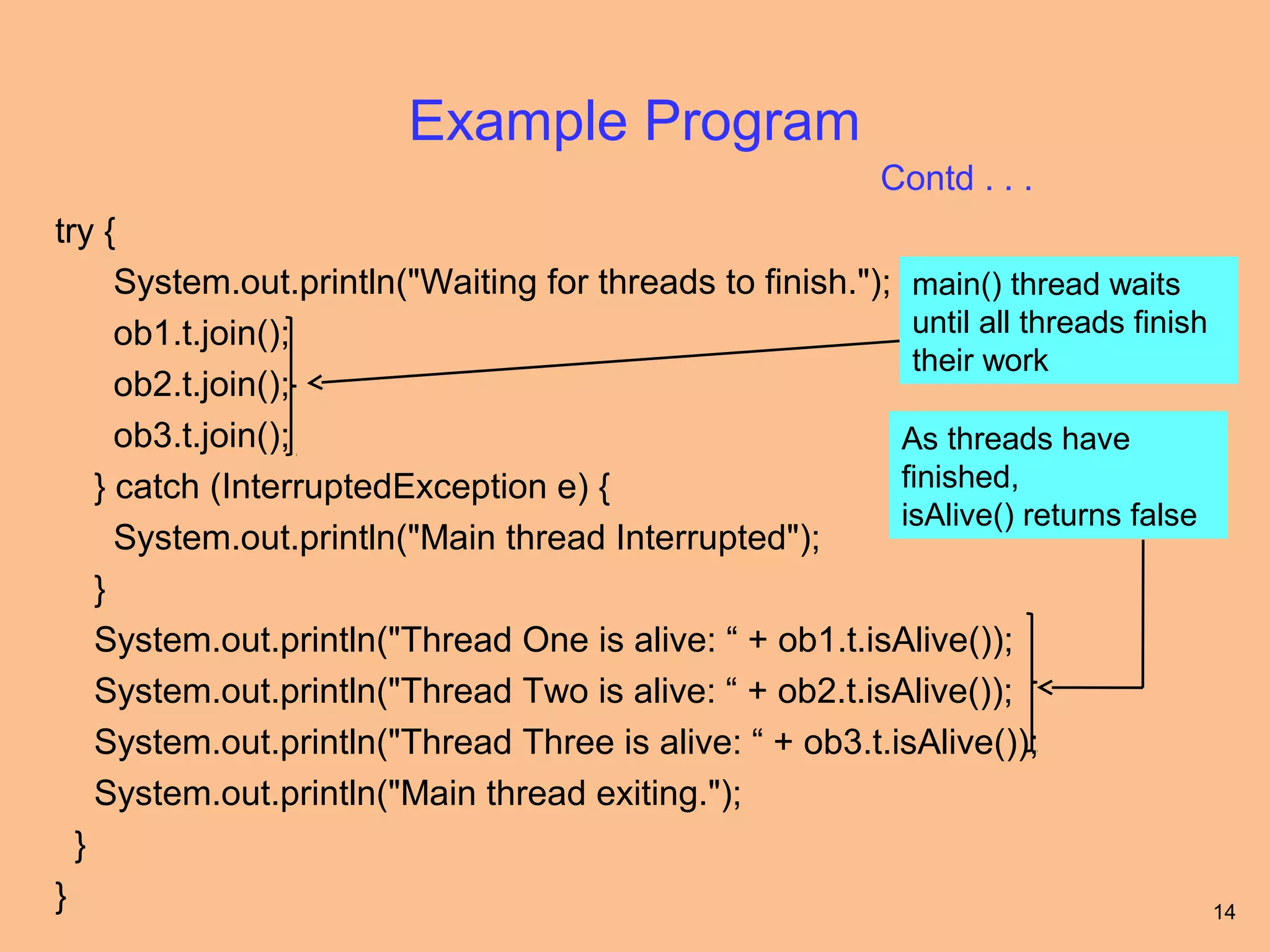
try {
      System.out.println("Waiting for threads to finish."); main() thread waits
      ob1.t.join();                                         until all threads finish
                                                            their work
      ob2.t.join();
      ob3.t.join();                                        As threads have
    } catch (InterruptedException e) {                     finished,
                                                           isAlive() returns false
      System.out.println("Main thread Interrupted");
    }
    System.out.println("Thread One is alive: “ + ob1.t.isAlive());
    System.out.println("Thread Two is alive: “ + ob2.t.isAlive());
    System.out.println("Thread Three is alive: “ + ob3.t.isAlive());
    System.out.println("Main thread exiting.");
  }
}                                                                                    14
Example Program
                           Contd . . .
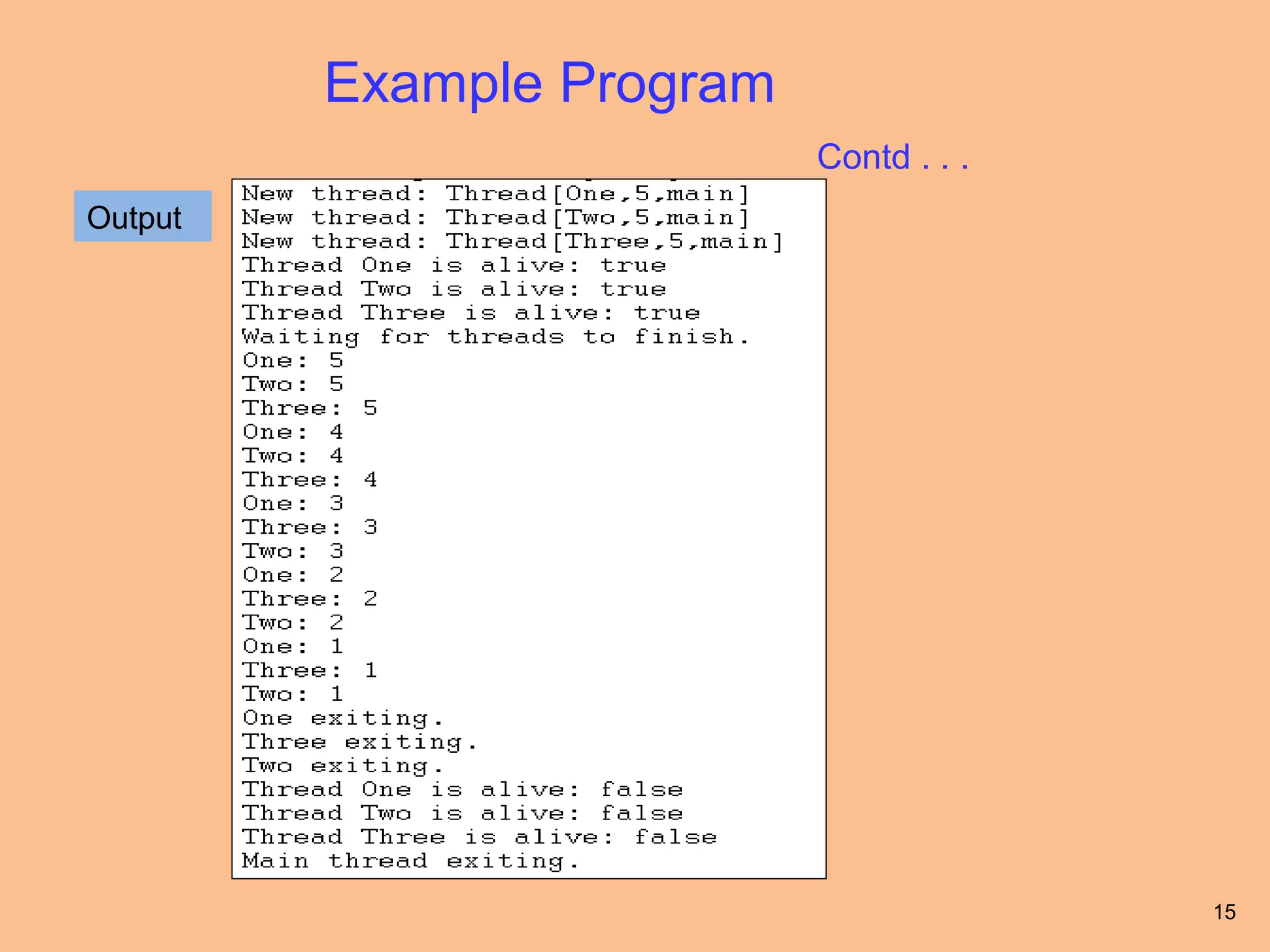
Output


                                         15
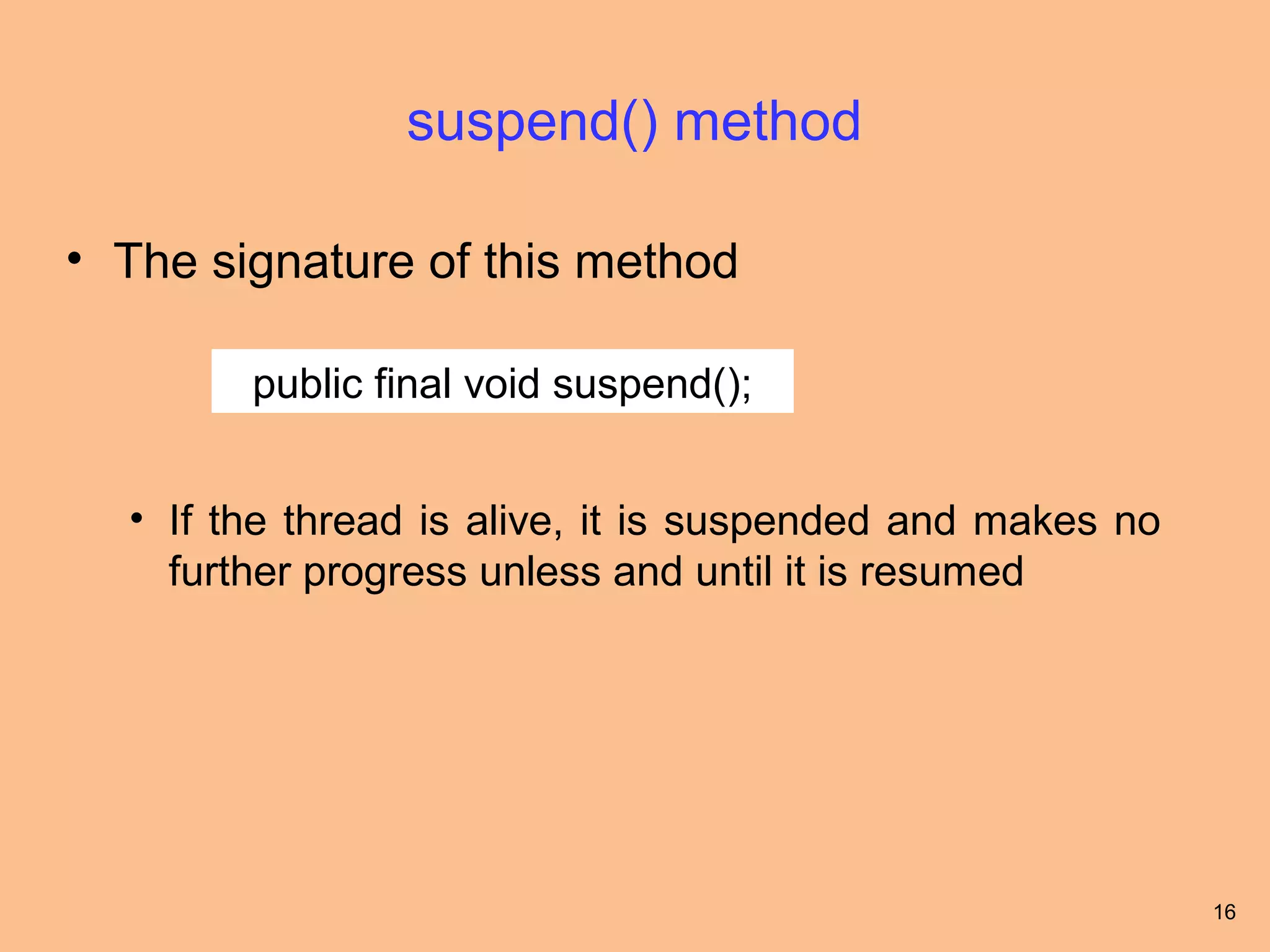
suspend() method

• The signature of this method

        public final void suspend();


  • If the thread is alive, it is suspended and makes no
    further progress unless and until it is resumed


                                                           16
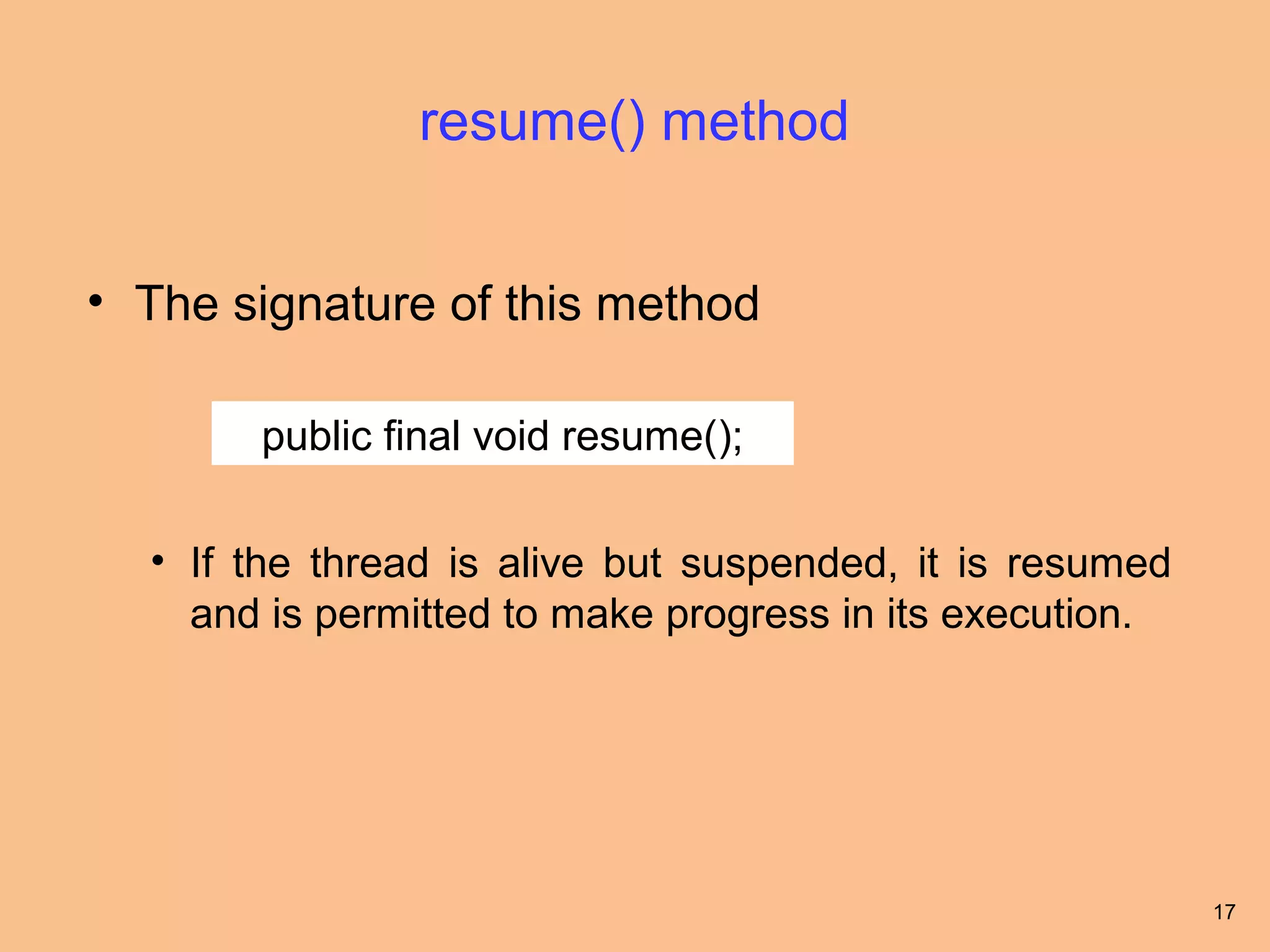
resume() method


• The signature of this method

       public final void resume();

  • If the thread is alive but suspended, it is resumed
    and is permitted to make progress in its execution.


                                                          17
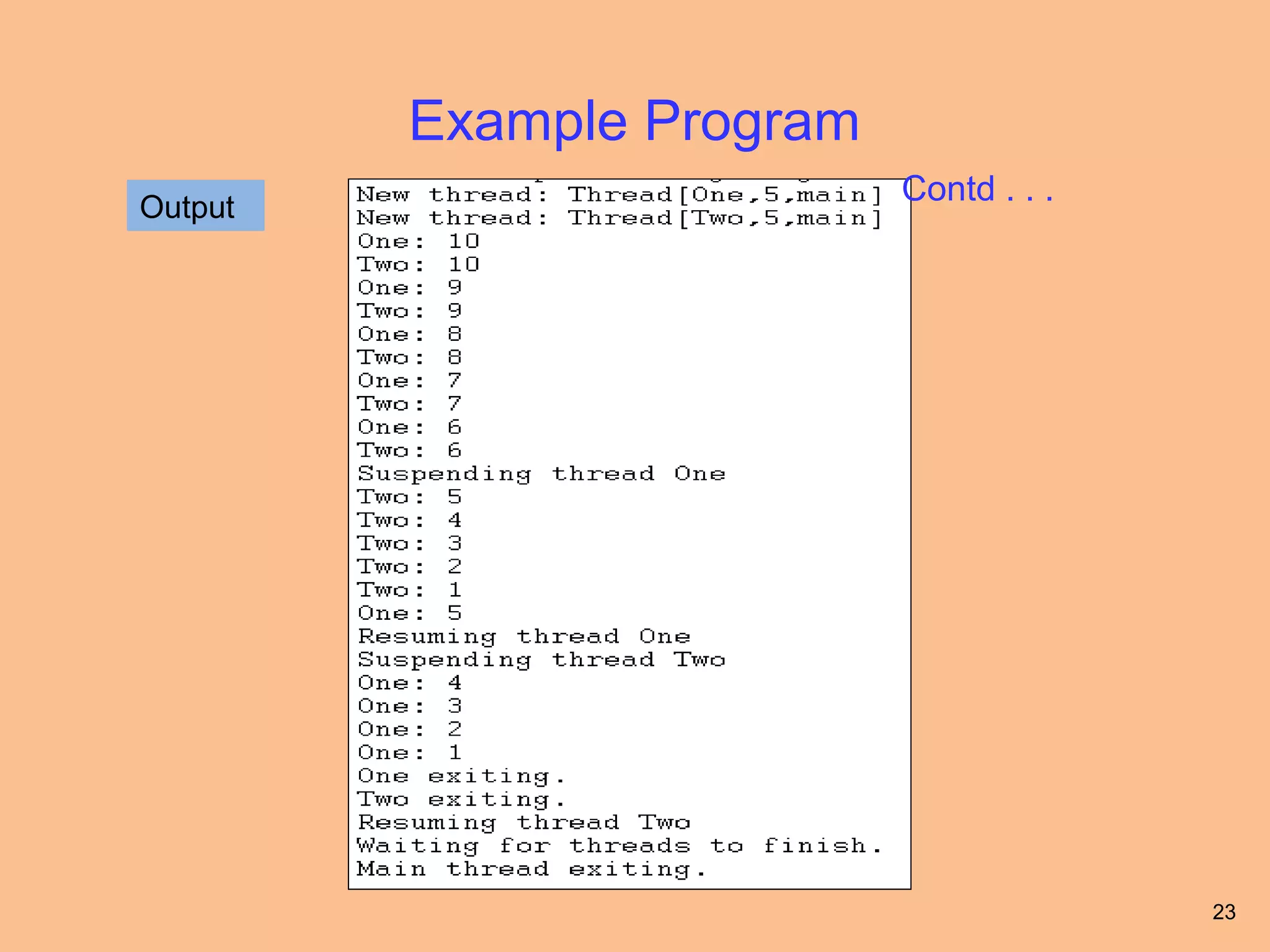
Example Program

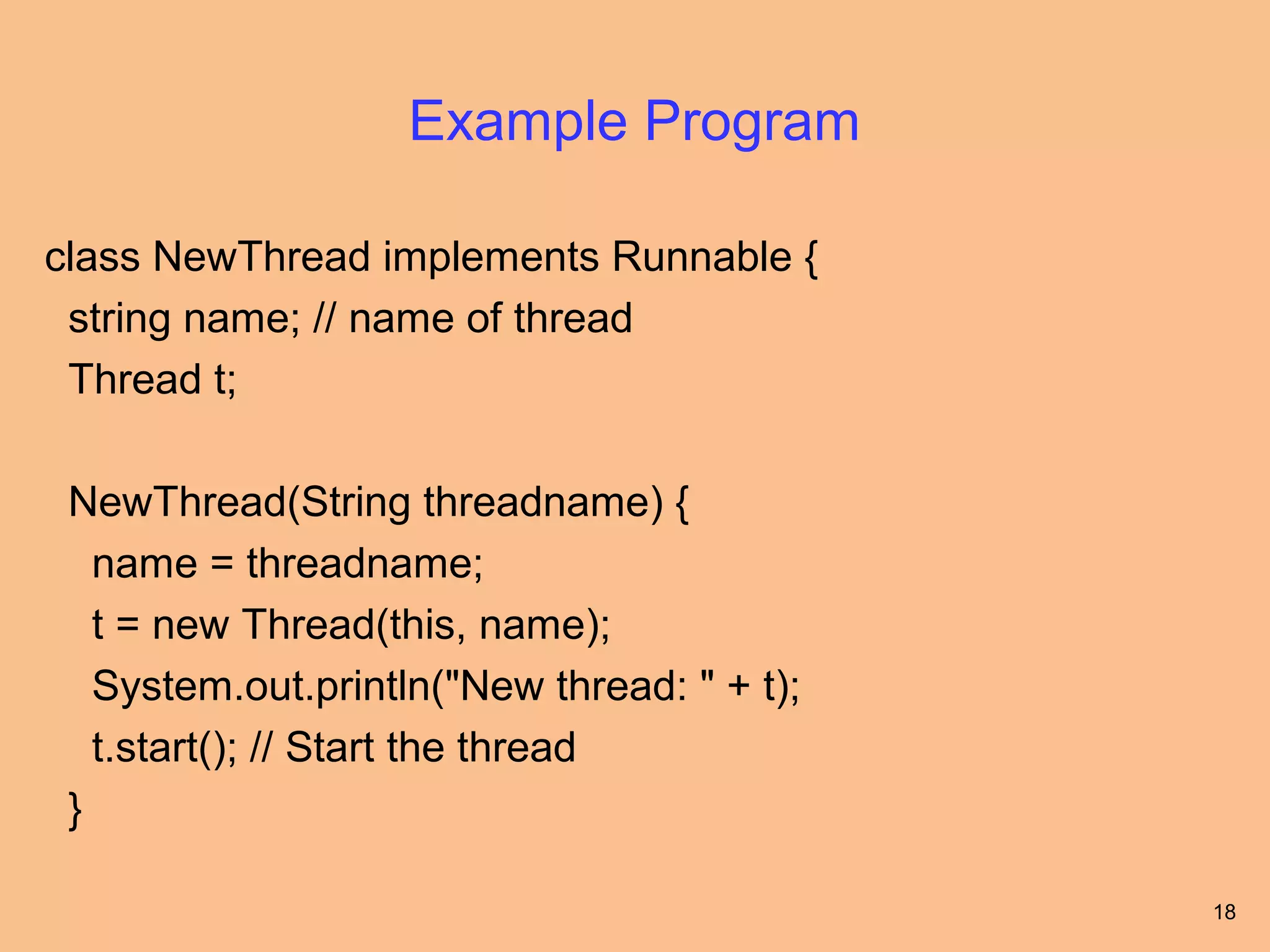
class NewThread implements Runnable {
 string name; // name of thread
 Thread t;

 NewThread(String threadname) {
   name = threadname;
   t = new Thread(this, name);
   System.out.println("New thread: " + t);
   t.start(); // Start the thread
 }

                                             18
Example Program
                                                Contd . . .
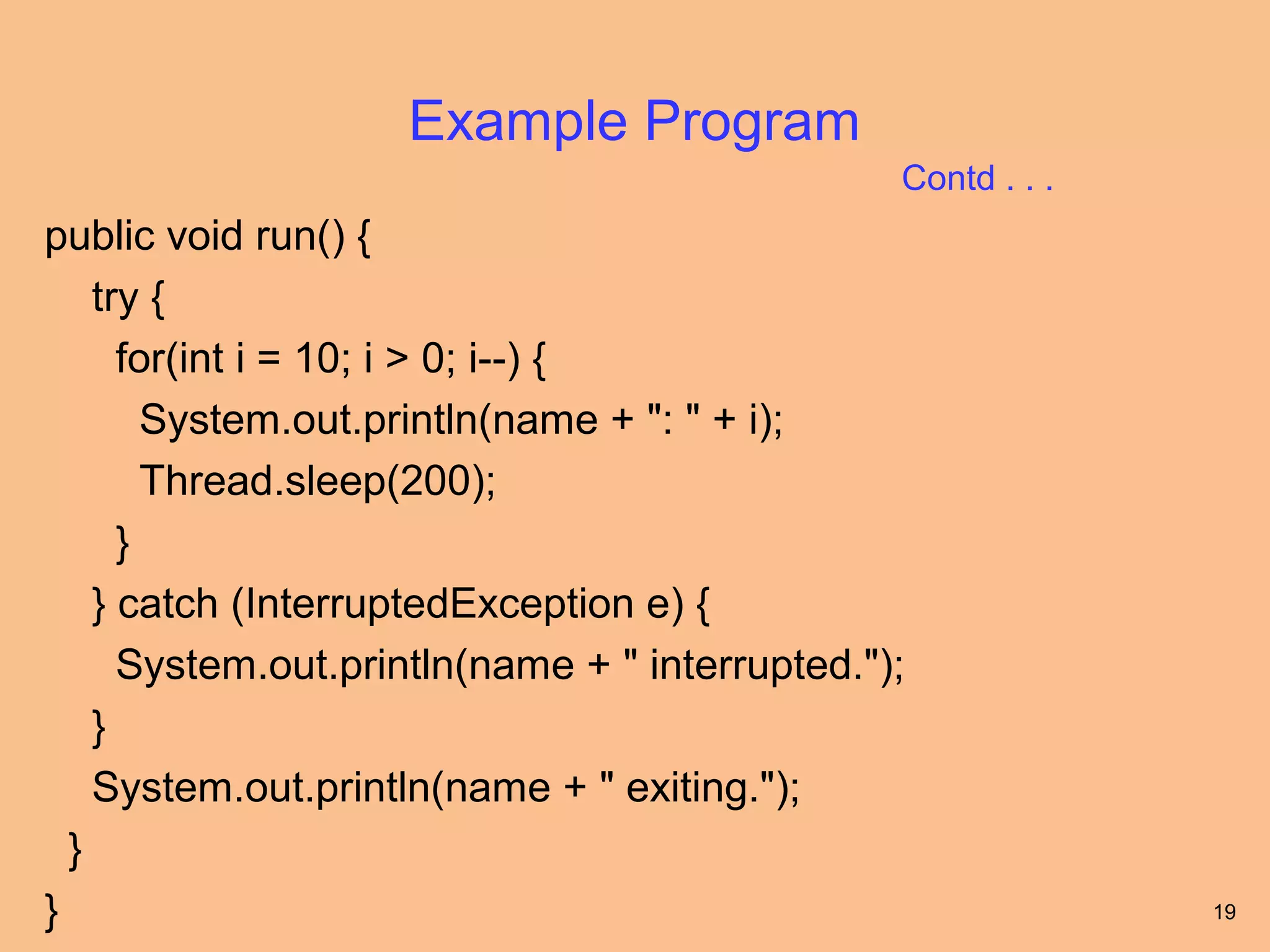
public void run() {
    try {
      for(int i = 10; i > 0; i--) {
        System.out.println(name + ": " + i);
        Thread.sleep(200);
      }
    } catch (InterruptedException e) {
      System.out.println(name + " interrupted.");
    }
    System.out.println(name + " exiting.");
  }
}                                                             19
Example Program
                                       Contd . . .
class SuspendResume {
 public static void main(String args[]) {
   NewThread ob1 = new NewThread("One");
   NewThread ob2 = new NewThread("Two");
   try {
     Thread.sleep(1000);
     ob1.t.suspend();
     System.out.println("Suspending thread One");
     Thread.sleep(1000);
     ob1.t.resume();
     System.out.println("Resuming thread One");
     ob2.t.suspend();
     System.out.println("Suspending thread Two");
                                                     20
Example Program
                                             Contd . . .


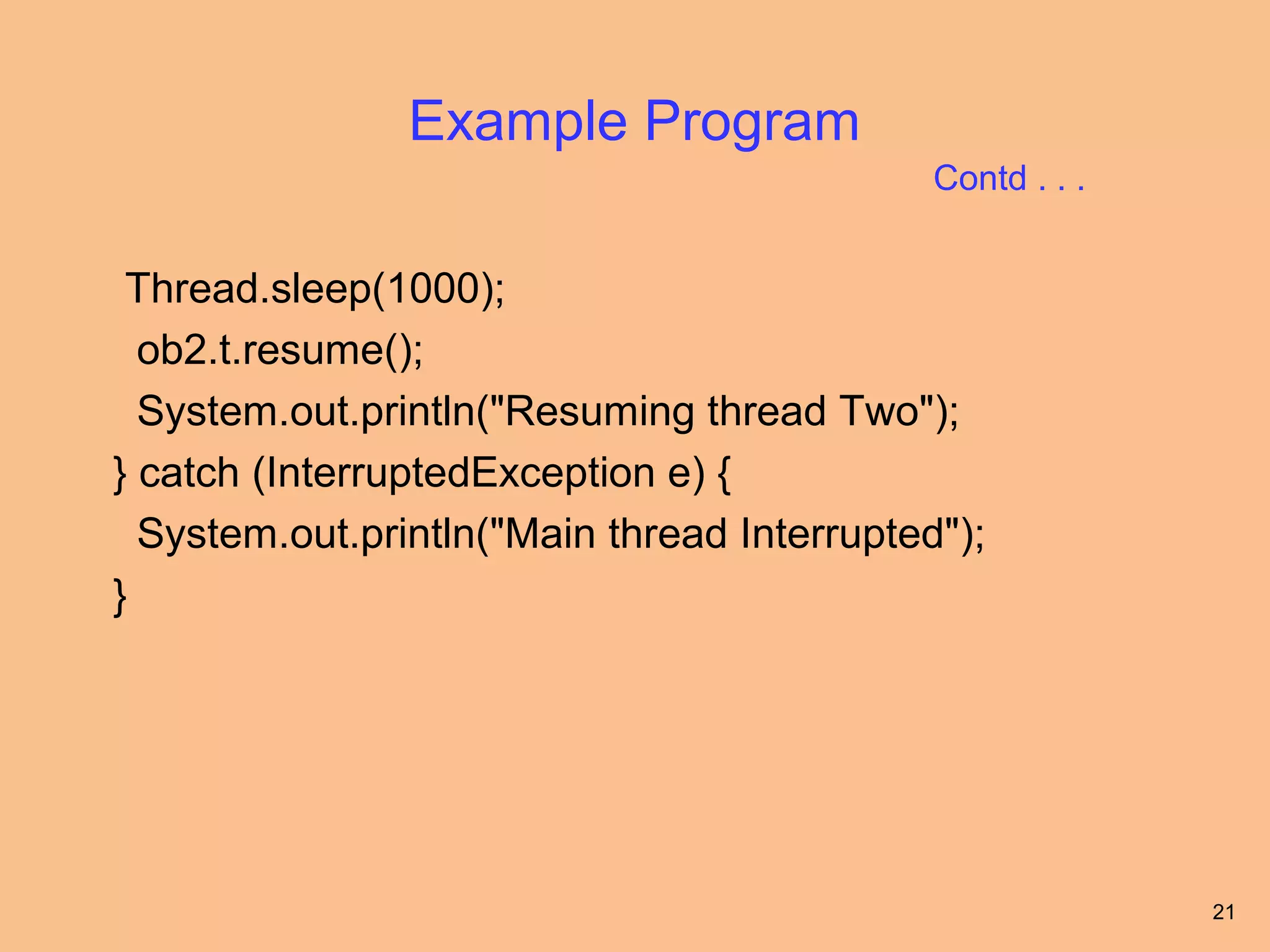
 Thread.sleep(1000);
  ob2.t.resume();
  System.out.println("Resuming thread Two");
} catch (InterruptedException e) {
  System.out.println("Main thread Interrupted");
}


                                                           21
Example Program
                                                   Contd . . .
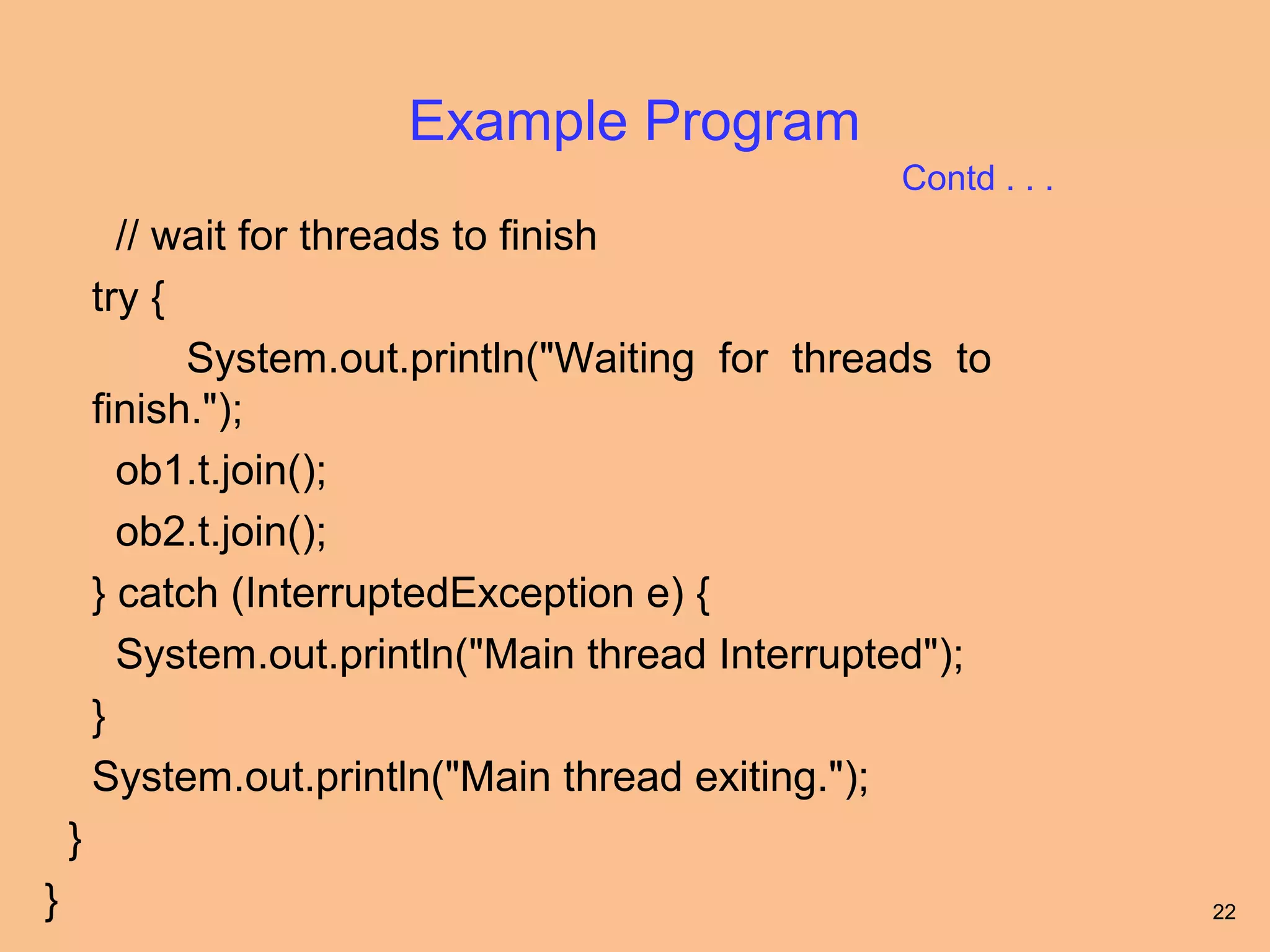
          // wait for threads to finish
        try {
              System.out.println("Waiting for threads to
        finish.");
          ob1.t.join();
          ob2.t.join();
        } catch (InterruptedException e) {
          System.out.println("Main thread Interrupted");
        }
        System.out.println("Main thread exiting.");
    }
}                                                                22
Example Program
Output
                           Contd . . .


                                         23
Summary
• In this class we have discussed
  • The life cycle of thread
  • The state transition diagram
  • The thread methods
     • isAlive()
     • join()
     • suspend()
     • resume()
• In the next lesson we look at the concept of
  synchronization

                                                 24
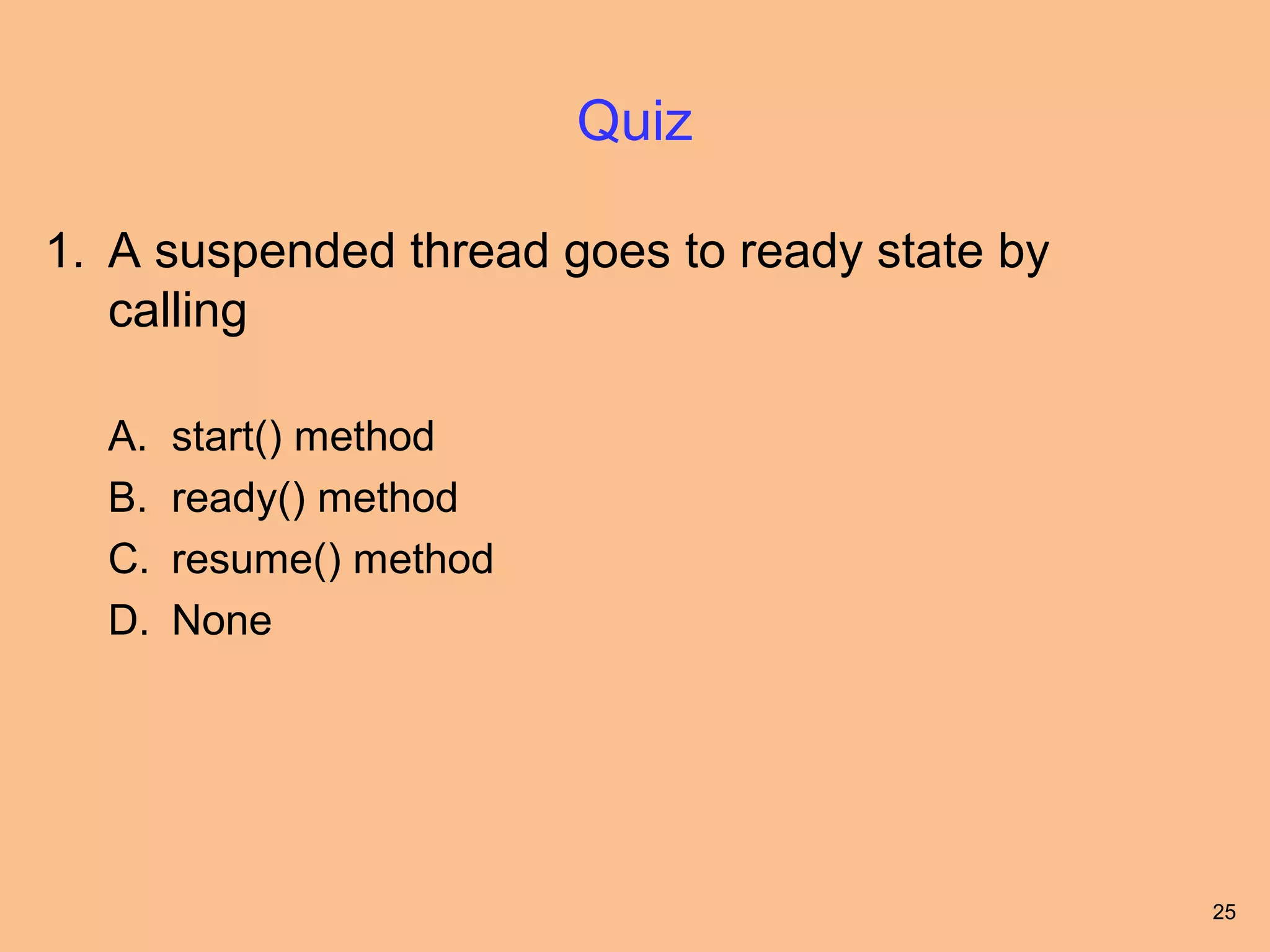
Quiz

1. A suspended thread goes to ready state by
   calling

  A.   start() method
  B.   ready() method
  C.   resume() method
  D.   None


                                               25
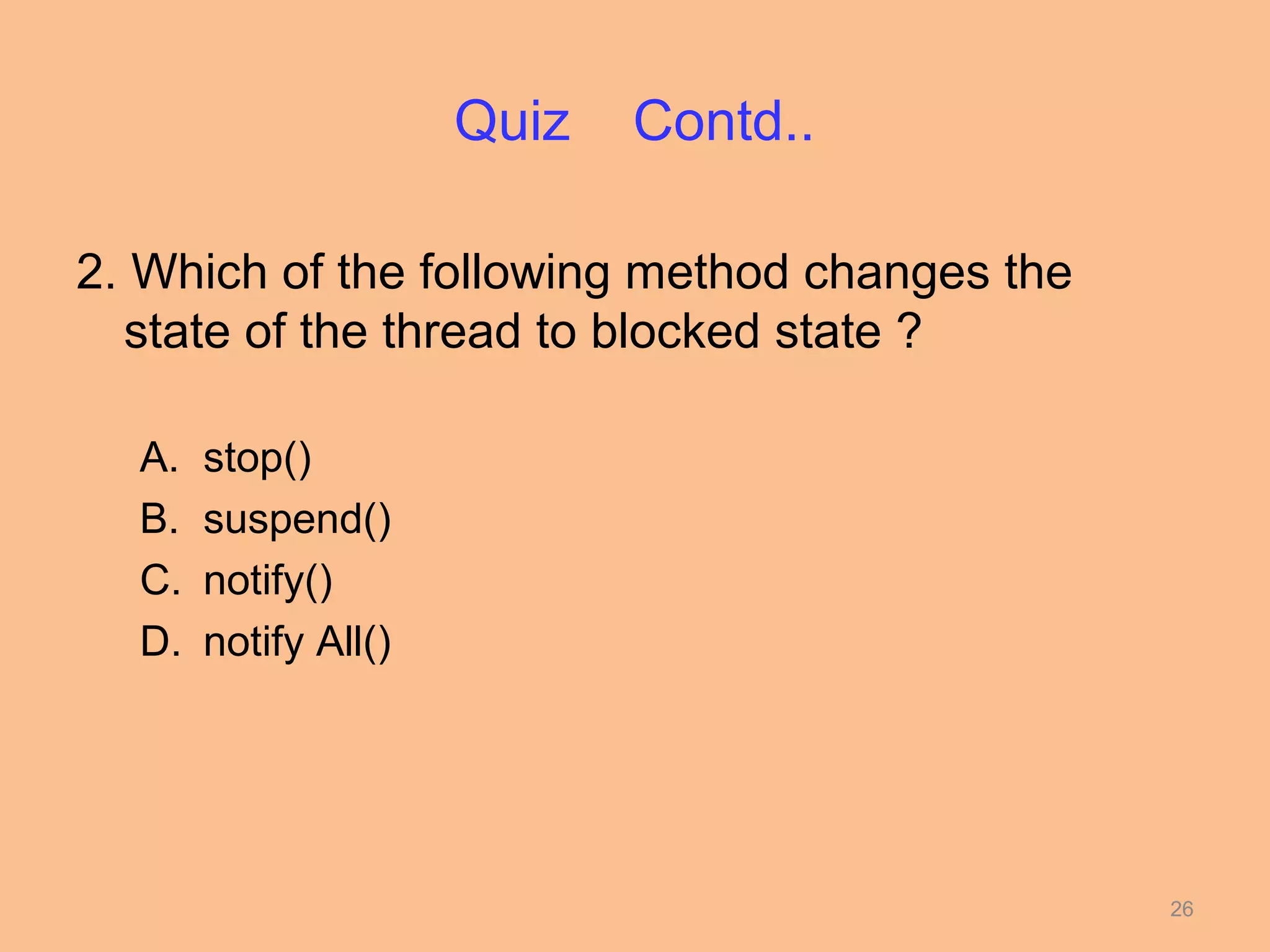
Quiz   Contd..

2. Which of the following method changes the
  state of the thread to blocked state ?

  A.   stop()
  B.   suspend()
  C.   notify()
  D.   notify All()


                                               26
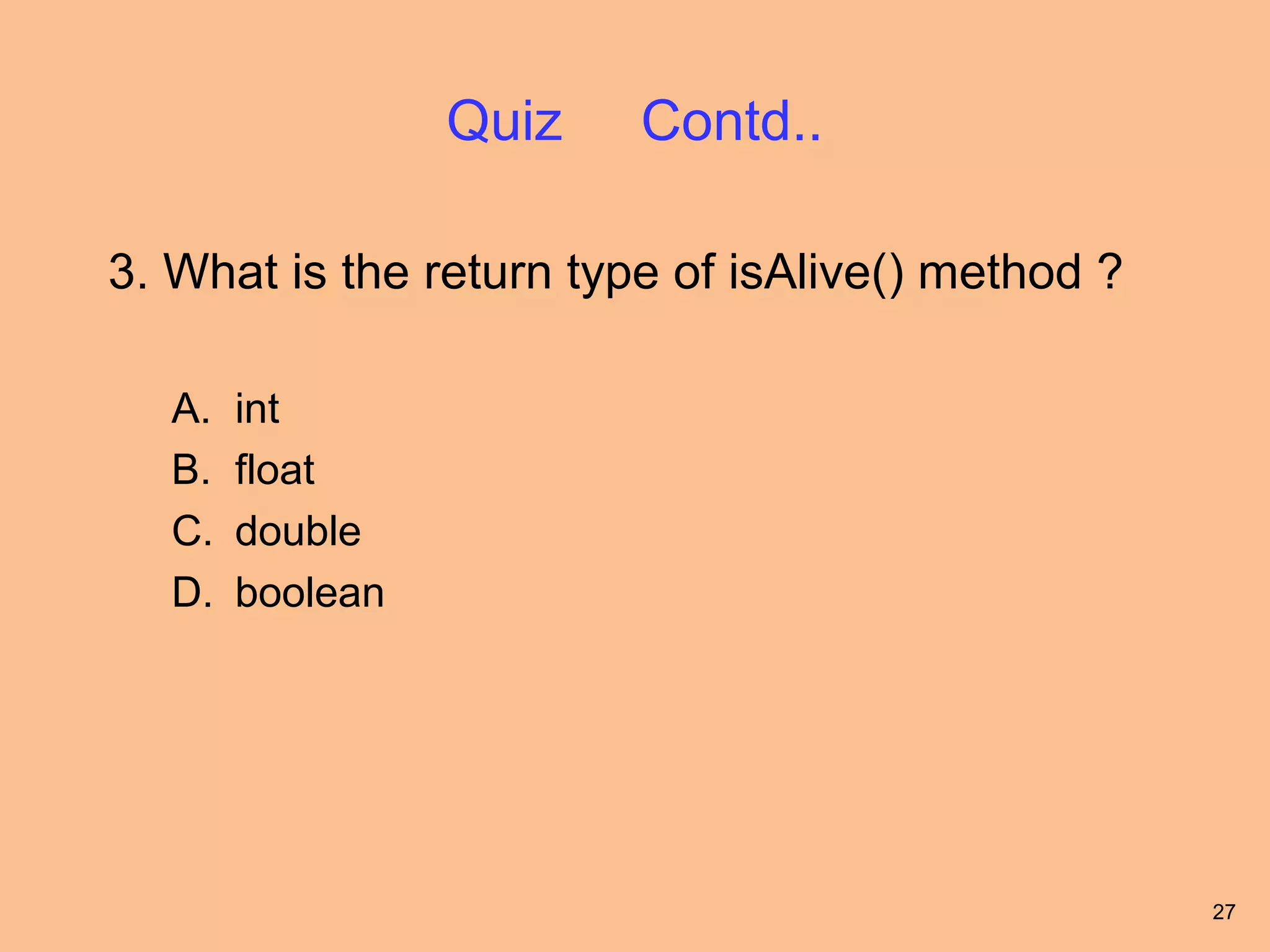
Quiz   Contd..

3. What is the return type of isAlive() method ?

   A.   int
   B.   float
   C.   double
   D.   boolean


                                                   27
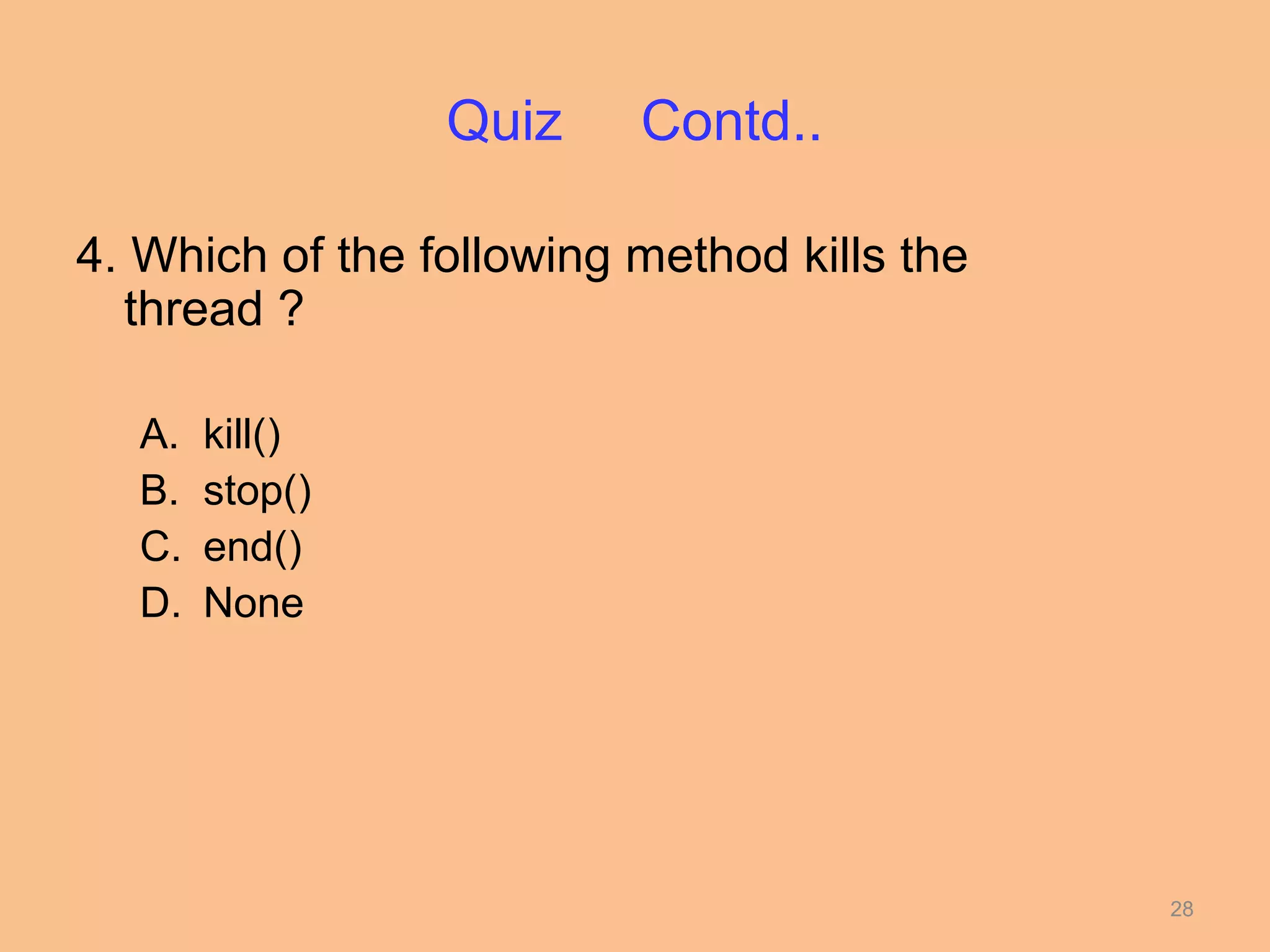
Quiz     Contd..

4. Which of the following method kills the
  thread ?

  A.   kill()
  B.   stop()
  C.   end()
  D.   None


                                             28
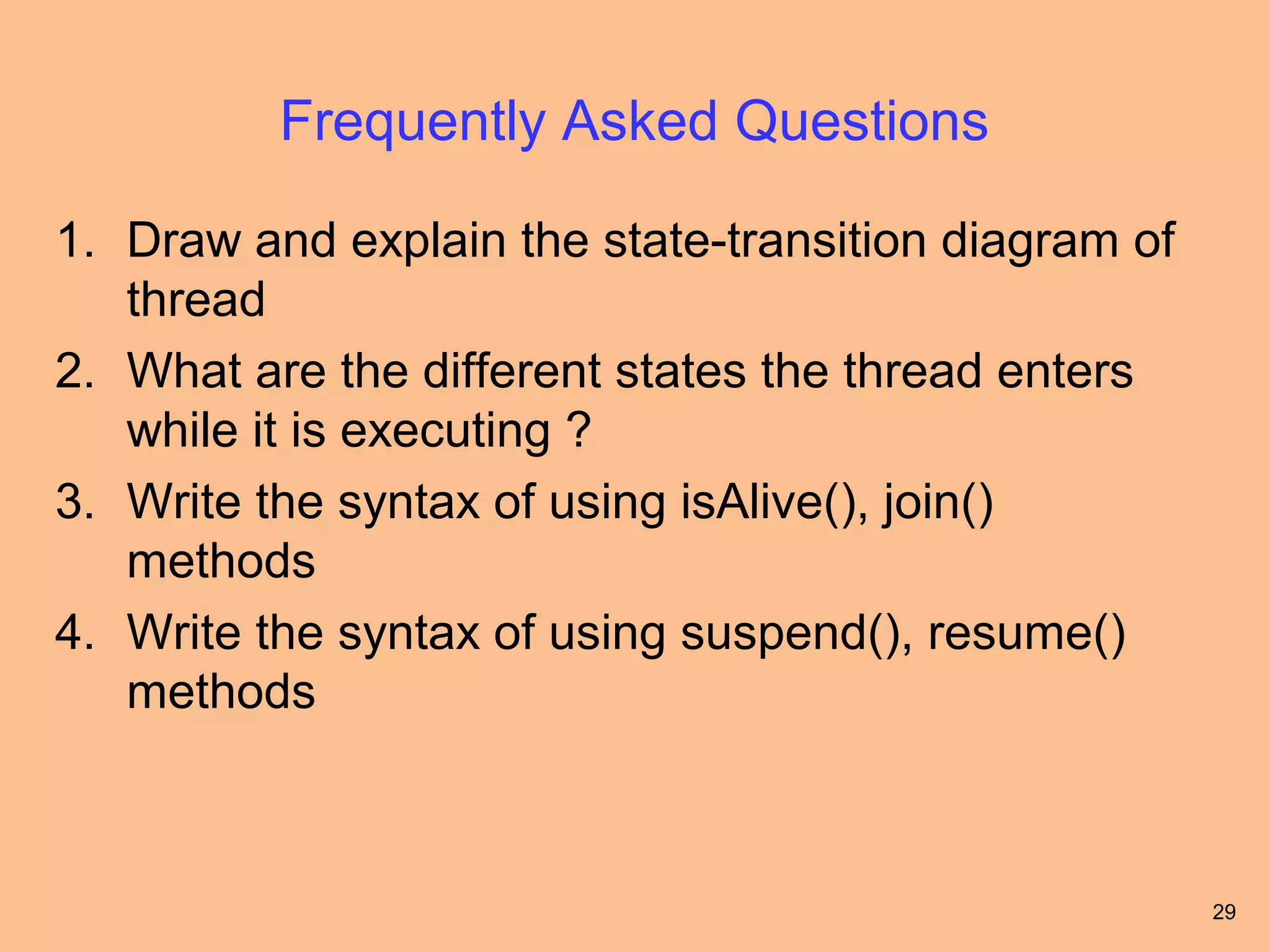
Frequently Asked Questions

1. Draw and explain the state-transition diagram of
   thread
2. What are the different states the thread enters
   while it is executing ?
3. Write the syntax of using isAlive(), join()
   methods
4. Write the syntax of using suspend(), resume()
   methods


                                                      29

Threadlifecycle.36

  • 1.
    Thread Lifecycle andThread Methods 1
  • 2.
    Objective On completion ofthis period, you would be able to learn • Thread Lifecycle • Thread methods • Example Programs 2
  • 3.
    Recap • In theprevious class we have seen how to set the priorities of threads • Thread class provides 3 constants for setting priorities • Thread.NORM_PRIORITY • Thread.MAX_PRIORITY • Thread.MIN_PRIORITY • Thread class also provides two methods • setPriority() • getPriority() 3
  • 4.
    Thread Life Cycle •Just like a Process has life cycle • Thread also has a life cycle • A Thread under goes different states while it is executing • We know the process state diagram • It is used to represent the life cycle of a process • Similarly the life cycle of a thread can be represented by thread state diagram 4
  • 5.
    Thread Life Cycle Contd . . . • A Thread can be in one of the following states • New born • Running • Ready to run • Blocked • Dead 5
  • 6.
    Thread Life Cycle Contd . . . The following figure shows the life cycle of a thread New born New born start() stop() stop() Ready to Running Dead Dead Run yield() suspend() resume() wait() notifyAll() stop() sleep() notify() Blocked Blocked Fig. 36.1. Thread lifecycle – state transition diagram 6
  • 7.
    Thread Life Cycle Contd . . . • When a thread object is created, it enters new born state • start() method changes the state to either running or ready to state • suspend(), sleep()or wait() methods moves the thread to a blocked state • resume(), notify() or notifyAll() methods moves the blocked thread to running/ready to run state • A call to stop() method kills the thread • A running thread can give away the control of execution to another thread by calling yield() methods 7
  • 8.
    Methods of Thread •Someof the methods of the Thread class are • start() • stop() • suspend() • resume() • wait() • notify() • notifyAll() • isAlive() • yield() • join() 8
  • 9.
    isAlive() method • Thesignature of this method public final boolean isAlive() • Returns true if the thread is not dead (run has not completed) • Returns false if the thread is dead 9
  • 10.
    join() method • Thesignature of join() method public final void join(); public final void join(long t); • Calling thread waits for thread receiving message to die before it can proceed • No argument or 0 millisecond argument means thread will wait indefinitely • Can lead to deadlock/indefinite postponement 10
  • 11.
    Example Program class NewThreadimplements Runnable { String name; // name of thread Thread t; NewThread(String threadname) { name = threadname; t = new Thread(this, name); System.out.println("New thread: " + t); t.start(); // Start the thread } 11
  • 12.
    Example Program Contd . . . public void run() { try { for(int i = 5; i > 0; i--) { System.out.println(name + ": " + i); Thread.sleep(1000); } } catch (InterruptedException e) { System.out.println(name + " interrupted."); } System.out.println(name + " exiting."); } } 12
  • 13.
    Example Program Contd . . . class DemoJoin { public static void main(String args[]) { NewThread ob1 = new NewThread("One"); NewThread ob2 = new NewThread("Two"); NewThread ob3 = new NewThread("Three"); System.out.println("Thread One is alive: “ + ob1.t.isAlive()); System.out.println("Thread Two is alive: “ + ob2.t.isAlive()); System.out.println("Thread Three is alive: “ + ob3.t.isAlive()); Use of isAlive() At this moment all threads 13 are alive and return true
  • 14.
    Example Program Contd . . . try { System.out.println("Waiting for threads to finish."); main() thread waits ob1.t.join(); until all threads finish their work ob2.t.join(); ob3.t.join(); As threads have } catch (InterruptedException e) { finished, isAlive() returns false System.out.println("Main thread Interrupted"); } System.out.println("Thread One is alive: “ + ob1.t.isAlive()); System.out.println("Thread Two is alive: “ + ob2.t.isAlive()); System.out.println("Thread Three is alive: “ + ob3.t.isAlive()); System.out.println("Main thread exiting."); } } 14
  • 15.
    Example Program Contd . . . Output 15
  • 16.
    suspend() method • Thesignature of this method public final void suspend(); • If the thread is alive, it is suspended and makes no further progress unless and until it is resumed 16
  • 17.
    resume() method • Thesignature of this method public final void resume(); • If the thread is alive but suspended, it is resumed and is permitted to make progress in its execution. 17
  • 18.
    Example Program class NewThreadimplements Runnable { string name; // name of thread Thread t; NewThread(String threadname) { name = threadname; t = new Thread(this, name); System.out.println("New thread: " + t); t.start(); // Start the thread } 18
  • 19.
    Example Program Contd . . . public void run() { try { for(int i = 10; i > 0; i--) { System.out.println(name + ": " + i); Thread.sleep(200); } } catch (InterruptedException e) { System.out.println(name + " interrupted."); } System.out.println(name + " exiting."); } } 19
  • 20.
    Example Program Contd . . . class SuspendResume { public static void main(String args[]) { NewThread ob1 = new NewThread("One"); NewThread ob2 = new NewThread("Two"); try { Thread.sleep(1000); ob1.t.suspend(); System.out.println("Suspending thread One"); Thread.sleep(1000); ob1.t.resume(); System.out.println("Resuming thread One"); ob2.t.suspend(); System.out.println("Suspending thread Two"); 20
  • 21.
    Example Program Contd . . . Thread.sleep(1000); ob2.t.resume(); System.out.println("Resuming thread Two"); } catch (InterruptedException e) { System.out.println("Main thread Interrupted"); } 21
  • 22.
    Example Program Contd . . . // wait for threads to finish try { System.out.println("Waiting for threads to finish."); ob1.t.join(); ob2.t.join(); } catch (InterruptedException e) { System.out.println("Main thread Interrupted"); } System.out.println("Main thread exiting."); } } 22
  • 23.
  • 24.
    Summary • In thisclass we have discussed • The life cycle of thread • The state transition diagram • The thread methods • isAlive() • join() • suspend() • resume() • In the next lesson we look at the concept of synchronization 24
  • 25.
    Quiz 1. A suspendedthread goes to ready state by calling A. start() method B. ready() method C. resume() method D. None 25
  • 26.
    Quiz Contd.. 2. Which of the following method changes the state of the thread to blocked state ? A. stop() B. suspend() C. notify() D. notify All() 26
  • 27.
    Quiz Contd.. 3. What is the return type of isAlive() method ? A. int B. float C. double D. boolean 27
  • 28.
    Quiz Contd.. 4. Which of the following method kills the thread ? A. kill() B. stop() C. end() D. None 28
  • 29.
    Frequently Asked Questions 1.Draw and explain the state-transition diagram of thread 2. What are the different states the thread enters while it is executing ? 3. Write the syntax of using isAlive(), join() methods 4. Write the syntax of using suspend(), resume() methods 29