INTELLIGENT TRANSPORTATION
SYSTEM
GUIDED BY:-
- Mr. Vikrant Singh
(Faculty, Civil Dept., UIT)
GROUP MEMBERS:
- Shashi Kumar Yadav (1428400075)
- Abhishek Pandey (1528400901)
- Vigyan Nidhi (1428400093)
- Swapnil Shrivastava (1428400089)
- Vishwas Mishra (1428400098)
- Shubham Shukla (1428400081)
UNITEDINSTITUTEOFTECHNOLOGY,NAINI,ALLAHABAD.
CONTENTS
• Project Team
• Introduction
• Literature Review
• Objective
• Stages Of Work
• Conclusion
• Recommendations
• References
PROJECT TEAM
• Abhishek (CONCEPT OF SPIKES)
• Shubham & Vishwas (SPIKES MODEL)
• Shashi (CONCEPT OF BLIND TURN SAFETY)
• Vigyan & Swapnil ( BLIND TURN MODEL)
3
INTRODUCTION
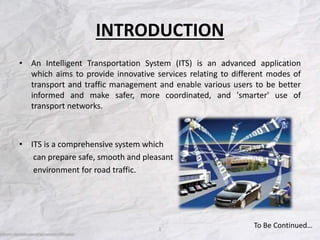
• An Intelligent Transportation System (ITS) is an advanced application
which aims to provide innovative services relating to different modes of
transport and traffic management and enable various users to be better
informed and make safer, more coordinated, and 'smarter' use of
transport networks.
• ITS is a comprehensive system which
can prepare safe, smooth and pleasant
environment for road traffic.
1
To Be Continued…
• Basic Idea of ITS:
 Intelligent Transport Systems (ITS) intend to add information and
communications technology to transport infrastructure and vehicles in an
effort to improve:
– Safety
– Reliability
– Efficiency
– Quality of means of transport.
2
LITERATURE REVIEW
• History :
The origin of the formal ITS program dates back to the nineteen sixties
with the development of the Electronic Route Guidance System, or ERGS
in the United States, to provide drivers with route guidance information
based on real-time traffic analysis. The system used special hardware
located at various intersections across the road network, on-board way
devices in vehicles that would form the hub of communication between
the driver and the ERGS system, and a central computer system that
processed the information received from the remote systems.
During the early seventies, the ERGS program led to a more sophisticated,
automated system comprising interactive visual digital maps called the
Automatic Route Control System or ARCS. The Urban Traffic Control
System was developed concomitantly, connecting various traffic signals
and computer generated predetermined signal timings for better traffic
organization.
3
• Paper Review:
 International Journal of Civil Engineering Research, Sumit Mallik,
Lecturer, Civil Engineering. Dept., R. C. Technical Institute,
Ahmedabad, Gujarat, Research India Publications (2014).
 Synthesis Report On ITS, Including Issues and Challenges In India,
Lelitha Vanajakshi, Gitakrishnan Ramadurai and Asha Anand (IIT
Madras), December 2010.
4
• Benefits Of ITS:
 Reduced rush hour congestion and delay.
 Increased safety and personal security.
 Time saving and Operation efficiencies.
 Reduced fuel consumption and emissions.
 Improved customer services and reduce frustration.
 Reduced road accidents and enhance economic productivity.
5
• Components Of ITS:
 Advanced Public Transportation System (APTS)
 Advanced Traffic Management System (ATMS)
 Incident Management System
 Electronic Toll Collection System (ETC)
 Vehicle Information and Collection System (VICS)
6
ADVANCED PUBLIC TRANSPORTATION
SYSTEM
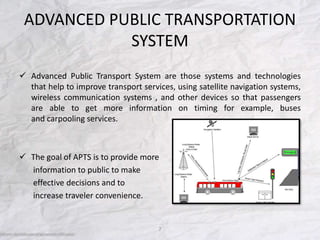
 Advanced Public Transport System are those systems and technologies
that help to improve transport services, using satellite navigation systems,
wireless communication systems , and other devices so that passengers
are able to get more information on timing for example, buses
and carpooling services.
 The goal of APTS is to provide more
information to public to make
effective decisions and to
increase traveler convenience.
7
ADVANCED TRAFFIC MANAGEMENT
SYSTEM
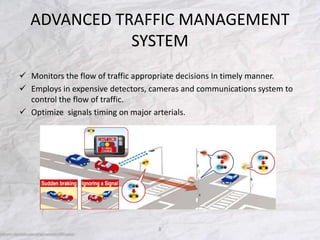
 Monitors the flow of traffic appropriate decisions In timely manner.
 Employs in expensive detectors, cameras and communications system to
control the flow of traffic.
 Optimize signals timing on major arterials.
8
INCIDENT MANAGEMENT SYSTEM
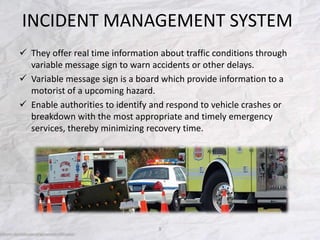
 They offer real time information about traffic conditions through
variable message sign to warn accidents or other delays.
 Variable message sign is a board which provide information to a
motorist of a upcoming hazard.
 Enable authorities to identify and respond to vehicle crashes or
breakdown with the most appropriate and timely emergency
services, thereby minimizing recovery time.
9
ELECTRONIC TOLL COLLECTION
SYSTEM
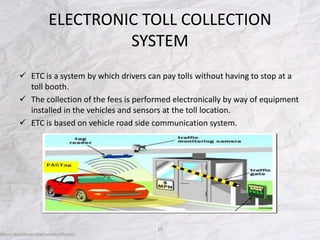
 ETC is a system by which drivers can pay tolls without having to stop at a
toll booth.
 The collection of the fees is performed electronically by way of equipment
installed in the vehicles and sensors at the toll location.
 ETC is based on vehicle road side communication system.
10
VEHICLE INFORMATION AND
COLLECTION SYSTEM
 This system includes updation of all road user about the traffic conditions
and other information congestion, jams, roads blocks, pollution level, etc.
 The information via FM Band or through roads maps quickly showing
traffic conditions in surrounding areas, the drivers can use this information
to select the best routes by using in vehicle monitor.
11
OBJECTIVE
• ITS aims to facilitate a national multi-modal surface transportation
system that features a connected transportation environment
around vehicles of all types, the infrastructure, and carry-in
passenger devices to serve the public good by leveraging
technology to maximize safety, mobility, and environmental
performance.
• An intelligent transportation system (ITS) is an advanced application
which, without embodying intelligence as such, aims to provide
innovative services relating to different modes of transport and
traffic management and enable users to be better informed and
make safer, more coordinated, and 'smarter' use of transport
12
STAGES OF WORK
• Data Collection
 There were on average 1,578 fatalities each year resulting from two
vehicles traffic crashes at intersections controlled by traffic signals.
 Approximately 51% of those fatal crashes were caused by drivers who ran
red lights.
 Potholes accounted for 6,424 Roads Accidents & 2,324 fatalities.
9,583 accidents & 3,396 accident deaths were attributed to speed
breakers.
 The State Highway Traffic police have identified more than 45 spots on
National Highway which are major accidental prone zones. Statistics have
revealed that a total number of 1,169 accidents were reported on
Mumbai-Ahmedabad highway which ended up killing 307 people in 2016.
 According to data, total number of accidents occurred due to traffic
signals involves 15,125 accidents, 4,322 killed and 12,995 injured.
13
• Analysis Of Collected Data
 Most of the accidents occurs due to Disobeying of Traffic Signals, Over
speeding, Blind turns and Potholes.
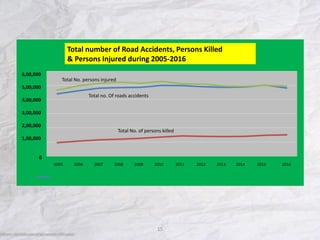
 Road accidents in the country have decreased by around 4.1% during
2016, with the year seeing 4,80,652 road accidents as against 5,01,423 in
2015. However fatalities resulting from these accidents have risen by
about 3.2% during the same period. Nearly 1,50,785 persons were killed in
2016 as against 1,46,133 in 2015.
 One serious roads accidents in the country occurs every minutes and 16
dies on Indian roads every hour.
 About 1214 road crashes occurs every day on India.
 Tamil Nadu is the state which involves the maximum number roads
accidents in India.
14
15
Total number of Road Accidents, Persons Killed
& Persons Injured during 2005-2016
6,00,000
5,00,000
4,00,000
3,00,000
2,00,000
1,00,000
0
2005 2006 2007 2008 2009 2010 2011 2012 2013 2014 2015 2016
Total No. persons injured
Total no. Of roads accidents
Total No. of persons killed
• Remedies
 Spikes On Roads
 Blind Turn Safety
 Pedestrian Crossing
 Stop Crash Alert
 Approaching Emergency Vehicles
16
SPIKES ON ROADS
• In India, traffic rules are hardly followed by peoples especially on
traffic signals and to make them follow rules on traffic signals. We
need to fit spikes over the roads which are used to puncture tires
and make electronic system which trigger spikes at upward
direction when the stop signal (RED LIGHT), is displayed on traffic
light.
• As the traffic light turns green, the system will again trigger those
spikes in downwards direction. Therefore, peoples can cross the
roads without breaking traffic rules.
17
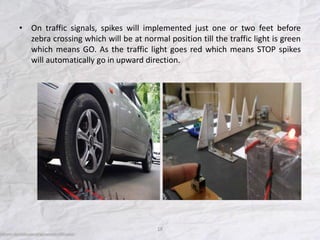
• On traffic signals, spikes will implemented just one or two feet before
zebra crossing which will be at normal position till the traffic light is green
which means GO. As the traffic light goes red which means STOP spikes
will automatically go in upward direction.
18
BLIND TURN SAFETY
• The accidents majorly happens on the blind turns of the roads so
the safety level should be increased on that blind turns. In order to
lower down the accident rates at the Blind turns by using the
certain Technologies.
• The Technology can be use in such a way that we can provide a
pressure switch (Pressure sensors) about one to two kilometers on
the either side of the blind turns. So, that the vehicle can get the
Information of the another vehicle coming from the opposite
direction through the signals.
19
20
PEDESTRIAN CROSSING
• When it comes to the pedestrian crossing, the Handicapped pedestrian
can cross the road easily by simply delivering a message through a device
to the intelligent transportation system and this system will quickly
transfer the signal to the upcoming vehicles, and this signal strictly orders
the coming vehicles to slow down its speed or stop. So, the pedestrian can
cross the roads without any harm.
21
STOP CRASH ALERT
• Connected Vehicles can improve roads safety by providing the
drivers 360 degree awareness of similarly equipped vehicle within a
range of 300 meters. Drivers will receive warning that inform
potential hazards through a visual display or seat vibration. These
are only warning that drivers remains in control of vehicle at all
times. These warning helps drivers to avoid potential crashes for
e.g., Intersection Movement Assist application, Do Not Pass
application in order to maintain the safety.
22
EMERGENCY VEHICLES APPROACHING
• Emergency Vehicle could use specific signals to pre-empty the traffic
signals. They can also use certain software to broadcast their presence to
the drivers with the obstructive view or difficulty in hearing the siren. With
the help of this software Emergency Vehicle (i.e., Fire Brigade, Ambulance,
etc.) can travel with faster speed and can reach their destination within
short period of time.
23
CONCLUSION
• India’s ITS cannot be entirely model led on the existing successful
ITS of other nations due to basic cultural, geographic and practical
differences amongst the countries. The existing concept shave to be
thoroughly understood in order to modify them to fit the Indian
traffic scenario.
• The rapidly increasing vehicle population in India, spurred by the
population boom and economic up turn lay sacrificial burden on
traffic management in the metropolitan cities and towns of the
country. While India has already made a for intelligent transport
systems in organizing traffic, more extensive and urgent integration
of advanced technology and concepts into main stream traffic
management is imperative.
24
RECOMMENDATIONS
• The accidents rates in India is at the alarming rate due to the
increment of vehicle population that is why role of intelligent
transportation system should be increased.
• So, The automation in India should be increased in order to
maintain the accident handling and it also helps in smooth flow of
transportation.
• Intelligent Transportation System helps in maintaining the bond
between traveler and the traffic rules and regulations (such as
traffic signs, traffic signals)
• In order to increase the accident handling the implementation of
concept of Emerging Technologies (i.e., Spikes, Blind turn alert)
25
REFERENCES
• https://www.google.com/intelligent_transportation_system
• https://en.wikipedia.org/wiki/Intelligent_transportation_system
• https://www.itsa.org
• https://timesofindia.indiatimes.com/danger-ahead-steep-road-amp-blind-
curve-sends-drivers-into-death-spin/articleshow
• https://www.marksandharrison.com/accident-attorney/car-
accidents/causes-of-car-accidents/disobeying-traffic-signals/
• https://storiesofworld.com/road-accidents-due-to-traffic-rules-we-
knowingly-avoid/
• https://www.morth.nic.in/roadaccidentsinindia/
• https://www.sites.ndtv.com/roadsafety/importantfeatures/
26

INTELLIGENT TRANSPORTATION SYSTEM(ITS) PRESENTATION

  • 1.
    INTELLIGENT TRANSPORTATION SYSTEM GUIDED BY:- -Mr. Vikrant Singh (Faculty, Civil Dept., UIT) GROUP MEMBERS: - Shashi Kumar Yadav (1428400075) - Abhishek Pandey (1528400901) - Vigyan Nidhi (1428400093) - Swapnil Shrivastava (1428400089) - Vishwas Mishra (1428400098) - Shubham Shukla (1428400081) UNITEDINSTITUTEOFTECHNOLOGY,NAINI,ALLAHABAD.
  • 2.
    CONTENTS • Project Team •Introduction • Literature Review • Objective • Stages Of Work • Conclusion • Recommendations • References
  • 3.
    PROJECT TEAM • Abhishek(CONCEPT OF SPIKES) • Shubham & Vishwas (SPIKES MODEL) • Shashi (CONCEPT OF BLIND TURN SAFETY) • Vigyan & Swapnil ( BLIND TURN MODEL) 3
  • 4.
    INTRODUCTION • An IntelligentTransportation System (ITS) is an advanced application which aims to provide innovative services relating to different modes of transport and traffic management and enable various users to be better informed and make safer, more coordinated, and 'smarter' use of transport networks. • ITS is a comprehensive system which can prepare safe, smooth and pleasant environment for road traffic. 1 To Be Continued…
  • 5.
    • Basic Ideaof ITS:  Intelligent Transport Systems (ITS) intend to add information and communications technology to transport infrastructure and vehicles in an effort to improve: – Safety – Reliability – Efficiency – Quality of means of transport. 2
  • 6.
    LITERATURE REVIEW • History: The origin of the formal ITS program dates back to the nineteen sixties with the development of the Electronic Route Guidance System, or ERGS in the United States, to provide drivers with route guidance information based on real-time traffic analysis. The system used special hardware located at various intersections across the road network, on-board way devices in vehicles that would form the hub of communication between the driver and the ERGS system, and a central computer system that processed the information received from the remote systems. During the early seventies, the ERGS program led to a more sophisticated, automated system comprising interactive visual digital maps called the Automatic Route Control System or ARCS. The Urban Traffic Control System was developed concomitantly, connecting various traffic signals and computer generated predetermined signal timings for better traffic organization. 3
  • 7.
    • Paper Review: International Journal of Civil Engineering Research, Sumit Mallik, Lecturer, Civil Engineering. Dept., R. C. Technical Institute, Ahmedabad, Gujarat, Research India Publications (2014).  Synthesis Report On ITS, Including Issues and Challenges In India, Lelitha Vanajakshi, Gitakrishnan Ramadurai and Asha Anand (IIT Madras), December 2010. 4
  • 8.
    • Benefits OfITS:  Reduced rush hour congestion and delay.  Increased safety and personal security.  Time saving and Operation efficiencies.  Reduced fuel consumption and emissions.  Improved customer services and reduce frustration.  Reduced road accidents and enhance economic productivity. 5
  • 9.
    • Components OfITS:  Advanced Public Transportation System (APTS)  Advanced Traffic Management System (ATMS)  Incident Management System  Electronic Toll Collection System (ETC)  Vehicle Information and Collection System (VICS) 6
  • 10.
    ADVANCED PUBLIC TRANSPORTATION SYSTEM Advanced Public Transport System are those systems and technologies that help to improve transport services, using satellite navigation systems, wireless communication systems , and other devices so that passengers are able to get more information on timing for example, buses and carpooling services.  The goal of APTS is to provide more information to public to make effective decisions and to increase traveler convenience. 7
  • 11.
    ADVANCED TRAFFIC MANAGEMENT SYSTEM Monitors the flow of traffic appropriate decisions In timely manner.  Employs in expensive detectors, cameras and communications system to control the flow of traffic.  Optimize signals timing on major arterials. 8
  • 12.
    INCIDENT MANAGEMENT SYSTEM They offer real time information about traffic conditions through variable message sign to warn accidents or other delays.  Variable message sign is a board which provide information to a motorist of a upcoming hazard.  Enable authorities to identify and respond to vehicle crashes or breakdown with the most appropriate and timely emergency services, thereby minimizing recovery time. 9
  • 13.
    ELECTRONIC TOLL COLLECTION SYSTEM ETC is a system by which drivers can pay tolls without having to stop at a toll booth.  The collection of the fees is performed electronically by way of equipment installed in the vehicles and sensors at the toll location.  ETC is based on vehicle road side communication system. 10
  • 14.
    VEHICLE INFORMATION AND COLLECTIONSYSTEM  This system includes updation of all road user about the traffic conditions and other information congestion, jams, roads blocks, pollution level, etc.  The information via FM Band or through roads maps quickly showing traffic conditions in surrounding areas, the drivers can use this information to select the best routes by using in vehicle monitor. 11
  • 15.
    OBJECTIVE • ITS aimsto facilitate a national multi-modal surface transportation system that features a connected transportation environment around vehicles of all types, the infrastructure, and carry-in passenger devices to serve the public good by leveraging technology to maximize safety, mobility, and environmental performance. • An intelligent transportation system (ITS) is an advanced application which, without embodying intelligence as such, aims to provide innovative services relating to different modes of transport and traffic management and enable users to be better informed and make safer, more coordinated, and 'smarter' use of transport 12
  • 16.
    STAGES OF WORK •Data Collection  There were on average 1,578 fatalities each year resulting from two vehicles traffic crashes at intersections controlled by traffic signals.  Approximately 51% of those fatal crashes were caused by drivers who ran red lights.  Potholes accounted for 6,424 Roads Accidents & 2,324 fatalities. 9,583 accidents & 3,396 accident deaths were attributed to speed breakers.  The State Highway Traffic police have identified more than 45 spots on National Highway which are major accidental prone zones. Statistics have revealed that a total number of 1,169 accidents were reported on Mumbai-Ahmedabad highway which ended up killing 307 people in 2016.  According to data, total number of accidents occurred due to traffic signals involves 15,125 accidents, 4,322 killed and 12,995 injured. 13
  • 17.
    • Analysis OfCollected Data  Most of the accidents occurs due to Disobeying of Traffic Signals, Over speeding, Blind turns and Potholes.  Road accidents in the country have decreased by around 4.1% during 2016, with the year seeing 4,80,652 road accidents as against 5,01,423 in 2015. However fatalities resulting from these accidents have risen by about 3.2% during the same period. Nearly 1,50,785 persons were killed in 2016 as against 1,46,133 in 2015.  One serious roads accidents in the country occurs every minutes and 16 dies on Indian roads every hour.  About 1214 road crashes occurs every day on India.  Tamil Nadu is the state which involves the maximum number roads accidents in India. 14
  • 18.
    15 Total number ofRoad Accidents, Persons Killed & Persons Injured during 2005-2016 6,00,000 5,00,000 4,00,000 3,00,000 2,00,000 1,00,000 0 2005 2006 2007 2008 2009 2010 2011 2012 2013 2014 2015 2016 Total No. persons injured Total no. Of roads accidents Total No. of persons killed
  • 19.
    • Remedies  SpikesOn Roads  Blind Turn Safety  Pedestrian Crossing  Stop Crash Alert  Approaching Emergency Vehicles 16
  • 20.
    SPIKES ON ROADS •In India, traffic rules are hardly followed by peoples especially on traffic signals and to make them follow rules on traffic signals. We need to fit spikes over the roads which are used to puncture tires and make electronic system which trigger spikes at upward direction when the stop signal (RED LIGHT), is displayed on traffic light. • As the traffic light turns green, the system will again trigger those spikes in downwards direction. Therefore, peoples can cross the roads without breaking traffic rules. 17
  • 21.
    • On trafficsignals, spikes will implemented just one or two feet before zebra crossing which will be at normal position till the traffic light is green which means GO. As the traffic light goes red which means STOP spikes will automatically go in upward direction. 18
  • 22.
    BLIND TURN SAFETY •The accidents majorly happens on the blind turns of the roads so the safety level should be increased on that blind turns. In order to lower down the accident rates at the Blind turns by using the certain Technologies. • The Technology can be use in such a way that we can provide a pressure switch (Pressure sensors) about one to two kilometers on the either side of the blind turns. So, that the vehicle can get the Information of the another vehicle coming from the opposite direction through the signals. 19
  • 23.
  • 24.
    PEDESTRIAN CROSSING • Whenit comes to the pedestrian crossing, the Handicapped pedestrian can cross the road easily by simply delivering a message through a device to the intelligent transportation system and this system will quickly transfer the signal to the upcoming vehicles, and this signal strictly orders the coming vehicles to slow down its speed or stop. So, the pedestrian can cross the roads without any harm. 21
  • 25.
    STOP CRASH ALERT •Connected Vehicles can improve roads safety by providing the drivers 360 degree awareness of similarly equipped vehicle within a range of 300 meters. Drivers will receive warning that inform potential hazards through a visual display or seat vibration. These are only warning that drivers remains in control of vehicle at all times. These warning helps drivers to avoid potential crashes for e.g., Intersection Movement Assist application, Do Not Pass application in order to maintain the safety. 22
  • 26.
    EMERGENCY VEHICLES APPROACHING •Emergency Vehicle could use specific signals to pre-empty the traffic signals. They can also use certain software to broadcast their presence to the drivers with the obstructive view or difficulty in hearing the siren. With the help of this software Emergency Vehicle (i.e., Fire Brigade, Ambulance, etc.) can travel with faster speed and can reach their destination within short period of time. 23
  • 27.
    CONCLUSION • India’s ITScannot be entirely model led on the existing successful ITS of other nations due to basic cultural, geographic and practical differences amongst the countries. The existing concept shave to be thoroughly understood in order to modify them to fit the Indian traffic scenario. • The rapidly increasing vehicle population in India, spurred by the population boom and economic up turn lay sacrificial burden on traffic management in the metropolitan cities and towns of the country. While India has already made a for intelligent transport systems in organizing traffic, more extensive and urgent integration of advanced technology and concepts into main stream traffic management is imperative. 24
  • 28.
    RECOMMENDATIONS • The accidentsrates in India is at the alarming rate due to the increment of vehicle population that is why role of intelligent transportation system should be increased. • So, The automation in India should be increased in order to maintain the accident handling and it also helps in smooth flow of transportation. • Intelligent Transportation System helps in maintaining the bond between traveler and the traffic rules and regulations (such as traffic signs, traffic signals) • In order to increase the accident handling the implementation of concept of Emerging Technologies (i.e., Spikes, Blind turn alert) 25
  • 29.
    REFERENCES • https://www.google.com/intelligent_transportation_system • https://en.wikipedia.org/wiki/Intelligent_transportation_system •https://www.itsa.org • https://timesofindia.indiatimes.com/danger-ahead-steep-road-amp-blind- curve-sends-drivers-into-death-spin/articleshow • https://www.marksandharrison.com/accident-attorney/car- accidents/causes-of-car-accidents/disobeying-traffic-signals/ • https://storiesofworld.com/road-accidents-due-to-traffic-rules-we- knowingly-avoid/ • https://www.morth.nic.in/roadaccidentsinindia/ • https://www.sites.ndtv.com/roadsafety/importantfeatures/ 26