MOHAMMED AQEEB
Introduction
Why ITS?
Intelligent Transport Technologies
Intelligent Transport Applications
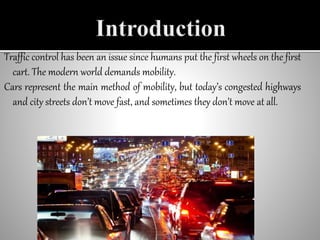
Traffic control has been an issue since humans put the first wheels on the first
cart. The modern world demands mobility.
Cars represent the main method of mobility, but today’s congested highways
and city streets don’t move fast, and sometimes they don’t move at all.
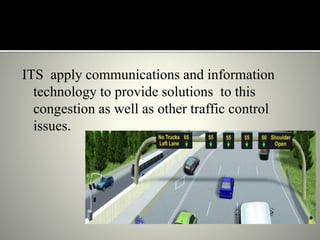
ITS apply communications and information
technology to provide solutions to this
congestion as well as other traffic control
issues.
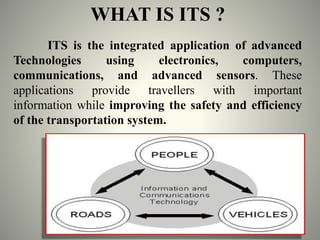
WHAT IS ITS ?
ITS is the integrated application of advanced
Technologies using electronics, computers,
communications, and advanced sensors. These
applications provide travellers with important
information while improving the safety and efficiency
of the transportation system.
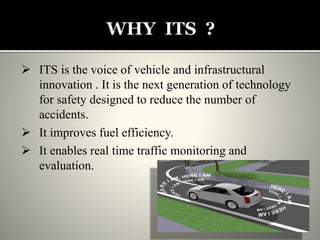
 ITS is the voice of vehicle and infrastructural
innovation . It is the next generation of technology
for safety designed to reduce the number of
accidents.
 It improves fuel efficiency.
 It enables real time traffic monitoring and
evaluation.
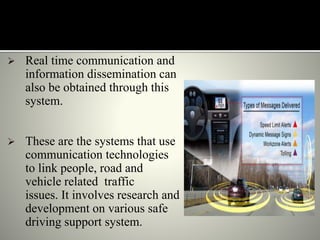
 Real time communication and
information dissemination can
also be obtained through this
system.
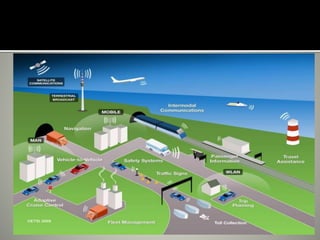
 These are the systems that use
communication technologies
to link people, road and
vehicle related traffic
issues. It involves research and
development on various safe
driving support system.
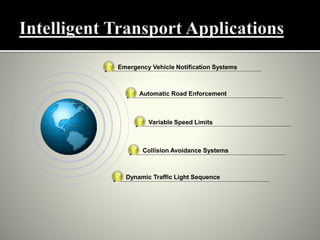
Emergency Vehicle Notification Systems
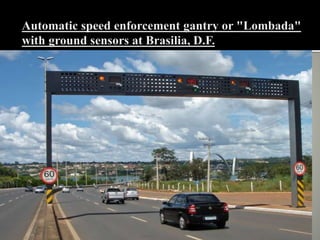
Automatic Road Enforcement
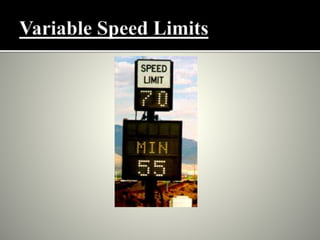
Variable Speed Limits
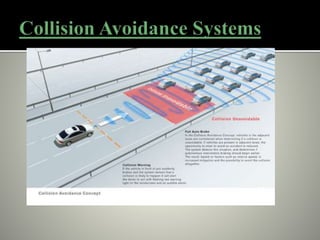
Collision Avoidance Systems
Dynamic Traffic Light Sequence
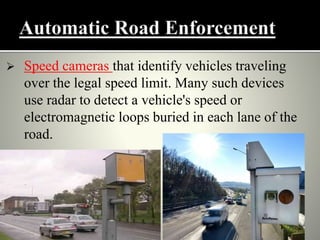
 Speed cameras that identify vehicles traveling
over the legal speed limit. Many such devices
use radar to detect a vehicle's speed or
electromagnetic loops buried in each lane of the
road.
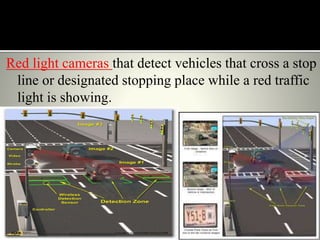
Red light cameras that detect vehicles that cross a stop
line or designated stopping place while a red traffic
light is showing.
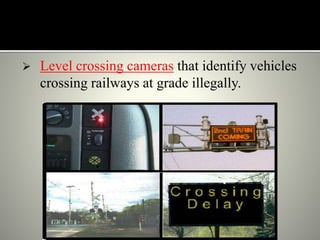
 Level crossing cameras that identify vehicles
crossing railways at grade illegally.
 Double white line cameras that identify
vehicles crossing these lines.
 Bus lane cameras that identify vehicles
traveling in lanes reserved for buses. In some
jurisdictions, bus lanes can also be used by
taxis or vehicles engaged in car pooling.
 The use of ITS in some developed countries like
America, Japan and England has given them
high progress in the field of transportation.This
helped them in their economic progress.Also
the traffic congestions, rate of road accidents,
wastage of fuels are decreased to a large extend.
 This gives the people of this country a more
economic mean of transportation with advance
information of transits. Now transportation has
become a safer and efficient mode for these
countries.
Hence with much more interest and
advanced research in the field of
ITS, it can be implemented in our
country and can prove to be the
solution of the traffic problems
including traffic congestion, air
pollution and traffic accident.
www.wikipedia.com
www.answers.com
www.howstuffworks.com
www.tech-faq.com
www.thetravelinsider.info
http://www.itsoverview.its.dot
http://www.transportsystems.com
http://www.mountain-plains.org
Aqeeb its ppt 1

Aqeeb its ppt 1

  • 1.
  • 2.
    Introduction Why ITS? Intelligent TransportTechnologies Intelligent Transport Applications
  • 3.
    Traffic control hasbeen an issue since humans put the first wheels on the first cart. The modern world demands mobility. Cars represent the main method of mobility, but today’s congested highways and city streets don’t move fast, and sometimes they don’t move at all.
  • 4.
    ITS apply communicationsand information technology to provide solutions to this congestion as well as other traffic control issues.
  • 5.
    WHAT IS ITS? ITS is the integrated application of advanced Technologies using electronics, computers, communications, and advanced sensors. These applications provide travellers with important information while improving the safety and efficiency of the transportation system.
  • 7.
     ITS isthe voice of vehicle and infrastructural innovation . It is the next generation of technology for safety designed to reduce the number of accidents.  It improves fuel efficiency.  It enables real time traffic monitoring and evaluation.
  • 8.
     Real timecommunication and information dissemination can also be obtained through this system.  These are the systems that use communication technologies to link people, road and vehicle related traffic issues. It involves research and development on various safe driving support system.
  • 9.
    Emergency Vehicle NotificationSystems Automatic Road Enforcement Variable Speed Limits Collision Avoidance Systems Dynamic Traffic Light Sequence
  • 11.
     Speed camerasthat identify vehicles traveling over the legal speed limit. Many such devices use radar to detect a vehicle's speed or electromagnetic loops buried in each lane of the road.
  • 12.
    Red light camerasthat detect vehicles that cross a stop line or designated stopping place while a red traffic light is showing.
  • 13.
     Level crossingcameras that identify vehicles crossing railways at grade illegally.
  • 14.
     Double whiteline cameras that identify vehicles crossing these lines.  Bus lane cameras that identify vehicles traveling in lanes reserved for buses. In some jurisdictions, bus lanes can also be used by taxis or vehicles engaged in car pooling.
  • 18.
     The useof ITS in some developed countries like America, Japan and England has given them high progress in the field of transportation.This helped them in their economic progress.Also the traffic congestions, rate of road accidents, wastage of fuels are decreased to a large extend.  This gives the people of this country a more economic mean of transportation with advance information of transits. Now transportation has become a safer and efficient mode for these countries.
  • 19.
    Hence with muchmore interest and advanced research in the field of ITS, it can be implemented in our country and can prove to be the solution of the traffic problems including traffic congestion, air pollution and traffic accident.
  • 20.

Editor's Notes