DR. PARUL AZAD
Intelligence Quotient
WHAT IS IQ?
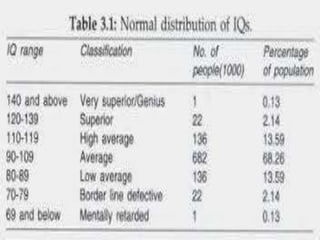
 IQ is an acronym for Intelligence Quotient.
So what is IQ? The IQ is a measurement of
your intelligence and is expressed in a
number.
 A person's IQ can be calculated by having
the person take an intelligence test. The
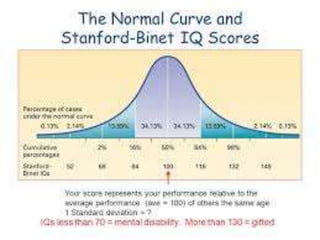
average IQ is 100. If you achieve a score
higher than 100, you are smarter than the
average person, and a lower score means
you are (somewhat) less smart.
DEFINITION OF IQ :
 Measure of a person’s cognitive capacity
relative to his or her peers. It is computed by
dividing the person’s mental age(as
measured on a scale such as Stanford Binet
scale) by his or her chorological age, and
multiplying with 100.
HOW TO CALCULATE IQ…?
 The development of NORMS allow us to
compare one person’s test results to
another's.
 Binet’s concept of MENTAL AGE led to the
development of the INTELLIGENCE
QUOTIENT.(IQ)
 MENTAL AGE/CHRONOGICAL AGE*100
TYPES OF VERBAL TEST IN INDIA
 1. Manry’s group test(Hindi, English, Urdu).
 2.Jha’s group test by Pandit lajja Shankar Jha
 3.Jalota & Tandan’s group test by SS Jalota &
R.K.Tandan
 4Group teat of Intelligence by Jalota
 5.Joshi’s group intelligence test
 6.Hundal’s intelligence test by Dr. Ps Hundal
 7.Udai Shankar intelligence test
 8.Pillai’s intelligence test
NON VERBAL TEST IN INDIA
 1.A.S.Nair’s non verbal intelligence test
 2. M.G. Premlata
 3.T.R.Sharma test
 4. N. Trivedi test
USE OF INTELLIGENCE TEST
 FOR THE PURPOSE OF SELECTION
 FOR CLASSIFICATION
 TO KNOW THE VARIOUS TYPE OF
PEOPLE
 PROMOTION OF PUPIL
 PREDICATION OF TEACHER
 HELPFUL IN LEARNING PROCESS
 USE OF VOCATIONAL GUIDANCE’
 USE IN ARMY & CIVIL SERVICES
CHARACTERISTICS OF GOOD TEST
 1. RELIABILITY
 2.VALIDITY
 3.OBJECTIVITY
 4.SCORABILITY
 5.COMPREHENSIVE
 6.INTERESTING
 7.ECONMICAL
STANFORD BINET TEST-1
 HISTORY:-
 STANFORD BINET TEST(1965) Intelligence
this is a new version of Binet Simen test. In
1905 two French Psychologist Binet and
Simen discover this intelligence test. After
that it was modified American Psychologist
Termon and Binet at Stanford University for
current use of intelligence assessment. In
1986 it is known as Stanford Binet
intelligence test form.
CONTINUES…
 This test can useful for measurement of
general intelligence test.
 It can useful for 2 year to superior adults up
to 45 years. It is very effective only to 16
years. For adults this test result is not
accurate or satisfactory.
TEST-2 FOR STANFORD BINET 5TH (2003)
 General mental ability
 45-60 Minutes of time
 Comprehensive measurement
 Helps identity :- learning disabilities, gifted,
MR,ADHD, speech and language and
Alzheimer, dementia. Traumatic brain injury,
autistic.
DIFFERENT TYPES OF INTELLIGENCE TESTS:-
 IQ tests that measure intelligence also
include:
 Stanford–Binet Intelligence Scales.
 Woodcock–Johnson Tests of Cognitive
Abilities.
 Raven's Progressive Matrices.
 Wechsler Adult Intelligence Scale.
 Cattell Culture Fair III.
 Reynolds Intellectual Assessment Scales.
WHAT ARE THE USES AND LIMITATIONS OF
INTELLIGENCE TESTS?
 1. For Vocational and Educational
Guidance: For certain vocations, we need a
certain level of intelligence. That is known by
tests of intelligence. Intelligence tests are
very useful in educational guidance, i.e., the
child can select the subject in the light of his
I.Q. other than his aptitude.
CONTINUES…..
 2. Useful in Class-room Teaching :
Intelligence tests are useful in class-room
teaching. The results of intelligence tests are
of great help to a teacher in assigning work
to individual students.
 They are especially useful in the early part of
a teacher’s contact with a particular class as
an aid in making teaching effective by
knowing the students’ mental level and in
conducting discussion.
CONTINUES…
 3. Used in Clinics:
Intelligence tests are used in clinics and in
mental hospitals in order to know as to how far
the disease has impaired the intellect.
 4. Grouping:
Grouping in the class-room is done on the basis
of intelligence test results so that special
classes are run for the weak and the brilliant.
CONTINUES….
 5. For Knowing Individual Differences:
Through intelligence tests, we can know
about individuals in a class.
 6. Scholarship:
They are used for giving scholarships to the
students.
 7. Useful for Employers:
Intelligence tests results are useful for
employers and for Parent-Teacher
Conference.
CONTINUES….
 8. Useful to Individuals :
Results of intelligence test are useful for the
individual also. He can know about his
performance in a particular field.
 9. Research :
Intelligence tests are useful for research.
 10. Promotion:
Also used for promotion of students to the
next class
 11. For Knowledge about Self :
Intelligence tests can tell you about your own
intelligence and you can improve upon it
CAUTIONS WHILE USING AN INTELLIGENCE TEST
 1. The teacher must recognize that I.Q. (especially from
verbal tests) is not a complete measure of a person’s worth.
It is an indication of only one limited type of ability.
 A person may have a good level of ability in many other non-
verbal aspects of living, i.e., mechanical, social, artistic and
musical. A child whose score on scholastic aptitude test is
low should in no way be rejected.
 2. Verbal group tests of intelligence must be supplemented
by other types of intelligence tests.
 3. Results of intelligence tests should not be declared to the
students in a way so as to label a particular student once for
all with a particular I.Q.
 4. In case it is suspected that the child was emotionally
disturbed at the time of testing, results should be considered
quite tentative.
 5. An I.Q. of 70 should be interpreted as an I.Q. somewhere
between 60 and 80.
Intelligence Quotient

Intelligence Quotient

  • 1.
  • 2.
    WHAT IS IQ? IQ is an acronym for Intelligence Quotient. So what is IQ? The IQ is a measurement of your intelligence and is expressed in a number.  A person's IQ can be calculated by having the person take an intelligence test. The average IQ is 100. If you achieve a score higher than 100, you are smarter than the average person, and a lower score means you are (somewhat) less smart.
  • 3.
    DEFINITION OF IQ:  Measure of a person’s cognitive capacity relative to his or her peers. It is computed by dividing the person’s mental age(as measured on a scale such as Stanford Binet scale) by his or her chorological age, and multiplying with 100.
  • 4.
    HOW TO CALCULATEIQ…?  The development of NORMS allow us to compare one person’s test results to another's.  Binet’s concept of MENTAL AGE led to the development of the INTELLIGENCE QUOTIENT.(IQ)  MENTAL AGE/CHRONOGICAL AGE*100
  • 8.
    TYPES OF VERBALTEST IN INDIA  1. Manry’s group test(Hindi, English, Urdu).  2.Jha’s group test by Pandit lajja Shankar Jha  3.Jalota & Tandan’s group test by SS Jalota & R.K.Tandan  4Group teat of Intelligence by Jalota  5.Joshi’s group intelligence test  6.Hundal’s intelligence test by Dr. Ps Hundal  7.Udai Shankar intelligence test  8.Pillai’s intelligence test
  • 9.
    NON VERBAL TESTIN INDIA  1.A.S.Nair’s non verbal intelligence test  2. M.G. Premlata  3.T.R.Sharma test  4. N. Trivedi test
  • 10.
    USE OF INTELLIGENCETEST  FOR THE PURPOSE OF SELECTION  FOR CLASSIFICATION  TO KNOW THE VARIOUS TYPE OF PEOPLE  PROMOTION OF PUPIL  PREDICATION OF TEACHER  HELPFUL IN LEARNING PROCESS  USE OF VOCATIONAL GUIDANCE’  USE IN ARMY & CIVIL SERVICES
  • 11.
    CHARACTERISTICS OF GOODTEST  1. RELIABILITY  2.VALIDITY  3.OBJECTIVITY  4.SCORABILITY  5.COMPREHENSIVE  6.INTERESTING  7.ECONMICAL
  • 12.
    STANFORD BINET TEST-1 HISTORY:-  STANFORD BINET TEST(1965) Intelligence this is a new version of Binet Simen test. In 1905 two French Psychologist Binet and Simen discover this intelligence test. After that it was modified American Psychologist Termon and Binet at Stanford University for current use of intelligence assessment. In 1986 it is known as Stanford Binet intelligence test form.
  • 13.
    CONTINUES…  This testcan useful for measurement of general intelligence test.  It can useful for 2 year to superior adults up to 45 years. It is very effective only to 16 years. For adults this test result is not accurate or satisfactory.
  • 14.
    TEST-2 FOR STANFORDBINET 5TH (2003)  General mental ability  45-60 Minutes of time  Comprehensive measurement  Helps identity :- learning disabilities, gifted, MR,ADHD, speech and language and Alzheimer, dementia. Traumatic brain injury, autistic.
  • 15.
    DIFFERENT TYPES OFINTELLIGENCE TESTS:-  IQ tests that measure intelligence also include:  Stanford–Binet Intelligence Scales.  Woodcock–Johnson Tests of Cognitive Abilities.  Raven's Progressive Matrices.  Wechsler Adult Intelligence Scale.  Cattell Culture Fair III.  Reynolds Intellectual Assessment Scales.
  • 16.
    WHAT ARE THEUSES AND LIMITATIONS OF INTELLIGENCE TESTS?  1. For Vocational and Educational Guidance: For certain vocations, we need a certain level of intelligence. That is known by tests of intelligence. Intelligence tests are very useful in educational guidance, i.e., the child can select the subject in the light of his I.Q. other than his aptitude.
  • 17.
    CONTINUES…..  2. Usefulin Class-room Teaching : Intelligence tests are useful in class-room teaching. The results of intelligence tests are of great help to a teacher in assigning work to individual students.  They are especially useful in the early part of a teacher’s contact with a particular class as an aid in making teaching effective by knowing the students’ mental level and in conducting discussion.
  • 18.
    CONTINUES…  3. Usedin Clinics: Intelligence tests are used in clinics and in mental hospitals in order to know as to how far the disease has impaired the intellect.  4. Grouping: Grouping in the class-room is done on the basis of intelligence test results so that special classes are run for the weak and the brilliant.
  • 19.
    CONTINUES….  5. ForKnowing Individual Differences: Through intelligence tests, we can know about individuals in a class.  6. Scholarship: They are used for giving scholarships to the students.  7. Useful for Employers: Intelligence tests results are useful for employers and for Parent-Teacher Conference.
  • 20.
    CONTINUES….  8. Usefulto Individuals : Results of intelligence test are useful for the individual also. He can know about his performance in a particular field.  9. Research : Intelligence tests are useful for research.  10. Promotion: Also used for promotion of students to the next class  11. For Knowledge about Self : Intelligence tests can tell you about your own intelligence and you can improve upon it
  • 21.
    CAUTIONS WHILE USINGAN INTELLIGENCE TEST  1. The teacher must recognize that I.Q. (especially from verbal tests) is not a complete measure of a person’s worth. It is an indication of only one limited type of ability.  A person may have a good level of ability in many other non- verbal aspects of living, i.e., mechanical, social, artistic and musical. A child whose score on scholastic aptitude test is low should in no way be rejected.  2. Verbal group tests of intelligence must be supplemented by other types of intelligence tests.  3. Results of intelligence tests should not be declared to the students in a way so as to label a particular student once for all with a particular I.Q.  4. In case it is suspected that the child was emotionally disturbed at the time of testing, results should be considered quite tentative.  5. An I.Q. of 70 should be interpreted as an I.Q. somewhere between 60 and 80.