Aptitude Test Group No - 7 Manjula Naicker (13) Priyanka Kamble (14)
Meaning Aptitude test,  examination that attempts to determine and measure a person’s ability to acquire, through future training, some specific set of skills (intellectual, motor, and so on).  The tests assume that people differ in their special abilities and that these differences can be useful in predicting future achievements.
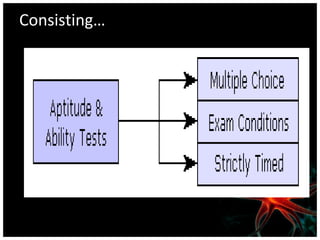
Consisting…
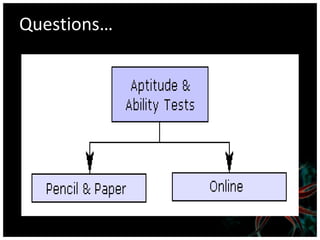
Questions…
History & Origin Developed during World War Carl Brigham a psychologist developed this test First used in the recruitment of Army called Army Alpha Use as a college admissions test in 1926. In 1933 James Bryant Conant decided to start a new scholarship program  In 1938 all the member schools of the College Board started using the SAT as a uniform exam, but only for scholarship applicants.  In 1942, because of the war, all the pre-existing College Board admissions tests were abolished, so the SAT became te test for all applicants.
. In 1944, under contract to the Army and the Navy, administered the SAT to more than 300,000 people all over the country on a single day.  In 1948 the Educational Testing Service was chartered and the SAT was on its way to becoming the basic college admissions device for millions
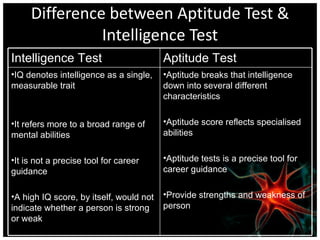
Difference between Aptitude Test & Intelligence Test Intelligence Test Aptitude Test IQ denotes intelligence as a single, measurable trait  It refers more to a broad range of mental abilities  It is not a precise tool for career guidance  A high IQ score, by itself, would not indicate whether a person is strong or weak  Aptitude breaks that intelligence down into several different characteristics  Aptitude score reflects specialised abilities  Aptitude tests is a precise tool for career guidance Provide strengths and weakness of person
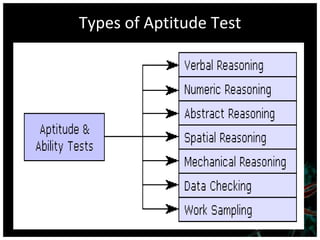
Types of Aptitude Test
Importance WHAT IS THE VALUE OF APTITUDE TESTING?   They are excellent predictors of future scholastic achievement.  They provide ways of comparing a child's performance with that of other children in the same situation.  They provide a profile of strengths and weaknesses.  They assess differences among individuals .
Contd.. They have uncovered hidden talents in some children, thus improving their educational opportunities.  They are valuable tools for working with handicapped children. Group aptitude tests---quick and inexpensive  Aptitude tests are valuable in making program and curricula decisions.
Usage in  Personnel Selection Instructional  Guidance  Occupational Purpose
Future Scope Employers can assess the cognitive capabilities of potential employees. Students can understand themselves and their own cognitive abilities. Changing as per he situation
Test Blue Print  Test Title – Aptitude Test  Purpose – Intelligent level, Thinking as per the situation, Simulation. Aspect of the Curriculum. Conditions of the test
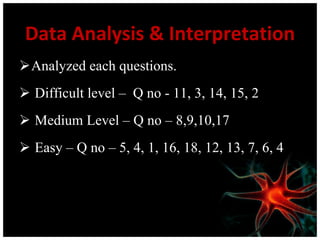
Data Analysis & Interpretation Analyzed each questions. Difficult level –  Q no - 11, 3, 14, 15, 2 Medium Level – Q no – 8,9,10,17 Easy – Q no – 5, 4, 1, 16, 18, 12, 13, 7, 6, 4
 
Item Analysis  Examines student responses Valuable in improving items Completely futile process
Item Analysis Report
Conclusion
 

Aptitude test

  • 1.
    Aptitude Test GroupNo - 7 Manjula Naicker (13) Priyanka Kamble (14)
  • 2.
    Meaning Aptitude test, examination that attempts to determine and measure a person’s ability to acquire, through future training, some specific set of skills (intellectual, motor, and so on). The tests assume that people differ in their special abilities and that these differences can be useful in predicting future achievements.
  • 3.
  • 4.
  • 5.
    History & OriginDeveloped during World War Carl Brigham a psychologist developed this test First used in the recruitment of Army called Army Alpha Use as a college admissions test in 1926. In 1933 James Bryant Conant decided to start a new scholarship program In 1938 all the member schools of the College Board started using the SAT as a uniform exam, but only for scholarship applicants. In 1942, because of the war, all the pre-existing College Board admissions tests were abolished, so the SAT became te test for all applicants.
  • 6.
    . In 1944,under contract to the Army and the Navy, administered the SAT to more than 300,000 people all over the country on a single day. In 1948 the Educational Testing Service was chartered and the SAT was on its way to becoming the basic college admissions device for millions
  • 7.
    Difference between AptitudeTest & Intelligence Test Intelligence Test Aptitude Test IQ denotes intelligence as a single, measurable trait It refers more to a broad range of mental abilities It is not a precise tool for career guidance A high IQ score, by itself, would not indicate whether a person is strong or weak Aptitude breaks that intelligence down into several different characteristics Aptitude score reflects specialised abilities Aptitude tests is a precise tool for career guidance Provide strengths and weakness of person
  • 8.
  • 9.
    Importance WHAT ISTHE VALUE OF APTITUDE TESTING? They are excellent predictors of future scholastic achievement. They provide ways of comparing a child's performance with that of other children in the same situation. They provide a profile of strengths and weaknesses. They assess differences among individuals .
  • 10.
    Contd.. They haveuncovered hidden talents in some children, thus improving their educational opportunities. They are valuable tools for working with handicapped children. Group aptitude tests---quick and inexpensive Aptitude tests are valuable in making program and curricula decisions.
  • 11.
    Usage in Personnel Selection Instructional Guidance Occupational Purpose
  • 12.
    Future Scope Employerscan assess the cognitive capabilities of potential employees. Students can understand themselves and their own cognitive abilities. Changing as per he situation
  • 13.
    Test Blue Print Test Title – Aptitude Test Purpose – Intelligent level, Thinking as per the situation, Simulation. Aspect of the Curriculum. Conditions of the test
  • 14.
    Data Analysis &Interpretation Analyzed each questions. Difficult level – Q no - 11, 3, 14, 15, 2 Medium Level – Q no – 8,9,10,17 Easy – Q no – 5, 4, 1, 16, 18, 12, 13, 7, 6, 4
  • 15.
  • 16.
    Item Analysis Examines student responses Valuable in improving items Completely futile process
  • 17.
  • 18.
  • 19.