INTELLIGENT BUILDINGS….
ABHISHEK KUMAR MAURYA
B.ARCH 4TH YEAR 8TH SEM
ROLL NO-131332390002
INTRODUCTION……..
A building incorporating :
information systems that support the flow of
information
Allowing business automation
Monitoring management and maintenance
Ensuring flexibility ,simplicity and economy
……......IS AN INTELLIGENT BUILDING
.
 INTRODUCTION
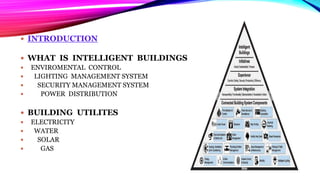
 WHAT IS INTELLIGENT BUILDINGS
 ENVIROMENTAL CONTROL
 LIGHTING MANAGEMENT SYSTEM
 SECURITY MANAGEMENT SYSTEM
 POWER DISTRIBUTION
 BUILDING UTILITES
 ELECTRICITY
 WATER
 SOLAR
 GAS
.
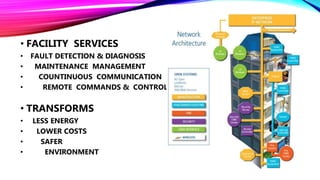
• FACILITY SERVICES
• FAULT DETECTION & DIAGNOSIS
• MAINTENANCE MANAGEMENT
• COUNTINUOUS COMMUNICATION
• REMOTE COMMANDS & CONTROL
• TRANSFORMS
• LESS ENERGY
• LOWER COSTS
• SAFER
• ENVIRONMENT
Components of an
IB
• Integration of various building systems
– Energy management system
– Lighting management system
– Security systems & fire safety
– Telecommunications & office automation
– Local area networks (LANs)
– Cabling management
– Intelligent maintenance mgt. system (IMMS)
– Computer aided facility management (CAFM)
FEATURES OF INTELLIGENT BUILDING……
1. Intelligent Building are flexible and responsive to different usage and environmental
contexts.
2. It is able to change states with respect to functions and user demands over time
and building spaces as its easy to program and re-program during use
3. It supports human communication between individuals and groups
4. It has a distributed long term and short term memory
5. It contains tenant and administration service systems
6. It is equipped with sensors (stationary and mobile) for direct or indirect input and manipulation of
signals from users, systems and the building structure
7.It is equipped with actuators for direct or indirect manipulation installations and the building
structure
8. It is well documented available in Virtual Reality with physical structure overlay
OBJECTIVES OF INTELLIGENT BUILDINGS…
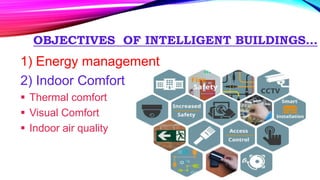
1) Energy management
2) Indoor Comfort
 Thermal comfort
 Visual Comfort
 Indoor air quality
ENERGY MANAGEMENT……
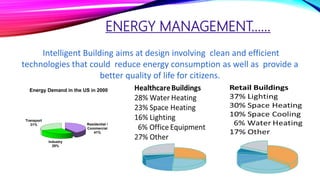
Intelligent Building aims at design involving clean and efficient
technologies that could reduce energy consumption as well as provide a
better quality of life for citizens.
Residential /
Commercial
41%
Industry
28%
Transport
31%
Energy Demand in the US in 2000
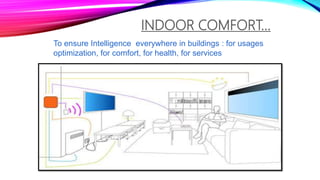
INDOOR COMFORT…
To ensure Intelligence everywhere in buildings : for usages
optimization, for comfort, for health, for services
HISTORY OF INTELLIGENT BUILDINGS
• 1980
• Yoneji Masuda writes the book 'Information Society' about changes in society,
information and knowledge industries, participatory democracy, examples from Japan.
• 1982
• AT&T establish the concept "INTELLIGENT BUILDINGS" due to marketing reasons.
• The INFORMART building is erected in Dallas
• 1984-1985
• The Smart House Development USA
• 'Automated Buildings', 'High Tech. Buildings', 'Smart Houses'. STS, Shared Tenants
Services (using PABX, private automatic branch exchange, is an automatic telephone
switching system within a private enterprise, Communication Service Management.
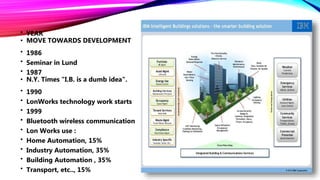
.• YEAR
• MOVE TOWARDS DEVELOPMENT
• 1986
• Seminar in Lund
• 1987
• N.Y. Times "I.B. is a dumb idea".
• 1990
• LonWorks technology work starts
• 1999
• Bluetooth wireless communication
• Lon Works use :
• Home Automation, 15%
• Industry Automation, 35%
• Building Automation , 35%
• Transport, etc.., 15%
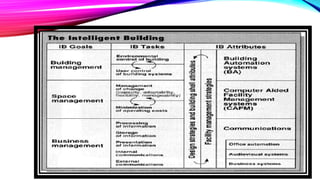
GOALS OF INTELLIGENT BUILDINGS.
Building management
Space management
Business management
.
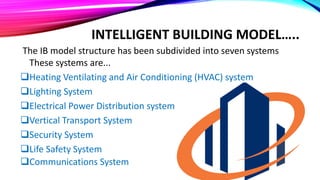
INTELLIGENT BUILDING MODEL…..
The IB model structure has been subdivided into seven systems
These systems are...
Heating Ventilating and Air Conditioning (HVAC) system
Lighting System
Electrical Power Distribution system
Vertical Transport System
Security System
Life Safety System
Communications System
.
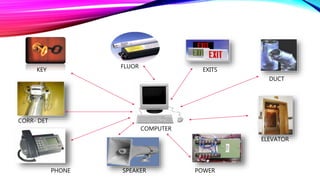
KEY
FLUOR
EXITS
DUCT
COMPUTER
ELEVATOR
PHONE SPEAKER POWER
CORR- DET
PRESENT TECHNOLOGY…
• Phones and intercoms
• Home automation
• Audio distribution (e.g. hi-fi speaker)
• Video distribution (e.g. TV)
• Video surveillance (e.g. security)
• Structured wiring
• Home theater, game station
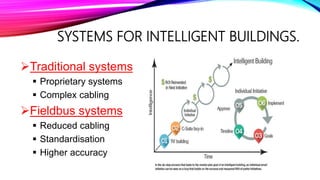
SYSTEMS FOR INTELLIGENT BUILDINGS.
Traditional systems
 Proprietary systems
 Complex cabling
Fieldbus systems
 Reduced cabling
 Standardisation
 Higher accuracy
FUTURE TRENDS….
The former Intelligent Building Institute (IBI) foundation advocated, a
few years ago, a need to recognize, in future building designs, the
transition from national economies to a combination of local and
global economies and therefore the need to facilitate each
employee’s access to global communication networks. They
predicted that information technology access will provide the
biggest single impetus for change in the office environment.
This prediction has now become a reality…..
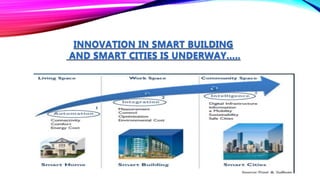
.INNOVATION IN SMART BUILDING
AND SMART CITIES IS UNDERWAY…..
CONCLUSIONS……
“INTELLIGENT BUILDING IS MORE THAN BUILDING , IT IS
LIVING SYSTEM”
Following concept
 provides adaptation to growing market and communication globalization
 improve worker satisfaction and productivity
 enhance flexibility and management capabilities
 reduces energy consumption needs.
 lead to positive Cost to Benefit
 increased user satisfaction
 as potential future savings over the projected life cycle of the building
THANK YOU…
• a

Intelligent buildings

  • 1.
    INTELLIGENT BUILDINGS…. ABHISHEK KUMARMAURYA B.ARCH 4TH YEAR 8TH SEM ROLL NO-131332390002
  • 2.
    INTRODUCTION…….. A building incorporating: information systems that support the flow of information Allowing business automation Monitoring management and maintenance Ensuring flexibility ,simplicity and economy ……......IS AN INTELLIGENT BUILDING
  • 3.
    .  INTRODUCTION  WHATIS INTELLIGENT BUILDINGS  ENVIROMENTAL CONTROL  LIGHTING MANAGEMENT SYSTEM  SECURITY MANAGEMENT SYSTEM  POWER DISTRIBUTION  BUILDING UTILITES  ELECTRICITY  WATER  SOLAR  GAS
  • 4.
    . • FACILITY SERVICES •FAULT DETECTION & DIAGNOSIS • MAINTENANCE MANAGEMENT • COUNTINUOUS COMMUNICATION • REMOTE COMMANDS & CONTROL • TRANSFORMS • LESS ENERGY • LOWER COSTS • SAFER • ENVIRONMENT
  • 5.
    Components of an IB •Integration of various building systems – Energy management system – Lighting management system – Security systems & fire safety – Telecommunications & office automation – Local area networks (LANs) – Cabling management – Intelligent maintenance mgt. system (IMMS) – Computer aided facility management (CAFM)
  • 6.
    FEATURES OF INTELLIGENTBUILDING…… 1. Intelligent Building are flexible and responsive to different usage and environmental contexts. 2. It is able to change states with respect to functions and user demands over time and building spaces as its easy to program and re-program during use 3. It supports human communication between individuals and groups 4. It has a distributed long term and short term memory 5. It contains tenant and administration service systems 6. It is equipped with sensors (stationary and mobile) for direct or indirect input and manipulation of signals from users, systems and the building structure 7.It is equipped with actuators for direct or indirect manipulation installations and the building structure 8. It is well documented available in Virtual Reality with physical structure overlay
  • 7.
    OBJECTIVES OF INTELLIGENTBUILDINGS… 1) Energy management 2) Indoor Comfort  Thermal comfort  Visual Comfort  Indoor air quality
  • 8.
    ENERGY MANAGEMENT…… Intelligent Buildingaims at design involving clean and efficient technologies that could reduce energy consumption as well as provide a better quality of life for citizens. Residential / Commercial 41% Industry 28% Transport 31% Energy Demand in the US in 2000
  • 9.
    INDOOR COMFORT… To ensureIntelligence everywhere in buildings : for usages optimization, for comfort, for health, for services
  • 10.
    HISTORY OF INTELLIGENTBUILDINGS • 1980 • Yoneji Masuda writes the book 'Information Society' about changes in society, information and knowledge industries, participatory democracy, examples from Japan. • 1982 • AT&T establish the concept "INTELLIGENT BUILDINGS" due to marketing reasons. • The INFORMART building is erected in Dallas • 1984-1985 • The Smart House Development USA • 'Automated Buildings', 'High Tech. Buildings', 'Smart Houses'. STS, Shared Tenants Services (using PABX, private automatic branch exchange, is an automatic telephone switching system within a private enterprise, Communication Service Management.
  • 11.
    .• YEAR • MOVETOWARDS DEVELOPMENT • 1986 • Seminar in Lund • 1987 • N.Y. Times "I.B. is a dumb idea". • 1990 • LonWorks technology work starts • 1999 • Bluetooth wireless communication • Lon Works use : • Home Automation, 15% • Industry Automation, 35% • Building Automation , 35% • Transport, etc.., 15%
  • 12.
    GOALS OF INTELLIGENTBUILDINGS. Building management Space management Business management
  • 13.
  • 14.
    INTELLIGENT BUILDING MODEL….. TheIB model structure has been subdivided into seven systems These systems are... Heating Ventilating and Air Conditioning (HVAC) system Lighting System Electrical Power Distribution system Vertical Transport System Security System Life Safety System Communications System
  • 15.
  • 16.
    PRESENT TECHNOLOGY… • Phonesand intercoms • Home automation • Audio distribution (e.g. hi-fi speaker) • Video distribution (e.g. TV) • Video surveillance (e.g. security) • Structured wiring • Home theater, game station
  • 17.
    SYSTEMS FOR INTELLIGENTBUILDINGS. Traditional systems  Proprietary systems  Complex cabling Fieldbus systems  Reduced cabling  Standardisation  Higher accuracy
  • 18.
    FUTURE TRENDS…. The formerIntelligent Building Institute (IBI) foundation advocated, a few years ago, a need to recognize, in future building designs, the transition from national economies to a combination of local and global economies and therefore the need to facilitate each employee’s access to global communication networks. They predicted that information technology access will provide the biggest single impetus for change in the office environment. This prediction has now become a reality…..
  • 19.
    .INNOVATION IN SMARTBUILDING AND SMART CITIES IS UNDERWAY…..
  • 20.
    CONCLUSIONS…… “INTELLIGENT BUILDING ISMORE THAN BUILDING , IT IS LIVING SYSTEM” Following concept  provides adaptation to growing market and communication globalization  improve worker satisfaction and productivity  enhance flexibility and management capabilities  reduces energy consumption needs.  lead to positive Cost to Benefit  increased user satisfaction  as potential future savings over the projected life cycle of the building
  • 21.