Topic: Smart Buildings
Sustainable construction
CEM-08
Group Members:
1. Imran Khan Sherani
2. Syyed Sami Ul Haq Kaka Khel
3. Muhammad Irfan
4. Faheem
5. Muhammad Ali
 INTRODUCTION to Smart Building
 The Framework for Referencing Integration
 Structured Cabling Systems
 Wireless
 Communications Protocols
 Interoperable Smart Building System Databases
 DISCUSSION
 HAVC System
 Lightening Control System
 Electric Power Management System
 Access Control Systems
 Video Surveillance System
 Fire Alarm and Mass Notification systems
 Data Networks
 Audio Visual System
 Network Integration
 Various other Sensors Used in Smart Buildings
 Energy and Sustainability
 CASE STUDIES
 CONCLUSION & RECOMENDATIONS
 REFERENCES
 QUESTIONS / ANSWERS
Contents:
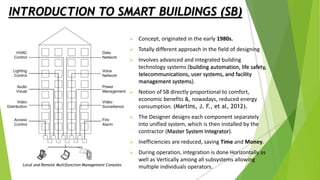
INTRODUCTION TO SMART BUILDINGS (SB)
 Concept, originated in the early 1980s.
 Totally different approach in the field of designing
 Involves advanced and integrated building
technology systems (building automation, life safety,
telecommunications, user systems, and facility
management systems).
 Notion of SB directly proportional to comfort,
economic benefits &, nowadays, reduced energy
consumption. (Martins, J. F., et al, 2012).
 The Designer designs each component separately
into unified system, which is then installed by the
contractor (Master System Integrator).
 Inefficiencies are reduced, saving Time and Money.
 During operation, integration is done Horizontally as
well as Vertically among all subsystems allowing
multiple individuals operators.
Local and Remote Multifunction Management Consoles
Framework for Referencing
Integration in Buildings
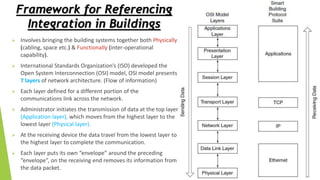
 Involves bringing the building systems together both Physically
(cabling, space etc.) & Functionally (inter-operational
capability).
 International Standards Organization’s (ISO) developed the
Open System Interconnection (OSI) model, OSI model presents
7 layers of network architecture. (Flow of information)
 Each layer defined for a different portion of the
communications link across the network.
 Administrator initiates the transmission of data at the top layer
(Application layer), which moves from the highest layer to the
lowest layer (Physical layer).
 At the receiving device the data travel from the lowest layer to
the highest layer to complete the communication.
 Each layer puts its own “envelope” around the preceding
“envelope”, on the receiving end removes its information from
the data packet.
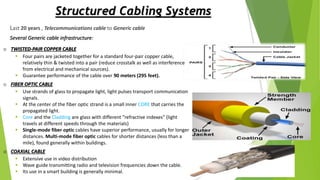
Structured Cabling Systems
Last 20 years , Telecommunications cable to Generic cable
Several Generic cable infrastructure:
o TWISTED-PAIR COPPER CABLE
 Four pairs are jacketed together for a standard four-pair copper cable,
relatively thin & twisted into a pair (reduce crosstalk as well as interference
from electrical and mechanical sources).
 Guarantee performance of the cable over 90 meters (295 feet).
o FIBER OPTIC CABLE
 Use strands of glass to propagate light, light pulses transport communication
signals.
 At the center of the fiber optic strand is a small inner CORE that carries the
propagated light.
 Core and the Cladding are glass with different “refractive indexes” (light
travels at different speeds through the materials)
 Single-mode fiber optic cables have superior performance, usually for longer
distances. Multi-mode fiber optic cables for shorter distances (less than a
mile), found generally within buildings.
o COAXIAL CABLE
 Extensive use in video distribution
 Wave guide transmitting radio and television frequencies down the cable.
 Its use in a smart building is generally minimal.
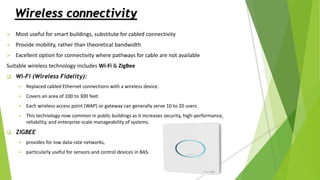
Wireless connectivity
 Most useful for smart buildings, substitute for cabled connectivity
 Provide mobility, rather than theoretical bandwidth
 Excellent option for connectivity where pathways for cable are not available
Suitable wireless technology includes Wi-Fi & ZigBee
 Wi-Fi (Wireless Fidelity):
 Replaced cabled Ethernet connections with a wireless device.
 Covers an area of 100 to 300 feet.
 Each wireless access point (WAP) or gateway can generally serve 10 to 20 users.
 This technology now common in public buildings as it increases security, high-performance,
reliability, and enterprise-scale manageability of systems.
 ZIGBEE
 provides for low data-rate networks,
 particularly useful for sensors and control devices in BAS.
Communications Protocols
Communicate data between network devices and other networks
1) ETHERNET
 Digital convergence
 Voice communication.
2) XML AND SOAP
 EXtensible Markup Language (XML) : for storing data in a plain text format, transports and formats data.
 Simple Object Access Protocol (SOAP): communicate data between applications.
3) BACNET
 Set Standard in BAS.
 E.g., the protocol covers how to request a value from a humidity sensor or send a pump status alarm.
4) LONWORKS
 Also known as LonTalk.
 How devices communicate, widely used in transportation and industrial automation.
5) MODBUS
 Messaging protocol between devices.
 How a controller requests, respond, detects errors and so on.
6) OLE (object linking and embedding)
 Software interface standard
 Have one driver ; eliminates duplication, inconsistencies and conflicts
Interoperable S.B System Databases
 Each technology system in a SB has some sort of data or database associated with
its operation, which may be required by another technology system.
STRUCTURED QUERY LANGUAGE (SQL)
 Rules for programing
 Databases from different manufacturers to interoperate
and exchange data
 SQL was to make it easy to query databases, but has
evolved to a full complement of programming, security,
and management tools.
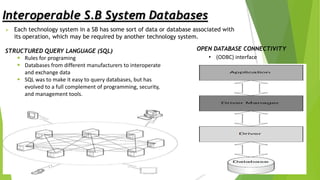
OPEN DATABASE CONNECTIVITY
• (ODBC) interface
HAVC System
 Maintains the climate in a building:
 Controls the temperature, humidity, air flow, and the overall air
quality.
 The typical cycle:
 System brings in outside air, mixes it with air returned from or
exiting the system, filters the air, passes it through a heating or
cooling coil to a required temperature, and distributes the air to
the various sections of a building.
 Commercial Vs. residential buildings
Smart buildings is the outcome of efficient
networking system. Following Different
types of instruments are used in smart
buildings depending upon the requirements
and specification. Here we have discussed
the major one’s
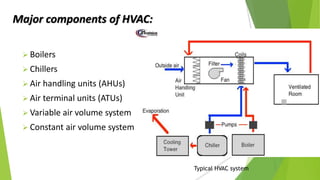
Major components of HVAC:
 Boilers
 Chillers
 Air handling units (AHUs)
 Air terminal units (ATUs)
 Variable air volume system
 Constant air volume system
Typical HVAC system
HVAC Controls:
 Control Variable conditions such as; liquid and gas pressure,
temperature, humidity, the flow rate of liquids and gases, their speed
and on/off state of mechanical equipment.
 Different instruments e.g. sensors, gather data about these variable
conditions
 System controller gets input data through these sensors and control
actuator devices based on the input.
Management levels:
 Management level
 System-level or building-level controllers
 Field-level controllers
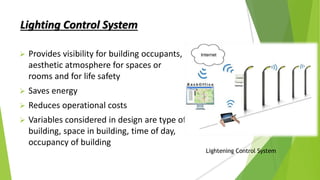
Lighting Control System
 Provides visibility for building occupants,
aesthetic atmosphere for spaces or
rooms and for life safety
 Saves energy
 Reduces operational costs
 Variables considered in design are type of
building, space in building, time of day,
occupancy of building
Lightening Control System
Functions of a lighting control system:
 Scheduling:
 Pre-determined schedule
 Occupancy sensors:
 Where occupancy Is unpredictable
 Daylight:
 Daylight harvesting/daylighting
 Window coatings:
 Spectrally selective
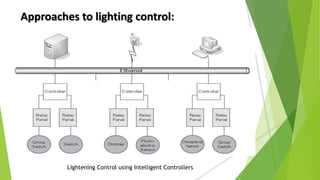
Approaches to lighting control:
Lightening Control using Intelligent Controllers
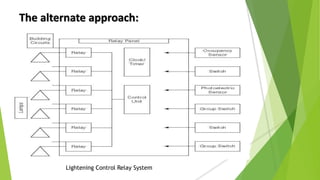
The alternate approach:
Lightening Control Relay System
Electric power management system (EPMS)
 Monitors the electrical distribution system
 provides data on overall and specific power consumption, power
quality, and event alarms
 Based on that data the system can assist in defining, and even
initiating, schemes to reduce power consumption and power
costs.
 Typical systems monitor the power service entrance of a building
or campus, switchgear, generators, network protectors,
switchboards, panel boards, uninterruptible power supplies
(UPS), emergency power generation, and more.
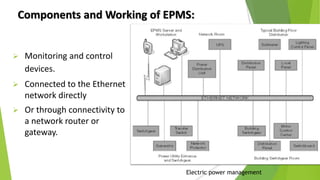
Components and Working of EPMS:
 Monitoring and control
devices.
 Connected to the Ethernet
network directly
 Or through connectivity to
a network router or
gateway.
Electric power management
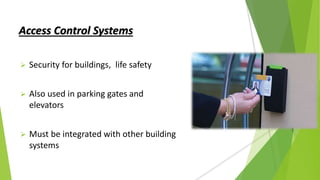
Access Control Systems
 Security for buildings, life safety
 Also used in parking gates and
elevators
 Must be integrated with other building
systems
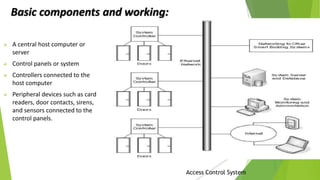
Basic components and working:
 A central host computer or
server
 Control panels or system
 Controllers connected to the
host computer
 Peripheral devices such as card
readers, door contacts, sirens,
and sensors connected to the
control panels.
Access Control System
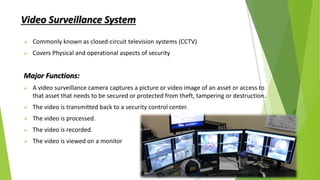
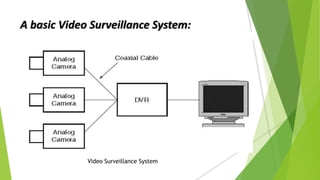
Video Surveillance System
 Commonly known as closed-circuit television systems (CCTV)
 Covers Physical and operational aspects of security
Major Functions:
 A video surveillance camera captures a picture or video image of an asset or access to
that asset that needs to be secured or protected from theft, tampering or destruction.
 The video is transmitted back to a security control center.
 The video is processed.
 The video is recorded.
 The video is viewed on a monitor
A basic Video Surveillance System:
Video Surveillance System
Fire Alarm and Mass Notification systems
 A primary life safety system, integrated with other systems.
 A fire alarm system will initiate communications to other building automation and
security systems to facilitate evacuation from the building and containment of the fire.
Such as:
 Signaling the HVAC system to restrict and contain smoke, heat and fire through
dampers and fans
 Using the access control system to clear a path for building evacuation by opening
doors, unlocking secured doors, and releasing powered exterior doors
 Using the access control system to contain and prevent the spread of fire and
smoke by closing interior doors
 Triggering emergency power for the fire alarm system and related systems
operation, exit signs, and lighting for building exit routes
 Capturing the elevator and shutting down its operation
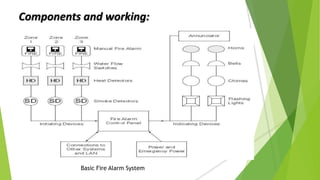
Components and working:
Basic Fire Alarm System
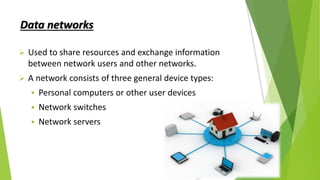
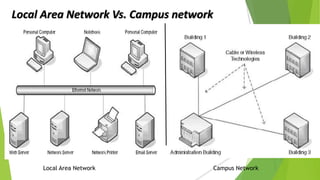
Data networks
 Used to share resources and exchange information
between network users and other networks.
 A network consists of three general device types:
 Personal computers or other user devices
 Network switches
 Network servers
Local Area Network Vs. Campus network
Local Area Network Campus Network
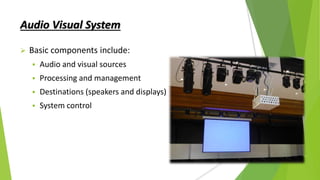
Audio Visual System
 Basic components include:
 Audio and visual sources
 Processing and management
 Destinations (speakers and displays)
 System control
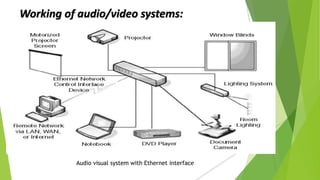
Working of audio/video systems:
Audio visual system with Ethernet interface
Network Integration
 “Whole (integrated systems) is greater in functionality than the sum of the
parts” (separate building technology systems).
 System/network integration means bringing the building systems together
both physically and functionally.
 Physically refers to the cabling, equipment space and infrastructure
support. It also touches on the common use of open protocols by the
systems.
 Functionally systems integration addresses the capability of multiple
systems to interoperate.
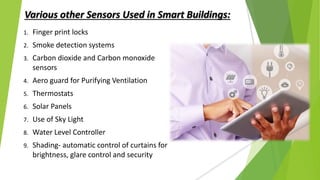
Various other Sensors Used in Smart Buildings:
1. Finger print locks
2. Smoke detection systems
3. Carbon dioxide and Carbon monoxide
sensors
4. Aero guard for Purifying Ventilation
5. Thermostats
6. Solar Panels
7. Use of Sky Light
8. Water Level Controller
9. Shading- automatic control of curtains for
brightness, glare control and security
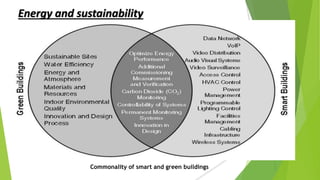
Energy and sustainability
Commonality of smart and green buildings
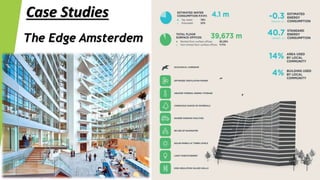
Case Studies
The Edge Amsterdem
The Edge Amsterdem
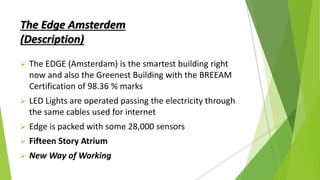
(Description)
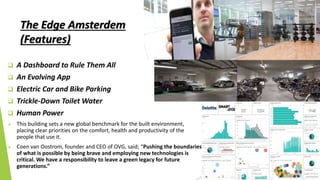
 The EDGE (Amsterdam) is the smartest building right
now and also the Greenest Building with the BREEAM
Certification of 98.36 % marks
 LED Lights are operated passing the electricity through
the same cables used for internet
 Edge is packed with some 28,000 sensors
 Fifteen Story Atrium
 New Way of Working
The Edge Amsterdem
(Features)
 A Dashboard to Rule Them All
 An Evolving App
 Electric Car and Bike Parking
 Trickle-Down Toilet Water
 Human Power
 This building sets a new global benchmark for the built environment,
placing clear priorities on the comfort, health and productivity of the
people that use it.
 Coen van Oostrom, founder and CEO of OVG, said; “Pushing the boundaries
of what is possible by being brave and employing new technologies is
critical. We have a responsibility to leave a green legacy for future
generations.”
Case Studies
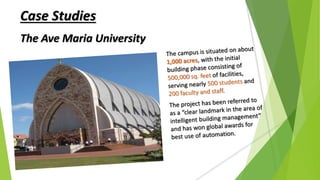
The Ave Maria University
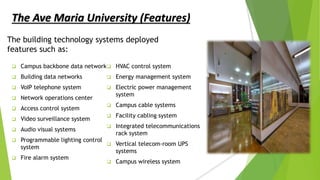
The building technology systems deployed
features such as:
 Campus backbone data network
 Building data networks
 VoIP telephone system
 Network operations center
 Access control system
 Video surveillance system
 Audio visual systems
 Programmable lighting control
system
 Fire alarm system
 HVAC control system
 Energy management system
 Electric power management
system
 Campus cable systems
 Facility cabling system
 Integrated telecommunications
rack system
 Vertical telecom-room UPS
systems
 Campus wireless system
The Ave Maria University (Features)
 Shown significant Cost savings
 Combined facility management & IT groups into a single operations center.
 Provided some efficiency in equipment and labor and saved $350,000/year from
the departments’ combined budgets.
 Project overall, saved approximately $1 million in cabling cost (30%).
 Energy management tools allowed the university to continuously reduce energy use
and costs.
 Ave Maria now spends about $600,000 less on energy per year than when it first
opened in 2007.
The Ave Maria University
(Results)
Conclusion
1. “Knowing the Location” and “Determining the Location” are the essential
requirements of constructing a smart building (Turgut, Zeynep, et al., 2016).
2. A Smart building technology refers to the integrations of four systems Building
Automation system (BAS), a Telecommunication system (TS), an Office Automation
system (OAS) and a Computer Aided Facility Management System (CAFMS).
3. A truly smart building does not expect the people who use it to adapt to the
building, but the building to adapt to the people.
4. Have lower net operating costs.
5. Smart buildings are more sustainable as they take into account multiple variables.
6. Smart buildings can enable a dynamic approach based on performance and actual
operations.
7. In order to make people happier and to increase the productivity, we need
sustainable buildings and if we want sustainable buildings, we need smart buildings.
References:
1. Smart Building Systems for Architects, Owners and Builders, JAMES SINOPOLI, 2010.
2. Transforming the Market: Energy Efficiency in Buildings, World Business Council for Sustainable Development (WBCSD), 2009.
3. Martins, J. F., et al. "Smart homes and smart buildings." 2012 13th Biennial Baltic Electronics Conference. IEEE, 2012.
4. Lin, Yu-Ju, et al. "A power line communication network infrastructure for the smart home." IEEE wireless communications 9.6 (2002): 104-111.
5. Paradiso, Joseph, et al. "Guest Editors' introduction: smart energy systems." IEEE Pervasive Computing 10.1 (2011): 11-12.
6. Fong, Kwong Fai, Victor Ian Hanby, and Tin-Tai Chow. "HVAC system optimization for energy management by evolutionary programming." Energy and
Buildings 38.3 (2006): 220-231.
7. Sane, H. S., C. Haugstetter, and S. A. Bortoff. "Building hvac control systems-role of controls and optimization." 2006 American Control Conference.
IEEE, 2006.
8. Galasiu, Anca D., and Jennifer A. Veitch. "Occupant preferences and satisfaction with the luminous environment and control systems in daylit offices: a
literature review." Energy and Buildings 38.7 (2006): 728-742.
9. Vattano, Starlight. "Smart Buildings for A Sustainable Development." Journal of Economics World 2 (2014): 310-324.
10. Chen, Thou-Ho, Ping-Hsueh Wu, and Yung-Chuen Chiou. "An early fire-detection method based on image processing." Image Processing, 2004. ICIP'04.
2004 International Conference on. Vol. 3. IEEE, 2004.
11. Chen, Wen-Tsuen, et al. "Design and implementation of a real time video surveillance system with wireless sensor networks." Vehicular Technology
Conference, 2008. VTC Spring 2008. IEEE. IEEE, 2008.
12. Lesko Jr, Charles J., and PMP Yolanda A. Hollingsworth. "Integration of 3-D Web and Semantic Web Technologies: A New Structure for Communications
Plans." PMI Research & Education Conference. 2010.
13. Lohiya, Gaurav. "Contractors and LEED Credits: Towards Sustainable Construction." ICSDEC 2012: Developing the Frontier of Sustainable Design,
Engineering, and Construction. ASCE, 2013.
14. Turgut, Zeynep, Gulsum Zeynep Gurkas Aydin, and Ahmet Sertbas. "Indoor Localization Techniques for Smart Building Environment." Procedia
Computer Science 83 (2016): 1176-1181.
Presentation-1.pptx
Presentation-1.pptx

Presentation-1.pptx

  • 2.
    Topic: Smart Buildings Sustainableconstruction CEM-08 Group Members: 1. Imran Khan Sherani 2. Syyed Sami Ul Haq Kaka Khel 3. Muhammad Irfan 4. Faheem 5. Muhammad Ali
  • 3.
     INTRODUCTION toSmart Building  The Framework for Referencing Integration  Structured Cabling Systems  Wireless  Communications Protocols  Interoperable Smart Building System Databases  DISCUSSION  HAVC System  Lightening Control System  Electric Power Management System  Access Control Systems  Video Surveillance System  Fire Alarm and Mass Notification systems  Data Networks  Audio Visual System  Network Integration  Various other Sensors Used in Smart Buildings  Energy and Sustainability  CASE STUDIES  CONCLUSION & RECOMENDATIONS  REFERENCES  QUESTIONS / ANSWERS Contents:
  • 4.
    INTRODUCTION TO SMARTBUILDINGS (SB)  Concept, originated in the early 1980s.  Totally different approach in the field of designing  Involves advanced and integrated building technology systems (building automation, life safety, telecommunications, user systems, and facility management systems).  Notion of SB directly proportional to comfort, economic benefits &, nowadays, reduced energy consumption. (Martins, J. F., et al, 2012).  The Designer designs each component separately into unified system, which is then installed by the contractor (Master System Integrator).  Inefficiencies are reduced, saving Time and Money.  During operation, integration is done Horizontally as well as Vertically among all subsystems allowing multiple individuals operators. Local and Remote Multifunction Management Consoles
  • 5.
    Framework for Referencing Integrationin Buildings  Involves bringing the building systems together both Physically (cabling, space etc.) & Functionally (inter-operational capability).  International Standards Organization’s (ISO) developed the Open System Interconnection (OSI) model, OSI model presents 7 layers of network architecture. (Flow of information)  Each layer defined for a different portion of the communications link across the network.  Administrator initiates the transmission of data at the top layer (Application layer), which moves from the highest layer to the lowest layer (Physical layer).  At the receiving device the data travel from the lowest layer to the highest layer to complete the communication.  Each layer puts its own “envelope” around the preceding “envelope”, on the receiving end removes its information from the data packet.
  • 6.
    Structured Cabling Systems Last20 years , Telecommunications cable to Generic cable Several Generic cable infrastructure: o TWISTED-PAIR COPPER CABLE  Four pairs are jacketed together for a standard four-pair copper cable, relatively thin & twisted into a pair (reduce crosstalk as well as interference from electrical and mechanical sources).  Guarantee performance of the cable over 90 meters (295 feet). o FIBER OPTIC CABLE  Use strands of glass to propagate light, light pulses transport communication signals.  At the center of the fiber optic strand is a small inner CORE that carries the propagated light.  Core and the Cladding are glass with different “refractive indexes” (light travels at different speeds through the materials)  Single-mode fiber optic cables have superior performance, usually for longer distances. Multi-mode fiber optic cables for shorter distances (less than a mile), found generally within buildings. o COAXIAL CABLE  Extensive use in video distribution  Wave guide transmitting radio and television frequencies down the cable.  Its use in a smart building is generally minimal.
  • 7.
    Wireless connectivity  Mostuseful for smart buildings, substitute for cabled connectivity  Provide mobility, rather than theoretical bandwidth  Excellent option for connectivity where pathways for cable are not available Suitable wireless technology includes Wi-Fi & ZigBee  Wi-Fi (Wireless Fidelity):  Replaced cabled Ethernet connections with a wireless device.  Covers an area of 100 to 300 feet.  Each wireless access point (WAP) or gateway can generally serve 10 to 20 users.  This technology now common in public buildings as it increases security, high-performance, reliability, and enterprise-scale manageability of systems.  ZIGBEE  provides for low data-rate networks,  particularly useful for sensors and control devices in BAS.
  • 8.
    Communications Protocols Communicate databetween network devices and other networks 1) ETHERNET  Digital convergence  Voice communication. 2) XML AND SOAP  EXtensible Markup Language (XML) : for storing data in a plain text format, transports and formats data.  Simple Object Access Protocol (SOAP): communicate data between applications. 3) BACNET  Set Standard in BAS.  E.g., the protocol covers how to request a value from a humidity sensor or send a pump status alarm. 4) LONWORKS  Also known as LonTalk.  How devices communicate, widely used in transportation and industrial automation. 5) MODBUS  Messaging protocol between devices.  How a controller requests, respond, detects errors and so on. 6) OLE (object linking and embedding)  Software interface standard  Have one driver ; eliminates duplication, inconsistencies and conflicts
  • 9.
    Interoperable S.B SystemDatabases  Each technology system in a SB has some sort of data or database associated with its operation, which may be required by another technology system. STRUCTURED QUERY LANGUAGE (SQL)  Rules for programing  Databases from different manufacturers to interoperate and exchange data  SQL was to make it easy to query databases, but has evolved to a full complement of programming, security, and management tools. OPEN DATABASE CONNECTIVITY • (ODBC) interface
  • 10.
    HAVC System  Maintainsthe climate in a building:  Controls the temperature, humidity, air flow, and the overall air quality.  The typical cycle:  System brings in outside air, mixes it with air returned from or exiting the system, filters the air, passes it through a heating or cooling coil to a required temperature, and distributes the air to the various sections of a building.  Commercial Vs. residential buildings Smart buildings is the outcome of efficient networking system. Following Different types of instruments are used in smart buildings depending upon the requirements and specification. Here we have discussed the major one’s
  • 11.
    Major components ofHVAC:  Boilers  Chillers  Air handling units (AHUs)  Air terminal units (ATUs)  Variable air volume system  Constant air volume system Typical HVAC system
  • 12.
    HVAC Controls:  ControlVariable conditions such as; liquid and gas pressure, temperature, humidity, the flow rate of liquids and gases, their speed and on/off state of mechanical equipment.  Different instruments e.g. sensors, gather data about these variable conditions  System controller gets input data through these sensors and control actuator devices based on the input. Management levels:  Management level  System-level or building-level controllers  Field-level controllers
  • 13.
    Lighting Control System Provides visibility for building occupants, aesthetic atmosphere for spaces or rooms and for life safety  Saves energy  Reduces operational costs  Variables considered in design are type of building, space in building, time of day, occupancy of building Lightening Control System
  • 14.
    Functions of alighting control system:  Scheduling:  Pre-determined schedule  Occupancy sensors:  Where occupancy Is unpredictable  Daylight:  Daylight harvesting/daylighting  Window coatings:  Spectrally selective
  • 15.
    Approaches to lightingcontrol: Lightening Control using Intelligent Controllers
  • 16.
  • 17.
    Electric power managementsystem (EPMS)  Monitors the electrical distribution system  provides data on overall and specific power consumption, power quality, and event alarms  Based on that data the system can assist in defining, and even initiating, schemes to reduce power consumption and power costs.  Typical systems monitor the power service entrance of a building or campus, switchgear, generators, network protectors, switchboards, panel boards, uninterruptible power supplies (UPS), emergency power generation, and more.
  • 18.
    Components and Workingof EPMS:  Monitoring and control devices.  Connected to the Ethernet network directly  Or through connectivity to a network router or gateway. Electric power management
  • 19.
    Access Control Systems Security for buildings, life safety  Also used in parking gates and elevators  Must be integrated with other building systems
  • 20.
    Basic components andworking:  A central host computer or server  Control panels or system  Controllers connected to the host computer  Peripheral devices such as card readers, door contacts, sirens, and sensors connected to the control panels. Access Control System
  • 21.
    Video Surveillance System Commonly known as closed-circuit television systems (CCTV)  Covers Physical and operational aspects of security Major Functions:  A video surveillance camera captures a picture or video image of an asset or access to that asset that needs to be secured or protected from theft, tampering or destruction.  The video is transmitted back to a security control center.  The video is processed.  The video is recorded.  The video is viewed on a monitor
  • 22.
    A basic VideoSurveillance System: Video Surveillance System
  • 23.
    Fire Alarm andMass Notification systems  A primary life safety system, integrated with other systems.  A fire alarm system will initiate communications to other building automation and security systems to facilitate evacuation from the building and containment of the fire. Such as:  Signaling the HVAC system to restrict and contain smoke, heat and fire through dampers and fans  Using the access control system to clear a path for building evacuation by opening doors, unlocking secured doors, and releasing powered exterior doors  Using the access control system to contain and prevent the spread of fire and smoke by closing interior doors  Triggering emergency power for the fire alarm system and related systems operation, exit signs, and lighting for building exit routes  Capturing the elevator and shutting down its operation
  • 24.
  • 25.
    Data networks  Usedto share resources and exchange information between network users and other networks.  A network consists of three general device types:  Personal computers or other user devices  Network switches  Network servers
  • 26.
    Local Area NetworkVs. Campus network Local Area Network Campus Network
  • 27.
    Audio Visual System Basic components include:  Audio and visual sources  Processing and management  Destinations (speakers and displays)  System control
  • 28.
    Working of audio/videosystems: Audio visual system with Ethernet interface
  • 29.
    Network Integration  “Whole(integrated systems) is greater in functionality than the sum of the parts” (separate building technology systems).  System/network integration means bringing the building systems together both physically and functionally.  Physically refers to the cabling, equipment space and infrastructure support. It also touches on the common use of open protocols by the systems.  Functionally systems integration addresses the capability of multiple systems to interoperate.
  • 30.
    Various other SensorsUsed in Smart Buildings: 1. Finger print locks 2. Smoke detection systems 3. Carbon dioxide and Carbon monoxide sensors 4. Aero guard for Purifying Ventilation 5. Thermostats 6. Solar Panels 7. Use of Sky Light 8. Water Level Controller 9. Shading- automatic control of curtains for brightness, glare control and security
  • 31.
    Energy and sustainability Commonalityof smart and green buildings
  • 32.
  • 33.
    The Edge Amsterdem (Description) The EDGE (Amsterdam) is the smartest building right now and also the Greenest Building with the BREEAM Certification of 98.36 % marks  LED Lights are operated passing the electricity through the same cables used for internet  Edge is packed with some 28,000 sensors  Fifteen Story Atrium  New Way of Working
  • 34.
    The Edge Amsterdem (Features) A Dashboard to Rule Them All  An Evolving App  Electric Car and Bike Parking  Trickle-Down Toilet Water  Human Power  This building sets a new global benchmark for the built environment, placing clear priorities on the comfort, health and productivity of the people that use it.  Coen van Oostrom, founder and CEO of OVG, said; “Pushing the boundaries of what is possible by being brave and employing new technologies is critical. We have a responsibility to leave a green legacy for future generations.”
  • 35.
    Case Studies The AveMaria University
  • 36.
    The building technologysystems deployed features such as:  Campus backbone data network  Building data networks  VoIP telephone system  Network operations center  Access control system  Video surveillance system  Audio visual systems  Programmable lighting control system  Fire alarm system  HVAC control system  Energy management system  Electric power management system  Campus cable systems  Facility cabling system  Integrated telecommunications rack system  Vertical telecom-room UPS systems  Campus wireless system The Ave Maria University (Features)
  • 37.
     Shown significantCost savings  Combined facility management & IT groups into a single operations center.  Provided some efficiency in equipment and labor and saved $350,000/year from the departments’ combined budgets.  Project overall, saved approximately $1 million in cabling cost (30%).  Energy management tools allowed the university to continuously reduce energy use and costs.  Ave Maria now spends about $600,000 less on energy per year than when it first opened in 2007. The Ave Maria University (Results)
  • 38.
    Conclusion 1. “Knowing theLocation” and “Determining the Location” are the essential requirements of constructing a smart building (Turgut, Zeynep, et al., 2016). 2. A Smart building technology refers to the integrations of four systems Building Automation system (BAS), a Telecommunication system (TS), an Office Automation system (OAS) and a Computer Aided Facility Management System (CAFMS). 3. A truly smart building does not expect the people who use it to adapt to the building, but the building to adapt to the people. 4. Have lower net operating costs. 5. Smart buildings are more sustainable as they take into account multiple variables. 6. Smart buildings can enable a dynamic approach based on performance and actual operations. 7. In order to make people happier and to increase the productivity, we need sustainable buildings and if we want sustainable buildings, we need smart buildings.
  • 39.
    References: 1. Smart BuildingSystems for Architects, Owners and Builders, JAMES SINOPOLI, 2010. 2. Transforming the Market: Energy Efficiency in Buildings, World Business Council for Sustainable Development (WBCSD), 2009. 3. Martins, J. F., et al. "Smart homes and smart buildings." 2012 13th Biennial Baltic Electronics Conference. IEEE, 2012. 4. Lin, Yu-Ju, et al. "A power line communication network infrastructure for the smart home." IEEE wireless communications 9.6 (2002): 104-111. 5. Paradiso, Joseph, et al. "Guest Editors' introduction: smart energy systems." IEEE Pervasive Computing 10.1 (2011): 11-12. 6. Fong, Kwong Fai, Victor Ian Hanby, and Tin-Tai Chow. "HVAC system optimization for energy management by evolutionary programming." Energy and Buildings 38.3 (2006): 220-231. 7. Sane, H. S., C. Haugstetter, and S. A. Bortoff. "Building hvac control systems-role of controls and optimization." 2006 American Control Conference. IEEE, 2006. 8. Galasiu, Anca D., and Jennifer A. Veitch. "Occupant preferences and satisfaction with the luminous environment and control systems in daylit offices: a literature review." Energy and Buildings 38.7 (2006): 728-742. 9. Vattano, Starlight. "Smart Buildings for A Sustainable Development." Journal of Economics World 2 (2014): 310-324. 10. Chen, Thou-Ho, Ping-Hsueh Wu, and Yung-Chuen Chiou. "An early fire-detection method based on image processing." Image Processing, 2004. ICIP'04. 2004 International Conference on. Vol. 3. IEEE, 2004. 11. Chen, Wen-Tsuen, et al. "Design and implementation of a real time video surveillance system with wireless sensor networks." Vehicular Technology Conference, 2008. VTC Spring 2008. IEEE. IEEE, 2008. 12. Lesko Jr, Charles J., and PMP Yolanda A. Hollingsworth. "Integration of 3-D Web and Semantic Web Technologies: A New Structure for Communications Plans." PMI Research & Education Conference. 2010. 13. Lohiya, Gaurav. "Contractors and LEED Credits: Towards Sustainable Construction." ICSDEC 2012: Developing the Frontier of Sustainable Design, Engineering, and Construction. ASCE, 2013. 14. Turgut, Zeynep, Gulsum Zeynep Gurkas Aydin, and Ahmet Sertbas. "Indoor Localization Techniques for Smart Building Environment." Procedia Computer Science 83 (2016): 1176-1181.

Editor's Notes

  • #11 HVAC systems in commercial and institutional buildings are very different from those used in typical residential housing. Larger buildings have a greater density of people, lighting and other equipment, all of which generates more heat. The result is that air conditioning, or the recirculation of air, becomes more important than providing heat, depending on the local climate. Although there may be a centralized HVAC system in commercial and institutional buildings, sections of large buildings have different HVAC needs or thermal loads depending on how the space is utilized.
  • #12 -An air handler is usually a large metal box containing a blower, heating or cooling elements, filter racks or chambers, sound attenuators, and dampers. Air handlers usually connect to a ductwork ventilation system that distributes the conditioned air through the building and returns it to the AHU. -A boiler is a closed vessel in which water or other fluid is heated. -A chiller is a machine that removes heat from a liquid via a vapor-compression or absorption refrigeration cycle. This liquid can then be circulated through a heat exchanger to cool equipment, or another process stream. -Air terminal units (ATUs) address specific HVAC thermal loads or zones. Thermal loads in a space can consist of exterior loads (outside air temperatures increasing or decreasing) and interior loads (people, lighting, computers, and other sources). A thermal zone is a space or group of adjoining spaces in a building that have similar thermal loads. ATUs compensate for these thermal loads and zones by varying the air temperature, varying the air volume, or doing both. -The British thermal unit (Btu or BTU) is a traditional unit of heat; it is defined as the amount of heat required to raise the temperature of one pound of water by one degree Fahrenheit
  • #13 -A differential pressure gauge is a visual indicator, designed to measure and illustrate the difference between two pressure points within a process system. -Relative pressure is the atmospheric pressure corrected to sea-level conditions. To compare pressure conditions from one location to another, meteorologists correct the measured pressure (referred to as absolute pressure) to sea-level conditions. -Digital Data Control (DDC) is the automated control of a condition or process by a digital device (computer). DDC takes a centralized network-oriented approach. All instrumentation is gathered by various analog and digital converters which use the network to transport these signals to the central controller. -In ventilation systems, static pressure is the pressure exerted by the air inside a building, relative to the outside air pressure, when exhaust fans are turned on. Measuring and maintaining proper negative pressure allows the ventilation system to mix outside air with inside air more efficiently and effectively.
  • #15 -A server is a high-performance computer designed to process requests and deliver data over a network connection, like Web, proxy. -A web browser is a software application for retrieving, presenting and traversing information resources on the World Wide Web i.e. chrome, fire fox etc
  • #16 -One approach to the lighting control system is the use of intelligent controllers. These controllers are distributed throughout a facility and manage downstream relay panels. The controllers and the system server are networked via an Ethernet network -Relays are switches that open and close circuits electromechanically or electronically. They control one electrical circuit by opening and closing contacts in another circuit. When a relay contact is normally open (NO), there is an open contact when the relay is not energized. -Dimmers are devices used to lower the brightness of a light. -A photoelectric sensor, or photo eye, is an equipment used to discover the distance, absence, or presence of an object by using a light transmitter, often infrared, and a photoelectric receiver. They are largely used in industrial manufacturing. -group switch-ability to control individual lights or groups of lights from a single user interface device -In a fluorescent lighting system, the ballast regulates the current to the lamps and provides sufficient voltage to start the lamps
  • #17 -Another emerging networking approach for lighting control systems is the distribution of the intelligence and controls further downstream to each device. Typically, this would be a network interface for each lighting ballast. This approach centralizes the control to the network server and allows for network interfaces to specific devices.
  • #18 -A network protector is a type of electric protective device used in electricity distribution systems. The network protector automatically disconnect its associated power transformer from the secondary network when the power starts flowing in reverse direction. -A distribution board (also known as panelboard, breaker panel, or electric panel) is a component of an electricity supply system that divides an electrical power feed into subsidiary circuits, while providing a protective fuse or circuit breaker for each circuit in a common enclosure. -In an electric power system, switchgear is the combination of electrical disconnect switches, fuses or circuit breakers used to control, protect and isolate electrical equipment. Switchgear is used both to de-energize equipment to allow work to be done and to clear faults downstream.
  • #19 -A transfer switch is an electrical switch that switches a load between two sources as such used in generators installations. -In a computer network, an IP Gateway is a node that allows communication between networks. An IP Gateway, sometimes known as a router
  • #23 -Coaxial cables are a type of cable that is used by cable TV and that is common for data communications. Taking a a round cross-section of the cable, one would find a single center solid wire symmetrically surrounded by a braided or foil conductor. Between the center wire and foil is a insulating dialectric.
  • #25 -A local area network (LAN) is a group of computers and associated devices that share a common communications line or wireless link to a server. Typically, a LAN encompasses computers and peripherals connected to a server within a distinct geographic area such as an office or a commercial establishment. -annunciator- An indicator that announces which electrical circuit has been active -Ethernet, pronounced "E-thernet" (with a long "e"), is the standard way to connect computers on a network over a wired connection. It provides a simple interface and for connecting multiple devices, such computers, routers, and switches. With a single router and a few Ethernet cables, you can create a LAN, which allows all connected devices to communicate with each other.
  • #29 - Analog waves are smooth and continuous, digital waves are stepping, square, and discrete -The Internet is a broad public network that anyone can access through an Internet service provider while in contrast, an intranet is a private network maintained by an organization for the use of its own employees, members or others who are explicitly permitted access. The primary difference between the Internet and an intranet has to do with accessibility. -Ethernet is the name of the most commonly used LAN today. A LAN (Local Area Network) is a network of computers that covers a small area like a room, an office, a building or a campus. It is used in contrast with WAN (wide area network) which spans for much larger geographical areas. Ethernet is a network protocol that controls how data is transmitted over a LAN
  • #30 -An open protocol allows vendors' equipment to interoperate without the need for a proprietary interface ( a proprietary protocol is a communications protocol owned by a single organization or individual.)or gateway. They talk the same language and no translation is needed. A closed protocol is one that is proprietary and not open to communication other products without an interface or gateway (such as SNA). -interface- a device or program enabling a user to communicate with a computer.
  • #32 At present, there are about 18 to 20 buildings in Pakistan which are LEED Certified and registered with the US Green Building Council. These include British Council Library in Lahore, NCC, Mega Corporate Office and Karachi Citiplan in Karachi. Coco Cola Pakistan Icecek Plant in Multan and the World Bank Country office in Islamabad. -VOIP- voice over internet prtocol